Only 49% of U.S. companies have a formal crisis communications plan, yet 98% of leaders who activated theirs said it was effective, with 77% calling it very effective, according to the crisis management statistics summarized here. That gap is the whole reason a crisis communications agency exists.
Most organizations don't fail in a crisis because they care too little. They fail because they respond too late, approve statements too slowly, say too much before facts are verified, or go silent while customers, staff, donors, regulators, and reporters fill in the blanks for them.
For small businesses and nonprofits, the risk is sharper. You usually don't have an in-house legal team, a media relations lead, and a social listening desk ready to go. You have a founder, an operations lead, maybe a marketing manager, and a board member texting after hours. That can work for normal communications. It doesn't work well when allegations surface, a data issue breaks, a product has to be pulled, or a staff incident turns public.
A good crisis communications agency doesn't just write statements. It helps you decide what to say, when to say it, who says it, what not to say, and how to keep one bad day from turning into a long reputation problem.
What Is a Crisis Communications Agency and Why You Need One
A crisis communications agency is a specialist firm that prepares organizations for reputation-threatening events and manages communications when those events happen. That's different from general PR. General PR builds visibility. Crisis work protects trust under pressure.
When a crisis hits, the communication problem is rarely isolated. A customer issue becomes a media issue. A staff issue becomes a donor issue. A system outage becomes a social media issue. A legal issue becomes an internal morale problem. Crisis agencies are hired to coordinate those moving parts into one response.
If you want a basic primer on the discipline itself, this overview of crisis communications is a useful starting point.
What they actually do
At the simplest level, these agencies do two jobs:
- Prepare you before the event with plans, message frameworks, approval workflows, spokesperson prep, and simulations
- Run point during the event so your team can make decisions without losing control of the narrative
The difference between those two states is dramatic. Without preparation, teams argue over wording, legal reviews everything in isolation, executives want perfect answers before saying anything, and reporters publish before you're ready. With preparation, the team already knows who approves what, where updates live, and which messages go to employees, customers, partners, and the press.
Practical rule: In a crisis, speed matters. But controlled speed matters more than improvisation.
Why hiring one matters
A crisis agency gives you three things most internal teams lack in the moment:
Outside judgment
Internal teams are often too close to the issue. They know the backstory, the politics, the personalities. That can blur judgment.A tested process
Good agencies don't start from a blank page. They use playbooks, briefing structures, statement templates, and escalation routines.Message discipline under stress
Panic creates overexplaining, defensiveness, and contradictions. A crisis specialist strips the response back to what is verified, relevant, and defensible.
For SMBs and nonprofits, the primary value isn't prestige. It's containment. You hire a crisis communications agency so one incident doesn't pull leadership off mission-critical work for days or weeks.
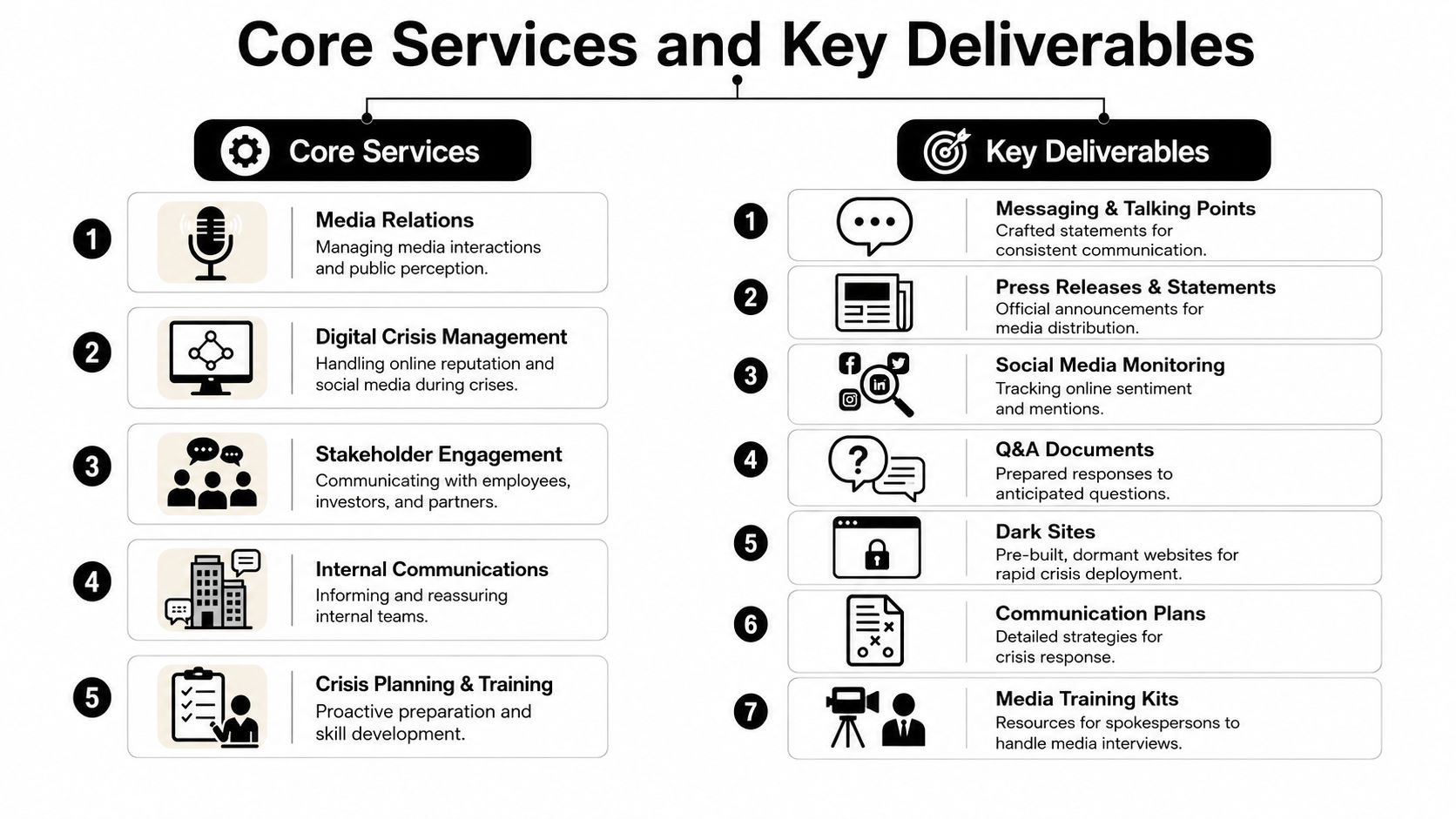
Core Services and Key Deliverables Explained
A strong crisis communications agency usually offers two categories of support. The first is proactive preparedness. The second is reactive response when something has already gone wrong.
Proactive preparedness work
This is the work most organizations postpone. It also tends to be the work that saves them when pressure hits.
A typical preparedness scope includes:
Risk and vulnerability audit
The agency interviews leadership, reviews likely threat scenarios, maps exposed audiences, and finds weak points in your current approval process.Crisis playbook development
This usually includes holding statements, role assignments, contact trees, decision triggers, channel guidance, and escalation paths.Spokesperson and media training
Leaders learn how to handle hostile questions, stay inside verified facts, and avoid speculative answers.Simulation drills
The agency runs tabletop exercises so your team can test response flow before a real event.
The training piece matters more than many buyers realize. The crisis communication metrics analysis from Determ notes that the crisis response training completion rate measures the share of employees who completed role-specific crisis training, and that organizations with documented procedures and trained teams achieve faster activation and more coordinated messaging.
That's why a plan sitting in a shared drive isn't enough. If nobody has practiced using it, the plan becomes a false comfort.
Reactive response work
Once the issue is live, the agency shifts from planning to command support. The best firms become your temporary communications nerve center.
That usually includes:
Initial assessment and message triage
They establish what is known, unknown, and unconfirmed.Holding statements and media responses
They draft the first public language, press replies, executive notes, and internal staff guidance.Stakeholder messaging
Customers, employees, funders, board members, partners, and local community groups may each need different updates.Monitoring and correction
The agency tracks reporter questions, social chatter, customer complaints, and emerging misinformation.Post-incident review
After the immediate heat passes, they document what worked, what failed, and what needs to change.
A weak crisis response sounds polished but evasive. A strong one sounds clear, bounded, and grounded in what the organization can verify.
Deliverables you should expect in writing
When you hire a crisis communications agency, don't settle for vague promises like "strategic support." Ask for actual outputs.
Common deliverables include:
| Deliverable | What it should include |
|---|---|
| Crisis playbook | Roles, approval chain, trigger events, channel guidance, escalation flow |
| Holding statements | Short first-response drafts for likely scenarios |
| Q&A document | Anticipated tough questions with approved answers |
| Media training kit | Interview guidance, bridging language, do-not-say list |
| Dark site copy | Prebuilt crisis landing page content |
| Internal comms templates | Staff email drafts, manager talking points, board updates |
If local reputation matters to your business, customer review response language should also be part of the toolkit. Even though review outreach isn't crisis work by itself, practical resources like Google review templates for local businesses are useful because they show the difference between routine reputation messaging and the more controlled language you need in a sensitive situation.
When to Engage an Agency Retainer vs Emergency Response
The core choice is simple. Do you want a crisis communications agency in place before anything happens, or do you want to call one after the problem is already public?
Those are very different buying decisions.

Retainer means readiness
A retainer works like insurance with active maintenance. The agency gets to know your business, your leadership team, your legal sensitivities, your donor or customer base, and your risk profile before you're under scrutiny.
That setup has clear advantages:
- Faster activation because the agency already knows who approves statements
- Better judgment because they understand your operating context
- Cleaner coordination with legal, HR, operations, and leadership
- Regular upkeep through training, scenario planning, and message review
For nonprofits, a retainer can also help with board alignment. That's often where crisis response slows down. The issue isn't writing the statement. It's getting agreement on whether to issue one.
Emergency response means buying under pressure
Sometimes you don't have the luxury of preparing first. A story breaks, screenshots spread, a regulator calls, or a customer incident gains traction. You hire the agency in the middle of the problem.
That can still work, but the trade-offs are real:
- The agency starts with limited context
- Your internal team is already stressed and fragmented
- Leadership often expects instant answers
- Early statements may be delayed while facts are gathered and decision-makers align
I've seen organizations make this harder by trying to brief the agency with opinions instead of facts. In the first hours, the agency needs timelines, names, affected groups, what has been verified, and what actions are already underway. It doesn't need a defense speech.
Bring in outside help the moment you suspect the issue may outgrow routine customer service or internal HR handling.
Which model fits your organization
A retainer usually makes sense if you have any of these conditions:
- Public-facing brand exposure that can attract media attention
- Multiple stakeholder groups such as customers, donors, franchisees, members, or investors
- Regulated operations where mistakes in language create extra risk
- Lean internal teams that can't absorb a fast-moving issue
Emergency support can be sufficient if your risk profile is narrower and you already have disciplined internal communications leadership.
Here is the blunt version. If your organization would struggle to identify a spokesperson, approve a holding statement, and brief staff quickly, a retainer is the safer route. If you already have that structure and just need surge capacity for a serious event, emergency engagement may be enough.
How to Choose the Right Crisis Communications Agency
Most buyers make the same mistake. They choose a firm based on brand recognition, a polished pitch deck, or a list of famous clients. None of that tells you how the agency will perform when your CEO is exhausted, reporters are calling, and facts are still developing.
Choose a crisis communications agency the way you'd choose lead counsel for a sensitive matter. You need judgment, responsiveness, discipline, and a process that holds up under strain.
If you're building an initial list of providers, this roundup of crisis management PR firms can help you map the field before you start interviews.
What to evaluate first
Start with fit before credentials. The right firm for a multinational public company may be wrong for a regional healthcare nonprofit or a founder-led retail brand.
Look closely at these four filters:
Relevant crisis type
Ask whether they've handled issues like yours. Product recalls, executive misconduct, cyber incidents, labor disputes, nonprofit governance issues, and customer harm cases all require different instincts.Actual operating team
Don't buy the senior team and get handed to juniors. Ask who writes, who approves, who joins calls after hours, and who speaks with legal.Decision-making style
Some agencies are aggressive and media-forward. Others are cautious and stakeholder-first. Neither is universally correct. The fit depends on your risk profile.Ability to work with small teams
SMBs and nonprofits need firms that can function without layers of internal infrastructure.
Vendor evaluation checklist
Use this table during calls and score each agency after the meeting, not during it.
| Criteria | Why It Matters | Key Questions to Ask |
|---|---|---|
| Industry familiarity | Context changes message strategy and escalation risk | What kinds of organizations like ours have you supported? |
| Crisis specialization | General PR skill doesn't always translate to crisis control | What percentage of your work is crisis-related? |
| First-24-hours process | Early confusion causes avoidable damage | Walk me through your process in the first 24 hours. |
| Team structure | You need to know who will actually do the work | Who is on point after hours and on weekends? |
| Media handling approach | Some situations require engagement, others restraint | How do you decide when to respond, hold, or go on record? |
| Stakeholder coordination | Staff, board, donors, and customers often need separate messaging | How do you sequence internal and external communications? |
| Legal collaboration | Legal and communications must work together without gridlock | How do you handle conflicts between legal caution and public expectations? |
| Monitoring capability | You need visibility into narrative spread | What do you monitor during an active incident? |
| Training and drills | Readiness depends on rehearsal, not documents alone | Do you provide simulations and spokesperson training? |
| Post-crisis review | Organizations need operational lessons, not just message cleanup | What does your debrief include after the event closes? |
| Budget flexibility | Smaller organizations often need phased support | Can you scope a lighter preparedness package before a retainer? |
RFP and interview questions worth asking
Skip generic questions like "What makes you different?" Ask for operating detail.
Use questions like these:
- Describe a situation where facts were incomplete. How did you advise the client to speak publicly without overcommitting?
- How do you handle disagreement inside the client team? Who do you want in the decision room?
- What do you need from us in the first two hours?
- What are your absolute requirements in a crisis response?
- How do you prepare executives for hostile interviews?
- How do you define a successful outcome when the bad news can't be avoided?
A useful cross-check is to compare how vendors think about tools and message control. Resources like Pebb's crisis messaging comparison can help your team understand what structured communication workflows look like before you evaluate agencies' processes.
Don't ask an agency whether it's good under pressure. Ask how it prevents internal chaos when pressure hits.
Red flags that should end the conversation
Walk away if you hear any of these:
Guarantees about outcomes
No serious firm can promise favorable coverage or no reputational damage.Overreliance on media contacts
Crisis response isn't a rolodex exercise. It's a judgment exercise.No clear after-hours protocol
Crises don't respect office hours.Confident answers without fact discipline
If the agency sounds too certain about situations it hasn't examined, that same habit may show up in your response.
The best agency often isn't the loudest one. It's the one that asks precise questions, pushes for facts, and explains trade-offs without theatrics.
Decoding Pricing Models and Typical Timelines
Most buyers want one clean number. Crisis agencies rarely work that way because the scope changes with the facts, the stakeholder map, and the duration of the issue.
Still, the pricing models are predictable. What matters is knowing what each model buys you, where scope expands, and how to keep a manageable project from turning into an open-ended spend.

The common pricing structures
Most crisis communications agency engagements fall into three buckets.
| Pricing model | Best for | What to watch |
|---|---|---|
| Monthly retainer | Ongoing preparedness, light incidents, leadership access | Make sure deliverables and response expectations are defined |
| Project fee | Crisis plan development, training, simulations, media prep | Confirm revision rounds and what happens if scope expands |
| Hourly emergency support | Active incidents with uncertain duration | Costs can climb fast if roles and approvals are messy |
For budget-conscious organizations, project-based preparedness often makes more sense than jumping straight into a large retainer. You can buy a playbook, spokesperson prep, and a tabletop exercise first, then decide whether ongoing support is warranted.
That matters because the market often skews toward large-enterprise examples. The agency roundup that highlights this gap notes premium agency pricing in the $10,000 to $50,000+ range for crisis playbooks and simulations, while also pointing out the lack of practical guidance for SMBs and nonprofits seeking lighter-weight options.
How agencies manage scope
Scope control is not a finance detail. It's an operational discipline.
The financial KPI discussion on crisis communications agency metrics cites a benchmark of approximately 800 billable hours per crisis case. In its example, 5 major crisis events and 4,500 billable hours worked out to 900 hours per case, which exceeded that benchmark and signaled scope expansion.
You don't need to manage your agency by spreadsheet alone, but you do need a trigger for re-scoping. If the issue broadens from one statement and media handling into employee briefings, board communications, customer refunds, social moderation, and executive coaching, the work has changed. Your budget should reflect that openly, not by surprise.
Ask the agency when it pauses and tells you the engagement has become a different project. If they can't answer that clearly, expect billing friction later.
What timelines usually look like
A crisis engagement rarely follows a tidy project plan, but the work tends to move in phases:
Immediate response
Fact gathering, risk assessment, holding language, spokesperson designation, internal alignmentActive management
Ongoing updates, media handling, stakeholder outreach, rumor correction, executive guidanceStabilization
Reduced inbound pressure, clearer facts, revised messaging, recovery planningPost-crisis review
Debrief, plan updates, training fixes, documentation
For SMBs and nonprofits, the most cost-effective approach is often a phased buy. Start with readiness assets. Add limited advisory access. Escalate only if the risk materializes. That's usually smarter than paying for heavyweight coverage you may never use.
Crisis Communications in Action Case Study Examples
Theory gets clearer when you see how decisions play out. These examples are anonymized composites based on common crisis patterns. They show what a crisis communications agency does well, what happens when nobody is steering, and where a modest intervention can stop a problem from becoming a headline.

Case one, product recall handled well
Situation
A regional consumer brand discovered a quality problem that affected a limited batch of products. Customer complaints started appearing online before the internal operations team had finished its review.
Action
The agency pushed the company to issue a narrow holding statement based only on verified facts. It separated customer safety messaging from refund instructions, gave staff a simple internal brief, and prepared a short Q&A for retail partners. The CEO did not become the first spokesperson. Customer care did.
Result
The company didn't look perfect. It looked organized. That matters more. Customers saw acknowledgment, a concrete next step, and regular updates instead of shifting explanations.
Case two, data incident handled badly
Situation
A small service business suspected a data exposure issue and tried to keep it quiet while it investigated. Staff were told not to comment. Customers learned about the problem from online discussion, not from the company.
Action
No agency was engaged until after angry posts and local media questions started. By then, leadership had already made the central mistake. Silence created a trust vacuum, and inconsistent replies from customer service made it worse.
Result
The late agency hire still improved message control, but it couldn't erase the original perception that the business was evasive. Recovery took longer because the communications problem became a character problem.
When people think you're hiding, even accurate later statements face extra skepticism.
Case three, rumor contained before escalation
Situation
A nonprofit heard that a misleading allegation about financial misuse was circulating among donors and community partners. Nothing had broken publicly yet, but internal anxiety was rising.
Action
Because the organization already had outside crisis support, the agency quickly reviewed the claim, mapped likely spread channels, drafted board talking points, and prepared donor-facing language. Leadership reached out directly to key stakeholders before the rumor hardened.
Result
The issue never became a public controversy. That is a successful crisis outcome, even though nobody outside the organization ever sees it. Good crisis communications isn't only about managing visible disasters. It's also about stopping escalation early.
These examples point to the same operational truth. Early clarity beats late polish. A crisis communications agency can't remove the underlying event, but it can keep confusion, contradiction, and delay from multiplying the damage.
Essential Crisis Press Release Templates and Workflows
A crisis plan is only useful if your team can turn it into a statement quickly. That means you need a workflow, not just sample wording.
A practical workflow looks like this:
- Confirm the facts your organization can stand behind now
- Assign one owner for drafting and one approver from leadership
- Separate audiences into media, customers or donors, employees, and partners
- Issue the first statement without waiting for every answer
- Schedule update intervals so silence doesn't create new confusion
If you need a broader planning framework behind these templates, this sample crisis communication plan is a useful reference.
Template one, initial holding statement
Use this when the issue is new and facts are still developing.
FOR IMMEDIATE RELEASE
[Organization Name] is aware of [brief description of incident].We are currently reviewing the situation and working to verify the facts. Our immediate priority is [customer safety / service continuity / staff support / issue resolution].
We will share additional information as soon as it is confirmed. Media inquiries may be directed to [name, title, contact information].
Why it works: it acknowledges the issue, states a priority, and avoids speculation.
Template two, informative update release
Use this once you have verified facts and a clear action path.
FOR IMMEDIATE RELEASE
[Organization Name] is providing an update regarding [incident].Based on the information currently confirmed, [insert concise factual update].
We have taken the following actions: [action one], [action two], [action three].
We understand the concern this situation may cause for [customers / employees / donors / partners], and we are continuing to provide updates through [channel].
Media contact: [name, title, contact information]
Why it works: it moves from acknowledgment to evidence of action.
Template three, resolution and next steps release
Use this when the immediate crisis has stabilized and stakeholders need closure.
FOR IMMEDIATE RELEASE
[Organization Name] has completed the immediate response to [incident].We have [resolved the issue / restored operations / completed the review / implemented corrective steps].
We are now focused on [follow-up action, policy change, customer support process, training, review].
We appreciate the patience of [stakeholders] and remain committed to clear communication and accountability.
Why it works: it closes the loop and points to prevention, not just recovery.
Keep these templates short. In a crisis, your first release is not your life story. It's a control document.
If you want ready-to-use guidance for writing, formatting, and distributing high-stakes announcements, Press Release Zen offers practical templates and walkthroughs that help teams move faster without sounding careless.