The call usually comes early. A customer posts a screenshot that starts spreading. A reporter emails asking for comment. An employee messages a manager because they saw a rumor on LinkedIn before hearing anything internally. At that point, nobody cares whether your team has a beautifully written PDF in a shared folder. What matters is whether people know who decides, who speaks, what gets verified, and which channel goes live first.
That's why a crisis communications plan has to work like an operating system, not a memo. Under pressure, teams don't need more theory. They need a practical response model that moves fast, keeps messaging aligned, and prevents avoidable mistakes in the first hour.
Why You Need a Crisis Plan Before You Need It
Most organizations don't struggle in a crisis because they lack smart people. They struggle because smart people are forced to improvise at the exact moment improvisation becomes expensive.
A crisis compresses time. Legal wants caution. Operations wants facts. Leadership wants visibility. Customers want answers. Employees want reassurance. Reporters want a statement now. If you haven't already decided how those tensions get managed, the organization starts making decisions in fragments.
That is the true cost of not planning ahead.
A major data point makes the point clearly. Only 49% of U.S. businesses had a formal crisis communications plan, yet among those that activated one, 98% said it was effective and 77% said it was very effective, according to Capterra's 2023 crisis communications research. That gap matters. Nearly half of organizations are still operating without a documented framework, even though the overwhelming majority of teams that use one say it works.
What a plan changes in the first hour
A usable plan does three things immediately:
- It removes ambiguity: People know whether the incident qualifies as a crisis and who has authority to activate the response.
- It cuts response lag: Teams don't waste the first hour hunting for phone numbers, approvals, or old boilerplate.
- It keeps messages consistent: Employees, customers, media contacts, and partners hear the same core facts and the same next steps.
Without that structure, organizations often create a second crisis inside the first one. One executive says one thing. Social says another. Customer support learns about the issue from angry inbound tickets. Then the public sees contradiction, not control.
Practical rule: If your response depends on getting the right people into a room to figure things out from scratch, you don't have a crisis plan. You have a hope-based process.
A good framework also forces a distinction many teams blur. A crisis management plan addresses the broader operational response. A crisis communications plan governs how information gets verified, approved, and delivered. If that distinction feels fuzzy inside your company, start with this straightforward explainer on what crisis communications means in practice.
The difference between confidence and false confidence
Some organizations assume they can “handle it when it happens” because they have experienced leaders. That confidence often disappears when the issue lands outside normal business hours, involves legal exposure, or spreads across multiple channels at once.
Prepared teams don't become robotic. They become faster and clearer. They know which facts must be confirmed before speaking, which message can be issued immediately, and which audiences must hear from the company first. That discipline is what protects trust when the facts are still developing.
First Steps in Crisis Preparedness
Before you draft statements or assign spokesperson duties, do the strategic work that most weak plans skip. The quality of your plan depends on whether it reflects your actual risks, your actual stakeholders, and your actual decision bottlenecks.
The most common planning failures aren't glamorous. They're basic. Poor risk assessment and unclear ownership are recurring breakdowns, and best-practice planning starts by identifying likely scenarios, assessing vulnerability and impact, and mapping stakeholders before an incident occurs, as outlined in AKCG's crisis communications guidance.
Start with scenario mapping

Don't begin with generic categories like “reputational issue” or “bad press.” Begin with situations your organization could face.
Typically, that means listing scenario clusters such as:
- Operational disruption: Service outage, delivery failure, facility issue, event cancellation.
- Trust and conduct issues: Executive misconduct allegation, employee incident, customer complaint that goes public.
- Security events: Data exposure, account compromise, fraudulent communication.
- External shocks: Severe weather, civil disruption, vendor failure, regulatory action.
- Synthetic media threats: Fake statement, manipulated executive video, AI-generated impersonation.
Now pressure-test each scenario. Ask simple questions, not abstract ones. Who would know first? Who gets harmed or alarmed first? What facts would be available in the first thirty minutes? What could spread publicly before your team is ready?
Communications teams benefit from operational thinking. If you want a useful model for escalation and ownership, DocsBot's incident management insights are worth reviewing because they frame incidents around triggers, roles, and response flow rather than loose intentions.
Assess impact and vulnerability
A scenario isn't high priority just because it sounds dramatic. It becomes high priority when your organization is vulnerable to it and when stakeholder consequences are immediate.
Use a working screen like this:
- Likelihood: Could this plausibly happen given your business model, leadership profile, systems, and public visibility?
- Speed: Would this unfold slowly, or would stakeholders know before you do?
- Complexity: Would legal, HR, IT, operations, and PR all need to coordinate?
- Visibility: Is this likely to stay internal, or does it have obvious media and social exposure?
- Trust impact: Would this make customers, staff, partners, or regulators question your control and credibility?
Not every scenario deserves a full playbook. But every scenario that could force same-day external communication should be documented at least at a working level.
The biggest planning mistake isn't missing an unlikely edge case. It's failing to define what counts as a crisis until one is already underway.
Map stakeholders before they demand answers
Many plans name audiences too broadly. “Employees,” “customers,” and “media” are a start, not a map.
Build the list around who needs different information at different times. Frontline staff need talking points and escalation instructions. Customers need status, impact, and what to do next. Investors may need a governance-level update. Partners may need operational guidance. Regulators may require formal notification language. Media need a clear point of contact and a statement that doesn't create contradictions.
A stakeholder map should answer four practical questions:
- Who hears from us first
- What do they need to know right away
- Which channel reaches them fastest
- Who owns that communication
If you need a working starting point for the document itself, a crisis communications plan template can help organize scenarios, stakeholders, approvals, and message assets in one place.
Assembling Your Crisis Communications Playbook
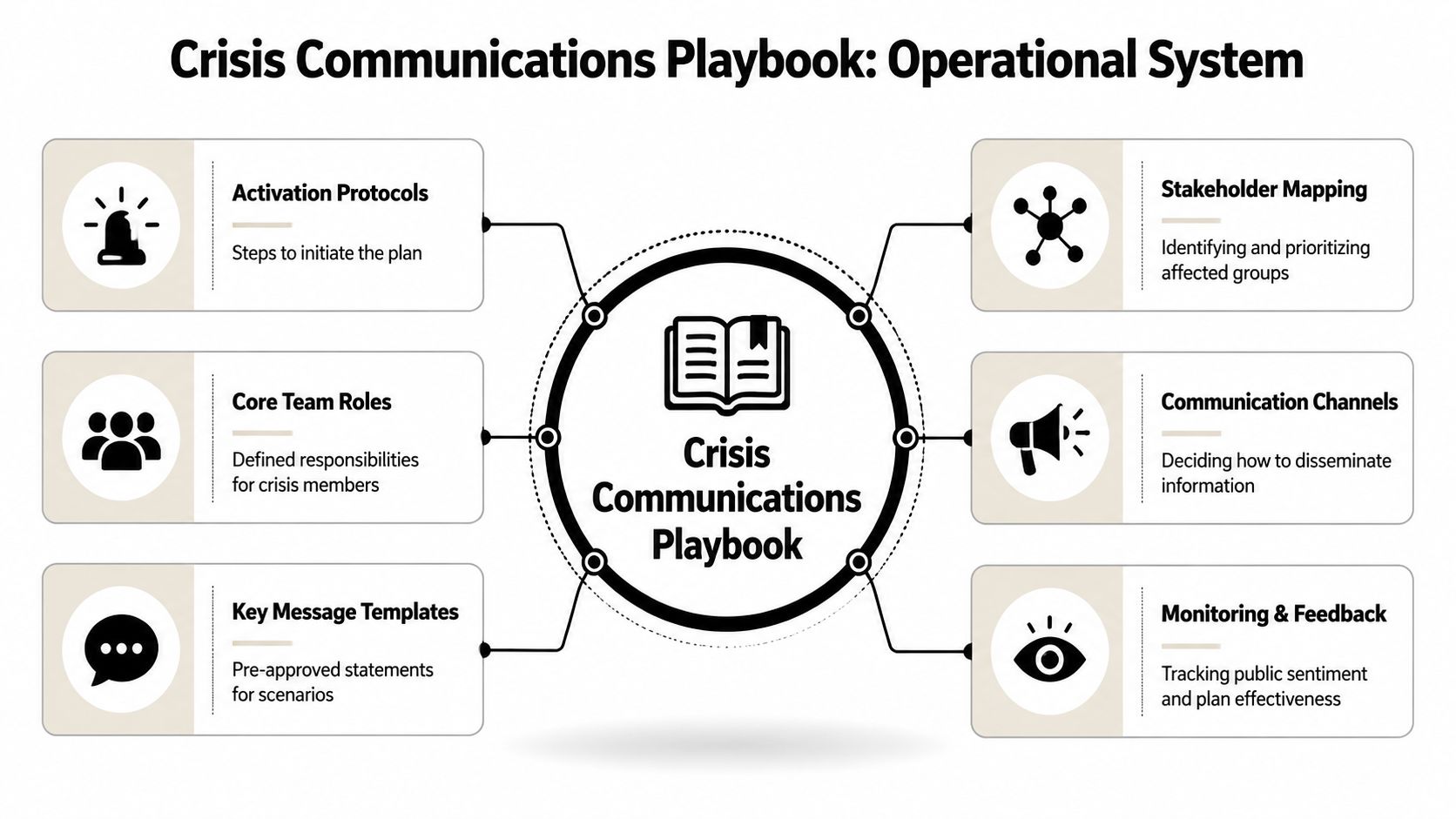
The plan itself should be built for execution. If it reads like a policy binder, it will fail at the moment it's needed most. The better model is a playbook that tells people exactly how to move once a threshold has been crossed.
A strong crisis plan should define activation criteria, assign named roles with backups, map communication channels, and include pre-approved templates and contact lists to reduce decision latency, as noted in Cassling's guidance on crisis communication planning.
Build around activation, not theory
A plan should open with a simple question. What triggers activation?
That might be a confirmed security incident, a developing public allegation, a product issue affecting customers, a harmful rumor gaining traction, or any event likely to require coordinated internal and external messaging. What matters is clarity. If your trigger language is vague, people will hesitate. Hesitation is where confusion starts.
Your first page should tell any senior manager:
- What counts as activation
- Who can activate the plan
- What level of response applies
- Who must be notified immediately
Some organizations use full and partial activation. That's useful because not every issue needs the entire machine running. A contained issue may only need leadership, comms, and legal. A wider incident may require HR, IT, operations, customer support, and executive leadership at once.
Name the team and assign backups
Job titles alone aren't enough. The playbook should list names, responsibilities, and backups. People go on vacation. Phones die. The primary spokesperson may be personally involved in the issue. If your plan assumes perfect availability, it isn't operational.
Here's a practical baseline team structure:
| Role | Primary Responsibility |
|---|---|
| Crisis Lead | Activates the plan, coordinates response, sets priorities |
| Executive Sponsor | Makes high-level business decisions and approves major strategy shifts |
| Spokesperson | Delivers approved public statements and handles media-facing communication |
| Internal Communications Lead | Informs employees, managers, and internal stakeholders |
| Legal Counsel | Reviews risk, disclosure language, and approval thresholds |
| Operations Lead | Confirms operational facts, service status, and remediation steps |
| IT or Security Lead | Verifies technical details for cyber or systems-related incidents |
| Social Media Monitor | Tracks public reaction, misinformation, and escalation signals |
| Customer Support Lead | Aligns frontline responses, scripts, and issue routing |
A contact list should include direct mobile numbers, after-hours contacts, and backup paths. Store it in more than one place. Shared drive access fails at the worst times.
Decision standard: If a team member can't open the plan on a phone and know what to do in two minutes, simplify the document.
Prepare message frameworks, not polished speeches
The first statement in a crisis is rarely the final one. That's why teams need holding statements and message frameworks, not finished prose for every possible event.
A strong framework usually answers:
- What happened: Only verified facts.
- What you're doing now: Investigation, containment, support, coordination.
- Who is affected: If known, and stated carefully.
- What happens next: Next update window, help channel, response process.
For example, your initial customer-facing message might state that the company is aware of the issue, is verifying facts with the relevant internal teams, and will provide an update through a designated channel. That is enough to establish presence and control without guessing.
Pre-approved templates are especially useful for legal review. Teams that wait to draft from zero often lose time debating structure, not substance. In some organizations, comms and legal also benefit from adjacent workflow tools. For example, if your approvals include policy language, obligations, or contractual references, teams exploring efficient contract review using AI may find ways to speed supporting review work around the communications process.
Map channels before you need them
The playbook should also make channel choices in advance. Don't leave that to improvisation.
Use a simple channel map:
- Employee email or intranet: Internal instructions, manager guidance, FAQ, approved talking points.
- Press release: Formal statement for media, search visibility, and a stable reference point.
- Website banner or newsroom page: Central source of current status and updates.
- Social platforms: Short updates, correction of misinformation, direction back to the official statement.
- Direct customer outreach: Email, account notices, support messaging for affected users.
- SMS or emergency alerting: Time-sensitive internal alerts when immediate awareness matters.
Press Release Zen is one practical resource for teams that need templates and examples for structured crisis statements, especially when a formal release needs to be drafted fast and kept aligned with broader messaging.
Executing Your Plan When a Crisis Hits
A plan becomes real the moment someone decides this is no longer a routine issue. Execution is where strong preparation shows up. Weak teams debate whether the issue is “serious enough.” Strong teams use pre-set triggers, notify the right people, verify the facts that matter most, and get the first message out without overreaching.

Activate with a clear threshold
The first operational question is simple. Has the issue crossed the threshold for crisis activation?
Good triggers are concrete. They usually involve one or more of these conditions:
- Public exposure is underway: A reporter inquiry, viral post, public allegation, leaked document.
- Stakeholders are affected now: Service interruption, safety concern, data issue, significant confusion.
- Cross-functional coordination is required: Communications can't respond accurately without legal, IT, HR, operations, or executive input.
- The issue may escalate quickly: Especially when social sharing or messaging apps can outpace formal reporting.
Once activated, the crisis lead should move the team into a short sequence: verify facts, assign owners, set approval path, and designate the official update channel.
Use an escalation workflow that people can follow
In practice, escalation fails when it gets too elaborate. Keep it tight.
- Incident identified
- Crisis lead or designated backup assesses threshold
- Core response team notified
- Facts verified by relevant operational owner
- Initial holding statement approved
- Internal audience notified
- External message deployed through selected channels
- Monitoring loop begins
This is also where frontline teams matter more than many executives realize. Customer support and contact center staff hear confusion early, and they often surface message gaps before the media does. If your crisis model includes high-volume inbound communication, this guide to improving contact center quality assurance offers useful ideas for keeping scripts, monitoring, and escalation aligned when pressure spikes.
Say less, sooner. The first statement should prove control, not completeness.
Match the channel to the audience
Different channels do different jobs. One of the fastest ways to lose trust is to post publicly before telling your employees what's happening. Another is to bury important customer guidance in a media statement no customer will ever read.
Use channels deliberately:
- Employees first when operationally possible: Give managers a brief, factual internal note with explicit instructions on what to say and where to send questions.
- Website or newsroom as source of record: This becomes the stable destination you can reference elsewhere.
- Press release for formal external positioning: Useful when the issue has media visibility, legal sensitivity, or a need for a dated public statement.
- Social posts for distribution, not nuance: Keep them short. Link back to the source of record.
- Direct outreach for affected customers or partners: Don't make impacted people learn details from the press.
A useful explainer for teams handling the formal media side is this guide on how to write a crisis communication press release.
What the first press release should do
A crisis press release isn't the place to sound polished. It's the place to sound credible.
Keep the structure disciplined:
- Lead with the confirmed issue: State what the organization is aware of.
- Acknowledge impact carefully: Only what you know.
- State the response: Investigation, containment, support, corrective action.
- Give the next update path: Newsroom page, media contact, customer support route.
- Avoid speculation: No cause, blame, or scope claims that aren't verified.
Before your team drafts one under pressure, it helps to see an example of how a response can be framed on camera and under scrutiny:
Keep a live monitoring loop
Execution doesn't stop after the first statement. Once the message is out, monitor what people are hearing, not just what you said.
Watch for three things:
- Message drift: Different teams paraphrasing in ways that change meaning.
- Information gaps: Repeated questions that show your statement didn't answer what mattered.
- False narratives: Rumors, edited clips, fake screenshots, impersonation attempts.
That monitoring loop should feed directly back into the next update cycle. A crisis response that doesn't adapt becomes stale fast.
Running Drills for Real-World Readiness
A written plan can create false confidence. Teams read it, approve it, store it, and assume they're ready. Then a real event hits and nobody knows who owns the first internal message, who can approve a public statement after hours, or where the current contact list lives.
That gap is common. PR News reported that less than 25% of companies actively practice their crisis plans, even though many have one on file, according to Cision's crisis communication guidance. The same guidance also points to a newer blind spot. AI-driven misinformation is now a major concern, yet many organizations still train only for traditional scenarios.

Run the kind of drill your team will actually do
Most organizations don't need a cinematic simulation to start. They need repetition.
A strong drill program usually includes a mix of formats:
- Tabletop sessions: Leadership and functional owners walk through a scenario verbally and decide what they would do.
- Message drills: Comms drafts the first employee note, holding statement, social response, and press release under a short deadline.
- Approval drills: Legal, leadership, and communications test whether approval paths hold up outside business hours.
- Channel drills: Teams verify whether website, email, media list, intranet, and social workflows work in sequence.
Tabletops are especially valuable because they expose disagreement early. One executive may want silence until every fact is known. Legal may want to narrow language tightly. Customer support may need broader guidance immediately. You want those tensions surfaced in rehearsal, not in front of customers and reporters.
Add modern threat scenarios
Many plans still train for a product issue, a weather emergency, or a leadership scandal. Those are still important. But modern crisis readiness also has to account for fabricated content.
Test scenarios like these:
- A fake executive statement spreads online: A manipulated video appears to show the CEO announcing layoffs or admitting wrongdoing.
- A fraudulent press release circulates: The market, customers, or partners see a false announcement before your team does.
- An AI-generated audio clip reaches employees: Staff begin sharing a fake leadership message internally.
- A misinformation campaign targets a service disruption: Real operational issues get mixed with false claims.
Don't limit drills to what used to happen. Train for what can now be fabricated convincingly and distributed instantly.
For these scenarios, your crisis communications plan should include authenticity checks, a designated verification lead, evidence standards for rebuttal, and a takedown or escalation path that involves communications, legal, and IT together.
What practice reveals fast
Drills tend to uncover the same hidden weaknesses:
- Outdated contacts: Former employees still listed, personal mobile numbers missing, no backup for a key role.
- Approval confusion: Nobody knows who can sign off when the CEO is unavailable.
- Template problems: Old language, wrong branding, no version control, over-lawyered statements that don't work publicly.
- Channel mismatch: Teams planned for email, but the fastest correction route is a newsroom post plus social clarification.
The point of rehearsal isn't to produce perfect performance. It's to reduce hesitation, expose friction, and build muscle memory so the team can move with confidence when the issue is real.
After the Storm Post-Crisis Analysis and Plan Updates
The public pressure eventually fades. That doesn't mean the work is done. The post-crisis period is where organizations either get sharper or drift back into the same vulnerabilities.
A useful review starts quickly, while memories are fresh. Bring together the people who had a role in the response, including communications, leadership, operations, legal, HR, IT, customer support, and any frontline managers who handled questions directly. The goal isn't blame. The goal is to document what happened, what decisions were made, what information was missing, and where response speed improved or stalled.
Review the response from three angles
First, assess decision-making. Did the team activate at the right moment? Did approval paths help or delay? Were backups clear when primary owners were unavailable?
Second, assess message performance. Which messages landed well internally and externally? Where did stakeholders remain confused? Did the official source of record stay current?
Third, assess operational fit. Did the communications plan match what the broader organization could execute? It's common to discover that message promises outran operational reality, or that customer-facing teams needed different guidance than expected.
A crisis review should end with changed behavior, not a nicer meeting summary.
Turn lessons into document changes
A post-crisis review only matters if the plan gets updated. That means revising the playbook, not just circulating notes.
Use a practical update list:
- Replace stale contacts: Update names, backups, direct numbers, and after-hours paths.
- Fix trigger language: Clarify activation criteria that caused delay or debate.
- Rewrite weak templates: Keep what worked. Cut what sounded evasive or generic.
- Adjust channel priorities: Promote the channels that proved fastest and most reliable.
- Add new scenarios: If the crisis revealed a gap, convert that gap into a documented scenario and future drill.
The strongest organizations treat every incident as training data. They don't just “get through” the event. They refine the system so the next response is faster, cleaner, and more credible.
If your team needs practical help building that system, Press Release Zen offers guides, examples, and editable resources for crisis statements, press releases, and planning workflows that can support in-house teams, agencies, and business leaders preparing for high-pressure communication moments.