A lot of business owners meet crisis communications the same way. Not in a planning session, but on a normal workday that suddenly stops being normal.
A customer posts a complaint. Then another person shares it. Someone on your team replies too quickly, another waits too long, and now you have three different versions of the story floating around online. At that point, the primary problem isn't just the original issue. It's the confusion, the silence, and the appearance that nobody is in charge.
That's what crisis communications is for. In plain terms, it's the system you use to communicate clearly, quickly, and credibly when something threatens your reputation, operations, or stakeholder trust. It isn't corporate theater. It's practical control under pressure.
For small and mid-sized businesses, this matters even more because you usually don't have a large PR bench, a dedicated incident command center, or time to build a separate process from scratch. The workable approach is simpler. Build crisis thinking into the communication tools you already use, especially your press release workflow.
Your Brand's Reputational Fire Department
A crisis rarely announces itself as a crisis.
It often starts as something that looks manageable. A delayed shipment. A service outage. A photo from a customer that raises a safety concern. A frustrated ex-employee posting on LinkedIn. The first instinct is usually to "handle it internally." Sometimes that works. Sometimes it doesn't, and the delay becomes the story.
That is why I describe crisis communications as your brand's reputational fire department. You don't build a fire department while the building is burning. You decide in advance who gets called, who speaks, what gets checked first, and how people will be informed. The point isn't drama. The point is response discipline.

The gap between knowing this and doing it is still wide. Only 49% of U.S. businesses have a formal, documented crisis communications plan in place, with nearly 23% having no plan at all or being uncertain about their preparedness according to Capterra's crisis communications planning data.
What crisis communications actually covers
Crisis communications isn't limited to headline-making disasters. It includes any event where a delayed, inconsistent, or careless response can damage trust.
That can include:
- Customer-facing incidents such as recalls, outages, billing problems, or service failures
- Reputation threats such as negative press, social media backlash, or executive misconduct allegations
- Operational events such as cybersecurity incidents, vendor breakdowns, or facility disruptions
- Internal issues made public such as employee claims, policy failures, or leaked documents
A crisis communication plan doesn't eliminate bad events. It keeps a bad event from becoming a credibility collapse.
For many teams, a good first step is getting serious about managing your digital footprint. That work helps you see what customers, journalists, and partners are likely to find when they go looking for context during a tense moment.
The practical definition that matters
If you're asking what is crisis communications, the best answer is this: a repeatable way to tell the truth fast, show that someone is accountable, and give the right people useful updates before rumors outrun facts.
Small businesses often assume this requires a separate crisis unit. It doesn't. In practice, it starts with a documented contact list, a spokesperson decision, a review process, and a few message templates you can adapt under stress.
That is much more attainable than most companies think.
The Three Pillars of Effective Crisis Response
When teams get into trouble, it's usually not because they care too little. It's because they react in the wrong order. They defend before they verify. They over-explain before they acknowledge. Or they let each channel say something slightly different.
The cleanest way to avoid that is to work from three pillars.
Speed and transparency
The first job is to show up.
The widely accepted 15-20-60-90 timeline says organizations should acknowledge a crisis within 15 minutes, share more information by 60 minutes, and be prepared for media engagement within 90 minutes, as outlined in Regroup's guidance on effective crisis communications.
That doesn't mean you need every answer in the first message. You don't. It means you need to confirm that you are aware, that you're assessing the facts, and that you'll provide the next update on a clear timeline.
Crisis communications functions like emergency medicine. The initial priority is not to provide a definitive final diagnosis. Instead, the focus is to stabilize the situation, establish command, and prevent further harm.
What doesn't work is silence dressed up as caution. If people can't get facts from you, they'll get guesses from somewhere else.
Empathy and accountability
A technically accurate statement can still fail if it sounds emotionally absent.
People want to know three things: do you understand the impact, are you taking responsibility for your part, and what are you doing now. That is why empathy isn't “soft” language. It's a credibility signal. It tells customers, staff, and partners that you're responding as humans, not hiding behind legal formatting.
A flat statement full of process language often reads as self-protection. A concise statement that acknowledges disruption, inconvenience, fear, or frustration lands better because it reflects the audience's actual experience.
Practical rule: If your first paragraph would sound cold when read aloud to an affected customer, rewrite it.
Consistency and control
Consistency is what keeps a manageable problem from splintering into five different narratives.
Expert guidance commonly classifies crises into Level 1, Level 2, and Level 3, ranging from minor issues to major events that trigger full team mobilization, according to 5WPR's crisis communication strategy framework.
That tiering matters because not every issue deserves the same machinery.
| Crisis level | What it usually looks like | Communication posture |
|---|---|---|
| Level 1 | Limited issue, low spread, narrow audience | Monitor closely, prepare a response if it grows |
| Level 2 | Wider stakeholder concern, recurring complaints, visible public attention | Activate response lead, align stakeholder messages |
| Level 3 | Major event, legal exposure, safety or trust implications, broad public scrutiny | Full team mobilization, centralized approvals, multi-channel updates |
A tiered system helps you avoid two common mistakes. One is underreacting to a fast-moving issue. The other is overreacting so loudly that you create more attention than the original problem deserved.
If you want a practical checklist for how these principles show up under pressure, this guide to crisis communication best practices is useful because it translates theory into decisions teams have to make.
Assembling Your Crisis Communications Plan
A workable plan fits on a few pages and gets used. An impressive plan that nobody can find at the right moment is just office literature.
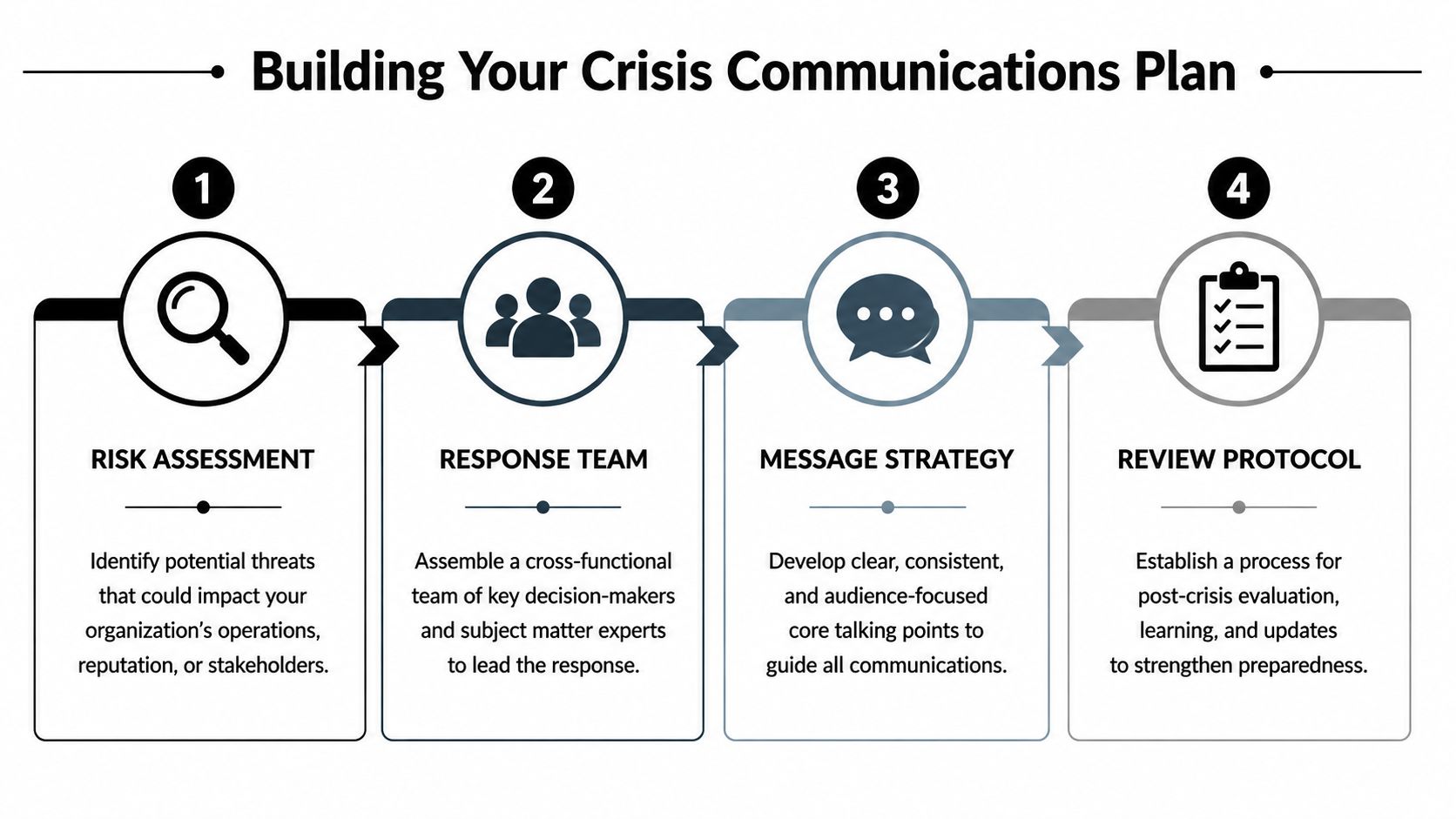
Most organizations need four building blocks. Not a giant binder. Not a war novel. Just four documented pieces that let people act without guessing.
Start with the people
Your crisis team should be small enough to move and senior enough to decide. In many businesses, that includes the owner or CEO, whoever leads communications or marketing, legal counsel if available, operations, and HR when employee impact is involved.
Each person needs a role, not just a seat at the table.
- Decision lead who can approve actions and resolve trade-offs quickly
- Communications lead who drafts, edits, and coordinates external messaging
- Operations lead who verifies what is happening
- Legal or compliance reviewer who flags risk without freezing the process
- Internal communications contact who keeps employees informed before they learn from the internet
One detail is absolutely critical. An essential plan element is having pre-screened spokespersons trained in media protocols, with backup roles designated per channel, including press, social, and internal communications, as described in Crisis Navigator's ten-step framework.
That backup role matters more than organizations typically anticipate. Spokespeople get sick, travel, freeze under pressure, or become part of the story. Plan for that before you need it.
Map who needs what
Not all stakeholders need the same message, and they should not receive it in the same format.
Customers need clarity about impact and next steps. Employees need internal direction and talking points. Regulators, partners, or investors may need more formal or more specific information. Media need a verified statement, a contact point, and a commitment on when you will update.
A simple stakeholder map is often enough:
| Stakeholder | What they need first | Best channel |
|---|---|---|
| Employees | What happened, what to say, what not to say | Internal email, chat, manager brief |
| Customers | Impact, action steps, support options | Website update, email, social, release |
| Media | Verified facts, spokesperson, next update time | Statement, press release, media inbox |
| Partners or regulators | Scope, operational implications, compliance actions | Direct outreach, formal notice |
Define triggers before emotions take over
A plan needs activation triggers. Otherwise, every incident turns into an argument about whether it's “really a crisis.”
Your triggers can be simple. Sudden public attention. Safety concern. Significant service disruption. Data exposure. Escalation from one channel into others. A legal or regulatory angle. Executive involvement. Staff confusion about what they are allowed to say.
The fastest teams aren't improvising better. They're deciding from pre-agreed triggers instead of debating vocabulary.
Build templates you can actually use
Small teams use this strategy to build momentum. Draft a holding statement, a customer update, an employee note, a social response, and a press release shell before any event occurs. Leave blanks for facts that change.
Keep the first response structure simple:
- What happened
- What you're doing
- Who is affected
- When the next update will come
- Where questions should go
If you need a starting point, a sample crisis communication plan can help teams move from a vague intention to a documented workflow without overcomplicating the process.
The Crisis Response Workflow in Action
A good plan looks abstract until you see it in motion. So take a common scenario. Your company runs a subscription software platform for local service businesses. At 8:10 a.m., users start reporting they can't log in. By 8:18, support tickets are piling up. By 8:24, a customer posts publicly that your system may have exposed account information.
At this stage, teams either create confidence or leak it.

The first fifteen minutes
The first move is activation, not speculation.
Someone on your team flags the issue in the designated channel. The response lead confirms who joins the call. Operations verifies known facts only. Communications opens the prepared template for a holding statement. Support is told exactly what to say and what not to say until more is confirmed.
You are working inside the 15-20-60-90 response windows covered earlier, but the operational question is simpler: what can you say now that is true, useful, and unlikely to need retraction?
A credible first statement might do four things:
- Acknowledge the issue without minimizing it
- State what is being investigated without guessing cause
- Tell affected users where to watch for updates
- Commit to the next update time
That first message isn't elegant. It isn't supposed to be. Its job is to establish command.
By the first hour
By this stage, the team should have a clearer picture of whether this is a service outage, a possible security event, or both. Undisciplined teams often make their most damaging mistake at this point, blending technical assumptions with public messaging.
Don't do that.
If customer data might be involved, your response process needs coordination with legal, security, and customer support. In incidents with a cybersecurity angle, practical guidance on managing a data breach effectively can help teams think through customer protection steps alongside communications.
Here is the better pattern:
| Time window | Internal priority | External action |
|---|---|---|
| 0 to 15 minutes | Confirm incident owner and gather known facts | Publish acknowledgment |
| 15 to 60 minutes | Assess scope, draft approved messages, align support | Issue expanded update |
| By 90 minutes | Prepare spokesperson, media Q&A, next update cadence | Respond to press and public inquiries |
Say less than you know if facts are unverified. Say more than you want if people need practical guidance.
That sentence captures the trade-off. Caution is good. Vagueness isn't.
A useful example of how teams talk through this in real situations is below.
The next phase
Once the first two updates go out, the workflow changes from reaction to management.
Support needs fresh scripts. Social replies need to point to the same source of truth. The spokesperson needs a short set of approved talking points. The website or newsroom update needs a timestamp so audiences know it is current.
At this point, your press release often becomes the anchor document because it gives media, customers, and search results one formal reference point. That only works if it matches what your support team and social team are saying.
After the incident stabilizes, document what happened. Which approvals slowed you down. Which channel created confusion. Which questions kept repeating. That review is where the next crisis gets easier.
How to Adapt Press Releases for Crisis Management
A standard press release template is built to announce. A crisis press release is built to stabilize.
That difference matters because 60 to 70% of PR practitioners at small and mid-sized firms report using generic press release templates even in crisis situations, often leading to delayed or inconsistent messaging, according to AKCG's guide for beginners in crisis communications.
The fix isn't throwing out the template. It's changing how you use each part.

Rewrite the headline and lead
In a normal release, the headline tries to attract interest. In a crisis release, the headline should reduce ambiguity.
Avoid promotional framing. Avoid euphemisms. Avoid cute language.
Use factual patterns such as:
- Company Name Issues Update on Service Disruption
- Company Name Responds to Product Recall
- Company Name Provides Statement on Reported Incident
Then make the lead paragraph do the hardest work. It should identify the issue, acknowledge impact, and state the immediate action. If an apology is appropriate, it belongs in the lead paragraph. Not buried in paragraph six.
Use the body as a control document
The body should answer the practical questions audiences will have. Structure helps more than flair here.
A reliable order is:
- Confirmed facts
- Actions already taken
- Guidance for affected people
- What is still being assessed
- Timing for the next update
If you're tempted to add marketing language, cut it. If you're tempted to explain your company history, cut that too. Under pressure, clarity beats polish.
The best crisis release reads like a calm briefing, not a campaign asset.
Adjust the boilerplate and contact block
In routine PR, the boilerplate is often static. In crisis communications, you may need a trimmed version that doesn't sound tone-deaf beside the incident.
The media contact also needs special handling. Use a monitored email and a real person who can respond quickly. If customer support is receiving public pressure, include a designated support route separately so journalists and customers don't jam the same inbox.
For teams building this into everyday workflow, one useful option is a guide on how to write a crisis communication press release. It helps translate a familiar press release structure into something that works when facts are moving and stakes are higher.
A significant advantage here is operational. If your staff already knows your release format, then adapting that format for a low-level or emerging crisis becomes much easier than inventing a whole new document under stress.
From Reactive Panic to Proactive Preparedness
Most businesses don't need a massive crisis apparatus. They need a clear, documented response they can effectively run.
That means knowing what counts as a crisis, assigning decision roles, preparing spokesperson backups, and turning your routine communication tools into response tools. For small and mid-sized teams, that last part is often the breakthrough. When your press release workflow already includes holding statements, stakeholder variants, and approval paths, crisis communications stops feeling like a separate discipline reserved for major corporations.
It becomes part of how you operate.
That shift matters because trust is built long before a hard day arrives. A prepared company sounds calmer, acts faster, and gives people fewer reasons to assume the worst. If you want another practical perspective on that mindset, these top crisis communication tips are a useful companion read.
Crisis communications isn't about looking polished in a bad moment. It's about being understandable, accountable, and steady when people need that from you most.
If you're building or revising your own process, Press Release Zen offers practical guides and templates for planning, writing, and adapting press releases for high-pressure situations without overcomplicating the workflow.