You've got the approval. Leadership wants the announcement out today. Program staff want every detail included. Legal wants tighter language. The media contact list is half current, half outdated, and someone asks whether this should even be a press release in the first place.
That's a normal day in public affairs.
A government press release isn't just a tidy document with a headline and a quote from an official. It's part public record, part media tool, part compliance exercise. If you treat it like brand copy, it usually fails. If you treat it like a legal memo, nobody reads it. The work is finding the line where clarity, authority, and process all hold up at once.
What Makes a Press Release Governmental
When a new communications hire asks me what makes a government press release different, I start with one rule: it exists to document official action for public understanding. Attention matters, but accountability comes first.
That changes everything about tone, structure, and approval. A commercial announcement can lean on positioning, momentum, and persuasion. A government press release has to stand up as a formal statement of record. It may announce policy, legislation, appointments, emergency information, public spending decisions, or program outcomes. The audience isn't just reporters. It's also residents, oversight bodies, partner agencies, advocacy groups, and anyone who may revisit the release later to verify what the agency said and when it said it.

Official source matters
A release becomes most authoritative when it comes from the agency that owns the action or the data. Major U.S. agencies don't publish these as scattered one-off statements. They maintain release hubs that create a dated, searchable record. The BEA current releases page is a strong example. It includes formal economic announcements such as the “Outdoor Recreation Economic Statistics, U.S. and States, 2024” release dated March 5, 2026. That kind of release infrastructure is why reporters and analysts treat agency pages as baseline reference points.
Practical rule: If the information affects public rights, spending, safety, compliance, or official interpretation, write it as if someone will quote it back to the agency later. Because they might.
The same principle applies at smaller levels of government. A city department, school district, county office, or state agency may not have the same volume as BEA or Census, but it still needs the same discipline. Date the release correctly. Identify the issuing office clearly. Make sure the language reflects an official position, not a staffer's preference.
It's closer to a public record than a pitch
New hires often look up examples from the private sector and borrow the wrong habits. They overstate. They bury the action. They lead with adjectives instead of facts. That's where the confusion starts.
A better mental model is this: a government press release should read like a document built for reuse. Journalists should be able to lift the lead. Residents should be able to scan it. Internal stakeholders should be able to defend it. If you need a quick refresher on baseline press release mechanics before adapting them to public-sector work, this overview of what a press release is is useful context.
Some agencies are also expanding accessibility across formats, especially for spoken summaries, call-in access, or multilingual delivery. Teams handling audio versions or voice-first public communications may want to review Vatis Tech AI for public sector audio as part of that broader accessibility stack.
Formatting Your Official Announcement for Clarity
Most government press releases fail in one of two ways. They either read like internal meeting notes, or they read like soft marketing copy. Neither works.
A good format is plain, disciplined, and built for extraction. Reporters scan. Residents skim. Staff forward. If the basic facts aren't visible at a glance, the release has already lost usefulness.
The non-negotiable structure
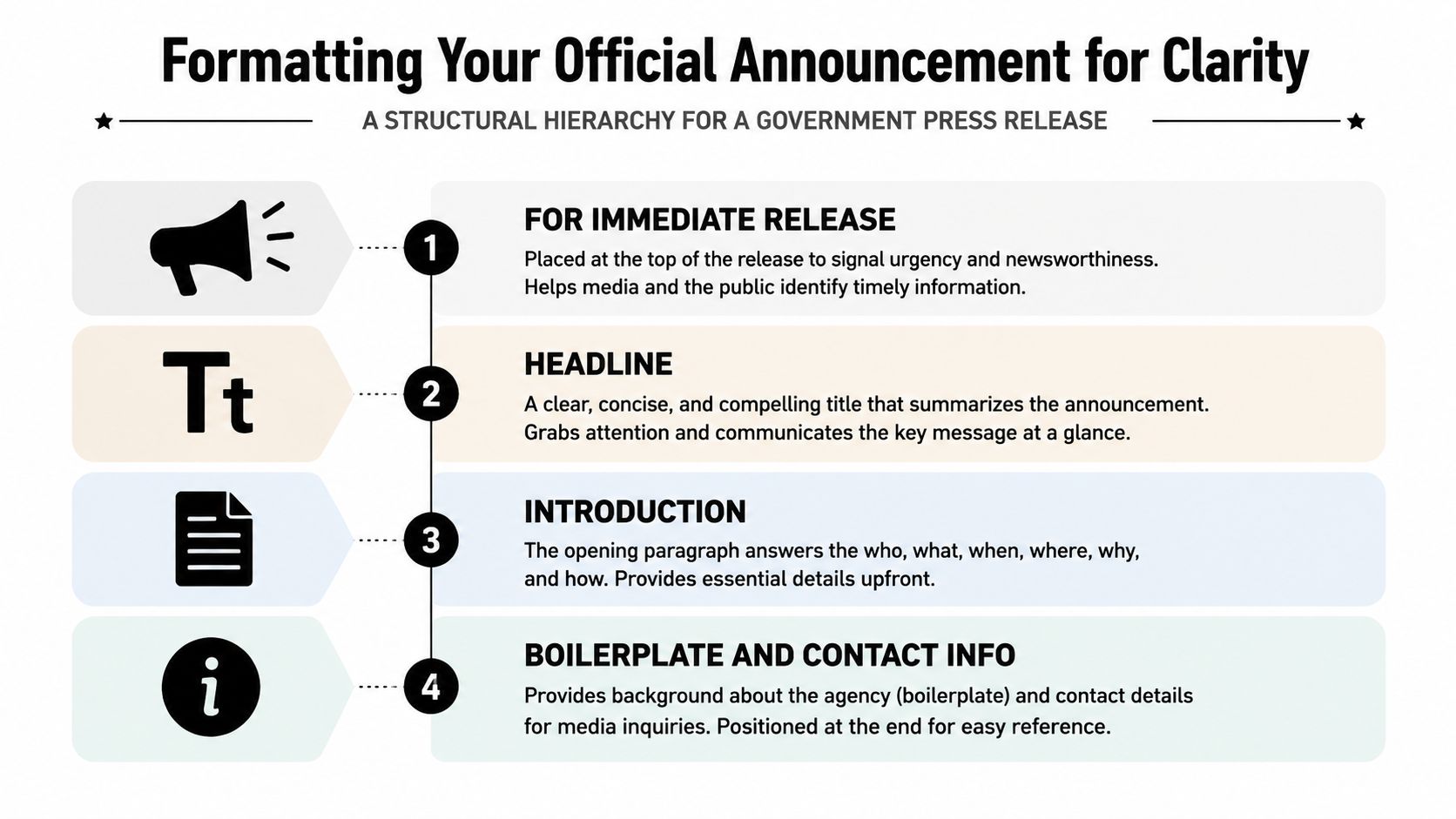
Government-focused guidance treats the release as a public-accountability instrument and expects standard journalistic architecture: headline, dateline, lead paragraph, supporting quotes, and background details, with the lead answering who, what, when, where, and why immediately. That framing is captured in this guide to government press release structure and examples.
Use this sequence:
Release label
Put “FOR IMMEDIATE RELEASE” at the top unless there's a justified embargo arrangement approved internally. Don't improvise with clever alternatives.Headline
State the action plainly.
Good: “City Department Launches New Permit Intake Process”
Weak: “A Major Step Forward for Better Services”Dateline
City and date belong at the start of the body. This grounds the announcement in time and place.Lead paragraph
Answer the core facts in the first paragraph. If a reader stops there, they should still understand the action.
Lead with the decision, not the backstory.
Body paragraphs
Add operational details, timelines, eligibility, public impact, and any necessary context.Attributed quotes
Quotes from officials should clarify intent, accountability, or implementation. They shouldn't repeat the headline with more adjectives.Boilerplate and media contact
End with a short agency description and a real contact path monitored by staff.
What each part needs to do
Here's the standard I use when editing:
Headline: Name the action in concrete terms.
Lead: Deliver the facts fast enough that a reporter can write a brief from it.
Quote: Add meaning, responsibility, or public-facing direction.
Background: Explain only what the reader needs to understand the action.
One common mistake is using the lead to summarize internal process. The public usually doesn't need to know that a workgroup met over several months or that staff collaborated across divisions. They need to know what changed, who it affects, and when it takes effect.
Style choices that improve trust
A government press release should be readable without sounding casual. That means:
- Use plain nouns and verbs: “The department issued updated guidance” beats “The department is proud to unveil enhanced guidance.”
- Name the issuing authority clearly: Use the office, agency, or department name exactly as it appears officially.
- Keep chronology clean: If implementation starts later, say so directly.
- Separate fact from aspiration: “The program will accept applications starting Monday” is a fact. “The program will transform access” is not a useful lead claim.
If your team needs a style refresher for punctuation, capitalization, and news formatting, this guide to an AP style press release is a practical companion.
The Real-World Impact of Government Statements
Government statements matter because they often become the baseline facts used by everyone else. A release isn't just something journalists may cover. It can shape the first frame through which the public understands an issue.
That's easiest to see when the underlying numbers are consequential. USAFacts reports that between 2000 and 2022 there were 1,375 school shootings in the United States, resulting in 515 deaths and 1,161 injuries in its compilation of publicly available government data at USAFacts. When numbers at that scale enter public discussion through official or government-sourced communication, they don't stay inside the release. They move into policy debates, board briefings, campaign arguments, newsroom coverage, and community meetings.
Why editors and analysts pay attention
The same pattern holds for economic and fiscal reporting. USAFacts also reports that the U.S. gained 178,000 jobs in March 2026 and that the federal government's budget deficit was $1.8 trillion in FY 2024. Those are the kinds of figures that can reset a news cycle in a single morning.
A practitioner should understand the chain reaction:
- Officials publish a release
- Reporters turn it into headlines
- Stakeholders interpret the announcement
- Markets, advocates, and local institutions respond
- The release becomes part of the durable public record
That's why loose wording causes trouble. If the release overstates, hedges, or leaves critical facts vague, every downstream user fills in the gap differently.
The practical implication for writers
Don't think of a government press release as summary content. Think of it as source material. Many readers will never see the underlying report, administrative record, or staff memo. They'll see the release, a headline based on it, and perhaps a social post quoting a line from it.
If the release is the cleanest public explanation of the action, the agency keeps control of the facts. If it's muddy, everyone else defines the story.
That's why precision beats flourish every time.
Navigating Legal Constraints and Internal Approvals
The draft you write is only one part of the job. The larger job is getting the release through review without losing the facts, the timing, or the public value.
Most agencies have a version of the same internal path. Program staff confirm substance. Communications shapes the message. Leadership checks alignment. Legal reviews risk, statutory language, and whether the release says more than the agency is prepared to defend publicly.

A workable approval chain
If you're new, don't wait until the final hour to discover who signs off. Build the chain early.
A simple internal workflow usually looks like this:
- Program review: Subject-matter staff verify facts, dates, operational language, and eligibility details.
- Communications edit: Public affairs strips jargon, fixes structure, and makes sure the lead is usable.
- Legal or policy review: Counsel checks claims, required disclaimers, and procedural risk.
- Leadership approval: Senior officials confirm that the release reflects agency position and timing.
This isn't bureaucracy for its own sake. Each layer catches a different kind of failure. Program staff catch factual slippage. Legal catches exposure. Leadership catches institutional consequences.
What legal review is really looking for
Legal review isn't just hunting for errors. It's asking whether the release creates confusion about authority, commitments, rights, or process.
Watch for these trouble spots:
- Premature certainty: Don't write as final what is still proposed, pending, or contingent.
- Regulatory confusion: Don't let a press release sound like the official notice if the binding action lives elsewhere.
- Political framing: Public agencies need nonpartisan language. Campaign tone creates immediate risk.
- Unverifiable claims: If you can't source it internally and defend it publicly, cut it.
The safest sentence is usually the clearest sentence.
Many teams also forget that internal emails, draft comments, and approval notes may become reviewable as public records depending on jurisdiction and circumstances. Even when a draft never leaves the building, you should assume process communications may later be scrutinized. That habit improves discipline fast.
Keep the process moving without weakening the release
The easiest way to lose a release is to circulate a draft that's still conceptually unstable. Before sending it for approval, make sure three things are already settled:
| Approval issue | What to lock down first | Why it matters |
|---|---|---|
| Core action | What exactly happened | Reviewers can't approve vague action language |
| Effective timing | When the public change starts | Timing errors create public confusion |
| Spokesperson ownership | Who can be quoted and who can answer follow-up | Media outreach collapses if ownership is unclear |
When teams want a quick overview of how public messaging and compliance intersect, this explainer is a decent starting point:
One more practical note. If a release keeps getting delayed, the problem usually isn't the writing. It's that the underlying decision isn't fully settled. No amount of copyediting fixes that.
Distributing Your Release for Maximum Public Reach
Sending a government press release to a media list is distribution. It isn't a distribution strategy.
A real strategy matches the message to the audiences that need it most. That includes reporters, yes, but also residents, partner organizations, regulated entities, local officials, and community intermediaries who often do the work of translating government language into action.
Build for more than media pickup
Traditional outreach still matters. Beat reporters, local editors, wire desks, and trade publications often decide whether the release enters the broader information stream. But public reach also depends on whether the release is usable on the agency website, in newsletters, on social channels, and in direct outreach to affected groups.
I usually break distribution into four lanes:
- Press lane: Reporters, assignment desks, editorial contacts.
- Owned channel lane: Agency newsroom, homepage, email updates, social accounts.
- Stakeholder lane: Community partners, nonprofits, schools, hospitals, local business groups.
- Service lane: Call centers, frontline staff, program inboxes, field offices.
If the release announces something residents need to do, the service lane matters as much as the press lane. Sometimes more.
Communication equity is part of distribution
A lot of press release advice stops at reach. Public-sector work can't. Some communities have less staff capacity, less time, lower trust, or weaker access to mainstream information channels. A 2023 Senate hearing on improving access to federal grants found that underserved communities face barriers such as limited human capital and organizational capacity, and witnesses recommended technical assistance and clearer expectations, as summarized in this account of the hearing on access for underserved communities. That same discussion noted expanding rural access messaging and highlighted the gap in common guidance around readability, bilingual delivery, and follow-up support.
That should change how you distribute a government press release.
Use practical adaptations such as:
- Simplified companion copy: Write a shorter plain-language version for web, email, and front-desk use.
- Bilingual delivery: If the affected audience includes non-English-speaking residents, don't rely on machine-summary snippets alone.
- Action-first formatting: Put deadlines, eligibility, application steps, or contact paths near the top.
- Partner handoff materials: Give community organizations a brief they can forward without rewriting your release.
- Follow-up pathways: Make sure someone can answer the obvious next question after publication.
Accessibility isn't a post-publication patch. It belongs in the release plan before launch.
Digital tactics that actually help
SEO matters, but not in the gimmicky sense. Clear headlines, descriptive subheads, scannable formatting, and a well-structured newsroom page help residents find the official version instead of a distorted retelling. Avoid clever headlines that hide the actual action. Search visibility improves when the page title and release language match what people would realistically search.
For teams tightening both outreach and discoverability, this guide on how to distribute a press release is a useful checklist.
What doesn't work is assuming one polished PDF solves the problem. Public reach comes from format variety, channel fit, and follow-through.
Templates and When to Use Other Official Formats
A good template speeds up drafting. It doesn't replace judgment.
That judgment matters most at the very beginning, when someone says, “We need a release,” and the right answer might be “No, we need a media advisory,” or “No, this belongs in a notice or filing.”
A clean government press release template
Use this as a starting point:
FOR IMMEDIATE RELEASE
[Agency Name] Announces [Specific Action]
[City, State] [Date]
[Agency name] today announced [specific action], effective [date/time if relevant], to [public purpose]. The action affects [who is affected] in [place or program area].[Second paragraph with operational detail, public instructions, eligibility, scope, or implementation facts.]
“[Quote from official that explains responsibility, purpose, or public benefit],” said [name, title].
[Background paragraph with only the context needed to understand the action.]
Media Contact
[Name]
[Title]
[Email]
[Phone]About [Agency Name]
[One-paragraph boilerplate describing the agency's function.]
A few notes matter more than the template itself:
- The headline should name the action.
- The lead should carry the public facts without requiring the quote.
- The quote should sound attributable and accountable.
- The background should inform, not sprawl.
When a press release is the wrong format
Many teams get tripped up on this point. Most guidance focuses on writing and distribution, but not on choosing the proper format. That distinction matters because 2023 federal guidance pushed agencies to improve public participation in rulemaking by making proposals clearer and more accessible, as discussed in this GovExec analysis of clearer rulemaking participation. If the official action requires procedural notice or comment, a press release can support the effort, but it shouldn't replace the formal channel.
Here's the quick comparison:
| Format | Primary Purpose | Best For |
|---|---|---|
| Press Release | Public announcement and media-ready summary of official action | Policy announcements, program updates, appointments, public-facing milestones |
| Media Advisory | Alerting media to an upcoming event or availability | Press conferences, site visits, public briefings, ceremonial events |
| Public Notice | Meeting legal or procedural notice obligations | Hearings, comment periods, zoning actions, procurement notices, rulemaking steps |
A simple decision test
Ask these questions before drafting:
Are we announcing something that already happened or is formally decided?
If yes, a press release may fit.Are we inviting media to attend something at a specific time and place?
Use a media advisory.Are we satisfying a legal notice requirement or opening a formal comment process?
Use the notice, filing, or docket mechanism first.Will the release create confusion about what is legally operative?
If yes, separate the narrative summary from the official procedural document.
For teams that also handle adjacent legal paperwork and want structured drafting support, automated legal forms for law firms can be a useful reference point for thinking about template discipline and document standardization across formal communications.
The main trade-off is straightforward. A press release is good at speed, readability, and media pickup. It's weaker when the public needs a binding procedural record, formal comment rights, or technical filing language. Smart communicators know the difference before they hit draft.
If you want practical help writing, formatting, and distributing your next announcement, Press Release Zen is a strong resource. It offers templates, walkthroughs, and plain-English guidance that can help newer teams move faster without cutting corners.