A lot of fashion brands are in the same spot right now. The product is good. The founder has taste. The collection photographs well. But outside a small circle of friends, buyers, and existing customers, almost nobody is paying attention.
That gap is where public relation in fashion does its real work.
Good PR doesn't rescue a weak brand. It gives a strong brand the language, proof, and visibility it needs to be taken seriously. In fashion, that matters more than many founders expect, because people don't buy garments on utility alone. They buy meaning, status, belonging, and confidence in what the brand stands for.
Why Public Relation in Fashion is Your Brand's Superpower
I've seen this pattern more than once. A designer launches with a sharp point of view, solid construction, and a collection that deserves attention. Six months later, the brand is frustrated because sales are uneven, editors aren't replying, and social content feels like it's disappearing into a void.
Usually the problem isn't the clothes. It's that the brand hasn't built a public story anyone can repeat.
Fashion PR became a formalized communications function as the industry grew more media-driven, and the role expanded well beyond magazine placement into online outlets, print, broadcast, social media, and influencer marketing, with practitioners shaping brand image and handling reputation management across audiences according to this fashion PR career profile. That's the clearest way to understand the discipline today. PR gives a brand context.
Advertising buys space. PR earns attention. That difference sounds simple, but it changes everything. An ad says what you want people to hear. A strong PR program gives editors, stylists, creators, and customers a reason to talk about you on their own terms.
Desire beats exposure
Visibility alone isn't enough. A brand can be seen everywhere and still feel forgettable. Fashion PR works when it makes a label feel current, credible, and worth discussing.
That usually comes from a mix of signals:
- Editorial relevance so media can place the brand in a wider conversation
- Cultural timing so the story feels connected to what people care about now
- Brand consistency so the same message shows up in interviews, product pages, and events
- Proof so claims hold up when someone asks the next question
Public relation in fashion is the discipline of turning a brand from “available” into “wanted.”
There's also a commercial reason to take this seriously. If you need a practical lens on how attention supports growth, this piece on driving revenue through brand awareness is useful because it connects visibility to business outcomes instead of treating awareness like a vanity concept.
The brands that win long term aren't always the loudest. They're the ones that know what they stand for, who needs to hear it, and how to keep reinforcing that narrative until the market starts repeating it back.
Understanding the Core Channels of Fashion PR
Think of fashion PR like a production with multiple stages. One stage is where other people talk about you. Another is where you control the script. A third is where audiences decide whether your brand deserves attention at all.
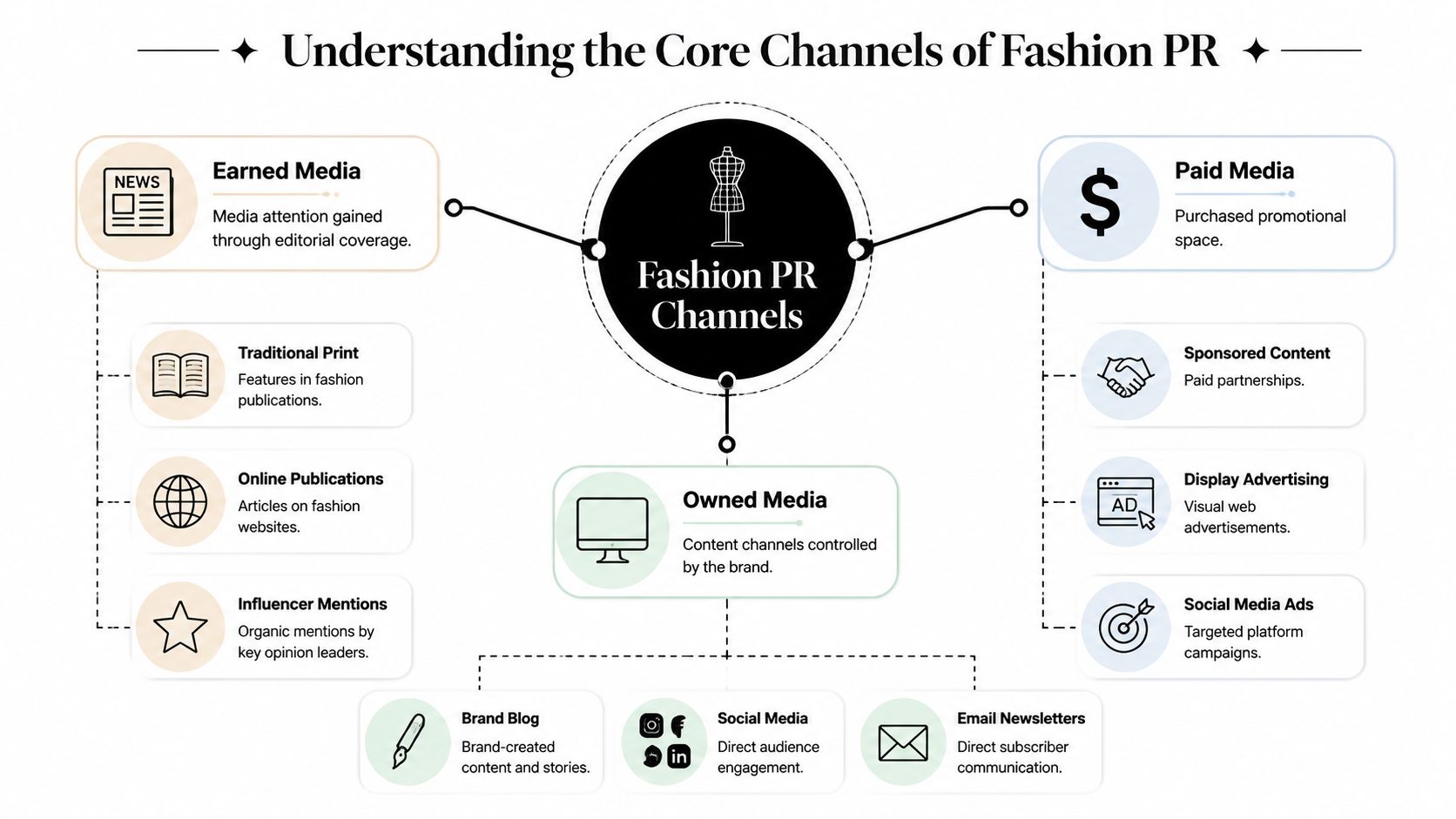
If a junior team member only understands one channel, they'll overuse it. That's why brands end up relying too heavily on gifting, or expecting Instagram to do the work of editorial, or assuming one feature will fix a weak narrative. It won't.
Earned media
This is still the backbone of authority. Earned media includes editorial coverage, online features, broadcast mentions, organic influencer mentions, and fashion week visibility that a brand didn't buy outright.
What makes earned media valuable is not just reach. It's third-party validation. When a respected editor, stylist, or publication includes your brand, they're lending you judgment.
Use earned media when you need to:
- Build credibility with stockists, investors, and new customers
- Frame a launch within a wider trend, cultural angle, or category
- Support pricing by appearing in the same environment as stronger-known brands
A well-targeted distribution process helps here. If your team is comparing options for syndication and pickup, this guide to fashion press release distribution best services and cost is a useful operational reference.
Owned media
Owned media is where the brand controls detail. Your site, blog, newsroom, lookbook, email, campaign copy, and founder messaging all sit here.
Many fashion brands get lazy. They spend time chasing coverage but neglect the pages journalists and consumers land on after they hear about the brand. If your owned channels are vague, overdesigned, or full of recycled campaign language, PR momentum dies on contact.
A quick comparison helps:
| Channel | Best use | Common mistake |
|---|---|---|
| Brand site | Explain the brand clearly | Writing like a mood board instead of a business |
| Lookbook | Support visual storytelling | No captions, no context, no download-ready assets |
| Deepen relationship | Sending only promotions with no narrative |
Social capital
Social isn't just posting. It's the accumulated trust and familiarity a brand builds through repeated, believable signals across creators, customers, comments, and community behavior.
This part of public relation in fashion is often mishandled because teams confuse activity with momentum. You don't need more posts. You need stronger alignment between what the brand says, what people repeat, and what the visuals confirm.
For teams refining that execution, these Moonb creative department tips are helpful because they focus on social media best practices in a way creative and PR teams can apply.
A healthy PR mix means each channel reinforces the others. Coverage should send people to strong owned assets, and owned assets should make social conversation easier.
Essential Tactics for Generating Brand Buzz
Many brands often start with the obvious playbook. Seed product. Dress talent. Host an event. Chase coverage. Those tactics still matter, but they don't work equally well for every brand, and they definitely don't work when there's no clear story underneath them.
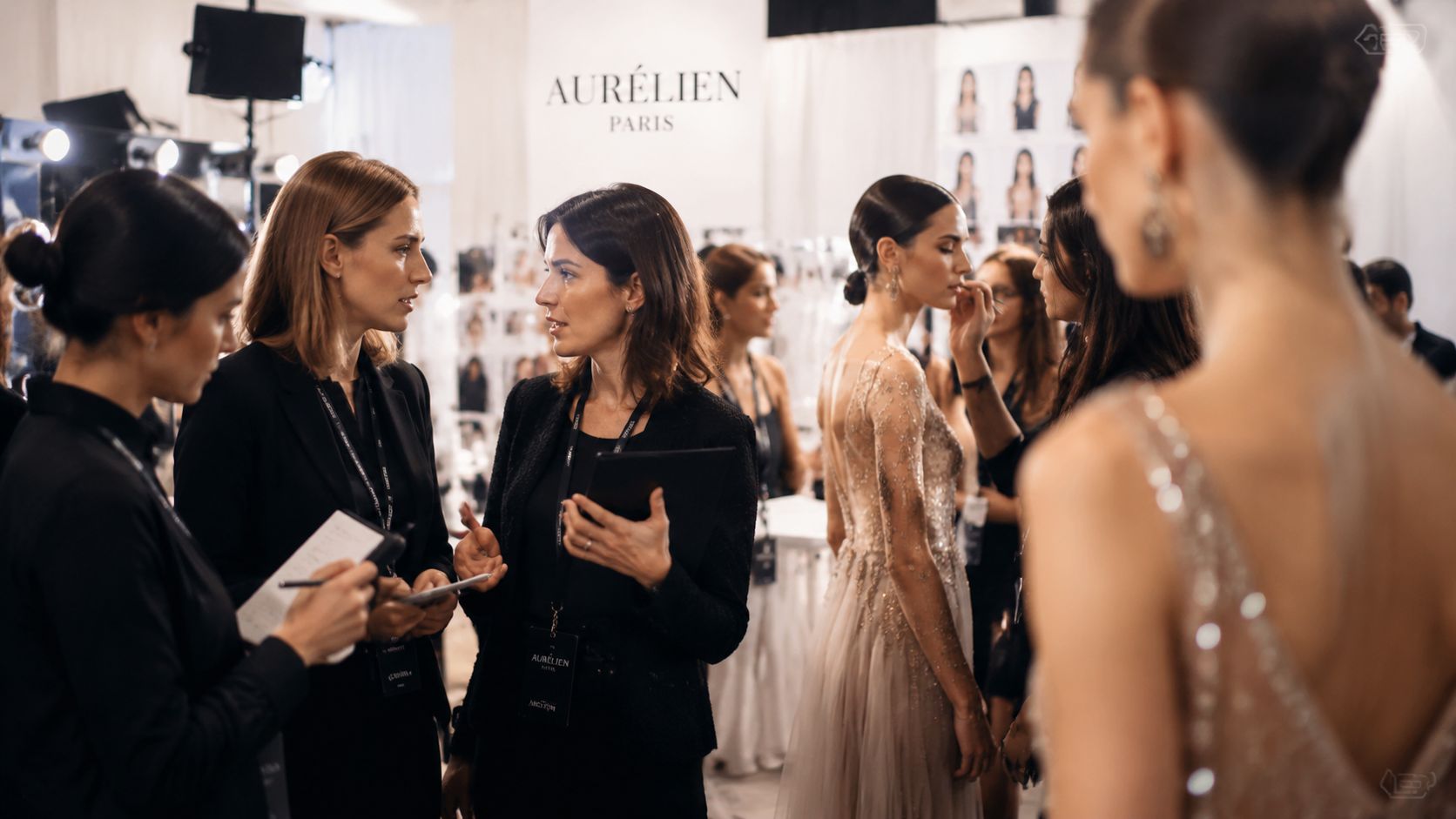
Reporting on current fashion content demand shows a stronger role for boutique-led communications, niche and underserved audiences, and culturally relevant stories over generic trend coverage in this fashion media insights report. That shift changes how you should choose tactics. Buzz is no longer just mass exposure. Often it's concentrated relevance.
Events that create usable stories
Runway shows, collection previews, dinners, pop-ups, and showroom appointments can all work. But the event itself is never the point. The point is what the event gives editors, creators, and guests to say afterward.
A weak event says, “We launched.” A strong event says something sharper:
- This brand belongs in a cultural conversation
- This collection solves a real wardrobe need
- This founder has a point of view people want to quote
- This community is specific, visible, and engaged
If the event won't generate photos, interviews, social proof, and a reason to follow up, scale it down and redirect budget into better assets.
Placements that fit the brand
Celebrity dressing and influencer partnerships still generate attention, but fit matters more than follower count. A single aligned placement can do more for brand identity than a broad gifting list with weak conversion into coverage or content.
Use this quick filter before sending anything out:
| Tactic | Works when | Fails when |
|---|---|---|
| Celebrity dressing | The talent genuinely matches the brand world | The placement feels random or purely transactional |
| Influencer seeding | The recipient already speaks to your buyer | The list is broad and unqualified |
| Paid creator partnership | You need message control and content reuse rights | The creator's audience doesn't trust sponsored fashion content |
If your team needs a sharper definition of media value, this explanation of earned media coverage examples and benefits helps separate true PR impact from paid exposure.
Niche beats generic more often now
One of the biggest mistakes I see is pitching “a new collection inspired by modern femininity” or “timeless luxury for everyone.” That language says nothing. Journalists can't do anything with it, and neither can customers.
What works better is specificity. Heritage construction. Senior style. Occasion dressing for a neglected consumer. A founder perspective tied to culture, identity, craftsmanship, or practicality. Not because niche is fashionable, but because clear stories travel further than vague ones.
If ten brands can use the same line in a pitch, it isn't a pitch. It's filler.
A useful industry perspective on visual storytelling and backstage presentation sits below.
The best tactic is the one your audience can repeat without your PR team standing beside them to explain it.
How to Write a Fashion Press Release That Gets Noticed
Most fashion press releases fail for one reason. They announce something without making it legible to the person receiving it.
Editors don't need a dramatic paragraph about vision, passion, or disruption. They need to know what happened, why it matters now, what visual assets support it, and whether there's enough substance to justify coverage.
Build it like a story tool
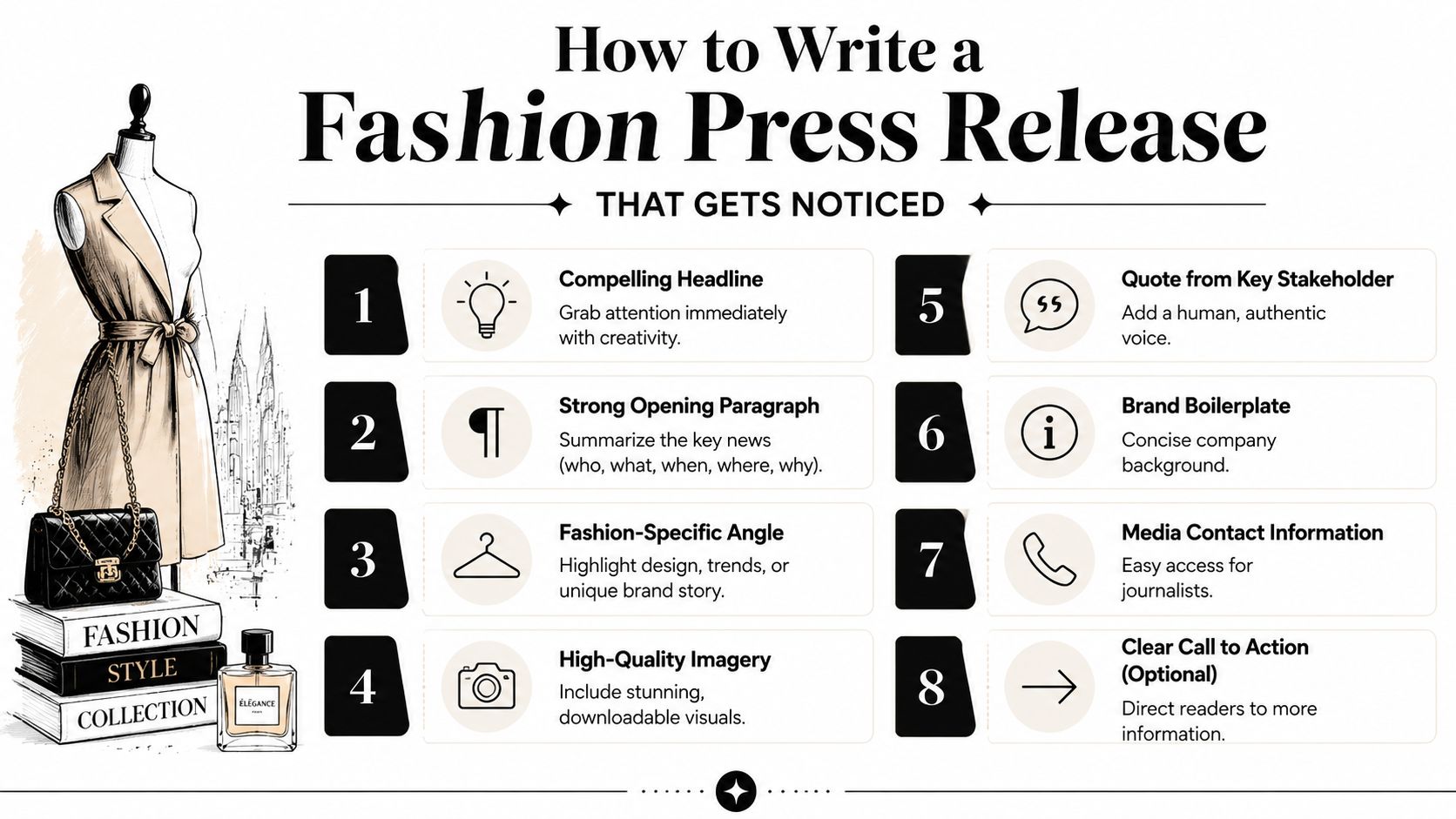
A fashion release should be easy to skim but rich enough to pitch from. The structure below works for launches, collaborations, store openings, campaign debuts, and designer announcements.
Headline
Keep it clear. The news belongs first. Collection launch, capsule collaboration, retail opening, or campaign debut.Opening paragraph
Cover who, what, when, where, and the specific angle. If the first paragraph reads like brand copy, rewrite it.Narrative paragraph
Explain the collection or announcement in terms an editor can use. Think silhouettes, materials, use case, audience, and cultural relevance.Quote
Add a quote from the founder, designer, or brand lead that adds meaning rather than praise. Avoid “We are thrilled.”Assets and details
Include image access, availability, pricing if relevant, showroom details, interview contact, and launch timing.Boilerplate
Keep the company description short and usable.
Match the evidence to the outlet
Many teams overlook a key opportunity: in fashion PR, data-driven story selection works best when insights are split into trend signals, behavioral evidence, and sentiment indicators, and different media verticals need different levels of proof according to this data-led fashion PR guidance.
That has direct writing implications:
- Trade outlets respond to trend signals. Think silhouette movement, color direction, category shifts.
- Consumer lifestyle outlets often need behavioral evidence, such as what customers are repeatedly browsing, returning to, or discussing.
- Broader culture coverage is stronger when supported by sentiment indicators across social, on-site, and service conversations.
Practical rule: Don't attach one isolated datapoint and call it insight. Editors trust patterns more than internal anecdotes.
For teams that want examples and a working structure, this guide on how to write a killer press release for a fashion brand with sample template and example is a good drafting reference.
Common release mistakes
A short cleanup list saves a lot of outreach pain:
- Overwritten intros that hide the actual news
- No visual direction for stylists or editors
- Unsafe claims that imply facts the brand can't verify
- Weak quotes that sound generated instead of spoken
- No outlet angle so the same release gets blasted everywhere
A release isn't the whole campaign. But in public relation in fashion, it often determines whether your story gets ignored, misunderstood, or picked up and shaped correctly.
Measuring the True Impact of Your Fashion PR
Fashion PR used to get protected by ambiguity. Teams could point to placements, mention reach, and move on. That isn't enough anymore, especially when leadership wants to know what the budget produced besides a nice clipping file.
The bigger PR industry already shows how established this function is. U.S. PR agencies generated $14.54 billion in revenue in 2021, up from $14.07 billion in 2020, with estimated industry expenses of $11.5 billion that year, and the U.S. remained the largest PR market at about $10.1 billion in 2022, according to these public relations industry statistics. In fashion, that same source notes PR is increasingly judged through share of voice, coverage quality, and consumer impact.
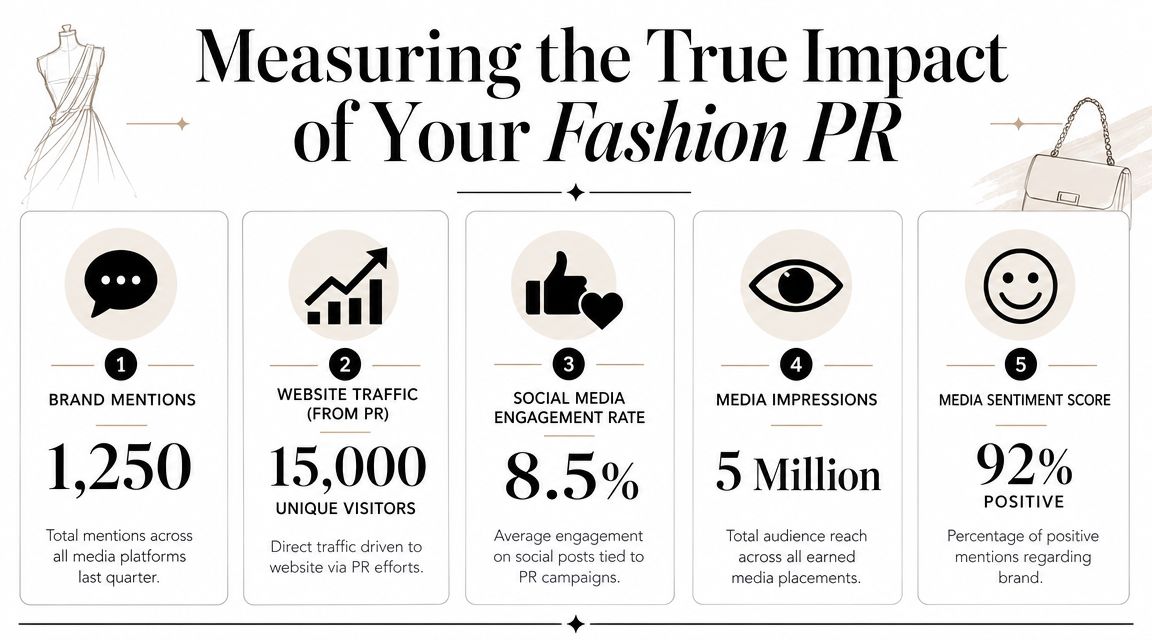
The infographic above is illustrative, not a benchmark. Your own dashboard matters more than generic totals.
What to track instead of vanity metrics
Don't let the team hide behind impressions alone. Measure what changes decisions.
Share of voice
Are you appearing in the right conversations more often than your direct competitors?Coverage quality
Was the placement a meaningful fashion outlet, a credible business publication, or a low-value repost?Message pull-through
Did the article use the narrative points you intended, or did the story drift?Consumer impact
Did branded search, product page visits, inquiries, or retailer interest rise after coverage?
Build a simple working dashboard
A useful dashboard doesn't need to be fancy. It needs to let a founder, CMO, or PR lead answer three questions quickly.
| Question | Metric to review | Why it matters |
|---|---|---|
| Are we visible? | Share of voice and quality placements | Shows market presence |
| Are we understood? | Sentiment and message pull-through | Shows narrative control |
| Are we moving business? | Referral traffic and downstream actions | Shows commercial relevance |
If your analytics team is trying to connect PR touchpoints to later conversion behavior, a primer on multi-touch attribution can help frame the discussion without reducing PR to last-click logic.
The best measurement model for public relation in fashion combines visibility, trust, and commercial movement. If one of those is missing, the story is incomplete.
Managing Crisis and Building Authentic Trust
Every fashion brand says it values authenticity. That word means nothing the day a journalist asks for evidence.
A critical test comes when a brand faces questions about sustainability, sourcing, labor, inclusion, plagiarism, or cultural insensitivity. In those moments, public relation in fashion stops being promotional and becomes operational. PR can only communicate what the company can support.
Fashion faces increasing scrutiny around environmental and social claims, and PR teams are expected to communicate improvements quickly and transparently during crises, while audiences respond better to authenticity and evidence-based narratives than generic trend talk, as noted in this fashion industry crisis and trust analysis.
What to prepare before anything goes wrong
The strongest crisis response starts months before the crisis. If a team is scrambling to verify facts after an allegation lands, it's already behind.
Keep a ready file that includes:
- Audits and certifications that confirm the brand's right to reference
- Targets and timelines for environmental or social initiatives
- Traceability records that show where products or materials come from
- Supplier standards and internal compliance language
- Inclusion metrics or hiring commitments that can be stated accurately
This isn't only for defense. It improves everyday pitching, because journalists trust brands that can answer follow-up questions cleanly.
How to phrase claims safely
A lot of reputational damage starts with sloppy wording. Teams write “sustainable,” “ethical,” or “inclusive” as broad identity claims when they should be describing specific actions.
Safer wording usually does three things:
| Weak claim | Stronger approach |
|---|---|
| “We are sustainable” | Describe the exact material, process, or target |
| “We support diversity” | State the initiative, scope, or measurable practice |
| “We are transparent” | Show what documentation or reporting is available |
That discipline matters even in positive announcements. If a release, interview, or caption overstates what the company can prove, the correction later will cost more than the original buzz was worth.
When journalists ask for proof, treat that as a normal part of the job, not a threat. Brands that answer clearly build trust faster than brands that get defensive.
Speed matters, but proof matters more
In a crisis, teams often confuse quick response with useful response. Fast statements full of vague reassurance rarely help. A shorter response with confirmed facts, a clear next step, and honest limits is far more credible.
Say what you know. Say what you're reviewing. Say when you'll update. Then update.
That approach won't erase every problem. But it gives the brand something far more durable than spin. It gives the public a reason to believe the company is taking responsibility seriously.
Your Strategic Blueprint for Fashion PR Success
The brands that get real value from PR don't treat it like a launch accessory. They treat it like a system.
Start with the narrative. If the team can't explain in plain language why the brand matters, no tactic will save it. Then choose channels based on how the audience discovers and validates fashion brands. After that, select tactics that fit the story instead of copying whatever another label did last season.
Execution matters, but discipline matters more. Write releases that help editors do their jobs. Build assets that make your point visible. Measure impact through quality, share of voice, sentiment, and business movement instead of flattering totals. And keep proof ready, because trust in fashion is harder to win than attention.
A practical working loop looks like this:
- Define the brand narrative with specificity
- Choose the right channels for authority, control, and community
- Use tactics selectively based on audience fit
- Write stronger press materials with real story value
- Measure outcomes that leadership can understand
- Prepare for scrutiny before it arrives
That's how public relation in fashion becomes more than noise generation. It becomes the management of relevance, reputation, and demand over time.
If you're mentoring a younger team member, this is the point to drill into them: the job isn't to get coverage at any cost. The job is to help the right people understand, trust, and talk about the brand for the right reasons.
If you need help turning strategy into assets your team can use, Press Release Zen is a practical resource for planning, writing, and distributing press releases. It's especially useful when you need templates, examples, and step-by-step guidance that reduce guesswork and make outreach easier to execute.