A marketing lead approves a funding announcement on Tuesday morning. By Wednesday afternoon, legal has marked up the draft, the CEO wants a stronger quote, sales wants links that support pipeline, and someone asks the question that usually arrives too late. Should this go out through an agency or can the team handle it internally?
An agency press release helps solve that operational problem. The release is only the visible output. The underlying work precedes it. Agencies shape the angle, pressure-test whether the news is strong enough to distribute, manage approvals, choose the right distribution path, and set expectations for what success should look like after publication.
That distinction matters because a release in 2026 is not just a writing job. It is a workflow, a budget decision, and a measurement problem. A good agency treats it that way. The team is not only asking, “Is this clean copy?” They are asking, “Will this survive executive review, fit the chosen wire or media list, support search visibility, and produce results the client can defend in a reporting meeting?”
Distribution platforms also shape how agencies work. PR Newswire presents itself as a service for distribution, targeting, monitoring, and marketing support. Another established distributor, 24-7PressRelease, reflects the same market reality. Press releases now move through structured systems, not just inboxes. That changes how agencies write, package, approve, and report on them.
Clients usually start with practical questions. What does an agency do that an in-house team may not have time, process, or media access to do well? How does the workflow run once the release is commissioned? What should the company measure after distribution, beyond whether the release appeared on a wire?
Table of Contents
- What Makes an Agency Press Release Different
- Agency vs In-House Key Decision Factors
- The Agency Press Release Workflow Demystified
- Understanding Agency Pricing Models
- Measuring Success and Calculating ROI
- Frequently Asked Questions About Agency Press Releases
What Makes an Agency Press Release Different
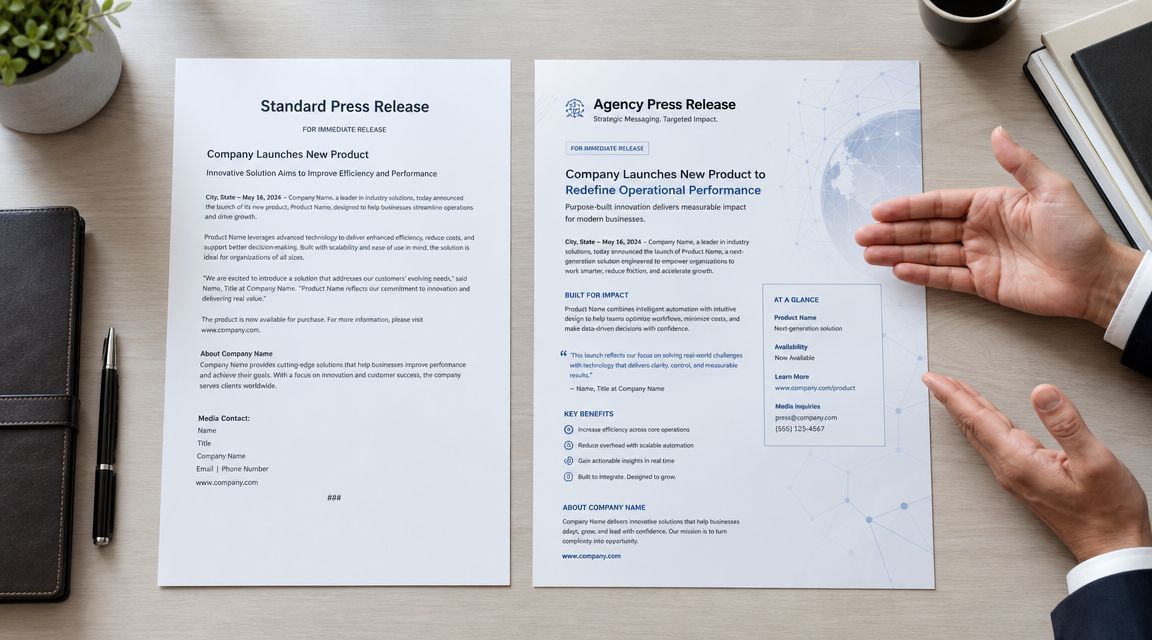
The difference starts before the first sentence is written. A DIY release is often drafted like a company announcement. An agency press release is built like a media asset that also needs to work for search systems, syndication partners, investors, and internal stakeholders.
It's built for extraction, not just reading
The strongest technical distinction is structural. PRLab's guidance recommends a headline of about 10 to 12 words and a first paragraph built around the 5Ws plus immediate market relevance. That means the lead doesn't wander. It tells an editor or analyst what happened, who announced it, why it matters now, and why the topic belongs in the current market conversation.
A weak in-house draft often opens with throat-clearing language. It praises the company before it states the news. That slows down everyone who touches it, including journalists scanning inboxes and systems extracting entities.
Practical rule: If the first paragraph can't stand alone as a summary of the announcement, the release isn't ready.
Agency writers also think carefully about nouns. Full company names, product names, executive names, locations, and category terms appear clearly and early. That helps with media usability, but it also makes the release more machine-readable.
It's also a distribution-ready asset
A second difference is packaging. Content Grip notes that modern best practice often keeps the core release compact, around 300 to 500 words, while moving dense material into linked press kits and strengthening the release with visuals, data, and named quotes. That compact structure isn't cosmetic. It supports newsroom workflows and AI-driven extraction.
An agency usually pressure-tests every supporting element before distribution:
- Headline discipline keeps the release specific enough for news judgment and clear enough for search visibility.
- Named quotes add accountability. Anonymous enthusiasm doesn't help credibility.
- Proof points matter more than adjectives. Product claims need supporting context, validation, or accessible evidence.
- Boilerplate control prevents mixed messaging across campaigns and business units.
What doesn't work is easy to spot. Overlong introductions, inflated language, jargon-heavy product claims, and executive quotes that say nothing specific all reduce pickup potential.
A strong agency release reads like an official public record with editorial discipline. That's the standard clients should expect.
Agency vs In-House Key Decision Factors
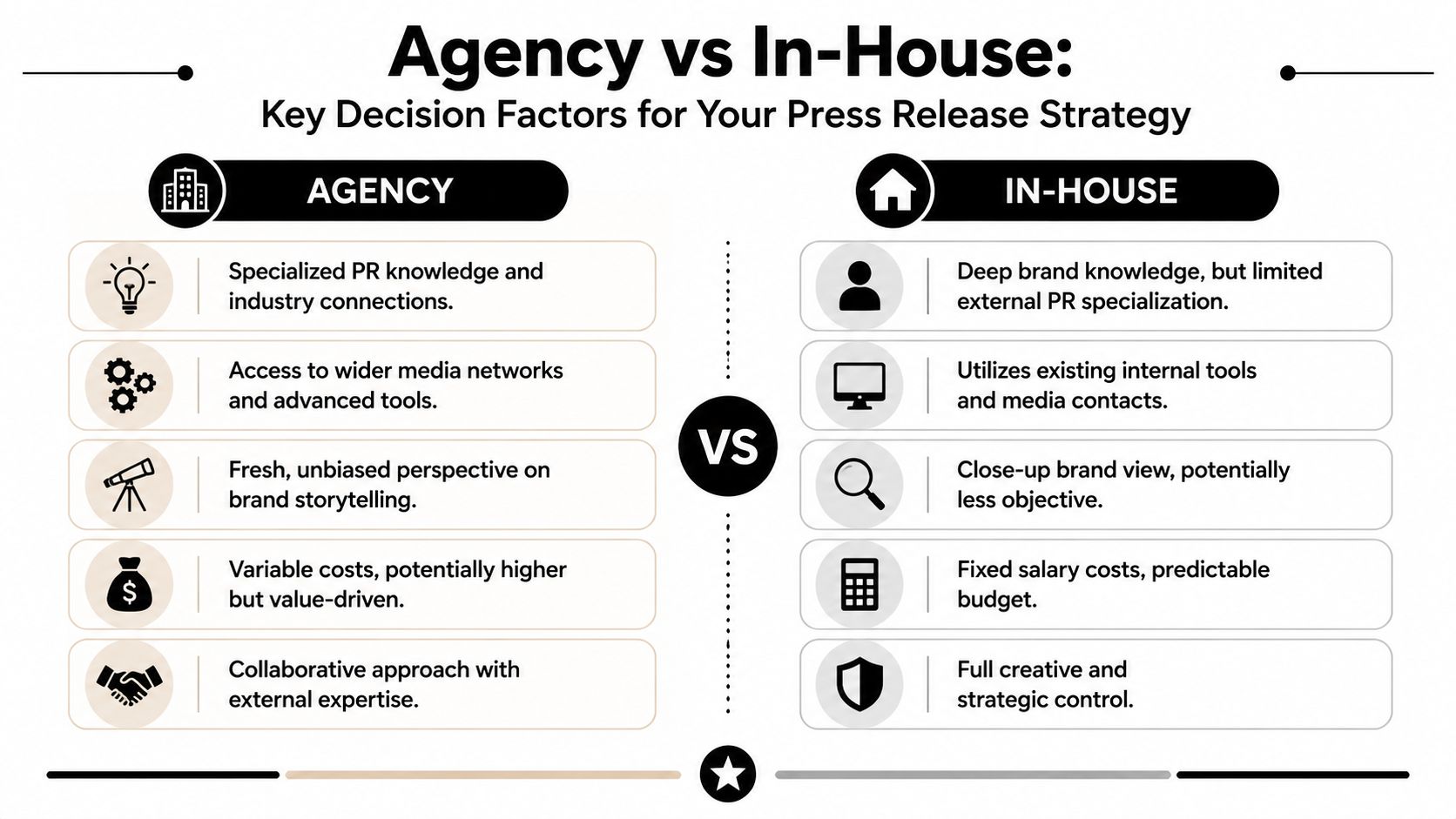
The agency versus in-house decision usually isn't philosophical. It's operational. The main question is whether the company needs a release written and distributed as a routine communications task, or whether the announcement carries enough risk, complexity, or opportunity that specialist support changes the outcome.
When in-house works well
An internal team can handle press releases effectively when the company already has strong messaging discipline, a reliable approval path, and people who understand media conventions. Routine announcements often fit this model. Location openings, event participation, community initiatives, or standard partner updates don't always require outside help.
In-house execution also makes sense when control is the top priority. Legal review may be sensitive. Product details may still be shifting. Leadership may want to keep drafting close to the business.
Still, internal teams often hit the same limits:
- Message proximity makes weak news judgment harder to spot.
- List limitations reduce the quality of outreach.
- Competing priorities slow approvals and distribution.
- Narrow optimization can leave investor, legal, regulatory, and AI-readability needs underdeveloped.
When an agency earns its keep
The equation changes when the release has several audiences at once. Everything PR argues that the press release increasingly serves as a multi-audience “single source of truth” for journalists, investors, regulators, attorneys, consumers, and AI systems. Specialized agencies are often better equipped for that kind of drafting and review than a generalist internal team.
That matters for funding announcements, acquisitions, executive transitions, public policy responses, regulated industry launches, and any release that may be cited later by partners or stakeholders.
A useful comparison comes from adjacent marketing functions. Teams weighing outsourced production against internal execution often use a make-versus-buy framework, like this analysis of make vs buy webinar production. The same logic applies here. The cheapest path on paper isn't always the lowest-cost path once delays, revisions, missed pickup, and internal time are counted.
For teams that are still deciding who should own authorship, guidance on who should write your press release helps clarify whether the draft should begin with internal subject matter experts, a PR consultant, or a hybrid process.
A simple decision table
| Decision factor | In-house is usually enough | Agency is usually better |
|---|---|---|
| News complexity | Straightforward updates | High-stakes or technical news |
| Audience mix | Primarily customers or local media | Media, investors, regulators, partners |
| Approval burden | Simple and fast | Multi-layered and high risk |
| Distribution needs | Limited and targeted | Broad syndication and active outreach |
| Internal bandwidth | Dedicated communications capacity | Team is stretched or lacks PR depth |
The inflection point is simple. If the release has to perform across multiple audiences and survive scrutiny after publication, agency support usually pays for itself.
The Agency Press Release Workflow Demystified
A common client scenario goes like this. The launch date is fixed, legal still has comments, the product lead wants technical detail in the headline, and the CEO wants the quote to sound bigger than the evidence allows. Agency workflow exists to keep that situation from turning into a weak release or a missed window.
Discovery and strategy
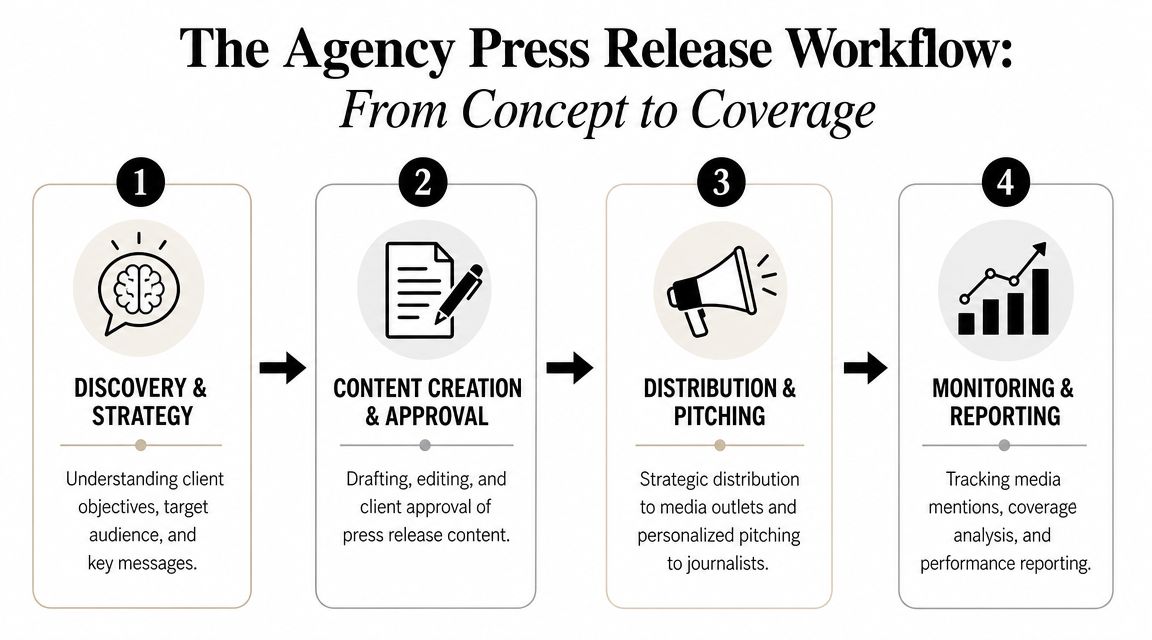
The work starts with a real brief, not a request to "write something up." An agency needs the business context behind the announcement, the audience that matters most, the claims that can be defended, the approval chain, and the date the release has to go live.
That early step shapes the entire assignment. A funding announcement, a product launch, a partnership, and a regulatory milestone may all use the same format, but they do not require the same framing, proof, or distribution plan. In 2026, that distinction matters more because releases are judged across several channels at once. Journalists assess news value, buyers scan for credibility, search systems evaluate structure and topical relevance, and internal stakeholders want language they can reuse elsewhere.
Good agencies pressure-test the story before drafting. If the news is thin, they say so. Sometimes the right call is to tighten the angle. Sometimes it is to pair the release with customer proof, data, or an executive interview. Sometimes the best decision is to wait a week and announce something stronger.
Drafting and approval
Drafting is usually the shortest part of the process. Alignment is the longer part.
The agency's job is to turn raw inputs into a release that can survive scrutiny outside the company. That means trimming claims the client cannot support, removing language that sounds impressive only to insiders, and deciding what belongs in the release versus a fact sheet, blog post, or media note.
A typical approval path looks like this:
- Working draft review by the day-to-day marketing or communications owner.
- Fact and risk review by product, legal, compliance, investor relations, or executive stakeholders.
- Quote approval from each named spokesperson.
- Final release approval on the exact version, headline, boilerplate, and links to be distributed.
The trade-off is straightforward. More reviewers can improve factual accuracy, but too many editors usually weaken the message. The agencies that run this well do not just collect comments. They set deadlines, assign one decision-maker, and force conflicting edits into a single call when needed. That discipline saves days.
A press release gets better when experts verify facts. It gets worse when every stakeholder rewrites it in their own style.
Distribution and monitoring
Once the release is approved, the workflow shifts from editorial control to execution. Distribution can include wire submission, direct media outreach, publication in the company newsroom, and reuse across sales, social, partner, and executive channels. The right mix depends on who needs to see the news and what action the business wants after publication.
This is one of the biggest operational differences clients notice when working with an agency. Distribution is not just "send the release." It involves formatting for syndication, checking links, confirming geography or industry targeting, scheduling around embargoes or market hours, and making sure tracking is in place before the release goes live.
Monitoring starts almost immediately. Agencies watch for pickup quality, referral traffic, branded search lift, journalist responses, message accuracy in coverage, and whether the announcement reaches the audience it was meant to reach. If results come in weak, the release may need a second layer of pitching, an executive byline, a customer-facing FAQ, or a sharper follow-up angle.
The workflow looks simple from the outside because experienced teams make it look controlled. In practice, strong agency work is a chain of small decisions made in the right order, with enough process to protect timing, accuracy, and results.
Understanding Agency Pricing Models
Pricing frustrates many buyers because “press release services” can refer to very different scopes. One proposal may cover drafting only. Another may include strategy, revisions, wire distribution, list building, and pitching. Without a clear billing model, comparisons become misleading fast.
Retainer model
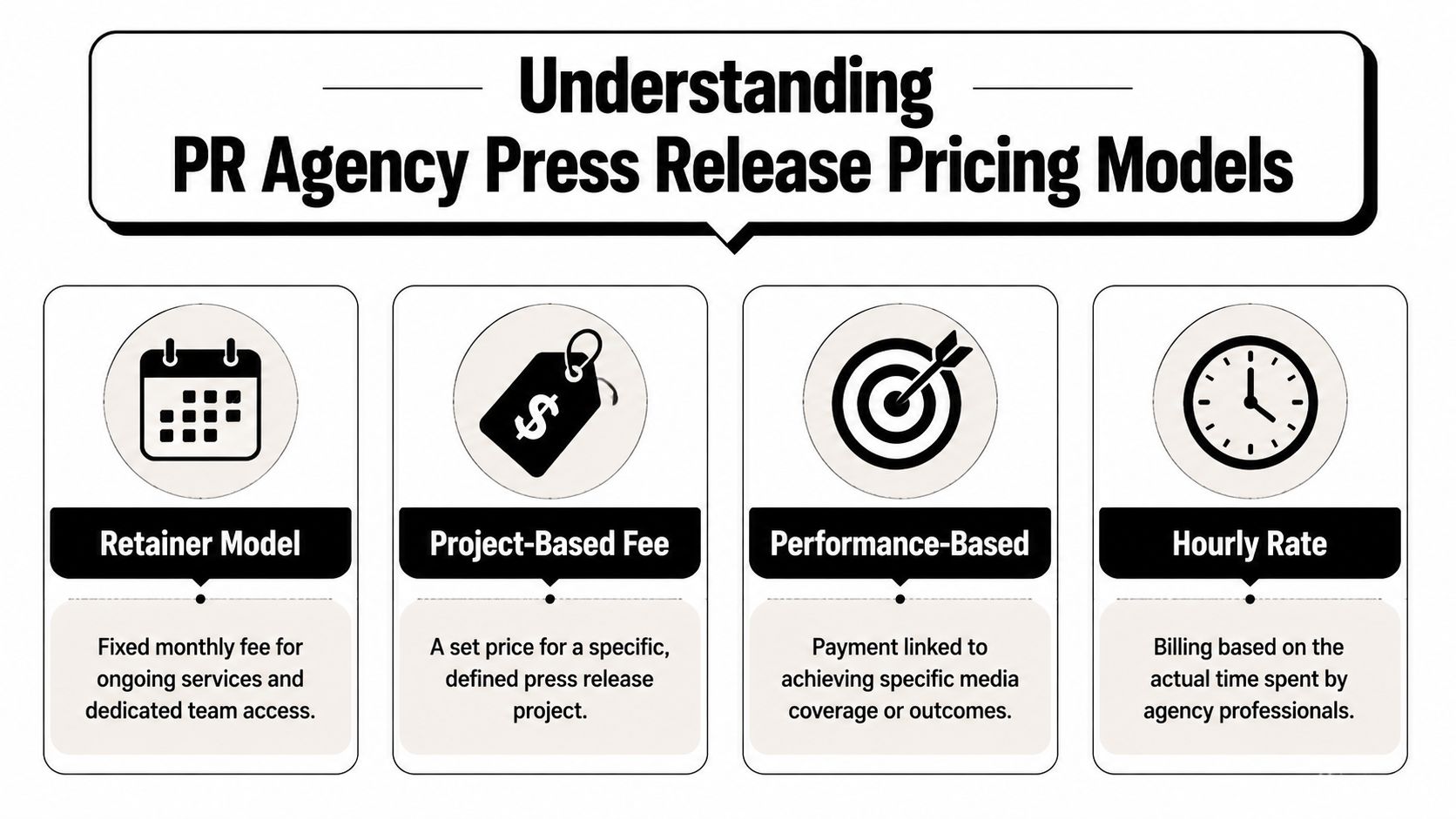
A retainer is ongoing monthly support. This structure works best when press releases are only one part of a broader PR program. The client gets recurring access to agency time, planning support, and continuity across announcements.
Retainers tend to fit companies with active launch calendars, executive visibility goals, or regular fundraising, hiring, and partnership activity. The benefit isn't just volume. The agency learns the business well enough to move faster and catch inconsistencies earlier.
Project-based fee
A project fee is usually the clearest option for a defined announcement. One launch, one transaction, one event, one release package. It's often the easiest model for startup teams and small businesses because the scope can be tightly defined before work begins.
Clients should still clarify what the project includes:
- Drafting only or drafting plus revisions
- Distribution support or separate wire costs
- Media outreach or distribution-only service
- Reporting or simple confirmation of publication
For buyers trying to compare service pricing across support roles, it helps to look at adjacent outsourcing decisions too. A practical example is this breakdown of virtual assistant pricing and ROI, which shows why scope definition matters more than headline price.
Pay-per-release and hybrid billing
Some firms offer a per-release package. That can work for companies with occasional announcements and no need for a broad PR relationship. The risk is that low-cost packages often stop at basic drafting and wire submission, with limited strategic input.
Hybrid pricing also appears often in PR. A client may pay a small monthly base for planning, then pay separately for major releases, wire distribution, or outreach campaigns. This can be sensible when announcement volume is uneven.
For buyers who want a grounded framework for quote review, cost guidance on a typical press release in 2024 is useful because it breaks down what different service tiers usually include.
The right model depends less on budget size than on cadence, complexity, and how much support the internal team needs.
Measuring Success and Calculating ROI
A client approves a release, sees it distributed, and expects the report to prove whether the spend was justified. That is the ultimate test. Distribution confirms the work was executed. ROI shows whether the announcement produced something the business can use.
Start with the goal the release was meant to serve. A product launch, funding announcement, executive hire, crisis response, and partnership deal should not be judged by the same scoreboard. Agencies get into trouble when they report every release the same way, because pickup volume alone rarely tells a CFO, founder, or marketing lead what changed.
The first layer is execution quality. Did the release publish correctly across the intended channels? Did the links work, the quotes render properly, and the assets appear where they were supposed to appear? Those details sound minor until a broken URL or missing logo turns a paid distribution into wasted reach.
The second layer is performance. A 2025 press release benchmark guide reports that the average press release can deliver an ROI of 100% to 175% over a 90-day period, website traffic typically rises 10% to 20% after a release, and qualified sales leads average 5 to 10 per release. Use numbers like these as reference points, not promises. They help set expectations, but the right comparison is usually your own baseline, your own announcement type, and your own sales cycle.
I tell clients to ask one question after every release: what changed that mattered?
A solid agency report usually tracks several signals together:
- Coverage quality. Whether the release appeared in outlets that reach the right buyers, investors, partners, or local stakeholders.
- Referral traffic. Whether readers clicked through from coverage, syndication pages, or the company newsroom.
- Search impact. Whether branded search, key announcement terms, or related landing pages saw measurable lift.
- Lead activity. Whether the release contributed to demo requests, contact form submissions, trial starts, or sales conversations.
- Asset reuse. Whether the release created usable copy for sales outreach, investor materials, email campaigns, or executive communications.
These metrics matter in different ways depending on the brief. If the release supports demand generation, lead quality and conversion rate matter more than raw pickup. If the release supports reputation or investor communication, accuracy, message control, and citation in credible outlets may matter more than clicks.
PR also performs better when it is measured alongside adjacent channels, not in isolation. Teams already focused on optimizing social media results often see stronger returns when the release, social posts, newsroom update, and follow-up content are published on the same timetable.
For teams setting up reporting from scratch, this guide to press release KPIs and performance measurement is a useful checklist for deciding what to track after publication.
The trade-off is simple. The more tightly you want PR tied to revenue, the more disciplined your tracking needs to be. That usually means campaign links, dedicated landing pages, CRM attribution, and agreement upfront on what counts as a win. Without that setup, agencies can still report activity. They just cannot defend business impact with the same confidence.
Frequently Asked Questions About Agency Press Releases
How long does an agency press release take
Most releases take longer than clients expect because writing is only one part of the job. Discovery, fact validation, executive quote approval, legal review, and distribution setup all take time. A small announcement with a clean approval path can move quickly. A regulated or high-stakes announcement usually moves slower because more people need to sign off on exact wording.
Can an agency guarantee media coverage
A reputable agency won't guarantee placement in a specific publication. Editors make editorial decisions, not agencies. What a good agency can promise is process quality: stronger positioning, cleaner drafting, targeted distribution, and disciplined follow-up.
If a proposal guarantees top-tier coverage with no caveats, that's usually a warning sign.
What should be ready before kickoff
The smoothest projects start with a basic asset pack. That usually includes:
- Confirmed facts such as names, titles, dates, locations, and approved claims
- A clear objective so the agency knows whether the release is for reach, credibility, search, leads, or record-keeping
- Approved spokespeople who can be quoted without last-minute uncertainty
- Supporting assets like product screenshots, executive bios, logos, FAQs, or a press kit
- A review owner inside the company who can consolidate feedback and keep approvals moving
An agency press release works best when the client treats it as a business-critical publication, not as a quick writing task delegated at the last minute.
Press Release Zen is a practical resource for teams that need help planning, writing, and distributing releases with less guesswork. Its guides, templates, and comparison content can help businesses decide what to handle internally, what to outsource, and how to prepare a release that stands up to media, stakeholder, and search scrutiny.