You're probably in one of three situations right now. A launch is coming and your team knows the product is strong, but the story still feels flat. Reporters aren't responding, your executives sound too technical, or your last agency produced a stack of clips that looked good internally and did very little for pipeline, hiring, or investor confidence. That's the uncomfortable middle ground where most PR searches begin.
Choosing among technology pr companies gets messy fast because almost every firm promises strategic storytelling, media relationships, and category leadership. Very few explain how they'll connect that work to business goals, which matters even more in a segment tied to a fast-expanding PR market and a technology sector that continues to rank among the strongest growth areas for agencies worldwide, according to this 2024 and 2025 PR industry summary. At the same time, MarTech budgets keep growing, which raises the bar for agencies that need to understand measurement, analytics, and digital discovery instead of treating coverage as the finish line, as outlined in this MarTech market outlook.
This guide gets to the shortlist quickly, then gives you a practical way to vet them. If your internal team is also building founder visibility, this companion guide to LinkedIn posting strategy is worth keeping open in another tab because agency PR works better when executive content and earned media reinforce each other.
1. Bospar
Bospar is one of the easiest firms to shortlist if you want a tech specialist rather than a generalist agency with a technology page buried in its navigation. Its positioning is clear. It works with technology companies, it leans hard into media relations, and it tends to fit teams that move quickly and expect their agency to act like an extension of in-house comms.
That model works well for AI, cloud, cybersecurity, fintech, dev tools, and other categories where the spokesperson has to explain something complex without turning every interview into a product demo. Bospar also brings capabilities beyond media outreach, including crisis and reputation management, analyst relations, investor and funding communications, content, and social support.
Where Bospar fits best
Bospar is strongest when the company already has some raw material to work with. That might be a launch, fresh funding, a contrarian market point of view, internal data, or executives who can comment quickly on industry developments. Agencies like this create momentum when the client can keep feeding the machine.
A practical plus is its use of proprietary surveys and original research for storytelling. That matters because in crowded categories, opinion alone rarely breaks through. Data-led hooks give reporters and analysts a reason to pay attention.
Practical rule: If your team takes two weeks to approve a quote, don't hire a fast-moving shop and expect magic.
A few trade-offs are worth stating plainly:
- Best for responsive teams: Bospar tends to reward clients who can make spokespeople available and approve materials quickly.
- Less ideal for heavy on-site expectations: Its distributed model won't appeal to every team that wants regular in-person workshops.
- Good for earned media plus executive positioning: It's not just a press release engine.
If Bospar makes your shortlist, ask them to walk you through how they'd handle your next announcement from narrative through outreach. Compare that process against your own launch needs, and review a strong tech product press release format before the pitch meeting so you can test how strategic their recommendations really are.
2. Highwire

Some firms feel like PR agencies that added digital services later. Highwire feels built for the opposite direction. It approaches communications as part of a broader growth system, which makes it a strong candidate for enterprise and growth-stage technology brands that want communications, creative, and analytics working together.
That's useful in B2B tech and cybersecurity, where a media hit rarely stands alone. The same message often needs to show up in analyst briefings, executive content, campaign assets, customer narratives, and sales enablement. Highwire's integrated model is built for that kind of coordination.
When the integrated model helps
If your leadership team keeps asking how PR affects revenue, Highwire is closer to the right shape than an agency that only reports clips and impressions. The strongest technology pr companies now need to tie work to planning and measurement, not just visibility. That shift mirrors the broader industry conversation around filtering opportunities by business relevance rather than chasing vanity coverage, a point emphasized in this tech PR agency perspective from Channel V Media.
The benefit is strategic consistency. The risk is overbuying.
- Strong fit for enterprise narratives: Highwire suits companies with multiple stakeholders, long sales cycles, and reputation goals that span more than media.
- May be more than you need: If all you want is founder profiling and launch outreach, a full-funnel agency can feel heavy.
- Premium posture: Expect a process-driven engagement, not a lightweight test.
Coverage only matters if the right buyer, analyst, partner, or investor sees it and acts on it.
Highwire is also a smart option if your media list has to include vertical trade press, security press, and top-tier business outlets at the same time. Before you hire any agency for AI or infrastructure storytelling, pressure-test whether they know the ecosystem by reviewing your target publications against a list of AI publications and journalists. Then ask Highwire which stories belong in earned media and which should stay in owned channels.
3. Hotwire
If your launch spans more than one market, Hotwire deserves attention. It's a global technology-focused communications and marketing consultancy with enough breadth to support PR, brand strategy, research, digital, ABM, ESG, and measurement across regions.
That global coordination is the main reason to consider it. A US-only startup with one announcement may not need the machinery. A scale-up managing different buyer narratives across North America, EMEA, and APAC often does.
Why scale changes the agency decision
Multiregion programs fail when each local team tells a different story. Hotwire's structure can help avoid that by keeping a central narrative while adapting for local media and market context. Its data and analytics capabilities also matter because distributed campaigns get hard to compare if every region reports success differently.
The downside is process. Early-stage teams often underestimate how much coordination global PR requires, then get frustrated by approvals, reviews, and localization rounds.
- Best for coordinated launches: Product rollouts, category education, and reputation work across multiple regions.
- Useful for modern comms teams: Especially if you want AI consulting and stronger analytics inside the program.
- Potential mismatch for very early-stage startups: More structure isn't always better when the company is still finding its message.
A practical test is to ask Hotwire how they'd manage one global announcement with regional variations. Listen for specifics around lead market ownership, spokesperson mapping, and measurement. If the answer sounds generic, the global footprint won't save the program.
For teams planning broad distribution alongside targeted outreach, it also helps to understand the strengths and limits of different press release distribution services. Distribution can support a coordinated launch, but it doesn't replace market-specific pitching or narrative adaptation.
4. PAN Communications
PAN Communications is a good example of where technology PR is heading. Not just toward awareness, but toward measurable commercial impact. PAN has deep roots in B2B tech and positions its work around a Brand-to-Demand approach, which is exactly the direction many marketing leaders now want from agency partners.
That matters because technology PR has become one of the more strategically important corners of the broader PR market. Buyers are harder to reach, categories are more crowded, and leadership teams want proof that communications supports revenue, not just reputation.
The practical advantage of PAN
PAN makes the most sense for companies that want PR integrated with content, creative, websites, demand generation, and AI optimization. If your business runs on long sales cycles and committee buying, this can be powerful. The earned story informs the campaign message, the campaign drives traffic, and the website captures demand.
That said, there's a clear trade-off. If you only need media relations around a launch, PAN may be broader than necessary.
Consider PAN if your priorities look like this:
- You sell to B2B buyers: Especially in AI, cloud, DevOps, cybersecurity, HR tech, or supply chain.
- You need narrative tied to pipeline: Not just top-of-funnel visibility.
- You want one partner across multiple functions: PR, content, creative, and demand generation under one scope.
The caution is simple. Integrated agencies can produce strong work, but they also require clean internal ownership. If your PR lead, demand gen lead, and product marketing lead don't agree on goals, even a capable firm will spend too much time mediating.
PAN often stands out from more traditional technology PR companies. It's not selling publicity in isolation. It's selling alignment between story and demand, which is often what growth-stage B2B teams need.
5. Method Communications

Method Communications is built for companies that don't just need coverage. They need market interpretation. That's an important distinction. In AI, cybersecurity, frontier tech, and fintech, the challenge often isn't getting a mention. It's shaping how buyers, investors, and industry influencers understand what category you belong in.
Method leans into narrative development, thought leadership, analyst relations, crisis support, paid digital, creative, and research. It also has a Startup Studio, which makes it more relevant than many agencies for companies still refining how they tell the story at all.
A better fit for category creation
Method's AEO practice is especially notable because discoverability is changing. Tech PR now overlaps with SEO, GEO, and answer-engine visibility more directly than many legacy agencies admit. That aligns with the broader shift described in this tech PR guide from PRLab, which argues that discoverability now includes trusted media, niche creators, developer circles, SEO, and GEO, not just traditional outlets.
That's a good sign if your buyers don't move from article to demo in one step. Many now encounter your company through AI summaries, branded search, community chatter, executive content, and secondary citations.
Smaller, relevant placements often outperform broad coverage bursts that reach the wrong audience.
Method tends to work best when the company has ambition beyond incremental PR. Think category creation, major launches, or a need to define a point of view in a noisy market.
A few real-world trade-offs:
- Strong for strategic repositioning: Especially when the company needs to sharpen narrative, not just pitch product news.
- Useful for integrated campaigns: Paid and earned can reinforce each other.
- Probably too much for low-news-cadence startups: If there's little to say and no appetite for thought leadership, the engagement will struggle.
If you're evaluating Method, ask to see how it translates complex product claims into simple language for different audiences. That skill matters more than a flashy media list.
6. Mission North
Mission North is one of the more interesting picks on this list because it blends classic tech PR with stronger public-affairs and policy sensitivity than many competitors. That becomes important fast in AI, fintech, cybersecurity, climate tech, health tech, and any company likely to face regulatory scrutiny or stakeholder pressure beyond customers.
A pure media-relations shop can generate attention. It may not be prepared to help when the story intersects with lawmakers, agencies, advocacy groups, or public trust concerns. Mission North is better built for those moments.
When policy context matters
Its offering spans PR, a content studio, digital marketing, speakers bureau, and data storytelling. That mix can help companies that need to educate the market while also preparing executives for harder conversations about risk, governance, and societal impact.
I'd look closely at Mission North if your leadership team is doing any of the following:
- Entering a regulated category: AI governance, fintech compliance, security, or health-related markets.
- Building executive voice: Especially for speaking programs and issue-oriented thought leadership.
- Needing research-led storytelling: When original data can support market education and credibility.
The trade-off is executive time. Advisory-heavy firms often need more access, more reviews, and more strategic involvement from leadership. That's usually worth it for sensitive narratives, but it can frustrate teams that want a hands-off vendor.
The best agency for a regulated or controversial category usually asks harder questions earlier.
Mission North also benefits companies that need more than launch PR. If your comms plan includes content, speaking, stakeholder engagement, and policy awareness, the integrated structure is a plus rather than a burden. If not, it may be more agency than your immediate brief requires.
7. Sparkpr
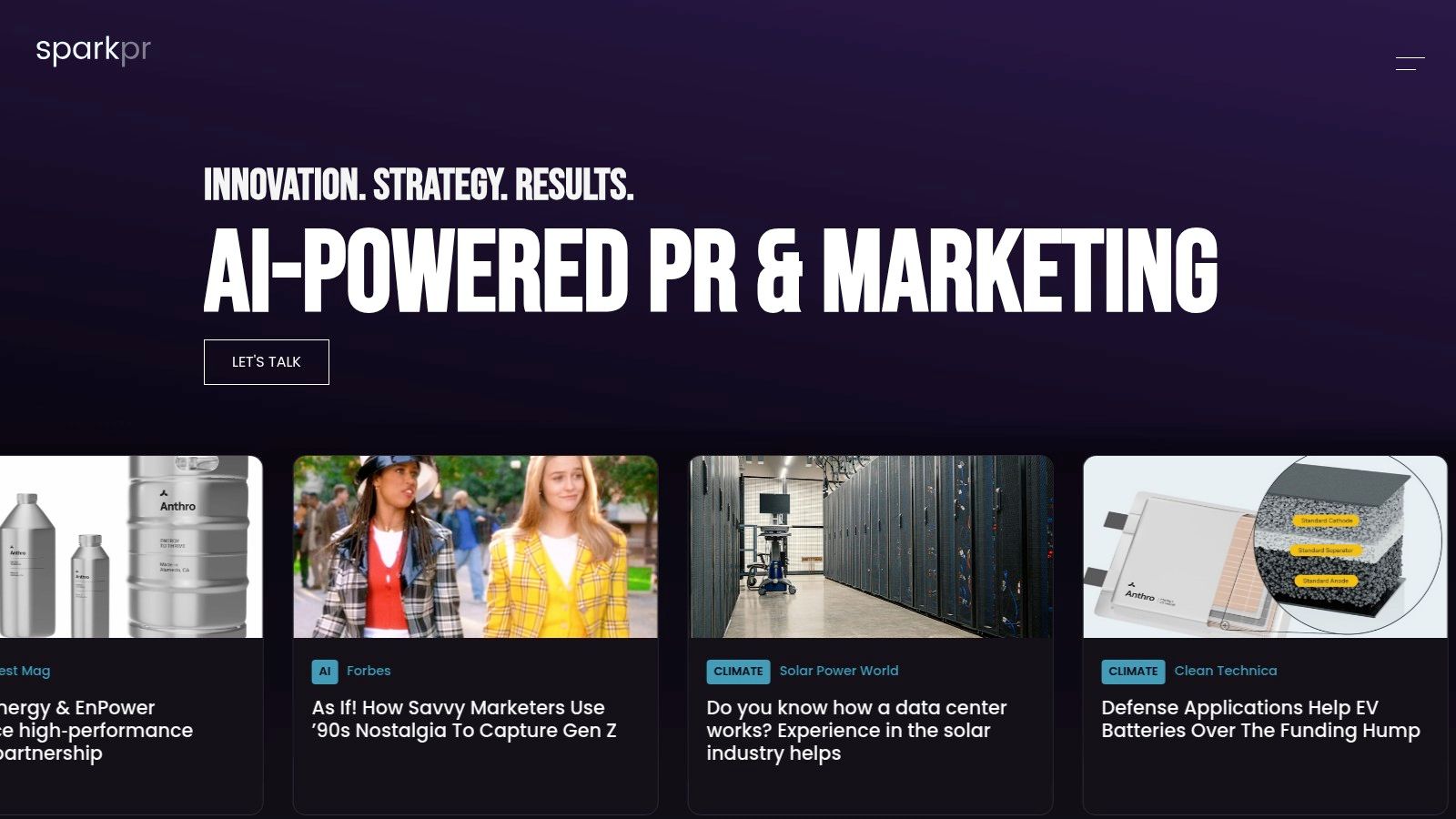
Sparkpr has been around long enough to have worked through several technology cycles, and that matters. Agencies that survive shifts from consumer apps to SaaS, then into AI and blockchain, usually learn what's durable and what's hype. Sparkpr's value is that accumulated pattern recognition, especially for venture-backed companies trying to move fast.
It supports media relations, content, thought leadership, and integrated marketing across AI, enterprise SaaS, consumer tech, fintech, and blockchain or Web3. It also has strong venture and portfolio-company fluency, which makes it especially relevant if your investors expect a sharper external narrative after funding or ahead of a major milestone.
Why Sparkpr works for momentum stories
Some agencies are best at slow-burn reputation building. Sparkpr is more compelling when the company has motion. New funding, a major product move, a bold founder, a category shift, or a market event that creates urgency. It suits brands that want to turn momentum into a sequence of stories instead of a single press hit.
That doesn't mean every startup should hire it.
- Good fit for VC-backed growth stories: Especially when investors, customers, and talent all need to hear a coherent narrative.
- Less ideal for companies with little news cadence: Even a strong agency can't manufacture sustained attention from nothing.
- Realistic expectations still matter: No agency can guarantee specific media outcomes.
The practical interview question for Sparkpr is simple: what would you do with our next six months of news if the market got noisier tomorrow? You want to hear sequencing, spokesperson planning, and channel prioritization. Not just outlet names.
Top 7 Technology PR Firms Comparison
| Agency | 🔄 Implementation complexity | ⚡ Resources & speed | 📊 Expected outcomes | 💡 Ideal use cases | ⭐ Key advantages |
|---|---|---|---|---|---|
| Bospar | Low–Moderate, distributed, agile processes | High, requires rapid spokespeople/content | Strong earned media and analyst visibility | Fast-moving tech companies with tight timelines | Tech-specialist staff and journalist backgrounds |
| Highwire | Moderate–High, integrated creative + analytics workflows | High, full-funnel teams; premium resourcing | Measurement-led enterprise visibility and brand growth | Enterprise and growth-stage B2B tech programs | End-to-end comms + proven enterprise track record |
| Hotwire | High, global coordination and multi-region processes | High, global resources and analytics tools | Strong multiregion launch impact with data-driven insights | Global product launches and coordinated regional campaigns | Global footprint with AI/insights-enabled offerings |
| PAN Communications | Moderate–High, brand-to-demand integrated scopes | Moderate–High, PR + demand gen + content capabilities | Measurable pipeline impact linking narrative to lead gen | B2B tech scaling to demand-generation programs | Tight PR + content + demand-gen integration |
| Method Communications | Moderate, narrative/AEO and integrated creative work | Moderate, senior cross-disciplinary teams; proposal-based | High category-creation potential and search/AI visibility | Challenger brands and high-moment product/category launches | AEO practice and narrative-first storytelling |
| Mission North | Moderate–High, advisory and public-affairs workflows | Moderate, requires executive time for briefings | Strong policy engagement and research-led content outcomes | Tech firms facing regulatory/policy challenges | Public-affairs capability and content studio strength |
| Sparkpr | Moderate, established launch processes across cycles | Moderate, VC/startup fluency; needs steady news cadence | Reliable launch performance and integrated marketing lift | VC-backed brands and fast-paced launches | Two decades of tech PR experience and venture fluency |
Next Steps Agency, In-House, or Hybrid
A shortlist is useful, but it doesn't make the decision for you. The real question is whether you need outside firepower, internal control, or a combination of both. Most companies don't fail because they picked a bad name from a list. They fail because they hired an agency before they had a clear story, realistic approval timelines, or agreement on what success should look like.
Start with this vetting framework in every agency conversation:
- Ask how they define success: If the answer stays at coverage volume, keep pushing. You want to hear business goals, audience relevance, analyst trust, discoverability, launch readiness, and the role of PR in supporting pipeline.
- Ask for a sample operating rhythm: Who attends weekly calls, who owns approvals, how quickly they need executive access, and what happens when news breaks.
- Ask what they'd say no to: Good agencies don't chase every outlet or every announcement. They should be able to explain when less coverage is better coverage.
- Ask how they handle channel mix: Trusted media still matters, but niche creators, developer communities, executive LinkedIn, SEO, and generative-answer visibility now matter too.
- Ask for your first ninety days in plain language: Narrative work, media mapping, spokesperson prep, launch sequencing, and measurement should all be visible.
A simple interview prompt I use is this: “If you joined next month, what would you stop us from doing first?” Strong agencies usually identify wasted effort fast. Weak ones just mirror your brief back to you.
The in-house route works when you already have a disciplined marketing team, executives who can commit time, and a product story that's easy to translate. A hybrid model often works best. Keep strategy, executive alignment, and core messaging close to the company, then use an agency for market access, launch execution, analyst work, or crisis support.
If you're starting lean, in-house PR can still be effective with the right process and tools. Press Release Zen is one practical resource for teams that need templates, distribution guides, and checklists to run announcements without a full agency scope. That approach won't replace a strong partner forever, but it can help you build the habits that make any future agency relationship better.
If you're handling PR with a lean team or want to pressure-test agency work before you hire, Press Release Zen offers practical templates, press release guides, and distribution resources that can help you build a stronger technology PR process.