From Grand Opening to E-Commerce: Mastering Your Retail News
A retail announcement often feels bigger inside the company than it does outside it. A new location is months in the making. A seasonal collection has real margin implications. A local maker partnership can signal a smart merchandising shift. Then the draft press release reads like a flyer, and editors ignore it.
That's the gap many organizations are dealing with right now. They don't need more generic writing tips. They need retail press release examples that show what a publishable announcement looks like, why one version gets noticed, and how to adapt the structure without sounding copied.
This guide gets there fast. It pulls together seven useful resources and newsroom examples, then breaks down the editorial mechanics behind them. The focus isn't just on attractive layouts or polished headlines. The focus is on what makes a retail release usable to journalists, relevant to trade media, and persuasive to shoppers.
The best retail press release examples do three things well. They anchor the announcement in a real business change, front-load what customers gain, and include details media can lift without rewriting the story from scratch.
Table of Contents
- 1. Press Release Zen
- 2. PR Newswire
- 3. eReleases
- 4. Business Wire
- 5. Retail Dive DiveWire
- 6. Target Corporate Newsroom
- 7. Whole Foods Market
- 7-Point Retail Press Release Comparison
- Your Action Plan Writing and Distributing Your Next Release
1. Press Release Zen
A retail team has a store opening in two weeks, a supplier partnership to announce, and no time to build a release from scratch. Press Release Zen is useful in that situation because it supports the whole job. You can study examples, tighten the structure, and compare distribution options without bouncing between five different resources.
That matters more in retail than many teams expect. A release can look polished and still miss pickup because the angle is weak, the quote says nothing, or the distribution choice does not match the story.
Why it stands out
Press Release Zen earns a place near the top of this list because it covers the part example roundups often skip. It explains why a release works, where the story should lead, and how distribution affects the outcome. Its guide on writing an effective press release example helps turn a rough announcement into a publishable draft instead of leaving readers with a few screenshots and no process.
The breadth also helps. Retail teams rarely publish only one type of news. They may need a launch release one month, an event release the next, then a response to an operational issue or leadership change. A resource library that covers multiple scenarios is more practical than a page full of generic product-launch samples.
Good retail PR examples do more than show format. They reveal what belongs in the headline, what earns a quote, and what gives an editor a reason to keep reading.
Another practical advantage is that the site connects writing with distribution decisions. If your team is still choosing a wire or evaluating alternatives, its press release distribution service comparison gives useful context before you commit budget.
What to copy from it
The strongest lesson here is operational discipline. Retail releases perform better when the writer decides the angle first and treats the template as support, not as the story.
Use this sequence:
- Lead with the actual development. New location, seasonal launch, partnership, hiring move, community initiative, or measurable business change.
- Write the first paragraph for an outside reader. State what happened, where, and why it matters now.
- Add detail that local or trade media can use. Store size, opening date, market served, customer problem solved, or category relevance.
- Use quotes to add judgment or context. Do not waste them on praise that repeats the headline.
- Match the release to the channel early. A local opening, investor update, and national product launch need different distribution plans.
That last point gets overlooked. I have seen teams polish copy for hours, then realize too late that they wrote a local-news release and sent it through a broad national wire. The release was fine. The channel choice was not.
Best fit and trade-offs
Press Release Zen fits small retail brands, agencies, and lean in-house teams that need help getting from blank page to finished release quickly. It is also useful for operators who want examples plus execution guidance, not just inspiration.
The trade-offs are practical:
- Strong on workflow guidance. Templates, examples, and format advice reduce drafting time.
- Useful for distribution research. It helps teams compare options before paying for syndication.
- Less valuable if you only want newsroom archives. Enterprise teams with established PR systems may use it more as a reference than a primary tool.
- Requires editorial judgment. Templates speed up production, but retail teams still need to sharpen the news angle for their market.
That is why this source works well as the first stop in a serious list of retail press release examples. The value is not the sample alone. The value is seeing how the headline, structure, quote, and distribution choice work together so you can publish something reporters can use.
2. PR Newswire
PR Newswire's retail resources are useful because they push the writer past surface-level retail copy. The strongest guidance there isn't about adding more product adjectives. It's about making the release newsworthy.
That distinction matters. Many retail announcements fail because they're brand-centric. The examples and guidance highlight a better frame. Tie the announcement to a local trend, community development, consumer behavior shift, or a measurable business change. That gives editors a reason to care.
Where the examples get stronger
The most useful idea here is the contrarian one. A retail release usually performs better when it connects to an external story rather than acting as a self-contained brand update. This is also where many example libraries fall short. They show polished copy, visuals, and store details, but they under-explain why the story matters outside the company.
Retail releases get easier to place when the first paragraph answers a newsroom question, not a marketing one.
PR Newswire is also a good place to observe wire-style discipline. The formatting is familiar to editors, the headlines tend to be direct, and the overall structure usually avoids the catalog feel that weak retail releases fall into.
What to borrow
Retail teams can use this resource in two ways.
- Study editorial framing: See how stronger releases connect an opening, launch, or campaign to a broader public-facing reason.
- Audit the lead paragraph: If the release opens with brand enthusiasm instead of a business or community development, the lead is probably too soft.
- Pressure-test distribution needs: Teams planning syndication should also review press release distribution services before choosing a wire, because paid placement and visibility strategy aren't the same decision.
The main limitation is scale. The examples tend to skew toward brands already using a major wire. That means smaller retailers may need to simplify the structure and localize the angle more aggressively.
3. eReleases
eReleases retailing samples work well for one specific reason. They lower the intimidation barrier.
A lot of retail teams don't need a theory-heavy guide first. They need to see a recognizable structure for a grand opening, a local rollout, or a chain expansion, then adapt it. eReleases is useful for that kind of practical modeling because the page gathers multiple scenario types in one place.
Why beginners like it
The formatting is approachable. Headline, dateline, body, quote, boilerplate. Nothing feels overly stylized or precious. That makes it easier for a junior marketer, founder, or store manager to understand what belongs where.
It's also a helpful reference for localized detail. Retail releases get stronger when they include the information a regional editor requires, such as what's opening, where it is, what shoppers can expect, and why the launch matters locally. eReleases examples make those pieces visible.
A second advantage is adaptability. Some teams freeze because they think every press release must sound corporate. These samples show a cleaner, simpler baseline.
Where it needs supplementation
The weakness is strategic depth. The page helps with structure, but it won't fully solve the harder editorial question: is this announcement newsworthy enough to send at all?
That's where a writer should apply stronger retail best practices. For product launches, examples reviewed by Instant Press on pickup-worthy release structure recommend an inverted-pyramid approach that puts the customer use case and measurable benefit first, while pushing technical specifications later. That advice is especially relevant in retail categories where teams love features more than outcomes.
- Use eReleases for the shell: It's good for getting the bones of the release right.
- Add a sharper lead: Rewrite paragraph one around shopper value, business change, or local significance.
- Trim feature clutter: If specs dominate early, the release reads like a product sheet.
For beginners, that combination works well. eReleases provides the form. A stronger editorial filter turns it into something more publishable.
4. Business Wire
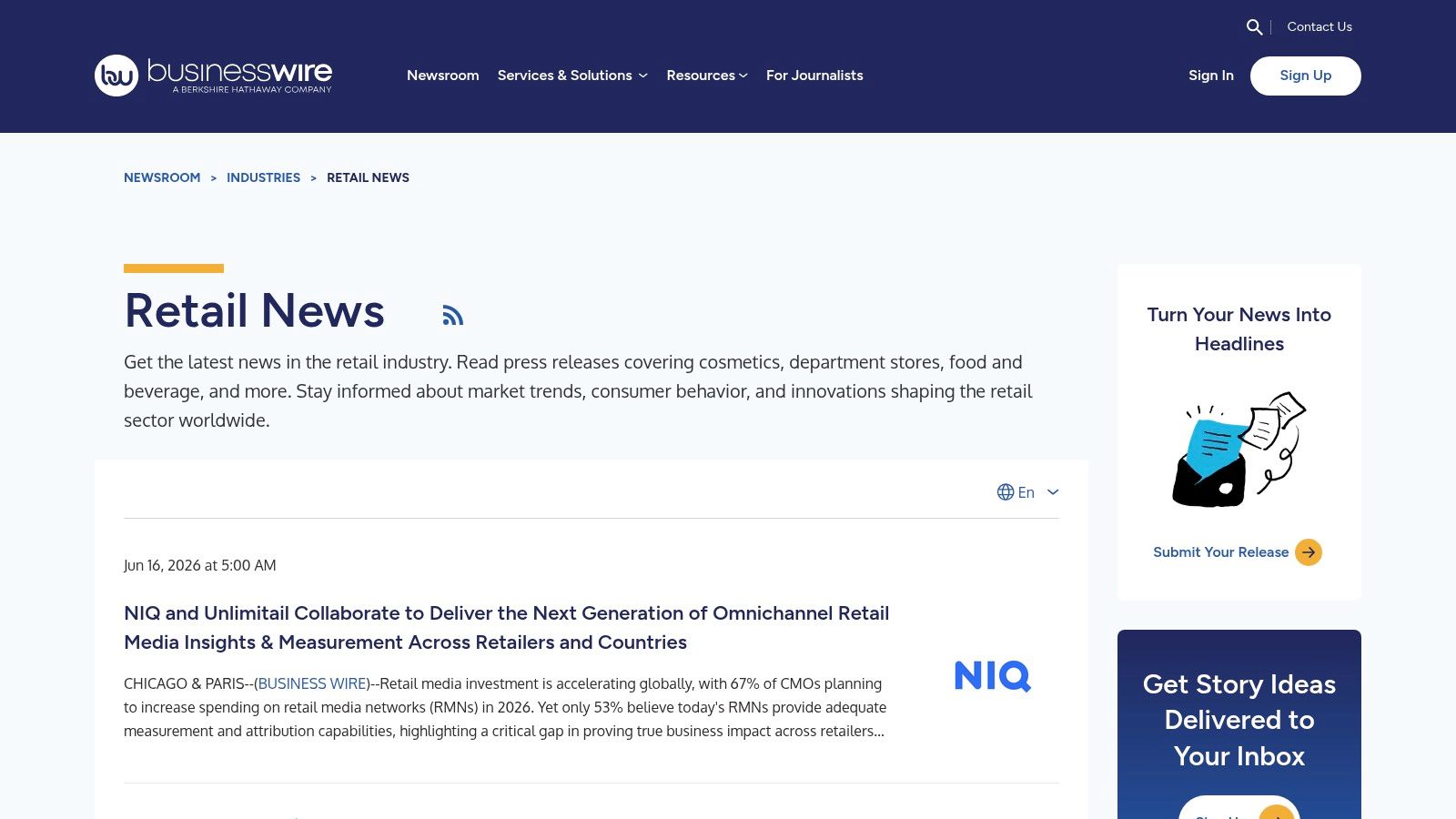
Business Wire's retail newsroom feed is less a curated classroom and more a live market scan. That's exactly why it's useful.
A static example page can age quickly. A newsroom feed shows what retailers are announcing right now, how they phrase expansion, partnerships, remodels, and product launches, and how multimedia gets attached in a wire environment. For someone writing retail press release examples into a real workflow, that recency matters.
What the feed reveals
The biggest advantage here is pattern recognition. Browse enough retail releases and certain habits become obvious. Strong headlines state the event cleanly. Subheads add context rather than repeating the headline. Quotes often carry the strategic rationale. Boilerplates do quiet credibility work.
Business Wire is also useful for studying disclosure language. Retail announcements often need to sound commercial without drifting into ad copy. The standardized environment forces a more disciplined tone.
One especially useful benchmark comes from the strongest retail examples cited elsewhere. In a roundup discussed by The Square's press release examples analysis, CartBridge paired expansion into Spain and Italy with concrete business proof, stating that it had reached nine active markets across Europe and crossed €500 million in annual GMV, representing a 180% year-over-year increase. In the same source, MesaVerde framed rollout scale by citing availability across 1,200 points of sale in Portugal and Spain. That's the kind of specificity worth scanning for in a live feed.
Numbers matter in retail PR when they show scope, scale, and momentum in one glance.
How to use it without copying weak releases
Not every release in the feed is good. That's the trade-off.
- Filter for relevance: Look for announcements similar to the one being drafted.
- Borrow structure, not slogans: Many paid wire releases still overstate the brand story.
- Collect headline patterns: Business Wire is excellent for seeing how retail companies title operational milestones.
This is one of the best resources for trend scanning. It isn't the best first stop for beginners who need explanation.
5. Retail Dive DiveWire
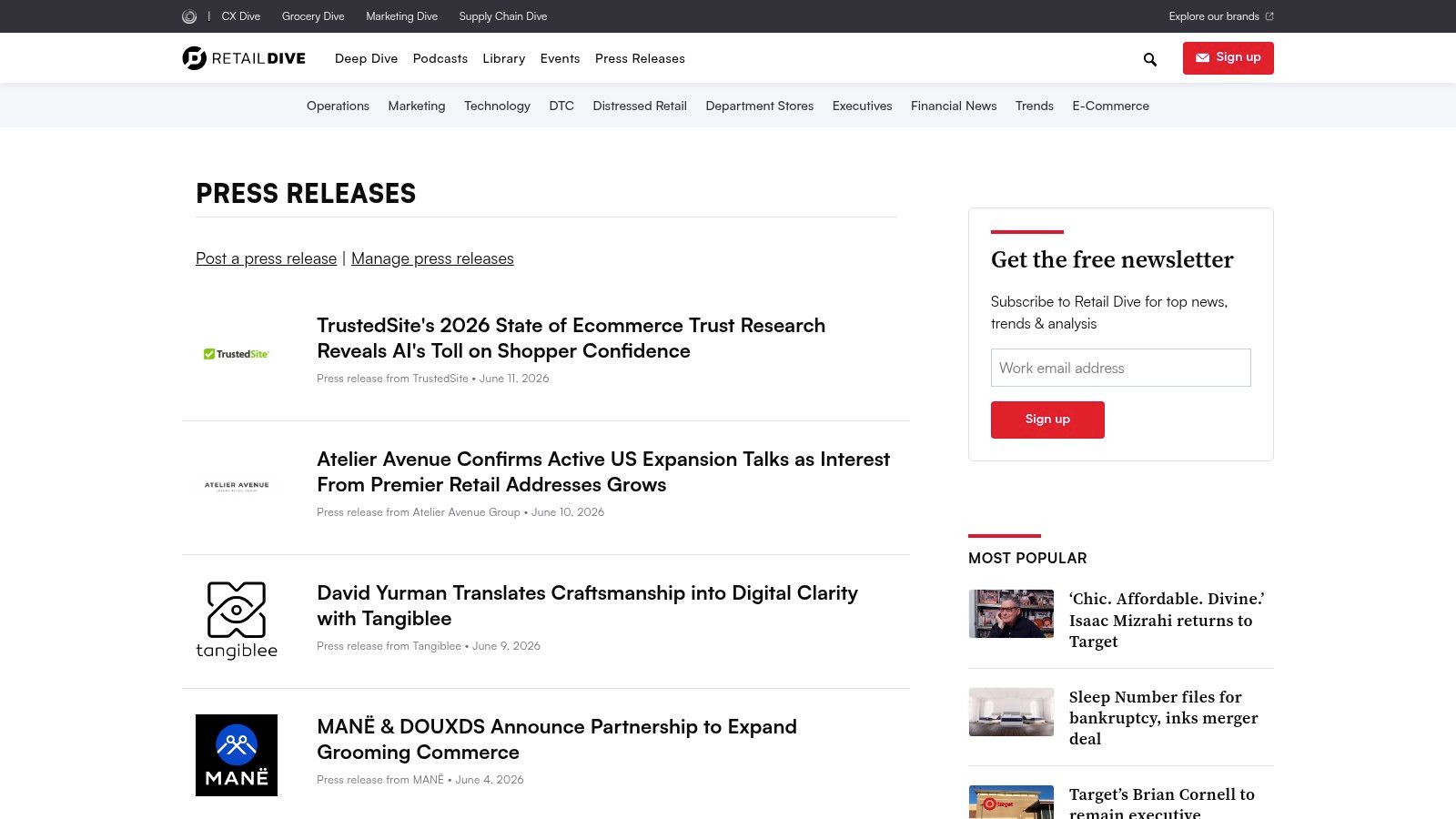
Retail Dive's press release section is valuable because it sits closer to trade readership than broad consumer-facing PR examples do. That changes the writing.
A release aimed at a local newspaper can focus on neighborhood access, seasonal assortment, and opening details. A release aimed at retail operators or trade editors needs a different center of gravity. Merchandising logic, POS implications, loyalty strategy, delivery operations, and store format changes carry more weight.
Why trade context matters
Many retail teams often miss the mark. They reuse one announcement everywhere. The result is a release that's too promotional for trade media and too industry-heavy for local coverage.
DiveWire helps solve that by showing how retail language shifts when the expected reader is a peer in the industry. Terms tied to store ops, last-mile fulfillment, retail tech, and customer experience strategy appear more naturally. That makes the archive useful for retail-tech vendors, multi-location brands, and service providers selling into retail.
A release written for shoppers asks, “Why visit?” A release written for trade readers asks, “Why does this matter to the business?”
Best use case
This resource is strongest when the news has an operational or strategic angle, such as:
- Retail technology rollouts: POS, payments, analytics, or fulfillment tools.
- Multi-store operational changes: New formats, loyalty programs, or supply partnerships.
- Industry-facing announcements: Vendor partnerships, logistics moves, or merchandising infrastructure.
The caution is simple. DiveWire is a posting channel, not a guarantee of editorial endorsement. Quality varies because submission and distribution are paid. That means it's smart to study tone and framing there, but unwise to assume every posted release is exemplary.
For trade-oriented retail press release examples, though, it fills an important gap. It shows how industry readers expect retail news to sound.
6. Target Corporate Newsroom
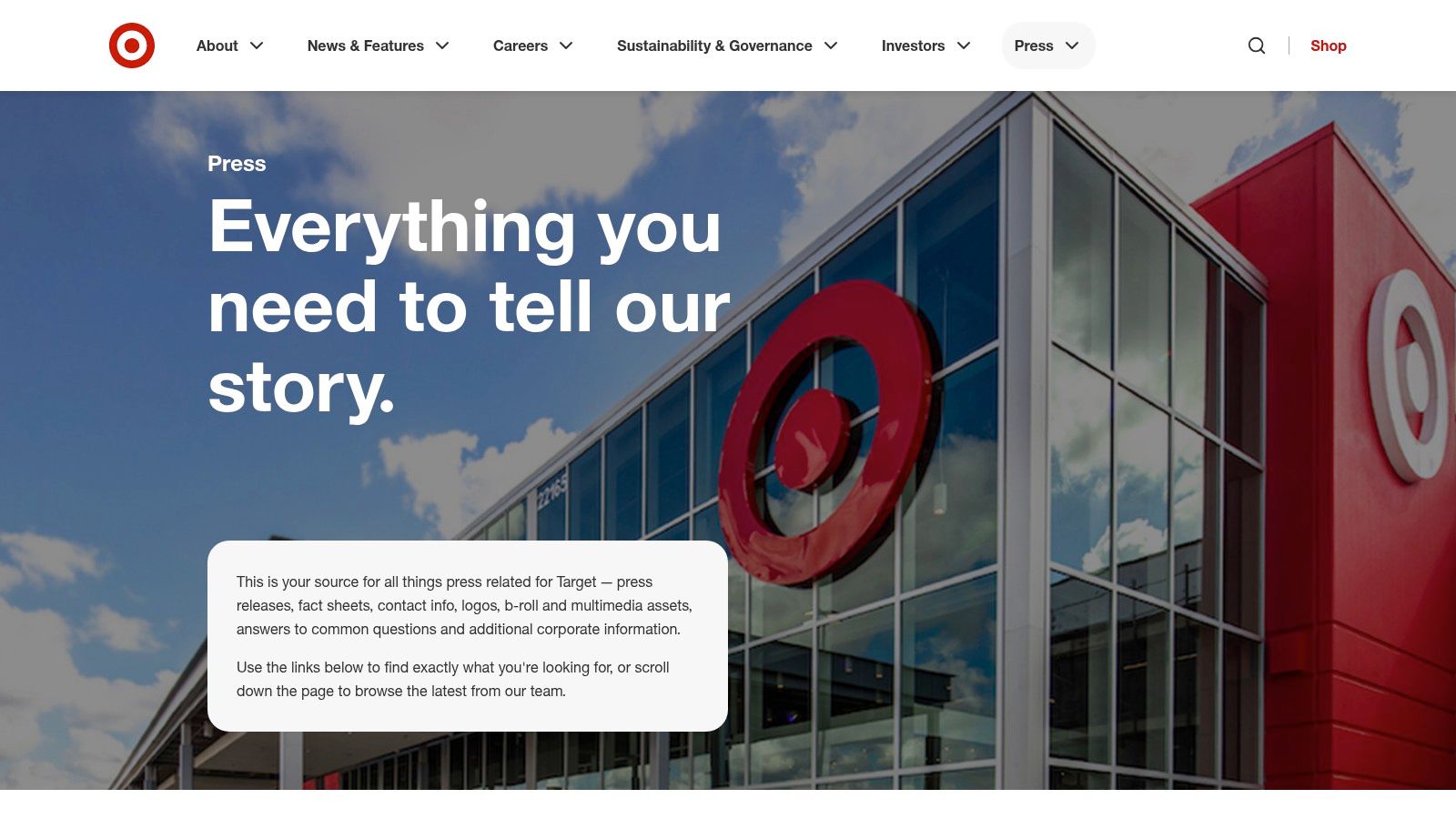
Target's corporate press page is one of the cleaner enterprise references for retail announcement structure. The language is polished, the formatting is consistent, and the releases usually understand the difference between a business milestone and a marketing blast.
That makes Target useful as a model, especially for teams that want to study how a large retailer handles openings, formats, partnerships, and localized benefits without losing editorial discipline.
What enterprise retail gets right
Target-style releases tend to be clear about what changed and why it matters. They also usually keep executive quotes focused on strategic rationale rather than generic excitement. That's harder than it sounds. Most weak quotes only say the company is “thrilled” or “excited.” Better quotes explain customer need, store purpose, or community relevance.
There's also a lesson here in consistency. Enterprise retailers use repeatable templates because repeatable templates reduce friction. Smaller teams can benefit from the same approach by using a new store opening press release template instead of reinventing each announcement from scratch.
For brands studying channel strategy, there's also useful context in broader retail selling motions, including this strategy for big-box retail like Target, because press releases often work best when they support a larger retail narrative rather than standing alone.
What smaller teams should simplify
Smaller retailers shouldn't mimic the full enterprise tone. It can feel too formal and distant.
- Keep the structure: Headline, dateline, lead, quote, proof points, boilerplate.
- Reduce the corporate gloss: Use plain language where a national chain might sound institutional.
- Localize harder: Neighborhood relevance usually matters more for a regional retailer than broad brand messaging.
Target is best treated as a formatting and discipline model, not a voice template. Copy the clarity. Don't copy the scale.
7. Whole Foods Market
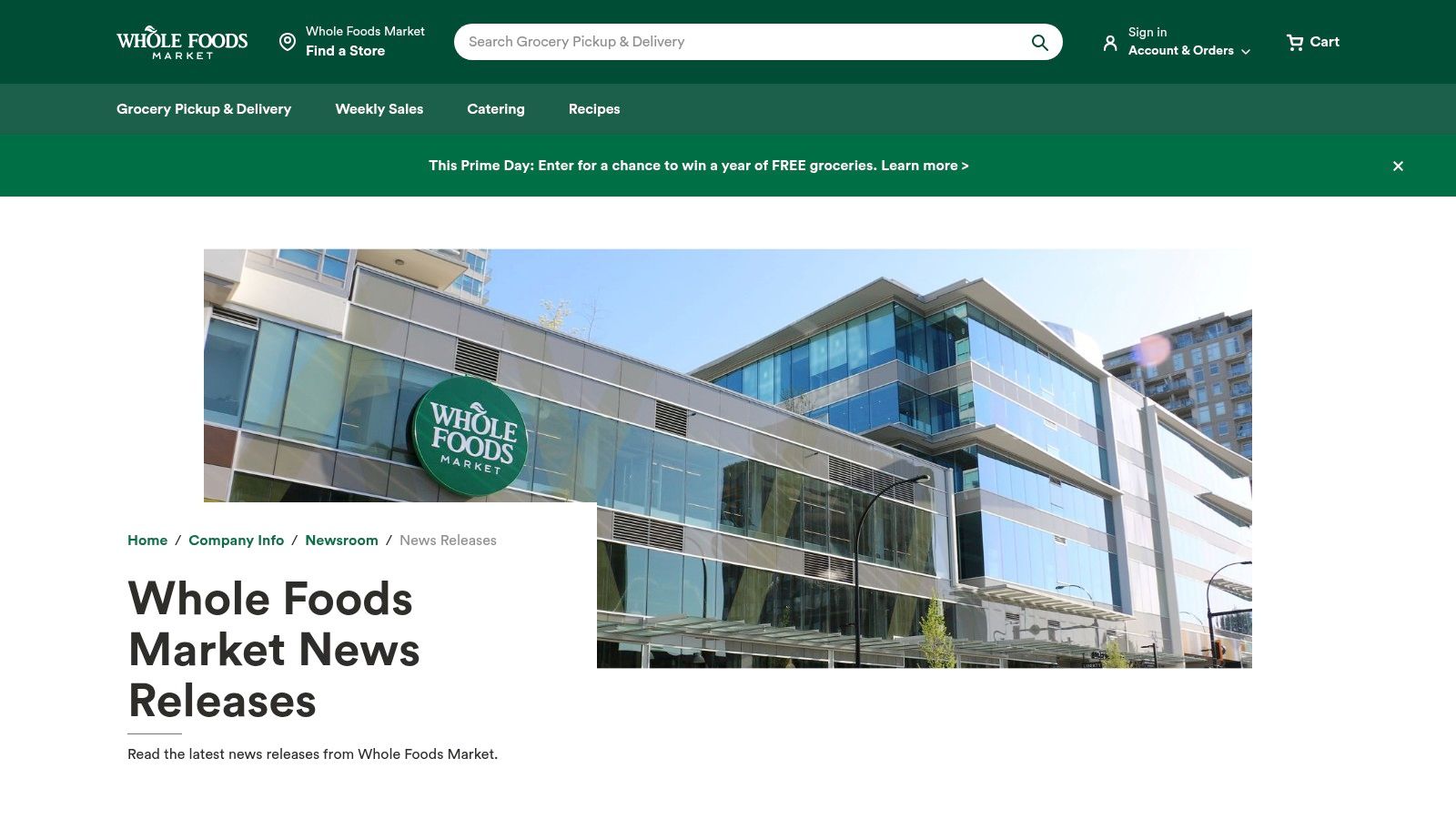
Whole Foods Market's newsroom is especially useful for retailers that need a more consumer-readable style without turning the release into ad copy. The writing often feels closer to a localized news brief than a corporate filing.
That's a strong fit for openings, concept launches, and neighborhood-based retail stories. Whole Foods examples tend to show how a national brand can still frame an announcement around shopper convenience, local relevance, and service highlights.
What makes these examples useful
The strongest lesson here is framing. Retailers often have internal reasons for an opening or format shift, but the release needs to translate those reasons into customer-facing meaning. Whole Foods does that well by emphasizing how the location or concept fits a neighborhood, how it serves shopper routines, and what the experience offers.
This aligns with broader retail best practice. Prezly's retail press release examples emphasize that retail releases perform best when they include consumer-facing visuals, localized merchandising detail, shareable social assets, and explicit localization for stock and currency. Whole Foods-style newsroom writing often supports that same principle even when the exact release format differs.
Good retail PR gives editors enough local texture to write the story, and enough shopper detail to make readers care.
What to adapt carefully
There are two limits to copying this style too exactly.
First, grocery has its own rhythm. Convenience, perishables, neighborhood fit, and routine shopping missions shape the language. A fashion label, electronics retailer, or specialty home brand may need a different emphasis.
Second, a strong brand can write more economically because the audience already knows the company. Smaller retailers usually need a bit more context in the lead and boilerplate.
Still, for concise and shopper-friendly retail press release examples, Whole Foods is one of the better newsroom models to study.
7-Point Retail Press Release Comparison
| Source | Implementation complexity | Resource requirements | Expected outcomes | Ideal use cases | Key advantages |
|---|---|---|---|---|---|
| Press Release Zen | Low for drafting (templates/guides); medium to apply distribution advice | Minimal cost to use content; time to customize; paid distributor still needed for placement | Faster drafting, fewer errors, better vendor selection (no guaranteed distribution) | In-house communicators, startups, agencies needing templates and distribution research | Sector-specific templates, step-by-step guides, up-to-date platform comparisons and SEO tips |
| PR Newswire | Low to browse examples; high to publish (membership/paid) | Free to view; paid membership and distribution fees to publish | High-quality retail exemplars; broad wire distribution if paid | Brands seeking wide distribution or examples that follow wire formatting | Editor-curated retail examples; wire-aligned formatting and credibility |
| eReleases | Low (beginner-friendly templates and samples) | Free examples; optional paid distribution services | Ready-to-adapt templates and clear structure for beginners | Small businesses and beginners drafting store-opening or local announcements | Multiple retail-specific samples, grand-opening templates, clean formatting |
| Business Wire | Low to scan feed; high to publish (quote-based pricing) | Free browsing; paid distribution with variable pricing | Large, up-to-date sample set for trend scanning; national visibility when distributed | PR pros tracking industry trends and brands making major announcements | High-volume searchable feed, standardized formatting, broad coverage |
| Retail Dive (DiveWire) | Low to view trade examples; medium to publish (paid bundles) | Free examples on site; paid DiveWire submission and reporting options | Targeted trade-reader exposure and industry-tailored messaging | Retail trade PR and announcements aimed at industry editors | Trade-focused placement, examples of tone/jargon that resonate with retail media |
| Target Corporate Newsroom | Low to study; high standard to emulate | Free to access; requires significant PR resources to match enterprise quality | Polished, media-ready releases demonstrating corporate framing and assets | Organizations modeling Fortune-50 formatting or community-impact messaging | Consistent, high-quality releases with strong quotes, localization and media assets |
| Whole Foods Market | Low to browse; focused consumer tone | Free access; adaptation needed for non-grocery categories | Concise, neighborhood-focused releases useful for localization and shopper messaging | Grocery retailers, neighborhood store openings, consumer-facing announcements | Clear consumer-oriented storytelling, strong localization and boilerplate use |
Your Action Plan Writing and Distributing Your Next Release
The strongest retail press release examples on this list all point to the same lesson. A release works when it stops behaving like a promotional announcement and starts behaving like usable news.
That means the first decision isn't wording. It's angle. A grand opening can be framed around neighborhood growth, product access, convenience, or local collaboration. A launch can be framed around customer use case, not internal product enthusiasm. A partnership can be framed around what changes for shoppers, not who signed the agreement.
The next move is structure. Start with a direct headline that states the event. Build a first paragraph that answers four questions fast: what happened, where it happened, who it matters to, and why now. Keep the quote specific. If the quote can be dropped into any retail release, it isn't doing enough work.
After that, add proof. In retail, proof often means expansion details, distribution scope, merchandising specifics, or other concrete business signals. If there's no safe quantitative detail available, use qualitative evidence carefully and avoid puffery. The release should still feel grounded.
A workable draft process looks like this:
- Choose one news angle: Don't combine opening news, product launch, brand story, and founder biography in one lead.
- Write the first paragraph for editors: Put the most usable facts first.
- Push specs and background lower: Customer impact belongs earlier than technical detail.
- Localize the release: Include neighborhood, market, store, or shopper context where relevant.
- Match the outlet: Local media, trade media, and wire distribution require different emphasis.
- Attach media assets thoughtfully: Product shots, storefront visuals, or merchandising images should support the story, not clutter it.
Distribution comes last, not first. A weak release won't become strong because it's sent through an expensive wire. Teams should draft well, then choose the channel that fits the audience, budget, and geographic reach required.
Press Release Zen is a strong place to start that process because it combines templates, structural guidance, and distribution comparisons in one practical workflow. For teams that need to move from idea to publishable release without wasting cycles, that combination is hard to beat.
Press Release Zen is a useful next stop for anyone building retail press release examples into a repeatable process. Its templates, walkthroughs, and distribution guides help teams draft faster, avoid common PR mistakes, and turn routine retail updates into cleaner, more publishable announcements. Explore Press Release Zen to find retail-ready templates, writing guides, and practical distribution advice.