A PR package most often means a curated box of products, samples, or branded items sent to influencers, journalists, or celebrities to encourage voluntary coverage. In that common modern use, the recipient has no contractual obligation to post, which is why people often confuse it with gifting, sponsorships, and media outreach all at once.
That confusion usually starts the moment someone hears the term in a meeting, sees it in a creator email, or gets a proposal from a PR vendor. One person means a gift box for influencers. Another means a downloadable press kit. A third means a paid service package for distributing a press release. All three uses show up in real business conversations, and all three are valid in context.
That's why the question What does PR package mean doesn't have just one answer. It has one common answer and two other business meanings that matter just as much if a team wants to avoid crossed wires, wasted spend, and mismatched expectations.
Table of Contents
- The Three Meanings of a PR Package
- Anatomy of an Influencer PR Package
- Building Your Digital PR Package or Media Kit
- Understanding Press Release Distribution Packages
- Choosing the Right PR Package for Your Goals
- Essential Dos and Donts for PR Package Success
- Putting It All Together
The Three Meanings of a PR Package
The easiest way to understand the phrase is to treat it like a Swiss Army knife. The handle is the same, but the tool changes depending on the job.
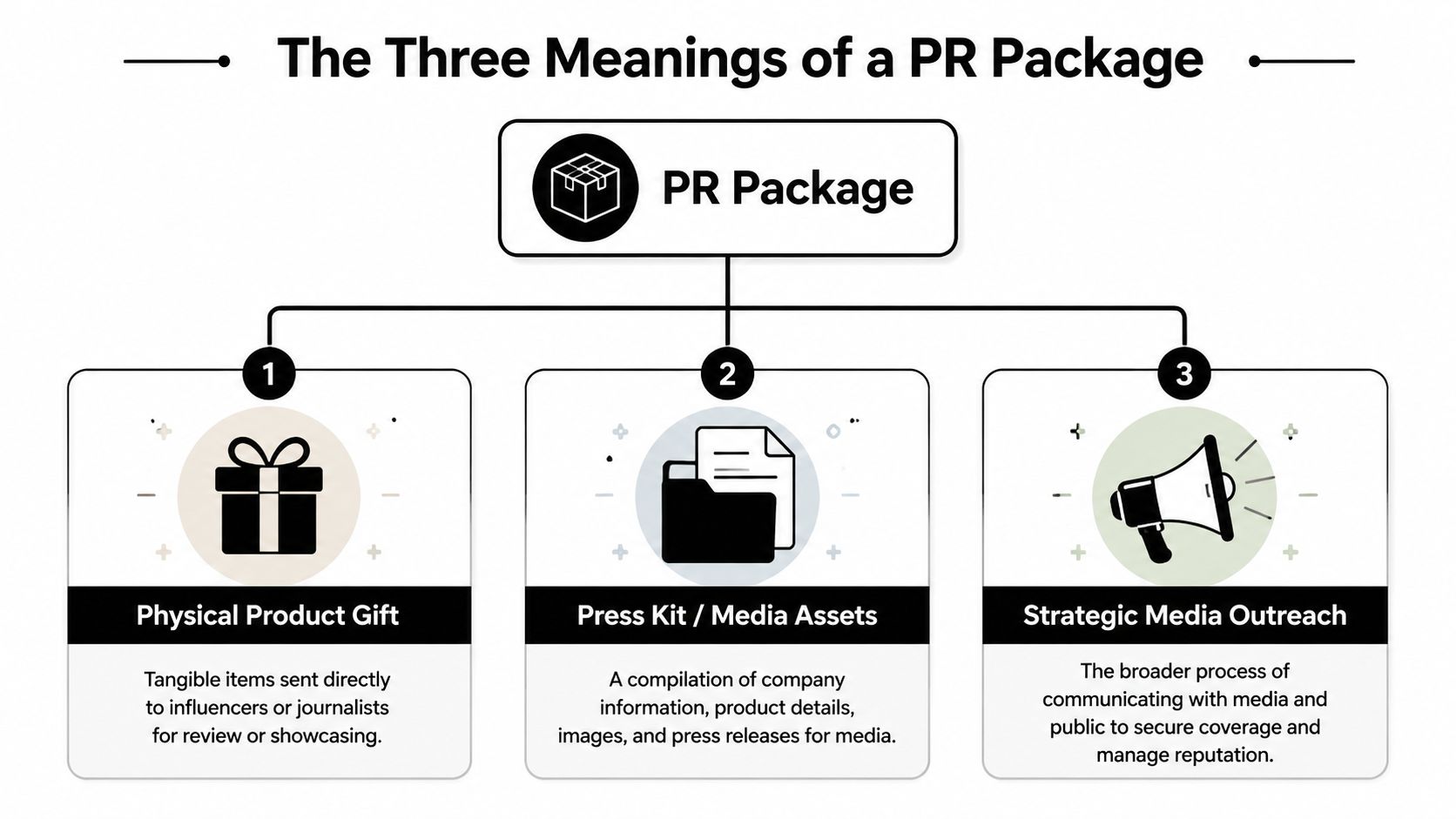
The physical product gift
This is the meaning widely understood today. A company sends a box with products, samples, brand materials, and sometimes swag to a creator, journalist, or public figure. Boston University's PRLab describes this as a public relations package with no contract, used to encourage genuine third-party endorsement rather than paid ad placement, as explained in Boston University PRLab's overview of PR packages.
This version usually appears in beauty, fashion, food, wellness, lifestyle, and consumer product marketing. If someone says, “Let's send PR packages to creators,” they almost always mean this.
The digital media kit
Sometimes a PR package isn't a box at all. It's a bundle of media-ready files. Think logos, founder bios, product photos, press releases, fact sheets, and contact details gathered in one place for journalists or partners.
When that's the meaning, the clues are words like “assets,” “download folder,” “brand materials,” or “press page.” If the discussion involves newsroom access, image files, or approved messaging, the term points to a media kit.
A simple test helps. If the package is meant to be opened by hand, it's probably the influencer box. If it's meant to be downloaded, it's probably the media kit.
The distribution service package
The third meaning shows up when someone is buying a PR service. Here, “PR package” refers to a tiered offering from a distribution provider or agency. The buyer isn't purchasing products in a box. The buyer is purchasing outreach features, formatting support, placement options, targeting, or reporting.
A small business owner might hear “basic package” or “premium package” and assume it includes creative strategy. Sometimes it does. Sometimes it only includes release distribution. That's why context matters so much.
How to identify the meaning fast
A quick sorting method saves a lot of confusion:
| If the conversation mentions | It usually means |
|---|---|
| Unboxing, samples, creators, product seeding | Influencer or media gift box |
| Logos, headshots, fact sheet, downloadable assets | Digital media kit |
| Pricing tiers, distribution, syndication, reporting | Distribution service package |
Once a team learns that shorthand, the phrase stops being fuzzy. It becomes specific, useful, and easier to act on.
Anatomy of an Influencer PR Package
A founder sends a new product to ten creators. Two post about it right away. Three ask what it is supposed to do. The rest never mention it. In many cases, the difference is not the product itself. It is the package around it.

In this article, "PR package" can mean three different things. Here, it means the physical influencer box. It is the version someone opens, handles, tests, and may feature in content. That matters, because the job of this package is different from a downloadable media kit or a paid distribution service.
What goes inside the box
An influencer PR package works like a guided first impression. It should help the recipient understand the product quickly, see why it fits their audience, and know who to contact if they have questions.
The strongest boxes usually include a few core parts:
- Hero product: The main item the brand wants the creator to try, photograph, review, or mention.
- Supporting items: Related products, accessories, or samples that give context and show how the hero product fits into a routine or use case.
- Story material: A short insert, launch card, or product explainer that answers the basic questions. What is it? Who is it for? Why is it new or relevant now?
- Branded presentation: Packaging choices that make the send-out feel intentional and easy to understand.
- Contact details: A clear name, email address, or account handle for follow-up.
A skincare launch shows how this works in practice. The hero product might be a serum. The supporting items could be a cleanser and moisturizer that show where the serum belongs in the routine. The insert explains the ingredient focus, the skin concern it targets, and the kind of customer who will care.
Without that context, a creator has to do extra work to understand the send. Extra work lowers the chance of coverage.
Why packaging matters
Packaging shapes comprehension before it shapes aesthetics.
A good influencer PR package is a communication tool. The box, the order of the items, the note, and the product explanation all work together to answer the questions a creator will have in the first minute. Gentlever's explanation of PR packages points to this same idea. Clear packaging helps the recipient understand the brand and create content with less confusion.
That is why flashy presentation alone rarely carries the result. Tissue paper, inserts, color matching, and custom trays can improve the experience, but they only help if the recipient can quickly tell what the product does, who it serves, and why this launch matters.
Practical rule: If the recipient has to guess what the product does, who it's for, or why it matters now, the package is underbuilt.
Basic and VIP packages
Brands often create more than one version of an influencer package. That is not about showing favoritism for its own sake. It is about matching spend to likelihood of impact.
A basic package might include the hero product, a concise insert, and clean packaging. A VIP package might add personalization, fuller product context, premium presentation, or a broader set of items for creators who are a strong fit for the campaign.
This approach works like tiered event seating. Everyone does not need the same access level to achieve the goal. A broad seeding list may need efficient, informative boxes. A short list of priority creators may justify more customization because the relationship and content potential are stronger.
The key is to decide the tier based on strategy, not impulse. Consider audience fit, past responsiveness, product margin, and the kind of coverage you want.
The line between PR and paid promotion
This is one of the most common points of confusion for small businesses.
An influencer PR package is usually a gift with no posting requirement. The brand is offering the product for consideration, not buying deliverables. If the agreement includes a required post, usage rights, revision rounds, approval terms, or a deadline, the work has shifted into paid creator marketing.
That distinction affects budgeting, outreach language, and expectations inside the team. It also affects compliance. Creators who choose to post gifted items still need to disclose the relationship appropriately.
If your team is sorting out where gifting ends and sponsored content begins, this guide on PR packages for influencers offers a useful breakdown.
Clear expectations protect the relationship. They also help the brand measure the right outcome. With gifting, the goal is relevance and earned interest. With sponsorship, the goal is contracted delivery.
Building Your Digital PR Package or Media Kit
A digital PR package is the grab-and-go version of brand information. Journalists, bloggers, podcast hosts, and partners want fast access to usable assets. If they have to email for every logo, photo, or executive bio, the organization has made their job harder than it needs to be.
What belongs in a strong media kit
A useful digital package is organized around speed and accuracy. It should help someone write, record, or publish with minimal back-and-forth.
Common pieces include:
- Company overview: A short backgrounder that explains what the organization does in plain language.
- Leadership bios: Short, current bios for founders or executives, plus headshots that are publication-ready.
- Brand assets: Logos in common formats and simple guidance on acceptable use.
- Product imagery: Clean photos or videos that show the product clearly and match current branding.
- Press materials: Recent releases, launch summaries, or fact sheets that support accurate coverage.
- Contact information: One clear media contact, not a maze of generic inboxes.
How to make it usable
The best media kit is easy to find and easy to scan. Many teams host it on a website press page, newsroom, or media center. Others use a clean cloud folder with consistent naming and permissions. Either option can work if the files are current and logically grouped.
A journalist under deadline doesn't want a beautifully branded maze. A journalist wants the approved logo, the right founder headshot, the correct company description, and a fast path to confirmation if a question comes up.
The easiest media kit to use is usually the one that says less, organizes better, and removes guesswork.
A common source of confusion
Teams often mix up a press kit and a media kit, then use “PR package” as a catch-all. That's not disastrous, but it does create friction. A press kit is often built around a specific announcement. A media kit can serve as the broader standing resource for the brand.
For a cleaner breakdown of those terms and how they're used in practice, this guide to press kit vs media kit differences and best practices gives teams a more precise language set.
The standard to aim for
A professional digital PR package should make coverage easier, not louder. It doesn't need decorative language. It needs clear files, current information, and a structure that respects the recipient's time.
Understanding Press Release Distribution Packages
The third meaning of PR package is the most transactional. It appears when a company buys a service to distribute a press release. In that setting, the “package” is a pricing tier, not a box or asset folder.
What businesses are actually buying
A distribution package typically bundles practical delivery features. Depending on the provider, those features may include formatting support, media targeting, multimedia options, publication reach, reporting, or editorial review. Some services keep things lean. Others wrap in consultation and add-ons.
That's why businesses should read package names carefully. “Standard” and “premium” sound strategic, but the actual difference may be something as simple as multimedia support, category targeting, or a broader distribution list.
A simple comparison mindset
A useful way to assess options is to compare them by announcement type rather than by package label.
| Package tier | Usually fits | Questions to ask |
|---|---|---|
| Basic | Simple updates, local announcements, low-complexity news | Does it include the formatting and visibility needed for this announcement? |
| Standard | Product launches, partnerships, event news | Are images, targeting, or reporting included? |
| Premium | High-stakes launches, major corporate announcements, broader campaigns | Is the extra spend tied to meaningful distribution or just feature padding? |
The goal isn't to buy the biggest package. The goal is to match the service to the news.
Why this matters more than it sounds
Many teams blur the line between distribution and outreach. A distribution package can place a release into a network. It does not automatically replace direct pitching, relationship building, or a strong media kit. Sending a release widely is one tactic. Earning coverage still depends on the quality and relevance of the story.
That's also why package language can mislead newer buyers. A company may purchase broad distribution and still need targeted outreach to trade media, local press, investors, or niche newsletters.
How to compare providers without guessing
When comparing services, teams should look past marketing language and evaluate the actual workflow. What gets reviewed. What gets included. What reporting arrives after publication. What help exists if the release needs revision.
For businesses sorting through vendors, this overview of press release distribution services is useful because it frames services around practical selection criteria instead of just package names.
A good distribution package supports the announcement. It doesn't turn weak news into strong coverage.
Choosing the Right PR Package for Your Goals
Choosing well starts with a blunt question. What is the organization trying to accomplish?

Match the package to the situation
Different goals call for different package types. A few examples make that clearer:
- Launching a physical product: The influencer or media gift box usually fits best because the product needs to be seen, tried, and experienced.
- Announcing a funding round or new executive: A digital media kit plus distribution support often makes more sense than product gifting.
- Promoting an event or partnership: A media kit can support the story, while a distribution package helps circulate the announcement.
- Building creator relationships over time: A structured gifting program is often more useful than one-off send-outs with no follow-up process.
A team that sells skincare, snacks, apparel, or home goods often benefits from physical seeding. A B2B software company usually gets more value from strong messaging assets, a clean press page, and selective release distribution.
Ask the right diagnostic questions
This short decision filter works well in practice:
- Is there a physical product people need to experience?
- Is the main audience a creator, a journalist, or the general public?
- Does the news require downloadable assets for accuracy?
- Is the need relationship-based, announcement-based, or distribution-based?
- Can the team measure what happened afterward?
Those questions prevent a common mistake. Teams often choose the most visible tactic instead of the most useful one.
If the goal is product trial, ship the experience. If the goal is accurate reporting, build the asset kit. If the goal is broad announcement visibility, evaluate distribution support.
Keep ROI thinking grounded
Measurement is where a lot of PR package advice gets vague. Recent guidance notes that brands should track social mentions, traffic, and coverage from PR packages, while also asking whether the cost is worthwhile compared with alternatives like paid media or influencer whitelisting, as discussed in Unpakful's article on creating a PR package.
That matters because a package can look polished and still underperform. A brand might get pretty unboxing content but little downstream business value. Another brand might send a simpler package and earn strong creator fit, useful content, and better momentum.
For teams creating announcement materials from scratch, tools that simplify press release creation can help organize the message before deciding whether it belongs in a media kit, a distribution service, or both.
A practical way to think about spend
The right package is the one that supports the objective with the least waste. That sounds obvious, but it's where many budgets leak. Money disappears when companies send expensive influencer boxes for news that belongs in a press release, or buy broad distribution for a story that needs direct niche outreach.
Strategy is mostly choosing the right format before choosing the glossy version of that format.
Essential Dos and Donts for PR Package Success
A lot of PR package problems start with a simple mix-up. A team says, "We need a stronger PR package," but one person means an influencer send, another means a media kit, and someone else is pricing distribution. If the format is unclear, the execution usually slips too. The package may look polished and still miss the goal.
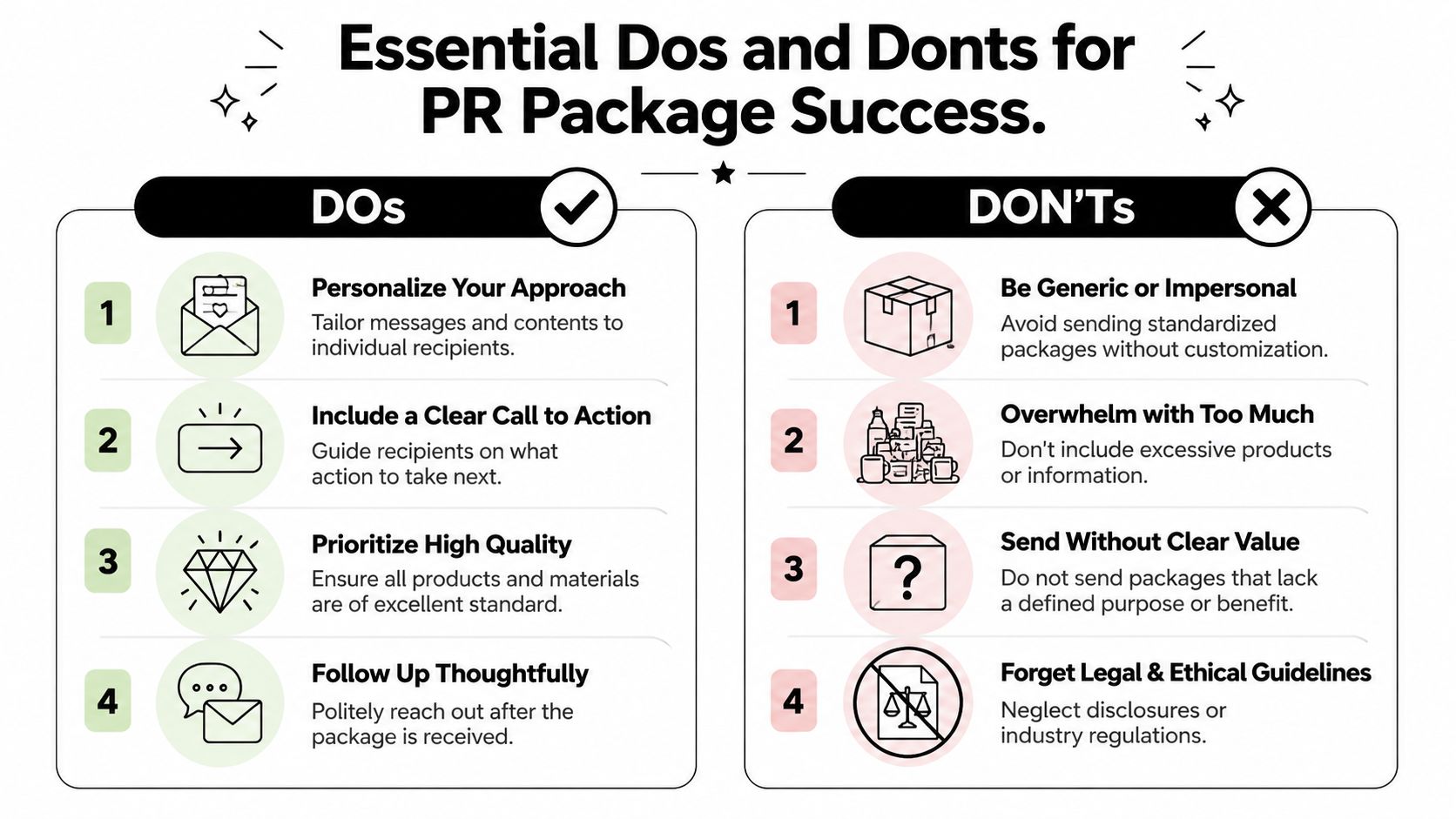
The fix is straightforward. Start by naming which kind of PR package you are working on, then judge success by what that format is supposed to do. An influencer box should be easy to try, photograph, and talk about. A media kit should make facts, assets, and angles easy to find. A distribution package should place the announcement where it has a realistic chance to be seen by the right outlets.
Dos that improve the odds
- Match the package to the recipient and the format: A beauty creator, a trade reporter, and a distribution platform do not need the same materials. Tailor the send so it fits the person or service receiving it.
- Give one clear story priority: A package works like a well-packed suitcase. If everything is trying to be the main item, nothing stands out. Lead with one product, one announcement, or one angle.
- Make the next step obvious: Tell the recipient what action makes sense next, whether that is testing the product, downloading assets, requesting an interview, or reviewing release details.
- Remove friction: Packaging should arrive intact. Links should work. Files should open. Captions, specs, and contact details should be easy to spot.
- Follow up with judgment: Give people time to receive, review, or try what you sent. Then send a short, useful follow-up that adds context instead of pressure.
Donts that weaken the effort
- Don't treat every PR package like an influencer box: If the goal is accurate coverage of company news, a reporter usually needs facts and assets more than decorative extras.
- Don't assume a send creates an obligation: A package creates awareness and makes coverage or posting easier. The recipient still decides whether the story fits.
- Don't overload the package: Too many products, too many talking points, or too many files create work for the recipient.
- Don't let presentation hide the message: Attractive packaging can help get attention, but clarity is what helps someone use the material correctly.
- Don't skip disclosure or basic compliance checks: Gifted products, claims, usage rights, and contact details all need to be handled cleanly.
- Don't send anything without a way to measure the result: Track the response that fits the format, such as content created, media replies, pickups, traffic, or coverage quality.
The professional standard
Strong PR teams treat the package as a tool, not a prop. That mindset changes a lot.
For an influencer package, the question is, "Did we make it easy for the right creator to experience and share the product?" For a media kit, the question is, "Did we reduce the reporter's research time and improve accuracy?" For a distribution package, the question is, "Did this announcement reach relevant outlets in a way that supports the business goal?"
A good package reduces effort on the other side. That is the common thread across all three meanings of "PR package."
Good PR packages give the recipient what they need to understand the story and act on it without extra guesswork.
A quick final checklist
| Do this | Avoid this |
|---|---|
| Identify which type of PR package you are creating before building it | Using one approach for influencer sends, media kits, and distribution |
| Lead with one clear message | Cramming in every product, feature, or quote |
| Include usable assets, context, and contact information | Assuming the recipient will research the missing details |
| Follow up politely and with purpose | Repeated nudges that add no value |
Teams that follow those habits usually waste less budget, create less confusion, and get better results from the package they chose.
Putting It All Together
When someone asks what does PR package mean, the right answer depends on context. Most often, it means a physical product box sent to influencers or media contacts with no obligation to post. In other settings, it means a digital media kit or a paid distribution service package.
That distinction matters because each version solves a different problem. The influencer box supports product discovery and earned visibility. The digital media kit supports accurate coverage and faster media response. The distribution package supports announcement delivery at scale.
Once a team learns to identify which meaning is in play, better decisions follow. Budgets get allocated more cleanly. Outreach becomes more intentional. Expectations become realistic.
PR works better when the format matches the goal. That's the key takeaway. A package isn't valuable because it looks polished. It's valuable when it helps the right person understand the story and act on it.
Teams that need practical help with press releases, media materials, and distribution planning can use Press Release Zen as a resource hub for templates, terminology guides, and step-by-step articles that support clearer PR execution.