Only 38% of sales reps receive formal training for a launch, and just 3% of that training uses role-playing, even though launch teams still expect reps to explain value, handle objections, and keep the story consistent once the product leaves the press release and enters the market. That gap is why new product launch training is not a support task, it's the control system that keeps PR, marketing, and sales from telling three different stories on day one. For teams building a repeatable model, how to create a training model is a useful reference point because launch readiness depends on behavior, not just material production.
Table of Contents
- Why Most Product Launches Fail Without Structured Training
- Building a Four-Phase Launch Enablement Framework
- Core Training Modules for PR and Communications Teams
- Sample Launch Training Agendas and Practical Exercises
- Fixing the Sales Handoff That Derails Most Launches
- Post-Launch Reinforcement and Localization Strategies
- Measuring Launch Training Success with KPIs and Coaching
Why Most Product Launches Fail Without Structured Training
The launch numbers are unforgiving. Roughly 30,000 new consumer products are launched each year, only about 40% of developed products reach the market, around 60% of launched products generate revenue at all, and about 95% ultimately fail to achieve meaningful commercial success, with only 3% surpassing $50 million in first-year sales, according to compiled launch statistics from multiple sources (G2 product launch statistics). That's not a messaging problem in isolation. It's a readiness problem.
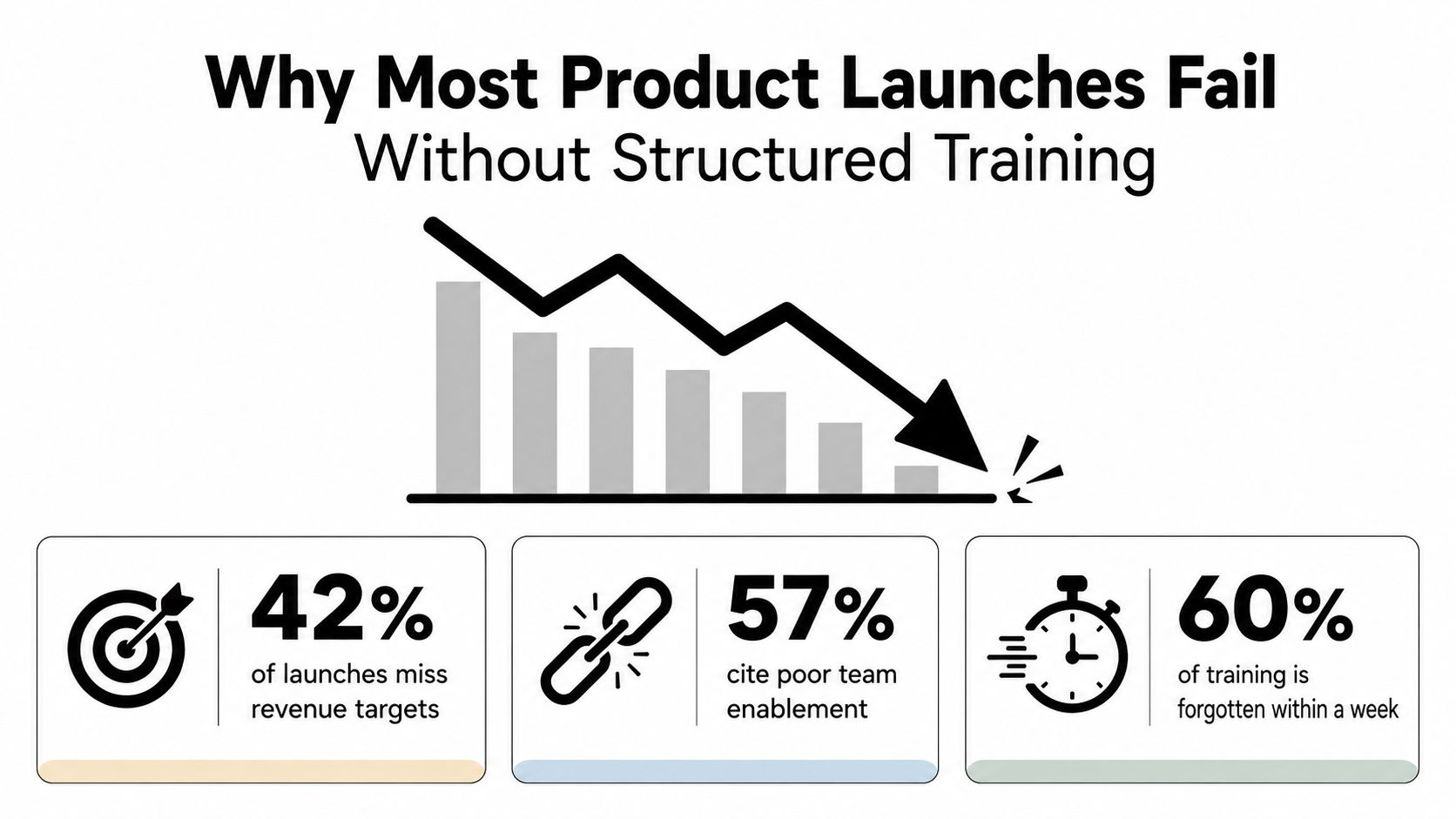
Launches usually break where internal handoffs break. PR writes the narrative, marketing packages it, and sales has to defend it in live conversations, often without enough rehearsal or shared language. When that handoff fails, the product may still have strong features, but customers hear fragmented positioning, weak proof points, and inconsistent answers.
Training is the risk-control layer
A structured launch program reduces that drift by turning assets into behavior. The training gap matters because launch success depends on sales readiness as much as product readiness, and the source on sales training for launches makes that explicit, noting the problem of incomplete internal enablement when most reps aren't trained (TD Magazine on sales training for new product launches). That's also why launch teams should treat training as a control mechanism, not a content dump.
Practical rule: if the launch message can't survive a live objection in a rep conversation, it isn't launch-ready yet.
The most useful mindset shift is simple. Don't ask whether the team received the deck. Ask whether the team can use the deck to explain the offer, defend the claim, and stay consistent under pressure.
Building a Four-Phase Launch Enablement Framework
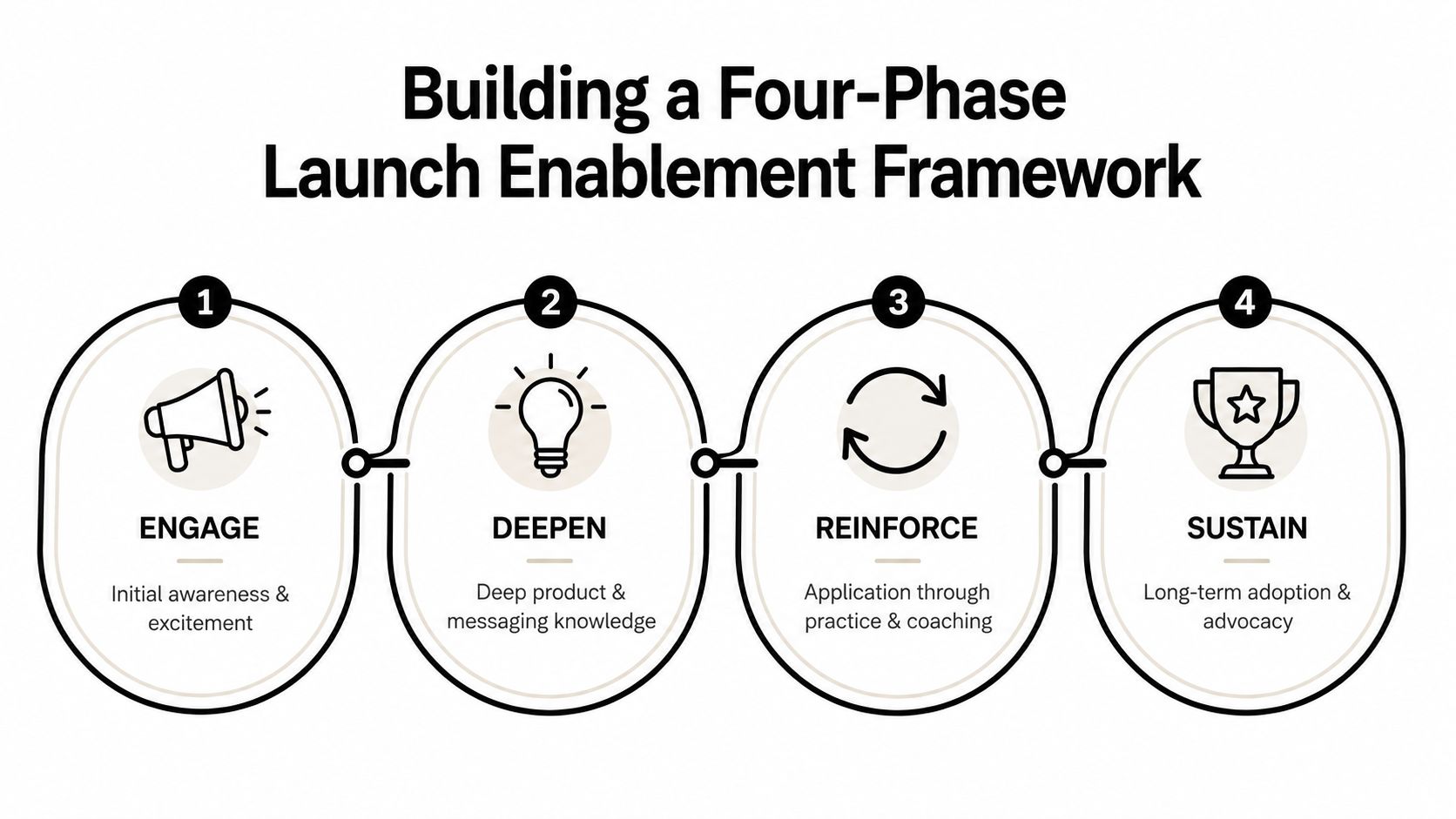
Most launch failures come from a false assumption that one training event equals readiness. The evidence-based alternative is a staged model with Engage, Deepen, Reinforce, Sustain, delivered as spaced learning rather than a single marathon session (Tier 1 Performance white paper). That matters because different groups need different learning at different moments. PR needs narrative precision early, sales needs objection handling before launch, support needs escalation clarity, and executives need tight talk tracks for public-facing moments.
Engage and deepen before launch
Engage is about orientation. Teams need the category story, the launch objective, the customer problem, and the reason the market should care. PR aligns with product and marketing on the core message hierarchy, while sales gets the first pass at positioning language.
Deepen is where the work gets practical. Spokespeople rehearse interviews, account teams practice objections, and customer success learns how the product fits into onboarding and support conversations. One launch methodology emphasizes cross-functional alignment before launch, including sales, marketing, customer success, and support, because messaging fractures when each group learns the story in a silo (Tier 1 Performance white paper).
Reinforce and sustain after launch
Reinforce should start immediately after launch, not weeks later. That's when managers review call evidence, PR checks message consistency in coverage, and teams revisit the same language in shorter practice loops. Sustain turns the launch into a repeatable operating rhythm, with refreshed coaching, searchable knowledge, and role-specific updates as the market reacts.
A strong launch process also benefits from defined metrics up front. Benchmark data in launch research shows best-performing companies reaching 76% average launch success versus 51% for other firms, while companies with a defined launch process saw 10% higher success rates and 3x greater revenue growth than ad-hoc approaches (Tier 1 Performance white paper). The takeaway isn't that every company will match those results. It's that process discipline changes the outcome enough to justify the effort.
Core Training Modules for PR and Communications Teams
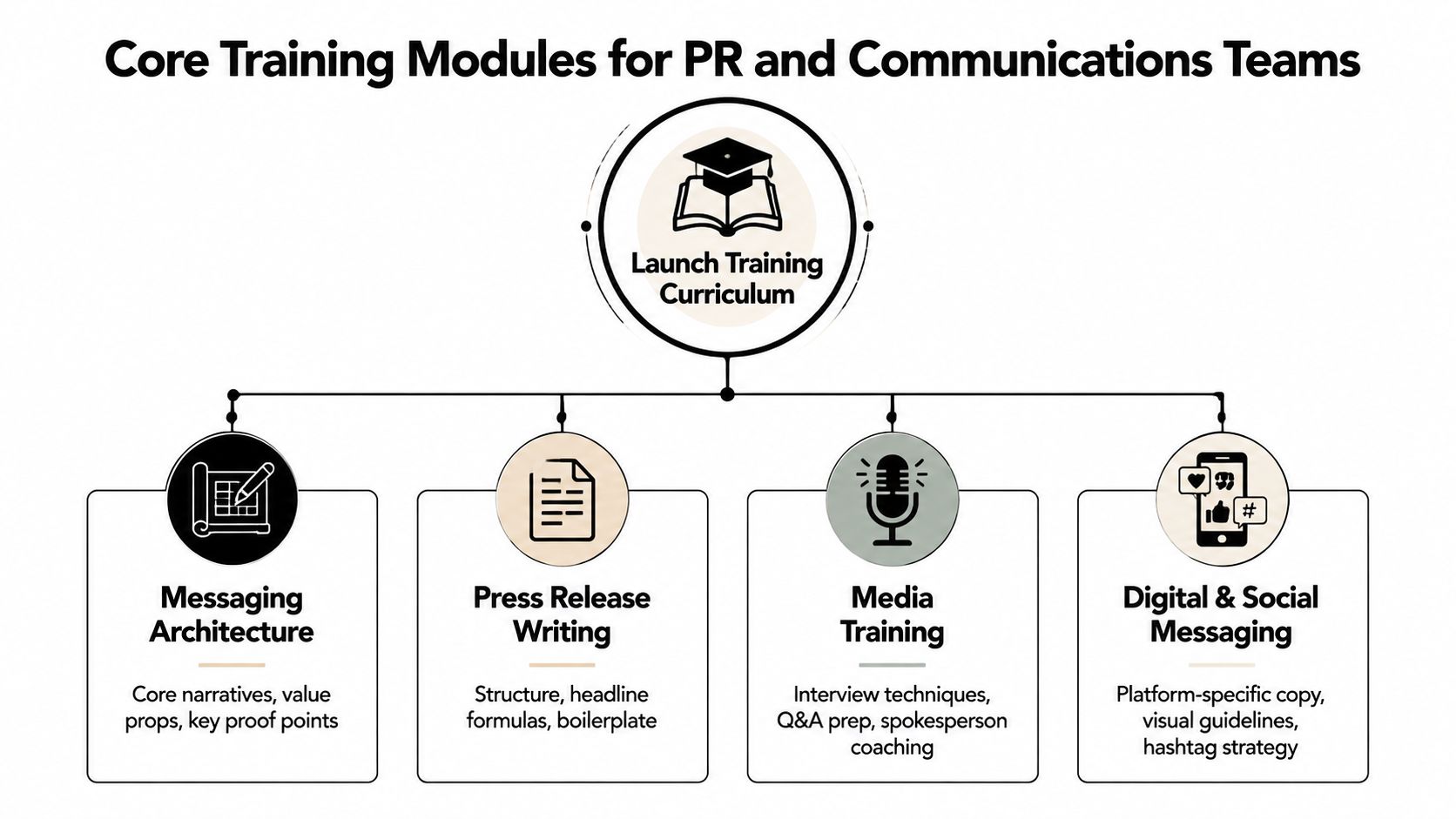
The PR curriculum has to do more than explain the product. It has to give communicators a usable structure for writing, pitching, briefing, correcting, and repeating the same story without flattening it. The best launch teams build the curriculum around what reporters, customers, and internal stakeholders ask, not around what the slide deck is easiest to produce.
Messaging architecture that holds under pressure
Messaging architecture should start with the one-sentence point of view, then ladder into proof points, audience-specific angles, and forbidden language. That hierarchy matters because the same product story has to work in a press release, a briefing note, a spokesperson answer, and a social post. If the foundation is loose, the rest of the launch turns into improvisation.
Press release writing and distribution
A launch press release needs structure, not decoration. The headline should state the news cleanly, the lead should answer why it matters, and the boilerplate should stay stable enough to reuse across assets. For a deeper walkthrough of interview preparation and spokesperson readiness, the internal guide on media training is a useful companion because interview skill and release quality usually rise and fall together.
Media training and embargo handling
Media training has to be practical. Spokespeople should answer hostile questions, redirect to the core message, and stop over-explaining features. Embargo handling deserves its own module because confidential launch details are easy to leak when teams don't know what's shareable, what's restricted, and what can be sent to which contact list.
Digital and social messaging
Digital and social messaging should be treated as a separate lane, not a copy-paste afterthought. Copy needs to fit platform norms, visuals need to stay on brand, and the launch narrative should be short enough to survive in a feed. A useful internal check is whether the same claim still makes sense when it's cut down to a post, a thumbnail, or a short announcement line.
Strong launch training doesn't just teach people what to say. It teaches them what to leave out.
The most common mistake is trying to cram all of this into one meeting. The better pattern is to teach the architecture first, then the actual assets, then the live behaviors that prove the team can use them.
Sample Launch Training Agendas and Practical Exercises
A good launch schedule feels tight but not frantic. It gives teams enough repetition to internalize the story without turning every session into another webinar that people half-listen to while answering email. The best agendas usually alternate teaching and practice, so each module ends with a visible output.
| Sample Two-Week Pre-Launch Training Schedule | |||
|---|---|---|---|
| Day | Session Focus | Audience | Duration |
| 1 | Launch narrative and customer problem framing | PR, marketing, product | 60 minutes |
| 3 | Press release drafting workshop | PR and comms | 75 minutes |
| 5 | Sales talk track and objection practice | Sales and enablement | 90 minutes |
| 7 | Spokesperson interview rehearsal | Executives and PR leads | 60 minutes |
| 9 | Embargo simulation and approval workflow | PR, legal, product | 45 minutes |
| 11 | Customer FAQ and support handoff | Customer success and support | 60 minutes |
| 13 | Full launch dress rehearsal | Cross-functional team | 90 minutes |
The agenda works because it separates written assets from live behavior. Press release drafting belongs in a workshop, not a lecture. Mock interviews belong in a rehearsal, not a theory session. Objection handling belongs in role play, because reps need to hear themselves stumble before customers do.
Practical exercises that actually expose gaps
Mock press conferences are useful when the room includes people who aren't in PR, because product leaders and sales managers often reveal the jargon that needs to be removed. Embargo simulation drills are valuable because they show where approvals slow down and where confidential language gets shared too widely. In both cases, the point is to surface failure before launch day does it for the team.
For presentation structure, the resource on hook examples for students can help teams think about openings that create attention quickly, which matters when a launch announcement has only a few lines to earn interest.
Useful standard: every training session should end with something observable, a draft, a talk track, a correction, or a recorded rehearsal.
A clean session plan usually includes the objective, the audience, the exercise, the owner, and the output. If a session doesn't produce one of those artifacts, it's probably too abstract for launch work.
Fixing the Sales Handoff That Derails Most Launches
The weakest handoff is usually not between product and PR. It's between marketing polish and the live sales conversation. Launch research identified training the sales force as a key success factor, and it rated highly important for launch outcomes, which is exactly what field teams learn the hard way when a rep opens with features instead of customer pain (UFMG launch study).
Teach customer-problem framing, not feature recitation
The sales team needs more than a feature list. It needs a reason to challenge the status quo, a way to frame the customer's current problem, and language for explaining economic value without sounding scripted. That's why a launch communication plan is often the missing bridge between announcement assets and frontline execution, and the step-by-step guide on how to write a communication plan is relevant here because the handoff only works when responsibilities are explicit.
The practical risk is simple. If reps only know what the product does, they default to reciting capabilities. If they understand why the buyer should move now, they can stay in control of the conversation when objections come up.
Measure behavior, not attendance
Training attendance is a vanity metric if nobody checks what reps can say. The stronger approach is to review call recordings, ask for live demos, and score whether the approved message appears in real conversations. That same launch source notes that customer-centric launch practices have been associated with sales gains of up to 130% of goal and margin gains of 20% over existing product lines, which shows how much the handoff can matter when the training is built around customer problems rather than internal features (UFMG launch study).
The old habit is to congratulate completion. The better habit is to verify fluency.
Post-Launch Reinforcement and Localization Strategies
Most launch programs stop at rollout, which is exactly when pressure begins. Teams go remote, questions multiply, field feedback shifts fast, and the original launch deck starts to age the moment buyers ask something the script didn't cover. That's why modern launch training works better as an operating system than as an event.
Short reinforcement loops help because people forget details once the launch rush passes. Current best-practice guidance favors microlearning through tools like Slack or Microsoft Teams, searchable knowledge hubs, role-specific paths, and frequent review of adoption and call evidence in the first 60 days (Highspot product training guidance). The practical use of that model is straightforward. Managers can push one question, one objection, or one new proof point into a channel, then collect responses and correct drift before it spreads.
Localization is the other blind spot. A launch message that sounds crisp in one market can sound awkward or even misleading in another if it leans on slang, informal shorthand, or visuals that don't travel well. Recent launch-training guidance recommends avoiding regional slang and colloquialisms, using closed captions, avoiding embedded text in images, and making sure visual examples reflect diverse audiences (Tier 1 Performance localization guidance).
Standard usability is key. If a regional team can't adapt the training without rewriting the entire story, the launch content wasn't built for scale. Searchable hubs, modular decks, and captioned assets make it easier for global teams to stay aligned without forcing every market into the same verbal style.
Measuring Launch Training Success with KPIs and Coaching
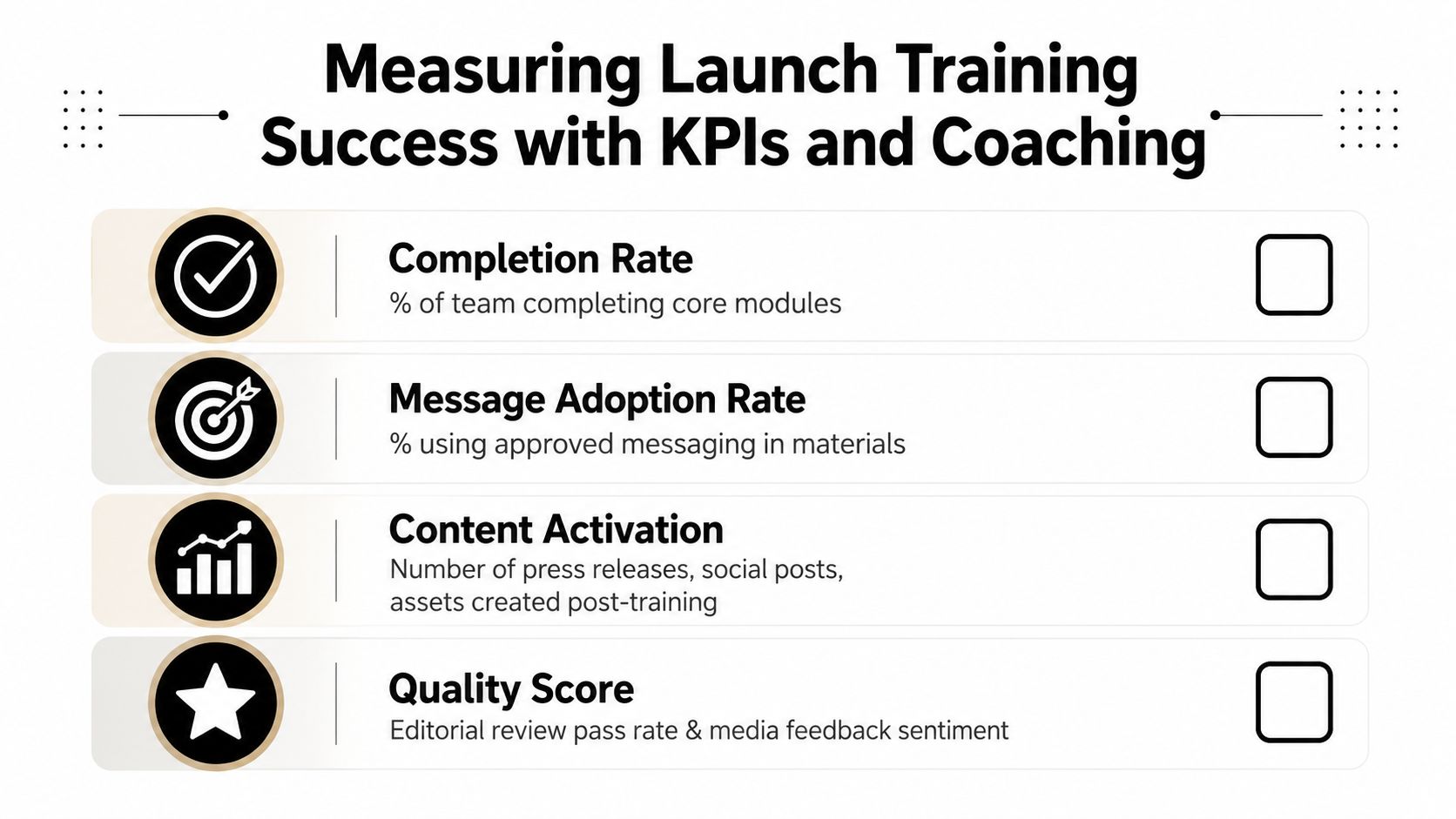
Launch training should be judged by what people do after the session, not by how full the calendar looked. A simple dashboard can track completion rate, message adoption rate, content activation, and quality score. For a structured view of PR measurement, the internal guide on press release KPIs fits naturally alongside sales enablement tracking because launch performance spans both media execution and frontline behavior.
What managers should watch
Managers should listen for three things in follow-up coaching. First, whether reps and spokespeople are using approved language. Second, whether they can explain the customer problem without drifting into product jargon. Third, whether their answers stay consistent across calls, interviews, and written materials. Those checks are more useful than generic praise because they reveal whether training is translating into behavior.
For a wider sales-enablement lens, critical sales KPIs to track is a good complement because launch teams need the same discipline that sales organizations use when they measure adoption and performance.
A simple coaching loop
A practical manager checklist looks like this:
- Review one live call or interview recording: Check message consistency and note where the story drifted.
- Score one asset from the field: Look at a press pitch, social post, or follow-up email for accuracy and alignment.
- Assign one correction: Give one concrete fix, not a vague reminder.
- Schedule one refresher: Bring the same issue back into the next reinforcement loop.
The point isn't to create more reporting. It's to catch message erosion before the market does. A launch that can be coached, measured, and corrected keeps its story intact longer than one that relies on a single training day.
Press Release Zen gives teams a practical place to build launch announcements, press materials, and process checklists without starting from scratch. For communicators trying to tighten the handoff between PR, marketing, and sales, Press Release Zen can serve as a reference point for structure, wording, and launch execution discipline.