The text message is drafted, then deleted. A parent's name is sitting at the top of the call list, and the question isn't whether to announce the elopement, it's who hears it first, how much they hear, and when. That's the job here, and if the order is wrong, the wording won't save it.
Elopement has also stopped being a rare family scandal. In the United States, 23% of married couples in 2022 said they had eloped or seriously considered elopement, UK marriage records are summarized as showing 18% of all marriages in 2021, up from 12% in 2010, and the same source says global elopement rates among millennials rose 45% since 2015, with more than 1.2 million couples choosing elopement in 2023 (elopement statistics). That shift matters because the announcement is no longer about explaining a secret, it's about managing expectations around privacy, family, and timing.
The couples who handle this well treat the announcement like a sequenced communications plan. Parents get the first quiet call, close friends get the next layer, and the wider world gets the public reveal only after the marriage is already stable in everyone's mind. When the relationship with family is tender, a second milestone, the celebration announcement, often lands better than trying to make one message do everything.
Table of Contents
- Why the Announcement Is Its Own Project
- Building Your Announcement Sequencing Plan
- Ready-to-Use Message Templates for Family and Friends
- Social Media Announcements That Land Well
- Formal Announcements and Press Releases
- Etiquette Landmines and Sensitive Wording
- Timing, Sequencing, and Troubleshooting Common Scenarios
Why the Announcement Is Its Own Project
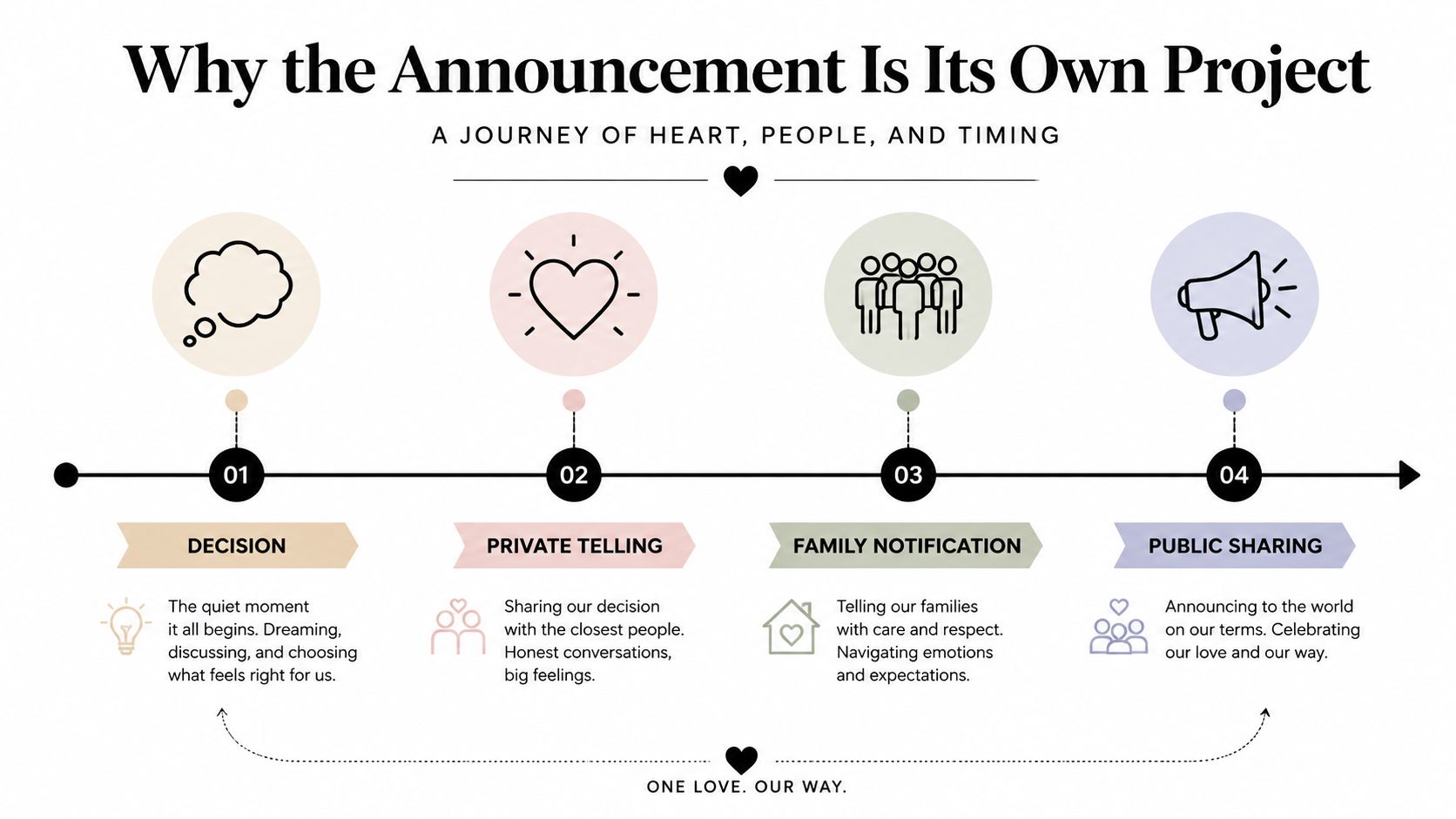
The night before an elopement, the hard part usually isn't the vow. It's the mental list of who gets told first, who might be hurt, and who absolutely must not find out from Instagram before breakfast. That's why the announcement deserves its own plan, not a rushed afterthought squeezed between dress packing and a bouquet run.
The message is not the strategy
A lot of couples think the issue is wording. It usually isn't. The friction often comes from sequencing, because the same sentence can feel loving or careless depending on who heard it first and how much room they had to process.
Privacy is still a major reason couples elope, and the data backs up how emotionally charged this can be. One compiled elopement report says 68% of couples who elope do so without guests present, 73% cite avoiding family disagreements or drama, and 22% do not tell any family members beforehand (elopement statistics). That means many families are reacting to timing as much as content. If the marriage is announced cold, from a distance, or after social media has already spilled the news, the conversation starts with hurt.
Practical rule: the announcement should reduce surprise, not amplify it.
The strongest approach is a two-stage reveal. First, share the marriage in a private, respectful way. Later, if there's going to be a celebration, announce that separately as a second moment. That gives relatives a clean emotional path. They can absorb the marriage first, then decide how they want to participate in the party, reception, or informal gathering that follows.
Why the two-stage reveal works better
A single all-at-once announcement tries to do too much. It asks relatives to celebrate, process exclusion, understand the choice, and maybe save the date, all in one breath. That's not realistic, especially when some family members expected a traditional wedding.
A staged approach lets the couple stay intentional. The marriage message can be short and warm. The later celebration invite can be upbeat and practical. That split also fits the reality that elopement is now a recognized modern wedding style rather than an odd exception. It makes the tone confident, not defensive.
For couples who want a simple playbook, keep this framing in mind: private first, public second, celebration last if needed. For broader PR-style planning, a communication plan example is useful as a model for ordering messages without overcomplicating them.
Building Your Announcement Sequencing Plan
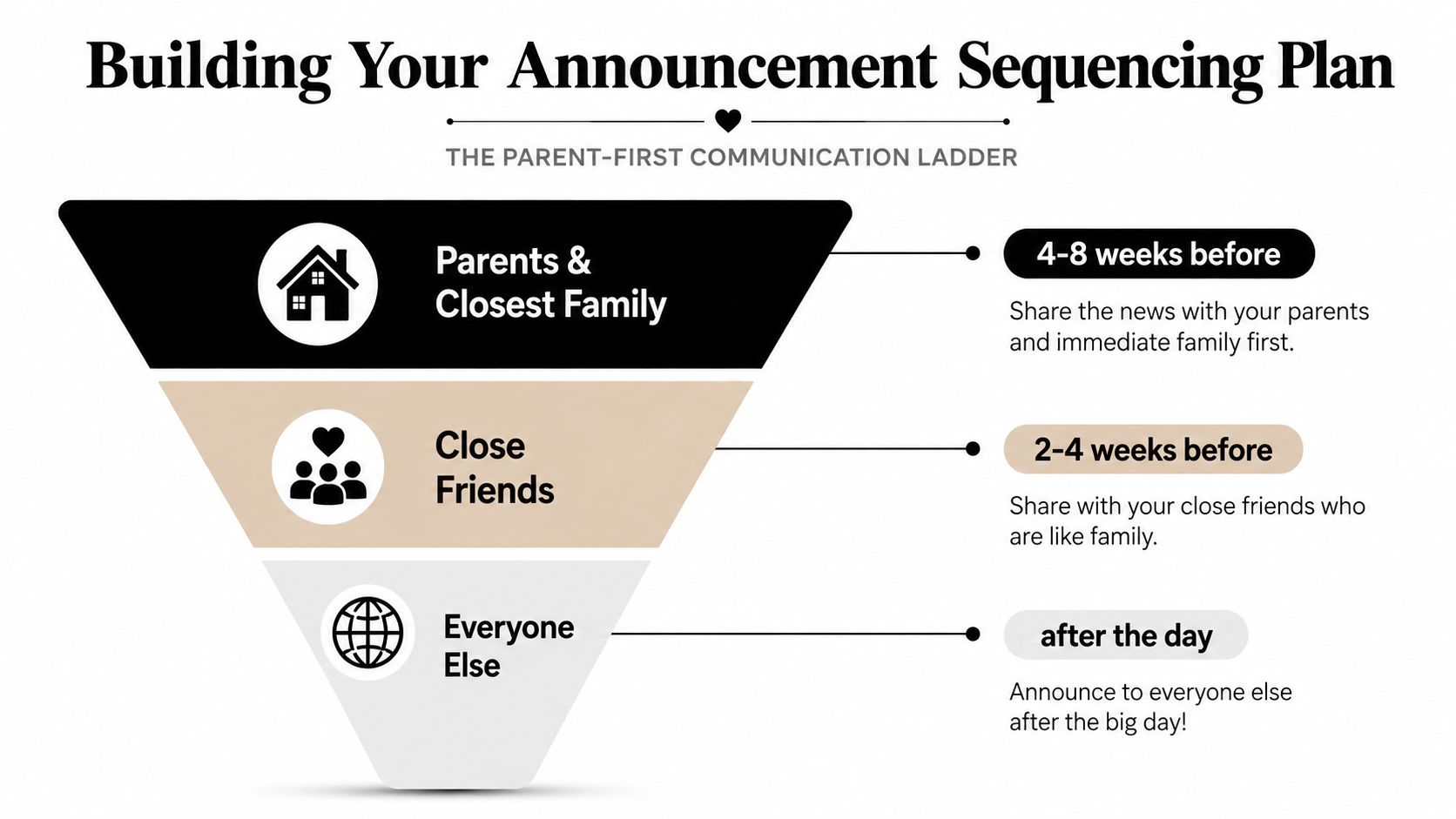
The cleanest way to announce an elopement is to think in layers. The first layer is the people who are most likely to feel blindsided, usually parents or closest family. The next layer is the people who will be excited but don't need advance notice to the same degree. The last layer is everyone else, including social followers and distant relatives who can hear it after the fact.
Start with the parent-first ladder
A widely used timing guide recommends telling parents or closest family 4 to 8 weeks before the event, close friends 2 to 4 weeks before, and everyone else after the day unless they're being invited to a celebration (announcement scripts and timing). That order isn't about being dramatic. It's about giving the people with the biggest emotional stake enough time to absorb the news before it becomes public.
Use the most personal channel for the most sensitive person. In-person is ideal for parents when possible. Video call is the next best choice if distance or schedules make face-to-face impossible. Siblings or very close relatives can get a phone call or voice note. Friends can usually hear it in a text, group chat, or email without damage to the relationship.
Strong boundary: if someone is likely to spiral, argue, or guilt-trip, do not start with text.
Build the sequence on one page
A simple one-page plan avoids chaos. Write three columns.
- Who hears it first: parents, siblings, closest friends, everyone else.
- How they hear it: in person, video, phone, voice note, text, group chat, email.
- What they get: marriage news only, marriage plus celebration note, or public announcement link.
This is also where personality and family politics matter. A parent who needs reassurance may need a longer call. A sibling who hates phone conversations may do better with a voice note followed by a text. Time zones matter too, because a midnight notification reads as careless even if the wording is perfect.
Break the order only for a real reason. A seriously ill parent, a deployed service member, or a time-sensitive situation that changes the family's expectations can justify a different sequence. Outside of that, stay with the ladder. It protects the couple from impulsive decisions and protects relatives from feeling replaced by the internet.
Ready-to-Use Message Templates for Family and Friends
The best wording for an elopement announcement sounds calm, not apologetic. It should acknowledge the relationship, state the decision clearly, and leave no opening for a debate disguised as curiosity. That's especially useful when a family member already assumes they're being excluded on purpose.
Templates for parents and grandparents
Warm and personal, for parents
“We wanted to tell you first. We've decided to elope, and the ceremony is going to be intimate and very intentional for us. We know that may be surprising, but we wanted you to hear it directly from us because you matter to us.”
Brief and matter-of-fact, for a parent who prefers straight talk
“We're eloping, and we wanted you to know before anyone else. This is the right choice for us, and we'd love to share photos and details afterward.”
Gentle but firm, for a grandparent who may feel hurt
“We know this may not be what you pictured, and we understand that it can feel disappointing. We're choosing a private ceremony, and we still want you to feel included in our lives and the celebration that comes after.”
Grandparents often need reassurance more than explanation. Keep the message about connection, not logistics. Avoid overloading the conversation with venue details, costs, or the backstory of why a big wedding felt wrong.
Scripts for siblings and the inner circle
Warm and personal
“We're excited, and we wanted you to know directly. We're eloping because this feels like the most authentic way to start our marriage, and we'd love your support.”
Brief and matter-of-fact
“We've decided to elope. We didn't want you to hear it secondhand, and we'll share the details after the day.”
Gentle but firm
“We know this may come as a surprise. The decision is made, and what matters most to us now is keeping the announcement respectful and simple.”
If a best friend expected to stand beside the couple at a traditional wedding, honesty matters more than polish. A text can open the door, but a call should follow if the friendship is close enough to deserve one. The person may still feel disappointed, and that's normal.
The same logic applies to tone and delivery. If the recipient is emotionally tender, switch from text to voice. If the relationship is easygoing, a clear message is usually enough.
For more adaptable structure, a template guide can help turn these drafts into messages that sound less stiff and more like the couple.
Social Media Announcements That Land Well
A public elopement reveal should feel like a celebration, not a confession. Once the inner circle knows, the social post can be short, warm, and visually clean. The goal is to show the marriage, not defend the decision.
Post the marriage, then keep the rest simple
Instagram is usually the first place to post because it handles images and short captions well. A carousel works better than a pile of singles because it lets the couple control the story, one image at a time. Facebook can carry the same message for older relatives and family friends who still live there. TikTok works if the couple wants something playful, but it should never be the only version of the announcement.
Use ceremony photos first. Details matter less than the actual moment the marriage happened. A candid kiss, a handhold, a ring shot, and one portrait are usually enough. Twenty near-identical images make the post feel like a dump instead of a reveal.
Caption template, warm and direct
“We eloped and couldn't be happier. We wanted a day that felt private, intentional, and true to us, and we're grateful for everyone who's cheering us on.”
Caption template, simple and upbeat
“We made it official. We chose an intimate elopement, and we're so happy to share the news.”
Caption template, celebration invite included
“We eloped and are sharing the joy now. We're excited to celebrate with loved ones soon and will share details separately.”
Hashtags should stay minimal. A couple of clear, readable tags are enough if the post is public. Don't bury the story in a wall of hashtags or overly theatrical text.
Decide in advance how public the post should be
If family drama is likely, comments can be turned off or tightly monitored. That's not rude. It's damage control. A single “Why weren't we invited?” thread can hijack an otherwise happy post and force the couple into explanations they never wanted to give online.
Tagging etiquette should be handled carefully. Tag only people who gave permission, and don't tag relatives who weren't informed yet. The day-of post can be minimal, just enough to acknowledge the marriage. The day-after post can carry a fuller gallery if the couple wants to share more.
A social media PR guide can be helpful for thinking through platform order, caption shape, and audience control without making the post feel corporate.
Formal Announcements and Press Releases
Not every elopement deserves a press release. Most don't. But some situations call for a more formal announcement, especially when the marriage connects to public-facing work, a destination partnership, or a charitable angle.
When a formal statement makes sense
A press release can fit if the elopement involves a tourism board, a venue collaboration, a charity tie-in, or a public-facing couple whose audiences expect a polished statement. That includes executive unions, public figures, and some creative professionals who are already used to formal media language. It also fits when the marriage itself is part of a larger public story, not just a private family event.
For couples who need a release format, the structure should stay lean. Start with FOR IMMEDIATE RELEASE, add a dateline, write a lead paragraph that answers who, what, when, where, and why, include a brief quote, and close with a short boilerplate. That's the whole backbone. Anything more risks turning a personal announcement into corporate wallpaper.
A sample shape looks like this.
FOR IMMEDIATE RELEASE
[Dateline]
[Couple names] announced their elopement in [location] on [date], choosing an intimate ceremony that reflected their priorities and setting. The couple shared the news with family first and will celebrate with loved ones at a later gathering.
“[Short quote about the meaning of the day],” the couple said.
About the couple: [One or two sentences of background relevant to the announcement.]
If local newspapers are part of the plan, contact them directly and keep the note concise. They don't need a dramatic pitch. They need a clean headline, the essential facts, and a reason the announcement matters to their audience.
For couples who want a layout reference, Wedding Studio can be useful as a design or presentation point of comparison when deciding how formal the final announcement should look.

Etiquette Landmines and Sensitive Wording
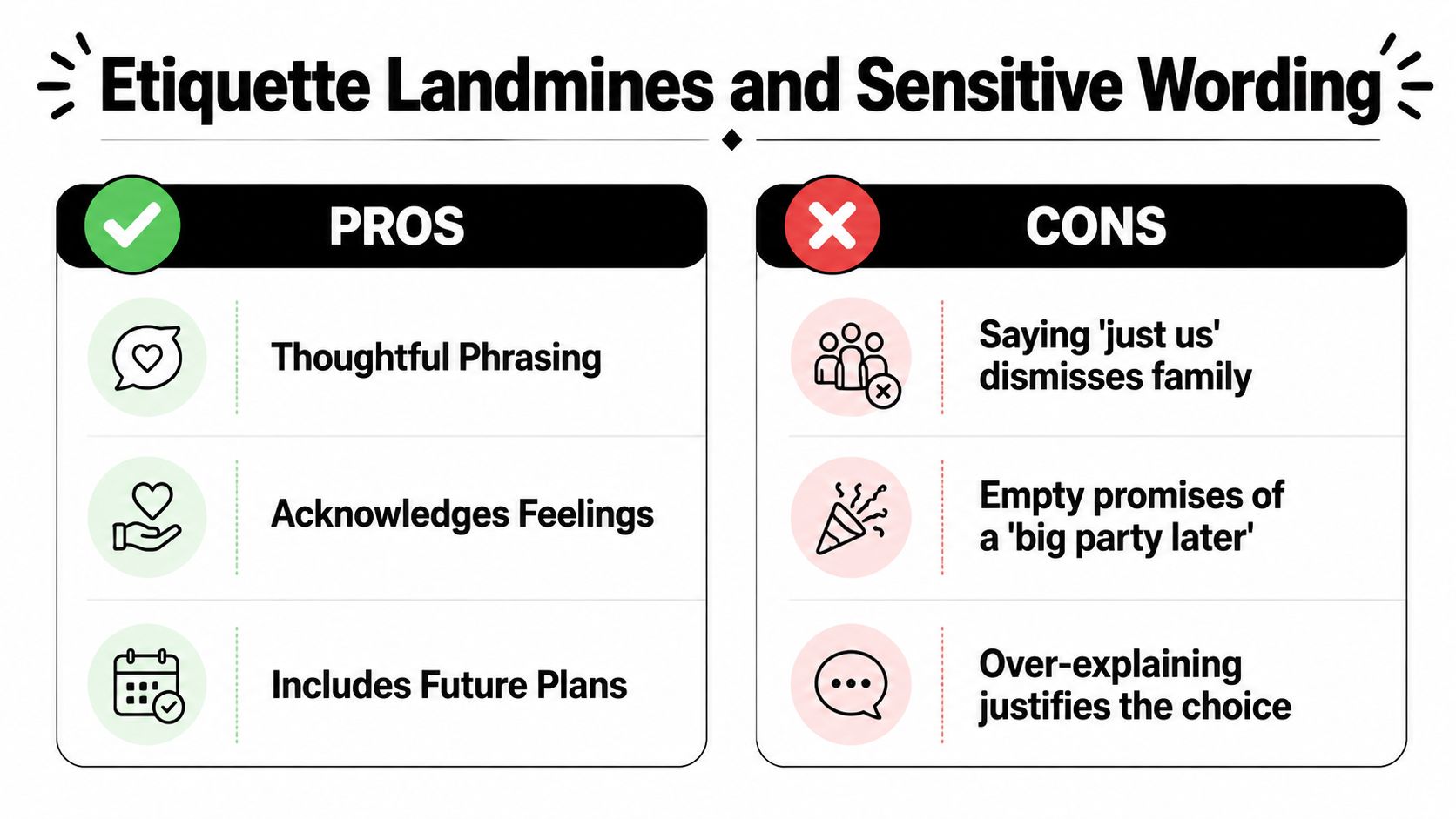
The wrong sentence can sting harder than the elopement itself. Saying “just us” may sound casual to the couple, but it can read as a dismissal of everyone who expected to matter. The fix is simple, speak in a way that respects feelings without pretending the family was part of the ceremony when they weren't.
What to say and what to avoid
Do say
- “We wanted to tell you directly.” That signals respect and reduces secondhand hurt.
- “We chose a private ceremony.” Clear, simple, and less loaded than explaining every reason.
- “We'd love to celebrate with you later.” Only say this if there really is a follow-up plan.
Do not say
- “It was just us.” It can sound like everyone else didn't matter.
- “We'll make it up to you.” That phrase creates a promise the couple may not want to keep.
- “You would've understood if you knew the cost.” Cost comparisons almost always land as a lecture.
A private ceremony does not need a defense. Over-explaining often makes the message sound uncertain, and uncertainty invites debate. Keep the explanation short, especially if the listener already feels wounded.
Repair language matters more than perfection. If the first message lands badly, a follow-up should acknowledge the feeling without reopening the whole decision.
Handling cultural, religious, and family loss considerations
If a parent has died, name that absence carefully. The announcement can acknowledge the loss without making it the focus of the marriage itself. If the family has religious expectations, the wording should avoid mocking or minimizing those traditions even when the couple is stepping outside them.
When the news follows a divorce, recent family conflict, or another hard season, the tone needs to be extra plain. No jokes. No cute ambiguity. State the marriage, acknowledge that it may surprise people, and keep the door open for a calmer conversation later.
For a partner gift after the elopement, a thoughtful option like husband gifts from OnlineGifts.us can help mark the day without turning the announcement into a shopping list. The gift matters less than the message, but small gestures can soften the emotional edges.
Timing, Sequencing, and Troubleshooting Common Scenarios
The safest roadmap is still the same, tell the closest people first, then widen the circle, then decide whether a celebration announcement belongs on its own track. That sequence protects trust and keeps the public reveal from outrunning the family conversation.
| Recipient | When to Tell | Best Channel | Tone |
|---|---|---|---|
| Parents or closest family | 4 to 8 weeks before | In person or video call | Warm, direct, reassuring |
| Close friends | 2 to 4 weeks before | Phone, voice note, text, or email | Honest and concise |
| Everyone else | After the day | Social post, email, or group update | Positive and simple |
Three situations that need a firm response
Eloped without telling anyone.
Own the choice, don't over-explain it. The announcement should say the marriage happened and that the couple is sharing it now. Apologies for the surprise can be brief, but don't turn the message into a lengthy defense.
Family found out on social media first.
Call the most important person immediately. The fix here is not a better caption, it's a direct conversation that acknowledges the misstep and resets the relationship.
There's a reception or vow-renewal later.
Treat it as a separate invitation. Don't blur a celebration into a retrospective announcement. The marriage is one milestone. The gathering is another.
Keep a saveable checklist with three items. Tell the first circle. Confirm the public timing. Decide whether a second celebration announcement will follow. That's enough to keep the whole process from turning into a free-for-all.
Press Release Zen helps people shape clear announcements, from simple updates to more formal public statements, and the same structure works when an elopement needs to be shared with care. If the wording still feels messy or the timing feels risky, visit Press Release Zen for practical templates and communication guidance that make the next message easier to send.