A lot of fashion brands are stuck in the same loop. They send a few samples, chase a glossy feature, celebrate a repost from a big account, and still can't answer a simple question: did any of that move the business forward?
That gap is where strong PR for fashion lives. Not in fantasy wish lists, not in vague “brand awareness” language, and not in collecting logos for a deck. It lives in a system that turns brand identity into stories, stories into placements, placements into measurable business signals, and those signals into better decisions next season.
Fashion is unusually exposed. Brands launch into a market defined by rapid product cycles, massive consumer choice, and intense scrutiny around image, relevance, and responsibility. The global apparel and footwear market reached $1.71 billion in 2020-2021 at current prices, womenswear represented 53% of global fashion retail spending in 2018, the industry produces more than 100 billion to 150 billion clothing items each year, and it accounts for around 10% of global carbon emissions, according to global fashion industry statistics compiled by FashionUnited. In that environment, attention is not a side issue. It's part of the product.
Table of Contents
- Laying Your Narrative Foundation
- Building Your Essential Fashion Press Kit
- Planning Your Seasonal Campaign Calendar
- Mastering Media and Influencer Outreach
- Executing High-Impact Events and Collaborations
- Measuring PR Success and Proving ROI
- Frequently Asked Questions About Fashion PR
Laying Your Narrative Foundation
Brands often think their story is “female-founded,” “sustainable,” “craft-driven,” or “luxury with a modern twist.” Those are positioning fragments. They are not yet a media narrative.
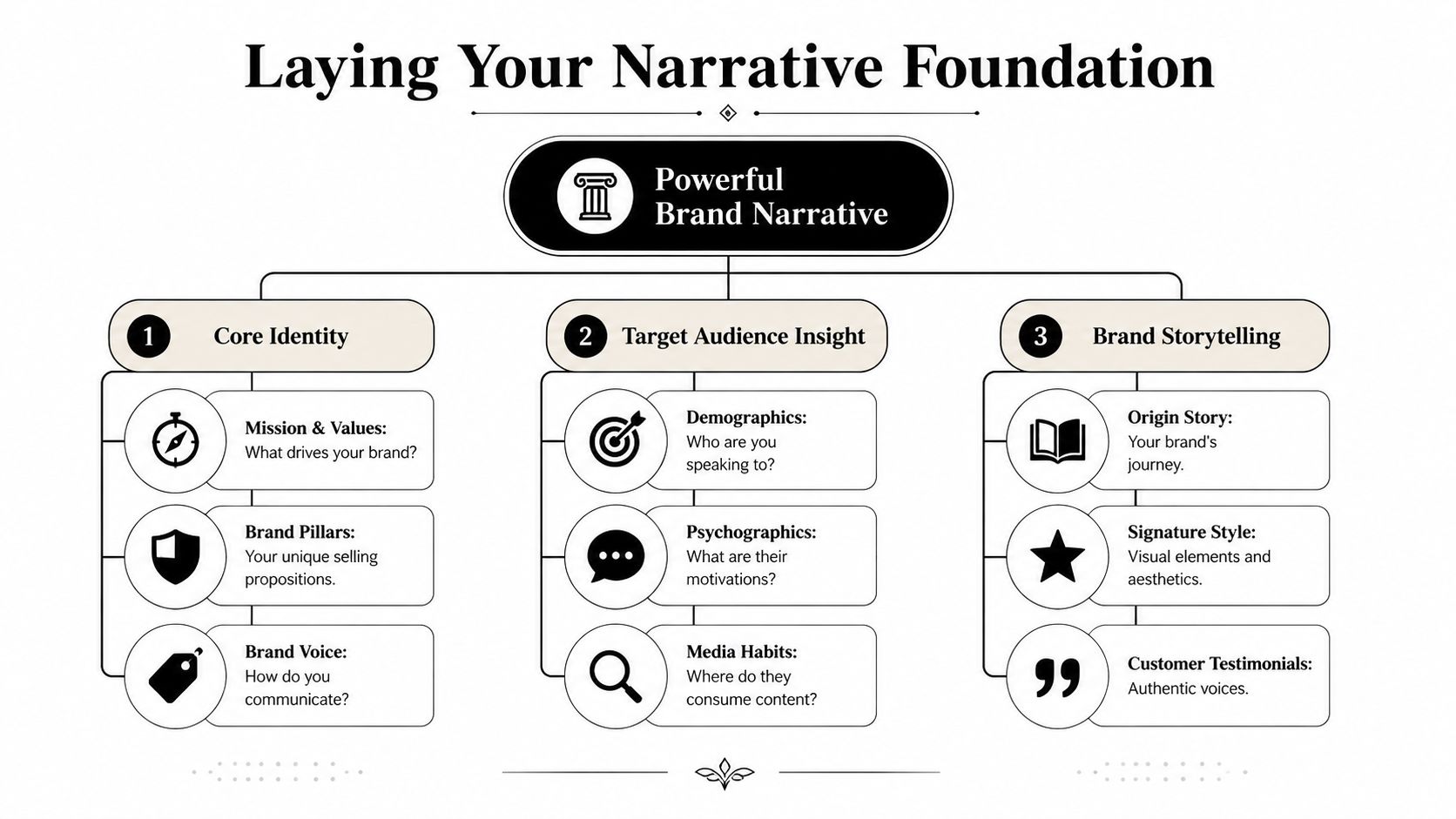
A useful narrative does three jobs at once. It tells editors why the brand matters now, tells customers what the brand stands for, and tells internal teams which details to repeat consistently. Without that foundation, PR for fashion becomes reactive. The brand pitches one thing for a product launch, another thing for a founder interview, and something else again when an influencer asks for background.
Start with the angle, not the biography
The cleanest way to build a narrative is to separate three layers.
| Layer | What it answers | Example direction |
|---|---|---|
| Core identity | What does the brand believe and make? | material discipline, occasion dressing, local production, technical fit |
| Audience insight | Who responds to this and why now? | wardrobe fatigue, event dressing needs, values-led shopping, styling convenience |
| Story frame | Why is this interesting beyond the brand itself? | cultural shift, consumer behavior change, category gap, timing tied to season |
That last column matters most. Editors don't need another founder summary. They need a reason a reader would care this week.
Practical rule: if the pitch can only be understood by someone who already works at the brand, it isn't ready.
This is also where adjacent trust signals matter. Brands selling higher-consideration products can learn from strategies for jeweler e-commerce trust, especially around transparency, proof, and reducing hesitation before purchase. Fashion PR and on-site trust building should reinforce each other, not operate as separate tracks.
Turn internal signals into editorial hooks
The strongest current shift is data-driven narrative journalism. As noted in Launchmetrics guidance on fashion PR tools and storytelling, many teams struggle with turning internal sales or consumer data into compelling media stories. The stronger approach is to use consumer behavior signals, such as styling video response, cart abandonment patterns, browsing duration, or repeat purchase trends, and shape them into timely or culturally meaningful angles rather than leading with raw internal numbers.
That changes the pitching question from “What happened in the business?” to “What does this reveal about how people are dressing, shopping, or deciding?”
A better narrative source file usually includes:
- Product signals that keep repeating. A silhouette that keeps selling out. A fabric customers describe the same way. A category customers return to before a travel season or event cycle.
- Behavior signals from the site or social channels. Which looks are saved but not purchased. Which styling posts trigger comments. Which product pages hold attention.
- Language signals from customer service, reviews, DMs, and creator feedback. Repeated phrases often become the most usable headline ideas.
Build a narrative file that the whole team can use
One working document should hold the brand's approved language, evidence, seasonal hooks, founder talking points, and editorial angles. Not a polished deck. A practical file.
Include these sections:
One-sentence brand thesis
A clear line that explains what the brand is solving or expressing.Three proof points
These can be qualitative if hard data isn't ready. The point is to back the thesis with something observed.Current cultural hooks
Event dressing, climate-aware fabrication, desk-to-dinner wardrobes, quiet statement pieces, gifting, occasion travel, or another angle that matches the collection.Words to use and avoid
This protects consistency. If every spokesperson describes the brand differently, the narrative blurs fast.
A strong narrative doesn't make PR easier because it sounds pretty. It makes PR easier because everyone can pitch from the same center.
Building Your Essential Fashion Press Kit
A fashion press kit should remove friction. If an editor, stylist, producer, buyer, or creator has to email twice for basic assets, the brand has already made the job harder than it needed to be.
The best press kits are not beautiful folders full of random files. They are working systems. Every asset has a purpose, every filename helps someone move faster, and nothing inside requires explanation.
What belongs in the folder
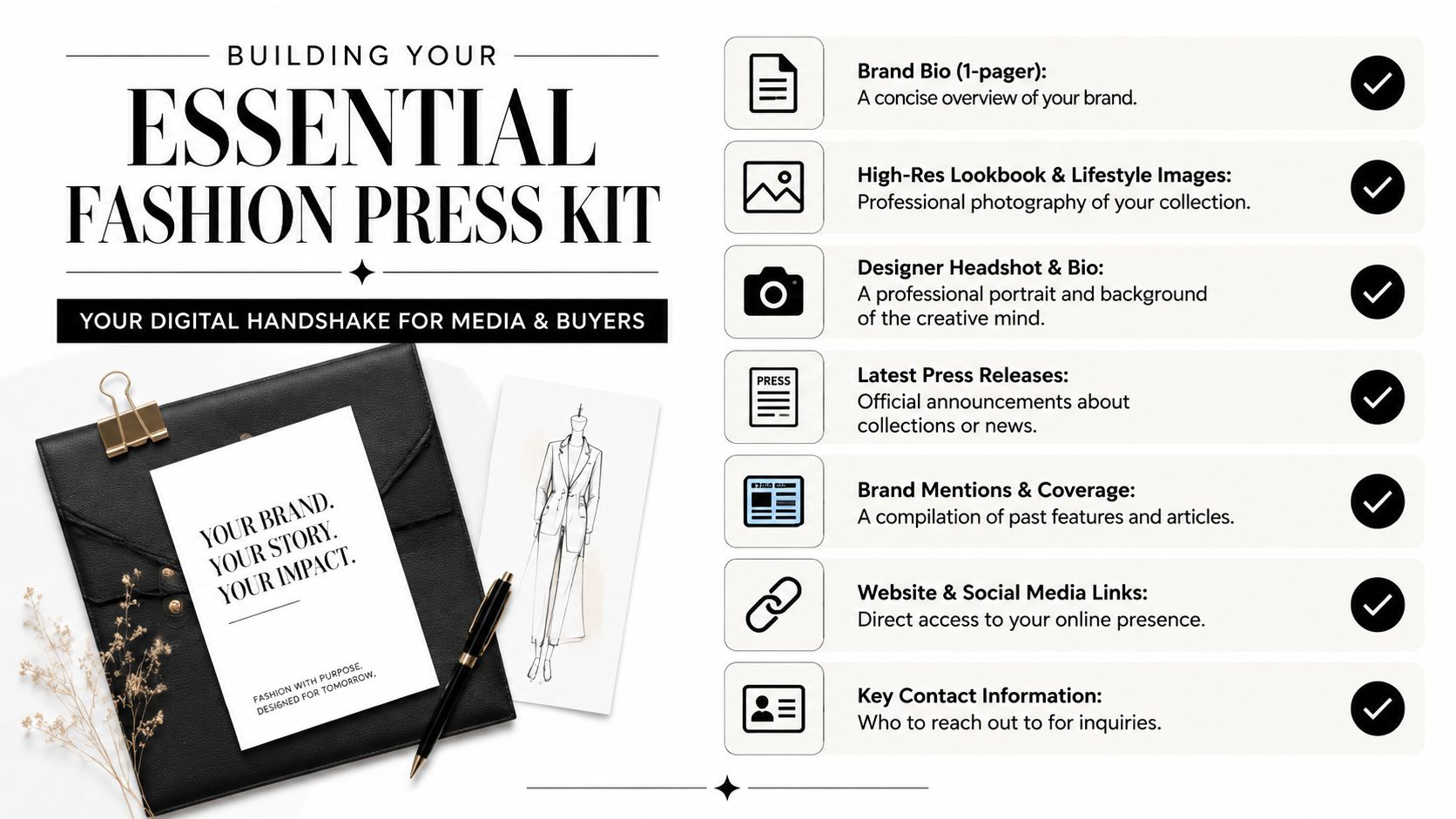
A clean digital press kit usually needs seven pieces.
Brand bio one-pager
Keep it brief. State what the brand makes, who it's for, what distinguishes it, where it's sold, and who to contact.Founder or creative director bio
This is not a life story. It should explain background, design point of view, and why this person has authority in the category.High-resolution lookbook
Show the collection as a world, not just isolated products. Include styled imagery that communicates mood, proportion, and intended use.Product cutouts or flats
Editors and stylists often need clean visuals for layouts, shopping stories, and internal planning. Lifestyle images alone won't cover that need.Latest press release
One current release is enough if it's sharp. It should announce the collection, partnership, launch, event, or retail milestone clearly.Existing coverage file
If the brand has coverage, gather links or PDFs in one place. Keep only useful examples.Contact sheet
Include PR contact, sample contact if separate, and showroom or market appointment details when relevant.
A press kit should answer the first five questions before anyone asks them.
How to organize it so people actually use it
Most weak press kits fail on structure, not content. Files arrive with names like FINAL2, newest version, or image select. That tells the recipient nothing.
Use a folder tree that mirrors real requests:
| Folder | What goes inside |
|---|---|
| 01 Brand Overview | bio, founder profile, fact sheet |
| 02 Collection Images | campaign, lookbook, still life, product cutouts |
| 03 Press Materials | current release, past releases, media notes |
| 04 Coverage | notable features, links, PDFs |
| 05 Contacts and Logistics | contact info, appointment details, sample process |
A few technical habits save time later:
- Use descriptive filenames
Include brand, season, collection name, image type, and look number if relevant. - Separate print-ready and web-ready assets
Don't make the recipient guess. - Include a short read-me doc
Mention what the folder contains and which assets are newest. - Keep cloud access simple
View access should work without back-and-forth approvals that stall deadlines.
Presentation standards that signal professionalism
A newer brand doesn't need the budget of a heritage house. It does need discipline.
The founder headshot should match the brand's quality level. The release should reflect the same language as the website. The product naming should stay consistent across lookbook, ecommerce, and outreach. When these details line up, the brand feels ready for coverage. When they don't, the media contact starts doing cleanup work, and that's rarely a good sign.
For PR for fashion, polish is not decoration. It's operational credibility.
Planning Your Seasonal Campaign Calendar
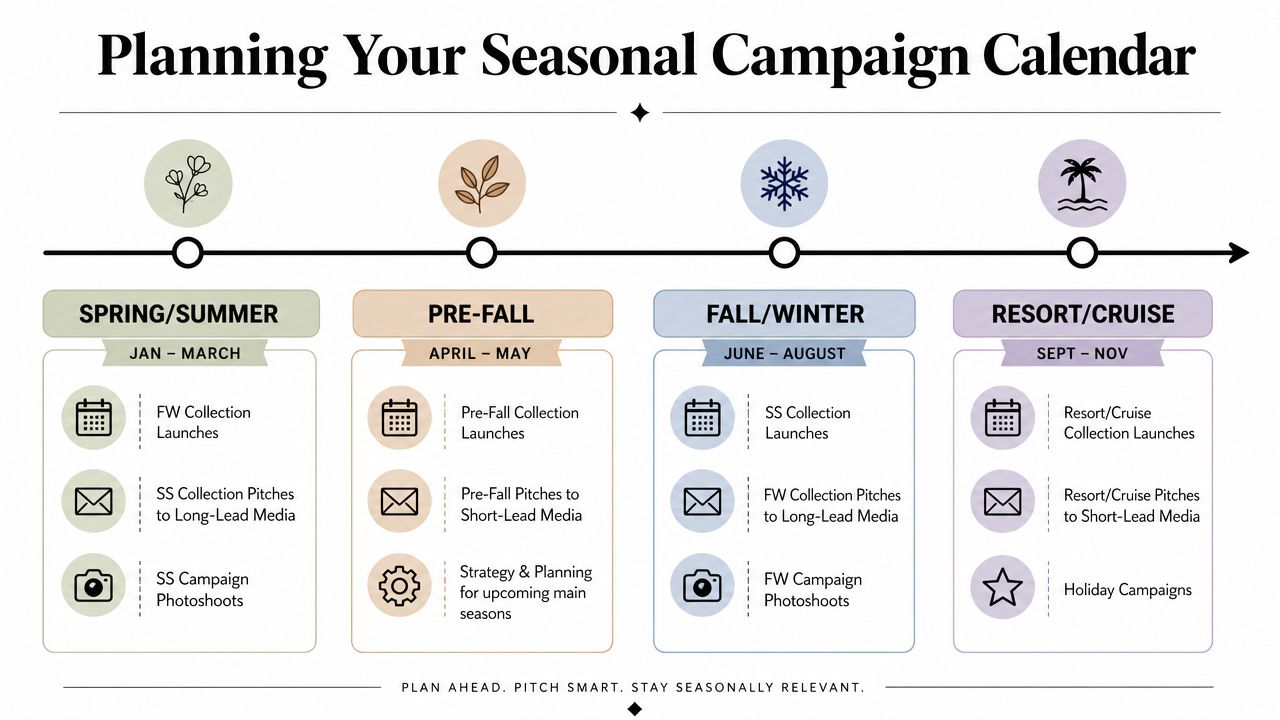
A fashion brand misses a seasonal window long before launch day. It happens when campaign images are late, samples are still stuck in production, pricing changes after editors were briefed, or the team pitches holiday product in the same week gift guides are closing. Fashion PR follows collection cycles, show calendars, retail windows, and editorial lead times, as outlined in Elle's overview of fashion PR responsibilities, which also summarizes U.S. labor data on the field. The pace is professional, crowded, and unforgiving.
Build the calendar around commercial moments
A good PR calendar starts with revenue reality. Look at last year's sell-through by category, your strongest weeks by channel, regions with unusual demand, products with high reorder rates, and the moments when average order value climbs. Those patterns give the team a sharper brief than "we need buzz for spring."
A cotton dress story hits differently if internal sales show dresses spike after the first warm weekend in your top three markets. A knitwear pitch gets stronger if returns stay low and repeat customers buy into the category each fall. That is the kind of internal data that turns a vague launch into a timely, newsworthy angle.
Start there. Then build the story, assets, and outreach schedule around the buying pattern you already see.
Work backward from the publish date
Set the external date first. Then map every dependency behind it.
Ask:
- Who needs advance access first
Long-lead editors, stylists, wholesale partners, creators, or top clients - What do they need to act
Samples, confirmed pricing, delivery timing, founder comment, imagery, line sheet, event details - What can stall the schedule internally
final product names, legal review, inventory confirmation, image approval, shipping readiness, executive sign-off
Many younger brands lose weeks when they plan the announcement and ignore the operational chain behind it.
If the sample set is incomplete, the pitch date is fiction. If pricing is still changing, the release is not ready. If inventory will not land for another month, coverage may create demand you cannot fulfill, which hurts more than a missed placement.
For controlled launches with a firm date, an embargoed press release strategy for fashion announcements can give selected media time to prepare coverage without publishing early. Use it only when the asset package is final and the contact list is disciplined.
Organize campaigns by business job
Month-by-month calendars look tidy, but they hide the reason each PR push exists. Grouping activity by business objective makes budget decisions easier and keeps teams from overinvesting in launches that look good and sell little.
| Campaign type | Primary purpose | Typical outputs |
|---|---|---|
| Collection launch | introduce new product story | release, lookbook, editor outreach, sample sends |
| Brand moment | deepen identity | founder profile, studio story, craftsmanship angle |
| Retail push | support sales windows | product placement pitches, gift guides, creator seeding |
| Reputation layer | shape perception | sustainability updates, partnership storytelling, behind-the-scenes content |
This mix matters because fashion PR cannot survive on launch moments alone. Brands need active stories between drops, especially during slower sales periods, pre-market appointments, and key gifting windows.
Put deadlines on the invisible work
The public-facing date is only one line on the calendar. The actual calendar includes image selects, sample trafficking, showroom prep, outreach list approvals, founder availability, retailer coordination, and post-campaign review.
Include all of these:
- asset lock dates
- pitch windows by audience type
- sample booking and return periods
- event and appointment dates
- follow-up windows
- review meetings tied to results
The review block should connect back to business outcomes. Which placements drove referral traffic. Which creator sends led to product page visits. Which story angle helped wholesale conversations. Which launch week activity correlated with stronger conversion or lower paid media pressure. Those are the answers that improve the next season's plan.
Visibility matters. Useful visibility matters more.
Mastering Media and Influencer Outreach
A weak outreach strategy usually looks impressive on paper. Big names. Big follower counts. Big publication logos. Then the replies are thin, the placements are vague, and the traffic doesn't line up with the effort.
Smart PR for fashion is narrower than people expect. Better targeting beats broader aspiration almost every time.
Stop chasing prestige for its own sake
The fastest way to waste budget is to confuse visibility with fit. A giant creator with broad lifestyle reach can create noise. A smaller creator whose audience already buys in your category can create action.
That isn't just a philosophical point. Micro-influencers with high audience overlap drive 15% higher ROI than generalist mega-influencers, according to Ekimetrics on influencer marketing ROI. The same source notes that fashion and beauty partnerships outperform average marketing channels when brands target creators who engage with the category.
That is the 10K versus 1M trade-off. The smaller account may have less surface-level prestige and more commercial usefulness.
A useful outreach filter asks:
- Does this person already speak to the right buyer?
- Does the audience expect fashion recommendations from them?
- Does the brand fit naturally into their existing content rhythm?
- Would a placement from them help a journalist, stylist, or customer understand the brand better?
If the answer is no, the follower count doesn't rescue the choice.
Build smaller, cleaner outreach lists
Most emerging brands build outreach lists by title alone. Fashion editor. Celebrity stylist. Influencer. That is too crude to be useful.
A more effective list is segmented by function:
| Contact type | What they need | What the brand should send |
|---|---|---|
| Editor | angle and assets | concise pitch, images, release, product details |
| Stylist | speed and sample clarity | availability, sizes, delivery timing, return process |
| Creator | fit and content relevance | personalized note, hero products, story reason |
| Producer or market editor | clean logistics | cutouts, credits, product specs, contact info |
This is why many broad blasts fail. They ignore the practical difference between someone who needs a quote, someone who needs a shoot sample tomorrow, and someone deciding whether a product belongs in a shopping edit.
The right outreach list feels almost too small. That's usually a sign it's finally targeted.
Write pitches that make selection easy
Editors and creators don't need a dramatic introduction. They need to understand the point fast.
A strong email usually includes:
A subject line with an actual angle
Not “New collection launch.” Use the story frame.A first sentence that places the news
Why this matters now, in one line.One short paragraph of proof
Product relevance, customer behavior pattern, founder expertise, or cultural timing.A clear ask
Interview, preview, sample request, roundup consideration, event attendance, or feature angle.A clean asset path
Link to press kit, image folder, or release.
If the team needs help tightening structure before outreach, a fashion brand press release template and example can help standardize the release side of the package. That matters because messy source material often produces weak pitching.
Follow-up should be measured. One reminder is normal. A second can work if something changed. Repeated nudging without a sharper angle usually lowers the brand's standing rather than helping.
Executing High-Impact Events and Collaborations
Not every brand needs a runway show. Many would get more value from a tighter event with a clear reason for people to attend and a clear path for content to travel afterward.
The easiest way to see this is through scenarios. The format should match the objective, not the other way around.
The press day scenario
A growing accessories label wants editorial depth, not just social noise. Instead of hosting a crowded launch party, the team sets up a two-day press day in a clean showroom. Appointments are staggered. Samples are grouped by story. One table shows hero products, another shows craftsmanship details, and a third shows styling pairings for upcoming seasonal coverage.
Why this works:
- Editors can inspect materials and ask useful questions.
- Stylists can pull with less confusion.
- The team gathers immediate feedback on what gets touched, photographed, and requested.
The event feels smaller, but the outputs are better. Coverage tends to be more precise because people understand the product.
The collaboration scenario
A contemporary ready-to-wear brand needs a fresh audience without drifting off-brand. Instead of partnering with a random large creator, the team collaborates with a ceramic artist whose visual world already overlaps with the collection palette and mood. The result is a limited content series, a small dinner, and a set of images that both brands can use.
This kind of partnership works when each side contributes something distinct:
| Collaboration partner | What they add | Risk if chosen poorly |
|---|---|---|
| Artist | aesthetic depth and cultural context | can feel forced if the worlds don't align |
| Non-competing brand | audience exchange and utility | can confuse positioning if price points clash |
| Creator | distribution and interpretation | can flatten the brand if content feels generic |
The strongest collaborations answer one quiet question: why these two, specifically?
The seeding scenario
A footwear brand wants more organic wear in market. Instead of mass gifting, the team builds a focused seeding list. One cluster goes to stylists who regularly dress talent in a category the shoe suits. Another goes to creators whose content already includes outfit construction and product discussion. A third is reserved for a few editors who use social informally even when the final placement may be print or digital editorial.
Seeding gets expensive when it becomes hopeful scattering. It becomes strategic when every send has a reason, a recipient fit, and a tracking method.
A brand doesn't need every event to be loud. It needs each activation to create something reusable. Better samples management, stronger imagery, relationship development, usable feedback, and coverage opportunities all count.
Measuring PR Success and Proving ROI
A fashion founder sees a brand mention go live in a top title, posts it to Instagram, and calls the week a win. Then the team checks sales, site behavior, wholesale inquiries, and waitlist activity. Nothing moved in a meaningful way. That is the gap good reporting closes.
PR earns its budget when it helps the business make better decisions. Coverage still matters, but the useful question is narrower. Which placement reached a likely buyer, carried the right message, and contributed to a result the team actually cares about?
What to measure after coverage lands
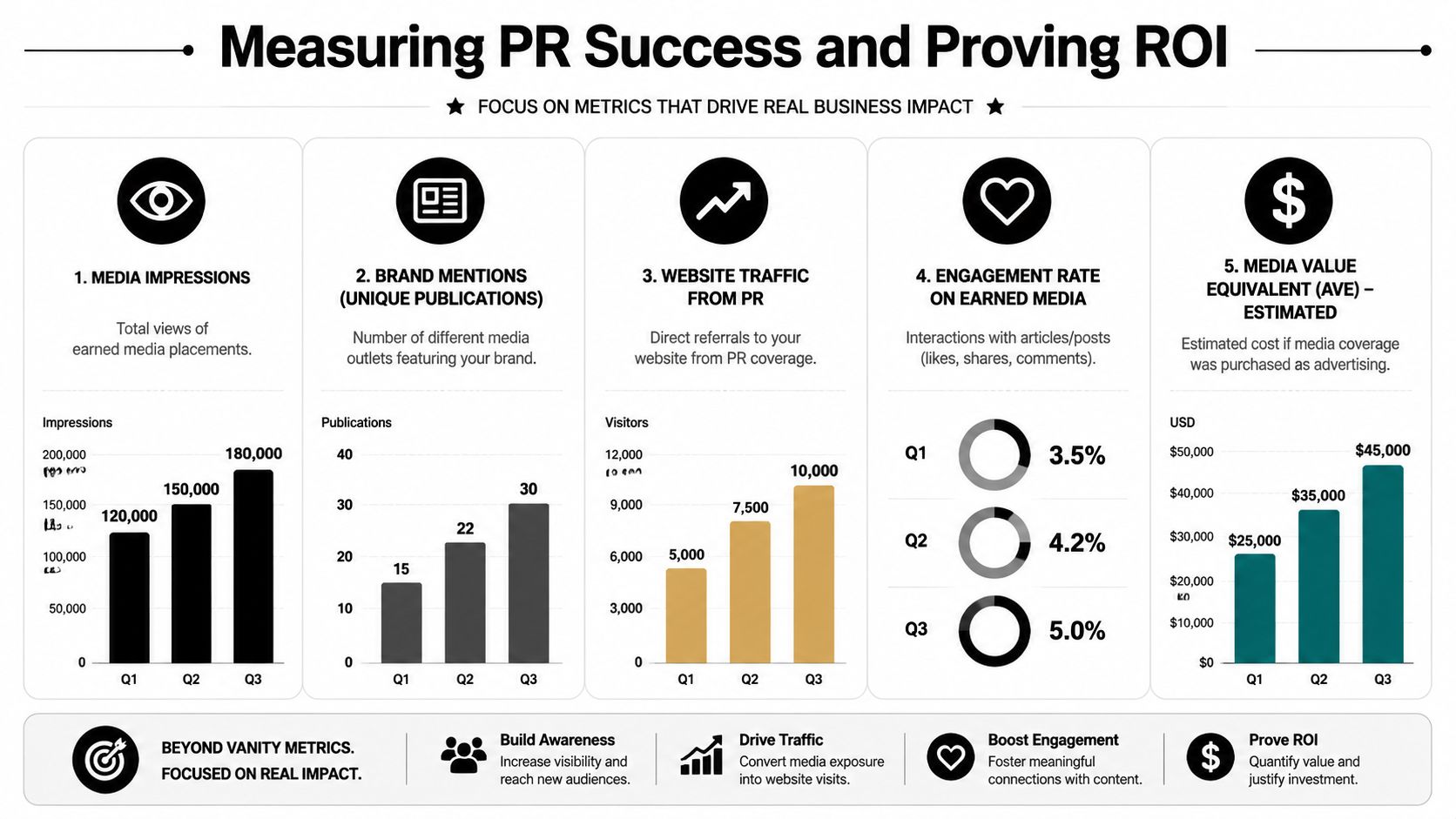
Fashion PR reporting gets clearer once the team separates visibility from business impact. A print feature, a shopping story, a creator post, and a celebrity wear moment can all be valuable, but they do different jobs. If the report treats them as interchangeable because they all generated impressions, it hides what worked.
Use a scorecard that tracks five things:
Coverage volume
Total mentions, placements, and share of voice in the category.Coverage quality
Outlet fit, message pull-through, image quality, product credit accuracy, and how prominent the brand was in the piece.Traffic and on-site behavior
Referral sessions, product page views, time on page, email sign-ups, and assisted paths to purchase.Commercial response
Sales lifts on featured SKUs, stronger conversion on highlighted categories, retailer interest, sample requests, or waitlist growth.Channel contribution
Which mix drove the result. Editorial, creators, owned social, partnerships, affiliates, or paid support around the placement.
Many fashion teams often encounter a common challenge. They report the loudest hit instead of the most useful one.
Internal data usually gives the sharper story. If press around a specific silhouette lines up with higher sell-through, more size sign-ups, or repeat traffic to that category, the next pitch should build from that demand signal. If a founder quote gets picked up but shoppers keep exiting the page, the issue may be the landing experience, not the publicity.
How to score quality, not just quantity
A weighted review system keeps the team honest. Not every mention deserves the same value, and experienced PR teams know that a small, precise placement can outperform broad exposure.
| Measurement area | Questions to ask |
|---|---|
| Outlet fit | Does this publication or creator reach the intended buyer? |
| Message pull-through | Did the piece carry the brand's actual angle, or only mention the name? |
| Visual strength | Was the product shown clearly and credited correctly? |
| Placement prominence | Was the brand a focal point or one item in a long roundup? |
| Business relevance | Did this support awareness, consideration, conversion, or retention? |
Weighting matters because trade-offs are real. A prestige title may raise credibility and help with buyers or stylists even if direct traffic is modest. A mid-tier creator may drive stronger conversion on a featured product because their audience shops with intent. Good reporting shows both outcomes without pretending they are the same kind of win.
Teams that need a cleaner monthly process can use a structured public relations reporting framework to standardize what gets tracked and compared.
Turn reporting into next-season decisions
The point of measurement is not to build a prettier recap deck. It is to decide what to repeat, what to cut, and what to test next.
If a founder interview drove better qualified traffic than a broad product roundup, book more expert commentary and fewer generic pitches. If stylists keep requesting one category for shoots but customers do not convert on it, adjust the merchandising story, pricing context, or product page. If niche creators consistently bring stronger buyers than larger fashion personalities, tighten the gifting list and protect budget for the smaller names.
This is how PR stops being a vanity line item. It becomes a working part of brand growth, tied to demand signals, conversion patterns, and the commercial goals that matter this season.
Frequently Asked Questions About Fashion PR
Most emerging brands don't need more mystique around fashion PR. They need direct answers, clean definitions, and a realistic sense of what to do first.
Common Fashion PR Questions
| Question | Answer |
|---|---|
| When should a brand start PR for fashion? | Start when the brand can support attention. That usually means clear positioning, usable imagery, a clean press kit, and someone who can respond quickly to media or sample requests. |
| Does a brand need a PR agency right away? | Not always. Early-stage brands can handle core outreach in-house if the story is clear and the contact list is focused. Agency support becomes more useful when the brand has enough news, assets, and budget to sustain outside effort. |
| What matters more, editors or influencers? | Neither matters more in every case. Editors can shape credibility and context. Creators can accelerate product discovery and audience response. The better question is which one serves the current objective. |
| How often should a brand pitch? | Pitch when there is a usable angle, not when the team feels anxious about visibility. Repetitive outreach without a fresh story trains contacts to ignore the brand. |
| What if the brand has no big numbers to share? | That isn't fatal. Many strong pitches are built on observed behavior, category insight, craftsmanship, founder expertise, or timely cultural relevance. The story has to be useful, not inflated. |
| Should samples go to everyone who asks? | No. Samples should follow strategy, stock reality, and expected value. Loose sample handling creates losses and weakens relationships when the team can't track what went where. |
| How long does PR take to show results? | Some responses are immediate, such as creator content or referral traffic after a placement. Reputation-building usually takes longer because it depends on consistency across seasons. |
| What is the biggest mistake brands make? | They chase visibility that looks impressive instead of visibility that fits the customer, supports the message, and can be measured against a real business goal. |
| Should every launch have a press release? | No. Some moments deserve a release. Others work better as targeted outreach, a founder note, a preview, or a sample-driven pitch. The format should match the story and the audience. |
| How does a brand know PR is working? | The brand should see stronger coverage quality, clearer message repetition, better referral behavior, more useful inbound interest, and sharper understanding of which voices and stories produce real value. |
Press Release Zen is a useful resource for teams that need practical support with releases, outreach structure, templates, and reporting workflows. For fashion brands managing PR in-house or tightening agency collaboration, Press Release Zen offers step-by-step guidance that can help turn scattered announcements into a more disciplined communications system.