Most advice on free press release distribution gets one thing wrong. It treats distribution as a directory submission task.
That’s why people post a release to a few free sites, paste the same link across social media, hear nothing back, and conclude that free doesn’t work.
Free can work. What doesn’t work is lazy distribution.
A useful free strategy looks less like buying reach and more like building a repeatable system. You publish the release on your own site, place it on reputable free distribution platforms, send a tighter version to a short list of relevant journalists, and then amplify it where your audience already pays attention. That combination is what turns “free” from a budget constraint into a practical advantage.
Why Free Press Release Distribution Is Your New Secret Weapon
Paid wire distribution is not the default answer many PR teams think it is.
For a startup, local business, nonprofit, consultant, or lean in-house team, a paid blast often buys reach you cannot use. Your news lands in broad databases, racks up impressions that look nice in a report, and still fails to reach the few people who could cover it.
Free distribution changes the discipline.
It pushes you to publish on channels you control, send the story to people who care about the beat, and keep using the announcement after launch day. That is why free distribution can outperform a paid blast for many everyday announcements, especially when the goal is coverage, search visibility, and steady brand discovery instead of a brief spike.

Free works when it is treated like a system
Free distribution became more practical once no-cost publishing platforms gave smaller organizations a place to host and syndicate releases without paying wire fees. That shift mattered because it lowered the barrier to entry. Small brands could start building a visible archive of news, show consistency, and create assets journalists could reference.
The bigger win was never the waived fee.
The bigger win was access to a repeatable process. Publish the release on your site. Place it on selected free platforms. Pitch a sharper version to a short media list. Rework the same news into social posts, community updates, founder commentary, and follow-up emails. That is a distribution engine, not a one-off submission habit.
Key takeaway: Free distribution works best as a multi-channel system. Owned media, targeted outreach, and amplification each do a different job.
The Upside Beyond Saving Money
Cost matters, but budget is only part of the case.
Free distribution improves decision-making because it removes the temptation to spray the same release everywhere and hope for pickup. Teams have to ask better questions. Who needs this story? Which audience might share it? What local, trade, or niche angle makes it worth opening?
That pressure is useful. It usually leads to tighter messaging and better targeting.
A well-run free process also gives you longer-term value from a single announcement:
- Owned visibility from publishing on your own site first, where the release can keep earning search traffic and support future content.
- Direct media opportunities from pitching relevant reporters, editors, bloggers, podcasters, and newsletter writers instead of waiting for passive discovery.
- Reusable content assets that can be turned into FAQ pages, sales follow-up, investor updates, local outreach, and social proof.
A release should not expire after one day. It should keep working across channels.
What free distribution often does better than broad paid blasts
Paid distribution still has a place. It can make sense for public company disclosures, regulated announcements, and news that needs formal wire handling or very wide syndication.
For routine launches, partnerships, local expansions, event news, new hires, and milestones, broad paid reach is often a poor fit. You do not need exposure to everyone. You need relevance with the right few.
That is where free distribution becomes a strong operator's tool. It helps build habits that compound. Better archives on your site. Better media lists. Better follow-up angles. Better understanding of where your audience pays attention.
Free distribution is not a stripped-down version of paid PR. It is a practical way to build a sustainable distribution engine that keeps getting sharper with each release.
The Pre-Distribution Playbook Your Press Release Needs
A weak release won’t get rescued by distribution.
That’s the hard truth. If the angle is soft, the headline is vague, and the first paragraph reads like internal company copy, free distribution will expose the problem faster than paid distribution ever will. Journalists won’t bite, readers won’t share it, and even your own social posts will feel forced.
Start with a headline that can survive outside your website
Your headline has to do two jobs. It must work as the release title on your site and as the subject line for outreach.
That means it needs to be specific, readable, and built around actual news. “Company Announces Exciting New Era” is filler. “Local Accounting Firm Opens Second Office in Bristol After Client Demand Growth” gives a reporter something concrete to evaluate.
A practical test helps. If someone saw only the headline in an inbox or search result, would they immediately know what happened and why it matters?
Use this checklist before you publish:
- Name the news: Product launch, funding, event, expansion, hire, report, partnership, milestone, award, or community initiative.
- Add a real angle: Location, audience impact, timely relevance, industry shift, or unusual detail.
- Keep the language plain: Skip “leading,” “cutting-edge,” “premier,” and other self-awarded adjectives.
Write the headline for the busiest person on your media list, not for your CEO.
Your lead paragraph needs to pass the five-second test
Most releases lose momentum in the first paragraph. They open with scene-setting, brand chest-beating, or generic mission language.
Don’t do that. Put the news in the top. The first paragraph should answer the five Ws cleanly: who, what, when, where, and why it matters. If a journalist stops after the opening lines, they should still understand the announcement.
A strong lead is short. It doesn’t make the reader dig.
Quotes should sound like a person, not a committee
Most boilerplate corporate quotes are useless because they say nothing a reporter can use.
A quote should add one of three things:
- A human motive behind the announcement
- A sharp opinion about the market
- A practical implication for customers, partners, or the community
If your quote could fit in any other company’s release, rewrite it.
Instead of saying your team is “thrilled to embark on this exciting journey,” explain what changed, what customers asked for, or why the launch happened now. Specificity is what makes a quote quotable.
Format for skim-readers and search engines
Dense press releases feel dated fast. Journalists skim. So do search crawlers.
Use short paragraphs, clear subheads when needed, and basic readability rules:
- Front-load the details: Put the strongest facts near the top.
- Use plain formatting: One idea per paragraph.
- Link with purpose: Send readers to a press kit, booking page, event page, product page, or report download.
- Prepare media assets: Have logos, executive headshots, product screenshots, and horizontal photos ready in a shared folder.
Treat the boilerplate like a mini landing page
The boilerplate often gets ignored during drafting, which is a mistake. It’s one of the most reused parts of your release.
A useful boilerplate should tell someone what the organization does, who it serves, where it operates, and what makes it relevant. Keep it stable enough to reuse, but not so generic that it reads like placeholder text.
A simple structure works well:
| Element | What it should do |
|---|---|
| Company description | Explain the business in plain English |
| Audience | Say who you serve |
| Differentiator | Mention your niche, model, or approach |
| Location or footprint | Add context for local or sector coverage |
| Next step | Point people to the right page or contact |
Build the press kit before you pitch
A press release without support materials creates friction. A reporter who has to ask for a logo, founder bio, product image, or event date may move on.
Keep a lightweight media kit ready. It doesn’t need to be fancy. It needs to be organized. Include approved visuals, short bios, company facts, contact details, and any supporting document that helps someone cover the story accurately.
That preparation is what makes free outreach feel professional instead of improvised.
Building Your Free Distribution Engine
Free press release distribution works best as a repeatable system, not a one-off submission spree. Teams that get real pickup without a budget usually combine three channels: owned media, free syndication sites, and smart amplification around the release.
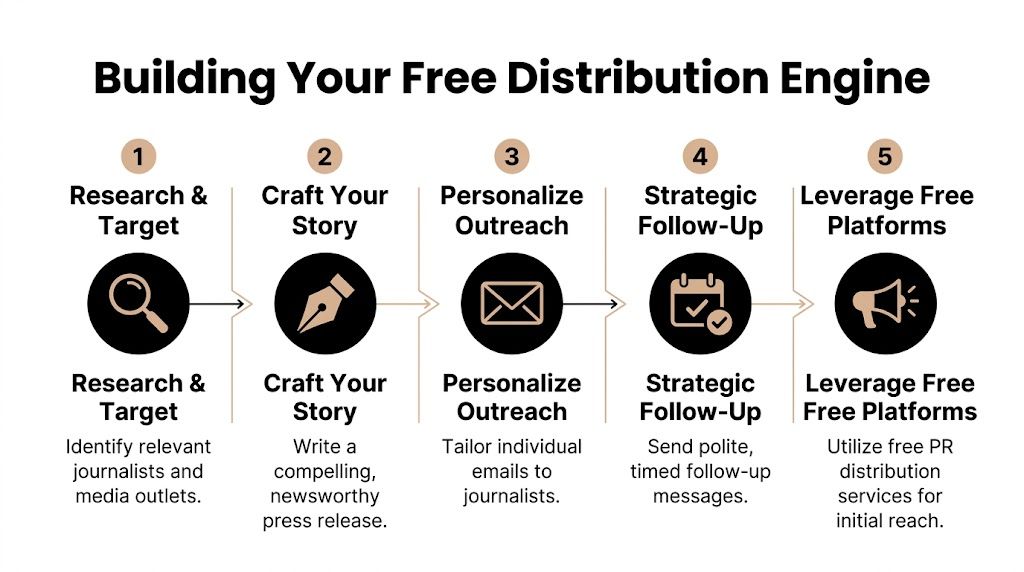
A common mistake is treating free distribution sites as the strategy. They are only one layer. The stronger play is to build a distribution engine that keeps sending signals from multiple places, all pointing back to your owned news page.
Your website is the anchor
Publish every release on your own domain first, inside a dedicated press or media section. That gives you the canonical version of the story, a permanent URL to share, and a clean place to host supporting assets.
It also gives you control. You can set the page title, add internal links, tighten the call to action, and keep every announcement archived in one place. Reporters, customers, partners, and search engines all benefit from that consistency.
If you are building that foundation from scratch, this guide to social media backlinks and website submission pairs well with a basic newsroom setup.
Publish on your site first. Every other free channel should support that page, not replace it.
Free platforms still have a job
Free press release platforms help with indexing, secondary visibility, and discovery by people who were never on your original list. That matters, especially for small brands with limited reach.
What they do not do is create context. A hosted release page can surface in search results or aggregators, but it rarely explains why the story matters to a specific reporter, buyer, or industry reader. That part still depends on your angle and your follow-through.
Here is a practical comparison set for 2026.
Top Free Press Release Distribution Sites Comparison 2026
| Platform | Key Feature | Best For | Limitations |
|---|---|---|---|
| PRLog | SEO-friendly hosted release pages and links in the body | Small businesses, nonprofits, consultants, startups | Pickup is usually foundational, not a substitute for outreach |
| openPR | Long-running free submission option with category targeting | European visibility, niche business announcements | Free posting limits can slow frequency |
| IssueWire | Free submission workflow and broad web visibility | Teams that need straightforward posting | Results depend heavily on release quality and follow-up |
| Free-Press-Release.com | Archived announcement visibility | Basic distribution support | Presentation and reach are less selective than direct pitching |
How the engine works in practice
Publishing order matters.
Many teams post to free sites first, then send cold emails, then upload the release to their own site as an afterthought. That sequence weakens the campaign. Journalists end up seeing a generic hosted page instead of your source page, and you lose the chance to concentrate traffic, links, and credibility on your own domain.
Use this sequence instead:
- Publish on your own site first with a clean URL, contact details, and working media assets.
- Submit adapted versions to free platforms based on each site's fields, categories, and formatting limits.
- Use your owned URL in outreach and social posts so every signal points back to the same source.
- Share the announcement in places your audience already pays attention to such as LinkedIn, X, Reddit communities, Slack groups, or industry forums.
- Track who engages so you can follow up where there is real interest.
The free platform supports distribution. Your site holds the asset. Your outreach creates the opportunity.
What free platforms are good at, and where they fall short
They are useful for baseline visibility. A release on a free platform can help branded searches, product-name searches, and early discovery around niche terms. It can also give your announcement enough surface area to look established when someone checks whether the news is real.
The trade-off is quality of attention.
Free sites rarely produce meaningful editorial coverage on their own. They are better at creating searchable mentions than at starting conversations. For a local business, nonprofit, early-stage startup, or solo consultant, that can still be enough to support outreach. For a competitive product launch or funding announcement, it is only one piece of the stack.
Build for repeat use
The best free distribution engine is boring in a good way. It runs on templates, habits, and cleanup after each launch.
Keep a standard newsroom format. Save your preferred release structure. Use consistent file names for images. Track every submission, post, and mention in one sheet. Note which sites indexed the release quickly, which communities drove clicks, and which angles earned replies.
That is how free distribution turns into a system instead of a scramble.
The Art of Direct Journalist Outreach Without a Budget
Free distribution sites can get your release indexed. Actual coverage usually comes from direct outreach.
Send fewer emails. Make each one sharper.

Many PR practitioners overcomplicate media lists. A paid database can save time, but it is not the starting requirement. Relevance is. Search mastheads, read recent coverage, check LinkedIn by beat and title, and scan X profiles or newsletter bios for what a reporter covers now. Build a short list by hand, then improve it with each campaign.
If you need a quick terminology check while building that list, this guide to what counts as a media outlet helps separate real targets from noise.
Good free outreach is a system, not a blast. Owned media gives you the asset. Targeted pitching gives you the shot at editorial pickup.
Build a small list with sharp fit
A list of 12 strong matches beats a list of 200 weak ones.
The filter is simple. Does this reporter cover this topic, in this format, for an audience that would care right now? If the answer is vague, leave them off.
Use four checks before you pitch:
- Recent relevance: Have they covered this topic in the past few weeks or months?
- Format fit: Do they publish quick news hits, reported features, roundups, or local business items?
- Audience fit: Would this story matter to their readers, listeners, or viewers?
- Proof of homework: Can you reference one recent piece naturally in your opening line?
That last point matters. One honest sentence about a recent article does more work than a long paragraph about your company.
Write subject lines for busy inboxes
Journalists do not need clever. They need clarity fast.
In this embargo and email outreach guidance, the presenter says embargo outreach sent 24 to 48 hours before public release can increase top-tier publication pickup by approximately 60 to 70%, and personalized email templates with subject lines under 50 characters can improve open rates by 40 to 55%.
Use that as a practical constraint. Keep the subject line short. Lead with the news angle, not your brand slogan.
Formats that work:
- New data on [topic] in [location]
- Interview opportunity with [name]
- Embargoed story for [publication]
- Local expansion news for [beat]
- Story idea tied to [recent trend]
A pitch template that sounds human
The best outreach email is easy to scan and easy to act on.
Subject: Local expansion news for retail beat
Hi [Name],
I’m reaching out because you’ve covered local retail growth and downtown openings recently.
[Company] is opening a new location in [place] on [date]. This may fit your beat because of [local hiring, customer demand, neighborhood impact, unusual business model, timely trend].
Key details:
- what’s happening
- why now
- who it affects
- what makes it different
The full release and images are here: [owned URL]
If helpful, I can set up a short interview with [founder/executive/customer partner] or send a version adapted for your audience.
Best,
[Name]
[Title]
[Phone]
That is enough for a first email.
Use exclusives and embargoes with discipline
Exclusives and embargoes can work well without a budget, but they come with trade-offs.
An exclusive gives one reporter a stronger reason to engage, but it also limits your options if they pass or stall. An embargo gives several reporters time to prepare, but it only works if the story has real substance and your timing is clear. In both cases, trust is the whole game.
Offer an exclusive only when the angle is genuinely strong and the reporter has a track record on the beat. Use an embargo when timing matters and you can provide enough context, quotes, and assets for someone to publish with confidence.
Journalists respond to fit, timing, and usefulness. Volume is a poor substitute for any of the three.
Follow up without becoming a nuisance
Weak follow-up usually fails in one of two ways. It never happens, or it adds no value.
A good follow-up is short and specific. Send one note after a reasonable pause if you have something new to add, such as a stronger local angle, a fresh quote, a clearer data point, or better images. If there is still no reply, stop.
A practical rhythm looks like this:
- Initial email: concise, relevant, complete
- Follow-up: one short note with a real update
- Final message: optional, only if something materially changed
Never send a guilt trip. Never send “just checking in” as the whole message. Give the reporter a better reason to care, or leave the inbox alone.
This is the part of a free distribution engine that compounds over time. Each launch helps you refine your list, sharpen your angle, and learn who responds.
Amplifying Your News on Social Media and Niche Forums
Free distribution breaks down when the release lives on your site, the pitch sits in an inbox, and nobody sees signs that the story is getting traction elsewhere.
Social and community channels solve that problem. They do not replace earned media outreach. They give your release more surfaces to get discovered, discussed, and clicked, which is exactly how a free distribution engine starts to compound.
Turn one release into several platform-specific assets
A press release is the source document, not the finished distribution plan.
For a product launch, turn the same news into a founder post on LinkedIn, a short X thread focused on the customer problem, an Instagram carousel with screenshots or launch photos, a Facebook post tied to local relevance, and a discussion post for a trade forum or Slack group. Each version should highlight one angle that fits the channel instead of repeating the opening paragraph from the release.
I treat this as adaptation, not reposting. A release gives the facts. Social posts give the framing, proof, and personality that help people care.
A simple repurposing stack looks like this:
- LinkedIn post: explain the business context, lesson, or market shift behind the announcement
- X post or thread: lead with the core news and one sharp takeaway
- Instagram story or carousel: use visuals, screenshots, event photos, or short founder clips
- Facebook or local groups: focus on geographic relevance or community impact
- Industry forum or subreddit: open with the problem, insight, or lesson, then add the link only where it helps
Native posts outperform copied press release text because they match how people actually read and respond on each platform.
Niche communities reward context
Reddit, trade forums, Discord servers, and professional groups can send qualified traffic and even surface your story to writers who watch those spaces. They can also shut you down fast if the post reads like an ad.
Lead with the useful part. A local real estate team might post fresh observations about a neighborhood trend and include the release as supporting context. A SaaS founder might share what changed in the workflow, what customers asked for, and what the launch says about the category. The announcement matters. The discussion value gets the click.
Community posts should start a conversation first and distribute the release second.
Multi-channel distribution beats self-hosting alone
Your newsroom or media page is still the hub. It gives you a stable URL, indexing control, and an asset journalists can reference. But on its own, it rarely creates enough motion.
Square notes in its guidance on how to distribute a press release that self-hosted releases typically generate 30 to 40% lower media pickup rates than multi-channel strategies, and that combining owned channels with targeted outreach can increase coverage by 150 to 200%.
That trade-off is easy to see in practice. A release published only on your site may rank for branded searches and help with credibility. A release supported by social posts, community discussion, direct outreach, and a page built for press releases for SEO has more chances to earn backlinks, mentions, and secondary pickup.
If you want the SEO side of amplification to keep working after launch week, this guide to link building for SEO is a useful companion.
Use a posting rhythm that extends the story
One post on launch day is rarely enough. Good amplification gives the same news a few chances to land from different angles.
Try this rollout:
| Timing | Action |
|---|---|
| Release day | Publish the release on your site and share the clearest social version |
| Later that day | Post a second angle, such as founder context, customer impact, or a quote |
| Next 2 to 3 days | Share one supporting asset at a time, such as screenshots, FAQs, photos, or reactions |
| End of week | Repost with a fresh hook tied to a question, response, trend, or early result |
This schedule works because it avoids repetition while keeping the announcement visible. It also gives journalists, customers, partners, and community members multiple entry points into the same story.
A free campaign gets stronger when every channel supports the others. Your site hosts the release. Outreach puts it in front of the right people. Social and niche forums create the surrounding activity that makes the news feel alive.
Measuring Success and Mastering Google News SEO
Free distribution only works as a repeatable channel if you measure it like a system, not a one-off post.
A release can miss a national headline and still do its job. I look for movement across search visibility, referral traffic, backlinks, journalist replies, partner interest, and assisted conversions. That is how a free distribution engine gets better over time. One release rarely carries the whole result. The combined effect of your site, outreach, reposts, and follow-up usually does.

Measure signals that predict future pickup
Start simple. Use Google Alerts for your brand name, product name, founder name, and the release headline. Check Google Search Console for impressions, clicks, and query growth on the release page. In analytics, review referral traffic from media mentions, syndication sites, social posts, and forum threads.
Then track the signals that tell you whether the story had legs:
- Backlinks earned
- Replies from journalists or editors
- Branded search lift after publication
- Demo requests, signups, or inquiries tied to the release
- Secondary mentions on blogs, newsletters, and community sites
If you want a clearer framework for how backlinks support visibility after the initial announcement, this resource on link building for SEO is worth reading.
For the release page itself, the long-term search value usually comes from how well that page is built and maintained. This guide to SEO press release strategy is useful if you want the owned version of the story to keep working after launch week.
Free PR gets easier to improve once you track leading indicators, not just headline coverage.
Google News rewards original, usable reporting
A lot of bad advice still treats Google News as a distribution shortcut. It is closer to an editorial filter.
According to Fit Small Business, Google News' 2025 to 2026 E-E-A-T updates rejected 60% more low-quality free PRs in Q1 2026, and the same review says free sites often see less than 10% inclusion rates on their own, which is why relying on submission alone is a weak plan, as noted in this analysis of free press release distribution services and Google News considerations.
That same Fit Small Business analysis says releases need to avoid duplicate content flags, include original reporting such as 300+ words with data, and use structured markup if you want a better chance of inclusion.
The trade-off is simple. Mass posting gets reach, but heavy duplication can make the story look disposable. A stronger approach is to publish the best version on your site first, then adapt the angle, quote, or supporting detail for each external placement and pitch.
Improve your odds without paying for distribution
Google News and search visibility improve when the release reads like a useful article, not a copied announcement.
Focus on four things:
- Original reporting. Include internal data, a short trend analysis, customer impact, or a real expert quote.
- Clear authorship. Use named executives or subject matter experts with titles.
- Strong structure. Write a specific headline, logical subheads, short paragraphs, and clean formatting.
- Editorial value. Give reporters something they can cite, compare, or follow up on.
Duplication control matters too.
Keep the canonical version on your own site as the fullest and strongest version. For free distribution sites, tighten the copy, change the framing, and point readers back to the original source page. That protects search value and gives your owned asset the best chance to collect links and branded queries.
Google News is not looking for a free submission. It is looking for a credible story page.
Use a one-page scorecard after every release
A spreadsheet is enough.
Track the release URL, publish date, outreach list, replies, backlinks, pickup quality, referral sources, branded search changes, and any business outcomes you can tie back to the campaign. After three to five releases, patterns show up fast. You will see which topics earn links, which headlines get ignored, which reporters reply, and which channels create assisted conversions instead of vanity traffic.
That is a key advantage of free distribution. It forces discipline. Teams that measure the full engine usually get better results than teams that pay for reach and never learn what caused pickup.
Frequently Asked Questions About Free Distribution
Free distribution pays off when you treat it as a system, not a shortcut. The release is one input. Pickup usually comes from the engine around it: your story angle, your outreach list, your owned page, and the follow-up distribution work that happens after publishing.
What if my press release gets zero pickup
Start with diagnosis, not volume.
Zero pickup usually points to one of three problems. The story had weak news value, the outreach list was too broad, or the pitch did not explain why that specific reporter should care now.
Do not resend the same release to a bigger list. Rework the angle first. Add a sharper local hook, a stronger data point, a clearer customer impact statement, or a more specific headline. Then send it to a smaller, better-matched group and reuse the announcement across your other channels.
A missed first round does not kill a release. It usually shows where the distribution engine broke.
What counts as success if I’m not paying for distribution
Success starts well before a national headline.
A useful outcome can be a niche publication mention, a quality backlink, a reply from a beat reporter, stronger branded search visibility, referral traffic from a trade community, or a piece of proof your sales team can use. Analysts at MediaHQ note in their free distribution and outreach analysis that combining free distribution sites with search and social channels can produce media pickup rates of 15 to 25%, and that personalized outreach can improve journalist reply rates by 40%.
That is why free distribution should be measured across visibility, response, authority, and business impact, not just raw placements. If you need a practical framework for that, this guide on how to measure content marketing ROI is a good place to start.
Are freemium upgrades worth it
Sometimes, but only when the upgrade solves a real problem.
Paying for broader syndication alone rarely changes the outcome if the story is weak or the targeting is sloppy. Paying can make sense if the platform gives you better formatting control, faster publishing, distribution to a niche audience you cannot reach yourself, or a workflow benefit during a time-sensitive launch.
Treat the upsell like any other media spend. Test it once, track the result, and keep it only if it improves outcomes you can see.
How many times can I reuse one press release
More than once. Usually far more.
One announcement can become a founder post on LinkedIn, a short email pitch, a Q&A for customers, a forum post for your niche community, a partner-ready blurb, a short-form video script, and a newsroom update. The smart move is not copying the same text everywhere. It is adapting the same core news for the audience and channel.
That approach builds a repeatable free distribution engine instead of forcing every release to do all the work on its own.
Should I send the full release in the email body
Usually no.
Lead with a short, personal pitch and link to the hosted release. That gives the journalist the angle fast and lets them click through if the story fits their beat. For contacts who prefer full text in email, add a plain-text version below your note. Use judgment based on the outlet and the reporter’s habits.
How often should I follow up
Once is usually enough.
A useful follow-up adds a new detail: fresh data, a customer example, a local angle, or a timely reason the story matters this week. Asking whether they saw your last email adds friction and does not improve the story.
Good follow-up improves the pitch. Bad follow-up only increases inbox fatigue.
If you want a cleaner system for drafting releases, organizing outreach, and avoiding the mistakes that kill pickup, Press Release Zen is a practical place to start. It’s built for teams that need usable templates, straight answers, and a better process for getting press releases out without wasting time or budget.