Your press release is polished. The launch date is set. The spokesperson has talking points. Then a reporter opens your email and decides, in a few seconds, whether this is worth showing up for.
A media advisory exists to win that decision.
It is a short, practical document built around the five W's. The job is simple: tell journalists what is happening, why it may be worth covering, and how to attend or get access. A press release carries the fuller narrative. The advisory handles attendance, timing, access, visuals, and interview availability.
The distinction matters because these assets fail in different ways. I see teams overload advisories with brand copy, product claims, and background that belongs in the release or press kit. Reporters then have to hunt for the details that drive coverage.
A strong example of a media advisory keeps the bar low for action:
- It gives a clear reason to care. What is new, timely, visual, or exclusive?
- It answers logistics fast. Date, time, location, format, access instructions, and contact details should be easy to spot.
- It signals what coverage is possible. Attendance, filming, interviews, embargoed briefings, or remote access.
- It respects the reporter's workflow. Short enough to scan. Specific enough to act on.
The best media advisories do not try to tell the whole story. They reduce friction between interest and attendance.
This article goes past template language. The six examples below show why each format works, where it breaks down, and what to adjust based on the situation. A launch advisory needs anticipation and operational clarity. A crisis advisory needs speed, control, and accuracy. A leadership change needs context without sounding defensive.
Use these examples as strategy models, not fill-in-the-blank documents. Format follows the reporting need. That is the difference between an advisory that gets ignored and one that gets a reply.
1. Product Launch Media Advisory
Product launches tempt teams to overexplain. That’s usually the first mistake. A product launch advisory should create anticipation and make attendance easy, not dump every feature and claim into the invite.
Start with what’s newsworthy. If it’s a live demo, say that. If media can test the product, say that. If a product manager or founder is available for interviews, put that near the top. Journalists covering launches want the operational details fast.
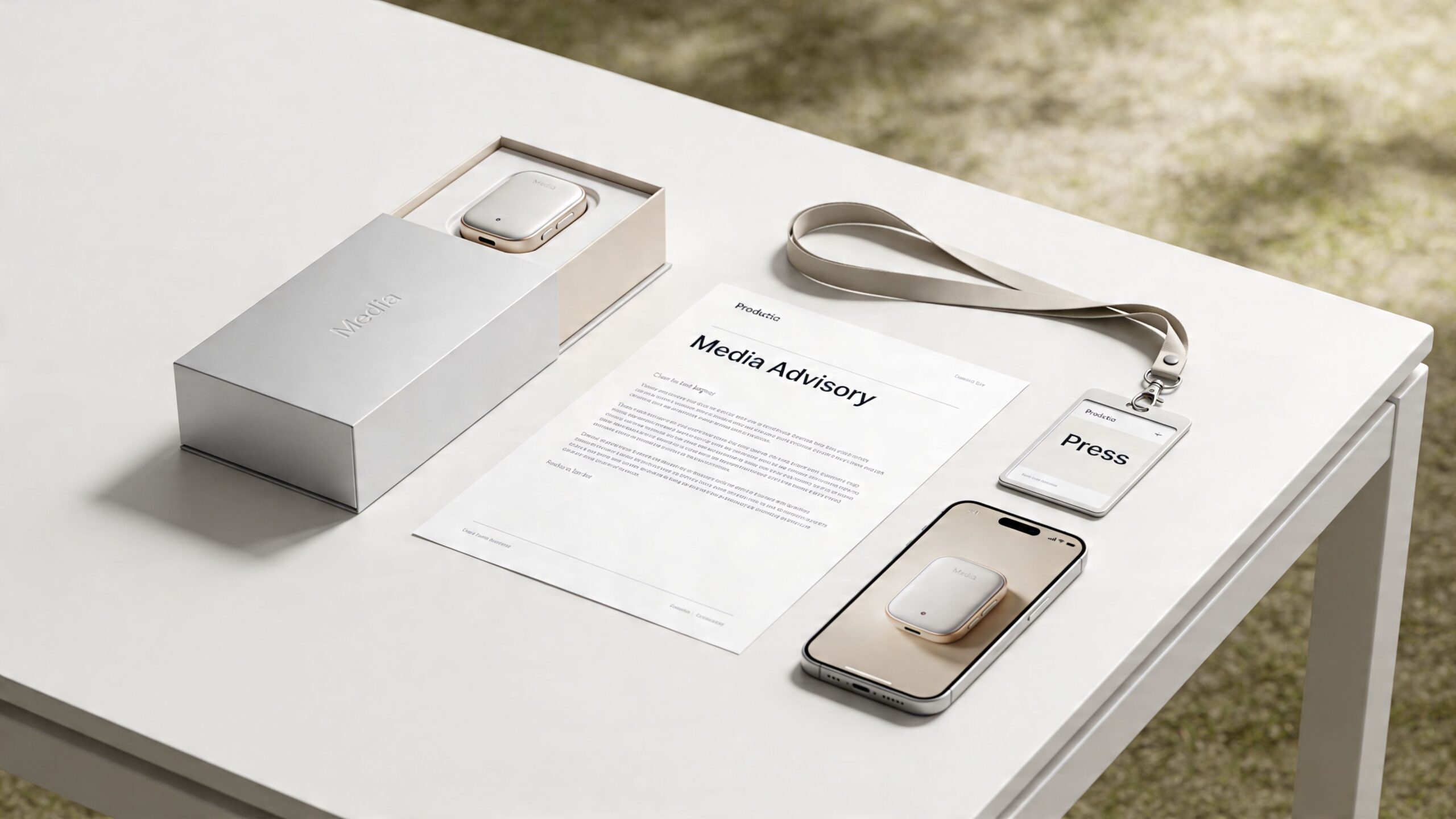
Early in the workflow, I like to keep the physical and digital assets separate. The advisory gets the invitation right. The press release, fact sheet, images, and demo notes live in the press kit.
What belongs in the launch version
A good example of a media advisory for a launch usually includes:
- Headline with the reveal angle: Name the product and the reason media should care, such as a first look, live demo, or executive briefing.
- Clear event logistics: Include date, time, timezone, location, access instructions, and whether the event is in person, virtual, or hybrid.
- Interview availability: List who’s available, such as the CEO, product lead, or engineering lead.
- Visual hook: Mention demos, hands-on stations, before-and-after comparisons, or a staged reveal.
- Embargo handling: If you’re offering advance access, state the embargo terms plainly and keep them consistent across outreach.
Practical rule: If a reporter can’t tell within a few seconds whether they’ll see something new on-site, the advisory is doing too much promotion and not enough invitation.
Apple-style launch invites work because they promise a reveal moment. Microsoft event advisories tend to work when they clarify access, speaker lineup, and timing around product announcements. Startups can use the same structure, especially when a funding announcement and product release happen together.
What doesn’t work is stuffing in every specification. Save deep technical details for the press release, media briefing, or downloadable product sheet. The advisory only needs enough detail to justify attendance.
A short training clip can help your team see the difference between hype and useful setup:
A stripped-down template
Use this shape:
MEDIA ADVISORY
[Brand] to unveil [product] at live media eventWho: [Executive names and titles]
What: Live product launch and media demo
When: [Date, time, timezone]
Where: [Venue or streaming access instructions]
Why: [One sentence on what makes the launch timely or distinctive]
Media opportunities: Product demos, interviews, photo/video access
RSVP: [Media contact name, email, phone]
If you’re choosing between a launch advisory and a launch press release, don’t treat them as interchangeable. The advisory gets attendance. The release carries the story.
2. Executive Leadership Transition Media Advisory
Leadership changes are where tone matters as much as format. A sloppy advisory can trigger speculation. A disciplined one signals continuity, access, and control.
This format works best when there’s an event, briefing, media call, or scheduled Q&A attached to the transition. If there’s no media moment, a direct pitch or press release may be better than forcing an advisory.
One of the strongest contrarian uses of an advisory is the executive transition briefing. That use case is often underserved in standard templates, which focus mostly on public events rather than narrative-shaping moments around leadership change, as noted in this media advisory template discussion.
What reporters need in a transition advisory
For CEO, president, executive director, or founder transitions, keep the advisory factual and restrained. Reporters usually want answers to four things right away:
- Who is incoming and outgoing: Full names, titles, and the effective timeline.
- Why now: Keep this concise. Succession, retirement, board appointment, planned transition, or role change.
- What happens next: State whether the incoming leader will be available for questions and whether the outgoing leader remains involved.
- Why the event matters: Earnings call overlap, strategic reset, market expansion, governance change, or nonprofit mission continuity.
If your team also needs a companion announcement, this new CEO press release guide is the right paired asset.
Keep the advisory neutral. If the language sounds defensive, reporters will assume there’s something to defend.
A bank announcing a new CEO, a nonprofit introducing a new executive director, or a founder moving into a chair role can all use the same skeleton. What changes is the sensitivity level. Public companies often need tighter alignment with investor relations and legal review. Nonprofits usually need stronger mission continuity language and board visibility.
A format that reduces confusion
A solid example of a media advisory here looks like this in practice:
MEDIA ADVISORY
[Organization] to host media availability on leadership transitionWho: [Incoming executive], [outgoing executive], [board chair or lead director]
What: Media briefing regarding leadership transition and next-phase strategy
When: [Date, time, timezone]
Where: [Office, conference venue, or virtual link instructions]
Why: [One sentence explaining the significance of the transition]
Interview opportunities: [Names and availability windows]
Media contact: [Name, email, phone]
What doesn’t work is turning the advisory into a tribute letter. Save the biography and full praise for the release or backgrounder. In the advisory, clarity beats ceremony every time.
3. Conference or Event Media Advisory
Conference advisories live or die on logistics. If reporters have to hunt for your session time, room, access rules, or interview window, you’ve already lost momentum.
This format is especially useful when the event itself is crowded. CES, SXSW, Dreamforce, NAB Show, and large trade conferences all produce inbox overload. The advisory has to earn attention by being fast to scan and precise.
The strongest event advisories stay within one page, often use bullet points, and focus on the hook, speaker names, exact timing, full location details, and a contact line. Guidance like that appears in this quick reference for creating media advisories.

What makes this format work
At conferences, journalists don’t need a broad company overview. They need to know whether stopping by your event is worth the time. The answer usually comes from one of these:
- Exclusive news: A launch, funding announcement, research reveal, or partnership.
- Recognizable speaker: A founder, analyst, policymaker, or customer with a real story.
- Visual access: Demo station, backstage walkthrough, product test area, or photo opportunity.
- Convenience: Clear registration path, badge instructions, and interview slots before or after the session.
A company speaking at CES might promote a product reveal plus hands-on time. A nonprofit gala advisory might lead with a keynote guest and a visual award presentation. A B2B software company at Dreamforce might pitch a session only if there’s actual news attached, not just “our team will be there.”
Reporters on event deadlines reward specificity. “Booth 1142, demo at 2 p.m., interviews from 2:30 to 3” beats polished brand language every time.
If you’re building a broader event communications plan, this guide to conference announcement press release examples and templates is a useful companion.
A conference-ready structure
Use a compact format:
MEDIA ADVISORY
[Company] to announce [topic] at [conference name]Who: [Speaker names and titles]
What: [Session, announcement, panel, demo, or press briefing]
When: [Date, time, timezone]
Where: [Convention center, room, booth number, or virtual access]
Why: [One sentence on relevance and news value]
Media details: Registration info, interview availability, asset access
Contact: [Name, email, phone]
What usually fails here is vagueness. “Visit us at Booth 820” isn’t news. “CEO to announce interoperability partnership at Booth 820, followed by media demos” gives a reporter a reason to care.
4. Crisis or Rapid Response Media Advisory
In a crisis, the advisory has a different job. It isn’t trying to build excitement. It’s trying to establish order.
That means speed, clarity, and zero ornament. Product recalls, data breaches, safety incidents, service outages, executive misconduct investigations, operational shutdowns. These situations punish slow or vague communication.
Royal Caribbean Group’s handling of pandemic-era briefings is a useful real-world signal. In the March 2020 CDC No Sail Order period, the company used tightly coordinated advisories to notify journalists about recurring safety briefings and executive photo opportunities, with detailed timelines and access instructions, according to this PRSA Silver Anvil case study collection.
What a crisis advisory must include
Crisis advisories need fewer adjectives and more operational detail:
- What happened: State the issue plainly.
- What the media event is: Briefing, statement, live Q&A, site update, or virtual press conference.
- Who will speak: Name the spokesperson and any subject-matter experts.
- When the next update is expected: If facts are still developing, commit to the next communication point.
- Where journalists can get help: Hotline, media desk, status page, or dedicated inbox.
This is also where weak phrasing causes damage. Avoid “isolated incident,” “out of an abundance of caution,” or anything that sounds like minimization unless legal and facts require that wording. Reporters hear that language all the time and often treat it as a red flag.
For teams building a fuller response plan, these crisis communication best practices are worth having on hand before you need them.
Say what the briefing is about, who will answer questions, and when the next update is coming. That alone lowers confusion.
A fast, usable template
MEDIA ADVISORY
[Organization] to provide media briefing regarding [incident]Who: [Spokesperson name and title], [relevant expert if appropriate]
What: Media briefing and Q&A regarding [incident or disruption]
When: [Date, time, timezone]
Where: [Location or virtual access details]
Why: [One sentence on why the briefing is being held now]
Public information resources: [Customer service page, hotline, status page]
Media contact: [Name, email, phone]
What works is a calm operational tone. What doesn’t work is trying to “win” the narrative in the advisory itself. The advisory opens the door to your briefing. It doesn’t replace the briefing.
5. Research, Study, or Report Release Media Advisory
Research advisories work when they frame the finding as news, not content marketing. That’s the distinction many teams miss.
If you’re releasing a study, survey, benchmark, or report, the advisory should lead with the finding that creates urgency. Not every chart belongs in the invite. One sharp line is enough if it points to a real public, industry, or market implication.
Media advisories are commonly used for briefings around new studies and announcements. They’re most effective when there’s new information to share and a reason for journalists to attend rather than just receive a PDF, as shown in this practical media advisory tips and example guide.

The right structure for research news
Good research advisories usually include:
- The headline finding: Keep it short and specific.
- Who can explain it: Author, researcher, analyst, executive sponsor.
- What the media moment is: Briefing, webinar, embargoed preview, or on-site presentation.
- Why this matters now: Tie it to a current trend, regulatory moment, season, or industry shift.
- Asset access: State whether media will receive the executive summary, full report, charts, or interview access.
Think of how Pew Research Center or major consulting firms frame releases. The best ones don’t overwhelm with methodology in the first line. They surface the news angle first, then make the expert available.
A model reporters can use quickly
MEDIA ADVISORY
[Organization] to release new report on [topic]Who: [Lead researcher], [executive], [partner organization if relevant]
What: Media briefing on newly released study/report findings
When: [Date, time, timezone]
Where: [Location or virtual access instructions]
Why: [One sentence on the finding’s significance]
Available assets: Executive summary, full report, charts, interview opportunities
Media contact: [Name, email, phone]
A weak example of a media advisory in this category reads like gated-content promotion. A strong one reads like a newsroom memo: here’s the finding, here’s who can explain it, here’s when you can ask questions.
If the study is dense, give reporters a concise summary in the email body and keep attachments secondary. That reduces friction and makes quick scanning easier.
6. Partnership, Merger, or Acquisition Media Advisory
At 8:30 a.m., one company posts the deal news, the other is still waiting on legal approval, and reporters start emailing both press inboxes with conflicting questions. That is how a strong transaction gets framed as a messy process story.
Partnership, merger, and acquisition advisories succeed or fail on coordination. The writing matters, but the essential work happens before anyone drafts the subject line. Two comms teams need the same story, the same timing, the same spokesperson rules, and the same answer to predictable questions about strategy, jobs, customers, and next steps.
This format works best when media have something specific to attend or access. Use it for a joint briefing, signing event, executive availability window, analyst call with press access, or a public announcement with photo and video value. If there is no clear media touchpoint, send a press release and run targeted outreach instead. That approach often creates less confusion and gives both organizations tighter message control.
Where deal advisories break down
The weak spot is usually process, not prose.
- One side treats the advisory like a publicity asset. The other treats it like a legal document.
- Investor relations, legal, and corporate communications work on different clocks.
- One team promises interviews before the other side has approved spokesperson access.
- Reporters get the headline, but not the logistics they need to cover it quickly.
A deal advisory has one job. Show media what they can do now, who they can speak with, and why the announcement matters beyond the transaction itself.
The strategic trade-off is simple. More detail can make the announcement feel substantive, but it also creates more approval risk. Less detail moves faster, but can leave reporters with too little to work with. The right middle ground is a short advisory backed by a tightly aligned FAQ for internal use.
Typical use cases include:
- A software partnership with a live product demo
- A nonprofit merger with board and leadership availability
- A healthcare joint venture with local market implications
- A public-company acquisition announcement tied to a call or press briefing
What a strong format includes
A useful deal advisory makes ownership obvious and access easy to scan.
- Named participants: Identify leaders from both organizations, not just company names
- Exact media moment: State whether this is a briefing, ceremony, call, Q&A, or interview window
- Timing details: Include date, time, timezone, and any embargo terms if relevant
- Location or access instructions: Physical venue, livestream details, dial-in, or credentialing steps
- Strategic significance: One sentence on why the partnership or transaction matters to customers, the market, or the community
- Contact handling: Clarify whether outreach routes through a joint press contact or separate media teams
If you cannot answer "who owns inbound media requests after send" before distribution, the advisory is not ready.
A cleaner deal announcement format
MEDIA ADVISORY
[Company A] and [Company B] to discuss [partnership/acquisition/merger]Who: [Leaders from both organizations]
What: Media briefing regarding announced [transaction or partnership]
When: [Date, time, timezone]
Where: [Headquarters, exchange, event venue, or virtual link]
Why: [One sentence on strategic significance]
Interview opportunities: [Executives available, timing, format]
Media contact: [Joint or separate press contacts]
The strongest advisories in this category feel controlled without sounding stiff. They give enough context for a reporter to decide whether to cover the news, then remove friction on access. Clean ownership matters here. Decide who sends it, whose contact appears first, who fields follow-ups, and how exclusives, background questions, and regional requests will be handled before the advisory goes out.
6 Media Advisory Examples Compared
A reporter scans your note in seconds and makes a simple call. Is this worth covering, and is it easy to act on?
That is why the format matters. Each advisory type solves a different newsroom problem. Some reduce uncertainty. Some create urgency. Some make attendance easy. The strongest teams choose the structure based on the reporting angle they want to trigger, not just the announcement category.
| Advisory Type | What makes it work | Trade-offs to manage | Best fit |
|---|---|---|---|
| Product Launch Media Advisory | Clear reveal timing, visuals, demos, and interview access give reporters something concrete to plan around | Asset delays, embargo slips, and overhyped claims can weaken trust fast | New products, feature rollouts, consumer launches, staged announcements |
| Executive Leadership Transition Media Advisory | Tight factual framing reduces speculation and gives business reporters the core answers quickly | Legal review, investor sensitivity, and internal alignment can slow distribution | CEO changes, succession plans, founder exits, board appointments |
| Conference or Event Media Advisory | Precise logistics, speaker value, and media access details help assignment editors decide quickly | Weak event news value leads to low pickup even when logistics are clean | Conferences, keynotes, trade shows, panels, award events |
| Crisis or Rapid Response Media Advisory | Speed, clarity, and a visible next step show control during uncertainty | Incomplete facts, approval bottlenecks, and inconsistent spokespeople create follow-up risk | Outages, recalls, incidents, service disruptions, security issues |
| Research, Study, or Report Release Media Advisory | A sharp finding gives journalists a headline angle before they open the full report | Dense methodology, weak findings, or inflated conclusions kill interest | Surveys, benchmark reports, industry studies, proprietary data releases |
| Partnership, Merger, or Acquisition Media Advisory | Coordinated messaging keeps the market narrative clean across multiple parties | Joint approvals, regulatory timing, and contact ownership complicate execution | Strategic partnerships, acquisitions, mergers, joint ventures |
A useful way to compare them is by the job each one needs to do:
- Product launch advisories create anticipation and access.
- Leadership transition advisories stabilize the story.
- Event advisories remove logistical friction.
- Crisis advisories establish control under pressure.
- Research advisories package one finding into a usable media angle.
- Partnership and M&A advisories coordinate message discipline across stakeholders.
If the advisory does not make the journalist's next action obvious, the format is wrong, even if the writing is clean.
In practice, I judge these six by three questions:
- Does it give the reporter a reason to care now?
- Does it reduce the work required to cover the news?
- Does it match the risk level of the announcement?
That last point gets missed. A product launch can carry some energy and color. A CEO exit cannot. A crisis advisory needs controlled language and confirmed facts. A research release needs one defensible takeaway, not a pile of charts.
Good advisories do not just announce. They shape the first frame through which the news gets reported.
If you are deciding between an advisory and a fuller announcement package, it helps to review how to write a press release. The advisory gets attention and action. The press release carries the fuller record, supporting detail, and broader quote set.
Use this comparison as a selection tool, not a template shortcut. The right format improves pickup because it fits the reporting moment. The wrong one creates extra work for journalists and extra cleanup for your team.
Your Next Steps for Flawless Media Outreach
The best media advisory isn’t the prettiest one. It’s the one a reporter can use immediately.
That means choosing the format that matches the moment. Product launches need anticipation and access. Leadership transitions need calm, factual framing. Conferences need exact logistics. Crises need speed and control. Research releases need a clear finding. Partnerships need airtight coordination.
A few habits separate effective outreach from inbox clutter:
- Segment the list carefully: A local TV producer, trade reporter, business editor, and freelance features writer don’t need the same pitch framing.
- Keep the advisory short: The one-page discipline exists for a reason. Reporters scan fast.
- Put the full value in the email body: Don’t force busy journalists to open an attachment just to learn the basics.
- Treat follow-up as part of the plan: A reminder shortly before the event often helps attendance, especially when logistics matter.
- Prep your spokespeople before outreach goes live: If journalists reply quickly and your team isn’t ready, you lose momentum.
- Match the advisory to the actual news value: If there’s no meaningful event or access point, send a targeted pitch instead.
One gap I see often is subject line discipline. Templates usually explain event structure well, but they often give weaker guidance on personalized email packaging for crowded inboxes. That matters because even a strong example of a media advisory can underperform if the email framing feels generic or mass-sent.
The safest rule is simple. Respect the reporter’s time. Lead with what’s happening, when it’s happening, and why attendance is worth it. Then make it easy to RSVP, easy to ask questions, and easy to cover.
If you want stronger open rates, cleaner media interactions, and fewer last-minute scrambles, tighten the workflow around the advisory instead of treating it like an afterthought. Pair it with a strong release, a usable press kit, and a concise outreach email. If your pitch email needs work, study how to write an introductory email people actually read.
A media advisory is small, but it has a strong impact. Used well, it turns an announcement into an event reporters can cover.
Press Release Zen helps teams turn messy announcement planning into clear, usable PR assets. If you need templates, practical guidance, and examples built for real announcements, visit Press Release Zen.