A crisis usually starts before the leadership team agrees that it's a crisis. A customer posts a video. Employees start texting each other. Reporters email the generic inbox. Sales asks what to say to accounts. Legal wants facts first. Marketing wants language. The CEO wants one answer to a simple question that suddenly isn't simple at all: what goes out now, who approves it, and where does it get published first?
That's the primary reason companies buy crisis communications services. Not to polish a statement after the damage is done, but to create order when information is incomplete, stakeholders are anxious, and every delay gives someone else room to define the story. If the basics still feel fuzzy, this overview of what crisis communications is helps frame the discipline.
Table of Contents
- Why Every Business Needs a Crisis Plan Now
- What Crisis Communications Services Actually Include
- Four Service Models for Crisis Support
- The Crisis Response Playbook and Timeline
- How to Evaluate and Choose a Provider
- Understanding Pricing and Contract Terms
- Sample Statements and Brief Case Examples
- Frequently Asked Questions
Why Every Business Needs a Crisis Plan Now
Most organizations don't fail in a crisis because they care too little about reputation. They fail because decision-making slows down at the exact moment speed matters most. Facts are still coming in, but stakeholders don't wait for certainty. They expect acknowledgment, direction, and a visible response.
That gap between event and response is where reputational damage accelerates. Employees start improvising. Customer-facing teams create their own scripts. One executive gives a cautious answer, another gives a confident one, and both end up sounding disconnected.
The readiness problem is larger than many leaders assume. 49% of U.S. businesses reported having a formal crisis communication plan, which means 51% did not, according to Cision's crisis communication insights.
Practical rule: If a company doesn't have named decision-makers, approved channels, and draft language before an incident, it doesn't have a usable plan. It has good intentions.
A crisis plan also does more than protect against headlines. It protects operations. Sales teams need guidance for customers. HR needs internal messaging. Legal needs a review path that won't stall every release. Executives need a way to approve facts without rewriting every sentence in real time.
What leaders often get wrong
- They treat planning as a PR exercise: It's really an operating model for high-pressure decisions.
- They wait for a likely threat: The exact trigger matters less than whether the team can activate quickly.
- They over-focus on the public statement: Internal alignment usually determines whether the public statement lands cleanly or creates more confusion.
Companies don't need a thick binder. They need a plan that people can use under pressure. That means clear roles, realistic escalation, and enough preparation that the first response doesn't start from a blank page.
What Crisis Communications Services Actually Include
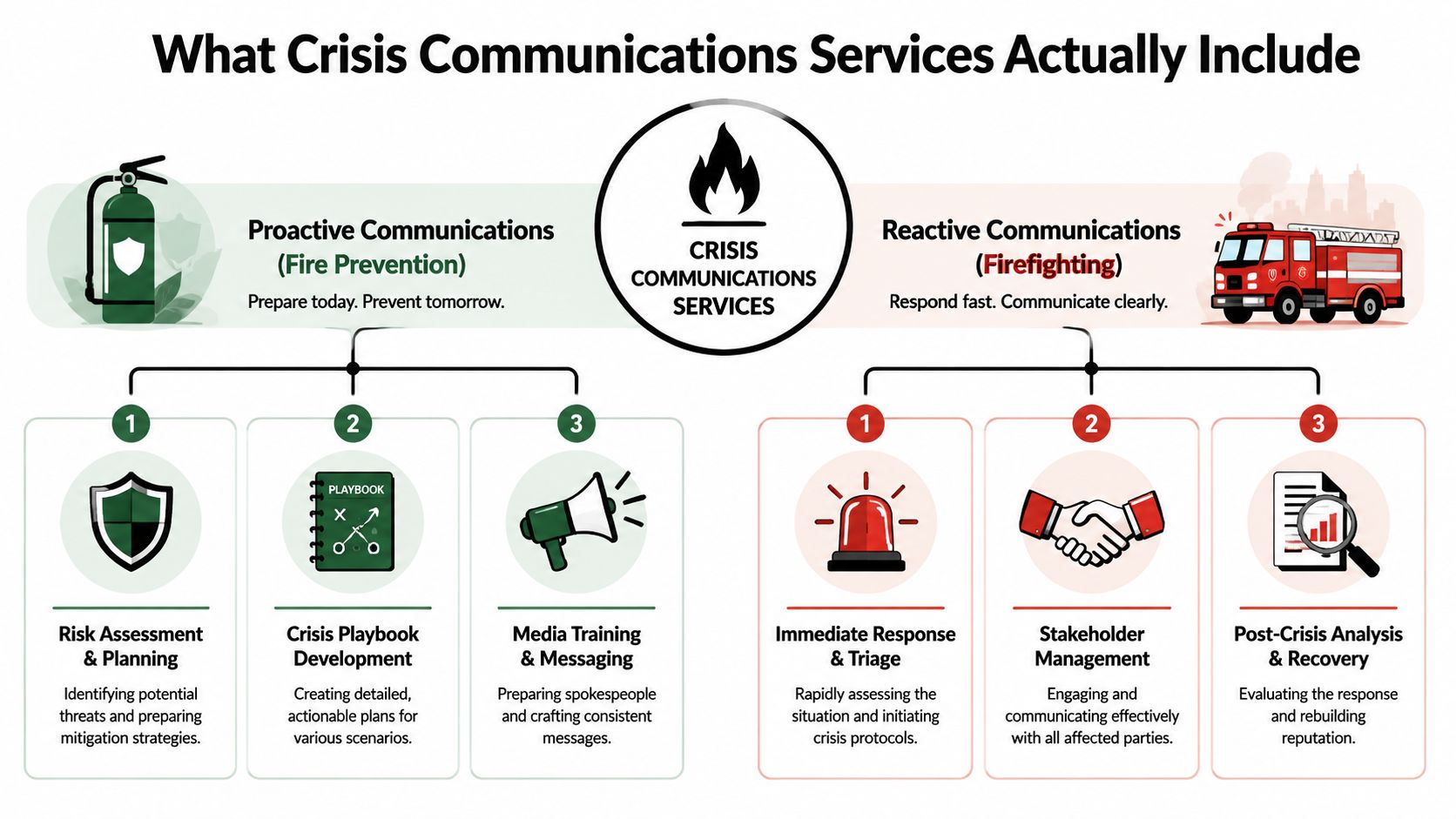
A useful way to think about crisis communications services is this: some providers work like fire inspectors, and some work like firefighters. The stronger firms do both. They help prevent avoidable incidents through planning and training, then step in when an event is active and the organization needs coordination, messaging, and control.
That's why the work is more operational than many buyers expect.
Proactive work before anything goes wrong
The preventive side of the service usually includes risk assessment, scenario planning, message frameworks, spokesperson prep, and escalation design. The provider assists in defining incidents, determining response triggers, approving internal and external messaging, and prioritizing communication channels.
That structure matters because a technically sound plan should define activation criteria, named approvers, and channel-specific procedures before an incident. It should also account for redundancy and update cadence, with guidance recommending updates at least every four to six hours during an active incident, as noted in Cassling's overview of crisis communication plan elements.
In practice, proactive services often include:
- Scenario workshops: Teams test product issues, workplace incidents, outages, executive misconduct claims, or data exposure events.
- Holding statements and Q&A drafts: These give legal and leadership something to refine, rather than forcing everyone to write from scratch.
- Spokesperson training: Media pressure exposes weak messengers fast. A prepared spokesperson knows how to stay accurate without sounding evasive.
Reactive work when the incident is live
When the crisis is active, the provider shifts from architecture to execution. The work becomes triage, message development, stakeholder coordination, media handling, social monitoring, and ongoing updates.
The strongest providers don't just write. They run the response rhythm.
That response rhythm usually includes monitoring what's being said, reconciling facts from operations and legal, deciding which audiences need what information, and keeping all channels aligned. Weaker firms often struggle with these aspects. They can draft a clean statement, but they can't manage conflicting inputs from legal, HR, customer support, and executives.
A capable crisis team should be able to handle at least these tasks without confusion:
- Internal coordination: Align leadership, legal, HR, customer teams, and operations on one fact pattern.
- External communications: Prepare statements for media, customers, partners, regulators, and social channels.
- Documentation: Maintain approval records, call logs, message versions, and stakeholder outreach history.
Buying crisis communications services means buying preparation plus operating discipline. If a provider talks only about media coverage and doesn't talk about approvals, escalation, and channel control, that's not a full crisis capability.
Four Service Models for Crisis Support
Companies usually buy crisis support in one of four ways. They build in-house capability, retain an agency, call for emergency help only when something breaks, or rely on an independent consultant. None of these models is universally right. The right choice depends on risk exposure, internal maturity, leadership availability, and how much coordination the organization can already handle on its own.
How the models differ in practice
Some teams want tight integration and daily familiarity. Others want external judgment and surge capacity. A few only need a plan and occasional training. The problem comes when companies buy a model that doesn't match how they make decisions.
| Model | Best For | Cost Structure | Speed of Activation | Level of Integration |
|---|---|---|---|---|
| In-house team | Larger organizations with recurring media, regulatory, or operational risk | Salaries, training, tools, and outside specialist support as needed | Fast once authority is clear internally | Highest, because the team already knows the business |
| Agency retainer | Companies that need readiness plus outside response capacity | Ongoing monthly fee, sometimes with separate emergency scope | Usually strong if roles and contacts are established | High when the agency participates in planning and drills |
| On-demand emergency support | Organizations that don't want ongoing spend but need expert backup | Premium project or hourly emergency billing | Slower at the start because intake and context happen live | Lower, especially in the first hours |
| Freelance consultant | Founder-led firms, nonprofits, or lean teams needing senior advice without a full agency | Project fee, advisory retainer, or hourly support | Varies widely based on availability and prior familiarity | Moderate when the consultant works directly with leadership |
An in-house model works best when the organization already has communications leadership, legal access, and executive buy-in. The advantage is context. The disadvantage is capacity. During a fast-moving event, the same people responsible for response may also be pulled into internal reporting, employee questions, and board updates.
An agency retainer gives a company extra bandwidth and a tested process. This is often the strongest model for firms with meaningful exposure but limited internal depth. The retainer only pays off, though, if the agency is embedded enough to know approval paths, business sensitivities, and stakeholder priorities before trouble starts.
An emergency-only arrangement sounds efficient and often disappoints. It can work for contained issues, but the first hours are usually spent gathering context, clarifying authority, and fixing contact gaps that a retained partner would already know.
A freelance specialist can be a strong middle ground when the company needs senior judgment and practical planning without a broader agency structure. The trade-off is resilience. One person may be excellent strategically but limited when monitoring, drafting, media handling, and executive support all spike at once.
A simple way to decide
If response quality depends on one or two people staying calm and available at all times, the model is too thin for a serious crisis.
A practical selection approach looks like this:
- Choose in-house when the business faces frequent complex issues and can support a real operating function.
- Choose a retainer when the business needs preparedness and rapid outside execution.
- Choose emergency support when risk is lower and leadership accepts slower initial mobilization.
- Choose a consultant when the immediate need is plan design, training, and executive guidance more than heavy response staffing.
The best model isn't the one with the most features. It's the one the organization can activate under stress.
The Crisis Response Playbook and Timeline
A crisis response playbook should make the first hour feel structured, not improvised. The team doesn't need every answer immediately. It needs a sequence. Without that sequence, organizations lose time arguing over wording, routing approvals to the wrong people, and treating channel selection as an afterthought.
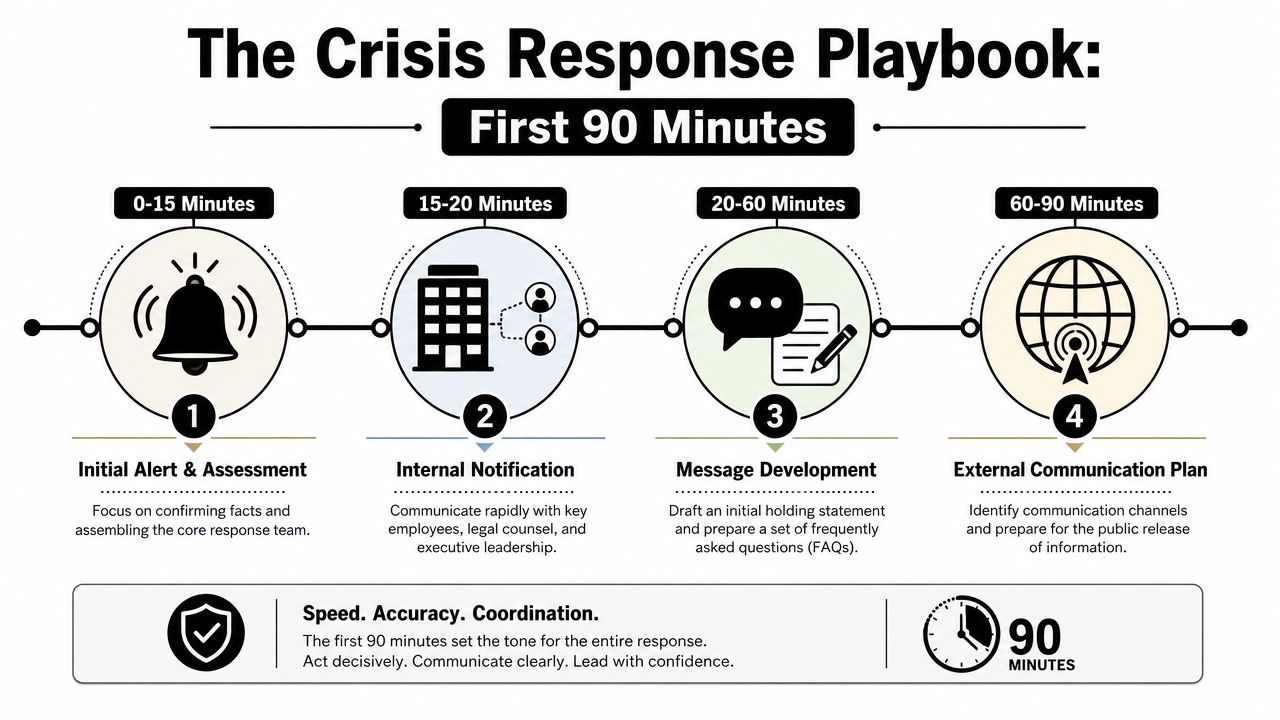
A widely used benchmark is the 15-20-60-90 timeline. Organizations should acknowledge a crisis within 15 minutes, share more detailed information by 60 minutes, and be prepared for deeper media engagement within 90 minutes, according to Regroup's discussion of effective crisis communications. For a practical planning resource, this guide to a crisis communications plan is useful when turning those benchmarks into internal workflow.
What happens in the first ninety minutes
The first 15 minutes are about confirmation and activation. Someone needs to verify the event, classify it, and pull in the core response group. This isn't the moment for long debate. It's the moment to answer three questions: what is known, what is still unverified, and who owns the next decision.
From 15 to 20 minutes, internal notification begins. Leadership, legal, HR, operations, and communications need the same short briefing. Not a polished memo. A clean internal alert with the known facts, immediate constraints, and next check-in time.
From 20 to 60 minutes, the team drafts the first holding statement and supporting Q&A. That language should acknowledge the issue, avoid speculation, and tell stakeholders what the organization is doing next. If customers, employees, or partners are affected differently, separate versions may be necessary.
From 60 to 90 minutes, the response shifts into outward communication and spokesperson preparation. The company should know which channel goes first, who speaks publicly, what the website or newsroom will say, and how social and customer support teams will stay aligned.
A delayed statement is often blamed on legal. More often, the real cause is that nobody defined the approval path before the incident.
A working playbook checklist
A usable playbook usually includes these elements:
- Activation rules: Define what triggers the plan and who has authority to start it.
- Core team roster: List primary and backup contacts across communications, legal, HR, operations, leadership, and customer support.
- Audience map: Separate employees, customers, investors, regulators, media, partners, and community stakeholders.
- Channel plan: Decide when to use email, website updates, news releases, social posts, direct outreach, voicemail, or hotline messaging.
- Message bank: Prepare holding statements, internal notices, Q&A, and spokesperson notes.
- Monitoring process: Assign responsibility for media, social, inbound inquiries, and rumor tracking.
- Update rhythm: Set internal review times and external refresh intervals so silence doesn't become the message.
- Recordkeeping: Log approvals, releases, edits, inquiries, and stakeholder outreach.
For small and midsize organizations, the mistake isn't lacking sophistication. It's lacking decisions. A lean playbook that names owners and channels beats a polished document that nobody can execute.
How to Evaluate and Choose a Provider
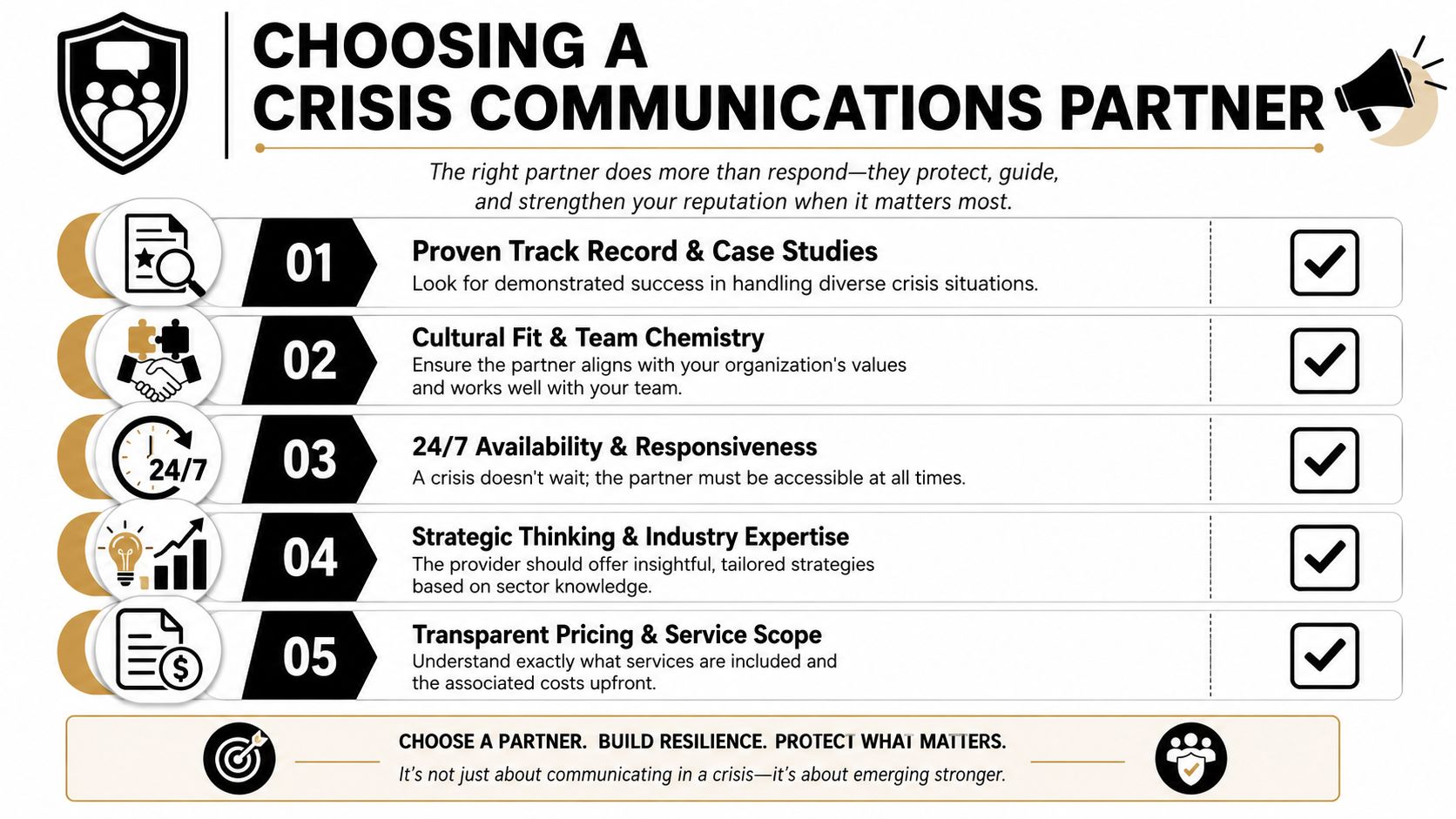
Most provider evaluations focus on obvious things. Media relationships. Writing quality. Category experience. Availability after hours. Those matter, but they don't tell a CEO or marketing director whether the provider can run a live response across departments that don't naturally move at the same speed.
That's the harder test. Effective crisis response requires coordinated messaging across leadership, legal, HR, investors, employees, media, and customers, plus a clear response hierarchy so the right people speak at the right time, as discussed in Percepture's overview of what a crisis communications agency does. If a provider can't manage that cross-functional governance, the writing won't save the engagement.
Governance matters more than pitch polish
A strong provider should be able to explain how decisions move, not just how messages sound. That includes who gets pulled into the room, how facts are reconciled, how legal review is contained, and how employee messaging stays consistent with what reporters and customers hear.
That's also why a standard PR agency isn't automatically a crisis partner. A launch campaign rewards creativity and speed. A crisis rewards disciplined escalation, message control, documentation, and calm judgment under uncertainty. Companies comparing firms often benefit from reviewing a specialist crisis communications agency framework before interviews start.
Social surfaces complicate this further. A provider needs a plan for comments, customer complaints, screenshots, and reposted misinformation, not just formal statements. For teams tightening their day-to-day channel discipline before a crisis ever hits, this resource on how to manage social media with PostClaw insights is useful background because weak routine governance often becomes obvious during a public incident.
Questions that expose the real operating model
Ask direct questions. Vague answers are a warning.
- How do you handle approvals under time pressure? A serious provider should describe a practical workflow, not just say they “work closely with stakeholders.”
- Who leads the response call? Someone needs to own cadence, task assignment, and message discipline.
- How do you separate facts from assumptions in the first hour? Listen for process, not confidence.
- What do you need from legal and HR to move quickly? Good providers know where bottlenecks usually appear.
- How do you manage internal and external messaging at the same time? If they only discuss media statements, the model is incomplete.
- What happens outside business hours? Availability should be explicit.
- How do you monitor and document changes during a live issue? Version control matters when facts evolve.
- What would you expect the executive team to decide in the first call? This reveals whether the provider understands leadership realities.
Choose the firm that can make the organization more governable under pressure, not the one that gives the sharpest presentation.
The best partner won't promise a painless crisis. They'll show how they reduce confusion, compress response time, and keep the company from fighting itself while the issue is still unfolding.
Understanding Pricing and Contract Terms
Pricing for crisis communications services varies because buyers aren't always purchasing the same thing. One company wants a plan, templates, and media training. Another wants round-the-clock access and live response support. A third wants a specialist on standby but hopes never to call. The contract structure usually tells more than the fee line does.
What pricing structures usually mean
A monthly retainer usually covers readiness work, periodic reviews, counsel, and some level of incident availability. That can include plan updates, scenario workshops, message review, spokesperson coaching, and access to a response team if an issue breaks. Retainers often work well for companies with ongoing exposure because the provider builds context over time.
A project fee is common when the need is discrete. Examples include writing a crisis plan, running a tabletop exercise, building stakeholder maps, or creating a message bank. This model is often efficient for organizations that already have internal communicators and just need structure.
An emergency hourly or premium response scope usually applies when the organization calls only after the problem is already live. That's often the most expensive way to buy help operationally, even if the company avoided a retainer beforehand, because the provider has to learn the organization while responding.
For teams comparing communication tooling alongside service contracts, it can help to Compare cloud communication plans so channel costs, emergency routing, and notification tools are considered separately from advisory fees.
Contract terms that deserve scrutiny
Read the operating terms, not just the price.
- Response availability: Define after-hours coverage, holidays, and who answers first.
- Scope boundaries: Clarify whether monitoring, media relations, executive prep, and internal communications are included.
- Escalation access: Confirm whether senior strategists are included or sold as an extra layer.
- Deliverables ownership: Make sure plans, templates, and message documents remain usable after the engagement.
- Crisis surge rules: Ask what happens when a situation extends over days and staffing needs expand.
The cheapest arrangement can become the costliest if it leaves the company without enough readiness, not enough access, or too many assumptions about what “support” includes. Good contracts remove ambiguity before the pressure starts.
Sample Statements and Brief Case Examples
Abstract guidance is useful up to a point. Teams also need to see what actual output looks like when facts are limited and pressure is high. The most common early deliverable is the holding statement. Its job isn't to resolve the issue. Its job is to acknowledge the situation, establish that the organization is active, and buy time for verified updates.
A holding statement template
This format works because it's plain, restrained, and adaptable:
We're aware of the situation involving [brief description of incident]. The matter is being reviewed by the appropriate internal teams, and the organization is working to confirm the relevant facts. At this stage, it would be premature to speculate. The immediate priority is [safety, service restoration, customer support, employee communication, or other priority]. Updates will be shared through [designated channel] as more verified information becomes available.
That statement does a few things well:
- It acknowledges reality: Silence often creates more concern than a limited initial statement.
- It avoids overcommitting: Early certainty is risky when facts may change.
- It signals action: Stakeholders need to know the company is doing something, not just observing the problem.
- It establishes a source of truth: One designated channel reduces confusion.
Poor holding statements usually fail in one of two ways. They either sound defensive and lawyered, or they promise specifics the organization can't support yet.
Two brief examples
Example one: Product issue with customer impact
A consumer brand discovers that a product defect may affect a recent shipment. Operations wants time to investigate. Sales wants reassurance language immediately. Customer support is already receiving complaints.
A disciplined response starts with internal segmentation. Retail partners need one message, direct customers need another, and employees need a script before the phones spike. The provider's role is to keep those versions aligned while operations confirms scope and leadership decides whether to pause sales, issue replacement guidance, or escalate to a broader recall process.
Example two: Executive conduct allegation
An allegation involving a senior executive creates a different challenge. The legal risk is higher, HR is central, and internal credibility may matter as much as media handling. A weak response treats this as a press problem. A stronger response treats it as a governance problem with external visibility.
The organization would typically issue a short acknowledgment, confirm that the matter is under review through the appropriate process, and avoid public commentary beyond verified facts. Internally, staff need assurance that the issue is being handled seriously and through established channels. Externally, the company needs consistency and restraint.
The right response doesn't sound the same across scenarios. The structure may repeat, but the stakeholder priorities change.
That's why templating helps, but only up to a point. Effective crisis communications services adapt the same core disciplines to very different kinds of pressure.
Frequently Asked Questions
When does an issue become a crisis
An issue becomes a crisis when normal approval paths and routine messaging no longer work. If the situation can affect safety, operations, customer trust, regulatory attention, employee confidence, or executive credibility, it should be treated with crisis discipline even before public attention peaks.
What should leadership do first
Confirm facts, activate the core response group, and establish one decision owner for communications flow. The first mistake is usually fragmentation. Different teams start responding independently before leadership sets a common fact base and approval path.
Is social media a separate crisis channel
No. It's one channel inside the broader response system. The mistake is treating social as a place for quick reactions while the “real” response happens somewhere else. Social posts, comments, direct messages, customer support scripts, and website updates need the same factual backbone and timing discipline.
Can a small business handle this without a large agency
Yes, if it has a clear plan, named roles, template language, and a realistic escalation path. Smaller organizations often do better with lean systems because they have fewer stakeholders to coordinate. They do worse when all authority sits with one founder who becomes a bottleneck.
What should be prepared before shopping for a provider
Have a short internal brief ready that covers likely risks, who currently approves external messaging, which channels the company controls directly, and whether legal, HR, and operations are willing to participate in planning. Provider selection gets easier when the organization knows its own constraints.
What's the most common buying mistake
Buying for statement writing alone. The hard part of crisis work is usually governance, not wording. If the provider can draft beautifully but can't help the company move decisions across departments, the engagement will break down when pressure rises.
Press Release Zen helps teams turn crisis planning into usable communication assets, including practical guidance for statements, templates, and distribution decisions. For organizations building their response process or refining message workflows before the next issue hits, Press Release Zen is a straightforward resource to keep on hand.