Most advice on a free crypto press release starts in the wrong place. It starts with site lists, submission forms, and shortcuts to distribution.
That isn't the hard part.
The hard part is getting visibility without making the project look unvetted, promotional, or careless. In crypto, a release doesn't just announce news. It signals whether the team understands disclosure, verification, and reputational risk. A weak free distribution strategy can turn a legitimate launch into something that looks indistinguishable from noise.
A better approach treats “free” as a budget choice, not a quality signal. The release still needs to read like formal corporate communication, carry proof that a journalist can verify quickly, and appear in channels that don't drag the brand into the wrong company. Teams that also want to optimiser pour moteurs IA conversationnels should think the same way. Structure, clarity, and verifiable claims matter whether the audience is a reporter, a community moderator, or an AI-driven discovery surface.
Table of Contents
- The Double-Edged Sword of a Free Crypto Press Release
- Crafting a Press Release That Journalists Actually Read
- Curated Free Distribution Channels and Platforms for 2026
- Beyond Wires Pitching Crypto Communities and Forums
- Navigating Compliance and Reputational Risk
- Measuring Success and Planning Your Next Announcement
The Double-Edged Sword of a Free Crypto Press Release
A free crypto press release can be smart. It can also be expensive in the one way early-stage teams can't afford: lost trust.
Founders usually search for free distribution because they need reach before they have budget. That's reasonable. Crypto teams often need to announce a launch, audit, partnership, listing, governance milestone, or ecosystem update while cash is being directed toward product and compliance instead of media spend.
The problem is that many free options flatten everything into the same visual bucket. A serious protocol update sits next to low-effort hype, anonymous token promotion, and recycled announcements with no proof attached. Once that happens, the release may still be “published,” but the brand starts to look cheap.
Practical rule: Free distribution only works when the release looks more credible than the channel it appears on.
That means a startup shouldn't ask only, “Where can this go for free?” It should ask four harder questions first:
- Is the news verifiable: Can a reporter confirm the launch, audit, integration, funding event, or public documentation without relying on the company's own claims alone?
- Does the release read neutrally: If every adjective were removed, would the announcement still sound important?
- Will the channel create guilt by association: If a prospect, exchange partner, or journalist sees the release there, does it help or hurt the project's reputation?
- Is there a follow-up path: Can the team turn the release into community discussion, founder outreach, and earned pickup instead of letting it sit unread?
A free crypto press release isn't low quality when it behaves like a formal announcement. It becomes low quality when the team uses free channels as a substitute for editorial discipline.
There's also a strategic upside many teams miss. Free methods force focus. They push startups to sharpen the angle, tighten the language, and target people who care instead of buying generic visibility. That usually produces better habits than spraying an announcement everywhere and hoping syndication does the work.
Crafting a Press Release That Journalists Actually Read
Most crypto releases fail before the second sentence. The headline is vague, the lead is stuffed with promises, and the body hides the only useful proof.
Editors don't need enthusiasm. They need a document they can scan fast and verify faster.

Start with the news, not the slogan
A headline should state the event plainly. “Protocol X launches mainnet for institutional stablecoin settlement” is usable. “Protocol X redefines the future of finance” is not.
The first paragraph needs the who, what, when, where, and why immediately. Guidance for crypto PR consistently recommends that structure because reporters want to know what happened before they decide whether to read further. Timing guidance also favors Tuesday through Thursday mornings in EST for English-language markets, while avoiding major conferences, market crashes, and competitor news cycles, as noted by EAK Digital's crypto press release guidance for 2026.
A journalist should understand the announcement in one paragraph without opening a second tab.
That lead paragraph should contain the announcement, not the backstory. Background belongs later. The opening is for the new fact.
Use a structure reporters can scan in seconds
A strong free crypto press release usually follows this sequence:
Headline
State the development directly.Subheadline
Add one line of context only if it clarifies the business significance.Lead paragraph
Answer who did what, when it happened, where it applies, and why it matters.Body paragraphs
Add proof, operational context, public links, and one or two attributable quotes.Boilerplate
Brief company description.Media contact
Name, email, and any official press contact route.
Another useful discipline is concision. Industry guidance recommends keeping the release around one page and supporting every meaningful claim with specific metrics or third-party data where applicable, according to Marketers Media's crypto press release writing guide. The same guide gives a strong example of replacing vague growth language with “user base grew from 20,000 to 85,000 in the last 12 months,” which is a 325% increase. That example matters because it shows the standard editors expect, not because every startup needs to force growth stats into every announcement.
For teams refining discoverability after the draft is complete, resources on optimizing content with AI can help tighten relevance and readability. The release still has to be factual first. Optimization should polish the wording, not invent authority the project hasn't earned.
Crypto details that belong in the body
Crypto announcements need sharper proof than ordinary startup news. The body should front-load anything a skeptical reader would check first.
Include details like these when they exist and are publicly confirmable:
- Launch specifics: Mainnet date, beta access status, supported chains, or rollout conditions.
- Audit references: Auditor name, report status, and where the public documentation lives.
- Partnership scope: What each party is specifically doing. Not “strategic partnership” as filler.
- Token context: Utility, governance role, access function, or ecosystem use, described carefully and without price language.
- Regulatory or corporate proof: Registration details, legal entity name, or official public filing if relevant.
What doesn't belong in the body is hype disguised as substance.
| Weak wording | Better wording |
|---|---|
| Revolutionary ecosystem expansion | Public launch of feature set with live documentation |
| Rapid adoption | Verifiable usage change or no claim at all |
| Strategic partnership | Named collaboration with defined technical or commercial scope |
| Fully secure platform | Audit reference and public security process details |
A clean quote also matters. It shouldn't sound like ad copy. It should explain why the milestone matters operationally. A founder quote can address product purpose. A partner quote can clarify implementation. Neither should make promises they can't document.
Curated Free Distribution Channels and Platforms for 2026
Free distribution works best when it is selective. The mistake isn't using free channels. The mistake is treating every submission portal as equally useful.
What paid distribution does that free channels don't
Paid wire services still shape the market because they offer standardized, formal syndication at scale. For context, PR Newswire is described as reaching more than 440,000 newsrooms, websites, direct feeds, and journalists, which helps explain why established wires remain central to formal announcement strategy in crypto and Web3, according to this review of cryptocurrency press release distribution platforms.
A free crypto press release won't match that kind of surface area. It doesn't need to.
What it can do is place the announcement where the right niche readers, forum moderators, independent writers, newsletter operators, and ecosystem participants are already paying attention. The benchmark for free distribution isn't mass wire reach. It's targeted relevance.
Top Free Crypto Press Release Channels for 2026
The smartest approach is to build a lean list and evaluate each outlet by audience fit, submission friction, and reputational fit. Teams that need a broader non-crypto baseline can also review this guide to how to distribute press releases for free.
| Platform | Niche Focus | Submission Type | Key Consideration |
|---|---|---|---|
| Company newsroom or blog | Official source of record | Self-published | Best place for the canonical version. Journalists prefer a source the company controls. |
| Medium publication | Founder-led storytelling, ecosystem explainers | Self-published or publication submission | Useful when the release needs extra context, but the release itself should stay concise. |
| LinkedIn company page | Investors, partners, B2B audiences | Organic post linking to official release | Strong for credibility if executives and team members amplify it thoughtfully. |
| X account and pinned thread | Crypto-native audience | Organic thread with proof links | Fast distribution, but weak if the post relies on slogans instead of documentation. |
| GitHub release notes or docs hub | Developer-facing projects | Self-published documentation | Strong support asset for infrastructure and tooling announcements. |
| Community newsletters | Protocol users, DAO contributors, ecosystem followers | Direct submission to editors or maintainers | High trust when the project is already part of that ecosystem. |
| Ecosystem partner blogs | L2s, wallet partners, tooling networks | Coordinated cross-post or shared announcement | Works well when the partner relationship is real and public. |
| Relevant startup directories and community calendars | Event-driven launches and demos | Submission form | Better for visibility around launches than for deep editorial pickup. |
A practical filter helps separate useful from wasteful:
- Use channels you can control: The official newsroom, company site, docs portal, and founder social accounts should always come first.
- Prioritize niche fit over generic volume: A DeFi protocol shouldn't push the same package to NFT collectors and expect good results.
- Check moderation quality: If an outlet looks overrun with junk, publishing there may hurt more than it helps.
- Submit supporting assets together: Include the release, one-paragraph summary, logos, founder contact, and documentation links in the same package.
Distribution quality depends less on the number of endpoints and more on whether the release lands where the right people already trust the format.
Beyond Wires Pitching Crypto Communities and Forums
Publishing the release is passive. Amplifying it takes human judgment.
Crypto communities don't reward announcements just because they exist. They respond when the post gives members something useful to evaluate, discuss, test, or challenge.

Reddit, Discord, and Telegram each punish lazy promotion differently
Reddit is the easiest place to damage credibility fast. Moderators and regulars can spot a pasted press release instantly. A better Reddit post uses the announcement as source material, then summarizes the actual development in plain language, links to the official post, and invites criticism or technical questions.
Discord requires more context and more restraint. Most servers have channel rules, self-promotion restrictions, and norms around introductions. Teams should identify where news belongs before posting. If a server has a dedicated announcements or ecosystem channel, use it. If it doesn't, ask a moderator first.
Telegram is faster and looser, but it can turn spammy quickly. The most effective posts are brief, factual, and anchored to one useful update. If the team is sharing a release into external groups, the post should feel like a heads-up, not a demand for attention.
Founders and community leads working on channel etiquette can borrow from Mava's Web3 community tips, especially around moderation expectations and community-first communication.
A better outreach frame
A release should be adapted for each community. One message doesn't fit every environment.
Try frames like these:
- For Reddit: “The team just published details on the launch. The main points are X, Y, and Z. The public docs and release are linked below. Feedback on the rollout design is welcome.”
- For Discord: “Sharing an official update for members tracking the roadmap. The launch is now public, and the docs plus announcement are live. Happy to answer implementation questions in-thread.”
- For Telegram: “Official update from the team. The announcement is now live, with public links to the release and docs. Key change: users can now access [feature] under [condition].”
Two habits improve results more than any posting trick:
- Lead with substance: Mention the concrete update first, then link.
- Stay in the thread: If the team posts and disappears, the announcement looks transactional.
Teams building a targeted media and outlet list alongside community outreach can use this roundup of top cryptocurrency publications and journalists to identify where a release may earn secondary visibility beyond social channels.
Community distribution works when the team behaves like a participant with news, not a marketer chasing clicks.
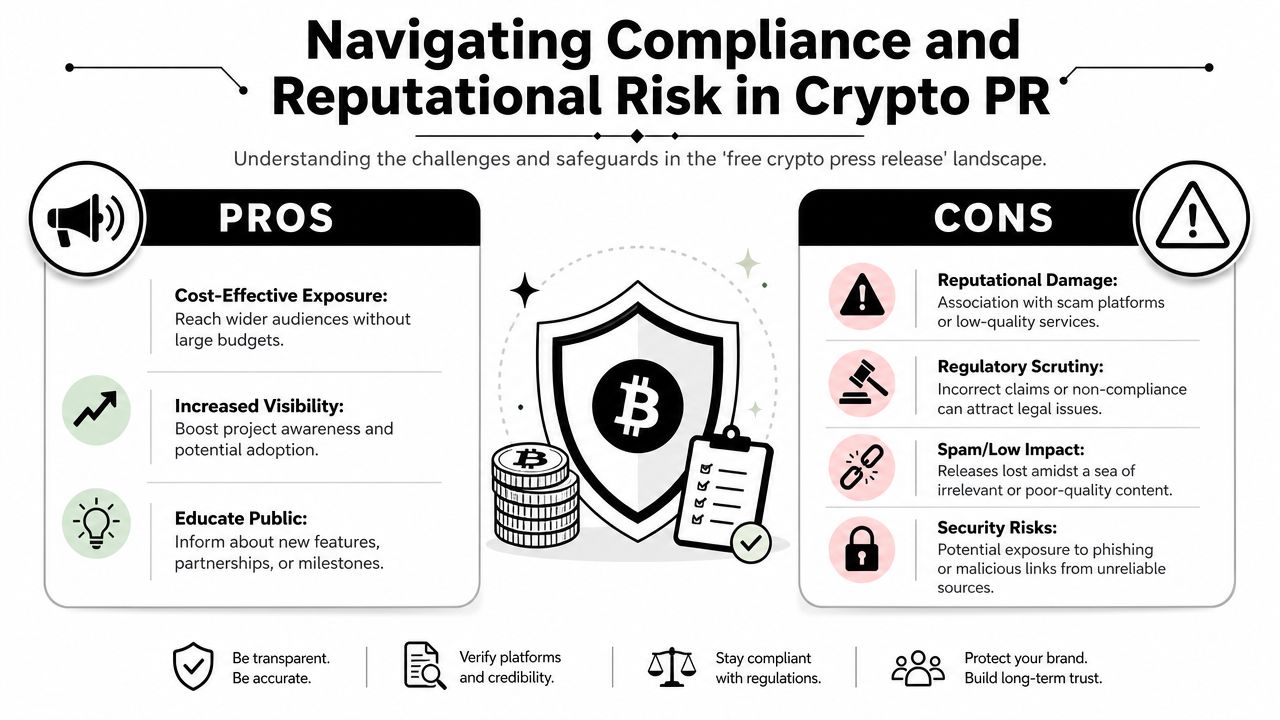
Navigating Compliance and Reputational Risk
The biggest mistake in free crypto PR is assuming the only downside is low reach. That's not the actual risk.
A significant risk is association. If the release appears in environments saturated with questionable projects, the startup may inherit skepticism before anyone evaluates the product on its own merits.
Why brand safety matters more in crypto PR
One investigation of crypto press-release distribution found that roughly 62% of 2,893 releases in its dataset came from projects flagged as High risk or Scam, according to Chainstory's analysis of crypto press release distribution platforms. That doesn't mean every free channel is bad. It means the category has a visible contamination problem.
For a legitimate team, that changes the question from “Can this be published?” to “What does publishing here imply?”
A release can be factually correct and still create reputational drag if it appears next to obvious junk, misleading promotions, or anonymous financial claims. Journalists, investors, compliance reviewers, exchange teams, and partners all notice context.
Say this, not that
Crypto announcements need legal and reputational restraint. Overstatement doesn't just read poorly. It can trigger avoidable scrutiny.
| Say this | Not that |
|---|---|
| “The company announced the public launch of…” | “The company is set to dominate…” |
| “The audit report is publicly available at…” | “The platform is completely safe” |
| “The token is designed for governance and network utility” | “The token will deliver strong returns” |
| “The parties signed an agreement covering…” | “This partnership changes everything” |
| “The roadmap includes planned milestones” | “The project guarantees future growth” |
Keep these boundaries in mind:
- Avoid investment language: Don't imply profit, guaranteed appreciation, or inevitable returns.
- Separate present facts from future plans: If something is planned, label it as planned.
- Name the evidence: Public docs, legal entity details, product links, and audit references carry the release.
- Confirm every partner mention: If the other party hasn't approved the wording, don't publish it.
Key takeaway: In crypto PR, credibility is often lost through implication, not outright falsehood.
A practical review checklist before submission
Before a free crypto press release goes out, a communications lead or founder should run this short review:
- Check the nouns: Are product names, entity names, and partner names accurate and approved?
- Check the verbs: Does the release describe what happened, not what the market “will” do?
- Check the links: Do all documentation links resolve to official assets?
- Check the venue: Would the team be comfortable sending the publication link to a regulator, exchange reviewer, enterprise prospect, or journalist?
If the answer to that last question is no, the channel isn't free. It's costly in a different currency.
Measuring Success and Planning Your Next Announcement
A release isn't successful because it went live. It's successful when it moves attention from passive exposure to measurable response.
That shift matters even more with free distribution because the budget argument disappears. If a team is saving money on placement, it should be more disciplined about measuring what the announcement did.

Track outcomes that show real market response
A practical crypto PR workflow should track branded search growth, referral traffic, secondary pickups, citations, lead quality, and assisted conversions rather than impressions alone, as recommended in Brandpush's guide to crypto press release distribution. That same guidance also warns against sending releases before the product, funding, integration, or audit can be publicly verified.
Those measurement categories matter because they reveal intent:
- Branded search growth shows whether people remembered the name and looked for it later.
- Referral traffic shows which placements and community posts drove actual visits.
- Secondary pickups and citations show whether other publishers or writers considered the announcement worth repeating.
- Lead quality helps B2B crypto companies see whether PR reached prospects, not just browsers.
- Assisted conversions show whether the release played a role before signup, demo request, or ecosystem participation.
Vanity metrics still have some context value, but they shouldn't steer decisions. A high view count on a low-trust outlet doesn't prove market traction.
Use each release to improve the next one
The best teams treat every announcement as a test of message, timing, and channel fit. That requires a simple post-release review.
Ask questions like these:
- Which headline angle got picked up or discussed most often
- Which channel drove the strongest traffic quality
- Which proof point reporters or community members repeated back
- Where skepticism showed up first
- Whether the supporting documents were easy for outsiders to find
A simple dashboard is enough if it helps the team compare releases over time. The process matters more than tool complexity. For a practical framework, this guide on tracking and measuring the success of your press releases can help teams set up a cleaner review loop.
One final standard is worth keeping. If the news isn't verifiable yet, it isn't ready for distribution. Waiting usually protects the brand more than rushing ever helps it.
Press Release Zen offers practical templates, distribution guides, and step-by-step press release resources for teams that want to publish with more clarity and fewer mistakes. If a startup needs help planning its next announcement, comparing distribution options, or tightening release structure before sending it out, Press Release Zen is a useful place to start.