A lot of teams hit the same moment. The press release is approved, legal has signed off, leadership likes the quote, and the launch date is fixed. Then the key question shows up. How does that release get in front of journalists, investors, partners, customers, and searchers without relying on a handful of email pitches and hope?
That's where newswire press release distribution becomes a practical tool rather than a vague PR line item. Used well, it creates reach, speed, and a public record of your announcement. Used poorly, it turns into a costly exercise in counting pickups that don't lead to traffic, links, leads, or authority. The difference usually isn't whether a company used a wire. It's whether the team matched the wire to a business goal and measured what happened after the send.
Table of Contents
- What Is Newswire Press Release Distribution
- How Newswire Distribution and Syndication Work
- Newswire Distribution vs Direct Media Outreach
- Understanding Distribution Tiers and Pricing Models
- Best Practices to Maximize Media Pickup and SEO
- Distribution Examples and an Actionable Checklist
- How to Choose the Right Distribution Provider
- Frequently Asked Questions About Newswire Distribution
What Is Newswire Press Release Distribution
Newswire press release distribution is the process of sending a release through a professional distribution network that can place it into media systems, databases, syndication channels, and public online destinations. It's different from emailing a list of reporters. A wire service is built for scale, formatting, routing, and downstream visibility.
That matters because a press release usually has more than one audience. Journalists may need it for fast awareness. Analysts and partners may need it for confirmation. Searchers may discover it later through syndication or branded queries. Internal teams may use it as the canonical public version of an announcement.
A good way to think about it is simple. Writing the release creates the asset. Distribution creates the market exposure.
For some announcements, that exposure is operationally important. Public company disclosures, major product launches, executive announcements, funding news, and broad awareness campaigns often benefit from the speed and breadth a wire can provide.
Practical rule: If the announcement needs both immediate visibility and a durable public footprint, a newswire usually deserves consideration.
The mistake is assuming distribution itself equals impact. It doesn't. A wire can place your news into the ecosystem, but editorial interest, search value, referral traffic, and lead quality still depend on message strength, targeting, timing, and follow-through.
How Newswire Distribution and Syndication Work
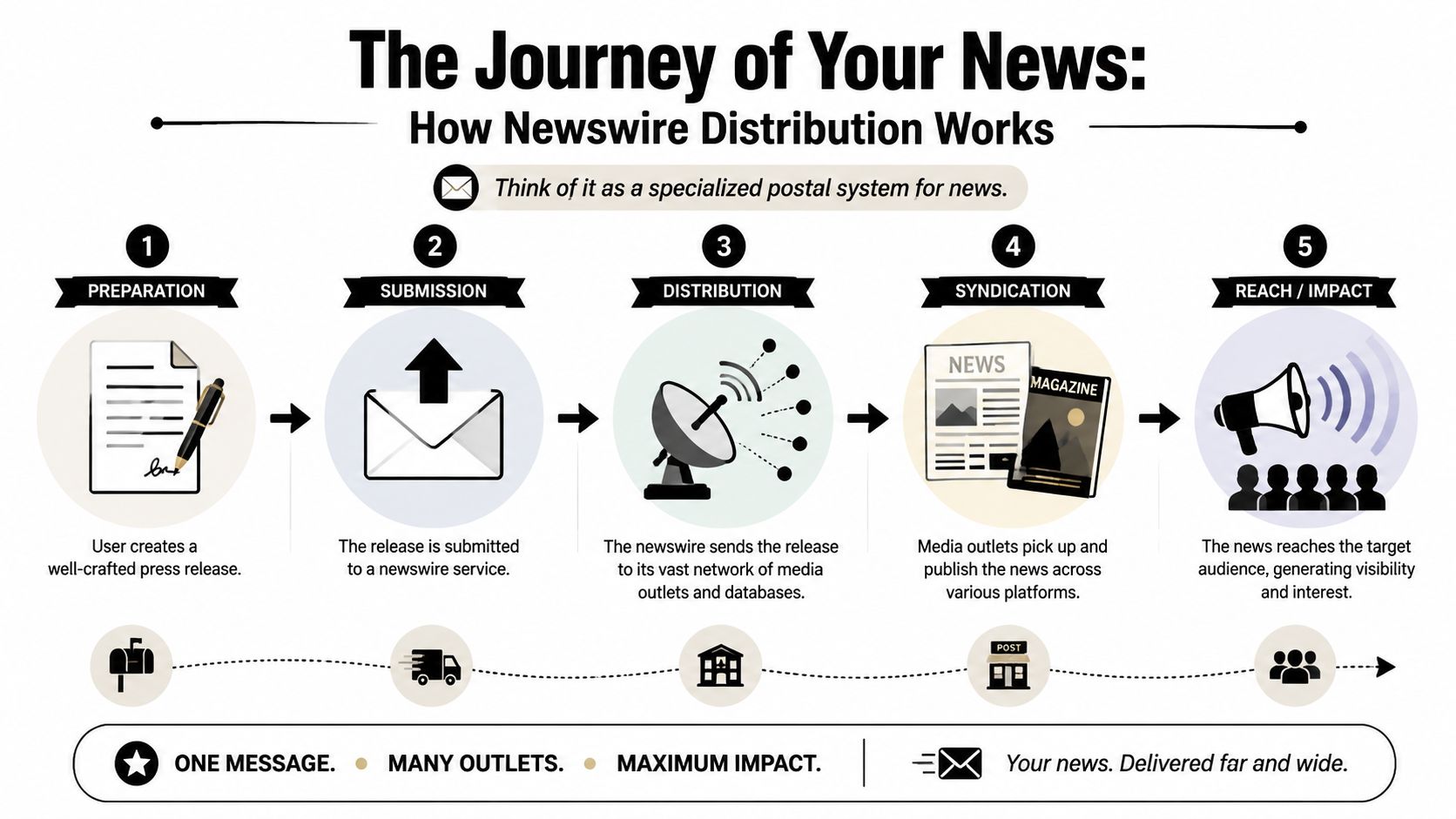
A team approves a release at 8:45 a.m. By 9:15, it is showing up in newsroom platforms, market data systems, company alert feeds, and a long tail of sites the team never contacted directly. That speed is the main reason wire distribution matters. It inserts an announcement into existing information infrastructure, which is very different from sending individual pitches and waiting for replies.
The wire as a distribution system
The process starts with setup. The team uploads the release, selects geography and industry targets, adds logos or other media, chooses a release time, and clears any formatting or compliance checks required by the provider. Good setup matters because the wire can route only what you configure correctly. Weak category choices or sloppy metadata reduce relevance fast.
After approval, the release typically moves through two channels at the same time:
Primary distribution
The wire sends the release directly into systems used by newsrooms, financial platforms, databases, media monitoring tools, and other subscription environments.Secondary syndication
The same release may then be republished or mirrored across business websites, aggregator pages, investor portals, and other downstream properties that pull wire content.
That distinction affects how results should be measured. Primary distribution gets the release into places where journalists, analysts, investors, and monitoring tools can see it quickly. Secondary syndication expands surface area, but many of those placements produce little editorial value on their own. For a clearer breakdown of that difference, this guide to article syndication and press release distribution is a useful reference.
What syndication does, and what it does not do
Syndication increases the odds that your announcement is visible in more places without extra manual outreach. It can also create a durable public record that supports branded search, investor diligence, partner validation, and basic message consistency.
It does not create earned coverage by itself.
That trade-off is where teams often misread performance. A release can appear on dozens or hundreds of sites and still produce no qualified traffic, no reporter interest, and no pipeline impact. If the goal is ROI, the useful questions are narrower. Did the release show up in the right channels? Did referral traffic arrive from meaningful domains? Did branded search lift? Did sales, investor relations, or recruiting teams get a measurable assist from the announcement?
Provider network strength still matters. PR Newswire states that its network reaches audiences globally on its official site, and the company has also published the claim that media and journalists reference its content 36% more often than its nearest competitor. Treat that kind of vendor-supplied comparison as directional, not decisive. In practice, network breadth helps distribution, but business value depends on the announcement, the targeting, and what the team does after the wire goes live.
One more operational point. Wire distribution does not replace direct communication. Internal alerts, customer emails, investor notifications, and reporter follow-up still need their own delivery plan. For teams handling those sends alongside a release, Scalelist's deliverability playbook is a useful reminder that inbox placement problems can undercut launch-day visibility just as easily as weak distribution settings can.
The practical view is simple. A wire sends the release into the system. Your job is to decide whether that system is likely to produce the outcomes you care about.
Newswire Distribution vs Direct Media Outreach
A launch goes live at 9:00 a.m. By 9:15, the release is indexed, the executive team has a public link to share, and investor or partner questions have a single source of truth. By noon, you still may not have a single meaningful story. That gap is the reason teams confuse distribution with results.
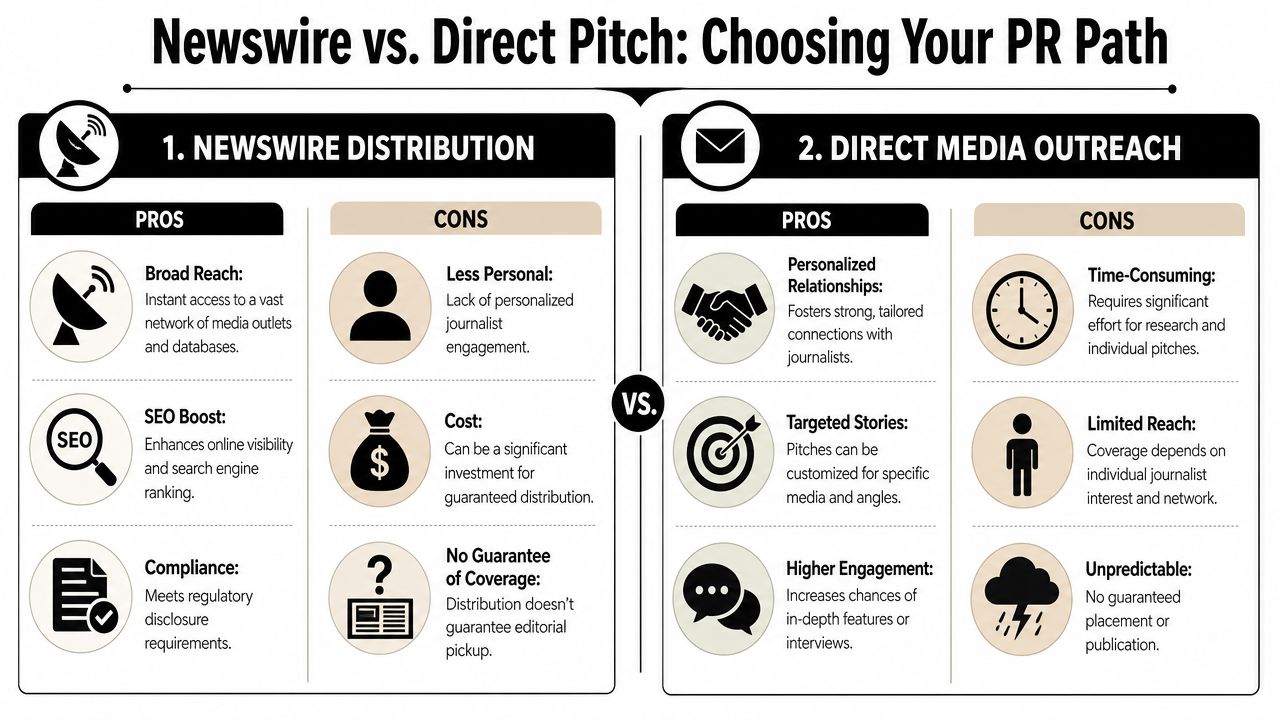
Newswire distribution and direct media outreach solve different problems. A wire gets an announcement into broad circulation quickly and creates a public record. Direct outreach is how you earn coverage that carries context, editorial judgment, and often better downstream value for SEO, lead generation, and brand authority.
A side by side comparison
| Criteria | Newswire Distribution | Direct Media Outreach |
|---|---|---|
| Primary goal | Broad awareness and public distribution | Targeted editorial coverage |
| Speed | Fast, centralized distribution | Slower, depends on research and pitching |
| Scale | Wide network and syndication | Limited by list quality and journalist interest |
| Personalization | Low | High |
| Best for | Public announcements, launches, disclosures, searchable visibility | Features, exclusives, interviews, trend stories |
| Coverage certainty | Distribution is guaranteed, coverage is not | Neither distribution nor coverage is guaranteed |
| Relationship value | Minimal | Strong if handled well |
| SEO utility | Useful for visibility and link pathways | Useful when earned stories link back |
| Workload | Operationally efficient once prepared | Labor intensive |
| Risk | Paying for reach that may be too broad | Spending time on pitches that never land |
The University of Southern California's Annenberg School describes wire services as a broad distribution tool, while targeted pitching is better suited to building reporter interest and earning story-specific coverage, as explained in USC Annenberg's media relations guidance.
When each approach wins
Choose a wire first when the announcement needs immediate public availability. Earnings releases, funding news, executive appointments, product launches with hard launch dates, regulatory updates, and partnership announcements often fall into this category. In those cases, speed, consistency, and a clean public record matter more than a customized pitch.
Choose direct outreach first when the primary value sits in the angle. If the story needs proprietary data, customer proof, a founder interview, local relevance, or an exclusive, reporters need more than a syndicated release. They need a reason their audience will care.
The strongest programs often use both, but with different expectations.
- Use the wire for distribution: It gives stakeholders a citable announcement and supports baseline visibility.
- Use pitching for earned coverage: It gives journalists context, access, and a story frame.
- Use owned channels for conversion: The newsroom post, landing page, email, and social posts are where you capture traffic and turn attention into action.
That last point is where ROI usually gets clearer. A wire can help people find the announcement. Direct outreach can get third-party validation. Owned channels are where you measure whether that attention produced demo requests, branded search lift, backlinks from relevant publications, recruiting interest, or sales conversations. Teams comparing providers should review these press release distribution service options with those outcomes in mind, not just pickup counts.
There is also an execution risk that gets overlooked. Direct outreach depends on deliverability. If pitches are landing in spam, weak response rates may have nothing to do with the story or the list quality. Teams tightening media outreach should review Scalelist's deliverability playbook.
The practical trade-off is simple. Wires buy reach and speed. Outreach earns relevance and stronger editorial outcomes. Use the wire when the market needs the announcement to exist everywhere at once. Use direct pitching when one good story in the right publication will do more for the business than a long list of low-value syndication placements.
Understanding Distribution Tiers and Pricing Models
Newswire packages usually look more complicated than they are. Most providers are selling combinations of geography, audience type, and add-ons. The problem isn't understanding the menu. The problem is buying more reach than the announcement warrants.
How tiers are usually structured
The most common tiers break down like this:
Local distribution
Best for store openings, community partnerships, local events, municipal announcements, and regionally bounded news. If the story only matters within one market, local placement is often enough.State or regional distribution
Useful when the audience spans multiple cities or an operating region. Franchises, regional nonprofits, healthcare groups, and multi-location businesses often fit here.National distribution
This makes sense when the announcement has broad commercial relevance, investor interest, or category significance. Product launches, funding announcements, major hires, and large partnerships often belong in this bucket.International distribution
Appropriate when the company serves multiple countries, the announcement affects global stakeholders, or the brand needs visibility across several markets at once.
There are also specialty circuits. These may target an industry such as healthcare or technology, a function such as investor media, or a demographic audience. Specialty targeting often delivers better practical value than expanding geography.
How to avoid overbuying distribution
A simple filter helps. Ask three questions:
- Who needs this news?
- Where do those people get information?
- Does wider reach improve the business result, or just the report?
That last question matters most. Wide distribution can look impressive while doing very little for qualified traffic or real market response. Teams comparing options can review Press Release Zen's comparison of press release distribution services to understand how providers differ by targeting, syndication, and reporting rather than choosing on headline price alone.
A national package for a strictly local story usually wastes budget. A local package for nationally relevant funding news can limit exposure where it matters. The right tier is the one that matches audience reality, not executive vanity.
Best Practices to Maximize Media Pickup and SEO
A release hits the wire at 4:30 p.m. on a Friday, buried under vague copy, weak subject matter, and no clear next step. It may still generate syndication. It usually will not generate the outcomes leadership cares about, such as qualified traffic, branded search lift, earned coverage, or sales follow-up.
That is the true standard for distribution. Pickup matters, but pickup alone is a poor success metric if it does not support visibility, authority, or pipeline.
Build the release for fast comprehension
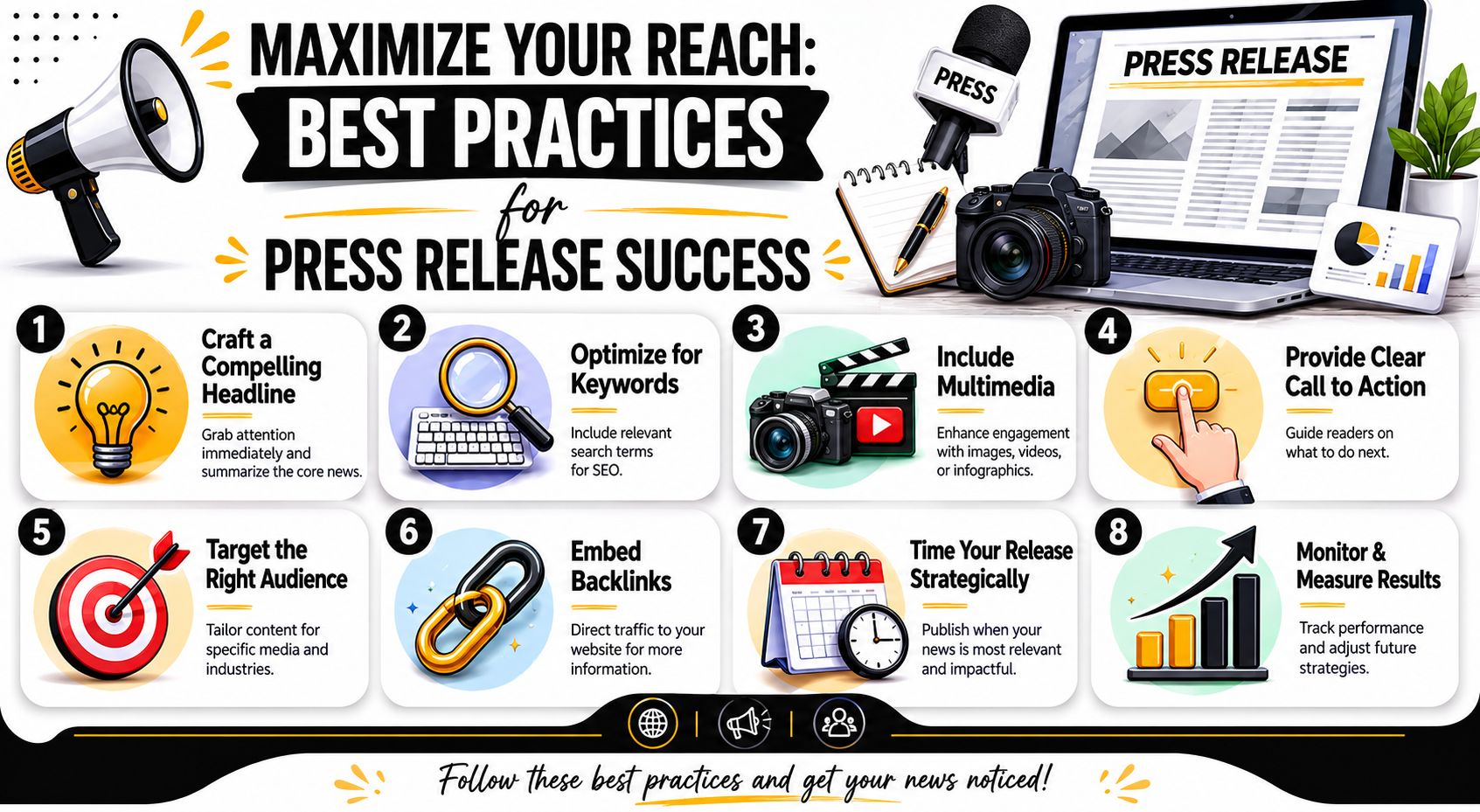
Journalists, analysts, prospects, and search engines all reward clarity. The release should explain the news quickly, surface the business relevance early, and make the next action obvious.
A practical standard looks like this:
- Lead with the news: The headline should state what happened in plain language. Clever wording usually lowers open rates and pickup because the angle is harder to spot.
- Put context in the first paragraph: Name the announcement, who it affects, and why it matters. If a reader has to hunt for the point, the release is doing extra work for no benefit.
- Use supporting detail selectively: Add product specifics, timing, proof points, or executive rationale only after the core announcement is established.
- Keep quotes on-message: Quotes should add interpretation, market context, or strategic intent. Generic excitement reads like filler and rarely survives into coverage.
- End with a defined action: Send the reader somewhere useful, such as a product page, event registration, investor resource, or media contact.
SEO should support the release without making it read like search copy. Use terms that buyers and reporters already use, especially in the headline, subhead, and first few lines. Teams doing keyword planning can Find valuable keywords before drafting. For a more detailed workflow on keyword placement, metadata, and release-page structure, use this press release SEO keywords and metadata guide.
Timing and targeting decide whether the right people see it
Good writing cannot rescue bad timing.
Morning distribution usually gives a release a better chance of being seen while editors and reporters are planning coverage. Midweek often performs better than late Friday or holiday-adjacent sends because attention is less fragmented. There are exceptions. Public companies, regulated announcements, event-based news, and crisis responses run on their own timelines. The point is to choose the timing deliberately instead of treating send time as an admin task.
Targeting deserves the same discipline. Broad distribution can increase raw impressions, but relevance drives meaningful pickup. A healthcare compliance update should reach healthcare trade reporters, sector analysts, customers, prospects, and partners who care about that issue. Sending the same release through a general consumer footprint may increase the report count while doing little for leads, authority, or earned coverage quality.
Teams most often waste budget. They buy reach, then judge success by syndication volume instead of asking whether the release reached the people who could act on it.
Treat amplification as part of the distribution plan
The wire is only one layer of execution. If the release matters, it should also appear in the company newsroom, feed the blog or resource center when appropriate, and give internal teams approved language to share the same day.
That coordination changes the business result. Owned channels help capture branded search and referral traffic while interest is highest. Sales teams can send the announcement to prospects without rewriting it. Investor, partner, and customer-facing teams get a consistent message. The release becomes a usable asset instead of a one-day posting.
Supporting assets also matter. Strong boilerplate copy reinforces brand positioning. Multimedia can improve engagement if it adds context instead of decoration. Links should point to pages built for the traffic they are likely to receive. If the announcement is a product launch, send readers to the launch page. If it is a funding round, send them to a page that explains growth plans, leadership, or market relevance.
The best distribution programs are measured after the send, not just at the moment of publication. Review referral traffic, branded search movement, assisted conversions, backlink quality, follow-up inquiries, and whether the release helped produce stronger direct coverage. That is how distribution shifts from a reporting exercise to a channel with clear ROI.
Distribution Examples and an Actionable Checklist
Strategy gets clearer when the same framework is applied to different kinds of announcements. The release, audience, tier, and success metric change by situation.

Three common distribution scenarios
A tech startup launching a product
The startup wants broad awareness, branded search lift, and traffic to a product page. A national or industry-relevant wire can make sense if the launch matters beyond a small niche. Direct outreach should run in parallel to target reporters covering the category, especially if demos, founder access, or customer context are available.
Success shouldn't be judged only by pickups. The better questions are whether the launch page attracted qualified traffic, whether branded search interest increased, and whether the release helped earn stronger downstream coverage.
A nonprofit promoting a community event
This story is usually geographic first. A local or regional wire may be enough, especially when paired with local media pitching, community calendar submissions, and social amplification. Paying for broad national distribution often adds little unless the nonprofit's mission has wider policy or fundraising relevance.
The KPI mix changes here. Registration interest, attendance, volunteer signups, donor traffic, and local media mentions matter more than raw syndication volume.
A public company issuing earnings or material business news
A wire often becomes essential because the release needs fast, wide, formal public dissemination. Precision matters. Formatting, timing, approvals, and investor-facing access all need to be locked down before the send.
A pre send checklist
Use this before any newswire press release distribution run:
- Confirm the objective: Awareness, compliance, SEO support, lead generation, event attendance, or stakeholder communication.
- Match the tier to the audience: Local, regional, national, international, or a specialty circuit.
- Pressure test the angle: Can someone outside the company explain why this matters in one sentence?
- Trim the copy: Keep only information that supports the actual announcement.
- Check required elements: Dateline, lead, quote, CTA, boilerplate, and contact details.
- Add useful links: Send readers to the page that matches the release goal.
- Prepare assets: Images, logos, video, executive headshots, or supporting documents if relevant.
- Set timing deliberately: Choose a release window that aligns with newsroom attention and audience relevance.
- Coordinate owned channels: Newsroom post, email, social, and sales enablement copy should be ready.
- Define post-send measurement: Decide in advance what counts as success beyond pickup volume.
A release should never go out until the measurement plan is set. Otherwise, the team ends up with a visibility report and no answer to whether the spend did anything useful.
How to Choose the Right Distribution Provider
A provider decision usually goes wrong in a familiar way. The team buys the package with the biggest outlet count, sends the release, gets a long pickup report, and still cannot answer a simple question from leadership: what did this do for the business?
Choose the provider that matches the job. For an earnings release, that usually means process control, compliance support, and confidence in timing. For a product launch, it may mean better industry targeting, multimedia handling, and reporting that ties traffic back to the right landing page. The right choice depends less on headline reach and more on whether the platform helps the team produce a result worth paying for.
What to evaluate before signing
Start with distribution quality, not the sales page totals. Ask for specifics on where releases appear, how targeting works by geography and industry, what specialty circuits are available, and what happens before the release goes live. Some providers offer stronger editorial review, formatting checks, and account support. Others are built for speed and self-serve use. Neither model is automatically better. It depends on how much risk the announcement carries and how much internal PR experience the team has.
Usability matters more than teams expect. A platform that creates approval confusion or makes edits painful will cost time right when timing matters most. Review these points closely:
- Targeting controls: Can the team select geography, industry, language, or audience type with enough precision to avoid paying for irrelevant reach?
- Workflow quality: Are approvals, scheduling, formatting, and last-minute edits easy to manage under deadline?
- Support model: Is hands-on help available for sensitive or complex announcements, or is the platform largely self-serve?
- Asset handling: Can the team attach images, logos, video, and links without creating formatting problems?
- Channel fit: Teams comparing wires with adjacent syndication options may also review best content distribution platforms to understand how those tools differ from PR distribution services.
Be skeptical of vague reach claims. If a provider cannot explain the difference between syndicated visibility, actual editorial pickup, and audience relevance, the reporting will probably overstate value.
What meaningful reporting looks like
Good reporting should help a communications lead defend the spend to finance, marketing, or the executive team. Analysts at Cision note in Cision's press release distribution tools insight that post-send reporting commonly includes media coverage, outlet relevance, geographic reach, social engagement, and website traffic. Those are useful inputs if they help the team improve targeting and message decisions on the next release.
They are not the endpoint.
A provider earns its place when reporting answers practical questions such as:
- Which placements reached the right audience, not just the largest audience?
- Did referral traffic reach a page built to convert?
- Did the release support backlink growth, branded search, or broader brand authority?
- Did the campaign produce leads, demo requests, signups, or another measurable downstream action?
- Would a narrower list or different circuit have produced better ROI?
That last point matters. Newswire's guidance in Newswire's press release distribution best practices makes the same distinction many PR teams learn after a few expensive sends. Broad distribution can inflate views and pickup counts without producing qualified traffic or revenue impact.
Use that standard when comparing vendors. A strong provider helps the team connect distribution to SEO support, lead generation, and authority building. A weak provider delivers an attractive dashboard and leaves the hard questions unanswered.
Frequently Asked Questions About Newswire Distribution
A common mistake shows up right after distribution. The team sees a pickup report, assumes the release worked, and moves on before checking whether it reached the right audience or supported any business goal. These FAQs address the questions that matter once vanity metrics stop being the standard.
| Question | Answer |
|---|---|
| Does a wire guarantee media coverage? | No. A wire gets the release into a distribution network. Editorial coverage still depends on whether the announcement is timely, relevant, and useful to a reporter or editor. |
| Is newswire press release distribution good for SEO? | It can support SEO if the release points to the right destination page, reinforces branded search visibility, and contributes to authority signals. It does not replace an SEO strategy built on strong site content, technical health, and earned links. |
| Should every press release go on a wire? | No. Some announcements work better through direct pitching, email to stakeholders, owned channels, or a narrower industry list. The right choice depends on the goal. If the release is meant to support investor visibility, broad awareness may make sense. If the goal is qualified leads from a niche audience, a smaller plan often performs better. |
| What's the biggest mistake teams make? | They judge success by pickup volume. That can hide weak outcomes if the placements send no qualified traffic, produce no conversions, and do little for brand authority. |
| When should a team use direct outreach instead? | Use direct outreach when the story needs a specific angle, an exclusive, executive access, local framing, or relationship-driven pitching. It is usually the better option for feature coverage and original reporting opportunities. |
| How long should the release be? | Keep it as short as the story allows. A release should give editors and readers the facts quickly, with a clear headline, a strong lead, and one action you want the audience to take. If extra detail is needed, a newsroom page or linked resource page usually handles that better than a longer release. |
| What should teams review after distribution? | Review outlet quality, audience fit, referral traffic, on-page behavior, conversion activity, and whether the release supported the intended result. That result might be signups, demo requests, search visibility, stronger branded search, or stakeholder communication. |
| Is broad distribution always worth paying for? | No. Broader distribution can raise visibility, but it also raises cost and can dilute relevance. For a narrow product launch or regional announcement, a focused industry or geography-based circuit often produces better ROI. |
Press Release Zen publishes practical resources for teams that need to plan, write, and distribute releases with fewer mistakes and clearer goals. For anyone comparing providers, improving release structure, or building a repeatable distribution workflow, Press Release Zen offers guides, templates, and strategy articles focused on execution rather than hype.