The sponsorship deal is signed. Legal has approved the language. The partner wants the announcement out quickly. Then the usual problem shows up. One side wants a big brand splash, the other wants mission and audience impact, and the draft starts reading like two unrelated marketing blurbs stitched together.
That's where most sponsorship announcement press releases go off course. They treat the release as an administrative task instead of a shared narrative. A strong announcement doesn't just confirm that a logo will appear on a jersey, event page, stage backdrop, or community program. It shows why the partnership matters, what each side gains, and why an outside audience should care right now.
Table of Contents
- The Strategic Value of a Sponsorship Announcement
- Crafting the Core Sponsorship Press Release Narrative
- Securing Essential Assets and Partner Quotes
- Sponsorship Announcement Templates and Sector Examples
- Optimizing and Distributing for Maximum Reach
- Common Pitfalls and Brand Considerations
The Strategic Value of a Sponsorship Announcement
A sponsorship announcement press release has one job on paper. Announce the partnership. In practice, it has several jobs at once. It has to reassure internal stakeholders, give the partner something usable, frame the business rationale, and offer journalists a clear reason to cover it.

That's why the release should be planned before anyone starts polishing wording. The first decision isn't tone. It's angle. If the sponsor wants business credibility and the sponsored party wants audience trust, the announcement has to satisfy both without sounding split. The best way to do that is to define the shared outcome early. Revenue growth, market expansion, community benefit, fan experience, product integration, or access to new audiences can all work. What fails is a draft that says only “Company A is proud to sponsor Company B.”
The commercial upside of strategic messaging is real. In 2024, the NBA held steady at 4,668 brand sponsors from the prior year, yet sponsorship revenue still rose 8% to $1.62 billion, driven in part by jersey patch advertising and other newer formats, according to eMarketer's sponsorship coverage. That matters because it shows the story isn't always “more sponsors.” Often it's “better monetized partnerships,” “smarter package design,” or “higher-value visibility.” A press release can and should frame that kind of value clearly.
Define what success looks like
A strong draft usually comes from a short planning memo built around three questions:
- Who needs to believe this matters: Journalists, customers, investors, local community members, event attendees, employees, or prospective partners may all read the same release for different reasons.
- What changed because of this partnership: Better funding, broader reach, stronger programming, fan perks, product access, or category exclusivity are stronger than vague “synergy.”
- What should happen next: Coverage, registrations, ticket sales, stakeholder confidence, inbound partnership interest, or traffic to a campaign page all shape how the release should be written.
Build one story for both brands
The release works best when both sides can point to the same central sentence. Not a legal summary. A narrative sentence.
Practical rule: If each partner would choose a different lead paragraph, the positioning isn't finished yet.
For example, a weak angle says the sponsor is “excited to support innovation.” A better angle says the sponsor is backing a program that gives founders access to funding, training, or exposure, while the sponsored organization gains a credible commercial partner with reach and resources. Both sides win, and an editor can understand the relevance in seconds.
This is also where many drafts become too inward-looking. A media-facing sponsorship announcement press release should answer an external question: why should a reader care if these two organizations are working together? If that answer isn't obvious in the first lines, the partnership may still be worth announcing, but the announcement won't earn much attention.
Crafting the Core Sponsorship Press Release Narrative
The cleanest sponsorship announcement press release follows the same logic journalists use when they scan an inbox. Lead with the news. Add context. Bring in human voices. End with background and contact details.
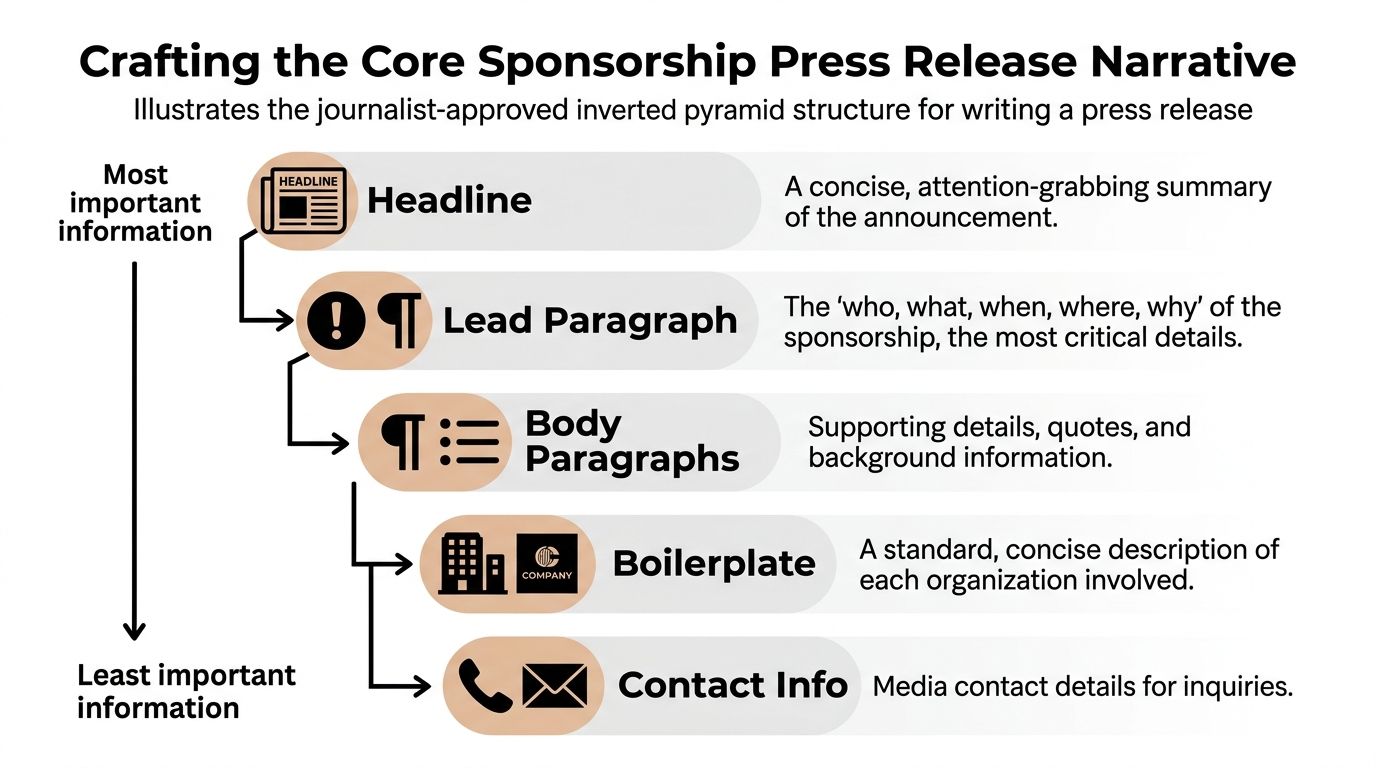
According to EasyPRWire's PR writing guidelines, the inverted pyramid structure remains the right model here. That guidance recommends a headline of 8–20 words that includes both sponsor and recipient names, plus a lead paragraph that answers the 5 Ws within 25 words. It also notes that this format can increase journalist engagement and reduce research time by 30–40% in major markets.
Start with the mutual value angle
Before writing, reduce the story to one line both partners can approve.
Examples:
- A software company sponsors a developer event to reach technical buyers while helping organizers expand programming.
- A regional bank sponsors a nonprofit initiative to deepen community trust while helping the nonprofit fund a visible local outcome.
- A consumer brand sponsors a sports property to increase visibility while improving the fan experience through activations.
That sentence becomes the release backbone. If a paragraph doesn't support it, cut it.
The release isn't a place to settle internal politics. It's a place to publish the clearest version of why the partnership matters.
For teams that need help tightening that value proposition, this guide on writing a compelling brand story is useful because it forces the narrative to connect audience need, brand role, and outcome.
Build the release in press-ready order
A journalist-friendly draft usually follows this sequence:
Headline
Name both parties and the point of the deal. Skip puffed-up adjectives.Dateline and lead
Put the who, what, when, where, and why in the opening lines. Here, weak drafts often wander into company history instead of news.Body paragraphs
Explain the scope of the partnership, what audiences should expect, and why this pairing makes sense now.Leadership quotes
One quote from each side. Each should add meaning, not repeat the lead.Boilerplates
Short organization descriptions. Keep them tight.Media contact
Include a real person who can answer follow-up questions quickly.
Here's what good versus weak lead writing looks like:
Strong lead: Apex Systems today announced a sponsorship partnership with CityTech Summit to support this year's developer programming in Austin and expand brand access to technical decision-makers.
Weak lead: Apex Systems is thrilled to share exciting news about an innovative collaboration that reflects its commitment to excellence and long-standing support for the technology ecosystem.
The first tells the reader what happened. The second sounds like internal marketing copy.
Headline formulas that save time
When deadlines are tight, headline formulas help. They don't replace judgment, but they stop teams from defaulting to vague language.
| Formula | Example |
|---|---|
| [Sponsor] partners with [Organization] to support [Initiative] | NorthRiver Bank partners with Eastside Arts Council to support youth programming |
| [Sponsor] named official [Category] sponsor of [Event or Team] | Volt named official hydration sponsor of the Metro Marathon |
| [Sponsor] sponsors [Program or Event] to expand [Benefit] | CloudForge sponsors DevBuild Week to expand founder access |
| [Sponsor] and [Organization] launch partnership around [Shared Goal] | Harvest Foods and City Harvest launch partnership around community nutrition |
| [Sponsor] backs [Recipient] for [Season, Campaign, or Initiative] | Summit Health backs River FC for the upcoming season |
A few headline rules matter more than cleverness:
- Put both names in the line: If one party is missing, the release loses search value and clarity.
- State the category or benefit: “Partners with” alone is often too thin.
- Keep legal phrasing out: “Pursuant to a multi-party agreement” belongs in the contract, not the headline.
The body should then support the headline with proof. Mention the audience impact, the activation plan, or the business reason for the partnership. Keep paragraphs short. Keep chronology clear. And don't bury the actual sponsorship under background details that belong lower in the release.
Securing Essential Assets and Partner Quotes
Most delays in a sponsorship announcement press release don't come from writing. They come from waiting on approvals, logo files, quote rewrites, and brand teams that discover late in the process that they don't like the visual presentation.
That's why asset collection should run in parallel with drafting, not after it.
Get the quotes before the draft hardens
Leadership quotes often arrive late and sound interchangeable. “We're excited.” “This partnership reflects our values.” “We look forward to working together.” None of that gives a journalist or stakeholder new information.
The better approach is to give each side a role before asking for a quote.
One side should speak to why the investment makes strategic sense. The other should speak to what the sponsorship enables. That division keeps both quotes from duplicating the lead.
A useful briefing note for executives usually includes:
- What not to repeat: The basic announcement facts already covered in the first paragraph
- What to add: Motivation, audience benefit, timing, or practical impact
- What to avoid: Empty superlatives, internal jargon, and legal language
- What to sound like: Direct, specific, and future-facing
Teams that need examples can review this resource on how to write a good quote for a press release, then shape each quote around one idea instead of five.
A usable executive quote sounds like a person explaining a decision. A weak one sounds like it passed through four approval layers and lost all meaning.
Assemble a real media package
Text-only releases can still work, but they put more burden on the reporter. According to PRLab's press release statistics roundup, 63% of companies now include multimedia assets in press releases, and embedding relevant URLs can increase website traffic by up to 77% when media outlets pick up the story.
That makes asset prep part of the writing process, not a nice extra.
A practical sponsorship package should include:
- Approved logos for both brands: Vector files if possible, plus PNG versions with transparent backgrounds
- A logo lockup: One approved combined treatment so partners don't improvise
- At least one strong image: Use something relevant to the sponsorship, not just a handshake in front of a wall
- A destination URL: Send traffic to a page that matches the announcement, not a generic homepage
- Alt text and descriptive file names: These help both accessibility and newsroom usability
Asset approval needs one owner. Without one, teams end up with duplicated versions named “final,” “final-v2,” and “use-this-one.” The release stalls, and timing slips.
One more trade-off matters here. The more stakeholders touch visuals, the slower the process gets. The fix isn't to cut people out. It's to set a hard approval sequence early, with one deadline for logos, one for executive quotes, and one for final signoff. That keeps the sponsorship announcement press release from turning into an endless review loop.
Sponsorship Announcement Templates and Sector Examples
A reusable template saves time, but only if the language adapts to the type of sponsorship. A bank backing a nonprofit initiative shouldn't sound like an energy drink sponsoring a race series. The structure can stay stable. The emphasis can't.
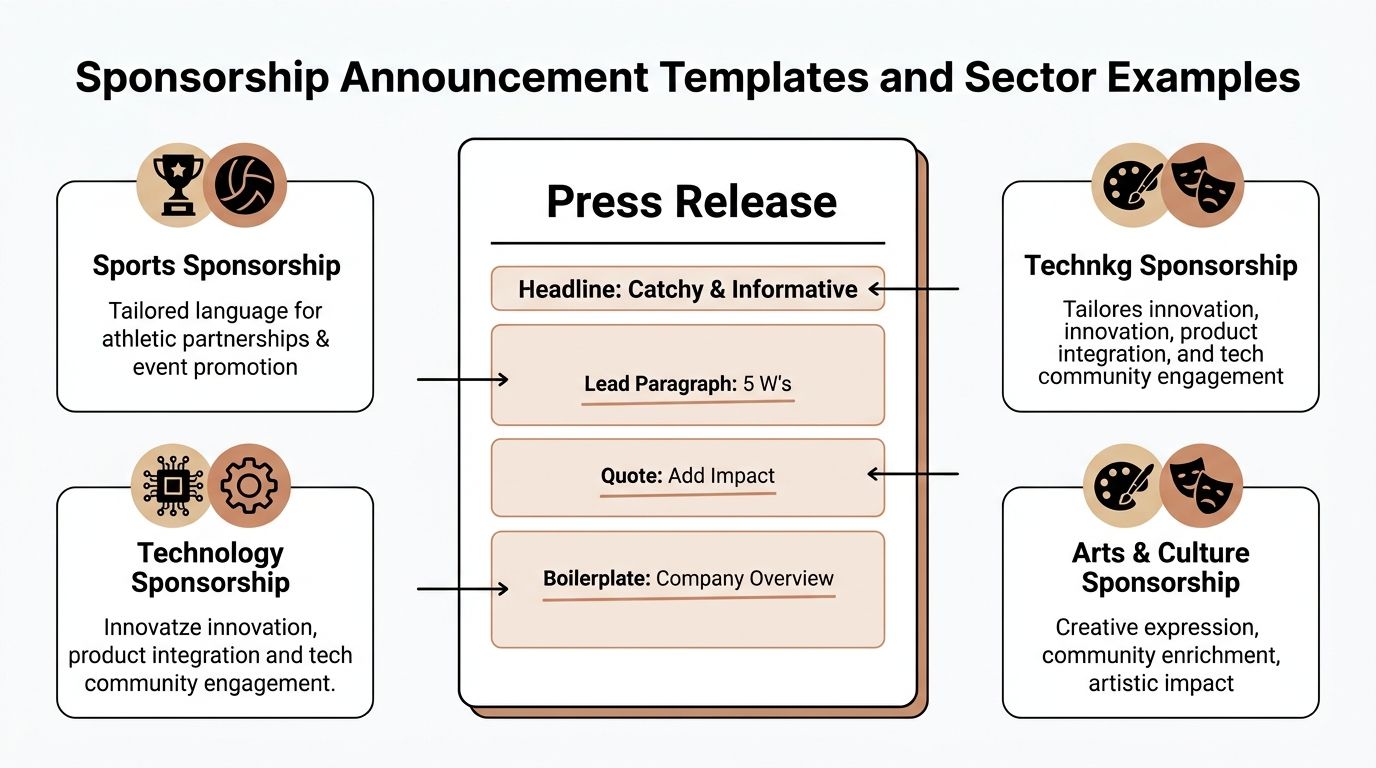
A reusable template with annotations
Below is a practical skeleton teams can adapt.
FOR IMMEDIATE RELEASE
[City, State] [Date][Sponsor] partners with [Organization] to support [initiative, event, or audience benefit]
[Sponsor], a [brief descriptor], today announced a sponsorship partnership with [Organization] to [core purpose] in [location or context]. The partnership will [key audience or business outcome].
The sponsorship includes [activation details, program support, event presence, content collaboration, or audience experience element]. The partnership aligns with [shared priority or market need].
“[Sponsor quote focused on strategic fit, audience relevance, or long-term intent],” said [Name, Title].
“[Recipient quote focused on what the sponsorship enables or improves],” said [Name, Title].
About [Sponsor]
[Two-sentence boilerplate.]About [Organization]
[Two-sentence boilerplate.]Media Contact
[Name]
[Title]
[Email]
[Phone]
Why this works:
- The headline says what happened.
- The lead centers the partnership, not self-congratulation.
- The middle explains what changes for an audience.
- The quotes split strategy and impact.
- The boilerplates stay out of the top half.
Technology sponsorship example
A startup sponsoring a hackathon should sound useful, current, and connected to builders.
“CloudForge partners with LaunchHack to support hands-on AI prototyping and founder education during this year's event.”
That line works because it links the sponsor to a concrete audience and outcome. It doesn't just announce logo placement.
The body can then mention platform credits, technical workshops, mentor participation, or product integration, as long as those details are approved and real. In technology, specificity matters. Readers want to know whether the sponsor is funding the event or actively improving it.
Community nonprofit sponsorship example
A local bank sponsoring a community nonprofit needs a different center of gravity. The tone should feel grounded, civic, and outcomes-focused.
“River County Bank partners with Neighborhood Food Network to support expanded access to local nutrition programs.”
That phrasing works because it keeps the nonprofit mission visible while still positioning the sponsor as an active contributor. The sponsor quote should address community commitment in practical terms. The nonprofit quote should explain what the support enables.
Often, many drafts get too sponsor-heavy. If the nonprofit appears only as a passive beneficiary, the mutual value story breaks. The community partner should have agency, voice, and credibility in the copy.
Sports sponsorship example
Sports sponsorship copy has to do two things well. It needs to serve business readers and fan-facing readers at the same time.
“Volt named official hydration sponsor of River FC for the upcoming season.”
That headline is direct and searchable. The body can then focus on fan activations, in-venue visibility, community clinics, or seasonal programming. Sports releases tend to drift toward hype. The fix is to write as if a beat reporter is scanning for what changes, where the sponsor appears, and why the club chose this partner.
A sports draft also benefits from disciplined quote roles:
- The sponsor talks about audience alignment, market presence, or fan engagement.
- The team or event talks about experience, support, and fit.
Across all three sectors, the same rule holds. The strongest sponsorship announcement press release doesn't read like one brand bought attention from another. It reads like both parties are advancing a visible outcome together.
Optimizing and Distributing for Maximum Reach
A polished draft can still underperform if it goes out with weak formatting, no outreach plan, and no reason for journalists to prioritize it. Distribution isn't a last click. It's part of the strategy.
According to PR Newswire's partnership press release guidance, only 12–15% of releases without a clear industry impact or customer benefit angle receive media pickup, while releases with concrete data points can see 68% higher pickup rates. That statistic should change how teams distribute sponsorship news. A wire alone won't rescue a release that lacks a reason to care.
Optimize for search and pickup
Start by making the page version of the release useful, not just published.
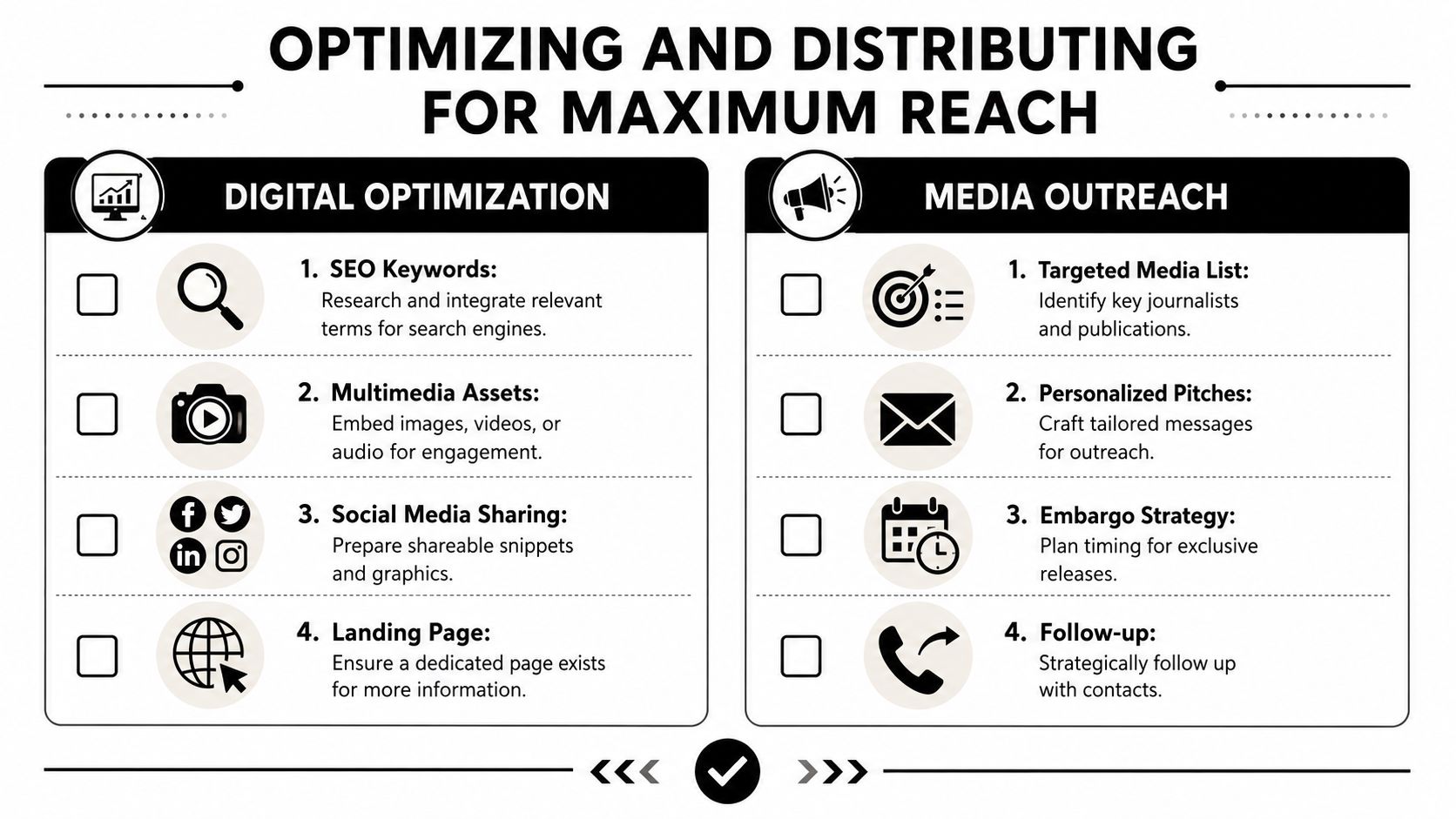
A practical optimization pass includes:
- Use the exact partnership terms naturally: Brand names, event names, sponsorship category, and location should appear in the headline, lead, and metadata without stuffing.
- Link to the right destination: Send readers to a campaign page, ticket page, program page, or newsroom page that continues the story.
- Keep multimedia attached: Reporters and editors are more likely to use a release that already contains usable assets.
- Write for skimming: Short paragraphs, clear subheads, and clean quote formatting help both readers and syndication pickup.
If the team is building a contact list for future outreach instead of relying only on one-off sends, this guide on how to build your email list effectively is a practical resource. Media lists and stakeholder lists need structure early, especially when sponsorship news is part of a recurring communications calendar.
Run outreach like a campaign
A sponsorship announcement press release deserves a small launch plan, not a “send and hope” routine.
A workable outreach checklist looks like this:
- Match the story to the right reporters: Sports business writers, local business desks, nonprofit reporters, event trades, and vertical outlets won't all care for the same reason.
- Personalize the email pitch: The note should explain why this partnership is relevant to that reporter's audience. One sentence is often enough.
- Time the release around the actual news moment: Launches tied to season starts, major events, funding cycles, or community milestones usually land better than random midday drops.
- Prepare follow-up materials: A short Q&A, approved logos, executive headshots, and a fact sheet save time when someone replies.
- Track interest and traffic: Use clear URLs so the team can tell whether pickup came from direct outreach, syndication, social sharing, or partner channels.
Editorial reality: A release gets more attention when it saves a reporter time. Clear angle, usable assets, fast follow-up.
Teams that want a fuller workflow for list building, syndication choices, and post-send follow-up can review this guide on how to distribute a press release.
One final point matters. Distribution should reflect the partnership model. A local sponsorship may perform best with regional media, chambers, community outlets, partner newsletters, and LinkedIn amplification from both organizations. A larger national deal may justify broader wire support plus direct pitching to sector reporters. Reach isn't about sending everywhere. It's about sending where the mutual value story will make immediate sense.
Common Pitfalls and Brand Considerations
Most weak sponsorship announcement press releases fail in familiar ways. The good news is that these are easy to catch before publication if someone reviews the draft like an editor instead of a stakeholder.
The mistakes that keep showing up
- The lead is buried: If the first paragraph opens with brand history or vague excitement, the actual announcement is too far down.
- The sponsor dominates the story: The sponsored organization needs a visible role, not a token mention.
- The language is inflated: Words like “groundbreaking” don't add credibility without proof.
- The quotes repeat the lead: Quotes should interpret the partnership, not restate it.
- The call to action is missing: Readers should know whether to register, attend, learn more, or contact someone.
- The brand voices clash: One side sounds formal and legal, the other sounds casual and community-focused. That mismatch is fixable, but only if someone harmonizes the draft.
The final review that protects both parties
Before sending, check the release against four filters:
News filter
Would an outsider understand what changed and why it matters?Partner filter
Does each organization appear to gain something clear and legitimate?Brand filter
Do the quotes, terminology, and visuals feel like they belong to the same announcement?Risk filter
Has legal or finance reviewed any sensitive references tied to exclusivity, rights, or financial commitments?
A sponsorship announcement press release works when it sounds balanced, useful, and credible. That usually comes from disciplined framing, not flashy wording. The strongest drafts make the partnership feel obvious in hindsight. Two organizations, one shared story, and a clear reason the market should pay attention.
Press Release Zen offers practical guides, templates, and distribution advice for teams that want to write cleaner announcements and avoid common PR mistakes. For anyone building a repeatable process around partnership news, Press Release Zen is a useful resource to keep on hand.