You finish the press release, read it twice, tighten the headline, clean up the quote, and feel good about the announcement. Then the key question arises: how do you distribute press release content so it gets picked up?
Strong announcements die. Not because the release was weak, but because the distribution was lazy, broad, mistimed, or impossible to measure afterward. A lot of teams still treat distribution like the administrative step after the strategic work. In practice, distribution is the strategic work.
A release that reaches the wrong inbox is invisible. A release that lands with the right reporter, supported by the right assets and followed by the right outreach, can turn a routine announcement into coverage, backlinks, qualified traffic, and a much stronger brand footprint.
Beyond the Send Button The Modern Press Release Playbook
Journalists still want press releases when the release is relevant and delivered well. 68% of journalists identify press releases as the most useful source for content or ideas, and 74% prefer to receive news announcements directly from PR professionals, according to eReleases press release statistics. That should settle one common misconception. Press releases aren't outdated. Poor distribution is.
The mistake I see most often is confusing activity with reach. A team sends the announcement through a wire, posts it on LinkedIn, emails a long list, and assumes they've covered distribution. They haven't. They've only created motion. What matters is whether the right people saw it, understood why it mattered, and had everything needed to cover it quickly.
Distribution is a campaign, not a click
A useful way to think about distribution is as a coordinated campaign across three layers:
- Targeted outreach: specific journalists, editors, newsletter writers, podcast producers, and niche publishers who already cover your subject
- Amplification: wire services and syndication when broad visibility or formal publication matters
- Owned support: your newsroom, blog, email list, and social channels that give the announcement a home base
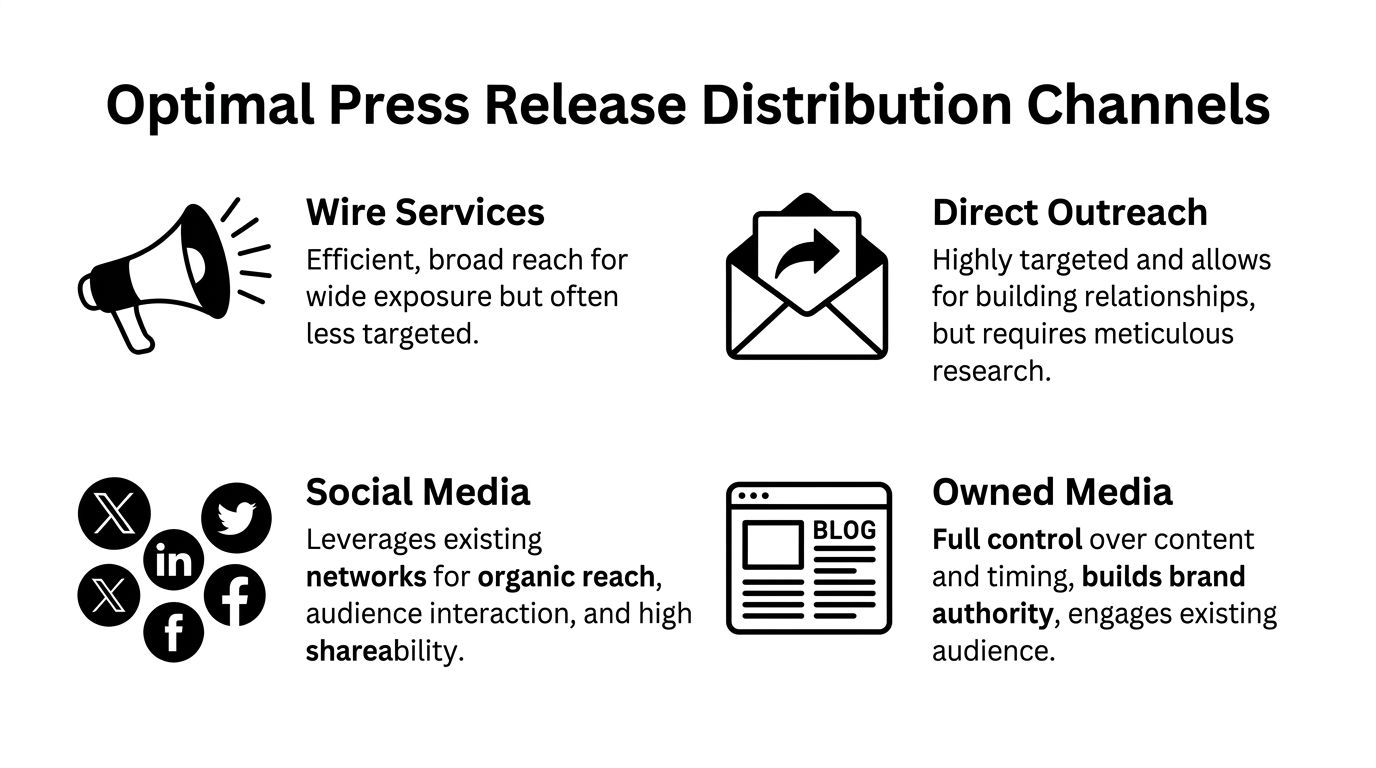
Each layer does a different job. Wires are good at breadth. Direct outreach is better at relevance and relationship building. Owned media gives you control and a permanent landing point.
Practical rule: If you can't explain why a specific contact should care about this release, don't send it to them.
A modern playbook also has to connect PR distribution with wider content distribution habits. If you're thinking beyond media lists and into multi-channel visibility, Master the distribution of content with our 2026 guide is a useful companion because it helps frame distribution as an ecosystem, not a one-off send.
What actually separates strong campaigns
The best distribution plans share a few traits:
- They start with a clear audience definition. "Business media" is not a target. "Retail trade reporters covering store expansion in the Midwest" is.
- They package the story for reuse. Journalists need facts, visuals, and fast access to context.
- They choose channels based on the announcement. A local partnership, product launch, nonprofit milestone, and executive hire should not follow the same route.
- They measure outcomes after the send. Pickup, referral traffic, backlinks, and response quality matter more than vanity reach.
Most disappointing PR outcomes come from treating distribution as a generic blast. The rest of this playbook is about replacing that habit with a system that gets your release seen, covered, and worth repeating.
Building Your Distribution Blueprint Who to Target and Why
The distribution list decides the outcome before your first pitch goes out. If the list is sloppy, the campaign is sloppy. If the list is precise, even a modest announcement can earn useful coverage.

A lot of people start with outlet names. Start with coverage intent instead. Ask who has a reason to care about this announcement, who reaches the audience you need, and who has covered adjacent stories recently. That gives you a list based on fit, not familiarity.
For smaller organizations, this matters even more. For nonprofits and small businesses, manual outreach to 50 hyper-targeted journalists can outperform broad wire services by 3x in pickup for underserved markets, and the same source notes that email open rates have declined 15% year over year, which is another reason generic blasts underperform according to Third Angle's press release guidance.
Build the list in tiers
Don't treat every contact the same. Build a tiered list.
Tier one is your highest-value group. These are the people most likely to write a real story, ask a follow-up question, or remember your brand for future news. This tier is usually small and should be hand-checked.
Tier two includes relevant trade outlets, regional publications, and specialist bloggers or newsletter operators. They may not all produce major features, but they often publish quickly and reach the exact audience you need.
Tier three includes broader distribution targets, wire-assisted visibility, and supportive channels that help with discoverability rather than dedicated coverage.
A simple working model looks like this:
| Tier | Who belongs here | Why they matter |
|---|---|---|
| Tier one | Beat reporters, editors, top trade writers | Best chance of meaningful earned coverage |
| Tier two | Niche blogs, newsletters, local outlets, association media | High relevance and faster publication |
| Tier three | Wires, general media inboxes, owned channels | Visibility, indexing, and broader awareness |
Research contacts like a reporter would
You don't need a giant database to build a sharp list, though tools can speed things up. Cision and Meltwater are common for PR teams with budgets. LinkedIn is useful for confirming role changes and beats. X can still help you spot what journalists are covering right now. Outlet websites often reveal more than databases do, especially through author archives and newsletter bylines.
Use these checks before adding anyone:
- Recent relevance: Have they covered this topic, industry, or issue lately?
- Geographic fit: Does your story matter in their market?
- Format fit: Do they write features, briefs, opinion, newsletters, or event roundups?
- Audience fit: Will their readers care about the business impact, local angle, policy angle, or human story?
A media list isn't an address book. It's an argument about why this story belongs in that person's workflow.
Tailor by sector, not just by size
Junior teams frequently lose the plot at this point. They hear "targeted" and still build one list for the entire campaign.
A nonprofit announcing a grant, community program, or impact initiative should look at mission-driven publications, local civic desks, philanthropy reporters, and issue-specific newsletters. A retail business opening a location should care about community outlets, local business editors, neighborhood blogs, and event calendars. A B2B software company should focus on trade media, analyst-facing publications, and niche creators with credibility in the space.
A few practical examples:
- Nonprofit campaign: Local press, cause-based media, regional TV assignment desks, donor and volunteer communities
- Real estate announcement: Local business journals, housing and development reporters, city newsletters, neighborhood publications
- Retail event or launch: Community calendars, lifestyle editors, local influencers, commerce and shopping newsletters
What to collect for each contact
Don't stop at name and email. A usable list includes context.
- Beat and angle: What do they cover?
- Recent article: One example you can reference in outreach
- Preferred format: Email, form, social DM, editorial calendar submission
- Notes on tone: Formal, data-driven, local-interest, executive-focused
- Priority level: So your best contacts get your best effort
The goal isn't a huge spreadsheet. The goal is a list you can act on without guessing. That's the difference between "sent" and "placed."
Assembling Your Press Kit Essential Assets and Formats
A good press release creates interest. A good press kit removes friction.
When a journalist opens your email and thinks, "This might work," the next few minutes matter. They want the logo, founder name, product image, company summary, and a clean way to verify facts. If those materials are missing, badly labeled, or buried in attachments, you turn a possible yes into extra work.
Your pre-flight checklist
A practical press kit usually includes:
- Final press release: Clean text version, easy to copy from email or landing page
- Boilerplate: Short company description used consistently across releases
- Executive headshots: High-quality images with clear file names
- Company logo files: Transparent and standard versions for different publication needs
- Product or service visuals: Screenshots, product photos, venue shots, or event images
- Fact sheet: A one-page overview of the company, program, launch, or initiative
- Spokesperson details: Name, role, email, and phone if appropriate
- Supporting links: Demo page, newsroom page, report page, event registration, or campaign landing page
- Video link if relevant: Hosted cleanly, not sent as a large file
If the story includes research, a partnership, or a public event, add the source material or a simple backgrounder. Journalists don't always need it, but they often appreciate having it ready.
Packaging matters more than people think
Avoid bulky attachments unless someone asks for them. Large files trip spam filters, clutter inboxes, and create version confusion. A cleaner option is a newsroom page or cloud folder with labeled assets. Journalists can download only what they need.
Your options usually break down like this:
| Format | Best use | Trade-off |
|---|---|---|
| Newsroom page | Ongoing PR activity and SEO value | Requires site upkeep |
| Cloud folder | Fast sharing of multiple assets | Can feel messy if naming is poor |
| Zip file | Useful when specifically requested | Less convenient and more likely to be ignored |
For many organizations, a newsroom page plus a backup cloud folder works well. That gives you a public, stable link and a private place to keep full-resolution files.
If you need help sorting the differences between these asset bundles, Press Release Zen has a practical guide on press kit vs media kit differences, features, and best practices.
Make the kit usable, not just complete
A bloated press kit can be almost as annoying as an empty one. Keep it tight.
Use descriptive filenames. Put headshots in one folder, logos in another, and product images in another. Name files in a way an editor can understand at a glance. "CEO-headshot-jane-smith" is useful. "FINAL2-new-use-this" is not.
Editor mindset: The easier you make it to publish accurately, the more likely your assets get used.
One more point that often gets missed: your press kit should match the announcement angle. If you're pitching a local expansion, include location-specific imagery. If you're pitching a nonprofit milestone, include community photos, leadership headshots, and a concise impact summary. A generic media folder tells the journalist you didn't finish the job.
Selecting Your Distribution Channels Wire, Direct, and Social
No single channel carries a press release far enough on its own. The strongest campaigns combine broad distribution, focused outreach, and owned amplification in a way that fits the actual news.
Channel choice is where teams either spend wisely or waste budget. Some announcements need the formal footprint of a wire. Some need hand-built outreach and nothing else. Most need a blend.
A useful principle comes from distribution practice documented by Agility PR: hybrid services that combine automation with personalization can help because manual outreach limits reach to 50 to 100 contacts, while wire services access over 10,000 outlets and can yield 25% to 50% more pickups. The same source warns that 80% of press release failures stem from non-newsworthy content that sounds like an ad, as noted in Agility PR's guidance on distribution mistakes.
That point matters. Better channels can't rescue weak news. But strong news usually needs more than one route.
What each channel does well
Wire services
Wires are useful when you need formal publication, syndication, broad discovery, or a timestamped public announcement. They're common for funding rounds, executive changes, partnerships, and launches where visibility across many outlets matters.
The downside is targeting. Wires distribute broadly, but they don't replace a human reason to cover your story. Think of them as infrastructure, not persuasion.
Direct journalist outreach
This is the highest-skill channel and often the highest-value one. A targeted pitch can lead to feature coverage, interviews, and stories that actually reflect your angle instead of reposting your release.
Direct outreach takes time. You need a researched list, a personalized note, and disciplined follow-up. But if your story has a clear fit for a known beat, this is usually the engine that creates real earned media.
Social media
Social doesn't replace PR distribution, but it does support it. LinkedIn is especially useful for executive commentary, hiring news, B2B launches, and partner amplification. X can help surface breaking relevance. Other platforms can work if your audience already pays attention there.
The trap is posting the link once and assuming you've amplified the release. Social works better when you recut the story into multiple angles: founder perspective, customer impact, visual teaser, or event reminder.
Owned media
Your newsroom, blog, email list, and website matter because they give your release a durable home. On these platforms, you control formatting, context, links, and calls to action. It's also the place you can send journalists when they want a clean source of truth.
Owned media rarely generates earned coverage by itself, but it supports every other channel and helps you preserve the long-term value of the announcement.
Press Release Distribution Channel Comparison
| Channel | Best For | Cost | Targeting | Potential Reach |
|---|---|---|---|---|
| Wire services | Formal announcements, syndication, broad visibility | Higher | Low to medium | Broad |
| Direct outreach | Earned coverage, features, journalist relationships | Time-intensive | High | Focused but valuable |
| Social media | Fast amplification, executive visibility, community engagement | Low to moderate | Medium | Variable |
| Owned media | Control, archive value, website traffic, supporting context | Low to moderate | High for your audience | Limited but durable |
How to choose the right blend
If the announcement is local, niche, or mission-based, start with direct outreach and owned media. Add a wire only if broader visibility serves a real purpose.
If the announcement is corporate, investor-facing, or meant to create broad awareness, a wire often makes sense. But still pair it with a customized shortlist of priority reporters. Otherwise you get syndication without storytelling.
For many teams, a practical blend looks like this:
- Primary path: Direct outreach to top-priority contacts
- Support layer: Wire distribution for publication footprint and discoverability
- Amplification layer: Website newsroom, email, and social repackaging
This is also where tools come in. Teams often compare providers before deciding how much to spend on syndication and reporting. If you're reviewing options, Press Release Zen has a side-by-side guide to best press release distribution services that can help frame the trade-offs.
What doesn't work
Some habits fail so consistently that they're worth calling out plainly.
- Mass emailing one pitch to everyone
- Using a wire as a substitute for targeting
- Sending promotional copy disguised as news
- Ignoring niche publishers because they seem smaller
- Posting once on social and calling that distribution
One feature in the right outlet can outperform a long list of low-relevance mentions.
If you're learning how to distribute press release content for impact, that's the central idea to keep. Coverage quality beats distribution volume almost every time.
Crafting the Perfect Pitch and Follow-Up Sequence
The pitch email is not a mini press release. It's a short note that helps the journalist decide whether the release deserves attention.

Most bad pitches share the same problem. They talk like the sender is trying to "announce exciting news" rather than helping the recipient assess a story. Journalists are busy. They need relevance, speed, and clarity.
A strong note usually has four parts:
- A subject line with the actual news angle
- A brief personalized opener
- A one or two sentence summary of what matters
- A clear next step
A usable pitch structure
Try something like this:
- Subject line: New retail expansion with local hiring angle in [City]
- Opening: Reference a relevant piece they wrote or a beat they regularly cover
- News summary: Explain what happened and why their audience would care
- Close: Offer the release, assets, interview access, or embargoed details
Personalization matters. Customized pitches can boost journalist responses by 4x, and a follow-up sequence of Day 1 email, Day 3 call, and Day 7 social nudge can increase coverage by 30%, according to HubSpot's press release distribution guidance.
That doesn't mean every email needs a custom essay. It means every email needs evidence that you selected this person on purpose.
What personalization should actually look like
Good personalization is specific and brief.
- Beat-based: "You recently covered neighborhood retail expansion in Austin."
- Format-based: "I noticed you round up local openings each week."
- Audience-based: "This has a community hiring angle that fits your local business coverage."
Bad personalization sounds forced, generic, or copied from a template.
If you want a broader framework for structuring concise outreach, this resource on how to write cold emails that get replies is worth reviewing. The discipline behind good cold email overlaps heavily with good media pitching.
Field note: The best pitch often feels slightly understated. It respects the recipient's judgment instead of overselling.
Timing and follow-up
Send when the journalist is likely to see and process the message, not when your internal meeting ends. Earlier in the day usually gives a pitch more room to move through the newsroom. If you're coordinating a larger announcement, embargoes can help selected reporters prepare coverage in advance, but only when the news is genuinely worthwhile and the terms are clear.
A follow-up should add value, not repeat the original email. That could mean a sharper local angle, a newly available spokesperson, a visual asset, or a clarifying data point already included in your release package.
Here’s a clean cadence:
- Day 1: Initial email with the strongest angle
- Day 3: Short follow-up with one added reason the story is relevant
- Day 7: Final light-touch nudge, sometimes through another channel if appropriate
A quick explainer can also help if your team is building this process from scratch:
What to avoid
A few pitch habits damage trust fast:
- Don't paste the entire release into the body unless requested
- Don't attach huge files on first contact
- Don't fake familiarity with the journalist's work
- Don't follow up daily
- Don't send the same pitch to multiple reporters at the same outlet without a plan
If someone passes, move on professionally. PR is cumulative. Today's no can still become next quarter's yes if your outreach stays relevant and respectful.
Tracking What Matters Measuring Pickup and Proving ROI
Once the release goes out, the campaign becomes an analytics problem. At this stage, teams either learn something useful or settle for vanity numbers.
A common mistake is celebrating "reach" without asking what happened next. Did anyone publish? Did the coverage drive referral traffic? Did you earn backlinks? Did a priority outlet respond? Those are performance questions. Potential impressions alone don't answer them.
Media pickup is the primary success benchmark for 72% of marketers, PR professionals track an average of eight key metrics after distribution, and referral traffic can increase by up to 220%. The same guidance stresses that one placement on a high-authority site delivers superior value over a large batch of weak mentions, according to this breakdown of press release performance metrics.
The metrics worth watching
Start with a compact reporting view:
- Media pickups: Which outlets published or referenced the release
- Referral traffic: Which placements sent visitors
- Backlinks: New links from media sites or related coverage
- Engagement signals: Shares, comments, reposts, and discussion around the story
- Conversions or leads: Form fills, registrations, demos, donations, or inquiries tied to the campaign
- Sentiment and message accuracy: Did coverage reflect the story you intended to tell?
Google Alerts can catch some mentions. Media monitoring tools such as Meltwater or similar platforms give a more complete picture when budget allows. UTM-tagged links help connect coverage to traffic and downstream action.
How to prove value without inflating it
Be careful with PR reporting language. Stakeholders often ask for a single ROI number, but PR value usually comes from a mix of outcomes: visibility, credibility, search benefit, direct traffic, and business action.
A practical way to report is to split outcomes into three buckets:
| Bucket | What to include | Why it matters |
|---|---|---|
| Coverage quality | Outlet relevance, authority, message fit | Shows whether the right audience saw the news |
| Audience response | Referral traffic, engagement, conversions | Shows business effect |
| Search and brand value | Backlinks, branded search lift, lasting newsroom traffic | Shows compounding value |
For a more detailed framework, Press Release Zen has a useful guide on tracking and measuring the success of your press releases.
If the release got published in many places but none of them mattered to your audience, distribution succeeded on paper and failed in practice.
Diagnosing a weak campaign
When pickup is low, don't jump straight to blaming the channel. Check the basics.
- Was the story newsworthy?
- Did the target list match the angle?
- Did the pitch explain relevance quickly?
- Did the release package make follow-through easy?
- Did your chosen channel fit the announcement?
Most underperforming campaigns fail for ordinary reasons. Wrong audience. Soft angle. Overly promotional copy. Weak follow-up. Thin assets. The good news is that these are fixable problems if you measure accurately.
Your Press Release Distribution Questions Answered
Should I send the release as a PDF or paste it into the email?
For first contact, keep the email short and include the release in a clean, accessible way. Many journalists prefer easy-to-copy text or a direct link to the full release and assets. A PDF can be useful in some workflows, but it shouldn't be the only way someone can read your announcement.
Is a wire service enough on its own?
Usually no. A wire can help with publication footprint and broad visibility, but it rarely replaces targeted outreach. If the story matters to a specific beat, person, or region, send it directly to the people most likely to care.
How many journalists should I contact?
There isn't one perfect number. What matters is relevance. A short list of highly aligned contacts is better than a long list built from assumptions. If you're tempted to add people "just in case," that's often a sign the list has drifted.
Should I follow up if no one replies?
Yes, but do it with restraint. One thoughtful follow-up can rescue a missed email. Repeated nudges with no new value usually hurt more than they help. If you follow up, add a sharper angle, a useful asset, or a reason the story matters now.
What if my release gets no pickup?
Treat that as diagnosis, not disaster. Review the list, angle, subject line, timing, pitch quality, and supporting assets. Sometimes the issue is the news itself. Sometimes the release was solid, but the distribution plan didn't match the story.
Should I post the release on my own website even if I'm using other channels?
Yes. Your website gives the announcement a stable home, supports search visibility, and gives journalists a clean source to reference. It also helps your future reporting because you can track what happens after readers land there.
How do I know whether coverage was actually good?
Look beyond volume. Good coverage reaches the right audience, reflects the right message, sends useful traffic, earns worthwhile backlinks, or creates business momentum. A smaller placement can be far more valuable than a long tail of irrelevant reposts.
What's the biggest distribution mistake?
Sending before the targeting is ready. Teams rush to publish because the release is finished. But distribution quality depends on the contact list, the assets, the chosen channels, and the pitch. The release is only one part of the system.
If you want practical help turning releases into publishable campaigns, Press Release Zen offers guides, templates, and distribution-focused resources built for teams that need clearer execution and better media pickup.