A communications team can spend a week refining a press release, align legal review, confirm executive quotes, and still run into confusion the moment the word PR leaves the newsroom and lands on social media. A brand might announce a PR initiative while, on the same day, an influencer posts a “PR unboxing” video and a developer mentions a merged PR in Slack. The acronym looks identical. The audience doesn't hear it the same way.
That gap matters more than many teams admit. In formal business writing, PR still means Public Relations. In slang and digital culture, it can point to free products, a personal best, software workflow, or even the newer verb form meaning to promote something publicly. For anyone responsible for brand communication, understanding PR meaning slang isn't trivia. It's message control.
Table of Contents
- The Shifting Meaning of PR in Digital Culture
- Grounding in the Original The Professional Meaning of PR
- Decoding the Slang The Many Faces of PR Today
- Reading the Room Context Clues for Deciphering PR
- The Professional Stakes Why Ambiguity Is a Risk
- Best Practices for Unambiguous Communication
- Frequently Asked Questions About PR Slang
The Shifting Meaning of PR in Digital Culture
A comms lead drafts a press release about a reputation issue. In the same hour, the social team is reviewing creator comments about a brand “getting good PR” from a product drop. Same acronym, different meaning, different risk.
Digital platforms changed how people hear “PR.” In formal business writing, the term still points to public relations work. In creator culture, it often points to visibility tactics, image management, gifted products, or the kind of brand access that shows up in unboxings and sponsored chatter. The letters did not change. Audience assumptions did.
That gap matters in practice. A junior team member might see “great PR” under a celebrity video and read it as praise for the communications strategy. In that setting, the commenter may be talking about image control or free product placement instead. The mistake is understandable. The cost is avoidable.
Channel context usually decides the meaning. On TikTok, Instagram, and YouTube, “PR” can signal PR boxes, creator mailers, affiliate-driven promotion, and brand seeding. In a board update, media pitch, or crisis statement, the same acronym still reads as strategic communications and reputation work, including online reputation management.
Use a simple rule. If the message is public, fast-moving, and creator-adjacent, spell out the activity instead of assuming “PR” will be interpreted your way.
That is why teams running both media relations and creator outreach need tighter language standards than teams writing only for journalists. A term that feels precise inside a communications department can become muddy in a caption, creator brief, or brand statement. For teams adapting their terminology across channels, this guide to social media PR strategy and terminology is a useful reference before reusing internal shorthand in public-facing copy.
Grounding in the Original The Professional Meaning of PR
In professional practice, Public Relations is still the anchor definition. It refers to the strategic communication process that builds mutually beneficial relationships between organizations and their publics, a definition reflected in the traditional usage summarized by Press Release Zen's business explanation of what PR stands for.
That definition matters because it protects the discipline from being reduced to spin, gifting, or visibility stunts. Professional PR covers message development, media relations, stakeholder communication, crisis response, executive positioning, and reputation stewardship. It is broader than publicity and more durable than a short campaign burst.
What the professional definition includes
A practitioner should treat PR as a management function, not just a content function. The work usually includes:
- Reputation protection: Preparing statements, managing scrutiny, and reducing avoidable misunderstanding.
- Media relations: Building journalist trust, pitching relevant stories, and responding clearly under deadline.
- Stakeholder communication: Speaking to customers, employees, partners, investors, and communities with purpose.
- Strategic alignment: Making sure public messaging supports business goals instead of drifting into disconnected noise.
Teams that need a practical complement to this discipline often look at adjacent resources on online reputation management, because the overlap is real. PR shapes narrative and trust. Reputation management deals with how that trust holds up in search, review environments, and ongoing public perception.
Public Relations remains the professional standard. Slang doesn't replace it. Slang only changes what some audiences assume when they hear the acronym.
That's the baseline every junior communicator needs before touching modern PR meaning slang. Without it, teams start using one acronym for several different jobs and lose precision before the draft even leaves the building.
Decoding the Slang The Many Faces of PR Today
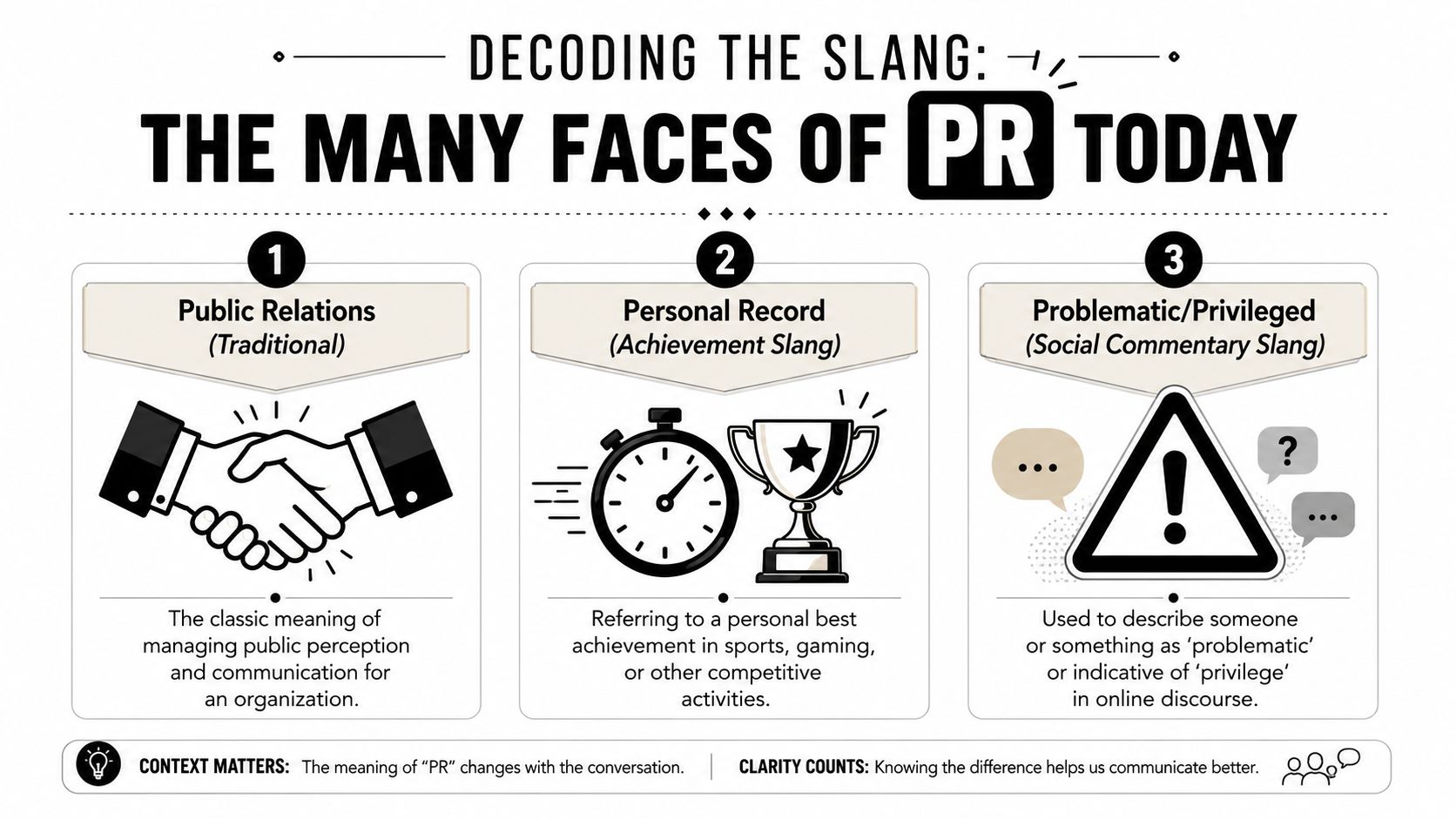
The acronym no longer belongs to one field. According to IMCWire's discussion of PR in digital branding, the term “PR” has at least three distinct major meanings: Public Relations, Personal Record, and Pull Request. In modern slang, especially within influencer culture, it has evolved to specifically denote the receipt of free products from brands (“PR boxes”) in exchange for social media exposure, a significant divergence from the traditional definition of PR as a strategic communication process.
Where the split usually happens
Public Relations is still the formal business meaning. A brand says “the PR team,” and the intended audience usually understands media strategy, announcements, messaging, and reputation work.
Personal Record appears in fitness, sports, and gaming. If a runner says, “That 5K was a PR,” the speaker means a personal best performance. A gamer might use it similarly after a new score.
Pull Request belongs to software development. In engineering teams, “Can you review my PR?” has nothing to do with publicity. It refers to a code review workflow.
Then there's the creator economy usage. In influencer culture, “I got PR from this brand” usually means the creator received a product package, often called a PR box, with the expectation of exposure rather than a formal newsroom-style media relationship.
PR Acronym Meanings at a Glance
| Term | Context | Meaning | Example Sentence |
|---|---|---|---|
| Public Relations | Business, media, communications | Strategic communication and reputation management | “The PR team approved the press statement.” |
| Personal Record | Fitness, sports, gaming | A personal best achievement | “She hit a new PR in the gym.” |
| Pull Request | Software development | A request to review and merge code changes | “The engineer opened a PR for the feature update.” |
| PR box / PR | Influencer culture | Free products sent by brands for exposure | “The creator posted a PR unboxing.” |
A practical mistake appears when teams assume one audience hears the same meaning as another. A founder speaking to journalists can safely use “PR strategy.” A lifestyle creator addressing followers may need “brand mailer,” “gifted product,” or “PR package” for clarity. A company with developers, marketers, and creator partners may need all three definitions active at once.
The same acronym can be perfectly clear inside one department and completely misleading outside it.
That's the challenge with PR meaning slang. The issue isn't whether slang is correct. The issue is whether the intended audience decodes the intended message.
Reading the Room Context Clues for Deciphering PR
Context usually solves the problem faster than dictionary definitions do.

A communications professional trying to decode PR in the wild should look at where the message appears, who is speaking, and what words surround the acronym. This is the same habit good editors use when they parse any internet shorthand. Anyone who has had to explain terms like the meaning of AFK already knows the pattern. Context carries the meaning.
Three clues that usually settle the meaning
Platform matters.
LinkedIn, a press release, or a corporate newsroom strongly suggests Public Relations. Twitch chat, Strava comments, and lifting content lean toward Personal Record. GitHub and engineering Slack almost always point to Pull Request. Instagram and TikTok beauty content often signal gifted products or PR boxes.
Speaker identity matters.
A chief communications officer saying “our PR response” means one thing. A fitness coach saying “new PR today” means another. A developer asking for PR feedback isn't discussing media at all.
Phrasing matters most.
Surrounding words usually remove doubt. “PR campaign,” “PR team,” and “PR statement” indicate the profession. “Hit a PR” suggests achievement. “Open a PR” points to software. “Got PR from a brand” or “PR haul” belongs to creator culture.
When PR becomes a verb
The newer wrinkle is grammar. A growing trend in 2024-2025 social media discourse is the use of “PR” as a verb, as in “I need to PR this outfit,” meaning to promote it or present it publicly in a good light, according to Slang.org's note on emerging PR usage.
That matters because verb usage changes the cue system. Once PR behaves like an action, not just a noun, teams can no longer rely on old definitions alone. A post saying “they're trying to PR this relationship” doesn't mean the speaker works in public relations. It means the speaker believes someone is framing something favorably for public view.
A quick internal test helps:
- Replace PR with Public Relations: If the sentence still works, the professional meaning may fit.
- Replace PR with personal best: If that makes sense, it's achievement slang.
- Replace PR with promote publicly: If the sentence suddenly clicks, it's probably the newer verb form.
This habit saves time in approvals, community management, and social listening.
The Professional Stakes Why Ambiguity Is a Risk
Most language drift is harmless until a brand publishes into it. Then ambiguity becomes a business problem.

If a company says it is “expanding PR efforts,” one audience may hear strategic communications while another hears influencer mailers and gifted boxes. That gap can cheapen the intended message. It can also make a serious initiative sound lightweight.
Teams that underestimate this usually run into problems in mixed-audience channels. A newsroom post, investor note, and executive talking point may all be clear internally. But the moment they're quoted in creator ecosystems, reposted in comment threads, or clipped into short-form content, shorthand starts working against them. That's one reason many teams train staff on what a PR specialist does in explicit terms rather than assuming the acronym still explains itself.
Where confusion causes damage
- Brand positioning gets diluted: A strategic communications program can sound like product seeding if the acronym isn't defined.
- Internal collaboration slows down: Marketing, engineering, and communications teams may each read PR differently in shared documents.
- Professional credibility takes a hit: Senior leaders may unintentionally reduce the scope of Public Relations by using the same shorthand creators use for gifting.
- Press materials lose precision: Journalists prefer clear terms. If a sentence can be read two ways, it usually needs rewriting.
Clear language protects strategy. Vague shorthand makes the audience do interpretation work the brand should've done first.
The strongest teams don't panic about slang. They adapt to it. The risk comes from pretending the acronym still travels untouched across every platform and audience.
Best Practices for Unambiguous Communication
Clear writing solves most of this. Not all of it, but most of it.
Language choices that reduce confusion
A disciplined communications team usually follows a few simple rules.
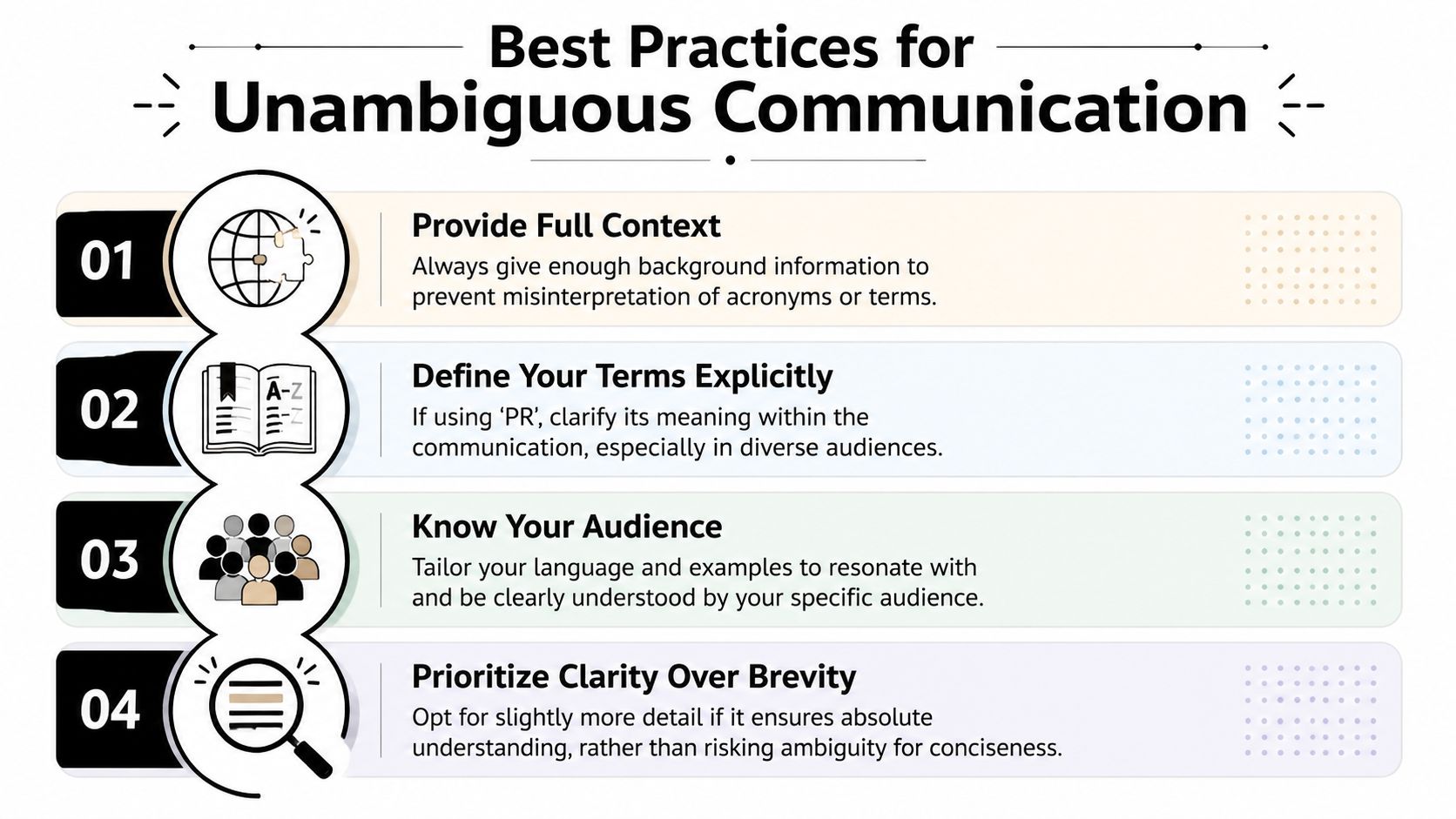
- Spell it out on first reference: In press releases, executive statements, and formal web copy, write Public Relations before using PR.
- Choose narrower terms when possible: “Media relations,” “corporate communications,” “creator seeding,” and “influencer gifting” are often better than one overloaded acronym.
- Match wording to the channel: A creator brief can say “gifted product package” if “PR” may blur the terms of the exchange.
- Review headlines harder than body copy: Headlines strip context. If “PR” appears there, ambiguity grows fast.
Short examples show the difference:
| Less clear | Better |
|---|---|
| “The company is investing in PR.” | “The company is investing in Public Relations and media relations.” |
| “The brand launched a PR program.” | “The brand launched a creator gifting program.” |
| “Our PR team led the response.” | “Our Public Relations team led the media response.” |
One additional rule helps in approvals.
“If an acronym has more than one active public meaning, define it before publishing.”
That's not old-fashioned. It's efficient. Precision keeps the audience focused on the message instead of guessing the category.
Frequently Asked Questions About PR Slang
A junior marketer drafts a release announcing a new PR program. The sales team reads it as public relations support. The creator team assumes it means product mailers. Engineering jokes that it must be a pull request queue. That kind of overlap is common, and it is exactly why teams need sharper language around PR.
As noted earlier, the slang use of PR is real and widely recognized online. In formal business communication, Public Relations still carries the clearest professional meaning. The practical question is not which meaning is "correct." The practical question is whether your reader can identify the right meaning without stopping to decode it.
Is it wrong to use PR in official copy
Use PR in official copy only when the audience and context make the meaning obvious.
In press releases, executive statements, investor materials, and crisis updates, I recommend writing Public Relations on first reference. That small choice prevents a preventable misunderstanding. In internal notes to a communications team, the acronym is usually fine because the shared context is already there.
Should brands avoid PR box language
Brands do not need to ban the phrase. They need to use it carefully.
“PR box” works in creator and consumer-facing contexts where the audience already understands it as a product mailer. It is less precise in contracts, disclosure guidance, campaign recaps, and any document where legal or commercial expectations matter. In those cases, terms like “gifted product,” “product mailer,” or “creator package” do a better job because they describe the exchange more clearly.
Can one company use PR in multiple ways internally
Yes, but only with rules.
Cross-functional companies often have several active meanings for the same acronym. Communications may mean Public Relations. Developer teams may mean pull requests. Influencer teams may mean PR mailers. Without a style rule, meeting notes, project briefs, and Slack updates get messy fast.
The fix is simple. Use the full term in cross-functional documents, and reserve the acronym for team-specific communication where the meaning is already settled.
Is the slang meaning disrespectful to the profession
Usually, no.
The slang meaning reflects visibility, not disrespect. Audiences see gifted boxes on social platforms, so they start using “PR” to describe the visible output rather than the broader communications function behind it. The professional risk is not offense. The risk is reduction. If a brand uses the shorthand carelessly, it can flatten a strategic discipline into a giveaway tactic.
What should PR teams do if executives use the term loosely
Set a house style and enforce it in review.
Executives often use familiar shorthand because it is fast. That is workable in meetings, but published copy needs more discipline. A communications team should define approved terms for media relations, creator gifting, affiliate seeding, and corporate communications, then apply those terms consistently across releases, talking points, and campaign briefs. That protects clarity without forcing awkward language into every sentence.
Press Release Zen is a useful next stop for teams that want sharper language in real-world announcements. Its guides, templates, and distribution explainers help communications staff write press releases that stay clear under pressure, whether the challenge is terminology, formatting, or audience mix. Explore Press Release Zen for practical support on writing and distributing stronger media communications.