Press releases still sit at the center of PR execution. In 2024, 87% of PR professionals said they rely on press releases to secure media coverage, according to Determ's 2024 PR statistics roundup. That single data point explains why a strong sample PR strategy saves time. Teams don't need to reinvent structure every time news breaks. They need a repeatable plan that connects message, distribution, and measurement.
A practical sample PR strategy gives a team a starting point for headlines, spokesperson quotes, media lists, launch timing, and follow-up. It also reduces the most common failure in PR: publishing a release with no clear audience, no story angle, and no way to judge whether it worked. For brands that want visibility across search, media, and owned channels, a press release works best when it sits inside a wider plan.
PR also doesn't stop at one format. While social media is often seen as the most effective overall PR tactic, professionals still combine releases with events and targeted pitching, as noted earlier. That's why the strongest examples below pair a release with outreach, content reuse, and KPIs.
Readers building a launch campaign should also study this podcast audience growth playbook because audience-building habits often translate well into ongoing PR distribution.
Table of Contents
- 1. Multimedia Press Release Strategy
- 2. Tiered Distribution and Target Audience Segmentation
- 3. Crisis Communications and Rapid-Response Press Release Strategy
- 4. Thought Leadership and Executive Commentary Strategy
- 5. SEO-Optimized Press Release Strategy
- 6. Community and Local Partnership Press Release Strategy
- 7. Exclusive Embargo and Strategic Media Release Strategy
- 8. Ongoing Relationship and Beat Reporter Cultivation Strategy
- 8-Point PR Strategy Comparison
- Putting Sample PR Strategies to Work
1. Multimedia Press Release Strategy
A multimedia release gives journalists more than text. It gives them usable assets. A SaaS company can include a short demo video, annotated product screenshots, founder headshots, and a simple infographic that explains the problem the product solves. A nonprofit can attach before-and-after images, a one-page impact graphic, and a brief testimonial clip.
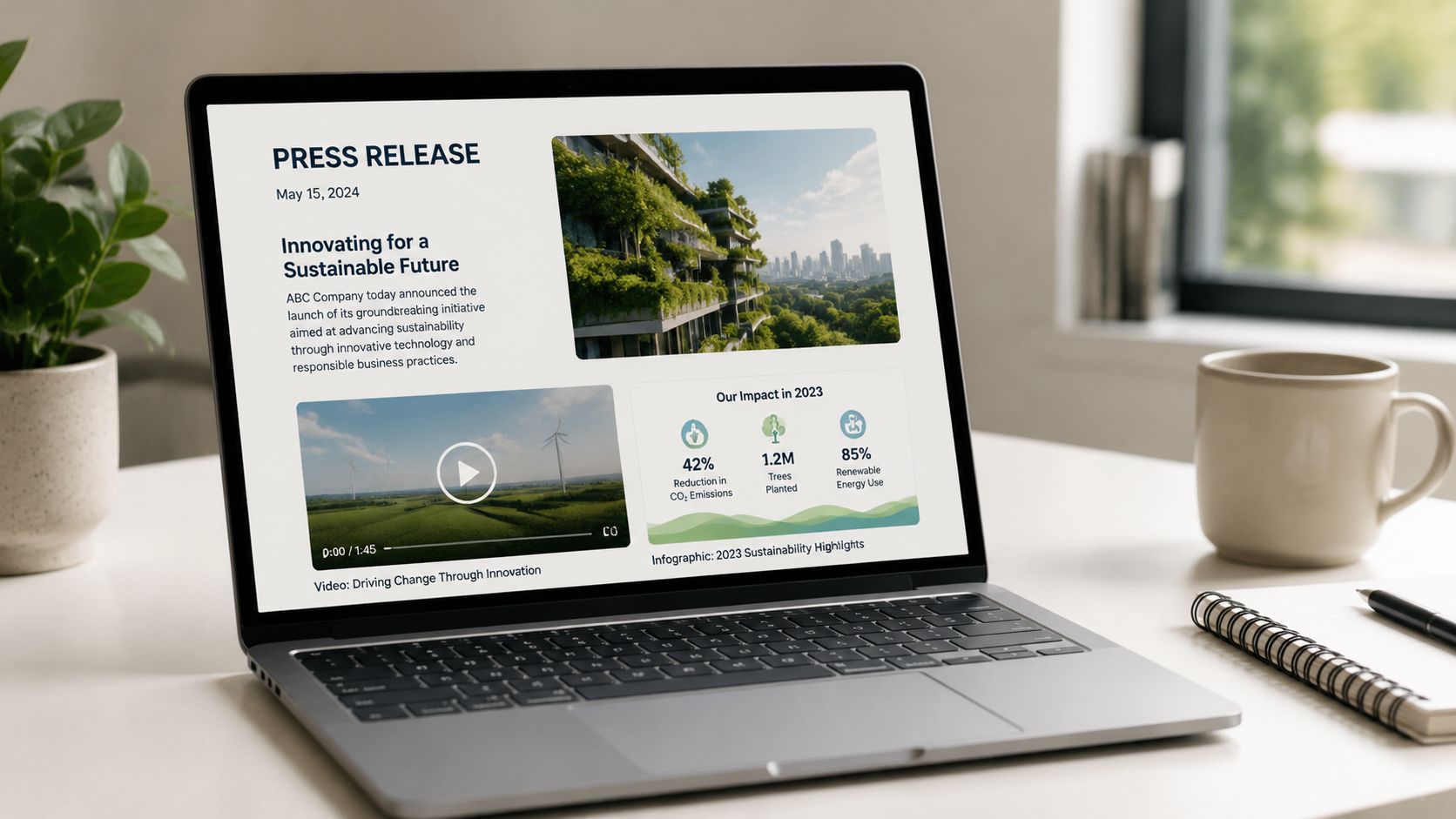
This sample PR strategy works best when the story already has visual proof. Real estate firms use listing photography and virtual tours. Retail brands send lifestyle product images. B2B companies often underestimate visuals, but even a product architecture graphic or customer workflow chart can make coverage easier to write.
What it looks like in practice
A launch package should include the release, a media folder, and one central landing page. The landing page holds the full announcement, downloadable assets, executive quotes, and contact details. Reporters then have one place to pull everything they need.
Practical rule: If a journalist needs to ask for the logo, product image, founder photo, and product screenshot separately, the release package is incomplete.
Useful asset mix:
- Hero image: A clean image that can run in news stories without extra editing.
- Short video: A brief demo or spokesperson clip. Keep it concise and focused on one message.
- Infographic: A simple visual that explains process, impact, or market context.
- Alt text: Descriptive image text that helps with accessibility and search visibility.
Sample structure and KPIs
Objective: Earn pickup for a product launch or initiative that benefits from visual storytelling.
Key message: “The announcement matters because it changes how the audience solves a specific problem.”
Sample headline: “ABC Software Launches New Workflow Platform With Real-Time Team Visibility”
Sample press release opener:
“ABC Software today announced the launch of its new workflow platform, designed to help operations teams manage approvals, tasks, and reporting from one dashboard. The release includes a live product demo, platform screenshots, and implementation resources for media and customers.”
Distribution plan: Send the release to the core media list, publish it in the newsroom, share selected assets on LinkedIn and email, and give sales and partnerships teams the same media folder for consistent outreach.
KPIs: Media pickups, asset downloads, referral traffic from coverage, branded search activity, backlinks, and inbound lead quality.
2. Tiered Distribution and Target Audience Segmentation
Sending one generic release to every contact usually weakens the pitch. A better sample PR strategy splits the media list into tiers based on relevance. Tier one gets the sharpest angle and the most personal outreach. Tier two receives an adapted version after the first outreach window. Tier three gets broader distribution once priority targets have had time to respond.
The structure is simple, but the payoff is clarity. A software startup might pitch a funding story one way to national tech press, another way to vertical SaaS writers, and a third way to local business outlets covering the company's home market.
How the tiers work
Tiering forces the team to answer one hard question: who is this story really for? A local expansion announcement may matter most to regional business journals and local TV producers, not national reporters. A compliance product launch may fit trade publications better than broad business media.
A useful segmentation model looks like this:
- Tier one: Highest-value reporters and outlets with a direct beat match.
- Tier two: Trade publications, niche newsletters, and secondary regional outlets.
- Tier three: Broad release distribution, database sends, and owned channel amplification.
A reporter covering healthcare IT doesn't need the same framing as a reporter covering startup funding. The news may be identical. The relevance isn't.
Sample rollout plan
Objective: Improve story fit and reduce wasted outreach.
Key message by segment:
For national media, emphasize market significance.
For trade outlets, emphasize industry pain points and operational details.
For local outlets, emphasize jobs, community impact, or regional relevance.
Sample headline for trade media: “ABC HealthTech Unveils New Patient Intake Platform for Multi-Location Clinics”
Sample press release opener:
“ABC HealthTech today introduced a patient intake platform built for multi-location clinics that need faster coordination between front-desk teams, providers, and billing staff. The company is rolling out the platform with implementation support designed for healthcare operations teams.”
Distribution plan: Personalize the first email wave to tier one. Wait a short interval before moving to the next tier. Track which version each outlet received and note reply patterns, open behavior, and requests for interviews.
KPIs: Response rate by tier, interview requests, placements by segment, quality of outlets secured, and share of coverage that reflects the intended message.
3. Crisis Communications and Rapid-Response Press Release Strategy
A crisis release needs speed, but speed without structure creates confusion. The strongest crisis sample PR strategy is built before the crisis starts. That means approved holding statements, a decision tree, named spokespeople, and one command path for legal, leadership, and communications.
Reputation can shift quickly when a company stays silent, so the release shouldn't try to solve the entire issue in one document. Instead, it should establish facts, explain immediate action, and tell stakeholders when the next update will come.
Core message order
A crisis statement usually works best in this order: acknowledgment, known facts, customer or public impact, immediate response, and next steps. If a retailer recalls a product, the first paragraph should tell customers what happened and what they need to do now. If a software company faces a service outage, the first paragraph should explain service impact and current response.
A prebuilt crisis communications plan template from Press Release Zen helps teams prepare approvals, roles, and statement formats before a live issue appears.
Silence often reads as avoidance. A short, accurate statement is usually better than a delayed perfect one.
Sample crisis release framework
Objective: Protect trust by responding quickly, clearly, and consistently.
Key message: “The organization is aware of the issue, is acting on it, and will provide further updates.”
Sample headline: “ABC Foods Issues Voluntary Recall of Select Snack Products”
Sample press release opener:
“ABC Foods is voluntarily recalling select snack products after identifying a packaging issue that may affect product labeling. The company has notified retail partners, removed affected inventory where possible, and published guidance for customers on its website.”
Distribution plan: Publish the statement in the newsroom, email affected stakeholders directly, push the same language to social channels, brief customer support, and update the website homepage or alert banner if public action is required.
KPIs: Accuracy of early coverage, support ticket themes, sentiment changes, direct stakeholder response, correction rate for misinformation, and follow-up media handling efficiency.
A strong crisis process also includes a second release if the situation develops. The first message establishes control. The next message proves follow-through.
4. Thought Leadership and Executive Commentary Strategy
Some announcements aren't product news. They're perspective. A thought leadership sample PR strategy turns executive expertise into timely commentary that journalists can quote, conference organizers can book, and prospects can trust.
This works well when the spokesperson has a real point of view tied to current events or industry shifts. A cybersecurity founder can comment on new compliance pressure. A real estate executive can explain regional buyer behavior. A nonprofit leader can add context to policy changes affecting community programs.

Turning expertise into coverage
The angle shouldn't read like self-promotion. It should answer a question the public already has. That's why reaction speed matters. If a regulation changes on Tuesday, the best commentary often lands that same day or the next morning.
Teams can also repurpose one idea into multiple formats. A bylined article can become LinkedIn posts, podcast talking points, newsletter commentary, and short quote pitches to journalists. For teams building that kind of reuse system, these ProdShort content repurposing insights offer a useful model.
A gap in many sample templates is the buyer journey link. As noted in Prowly's PR strategy template discussion, many resources don't clearly map story angles to stages of awareness, education, and decision. That's a useful reminder: an executive opinion piece may build top-of-funnel trust, while a webinar recap or detailed article may support mid-funnel evaluation.
Sample commentary release
Objective: Position an executive as a credible source on a live industry issue.
Key message: “The executive offers useful interpretation, not just company promotion.”
Sample headline: “ABC Logistics CEO Available to Comment on Supply Chain Planning Shifts”
Sample press release opener:
“As manufacturers adjust planning and fulfillment strategies, ABC Logistics CEO Jordan Lee is available to comment on the operational changes affecting inventory coordination, carrier communication, and forecasting discipline. Lee regularly advises distribution teams on process redesign and network resilience.”
Distribution plan: Build a rapid-response quote bank, maintain a short list of target reporters, publish commentary in the newsroom, and repurpose approved executive insights across podcast, email, and social channels.
KPIs: Quote inclusions, byline acceptances, speaking invitations, podcast appearances, executive profile growth, and qualified conversations that mention the published viewpoint.
5. SEO-Optimized Press Release Strategy
An SEO-focused release is written for journalists and searchers at the same time. It uses the words people search for, but it still reads like news. That means no keyword stuffing, no robotic headlines, and no vague announcement pages with no context.
This sample PR strategy matters because online PR campaigns can create measurable digital visibility when search, content, social, and email work together. One documented online PR case combined SEO, social content across Facebook, LinkedIn, Twitter, and Instagram, a branded podcast, and email list-building tools to grow organic traffic and subscribers over time, as described in this online PR case study from Attrock.
Search-first release planning
Start with one primary phrase and a few natural variations. A local law firm might target “employment lawyer in Denver” on a service page, but a press release should frame news such as an office opening, award, report, or community initiative. A B2B company might target a category phrase around a launch, integration, or research release.
A detailed guide to press releases for SEO from Press Release Zen can help teams shape headlines, links, and newsroom pages so releases support long-term discoverability.
Useful page elements:
- Headline: Clear, specific, and news-led.
- First paragraph: Includes the main phrase naturally and explains why the news matters.
- Internal links: Point to relevant product, service, or newsroom pages.
- Metadata: Write a strong page title and description for search visibility.
Sample SEO release setup
Objective: Increase discoverability for a newsworthy announcement and support long-tail search visibility.
Key message: “The company is announcing something new that solves a clearly named problem.”
Sample headline: “ABC Analytics Launches Retail Forecasting Platform for Multi-Store Brands”
Sample press release opener:
“ABC Analytics today launched a retail forecasting platform designed for multi-store brands that need clearer demand planning and reporting. The platform gives operations and finance teams a unified view of inventory patterns, store-level trends, and planning workflows.”
Distribution plan: Publish first on the company newsroom, optimize the URL and metadata, link to a matching product page, distribute to relevant outlets, and share snippets through newsletter and social posts that point back to the release.
KPIs: Branded and non-branded search impressions, referral traffic from coverage, backlinks earned, time on page, and conversions from visitors who land on the release or linked page.
6. Community and Local Partnership Press Release Strategy
Local PR works when the story is local. A neighborhood business opening, a workforce initiative, a school partnership, or a charity event gives regional outlets a reason to care. National framing usually weakens these announcements. Local framing sharpens them.
A nonprofit case discussed by Meg Seiler's PR transformation examples showed how a low-budget, human-interest approach improved website traffic, social engagement, follower growth, lead generation, and brand sentiment. The tactics were simple: tell beneficiary stories, pitch emotional local angles, and create community events that regional media can cover.

Why local angles work
Local editors often need stories with names, places, and visible community relevance. A franchised restaurant opening can mention hiring, neighborhood foot traffic, and partnership with a nearby nonprofit. A medical practice can highlight a free screening day with a local health partner. A bookstore can announce a literacy initiative with a school district.
The closer the story gets to a real neighborhood, the easier it becomes for local media to picture their audience caring about it.
Sample local partnership release
Objective: Build goodwill and local visibility through a community-relevant announcement.
Key message: “The organization is investing in a place, not just promoting itself.”
Sample headline: “ABC Market Partners With Westside Youth Center for Back-to-School Supply Drive”
Sample press release opener:
“ABC Market has partnered with Westside Youth Center to host a neighborhood back-to-school supply drive supporting local students and families. The campaign will include in-store collection points, volunteer support, and a community event designed to increase access to school essentials.”
Distribution plan: Send customized versions to local newspapers, radio producers, city business journals, school newsletters, neighborhood blogs, and partner organizations. Ask the community partner to share the release through its own channels and include a local spokesperson in the quote set.
KPIs: Local pickups, event attendance, referral traffic from community listings, partner shares, branded local search activity, and post-campaign sentiment feedback.
7. Exclusive Embargo and Strategic Media Release Strategy
Some stories deserve controlled timing. An embargo strategy gives selected reporters advance access before the public announcement, with a clear understanding that coverage won't publish before the agreed time. This works well for major launches, annual reports, research findings, executive appointments, and significant partnerships.
The value isn't secrecy for its own sake. It's preparation. Reporters get time to review materials, ask questions, and build a stronger story. The company gets better framing and more coordinated release timing.
When to use an embargo
An embargo should be reserved for news with real editorial value. If every release arrives with an embargo label, reporters stop treating it as special. A research report, major funding event, or category-defining launch is a stronger fit than a routine company update.
Teams planning this format can review the mechanics in Press Release Zen's guide to a press release embargo, especially around time zones, media kits, and follow-up.
A good embargo pitch includes:
- Clear timing: State date, time, and timezone in the subject line and body.
- Reason to care: Explain why the story matters to that reporter's audience.
- Preview materials: Share the release, visuals, FAQ, and spokesperson access.
- Fast response channel: Give one contact for questions before the lift time.
Sample embargo plan
Objective: Secure higher-quality earned coverage for a major announcement.
Key message: “Selected media receive early access because the story supports informed reporting.”
Sample headline: “Under Embargo Until Tuesday 9 a.m. ET. ABC Robotics Unveils Warehouse Automation System”
Sample press release opener:
“ABC Robotics will announce a new warehouse automation system designed for high-volume fulfillment environments. The company is providing advance access to selected media along with product visuals, executive interviews, and deployment context ahead of the public release.”
Distribution plan: Offer advance access to a small set of trusted journalists, hold short embargo briefings if needed, confirm receipt, answer questions promptly, then publish the announcement widely once the embargo lifts.
KPIs: Depth of initial coverage, accuracy of reporting, quality of headline framing, interview uptake, and follow-on coverage after the public release.
8. Ongoing Relationship and Beat Reporter Cultivation Strategy
The most durable PR advantage often comes from consistency, not a single big launch. A beat reporter strategy focuses on becoming a credible, useful source over time. That means sending fewer weak pitches and more relevant insights, background notes, source access, and timely expert commentary.
This relationship-first sample PR strategy aligns with a wider industry shift toward measurable value. The PR market is projected to exceed $133 billion by 2027, and 79% of PR professionals prioritize proving value through media coverage and reach, according to Meltwater's PR statistics overview. Strong reporter relationships help teams produce that value more predictably.
Building trust before the pitch
A beat relationship usually starts before any announcement. A PR lead reads recent bylines, notes recurring themes, and learns what the reporter covers. Then the outreach offers something useful. That might be a quick expert reaction to breaking news, background on an industry issue, or access to a practitioner who can explain a trend clearly.
Recent analysis also points to a more compelling angle style. Pitches built on benchmarks, trend insights, surprising findings, and emotional or contrarian lessons often outperform product-heavy framing, as discussed in this analysis of media pitch angles on YouTube. In practice, that means reporters often respond better to “what the client learned” than “what the company launched.”
Sample relationship cadence
Objective: Increase earned coverage consistency and improve story framing over time.
Key message: “The organization is a reliable source, not just a company asking for coverage.”
Sample soft-touch email angle:
“ABC Payments can provide a payments operations expert to comment on chargeback trends affecting subscription businesses this quarter. No launch attached. The team can also share examples of how finance leaders are adjusting customer communication around disputes.”
Distribution plan: Maintain a beat list with topic preferences, recent stories, and last contact dates. Share timely notes when relevant, respond quickly to inbound requests, and only pitch formal releases when the story clearly fits the reporter's beat.
KPIs: Repeat responses from the same reporters, quote requests, background call invitations, share of stories with accurate framing, and long-term placement quality across priority beats.
8-Point PR Strategy Comparison
| Strategy | Implementation complexity | Resource requirements | Expected outcomes | Ideal use cases | Key advantages |
|---|---|---|---|---|---|
| Multimedia Press Release Strategy | High, multimedia production and integration | High, designers, videographers, hosting, analytics | Increased media pickup, social sharing, improved SEO | Product launches, visual stories, campaigns needing shareability | Engaging content with multiple hooks for journalists and audiences |
| Tiered Distribution & Target Audience Segmentation | Medium, list research and messaging variations | Medium, media research, CRM, personalized pitches | Higher-quality placements and improved response rates | Startups seeking top-tier coverage, vertical or geographic targeting | Targeted outreach with better relevance and measurable ROI |
| Crisis Communications & Rapid-Response Press Release Strategy | High, rapid workflows and approval chains | High, crisis plans, legal review, trained spokespeople | Fast narrative control and reduced reputational damage | Product recalls, controversies, safety incidents, executive crises | Rapid, coordinated multi-channel response that mitigates harm |
| Thought Leadership & Executive Commentary Strategy | Medium, content creation and executive coaching | Medium, executive time, editorial support, research | Increased credibility and high-quality earned media placements | Industry positioning, executive visibility, keynote/speaking announcements | Builds authority and personal brand; creates reusable content assets |
| SEO-Optimized Press Release Strategy | Medium, keyword research and technical optimization | Medium, SEO expertise, tools, SEO-friendly distribution | Long-term organic search traffic and sustained discoverability | B2B product categories, local search, evergreen announcements | Improves search visibility and generates backlink value over time |
| Community & Local Partnership Press Release Strategy | Low–Medium, localized content and outreach | Low–Medium, local media lists, local contacts, location-specific copy | Higher local pickup and stronger community goodwill | Store openings, local events, franchise or multi-location promotions | Cost-effective local coverage and stronger community relationships |
| Exclusive Embargo & Strategic Media Release Strategy | Medium–High, coordination and embargo management | Medium, select outreach, briefing materials, precise timing | Premium placements and synchronized multi-outlet coverage | Major product launches, research releases, high-profile announcements | Secures prominent coverage and deepens journalist relationships |
| Ongoing Relationship & Beat Reporter Cultivation Strategy | Medium, sustained, ongoing engagement | Medium, time investment, CRM, regular outreach | Consistent, high-quality coverage and better story framing | Organizations seeking steady earned media and complex beats | Builds trusted-source status and easier access for future coverage |
Putting Sample PR Strategies to Work
A strong sample PR strategy does more than fill a page. It gives a team a repeatable way to decide what the story is, who should hear it first, which assets support it, and how success will be measured. That matters because PR now operates in a results-focused environment. Teams aren't judged only by whether coverage happened. They're judged by whether the right message reached the right audience and contributed to visibility, trust, or pipeline support.
The eight examples above work because each one matches a different type of announcement. Multimedia releases help when visuals carry the story. Tiered distribution helps when one message needs different framing by outlet. Crisis plans help when speed and consistency matter more than polish. Thought leadership helps when expertise is the news. SEO-focused releases support discoverability long after launch week. Local partnership strategies give community stories the local detail they need. Embargo plans help premium stories land with more depth. Beat cultivation creates the long-term trust that makes every future pitch stronger.
A practical rollout usually starts with three decisions. First, define the business outcome. That might be awareness, partner interest, sign-ups, stakeholder reassurance, or local goodwill. Second, define the audience. Journalists, customers, investors, community members, and regulators all need different framing. Third, define the proof. That means screenshots, executive quotes, event details, beneficiary stories, product visuals, research context, or customer examples.
Teams should also keep templates flexible. A press release should never feel copied and pasted into a live market. The structure can repeat. The angle can't. The best templates lock in the basics such as formatting, contact blocks, quote placement, boilerplate, and KPI planning. They leave room for story-specific detail.
Measurement is what turns a template into a system. For one campaign, the KPI mix may focus on media pickups, backlinks, and referral traffic. For another, it may focus on sentiment, local turnout, or executive quote placements. The metric set should match the campaign type. A crisis release and a local event release shouldn't be judged by the exact same dashboard.
Iteration matters just as much as launch. If tier-one media ignore the pitch, the angle may be wrong. If the release gets views but no backlinks, the newsroom page may need better supporting assets. If local outlets don't respond, the story may need stronger community voices or a better event hook. PR improves when teams review outcomes quickly and adjust the next release accordingly.
Press Release Zen's downloadable templates can speed up that process. They give teams a starting framework, but the strongest results come from adapting each strategy to the moment, the audience, and the message.
Press Release Zen helps PR teams, founders, agencies, and nonprofits turn rough ideas into publishable announcements. Readers who need practical templates, distribution guidance, and step-by-step press release examples can explore Press Release Zen for ready-to-use resources that support faster, clearer media execution.