The sent folder is full. The story felt solid. The subject line looked clean. Then nothing happened.
That silence usually doesn't mean the email was poorly written. More often, it means the pitch was built on an untested assumption. The team assumed the story mattered to the reporter, the reporter's audience, or the outlet's current priorities. In a crowded inbox, that's the mistake that kills most outreach before the first sentence gets a fair read.
A useful approach to how to pitch a story starts earlier than most guides admit. It starts before the draft, before the subject line, and before the media list is finalized. The strongest results come from validating the angle first, then writing a pitch that matches a journalist's current coverage, format, and editorial appetite.
Table of Contents
- Beyond Sending and Praying Your Introduction to Pitching
- Validating Your Story Angle Before You Pitch
- Building a High-Impact Media List
- How to Write a Pitch Reporters Actually Read
- Managing Assets Embargoes and Follow-Up Strategy
- Common Pitching Mistakes and How to Fix Them
- Frequently Asked Questions About Pitching
Beyond Sending and Praying Your Introduction to Pitching
Most bad pitching advice begins at the keyboard. It treats outreach like a writing exercise, when it's really a relevance test. A polished email won't rescue an angle that doesn't fit the journalist's beat, the outlet's priorities, or the current news cycle.

The practical fix is simple. Stop treating pitching as a one-step send action. Treat it as a workflow: validate the angle, choose the right reporter, write a fast-scanning email, support it with usable assets, and follow up like a professional.
Why inbox silence happens
Silence usually comes from one of four problems:
- The story isn't clearly newsworthy: The email explains the company update, but not why readers should care now.
- The wrong journalist got it: A good business story sent to a general assignment inbox often dies there.
- The angle is buried: Reporters scan quickly. If the point appears halfway down, the pitch loses.
- The ask is awkward: Some outreach reads more like a cold introduction than a story pitch.
For teams that struggle with that last issue, Ellie's email introduction tips are useful because they sharpen the opening without making it stiff or self-important.
Practical rule: A pitch is not a networking email with a news item attached. It's a concise case for why this story belongs in that reporter's coverage.
What actually changes outcomes
A repeatable pitching process works better than bursts of creativity. The strongest practitioners usually do three things before drafting anything:
- They confirm the angle fits current editorial interest.
- They choose one specific journalist who has already shown appetite for that type of story.
- They write for scanning, not admiration.
That approach removes a lot of guesswork. It also makes rejection more useful. When the angle is validated and the target is right, a no often gives clearer feedback than silence.
Validating Your Story Angle Before You Pitch
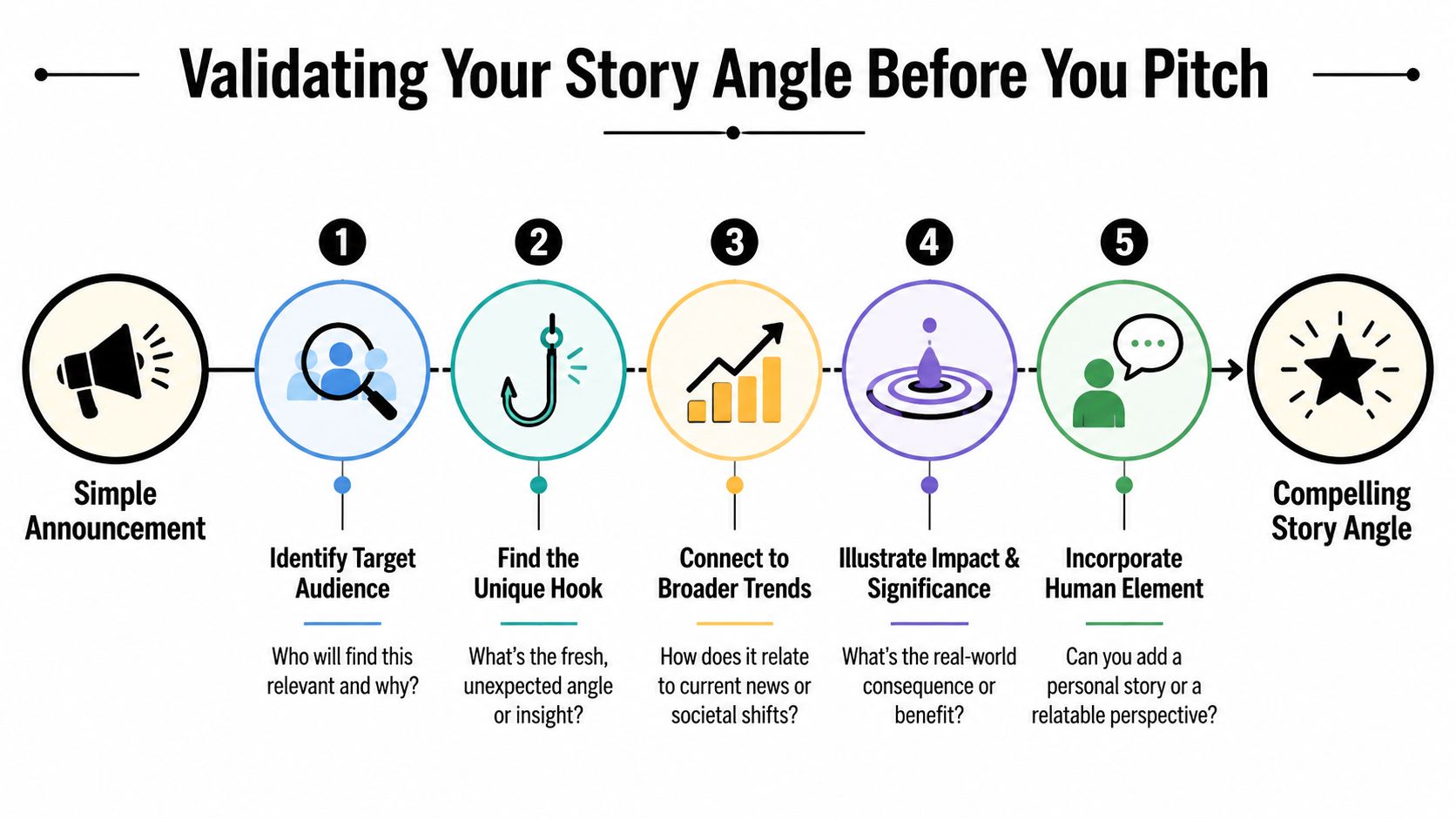
The weak version of a story angle sounds like an announcement. The strong version sounds like a reporting opportunity.
That difference matters because 78% of newsrooms reject pitches that fail to align with current editorial priorities, according to Notably PR's guidance on successful pitch angles. The same source says pitches using a Contrarian Insight angle secured 3.2x more coverage in 2025 than traditional breaking news angles. The lesson isn't that every pitch needs to be provocative. It's that a differentiated angle beats a generic update.
Start with the audience problem
Before drafting, strip the story down to one question: what problem does this help the journalist cover for readers?
A product launch is not automatically a story. A local partnership is not automatically a story. Even a strong milestone isn't enough on its own. The angle has to connect with a live editorial need such as consumer confusion, policy change, cost pressure, behavior change, or an underreported local impact.
A fast validation checklist helps:
- Audience relevance: Who benefits, loses, changes behavior, or faces a new risk because of this?
- Current fit: Does the outlet already cover this theme, or would the pitch require them to invent a new lane?
- Freshness: Is this genuinely new, or just new to the sender?
- Tension: Is there conflict, surprise, contradiction, or a meaningful shift?
- Proof: Can the team support the angle with examples, data, or credible voices?
If the pitch fails two or more of those tests, the problem usually isn't the email. The problem is the angle.
Pressure test the angle against recent coverage
The fastest way to validate relevance is to study the journalist's recent work. Not the author bio. Not the beat label alone. The actual articles.
Look for patterns in the last handful of stories:
| Cue to review | What it tells the pitcher |
|---|---|
| Recent headlines | Whether the reporter prefers trend pieces, profiles, explainers, or breaking developments |
| Sources used | Whether the journalist values executives, customers, researchers, local voices, or public records |
| Framing style | Whether the story needs a policy lens, a consumer angle, a business impact angle, or a human story |
| Missing thread | Where a credible new angle could extend the reporter's existing coverage |
A common mistake is forcing the story into the reporter's broad beat. A healthcare reporter might cover funding, workforce shortages, patient access, or digital tools, but not all with equal interest. The pitch needs to match the narrower pattern.
A validated angle should feel like the next logical story in that reporter's body of work, not a detour.
One useful exercise is to write three possible headlines before the pitch itself. If none of them sound like something the outlet would plausibly publish, the angle needs more work. That simple test often saves hours.
Building a High-Impact Media List
A bloated media list creates fake productivity. It looks busy, but it usually lowers quality at every step. Strong pitching starts with a smaller list where each name has a clear reason for being there.
Build a small list on purpose
A practical media list has fewer vanity targets and more fit. That means reviewing outlet type, audience, story format, and who writes the relevant coverage. Teams that still treat “media” as one giant bucket waste time pitching newsletters, trade publications, podcasts, local outlets, and national reporters with the same story framing.
Category clarity matters. Anyone sorting targets by type can get grounded quickly with this explanation of what counts as a media outlet. It helps separate the publication itself from the specific person who should receive the pitch.
A concise working list usually includes:
- Top-fit targets: The outlets and reporters whose recent work makes the story feel immediately compatible.
- Stretch targets: Ambitious placements where the story could fit, but needs stronger proof or a sharper angle.
- Secondary options: Good outlets to approach if an exclusive is declined.
Rank fit before reach
Big names tempt teams into skipping research. That's where outreach quality drops. A more disciplined process scores each target on a few practical questions:
- Beat match: Does this person cover the exact issue, not just the broad industry?
- Format match: Do they write trend stories, interviews, opinion-driven pieces, or short news hits?
- Geographic match: Is the story local, regional, or national in a way the outlet would care about?
- Evidence match: Does the team have the kind of proof this reporter tends to use?
A short note beside each name is more valuable than a giant spreadsheet full of empty fields. Example notes might say “often covers workforce angle,” “likes customer examples,” or “writes quick-turn trend pieces.” Those cues improve personalization later.
Contact accuracy matters too. Bad email data turns a thoughtful pitch into a bounced message or a note sent to the wrong desk. Teams that need a cleaner process can learn email discovery and verification before outreach starts. Verification is a quiet but important part of protecting sender reputation and avoiding sloppy mistakes.
The best media list is not the longest one. It's the one where every name can answer a clear question: why this person, for this story, right now?
How to Write a Pitch Reporters Actually Read
Once the angle is validated and the target is right, the writing gets easier. It also gets shorter. Reporters don't need a dramatic setup or a brand manifesto. They need the point, the proof, and a reason to care now.
A workable standard is clear. A high-impact pitch should use a subject line under 10 words, a personalized opening that references the journalist's work, and a scannable body of around 500 words according to PRLAB's media pitching guide. That same guidance also stresses exclusivity, meaning the pitch should go to one outlet at a time.
Get the structure right first
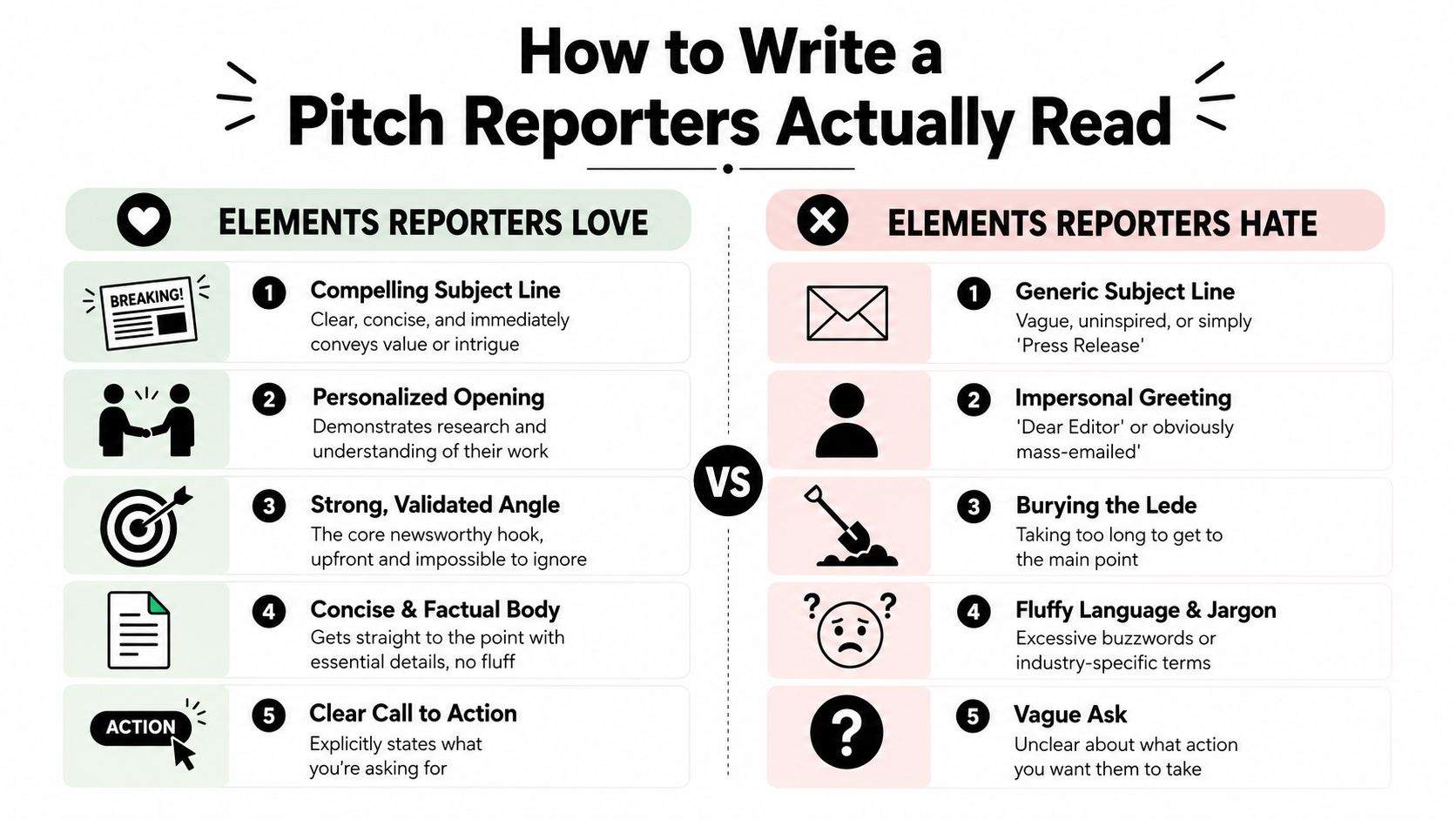
A solid pitch has four jobs. It needs to get opened, prove relevance quickly, make the story easy to evaluate, and give the reporter a simple next step.
That usually looks like this:
- Subject line: Lead with the news angle, not the company name. If appropriate for the outlet, include the word “pitch.” Keep it tight.
- Opening line: Refer to a specific recent article, column, or recurring theme the reporter covers.
- Body: Present the story angle in a scannable way. Subheads can help.
- Close: Offer interviews, data, visuals, and availability. Make the ask explicit.
The body works best when it answers the five Ws without sounding like a press release pasted into an email.
A practical pitch template
Below is a clean template that respects how journalists read.
Subject: [Healthcare] Pitch: Rural clinic staffing shift
Hi [First Name],
Your recent coverage of healthcare access in underserved communities stood out because it focused on the operational reality, not just policy language.
This may fit your coverage: a regional provider is seeing a new staffing pattern that's changing how patients access routine care in smaller towns.
Why this matters
The story isn't the organization announcement. The story is how care delivery is shifting for residents who often have fewer local options.What's new
- A timely local development tied to a broader healthcare access issue
- Named interview availability from leadership and frontline voices
- Supporting data and local examples that make the pattern concrete
What the reporter could explore
- What's changing for patients
- Why this shift is happening now
- What it may signal for similar communities
If useful, materials can be sent immediately, including background, spokesperson availability, and visuals.
Best,
[Name]
[Title]
[Phone]
[Email]
That format works because it gives the reporter a usable frame. It doesn't demand they figure out the story from a company update.
For teams pitching audio interviews instead of written stories, learn podcast guesting with Podmuse is a useful companion resource because podcast outreach needs a slightly different emphasis on host fit, talking points, and audience conversation value.
A more detailed walkthrough of pitch composition also helps when refining email mechanics. This guide on a PR pitch email is useful for tightening structure without lapsing into boilerplate.
Good versus bad pitch choices
At this stage, many teams lose the room. The difference often comes down to framing.
| Weak choice | Better choice |
|---|---|
| “We are excited to announce…” | Lead with the story angle or consequence |
| “Dear Editor” | Use the journalist's name |
| Brand history in paragraph one | Specific relevance in sentence one |
| Dense paragraph blocks | Short sections, bullets, or subheads |
| “Let me know your thoughts” | Clear ask such as interview interest or coverage consideration |
A few writing moves consistently improve readability:
- Cut throat-clearing: Remove warm-up lines that delay the point.
- Name the trend carefully: Tie the story to something the reporter already covers.
- Use plain language: Replace internal jargon with words a reader would understand.
- Show, don't posture: Offer evidence, examples, and access instead of adjectives.
A pitch should be easy to evaluate within seconds. If the reporter has to hunt for the angle, the email is already doing too much work.
The pitch also needs enough substance. Guidance from the University of North Dakota notes that a strong story pitch is thorough yet concise at roughly 500 words, should clearly establish newsworthiness, and should include the word “pitch” in the subject line unless the outlet says otherwise, according to UND's pitching guidance.
Managing Assets Embargoes and Follow-Up Strategy
A good pitch can still fail if the logistics are messy. Reporters don't want to chase headshots, wait for approvals, or download giant attachments from a first email. The easier it is to evaluate and publish the story, the more useful the sender becomes.
Make assets easy to use
Keep assets in a lightweight digital press kit or shared folder. The first outreach email shouldn't arrive with oversized attachments unless the journalist asked for them.
A useful asset package often includes:
- Approved images: High-resolution photos with clear labels
- Executive and expert bios: Short versions, not full résumés
- Fact sheet: Fast background on the company, initiative, or issue
- Interview availability: Specific windows and spokesperson options
- Data backup: Any underlying material needed to support claims made in the pitch
If the story depends on a survey or internal dataset, make sure someone can provide the underlying context quickly. Journalists won't trust numbers they can't verify.
Use exclusives and embargoes carefully
Exclusives can create urgency. They can also waste a story if offered too casually. If the angle is particularly strong for one publication, an exclusive makes sense. If the outlet declines, the story can move on to the next target.
Embargoes are different. They allow multiple journalists to prepare coverage before a shared release time. Teams that need the mechanics spelled out can review this explanation of a press release embargo. The key is clarity. State the embargo terms plainly and only use them when the information makes advance handling necessary.
Follow up without becoming a problem
Follow-up works best when it adds value, not pressure. A weak follow-up says, “just checking in.” A strong one adds a new reason to look, such as a newly available spokesperson, a local angle, or a timely peg.
A practical follow-up note can be brief:
Hi [First Name],
Sending this back to the top of your inbox in case the timing is right. There's now an additional local interview source available, and materials can be shared immediately if helpful.
That kind of message respects the journalist's time. It also gives a reason for the second touch beyond persistence for its own sake.
Common Pitching Mistakes and How to Fix Them
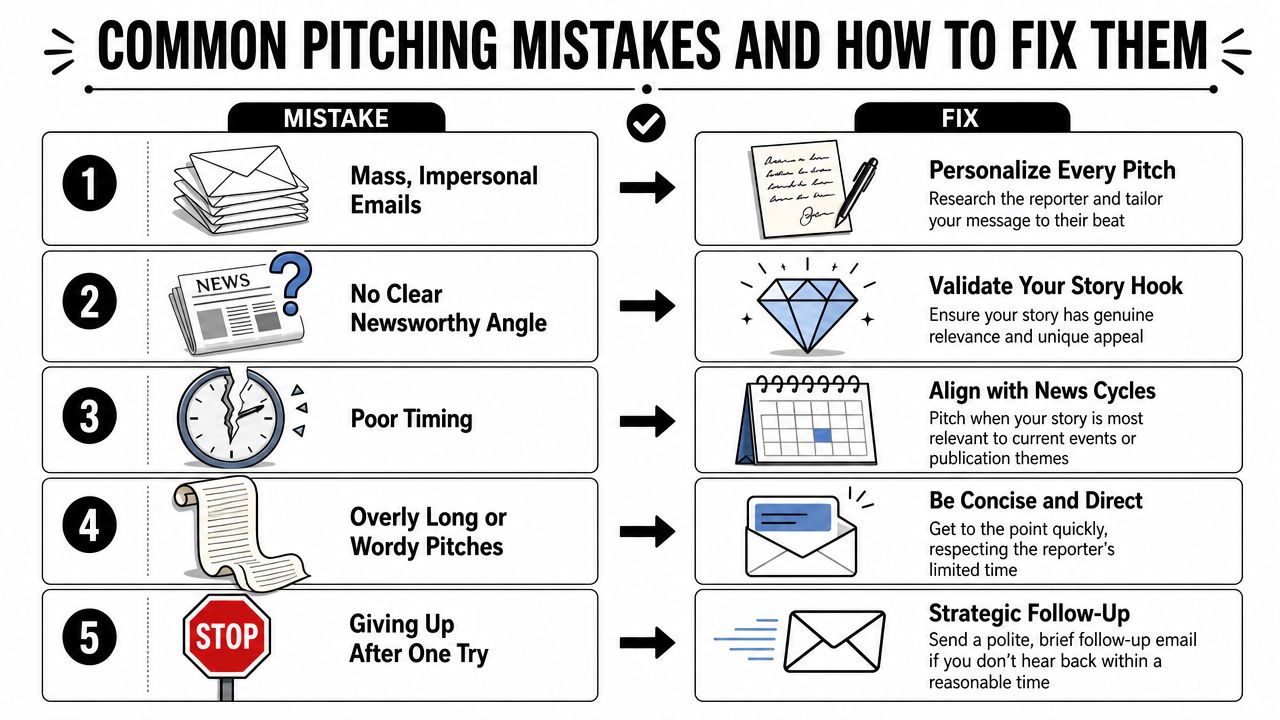
Most pitching problems are diagnostic. The response pattern usually points to the weak point in the process. Silence often means poor fit or a buried angle. Quick rejections often mean the story isn't distinct enough. Requests for clarification usually mean the email left too much work for the reporter.
Mistakes that signal weak preparation
One of the most common failures is pitching a company update as if that alone creates public interest. Another is sending the same email to every contact on the list and changing only the name.
Evidence is another frequent gap. Rockford Gray's guidance on using trends and data in news pitches notes that including tangible data validates newsworthiness. The example it gives, “Requests for our financial literacy program are up 40% this year,” works because it turns a generic announcement into a measurable trend reporters can build on.
Weak pitches ask journalists to believe the story matters. Strong pitches help them see why it matters.
Quick fixes that improve response odds
Instead of guessing what's wrong, match the problem to a fix:
- Mass email tone: Personalize the opening with one relevant reference to recent work.
- No clear angle: Rewrite the pitch around consequence, tension, or audience impact.
- Wordy draft: Trim anything that doesn't help the reporter assess news value.
- No proof: Add credible supporting detail, local examples, or verifiable data.
- Vague ask: State whether the sender is offering an interview, an exclusive, data access, or a reported trend story.
If a pitch still feels weak after those fixes, the best move is often to revisit the angle rather than keep polishing the wording.
Frequently Asked Questions About Pitching
Should a pitch include the full story
No. It should include enough information for the journalist to evaluate the idea quickly. That means the angle, why it matters now, what evidence exists, and who is available to speak. A pitch is an invitation to report, not a complete article pasted into an email.
How many times should someone follow up
A restrained approach works best. One thoughtful follow-up is usually enough unless the reporter engages and asks for more. Repeated nudges without a new reason to contact them can turn a decent pitch into a nuisance.
What if the story fits more than one outlet
Prioritize the best fit first. If the angle is strong and the outlet is a serious target, exclusivity is often the cleaner approach. If the story is declined, move to the next outlet on the list with a version suited to that publication.
What makes a pitch feel credible fast
Specificity. Named sources, usable assets, and concrete context all help. Generic excitement language does the opposite. A reporter should understand the story and see the reporting path without having to decode the sender's intentions.
Is a press release enough on its own
Usually not. A press release can support the outreach, but the pitch email has to do the harder job. It has to show fit, timing, and relevance to that particular journalist.
Press teams that want cleaner systems, stronger templates, and practical guidance for announcements, outreach, and distribution can find useful tools at Press Release Zen. It's a strong resource for turning scattered PR work into a more disciplined process.