In life sciences, digital marketing isn't a side project anymore. The global life sciences marketing budget reached $42.7 billion in 2023, up 7.2% year over year, driven primarily by digital transformation initiatives, according to Gitnux's life sciences marketing statistics roundup. That single figure changes the conversation. This isn't about posting on LinkedIn and hoping a scientist clicks. It's about building a regulated communication system that can educate, persuade, document, and withstand scrutiny.
Many beginners get stuck because most marketing guides treat compliance as a legal review that happens at the end. In life science digital marketing, compliance has to sit inside the campaign itself. The workflow for a webinar invite, a product page, a nurture email, and a press release all need evidence, approvals, and channel-specific controls before launch.
Table of Contents
- Understanding Life Science Digital Marketing
- Navigating Regulatory and Ethical Guidelines
- Identifying Target Audiences and Channels
- Crafting Effective Content Types for Audiences
- Planning Campaigns with Measurable Steps
- Applying Sector Examples and Distribution Best Practices
- Optimizing for SEO and Google News Visibility
- Implementing Press Release Templates and Next Steps
Understanding Life Science Digital Marketing
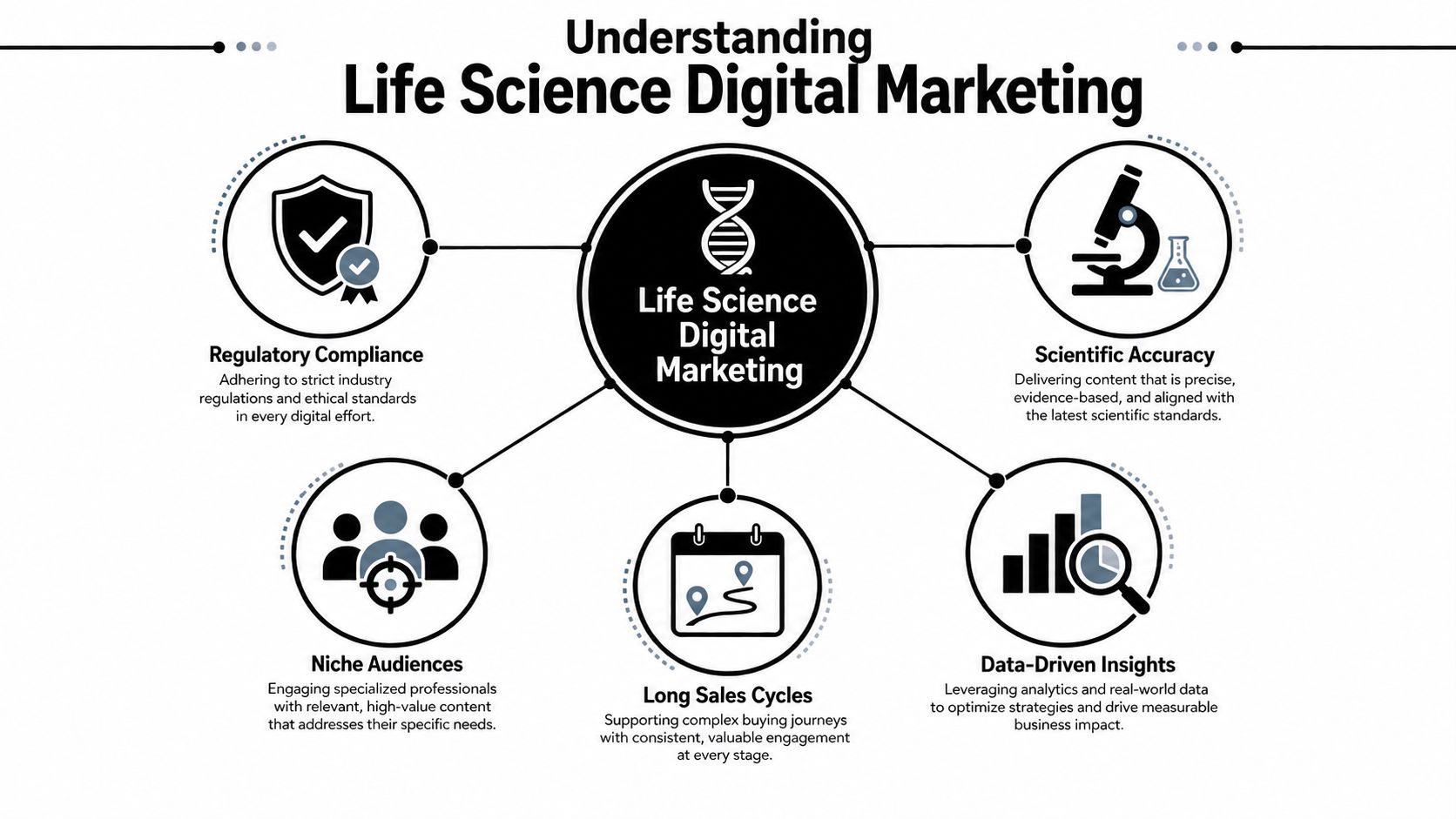
Life science digital marketing resembles lab work more than retail advertising. A scientist doesn't trust an instrument that hasn't been calibrated. A regulated marketing team shouldn't trust a campaign that hasn't been checked for scientific accuracy, audience fit, and claim support.
That analogy helps because the field confuses newcomers for a simple reason. The words look familiar. Website, email, SEO, social media, webinar. But in life sciences, each channel carries a different burden of proof. A landing page for a software tool can be punchy and brief. A landing page for a diagnostic, therapeutic, or research product often needs supporting references, approved phrasing, and careful audience targeting.
Why this field works differently
A generic marketer often asks, “What will get attention?” A life science marketer has to ask several questions first.
- Who is the audience: A researcher, clinician, patient, procurement team, or investor reads the same claim differently.
- What evidence supports it: A statement about performance, outcomes, or product capability needs a traceable basis.
- Which rule applies: Promotional content, educational content, and corporate communications don't all live under the same risk profile.
- What happens after the click: If the destination page creates confusion or overstates the benefit, the campaign can create compliance problems instead of leads.
Practical rule: In life science digital marketing, every tactic should have a scientific purpose and a documentation trail.
The core parts of a working system
The discipline usually rests on five connected parts.
| Component | What it means in practice |
|---|---|
| Audience insight | Building separate messages for HCPs, researchers, patients, and investors |
| Scientific accuracy | Checking claims against approved evidence and source materials |
| Channel selection | Matching the message to channels such as webinars, email, search, social, and newsroom content |
| Measurement | Tracking engagement signals that fit the campaign goal |
| Compliance safeguards | Routing drafts through medical, legal, regulatory, or privacy review when needed |
Confusion often starts when teams think compliance slows marketing down. Poor process slows marketing down. Good process makes launch easier because the team already knows which claims are allowed, which references are current, and who must sign off.
A strong life science digital marketing program also accepts a basic truth. Different audiences don't just prefer different channels. They require different levels of explanation. A scientist may want methods and citations. A patient may need plain language and clear next steps. An investor may want strategic significance and concise framing. The marketer's job is translation without distortion.
Navigating Regulatory and Ethical Guidelines
Compliance in life sciences isn't a final red pen. It's an operating system. If that sounds abstract, a simpler analogy helps. A cleanroom doesn't become safe because someone checks it after production. Safety comes from how people enter, move, document, and handle materials throughout the process.
The same principle applies to digital campaigns. AI can draft copy quickly, but speed without controls creates risk. Vodori's discussion of life sciences social media workflows notes that 80% of life science marketers adopt AI for speed, while many guides still miss the need for role-based approval systems that link social claims to evidence before publication.
Compliance is a workflow, not a disclaimer
Beginners often assume regulation means adding cautious wording. That isn't enough. The core issue is traceability. A compliant workflow should answer these questions for every high-risk asset:
- Who drafted the message
- Which claim or implication appears in the message
- What evidence supports each claim
- Who reviewed it
- Which version received approval
- Where the approved asset was published
This matters even more on social platforms because short-form content strips away context. A product benefit that seems harmless in a post may become problematic if the evidence link is missing, the audience is too broad, or the post implies an unapproved use.
For teams handling regulated healthcare communications, healthcare PR planning guidance can help clarify how announcements, media outreach, and review steps should align before publication.
A simple safe versus risky comparison
The difference between ethical marketing and risky marketing usually shows up in execution details.
| Scenario | Safer practice | Riskier practice |
|---|---|---|
| AI-generated social post | Draft is routed to medical and regulatory reviewers, with source links attached | Draft is posted after a quick brand check only |
| Product page update | Every benefit statement maps to approved evidence | Marketing rewrites claims for stronger impact without evidence review |
| Patient email | Plain language explains what the product does and what it doesn't claim | Promotional phrasing implies guaranteed outcomes |
| Press release | Corporate announcement sticks to verified milestones and approved wording | Announcement blends corporate news with unsupported clinical implications |
Ethical life science marketing doesn't hide uncertainty. It labels it clearly.
Another point confuses newer teams. Ethical communication isn't only about avoiding enforcement. It's also about preserving trust with professionals who know how to spot exaggeration. Researchers, physicians, and technical buyers tend to punish vague or inflated language quickly. Once trust slips, campaign performance usually follows.
A practical approach is to build a “native-format review” process. That means reviewers don't only approve a source document. They approve the actual format that will appear in the wild, such as the LinkedIn post, banner ad, email snippet, or release headline. Context changes meaning. Good teams review content in context.
Identifying Target Audiences and Channels
One product can have four very different audiences. That's where many campaigns break down. The team knows the science, but the message lands flat because everyone receives the same asset with different stakes, vocabulary, and decision criteria.
A useful way to think about audience planning is to separate knowledge level from decision role. A molecular biologist may have deep technical knowledge but limited budget authority. A procurement lead may control the purchase but care more about documentation, reliability, and implementation risk than assay design.
Who needs what kind of information
Four audience groups show up repeatedly in life science digital marketing.
- Medical professionals: They usually want concise clinical relevance, mechanism, evidence quality, and practical implications for care delivery or workflow.
- Researchers and scientists: They tend to respond to technical specificity, methods detail, application notes, white papers, and webinar content with substance.
- Patients and caregivers: They need plain language, balanced educational content, accessible navigation, and careful avoidance of overstated promises.
- Investors and business stakeholders: They often prefer strategic updates, milestone framing, leadership context, market positioning, and risk-aware communication.
These groups also move through channels differently. A scientist may discover a company through a conference recap, sign up for a webinar, download a white paper, and later request a demo. A patient may start with search, reach an educational article, and then look for support resources. An investor may encounter a press release, visit the newsroom, and then review executive materials.
Audience channel mapping
The easiest planning tool is a simple matrix. It keeps teams from choosing channels based on habit alone.
| Audience | Preferred Channels | Key Content Types |
|---|---|---|
| Medical professionals | Email newsletters, webinars, LinkedIn, professional publications, product pages | Clinical summaries, expert interviews, product updates, treatment education |
| Researchers | Webinars, white paper landing pages, technical blog content, niche forums, search | Application notes, abstracts, methods content, data explainers |
| Patients and caregivers | Search, patient resource hubs, email, advocacy partnerships, accessible social content | Educational articles, FAQs, condition guides, support updates |
| Investors | Newsroom pages, investor newsletters, executive LinkedIn posts, corporate announcements | Press releases, milestone updates, leadership commentary, business summaries |
A channel shouldn't be selected just because the team can manage it. It should be selected because the audience expects useful information there.
A webinar isn't just a format. For the right audience, it's proof that the company can explain its science in public.
A few simple channel rules help:
- Use search when intent is active: This works best when people are already looking for a problem, method, or category.
- Use email for sequence and continuity: Email is strong when the audience has already shown interest and needs follow-up education.
- Use webinars when explanation matters: Complex products often need live demonstration, questions, or expert framing.
- Use social for discovery and reinforcement: Social rarely carries the whole burden in life sciences. It usually introduces, reminds, and directs.
- Use newsroom and press materials for credibility: Journalists, partners, and investors often check official announcements before repeating a story.
Teams often ask whether one channel is “best.” That's usually the wrong question. The stronger question is which channel fits the audience's next decision. That framing leads to better sequencing and better compliance choices.
Crafting Effective Content Types for Audiences
Formats matter because people don't consume scientific information the same way at every stage. A researcher evaluating an instrument doesn't want the same document as an investor scanning pipeline progress. The content type should match the job the reader is trying to do.
Content formats that fit the buying journey
Some formats carry more weight earlier in the journey. Others work better once interest is established.
- White papers: Best when technical scrutiny is high. For researchers, the abstract should tell them quickly whether the paper is worth their time. Specificity beats polish here.
- Webinars: Useful when a topic needs demonstration, interpretation, or live Q&A. A webinar also creates replay content for later nurturing.
- Email campaigns: Effective for continuity. A sequence can move someone from an initial download to a webinar registration, then to a meeting request or product inquiry.
- Paid search: Helpful when people are actively seeking solutions or educational answers. Ad copy should be restrained and closely aligned to the landing page.
- Social media posts: Strong for discovery, event support, and distribution of approved assets. Weak when used as a substitute for evidence-rich content.
- Educational blog articles: Good for search visibility and top-of-funnel trust building, especially when they explain a technical topic in plain language.
One common mistake is trying to make every format do everything. A press release isn't a white paper. A white paper isn't a patient guide. A social post isn't the place to compress an entire evidence package.
How press releases fit the mix
Press releases are especially useful in life science digital marketing because they sit at the intersection of search visibility, official messaging, and stakeholder trust. They work best when the company has a real announcement, such as a partnership, product launch, clinical milestone, leadership change, or event.
A strong release usually includes these parts:
- A headline with one clear development
- A first paragraph with the key facts
- Body paragraphs that explain significance without overselling
- A company boilerplate
- Media contact information
The writing style should stay disciplined. For example, a biotech company announcing a research collaboration can explain what the collaboration covers, who is involved, and why it matters strategically. It shouldn't slide into broad claims about future patient outcomes unless those claims are already supportable and approved.
A useful drafting habit is to write two versions of the same core message. One version is technical and internal. The other is public-facing and simplified. The comparison exposes where the team has become too vague or too promotional.
Editorial check: If a sentence sounds impressive but cannot be tied to evidence, approval, or a concrete milestone, it probably doesn't belong.
For distribution timing, releases often perform better when they coordinate with the rest of the campaign stack. The newsroom post, executive social copy, investor note, and follow-up email should all point to the same approved message set. That consistency reduces confusion and cuts the chance of improvised claims.
Planning Campaigns with Measurable Steps
A good life science campaign doesn't start with graphics. It starts with operational discipline. Teams need a repeatable structure because regulated marketing becomes chaotic fast when goals, owners, and approvals stay fuzzy.
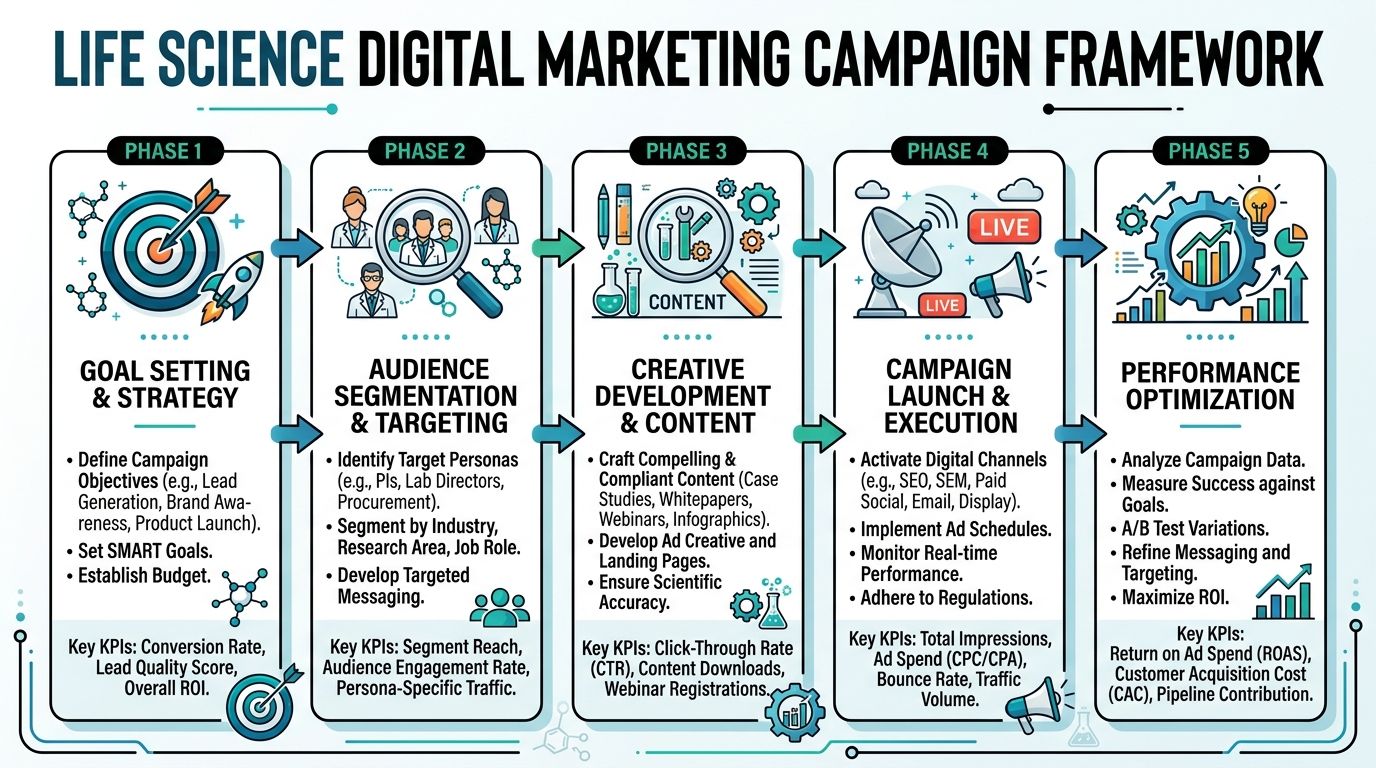
A practical model uses five phases.
A five-phase operating model
| Phase | Core action | What teams should define |
|---|---|---|
| Goal setting | Decide what success means | Inquiry growth, webinar signups, meeting requests, patient education reach, investor attention |
| Audience segmentation | Separate audiences by need and role | HCPs, researchers, patients, investors, procurement, partners |
| Creative development | Build approved assets | Landing pages, email, social, webinar copy, releases, paid ads |
| Launch | Publish and distribute | Channel schedule, approvals, owners, tracking links, handoff to sales or PR |
| Performance optimization | Adjust based on response | Message refinement, retargeting, page edits, follow-up timing |
The KPI question trips up beginners. They look for one master metric. Life science digital marketing rarely works that way. Different campaigns need different signals.
- For HCP email campaigns: click behavior and downstream interest matter more than vanity engagement.
- For researcher webinars: registration quality, attendance behavior, and follow-up actions are more revealing than raw signup volume.
- For patient resources: useful indicators include whether people find the right information and take an appropriate next step.
- For investor communications: leadership engagement, newsroom traffic quality, and direct follow-up interest often matter most.
Where automation makes the biggest difference
Automation works best when it responds to meaningful behavior, not random activity. A white paper download suggests a different level of intent than a brief homepage visit. A repeat view of a product page signals something different from a click on a general news item.
Fello's discussion of life science digital marketing tactics reports that visitor-triggered automation campaigns delivered within 24 hours of engagement drove a 70% increase in sales for biomedical clients. The lesson isn't “automate everything.” The lesson is that timing and relevance matter when a prospect is actively researching.
A simple workflow might look like this:
- A researcher downloads an assay guide.
- The system sends a follow-up email with a webinar replay or related application note.
- If the researcher returns to a product page, the team routes a more specific invitation such as a demo request or technical consultation.
- If activity stalls, the nurture sequence shifts back to educational content instead of forcing a sales ask.
The best automation feels like a helpful lab colleague. It answers the next question while the question is still fresh.
The measurable step that many teams miss is approval timing. If a triggered message must go out quickly, the approved content library must exist before the trigger fires. Otherwise, the workflow breaks at the exact moment speed matters most.
Applying Sector Examples and Distribution Best Practices
Different life science sectors use the same tools for different reasons. The tactics may look similar on the surface, but the distribution logic changes with the audience, product maturity, and regulatory risk.
Pharma, device, and biotech examples
A pharmaceutical brand often uses digital campaigns to support education around a condition area, physician awareness, or a corporate milestone. In that environment, distribution usually needs careful audience segmentation and conservative wording. A LinkedIn post may work as a doorway, but the destination asset carries the burden of detail and compliance.
A medical device company often benefits from demonstration-heavy content. Product walkthrough videos, procedure explainers, and webinar sessions can clarify workflow impact better than short copy blocks. Distribution works best when sales, clinical education, and marketing share a unified message set.
An early-stage biotech startup usually has a different problem. It may need visibility with investors, partners, scientific peers, and potential hires at the same time. In that case, a press release, executive social amplification, and niche media outreach can all support the same announcement if the message is tightly controlled. Teams planning that kind of outreach may find it helpful to review biotech-specific communication ideas in this biotechnology marketing guide.
One strategic lesson applies across all three. Distribution isn't only about reach. It's about routing the announcement to the right interpretive community. Scientists, journalists, investors, and customers don't read the same news the same way.
Distribution habits that prevent bottlenecks
The most common distribution failures are operational, not creative. The release is approved, but the landing page isn't. The sales team sees the news late. The executive social post uses wording that legal never reviewed. The newsroom metadata is missing.
A better approach is to treat distribution as an orchestration task.
- Pre-approve channel variants: Review the release headline, social copy, email teaser, and landing page summary as a package.
- Build a distribution calendar: Time external publication with internal awareness so sales and support teams aren't surprised.
- Use audience-specific follow-up: Journalists may need a concise angle. Researchers may need a technical asset. Investors may want strategic framing.
- Check operational handoffs: Confirm who monitors inbound questions from media, prospects, and partners.
Teams that work in specialized markets often borrow revenue process ideas from adjacent verticals. For a broader view of how industry-specific go-to-market systems differ, MarTech Do on vertical market RevOps offers useful context on why generic operating models often fail in niche sectors.
A final best practice is simple. Don't let the press release be the only artifact. The strongest announcements travel with supporting assets, such as a Q&A sheet, approved executive talking points, a product or program backgrounder, and clear contact routing. That package reduces confusion after publication, which is when many preventable mistakes begin.
Optimizing for SEO and Google News Visibility
SEO in life sciences isn't a trick for traffic. It's a credibility filter. Search engines treat scientific and healthcare content differently because the consequences of low-quality information are higher. That means teams need authority signals built into the content itself.
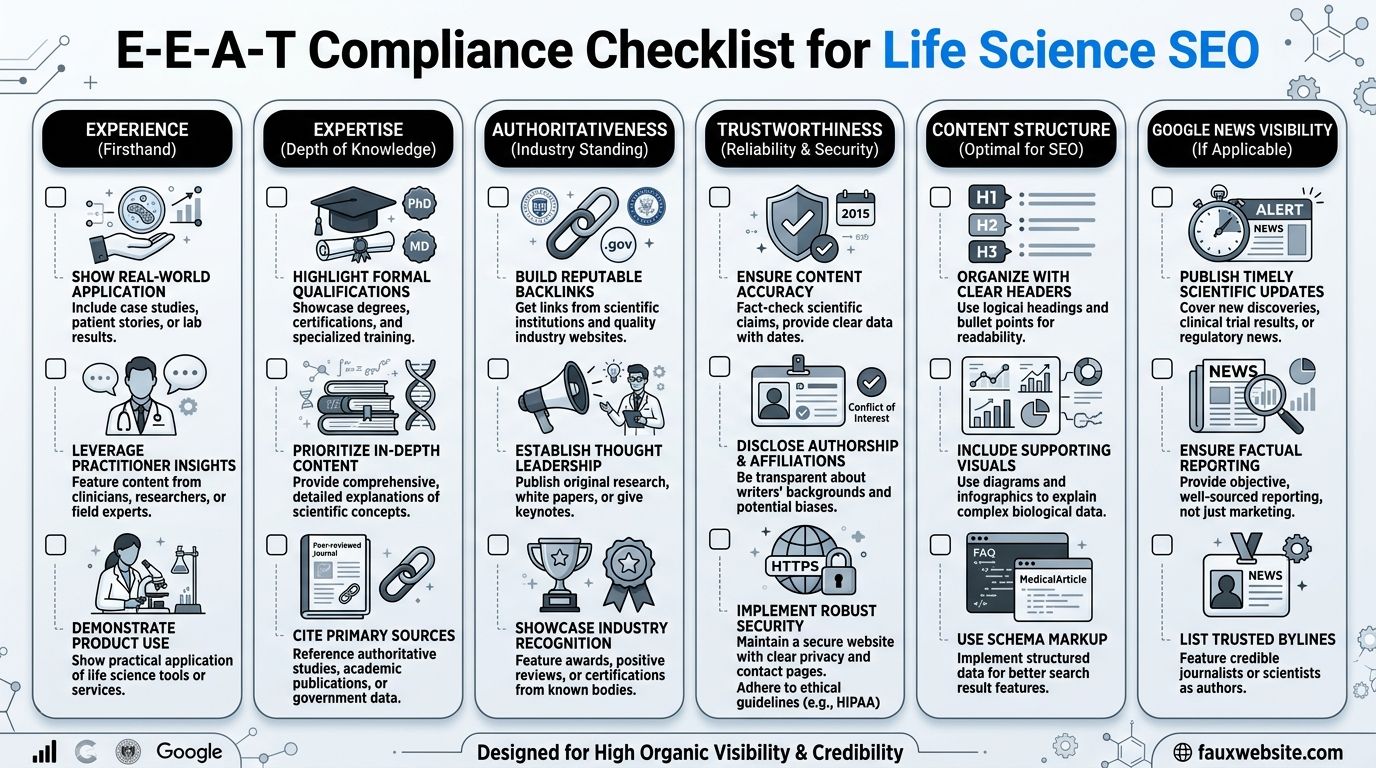
Empathy First Media's write-up on life science digital marketing methods states that Google's evaluation of scientific content strictly adheres to E-E-A-T, requiring primary research citations, expert validation, and an 80% educational to 20% promotional ratio for ranking in high-trust domains.
What Google expects from scientific content
E-E-A-T stands for experience, expertise, authoritativeness, and trustworthiness. In practice, life science teams should translate that into visible page elements.
| E-E-A-T element | Practical signal |
|---|---|
| Experience | Content reflects real operational or scientific context |
| Expertise | Subject matter review and technical accuracy are evident |
| Authoritativeness | References, credentials, and institutional clarity support the content |
| Trustworthiness | Transparent claims, clear sourcing, and honest framing reduce ambiguity |
That framework changes writing style. A page optimized for life science digital marketing shouldn't make aggressive unsupported claims. It should explain the topic clearly, cite primary research where relevant, show who authored or reviewed the content, and separate education from promotion.
For teams improving discoverability, life sciences SEO guidance can help connect newsroom content, on-page structure, and search visibility habits.
A practical visibility checklist
Google News visibility has its own practical layer. News content should be timely, clearly structured, and associated with an identifiable publisher or company newsroom. Clean headlines, descriptive subheads, accurate dates, and well-organized article pages all help.
A compact checklist keeps the work grounded:
- Show real authorship: Include author or reviewer names and relevant credentials where appropriate.
- Support important claims: Link claims to primary research or approved evidence where that fits the content type.
- Keep promotional language restrained: Educational framing usually performs better than hype in high-trust categories.
- Maintain newsroom consistency: Press releases, company updates, and expert articles should follow a recognizable structure.
- Use metadata carefully: Titles, descriptions, and article labeling should match the page content exactly.
Search visibility in life sciences often comes from clarity and proof, not cleverness.
A useful mindset shift helps here. SEO isn't separate from compliance. In this sector, the same habits that make content safer often make it more rankable. Transparent sourcing, accurate wording, and expert validation improve both trust and discoverability.
Implementing Press Release Templates and Next Steps
Press release templates help regulated teams move faster because they reduce improvisation. The template doesn't decide what can be claimed, but it creates a stable container for approved language, required disclosures, and consistent formatting.
Template for a clinical trial announcement
Below is a simple structure for a clinical trial update. The wording stays deliberately measured.
Headline
[Company Name] Announces [Clinical Trial Milestone] for [Program Name]
Dateline
[City, State], [Month Day, Year]
Opening paragraph
[Company Name], a [brief company description], today announced [specific milestone or update] related to [program or candidate]. The announcement concerns [brief factual context].
Body paragraph
The program is being evaluated for [general indication or use, if approved for disclosure]. The company stated that [neutral explanation of what the milestone means operationally or strategically].
Quote placeholder
[Executive Name, Title] said the update reflects the company's continued focus on [research, development, collaboration, patient support, or other approved priority].
Additional detail
Further information may include trial phase, participating institutions, collaboration structure, expected next operational step, or where stakeholders can find official study information, if disclosure is appropriate.
Boilerplate
About [Company Name]
[Short approved company description.]
Media contact
[Name]
[Title]
[Email]
[Phone]
This template works because it separates the fact of the milestone from any temptation to imply outcomes that haven't been established.
Template for a product launch announcement
A launch release needs a slightly different emphasis.
Headline
[Company Name] Launches [Product Name] for [Audience or Use Case]
Dateline
[City, State], [Month Day, Year]
Opening paragraph
[Company Name] today announced the launch of [Product Name], a [brief description] designed for [approved audience or setting].
Body paragraph
[Product Name] is intended to help [state approved functional role in plain language]. Key features include [approved feature list], with availability beginning [timing or market detail if approved].
Quote placeholder
[Executive Name, Title] said the launch supports [workflow improvement, research efficiency, customer access, or other approved positioning].
Supporting context
Include implementation details, distribution availability, training resources, or relevant support information. Keep the language descriptive rather than promotional.
Boilerplate and contact
Use the same closing structure as above.
A release becomes easier to distribute when the team prepares a launch checklist alongside it.
- Finalize approved wording: Match the release, social snippets, email teaser, and landing page summary.
- Confirm timing: Coordinate publication with internal teams, executives, and any outside partners.
- Prepare follow-up materials: Draft a Q&A sheet, spokesperson notes, and a press contact workflow.
- Track response: Monitor pickup, inbound questions, and which supporting assets people use.
The practical next step isn't writing more copy. It's building one shared release workflow with evidence links, version control, reviewer roles, and channel-ready variants. That single improvement often reduces both delay and risk.
Teams that want help turning announcements into organized, usable assets can explore Press Release Zen for practical templates, distribution guidance, and step-by-step press release resources suited for real-world communication work.