In medical language, PR most often means per rectum, which refers to giving medicine, doing an exam, or taking a temperature by the rectal route. In cancer care, PR can also mean partial response, which under RECIST criteria means tumor lesions have decreased by at least 30% from baseline without new lesions or progression of existing ones.
That's why this abbreviation causes so much confusion. A person might see PR on a prescription, a hospital note, a pathology report, or an oncology update and assume it has one fixed meaning. It doesn't. The meaning depends on where it appears, what kind of record it's in, and what words sit around it.
For what does PR stand for in medical terms, the answer is less like a dictionary definition and more like a translation skill. Medical shorthand works a bit like text-message abbreviations. The same letters can mean very different things depending on the conversation. In healthcare, understanding that context matters because abbreviations affect how people read instructions, interpret results, and ask questions about care.
Clear communication also matters beyond the chart itself. Anyone handling health information should understand privacy expectations too, and Ares' guide on PHI compliance offers a useful overview of how protected health information is handled. For readers coming from a communications background, it can also help to contrast medical shorthand with PR in a non-clinical setting, such as this explanation of PR in business, where the same letters mean something completely different.
Table of Contents
- Decoding the Confusion Around Medical Shorthand
- The Most Common Meaning Per Rectum
- PR in Oncology Partial Response
- Other Potential Medical Meanings of PR
- How to Interpret PR in Your Medical Records
- When in Doubt Always Ask for Clarification
Decoding the Confusion Around Medical Shorthand
A patient often first notices PR in a stressful moment. It may appear on discharge papers, beside a medication instruction, or in a report filled with unfamiliar abbreviations. Under pressure, it's easy to assume every abbreviation has one universal meaning.
That assumption is where confusion starts. In medicine, abbreviations are shortcuts for trained staff, but for patients and families they can feel like code. PR is a good example because it can refer to a route of medication administration in one setting and a treatment result in another.
Why context matters more than the letters
The letters alone don't carry enough meaning. The document type does. A prescription note points one way. An oncology scan report points another way. A vitals sheet can point somewhere else entirely.
Practical rule: When reading any medical abbreviation, the first question isn't “What do these letters mean?” It's “What kind of document is this?”
A helpful way to think about it is to treat PR like a word with multiple jobs. In one room, it acts like an instruction. In another, it acts like an outcome. The letters stay the same, but the role changes.
Where readers usually get tripped up
Most confusion happens for three reasons:
- The abbreviation appears without explanation. Staff may know the meaning instantly, but patients don't get the same built-in context.
- The same letters show up in different specialties. A pharmacist, an oncologist, and a nurse may all use PR, but not always to mean the same thing.
- People hesitate to ask. Many readers worry they should already know what the chart says.
That last point matters. Health literacy isn't about memorizing every abbreviation in medicine. It's about spotting uncertainty and asking the right follow-up question.
The Most Common Meaning Per Rectum
For general clinical use, PR most commonly stands for per rectum, meaning “by way of the rectum,” as described in this medical abbreviation reference. In that setting, PR tells healthcare staff the route used for medication, examination, or temperature measurement.
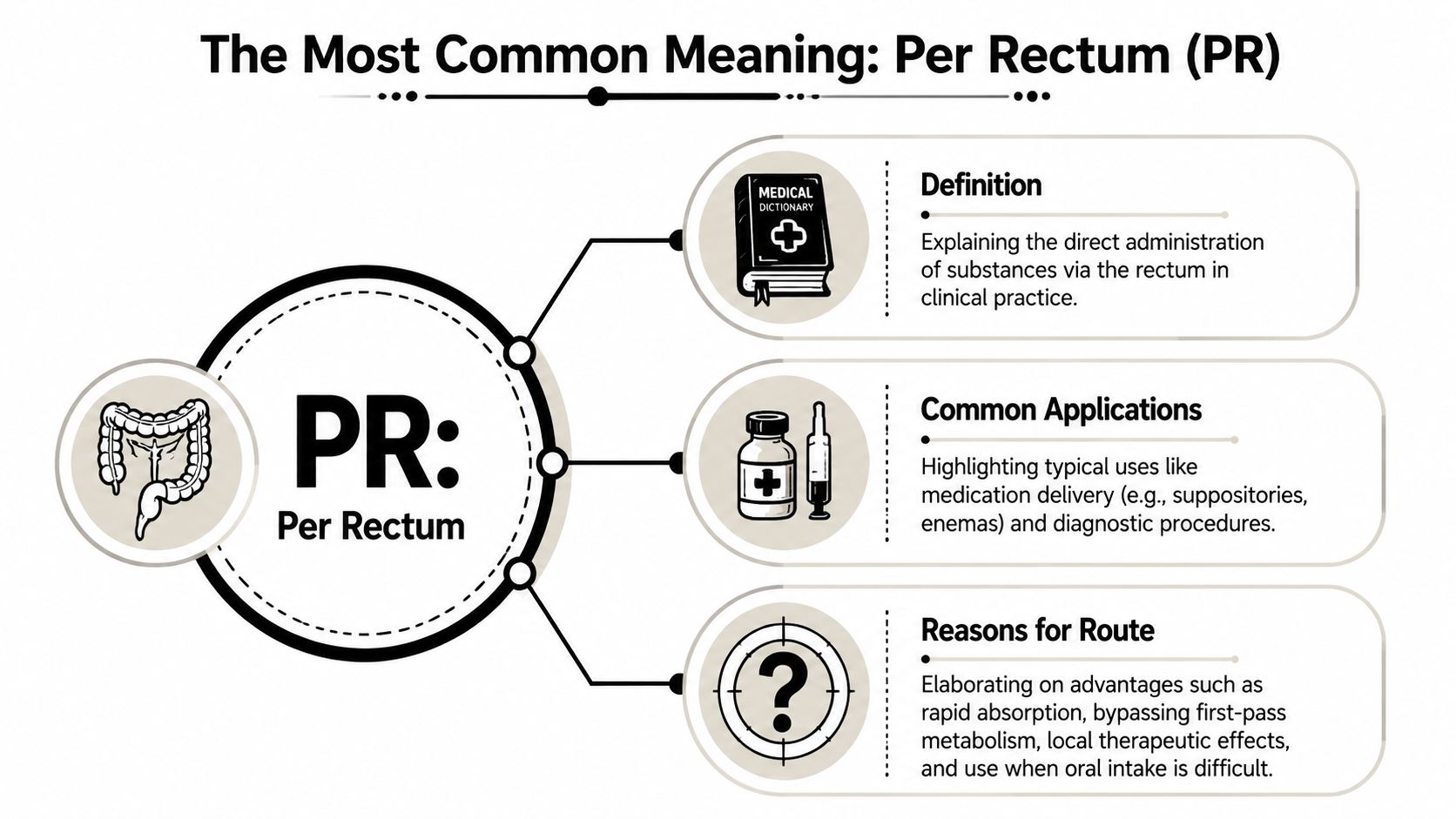
Why this route is used
The easiest way to understand medication routes is to picture a house with different doors. Oral medicine enters through one door. Intravenous treatment uses another. Per rectum is a different doorway into the body.
That doorway is used when the oral route isn't the best fit. The same reference notes that the rectal route may be chosen for medicines that need to bypass the digestive system or for patients who can't swallow, including some emergency sedation and antipyretic situations. The route matters because it affects drug absorption and bioavailability, which is why the abbreviation is important for preventing medication errors.
A simple way to remember it
A prescription context usually gives away the meaning. If PR appears next to a medication order, dosage instruction, or treatment note, it often signals how something is to be given, not a diagnosis and not a result.
Common examples include:
- Suppositories: Medicine placed in the rectum so the body can absorb it.
- Enemas: Fluids introduced rectally, often for treatment or preparation.
- Rectal temperature or exam notes: Clinical documentation may use the abbreviation when describing method.
A good memory cue is this: if the note sounds like an action to be carried out, PR is probably describing a route.
Route mistakes can change how a medicine works. Even when the drug name is correct, the wrong route can create confusion or lead to an unsafe administration choice. That's one reason standardized abbreviations remain part of routine documentation.
PR in Oncology Partial Response
In oncology and clinical research, PR can mean partial response, a treatment milestone defined by RECIST, and this oncology-focused overview notes that it means tumor lesions have decreased by at least 30% from baseline without new lesions or progression of existing ones.
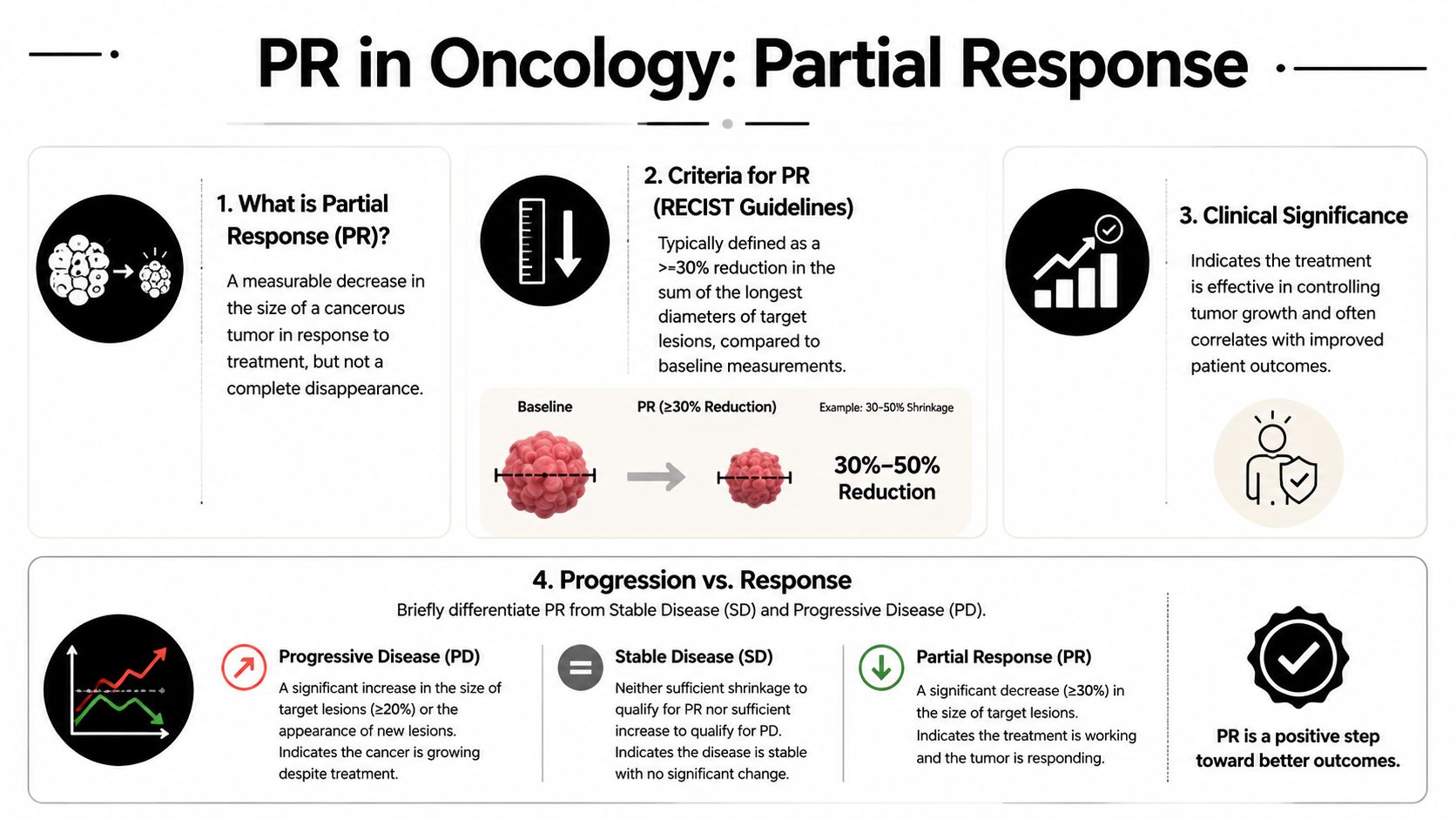
What partial response actually means
This use of PR belongs to a very different conversation from prescription shorthand. It appears in cancer treatment discussions, imaging reviews, and clinical trial language. Here, the abbreviation doesn't describe a route. It describes a measured response to therapy.
A simple analogy helps. Partial response is like winning a major battle without ending the entire war. The treatment has clearly made progress. But the cancer hasn't completely disappeared.
That distinction matters because many readers hear “partial” and assume the result is weak or disappointing. In oncology, it usually signals that treatment is having a meaningful effect, while still falling short of a complete response.
How to hear this term without panic
When PR appears in an oncology note, the nearby words usually include clues such as lesions, baseline, imaging, response, progression, or RECIST. Those are signs the abbreviation refers to treatment effect rather than medication route.
A quick comparison can help:
| Term | Plain-language meaning |
|---|---|
| Partial response | Tumors have shrunk enough to meet a recognized response threshold, but haven't disappeared completely |
| Complete response | The cancer is no longer detectable by the criteria being used |
In cancer care, PR is usually a result word. It tells the reader how the treatment is performing, not how a medicine is administered.
That makes context especially important for patients reading portal notes or trial summaries. The same two letters can carry very different emotional weight depending on the setting.
Other Potential Medical Meanings of PR
Not every medical use of PR points to per rectum or partial response. Some records use the abbreviation in other ways, and the document type usually makes the difference obvious.

When PR means pulse rate
On monitoring equipment, a vitals sheet, or a routine nursing record, PR can refer to pulse rate. Readers can usually identify this meaning because it appears beside other vital signs such as blood pressure, respiratory rate, oxygen readings, or temperature.
This version of PR behaves like a measurement label. It belongs to a row of observations, not to a medication order and not to a cancer response summary. If the abbreviation appears in a cluster of vital sign terms, pulse rate is the likely reading.
When PR means progesterone receptor
In pathology or breast cancer reports, PR can also refer to progesterone receptor status. That's a different clinical context again, and it usually appears alongside terms such as ER and HER2. Readers who want a plain-language breakdown of that hormone-receptor context may find Hirschfeld Oncology's guide to ER, PR, HER2 status helpful.
The fastest way to decode PR is to ask what kind of record is being read. A vitals chart, a prescription, and a pathology report each create a different meaning.
This is why searching what does PR stand for in medical terms often produces mixed answers. The abbreviation isn't unreliable. It's context-dependent.
How to Interpret PR in Your Medical Records
A practical reading method can reduce guesswork. Instead of trying to memorize every possible expansion of PR, readers can work through a short checklist.
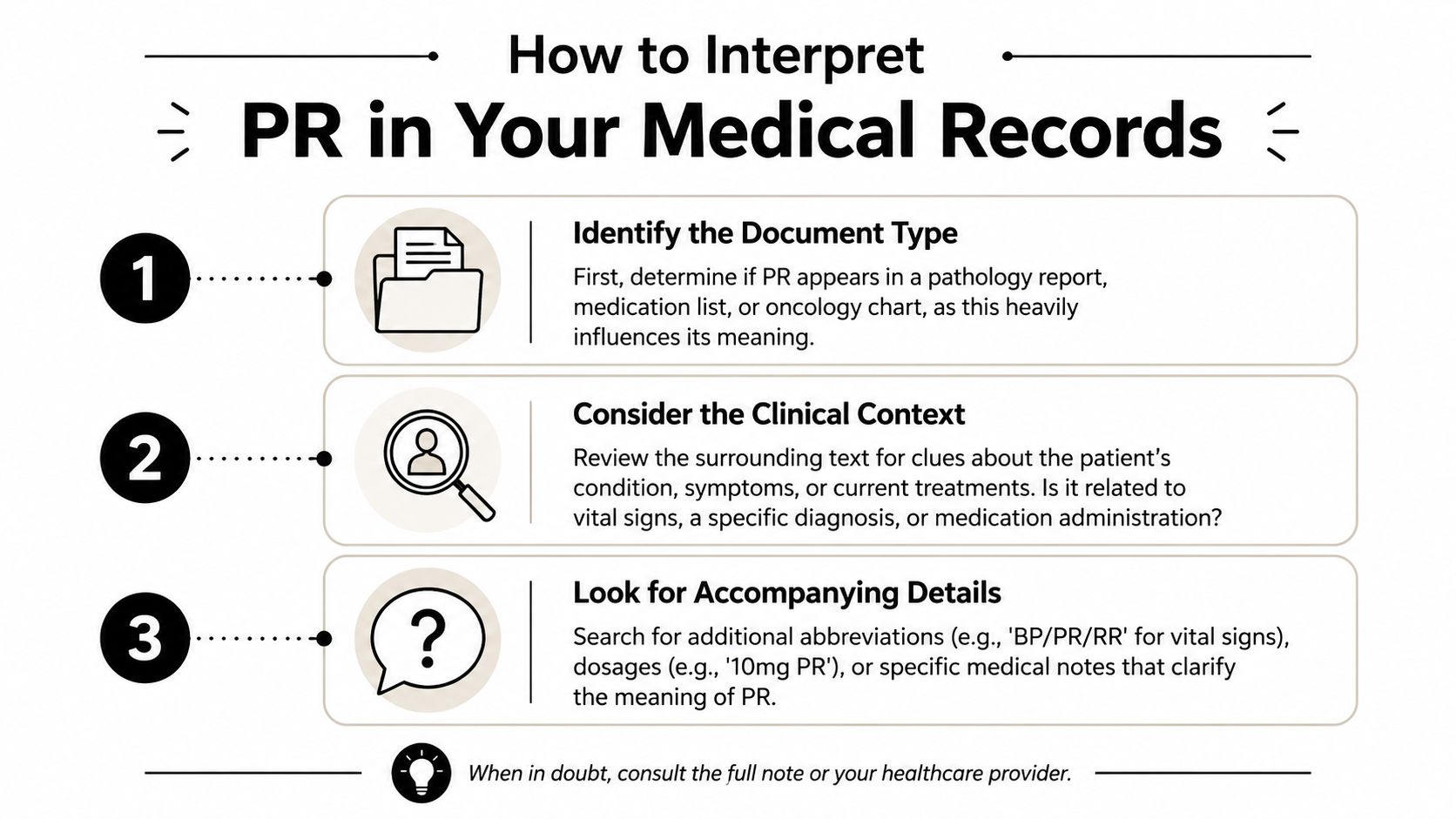
A three-step reading checklist
Identify the document type
Start with the source. Is it a prescription label, a hospital chart, a pathology report, or an oncology note? The record itself narrows the possibilities quickly.Look at the surrounding words
Nearby terms are the strongest clue. Dosage instructions suggest a route. Vitals language suggests pulse rate. Cancer-treatment language suggests partial response or receptor status.Match the setting
The clinical setting matters. A pharmacy handout, an infusion clinic report, and a routine checkup summary don't use abbreviations in the same way.
Readers who work in communications or healthcare-adjacent publishing may also appreciate how specialized terminology is explained for broader audiences in resources like these medical publications and journalists, where precise wording matters as much as readability.
A simple habit helps too. Before searching the abbreviation alone, search the abbreviation plus the document type. That approach usually gets closer to the right meaning than a broad lookup.
When in Doubt Always Ask for Clarification
The safest response to an unclear abbreviation is simple. Ask.
Patients aren't expected to decode every shorthand note in a chart. Clinicians, pharmacists, nurses, and office staff use abbreviations because they're efficient for documentation. That efficiency can leave gaps for everyone else. Asking for clarification isn't a disruption. It's part of safe care.
Simple scripts that make it easier
Some readers freeze because they don't know how to phrase the question. Short, direct language works best:
- At the doctor's office: “Could someone explain what PR means in this note?”
- At the pharmacy: “Is PR here telling me how this medicine should be given?”
- After reading a report: “This abbreviation has more than one meaning. Which meaning applies in this record?”
- During cancer care: “Does PR here refer to treatment response, or something else in the report?”
“Could that abbreviation be written out for the record?” is often the easiest question of all.
That kind of question can prevent mix-ups, especially when a patient is tired, overwhelmed, or managing several appointments at once. For readers interested in how the term PR is used in a broader healthcare communications context, this overview of PR in healthcare offers additional perspective.
Clear questions protect patients. They also make visits more productive, because everyone leaves with the same understanding of what the record says.
Press Release Zen helps teams turn complex topics into clear, usable communication. Readers who need practical templates, plain-language guidance, and step-by-step support for health, business, or industry announcements can explore Press Release Zen for more resources.