A biotech company can have a strong platform, credible data, and a real clinical need in front of it, then still struggle to gain traction because the message lands nowhere. The research team talks in mechanisms and endpoints. The founder talks in mission. The investor deck talks in milestones. The hiring page talks in culture. None of those stories are wrong. They're just disconnected.
That gap causes more damage in biotechnology than it does in most industries. A software company can often revise a landing page and move on. A biotech company is operating under scrutiny from clinicians, investors, regulators, journalists, future partners, and prospective hires at the same time. Each audience reads the same company through a different lens, and each one looks for different proof.
That's why marketing in biotechnology can't be treated as a thin layer applied after the science is done. It has to function as strategic translation. Good biotech marketing turns technical progress into commercial clarity without overstating the data, crossing compliance lines, or flattening scientific nuance into generic hype.
The practical challenge isn't “how to market biotech.” It's how to make one action carry multiple signals. A press release, conference abstract, webpage update, or trial milestone announcement has to help scientists assess rigor, help investors assess momentum, help partners assess fit, and help talent assess whether this is a serious place to build a career.
Table of Contents
- Introduction
- The High-Stakes World of Biotech Marketing
- Marketing Within the Lines Regulatory and Compliance Guardrails
- Decoding Your Audiences Scientists Investors and Patients
- Building Your Biotech Marketing Playbook
- The Biotech Press Release A Multi-Audience Masterpiece
- Measuring Success and Managing Your Reputation
- Conclusion
Introduction
A familiar pattern shows up in biotech launches. The company has a differentiated therapy, platform, assay, or enabling technology. Internal stakeholders know exactly why it matters. Outside stakeholders don't.
The disconnect usually isn't caused by weak science. It's caused by weak translation. A release announces “promising results” without enough context for scientists. A company page talks about “transforming patient outcomes” without giving investors a clear path from evidence to market opportunity. Recruiting content sounds polished, but it doesn't reassure experienced candidates that the company understands the realities of development, regulation, and commercialization.
That's where many teams get stuck. They split communications into separate lanes and assume each audience will be handled later. Science gets one message. Investor relations gets another. Partner outreach gets a third. Employer branding gets whatever time is left.
Practical rule: In biotech, fragmented messaging doesn't stay fragmented. It shows up as slower trust, slower deal flow, weaker media pickup, and more friction in follow-up conversations.
The stronger approach is integrated. The same core narrative should move across four audiences in a controlled loop: Science, Capital, Partners, and Talent. That doesn't mean using one bland message for everyone. It means building one evidence-based story with modules that different audiences can validate from their own angle.
That's the standard for serious marketing in biotechnology. The work is less about shouting louder and more about making each message carry multiple forms of proof at once. When that's done well, marketing stops being a support function and starts acting like commercial infrastructure.
The High-Stakes World of Biotech Marketing
A biotech company can publish one strong clinical update in the morning and spend the rest of the week answering four different questions about it. Scientists ask whether the methodology holds up. Investors ask whether the result changes the value of the program. Potential partners ask whether the asset fits their pipeline or platform strategy. Candidates ask whether the company is building something real enough to join.
That is the pressure built into biotech marketing. Every visible communication enters a signal loop. One message has to carry enough technical accuracy for scientific scrutiny, enough commercial relevance for capital, enough strategic clarity for partners, and enough credibility to attract talent.
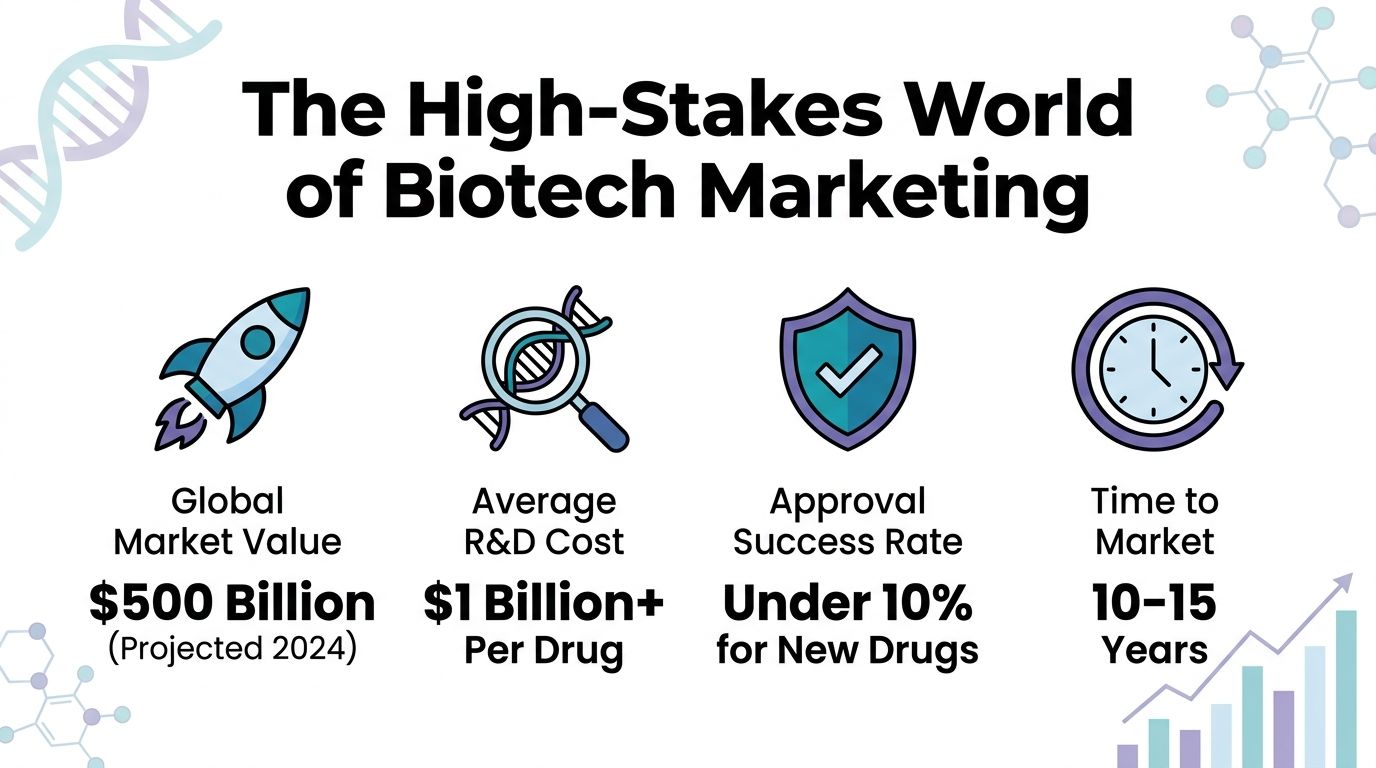
Competition changes what marketing has to do
In biotech, awareness alone has limited value. A company can get attention and still fail if the audience cannot quickly place the science, judge the maturity of the program, and see the business case. I often tell clients that biotech marketing works more like transaction support than brand theater. It has to reduce uncertainty, not just create recall.
That requirement changes the job description. Marketing needs to translate across functions without flattening the science. A press release, website update, conference abstract summary, or founder interview should all answer a practical question: what should this audience understand now, and what should they do next?
Weak positioning usually shows up in familiar ways:
- Scientists see claims without enough design, endpoint, or mechanism context.
- Investors see activity but no clear link to value inflection, timing, or market logic.
- Partners see interesting science but no obvious fit with their portfolio, geography, or development priorities.
- Talent sees ambition but not the operating discipline required to bring a program through development and commercialization.
Those are not separate messaging failures. They are one signal failure viewed from four angles.
The stakes are commercial, not just reputational
Biotech companies do not market under normal business conditions. The timelines are long, the proof thresholds are high, and the audience is trained to doubt loose language. One unclear announcement can slow diligence. One overclaimed result can create cleanup work with media, investors, and internal leadership. One vague company narrative can weaken recruiting because experienced operators read imprecision as a warning sign.
Clarity beats cleverness here. The companies that earn trust tend to communicate in a way that lets each audience verify the same core story for its own purpose.
That is why healthcare and biotech teams benefit from message discipline usually associated with investor relations, medical affairs, and corporate communications at the same time. Teams building that capability often borrow from proven PR approaches used in regulated healthcare communications because the operating reality is similar. Precision matters. Context matters. Wording changes outcomes.
Strong biotech marketing reflects trade-offs in public
Biotech messaging is rarely about saying more. It is about choosing what to emphasize without creating distortion. If a company highlights mechanism, it may sound scientifically serious but commercially abstract. If it pushes market potential too hard, discerning audiences may question whether the evidence base is mature enough. If it tries to satisfy everyone with broad language, no audience gets what it needs.
Good teams make these trade-offs deliberately.
They decide which proof points belong in the lead, which belong in supporting material, and which should wait until the company has stronger validation. They also know that a message built for the signal loop has to stay consistent across channels. A CEO quote, investor deck, careers page, and media pitch should feel like parts of the same company, not four separate drafts written for four separate agendas.
Biotech does not reward louder messaging. It rewards messaging that survives scrutiny from scientists, capital, partners, and talent at the same time.
Marketing Within the Lines Regulatory and Compliance Guardrails
In biotech, compliance doesn't sit outside marketing. It shapes the message from the first draft. Teams that treat legal and regulatory review as a final checkpoint usually end up with slow approvals, diluted copy, and avoidable rewrites.
The better mindset is to treat regulation as channel markers. They narrow the route, but they also make safe passage possible. A compliant campaign can still be persuasive. It just has to be built on approved claims, appropriate context, and disciplined wording from the start.

Claims have to match status
A common mistake in marketing in biotechnology is writing about a product in development as if it already has a settled clinical or commercial profile. That creates risk fast.
For an investigational product, marketers need language tied to study stage, stated endpoints, and factual development status. That means saying what was evaluated, what was observed, and what remains unproven. It means avoiding shortcuts that imply safety, superiority, broad efficacy, or real-world benefit beyond what the evidence supports.
Approved products create a different set of boundaries. Once a therapy has regulatory clearance or approval, claims still need to stay within the authorized label and appropriate promotional framework. That's especially important when teams repurpose scientific, investor, and patient-facing content across channels.
A practical way to reduce mistakes is to classify every message before drafting it:
| Message type | Safe starting point | Common risk |
|---|---|---|
| Corporate narrative | Company mission, platform focus, unmet need | Sliding into product claims |
| Pipeline update | Trial stage, endpoint language, study context | Overstating significance |
| Investor communication | Milestones, operational progress, market framing | Mixing financial optimism with unsupported product claims |
| Patient-facing information | Plain-language disease education, access pathways, support resources | Implying unapproved benefit |
Compliance should shape process, not kill momentum
Most delays happen because teams don't have a shared operating model. Marketing writes for readability. Clinical rewrites for accuracy. Legal strips adjectives. Leadership adds ambition back in. The document loops until the window for relevance closes.
A tighter process usually works better:
- Build a claims library: Approved phrases, evidence summaries, risk language, and prohibited shortcuts should sit in one working document.
- Separate scientific fact from promotional framing: If a sentence can't be sourced internally to approved materials or validated study data, it shouldn't be in the draft.
- Create audience versions from one master narrative: That lowers the chance that a patient page, investor note, and media release drift into contradiction.
- Review early, not just late: Medical, regulatory, and legal input works best at outline stage.
For teams that need a practical view of healthcare-specific PR constraints, this guide to PR in healthcare is a useful operational reference.
Working standard: If a marketer can't identify the source document behind a claim, that claim isn't ready for publication.
Compliance discipline also improves trust. Scientists notice loose wording. Investors notice inconsistency. Journalists notice inflation. Talent notices when the external message sounds polished but evasive. A company that communicates carefully often looks more mature than a company that communicates loudly.
Decoding Your Audiences Scientists Investors and Patients
A biotech company announces promising new data on Tuesday morning. By lunch, the scientific team is answering technical questions about assay design, an investor asks whether the result changes program value, and a patient advocate wants to know what this means right now for people waiting on treatment. One release triggered three very different readings of the same news.
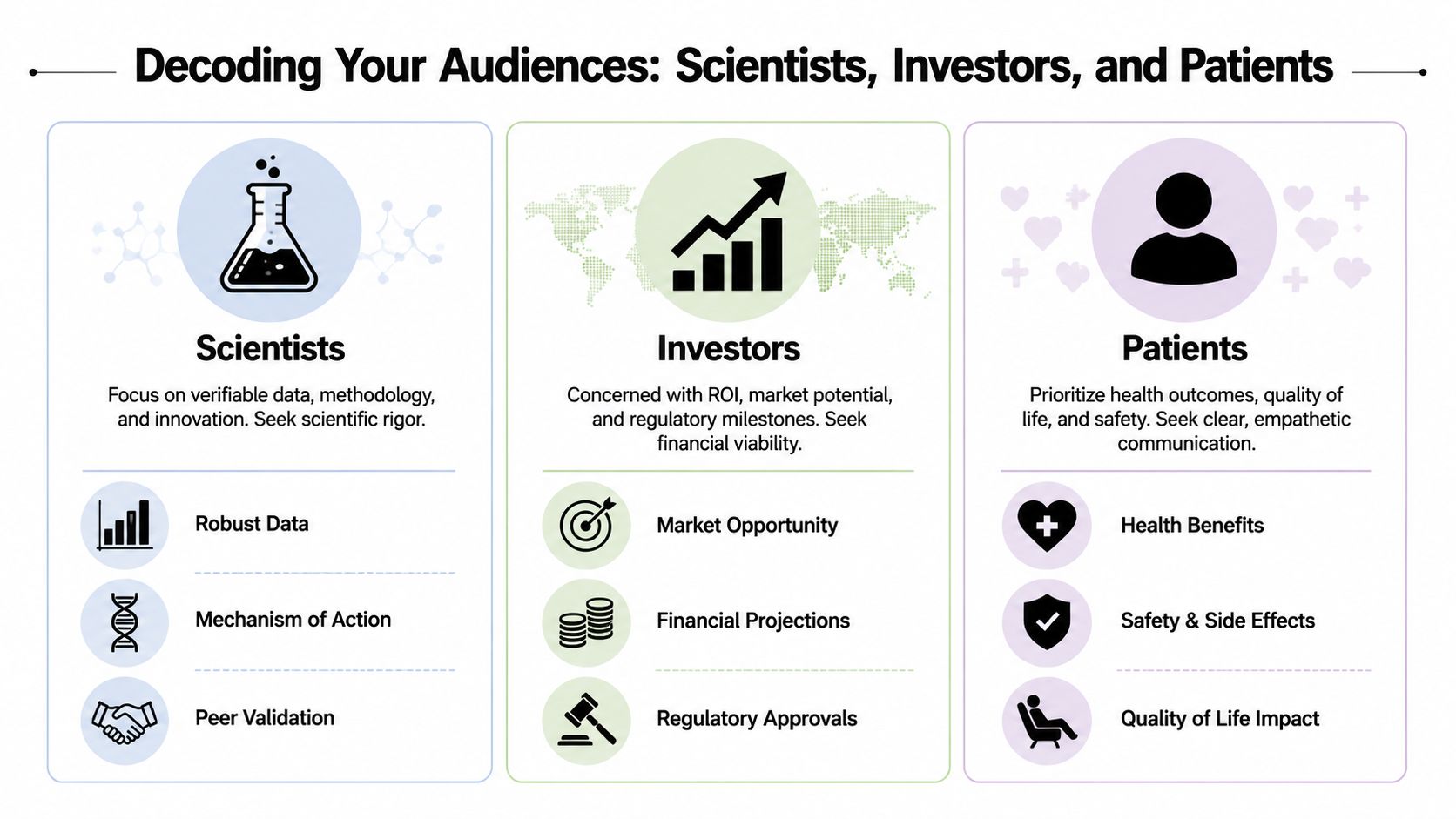
That is the core discipline in biotech marketing. I use a Signal Loop model. Each public message has to carry enough technical credibility for scientists, enough business meaning for capital, enough strategic clarity for partners, and enough plain-language context for patients and caregivers. Treating these as separate streams usually creates drift. One audience hears precision, another hears hype, and trust starts to break.
Scientists test whether the company understands its own claim
Scientists read with a red pen. They want to see what was studied, how it was measured, what the comparator was, where the limitations sit, and whether the conclusion fits the data. If that information is missing, they do not fill in the blanks generously.
Useful content for this group includes technical briefs, methods explainers, conference-linked summaries, and pages built around specific search terms that real researchers use. Editorial placement matters too. A feature aimed at a trade reporter who covers platforms, modalities, or trial design will do more than broad business press. For targeting, these lists of top biotechnology publications and journalists help teams match the story to the right outlet.
Language choices matter here. “Promising” is weak unless the company shows why. “Novel” means little without a point of comparison. Clear mechanism, study context, and stated limitations do more for credibility than polished copy ever will.
Investors read the same signal through risk, timing, and value
Investors are not looking for a literature review. They are trying to judge whether the science is translating into an investable company. The message has to connect the milestone to progress, execution quality, and the next value inflection point.
That usually means answering a tighter set of questions:
- What happened, specifically?
- Why does it matter now?
- What risk was reduced, if any?
- What comes next operationally?
- Does management sound disciplined or promotional?
A preclinical result can sound impressive and still fail with investors if the company cannot explain relevance to development, partnering, manufacturing, or financing. Early-stage teams also benefit from better targeting before outreach begins. Resources that help teams find biotech investors in the US are useful when building a realistic capital map instead of sending broad, low-fit pitches.
Patients and caregivers look for meaning they can use
Patient audiences do not need less truth. They need better organization of the truth.
The practical questions are usually straightforward. What condition is being addressed? What stage is the therapy in? Is this available now, only in trial settings, or still in research? What should a patient discuss with a physician? Copy that avoids those questions in the name of caution often creates more confusion, not less.
A simple test works well here:
- Would a non-specialist understand the first paragraph?
- Is the current development stage unmistakably clear?
- Does the copy respect uncertainty without sounding cold?
- Could a caregiver repeat the main point accurately after one read?
Patient-facing material also affects the other audiences in the loop. Investors notice when public language overstates readiness. Scientists notice when biology gets flattened into slogans. Prospective hires notice whether the company can talk about human impact without sounding theatrical.
Good biotech audience strategy starts with one source truth and then adjusts emphasis, not facts. Scientists need evidence structure. Capital needs milestone meaning. Partners need fit and execution signals. Patients need clear status and honest context. The strongest teams write one message that each audience can read from its own angle without finding a contradiction.
Building Your Biotech Marketing Playbook
A biotech marketing playbook has to work under pressure. The team gets new data on Monday, investor questions by Tuesday, partner outreach by Wednesday, and recruiting needs all week. If every group builds its own message from scratch, inconsistencies show up fast.
Start with a source narrative. One page is enough if it does the job. It should answer five operational questions: what happened, why it matters scientifically, what business consequence it creates, which claims are approved, and what each audience in the Signal Loop needs to hear. In biotech, one action rarely speaks to one audience. A trial update, publication, partnership, or press release has to send coherent signals to Scientists, Capital, Partners, and Talent at the same time.
That discipline saves rework.
Build around a message architecture, not isolated assets
A useful playbook separates core message from channel expression. The facts stay fixed. The emphasis changes by audience and use case.
For a meaningful preclinical or clinical milestone, I usually recommend a package that includes:
- A scientific brief that covers study design, mechanism, endpoints, and limits of interpretation.
- An investor narrative that explains milestone significance, program risk, timing, and what the result changes operationally.
- A partner memo that clarifies platform fit, development capabilities, and where collaboration could create value.
- A talent story that shows the company is building with rigor, attracting serious people, and making measurable progress.
The goal is consistency without copy-pasting. Scientists should see enough substance to respect the claim. Investors should see what de-risks the story and what still needs proof. Potential partners should understand where the company fits in a development or commercial chain. Candidates should see whether this is a place that knows what it is building and how it talks about progress.
If the same event produces four conflicting interpretations, the market notices.
Choose channels for authority, access, and reuse
Biotech teams often treat channel selection as a distribution question. It is a credibility question first.
A company website should hold the canonical version of the story. Trade media can validate relevance to the field. Conferences create live scrutiny and relationship access. LinkedIn works best as an executive amplification channel, not the primary home for technical claims. A press release can anchor the sequence if it is written to support follow-on use across all four audiences in the Signal Loop. This research study and industry report press release template is a practical starting point for structuring an announcement that can be repurposed across channels without losing precision.
Use channels based on how decisions get made.
| Channel | Best use in biotech | Common failure |
|---|---|---|
| Website content hub | Hold approved claims, data context, and the latest company narrative | Leaving key pages vague so teams improvise elsewhere |
| Trade media and contributed articles | Build third-party credibility with industry readers | Submitting promotional copy with no real point of view |
| Extend leadership voice, hiring visibility, and milestone awareness | Compressing technical nuance into oversimplified posts | |
| Conferences and symposia | Test message quality in real conversations and build field presence | Treating the event as the finish line instead of the start of follow-up |
| PR and media outreach | Create a market-facing record of progress | Pitching outlets that do not influence the target audience |
Patient communication can sit inside this system without turning the section into patient marketing. Teams working on disease education, trial awareness, or public-facing updates can borrow useful lessons from broader healthcare digital work on boosting healthcare patient engagement, especially around clarity, accessibility, and digital pathing.
What breaks the playbook
The recurring failures are operational, not mysterious.
- Message drift: legal, clinical, investor, and recruiting teams all describe the same milestone differently.
- Audience collapse: one generic asset tries to satisfy everyone and ends up persuading no one.
- Channel laziness: teams publish wherever they have access rather than where authority exists.
- Evidence gaps: the copy sounds polished, but the support is thin, missing, or buried.
- One-and-done execution: the announcement goes out, then nothing extends the conversation with the audiences that matter.
A good playbook reduces those errors before launch. It assigns ownership, approval paths, version control, audience priorities, and post-announcement follow-up. In practice, that is what makes the Signal Loop usable. One message enters the market, and each audience receives a version that fits its decision criteria without finding a contradiction.
The Biotech Press Release A Multi-Audience Masterpiece
The biotech press release is often treated as a news artifact. That's too narrow. In practice, it's a multi-audience signaling tool. It tells the market what happened, but it also tells multiple stakeholder groups how to interpret what happened.
That matters because a major biotech announcement rarely reaches just one constituency. Journalists read it for news value. Scientists read it for rigor. investors read it for implications. Potential partners read it for strategic fit. Candidates read it for seriousness and trajectory. If the release only satisfies one group, the communication underperforms.
A sharper standard is the Signal Loop model. One release should send coordinated signals to Science, Capital, Partners, and Talent. This is especially important because verified industry reporting notes that 84% of biotech startups fail to secure follow-on funding due to “poor narrative alignment” across distinct markets, making narrative consistency a commercial issue, not just a messaging issue.
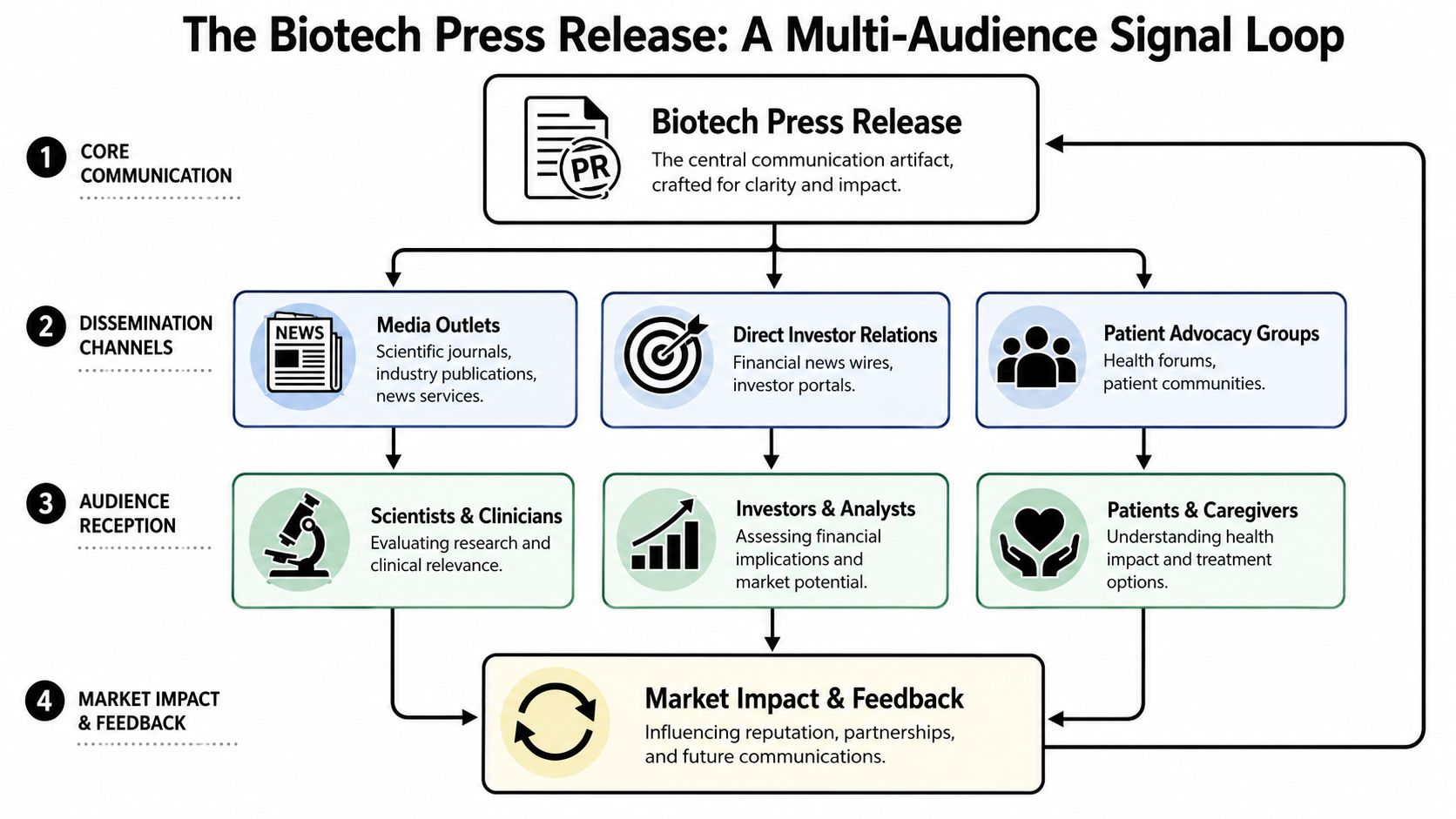
The Signal Loop model
The model is simple in concept and demanding in execution.
- Science: Does the release include enough methodological or clinical substance to sound credible?
- Capital: Does it explain why this event changes the company's position, prospects, or momentum?
- Partners: Does it show capability, relevance, and operational maturity?
- Talent: Does it suggest the company is coherent, credible, and building something worth joining?
Most weak releases collapse because they over-index on one of those. A science-heavy draft may impress insiders but fail investors and media. A finance-heavy draft may sound shallow to technical readers. A talent-focused culture note may feel disconnected from the actual milestone.
A biotech press release should read like one story with four proof paths built inside it.
For teams comparing broader approaches to healthcare digital marketing strategy, the lesson carries over well. Strong regulated-industry messaging doesn't fragment by channel. It adapts while keeping one coherent narrative spine.
How to write one release for four audiences
Start with the headline and subhead. They need to state the event clearly without overselling. “Announces positive breakthrough” is weak because it says almost nothing. A stronger structure names the milestone and its significance in factual terms.
Then build the body in modules.
The opening paragraph should answer the basic news question. What happened, to whom, and why now. The second paragraph should deepen the scientific or clinical context. After that, the release should branch into layered proof: operational significance, commercial relevance, and external context.
A useful drafting sequence is this:
State the event cleanly
Name the milestone, development stage, and context in plain terms.Add technical substance
Include enough detail to show the company respects expert readers. Often, this includes study design language, mechanism framing, or program scope.Translate commercial meaning
Spell out why the event matters for company progress. Not with hype. With logic.Add partner signal
Show where this development may affect collaboration, platform application, manufacturing readiness, or market path.Include talent signal
A quote, a team reference, or a brief line about execution can help experienced candidates assess organizational maturity.
When teams need a stronger starting structure, a practical press release template for research studies whitepapers and industry reports can help standardize drafting before internal review starts.
Biotech Press Release Structure for Multiple Audiences
| Section | Scientific Audience Focus (R&D, KOLs) | Investor Audience Focus (VCs, Analysts) | Media/Public Focus (Journalists, Patients) |
|---|---|---|---|
| Headline | Precise milestone language | Clear value-inflection signal | Readable, factual news angle |
| Subheadline | Program or data context | Why the milestone matters now | Plain-language framing |
| Lead paragraph | What happened in objective terms | Immediate relevance to company trajectory | Fast summary for general readers |
| Supporting detail | Study design, mechanism, endpoints, limitations | De-risking, milestone progression, strategic implications | Why the story matters beyond the company |
| Executive quote | Scientific credibility and disciplined wording | Leadership confidence grounded in execution | Human voice without hype |
| Company background | Platform and pipeline relevance | Business model and growth path | Credible context for unfamiliar readers |
| Boilerplate and links | Access to technical resources | Access to investor materials | Access to clear explanatory pages |
A good release doesn't try to satisfy every audience with every sentence. It gives each audience enough evidence to continue the conversation in the right direction. That's what makes the press release more than an announcement. It becomes the center of a signal loop that shapes perception across the market.
Measuring Success and Managing Your Reputation
In biotech, measurement can't stop at surface-level marketing metrics. Website visits, email opens, and social engagement can be useful operational signals, but they don't tell leadership enough. The more important question is whether communications are improving decision quality across the market.
That's why serious measurement in biotech should connect visibility to credibility, and credibility to business movement.
Measure what changes business outcomes
Biotech marketers need systems that show who engaged, how they engaged, and what happened next. That's where precision infrastructure matters. According to AccelaBrand's analysis of precision marketing in biotech, effective biotech marketing relies on data ecosystems that combine healthcare-specific CRM platforms, marketing automation, and advanced analytics to predict provider behavior and personalize engagement. The same analysis notes that these systems create actionable insights that help firms launch therapies more efficiently and achieve stronger market penetration.
That has practical value well beyond campaign reporting. A biotech-specific data setup can help teams distinguish between low-value attention and strategically important engagement.
Useful measurement categories often include:
- Audience quality: Are the right clinicians, KOLs, investors, partners, or recruits engaging?
- Content utility: Which assets move a stakeholder to request a meeting, download material, or continue due diligence?
- Message durability: Are key themes staying consistent across earned media, direct outreach, and stakeholder follow-up?
- Conversion by stakeholder type: Not just “leads,” but partner conversations, investor responses, media interest, and recruitment progress.
Reputation management starts before a crisis
Reputation in biotech is fragile because it sits on top of evidence, regulation, and expectation. A weak narrative during calm periods makes every difficult moment harder. If trial results disappoint, a clinical hold appears, or a journalist raises questions, the company's existing communication habits become visible fast.
Teams with disciplined measurement usually respond better because they already know:
- Which audiences matter most
- Which messages have been landing
- Where confusion is building
- Which channels carry the most trust
Reputation lens: In biotech, measurement is part of risk control. It shows where misunderstanding is likely to appear before it becomes a larger problem.
A strong reputation program usually includes message monitoring, stakeholder mapping, response workflows, and an updated source-of-truth library for approved language. It also depends on internal coordination. Marketing, medical, regulatory, investor relations, and leadership need one shared view of what the company is signaling.
That's the overlooked payoff of mature marketing in biotechnology. It doesn't just support growth. It protects the company when scrutiny sharpens.
Conclusion
Marketing in biotechnology works when the message does three things at once. It respects scientific reality, stays inside compliance guardrails, and gives each stakeholder a reason to keep moving toward the company. That's why integrated storytelling matters so much.
The strongest teams don't build separate narratives for science, capital, partners, and talent. They build one credible narrative with different proof paths. When that discipline shows up in content, PR, and measurement, marketing stops feeling like decoration and starts operating like a strategic asset.
Press Release Zen helps communications teams turn that kind of discipline into repeatable execution. For practical templates, biotech-relevant press release guidance, and step-by-step resources that make complex announcements easier to plan and publish, visit Press Release Zen.