A PR report can look busy and still answer the wrong question. A folder full of clippings, a neat spreadsheet of mentions, and a few cheerful screenshots may satisfy a weekly check-in, but they won't survive a boardroom question like, what did this coverage change? That gap is why the measurement of PR has moved from a reporting task to a management discipline, especially when executives want evidence that communications is affecting awareness, demand, or reputation.
The old habit was simple, count the clips and move on. That approach overstates value because exposure isn't the same as business impact, and modern measurement now separates outputs, outcomes, and impact so teams can track what they published, what audience behavior changed, and what the business gained, including conversions and pipeline influence (modern PR measurement guidance). Digital channels made that shift unavoidable. Coverage now leaves a trail through search, referral traffic, branded queries, and CRM activity, which means PR can be evaluated with more rigor than a binder of mentions ever allowed.
Table of Contents
- Why Measurement of PR Is Now a Boardroom Conversation
- Defining PR Measurement and the Modern Framework
- The Five KPI Categories Every PR Team Should Track
- Data Sources and Attribution Approaches for PR
- Building a Step-by-Step PR Measurement Plan
- Reporting Templates and Tools for PR Teams
- Common Misconceptions and the Future of PR Measurement
Why Measurement of PR Is Now a Boardroom Conversation
A PR director walks into a quarterly review with a thick packet of clippings. The chief executive skims the first page, then asks the only question that matters in the room, what did this coverage buy the business? That question is blunt, but it is fair. Leadership teams now expect PR to be measured with the same seriousness as paid media or performance marketing, because communications budgets compete for the same capital and scrutiny.
From clip counts to business proof
The old reporting habit rewarded visibility, even when visibility did not move buyers, partners, or customers. A stack of mentions can look active and still leave the business unchanged. The shift toward Barcelona Principles-style measurement changed professional expectations by separating what was produced, what changed in the audience, and what the organization gained. That framework matters because it forces the team to stop treating every mention as a win.
A better way to read PR results is to follow the chain from exposure to response to business effect. Coverage can send people to a site, shape branded search, support sales conversations, or influence how a stakeholder group talks about the company. Those are different signals, and they should not be collapsed into one headline number.
Digital PR also changed the evidentiary standard. Once coverage could be tied to traffic, search behavior, and downstream actions, it became harder to defend vague claims about influence without supporting data. In practice, that is why modern PR reporting increasingly looks like strategy support, not a media scrapbook.
Practical rule: If a metric cannot be tied to a business question, it belongs in the appendix, not the executive summary.
Why leaders care more now
Executives do not need every operational detail, but they do need to know whether communications helped create momentum. A mention in the right publication can be valuable, but only if it connects to something the business recognizes, such as attention from a priority audience, stronger brand search behavior, or movement in the pipeline. A boardroom conversation begins when PR stops saying, “We got covered,” and starts showing how coverage fit into a larger result.
The same pressure now extends to search visibility. PR does not only shape what people read on a page, it also influences what shows up in search and in generative answers. That means the measurement brief has grown wider. Teams now need to watch how coverage affects SEO signals, branded queries, referral quality, and the way AI tools summarize the company.
That is the shift. PR used to be judged mostly after the fact. Now it is expected to function as a decision tool for budget allocation and campaign direction, which raises the bar for every report that reaches senior leadership.
Defining PR Measurement and the Modern Framework
PR measurement is the disciplined practice of showing what communications produced, how people responded, and what changed for the business. That sounds simple, but confusion starts when teams mix those three stages into one pile of metrics. A placement, a click, and a lead are connected, yet they do not prove the same thing.
Think in relay-race terms
A useful way to understand the process is a relay race. The first runner hands off the baton when the message is published. The second runner carries it when the audience reacts. The final runner crosses the line when business behavior changes. If the baton never changes hands cleanly, the team cannot show how far PR moved.
The framework behind this thinking separates outputs, outtakes, and outcomes (measurement guidance from the AMEC Integrated Evaluation Framework). Outputs are the materials and placements a team creates. Outtakes capture audience response, such as reach, engagement, sentiment, and share of voice. Outcomes tie the work to traffic, leads, or conversions.
The five KPI categories fit inside that structure
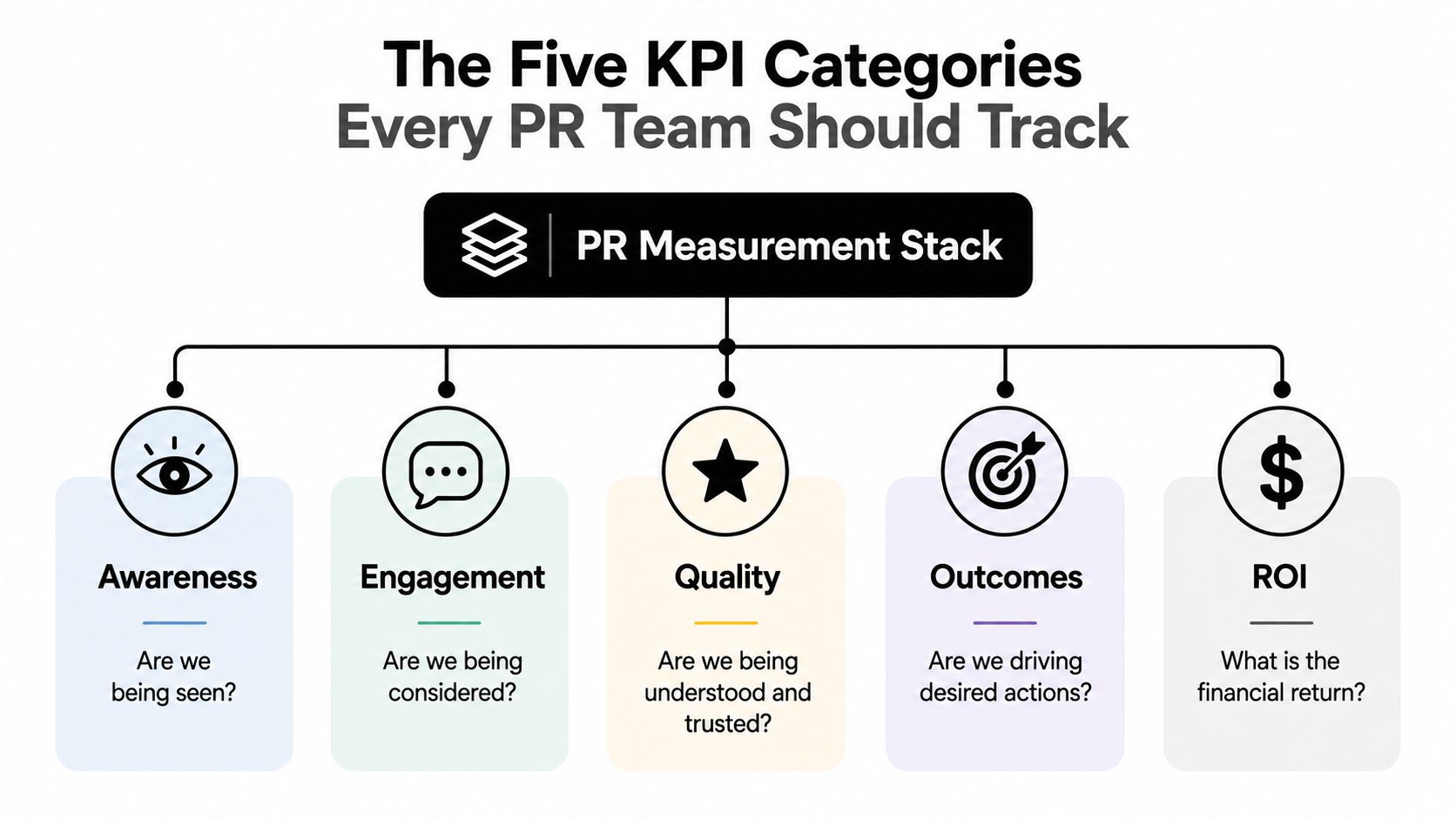
The mistake many teams make is collecting numbers without choosing the decision those numbers should support. A better measurement plan starts with the business goal, then assigns one or two KPIs to each stage of the relay. That keeps reporting clear and makes it much easier to answer skeptical questions in a review meeting.
Qualitative measures matter too. Tone, message pull-through, and the relevance of the outlet often explain more than raw volume. A large amount of coverage that misses the message is noise, not proof. When PR starts influencing SEO and GEO signals as well, the measurement frame needs to show whether coverage is only visible, or also helping the brand surface in search results and generative answers.
The Five KPI Categories Every PR Team Should Track
A strong dashboard does not need seventeen overlapping metrics. It needs a small set of measures that answer different stakeholder questions without repeating the same story. The five categories below work because each one maps to a different level of attention, trust, or business effect. They also help PR teams move beyond vanity reporting and toward attribution that a board can use.
Awareness tells leaders whether the brand is being seen
Awareness metrics answer a simple question, are we visible in the places that matter? Reach, share of voice, and coverage volume belong here. These numbers show whether the market had a chance to notice the brand, the same way a storefront window can be lit without proving anyone walked inside. A useful taxonomy of PR metrics should separate exposure from deeper impact, which is why industry guidance on KPI categories matters, as discussed in PRWeek's analysis of measurement frameworks.
Awareness is useful, but it is not proof of value by itself. It shows whether the brand appeared in the market. It does not show whether the audience understood the message or took action.
Engagement and quality answer whether people paid attention
Engagement metrics, such as clicks, comments, shares, and branded search behavior, show whether the coverage pulled people closer. Quality metrics go a step further. They look at sentiment and message pull-through, which help separate busy coverage from meaningful coverage.
That distinction matters in board reporting. A story can generate lots of visibility and still miss the strategic point if the headline is off-message or the tone is wrong. The best PR reports treat quality as a filter, not a nice-to-have. If the audience saw the story but did not absorb the message, the work helped less than the volume figure suggests.
Boardroom test: If a metric cannot distinguish between “seen” and “understood,” it is not enough on its own.
Outcomes and ROI connect PR to business decisions
Outcomes answer what changed next, such as web traffic, newsletter sign-ups, event registrations, downloads, or leads. ROI sits one layer higher and asks what the organization gained relative to effort or spend. A campaign with strong awareness but no outcome is incomplete. A campaign with outcomes and a clear line to revenue support is much easier to defend.
The caution from the field is simple. Quantitative PR measurement becomes persuasive when it is paired with context, baseline comparison, and a business goal. That is why the five-category view works. It keeps teams from mistaking motion for momentum, and it gives PR a cleaner path to show business outcomes, not just activity.
Data Sources and Attribution Approaches for PR
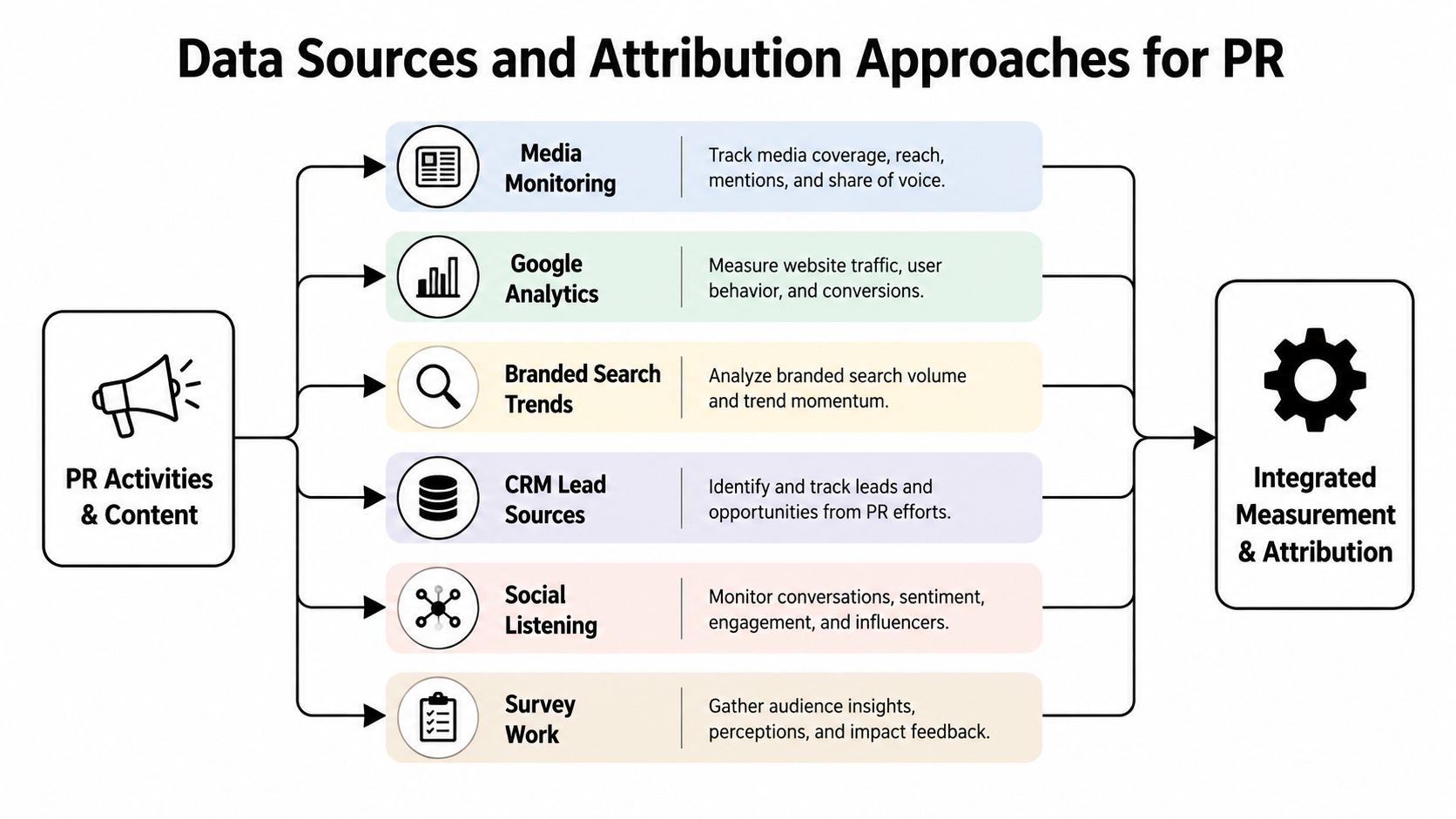
A PR team cannot defend measurement if the evidence sits in separate drawers. Media monitoring shows what appeared and where it appeared. Web analytics shows whether people moved from coverage to the site. Branded search trends show whether awareness turned into active interest. CRM lead sources show whether PR touched pipeline activity. Social listening and survey work add the missing layer, they show how people reacted and whether the message held up.
The hard part is not collecting more tools. It is deciding which source answers which question, and how far the team can go in claiming influence. A mention in the press may start attention, but it does not prove business impact by itself. A source map works like a courtroom exhibit. Each item has a role, and each role needs to be clear before anyone argues attribution.
Match the source to the question
Media monitoring answers a publication question. It shows what was published, where it ran, and whether the coverage reached the right outlets. Google Analytics answers a behavior question. It shows whether the audience came to the site and what they did next. Branded search trends answer an intent question. They show whether awareness translated into active curiosity. CRM lead sources answer a pipeline question. They show whether the work touched real lead activity. Social listening and survey work answer perception questions. They help show message resonance, tone, and changes in how the audience describes the brand.
That is also where measurement gets messy. Separate systems rarely produce one clean story, so teams often need proxy attribution or lift-style reasoning instead of pretending the data is exact. The AMEC framework support resources are useful because they stress that different providers can produce different results from the same campaign. That makes disciplined attribution more important than polished reporting.
Use attribution carefully
Last-touch attribution is easy to explain, but it rarely gives PR full credit for influence. UTM tagging helps connect specific placements to site behavior, yet it still only captures measurable clicks. Lift studies and proxy attribution work better when sales data or CRM data are incomplete, because they look for directional change rather than pretending a single source did all the work.
The practical lesson is simple. Attribution in PR should answer, “What changed after the activity?” rather than, “Which one placement deserves the trophy?” That is why a clean measurement setup needs tracked links, source mapping, and a clear view of what counts as success. A useful companion for teams building that setup is this guide to PR measurement tools.
A strong measurement approach also separates exposure from evidence. Exposure is useful, but board-level reporting needs a link to behavior, pipeline, or reputation change. If the team cannot show that chain, the report is still a media summary, not attribution.
Building a Step-by-Step PR Measurement Plan
A measurement plan works best when it's built before the campaign goes live. That way the team can decide what success means, where the data will come from, and which signals will count as evidence. Without that setup, reporting turns into retroactive storytelling.
Start with the business goal
The first step is to name the business outcome the campaign is supposed to support. That could be lead generation, sales-cycle support, reputation repair, partner awareness, or event registrations. Once that goal is clear, the team can choose a smaller set of KPIs that match it.
The second step is to define the objective and the KPI together. A launch campaign might target coverage in priority outlets, branded search lift, and referral traffic. A reputation campaign might care more about sentiment, message pull-through, and survey movement.
Set the baseline, then instrument the campaign
A baseline is the comparison point that keeps optimism honest. It might be prior campaign performance, pre-launch traffic, existing search behavior, or current media share. If the team skips that step, any increase looks impressive, even when it's just normal variation.
The next step is instrumentation. Tracking links, page tagging, and CRM source mapping need to be in place before distribution. Teams that publish first and tag later usually lose the cleanest evidence.
A measurement plan is strongest when it can survive a skeptical CFO, not just a friendly marketing review.
Use a simple ROI sketch
The table below shows a basic structure a small team can adapt. It's intentionally simple so the math stays legible in a board meeting.
| Line Item | Value | Source |
|---|---|---|
| Coverage volume | Qualitative campaign output | Media monitoring |
| Branded search lift | Qualitative interest signal | Search trends |
| Referral traffic | Qualitative site response | Web analytics |
| Influenced pipeline | Portion attributed through CRM and campaign tagging | CRM and sales reporting |
A practical workflow for collecting source material is a sitemap scraping api, which can help teams map published assets and keep an inventory of pages tied to campaigns. For small teams, that kind of structured inventory often matters more than another dashboard with prettier charts.
For teams formalizing the process, this PR measurement tools overview provides a useful lens on what to track and when.
Reporting Templates and Tools for PR Teams
The best report format depends on who's reading it. A weekly activity snapshot helps operators. A monthly dashboard helps managers. A quarterly narrative review helps executives. Each one should answer a different question, or the report becomes noise.
Choose the format before the tool
A weekly snapshot is usually short and tactical. It should cover placements secured, issues spotted, key messages landed, and any risks that need fast follow-up. A monthly dashboard should go one layer deeper with awareness, engagement, quality, and outcome signals. A quarterly review should explain what changed, what was learned, and what the team should do next.
Tool choice should follow that cadence. Google Sheets and Looker Studio can support simple reporting. Cision, Meltwater, Brandwatch, Talkwalker, and Agility PR are better suited to monitoring, aggregation, and trend analysis, especially when a team needs more than a manual clipping log.
Keep the executive version clean
Executives usually don't need every metric the team has available. They need three things, what happened, why it mattered, and what the business should do now. That means the report should start with the outcome, not the activity dump.
The publisher also maintains a public relations reporting guide that fits well with this cadence if the team needs a simpler template for internal use. It's one option among several, not a substitute for a measurement plan.
Use a repeatable report skeleton
- Headline summary: One paragraph that states the main result and the business implication.
- Awareness section: Coverage, share of voice, and priority outlet performance.
- Quality section: Sentiment, message pull-through, and notable placements.
- Outcome section: Referral traffic, sign-ups, downloads, or other tracked actions.
- Decision section: What should change in outreach, content, or target lists next.
A report built this way gives each audience what it needs without forcing everyone to read the same raw data dump.
Common Misconceptions and the Future of PR Measurement
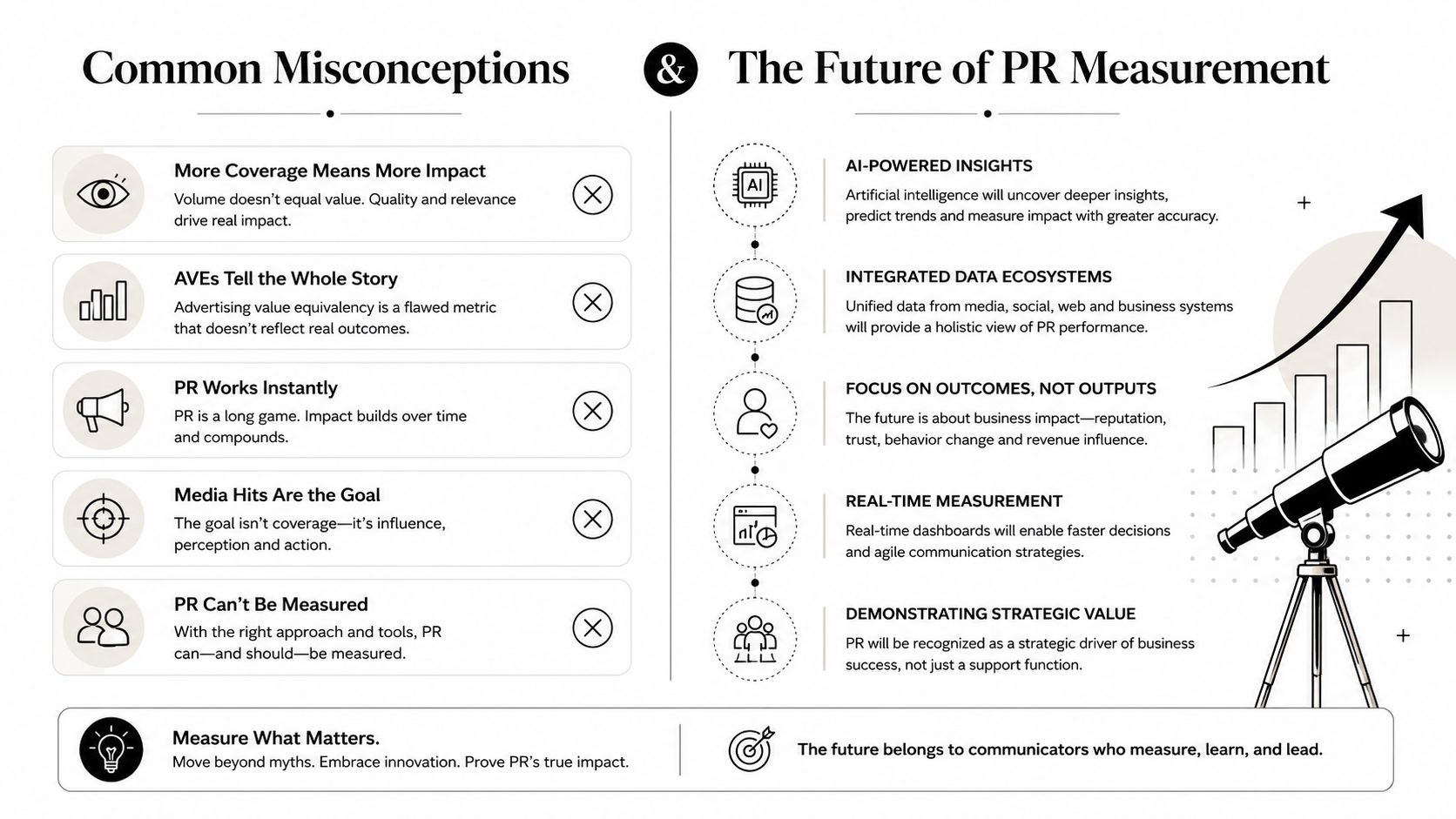
The easiest way to damage a measurement program is to defend the wrong metric for too long. Four misconceptions show up again and again, and each one gives the team a false sense of certainty.
What to stop saying
AVE is a valid currency is the oldest trap. Advertising Value Equivalency may look neat in a spreadsheet, but it doesn't show influence, behavior, or business impact. Share of voice alone proves value is another weak claim, because visibility is only an input. Impressions equal impact confuses exposure with persuasion. Measurement is only for the end ignores the fact that modern PR needs ongoing analysis, not a post-campaign costume change.
The better standard is clearer. Measure what was produced, what changed in the audience, and what the business gained. Then compare those results against a baseline and a stated goal.
Where measurement is heading
The generative-search era is pushing PR teams to think beyond traditional earned media. Recent industry coverage says measurement now needs to include SEO and GEO signals, because coverage can influence how brands appear in search and AI-generated answers (Search Engine Land on PR measurement, SEO, PPC, and GEO). That doesn't replace classic measurement, it adds another layer.
The practical response is a hybrid model. Teams need media quality, referral traffic, branded search behavior, and placement authority in the same conversation. Search visibility no longer belongs only to SEO teams when PR can shape it through earned coverage.
If the current dashboard still stops at impressions and SOV, the program isn't finished. It's outdated.
Press Release Zen helps teams plan, write, and distribute press releases with practical guidance, templates, and comparisons that support measurable communications work. For a team trying to tie earned media to outcomes, Press Release Zen offers a straightforward place to build better release workflows and stronger reporting habits.