The brief usually looks familiar. A biotech company has strong science, a careful legal review process, and a website full of technically correct pages that still don't rank. Product teams want visibility for complex terms. Medical and regulatory teams want precision. Leadership wants proof that organic search can influence pipeline, even when the buying cycle is long and the audience is skeptical.
That tension is exactly why life sciences SEO needs a different operating model. Generic B2B SEO advice breaks down fast when pages need scientific accuracy, substantiated claims, and trust signals that stand up to scrutiny from researchers, clinicians, procurement teams, and investors. The companies that win don't treat SEO as blog production. They treat it as discoverability infrastructure, editorial governance, and authority building working together.
Table of Contents
- Why Life Sciences SEO Requires a Different Playbook
- Audience and Keyword Research for Scientific Discovery
- A Content Strategy for Trust and Regulatory Compliance
- Building Authority with Technical SEO and Strategic Outreach
- Measuring SEO Impact and Avoiding Common Pitfalls
Why Life Sciences SEO Requires a Different Playbook
Life sciences SEO isn't standard SEO with a few technical terms added. The audience behaves differently, the content faces higher scrutiny, and the website usually has more friction points than a typical B2B site. Scientific buyers don't skim a page and convert. They compare protocols, verify claims, inspect data quality, and revisit vendors across a long evaluation window.
Modern search optimization in this sector has moved beyond broad keyword and backlink tactics into a more specialized discipline centered on technical performance, compliance, and subject-matter authority, with guidance emphasizing schema markup, crawlability, mobile-friendliness, and page-speed analysis as core requirements for life sciences websites, according to this life sciences SEO handbook.
What fails in regulated scientific markets
Three patterns tend to underperform.
- Thin glossary content: Publishing shallow definitions for complex scientific topics rarely builds trust. Experts can tell when a page was written for indexing rather than usefulness.
- Promotional copy on educational pages: When every page sounds like a product pitch, reviewers distrust the content and search engines get weaker topical signals.
- SEO detached from compliance: If optimization happens after legal and medical review, teams end up rewriting titles, headings, and claims too late in the process.
A better model treats SEO as part of the content design phase. That changes how pages are scoped, written, reviewed, and updated.
Practical rule: In life sciences, credibility isn't a layer added after content production. It's part of what makes the page rankable in the first place.
What has replaced generic SEO tactics
Strong programs usually share the same foundation:
| Area | What works | What doesn't |
|---|---|---|
| Technical setup | Clear indexation, strong internal linking, schema where relevant | Large resource libraries with orphaned pages |
| Content strategy | Buyer-stage content tied to specific scientific questions | Broad blogs with weak intent alignment |
| Authority building | Mentions and links from relevant scientific and industry contexts | Volume-focused link building from unrelated sites |
| Governance | Review workflows that preserve accuracy and search intent | Endless rewrites that strip pages of specificity |
This is also why AI visibility is now part of the conversation. Traditional rankings still matter, but regulated brands also need content that can be cited and trusted in AI-generated answers. Teams evaluating that shift can use resources on mastering AI search optimization to think beyond rankings alone and plan for citation-ready content.
The practical implication is simple. Life sciences SEO isn't a marketing add-on. It's an operating system for discoverability in biotech, pharma, diagnostics, and research services.
Audience and Keyword Research for Scientific Discovery
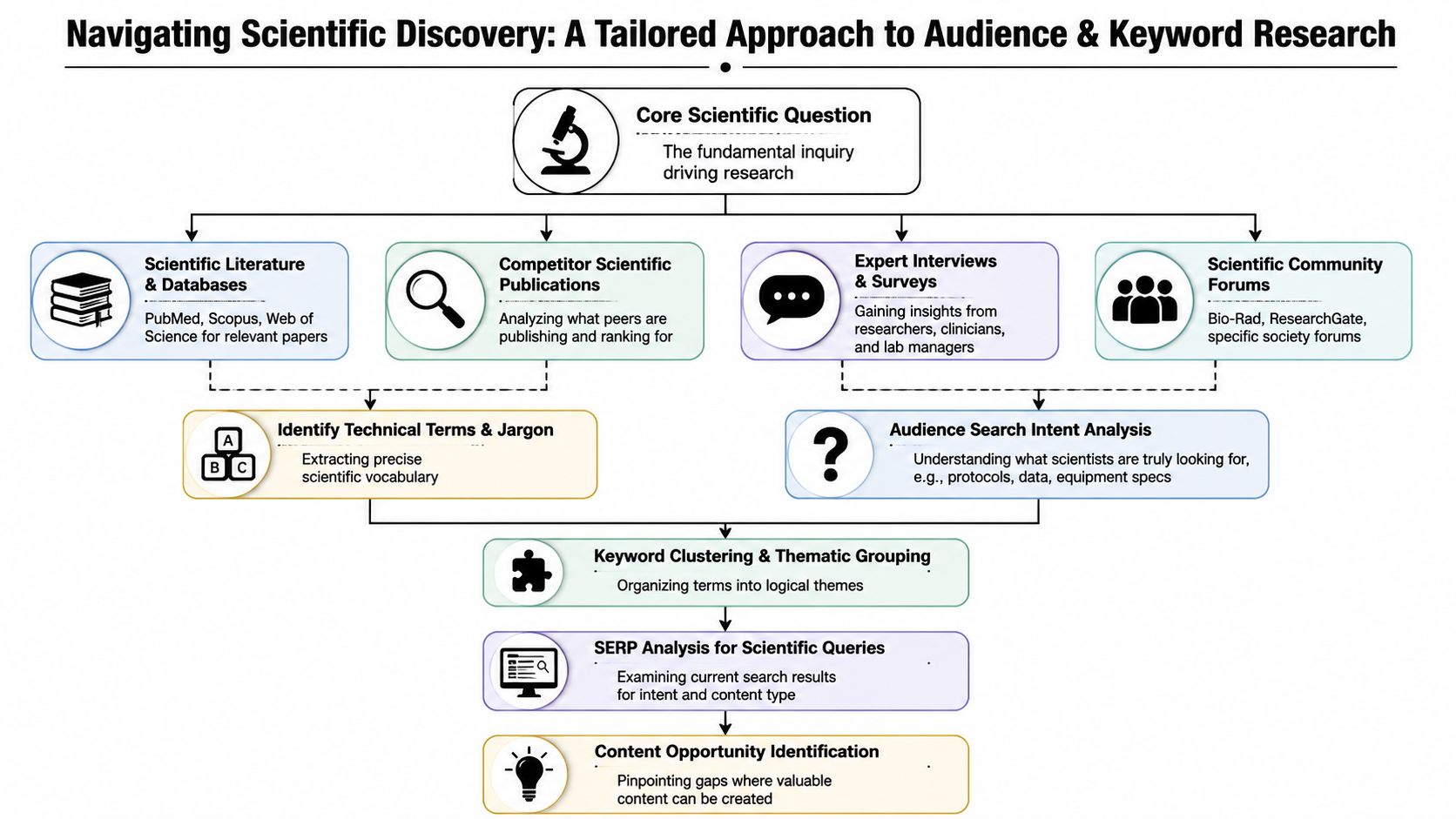
Keyword research in life sciences starts in the wrong place more often than teams admit. They open a tool, export terms, sort by search volume, and build content around phrases that look promising. That approach misses the actual job the page needs to do.
The better starting point is audience intent under scientific conditions. A principal investigator searches differently than a procurement lead. A clinician evaluating treatment-related information behaves differently than an investor assessing platform credibility. Those differences affect language, content depth, conversion paths, and review requirements.
Start with audience roles, not search volume
A practical research model maps queries to decision-making roles.
- Researchers: They look for mechanism details, assay validation, protocols, datasets, and publication-backed explanations.
- Clinicians: They usually need clarity, evidence, indications, and careful language around outcomes or applications.
- Lab managers and procurement teams: They compare specifications, workflow fit, reliability, compatibility, and support information.
- Investors and partners: They search for platform differentiation, pipeline context, milestones, leadership credibility, and market signals.
Each group uses overlapping terminology, but not identical intent. The phrase might be the same while the expected answer changes completely. A page optimized for product discovery often fails when the searcher is instead seeking technical documentation or scientific context.
Build keyword sets from scientific behavior
Life sciences buyers leave a trail of language long before they fill out a form. Useful inputs usually come from places marketing teams already touch but don't always mine systematically:
- Conference agendas and abstracts: These reveal how the field phrases emerging topics.
- Clinical trial databases: Useful for condition language, intervention terminology, and protocol-oriented questions.
- Scientific journals and review articles: These sharpen term precision and show accepted phrasing.
- Sales and field questions: Repeated objections and clarifications often become strong long-tail topics.
- Site search data and support logs: These expose wording gaps between internal language and external search behavior.
After that, clustering matters more than collecting. One core term may support several page types. For example, a scientific process term could justify a glossary page, a protocol page, a product page, a comparison page, and a technical FAQ. Treating it as one keyword with one page usually leaves intent uncovered.
Queries in this market often look narrow, but they're rarely simple. The same term can signal education, evaluation, or purchase readiness depending on who typed it.
A practical shortcut is competitor gap analysis. A 2024 guide recommends focusing on terms where competitors already rank in positions 5-20, because those pages are often the most realistic to overtake with stronger content and internal linking. The same guide also recommends keeping title tags under 60 characters and meta descriptions under 160 characters, which matters when teams write highly technical page copy that easily becomes too long for clean SERP display. Those recommendations are outlined in this life science SEO guide from Marzipan.
Use SERP analysis to decide content format
Many life sciences teams choose the right topic and still create the wrong asset. That's a formatting error, not a keyword error.
If the results page is dominated by technical explainers, a product page won't usually displace them. If the results show category pages, a thought leadership article may not earn visibility. Search engines often reveal the format expectation clearly:
- Educational SERPs: Build explainer pages, FAQs, or scientific primers.
- Commercial investigation SERPs: Use comparison pages, solution pages, or application-specific landing pages.
- Documentation-heavy SERPs: Publish protocols, datasheets, or validated process content.
- News-sensitive SERPs: Support the topic with press releases, publication summaries, and expert commentary.
A useful keyword map for life sciences includes more than target terms. It should also note reviewer type, acceptable claim level, ideal source support, internal link targets, and the intended conversion. That prevents a common failure where content ranks for the wrong reason and attracts traffic that can't progress.
A solid map also protects teams from overproduction. In this category, optimizing an existing technically valuable page often outperforms publishing a new one. Many sites already have overlooked assets buried in resource centers, PDF libraries, or product sections. The opportunity is frequently consolidation, not expansion.
A Content Strategy for Trust and Regulatory Compliance
The strongest life sciences content rarely sounds like marketing copy. It sounds clear, specific, referenced, and responsibly written. That isn't a branding choice. It's an SEO advantage.
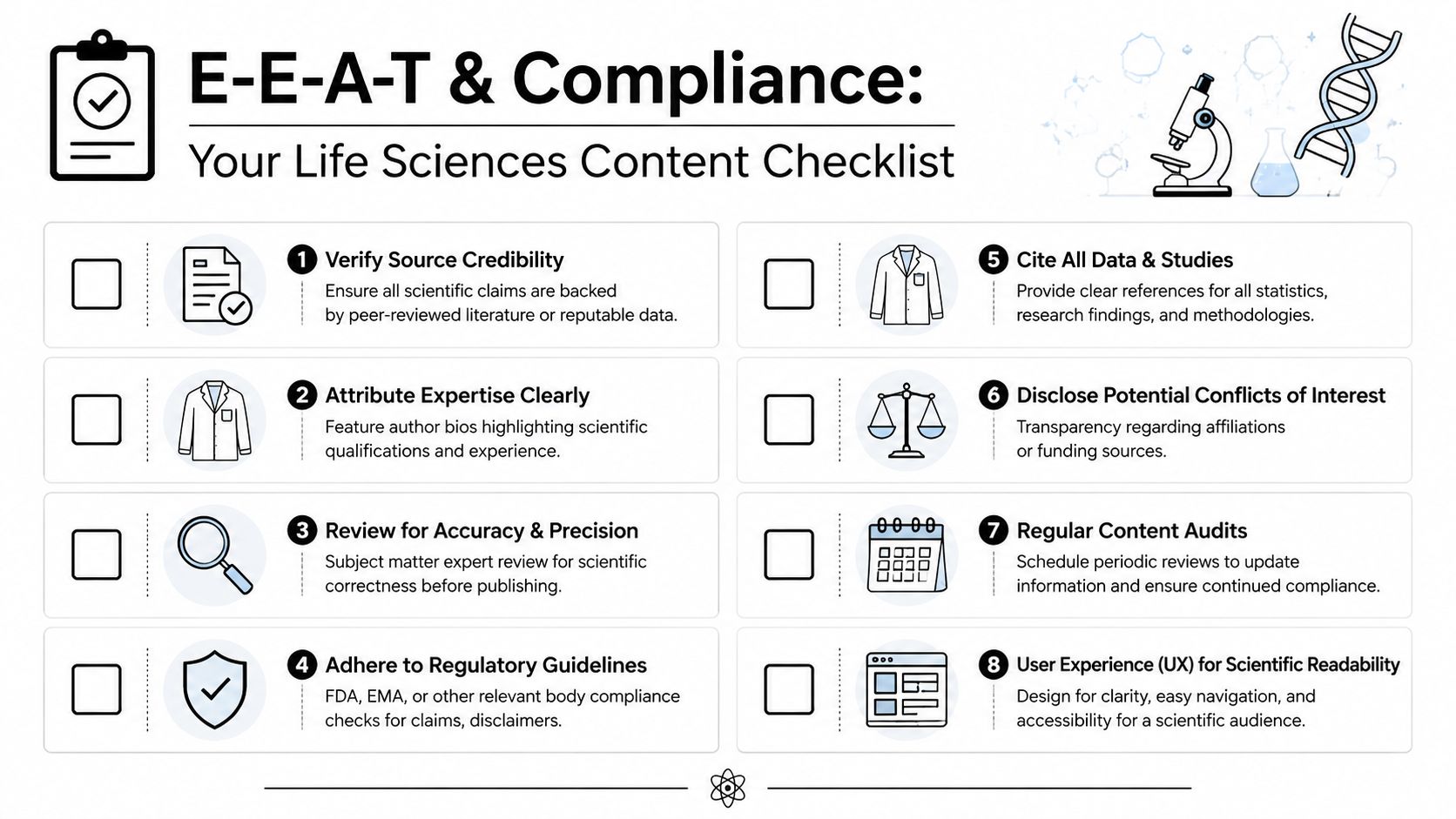
Search engines and expert readers both reward pages that reduce ambiguity. In regulated sectors, that means content needs traceable claims, qualified authorship, visible review discipline, and a clear separation between education and promotion. Teams that treat compliance as an obstacle often strip out the details that make content useful. Teams that treat compliance as editorial discipline usually publish pages that feel more credible and rank more sustainably.
Why compliance improves SEO instead of limiting it
Careful review forces better habits. It makes teams define what the page can claim, what it can reference, and what level of certainty is justified. That tends to produce cleaner positioning and stronger trust signals.
A practical life sciences SEO workflow is to run a technical audit first, then build a keyword map, optimize existing pages, earn authoritative backlinks, and track rankings and conversions weekly. The same guidance notes that most companies see initial ranking improvements in 3-4 months, while meaningful traffic and lead growth usually takes 6-12 months, based on this life science SEO guide. That timeline matters because compliant content usually takes longer to produce, but it also tends to hold value longer once published.
How to structure compliant scientific content
Instead of asking whether a page is promotional, ask whether each section has a justified role.
A reliable page structure often looks like this:
- Opening summary: Define the scientific topic or use case in neutral language.
- Evidence layer: Support claims with references, data context, or methodological explanation where appropriate.
- Practical interpretation: Explain what the information means for a buyer, researcher, or clinician without overstating conclusions.
- Commercial transition: Introduce relevant products or services only after the educational context is established.
- Disclosure and authorship: Make clear who wrote or reviewed the piece and why they're qualified.
For teams that need a model for turning dense evidence into useful, accessible educational material, examples of distilling medical research into guides can help clarify the editorial standard. The point isn't to imitate the format. It's to recognize how structure, sourcing, and restraint improve readability without weakening scientific integrity.
A compliant page can still persuade. It just persuades by being precise, attributable, and useful before it sells anything.
A few content decisions matter more than most:
| Decision point | Strong approach | Weak approach |
|---|---|---|
| Claim language | Narrow, supportable, contextual | Broad, absolute, inflated |
| Authorship | Named expert or reviewed contributor | Anonymous brand voice |
| Sources | Clearly referenced and current | Unattributed assertions |
| Calls to action | Matched to page intent | Product push on every page |
Where press release SEO fits
Many life sciences strategies leave value on the table. Press releases are often treated as separate from SEO, even though they can support authority, entity recognition, link earning, and topic reinforcement when used carefully.
The key is to stop using releases as keyword stuffing vehicles. In regulated industries, that backfires. A useful release should announce something real, such as published data, a partnership, a conference presentation, a clinical milestone, or a leadership appointment with clear relevance to the market. The SEO value comes from alignment and distribution, not repetition.
For healthcare teams building that workflow, healthcare PR guidance can help clarify how announcement strategy intersects with compliance, media relevance, and discoverability. A release should strengthen the authority of the site and the topic cluster around it. It shouldn't duplicate a landing page or make unsupported product claims.
When handled well, press release SEO does something standard content often can't. It creates a time-based signal of legitimacy around company activity, then supports evergreen pages with fresh context and external references.
Building Authority with Technical SEO and Strategic Outreach
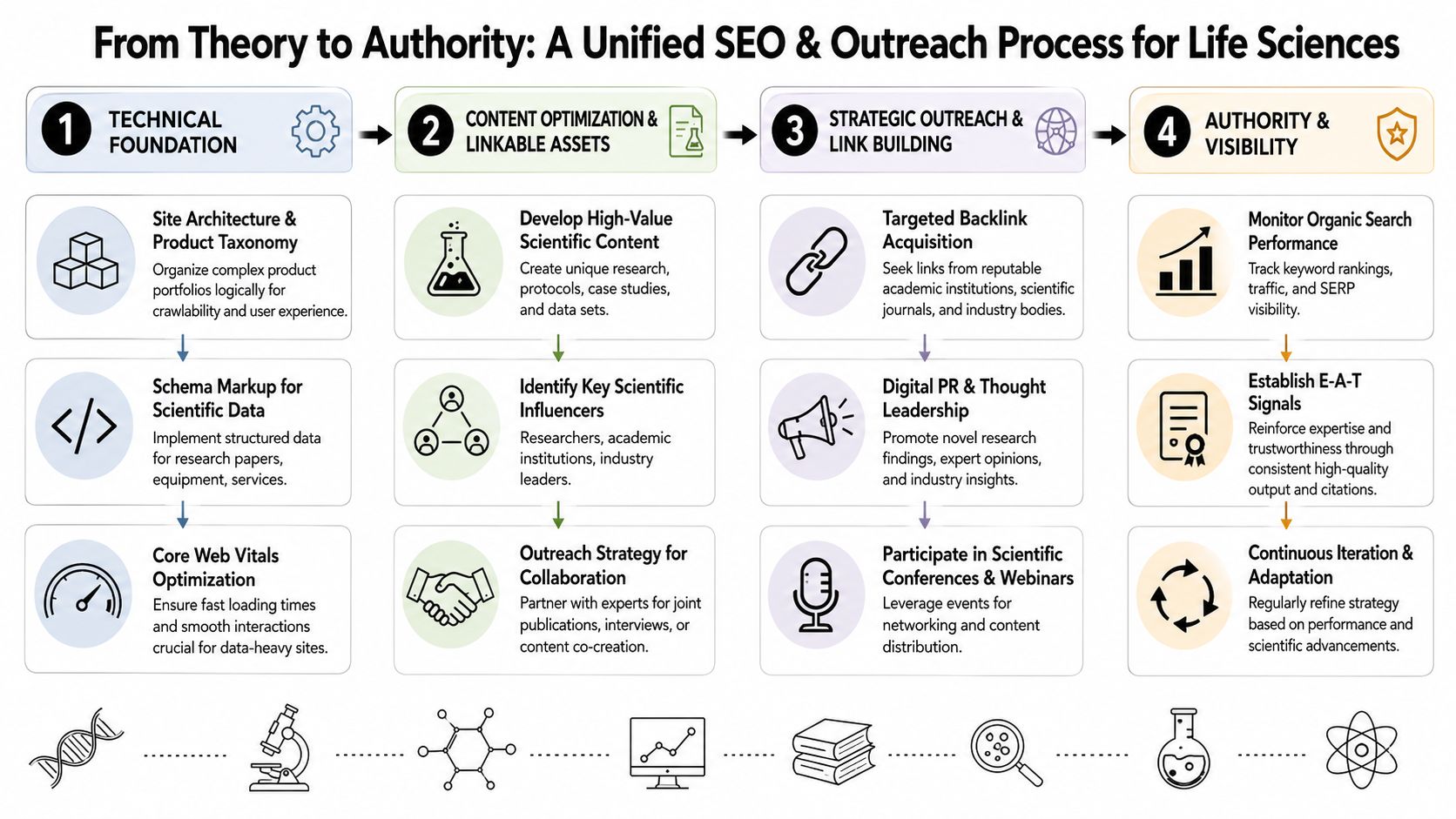
Authority in life sciences isn't built by content alone. It comes from the interaction between site structure, explicit search signals, and outside validation. A good article on a weak website still struggles. A technically strong website with no external credibility also stalls. The durable gains usually come when technical SEO and outreach reinforce each other.
Technical authority starts with architecture
Life sciences sites often grow unevenly. Product lines expand. acquisitions happen. resource centers multiply. The result is a taxonomy that makes internal sense but weak search sense. Search engines need a clean path from broad category to specific application, technology, indication, or asset type.
That usually means fixing:
- Fragmented navigation: Technical documents, solutions, and product content shouldn't live in disconnected silos.
- Weak internal linking: Related assets need editorial links, not just menu placement.
- Unclear canonical targets: Multiple near-duplicate pages can dilute signals.
- Heavy files with thin summaries: PDFs may hold valuable information, but web-native pages should carry the core context.
Schema also matters here. When sites publish scientific articles, datasets, event content, or research-oriented resources, structured data helps search engines understand what the asset is. That doesn't guarantee visibility, but it improves interpretability, especially on technical sites with specialized terminology.
Press release SEO as an authority layer
Press releases deserve a defined role inside life sciences SEO, not a side budget with vague awareness goals. Used well, they support three jobs at once: they document meaningful company activity, create external pathways back to core pages, and help establish authority around topics the brand wants to own.
A practical release program usually follows this sequence:
- Choose announcement types that deserve visibility. Published findings, partnerships, trial milestones, funding announcements, executive hires, and conference news tend to work better than generic company updates.
- Attach the release to a destination page. That might be a study summary, product page, data resource, or company news hub.
- Write for both compliance and pickup. The headline needs clarity. The body needs context. Claims need restraint.
- Support outreach with publication targeting. Distribution works better when paired with relevant journalist and trade publication lists.
For biotech communications teams planning that publication layer, curated resources covering biotechnology publications and journalists can help shape more targeted outreach rather than relying only on broad wire exposure.
The release itself isn't the strategy. The strategy is using credible announcements to strengthen the pages and topics that matter most.
How GEO changes authority strategy
AI visibility adds a newer constraint. Recent 2025-2026 industry analysis indicates that AI models prioritize citation-worthy content from sources like PubMed and Nature over traditional Google rankings, and one study found that 70% of AI responses omit brands that lack direct academic citations for their claims. That observation appears in the verified industry analysis provided in the brief.
The practical takeaway is that authority now needs two forms of proof:
| Visibility channel | What it tends to reward |
|---|---|
| Traditional search | Relevance, technical accessibility, page quality, link authority |
| AI-generated answers | Clear claims, citation-worthiness, source traceability, topical authority |
That changes content planning. A company page can be well optimized for traditional search and still be absent from AI-generated answers if its key assertions aren't anchored to credible, citable sources. Press release SEO can help here too, but only when releases connect to substantive assets and credible evidence. Announcements without source depth don't usually improve citation readiness.
Measuring SEO Impact and Avoiding Common Pitfalls
A life sciences SEO program can look healthy in a ranking report and still disappoint the business. The pattern is common. Organic traffic rises, sales says lead quality looks mixed, medical or regulatory reviewers are frustrated by revision volume, and leadership still cannot see how search supports revenue.
That gap usually comes from measurement design, not channel failure.
What to measure when the sales cycle is long
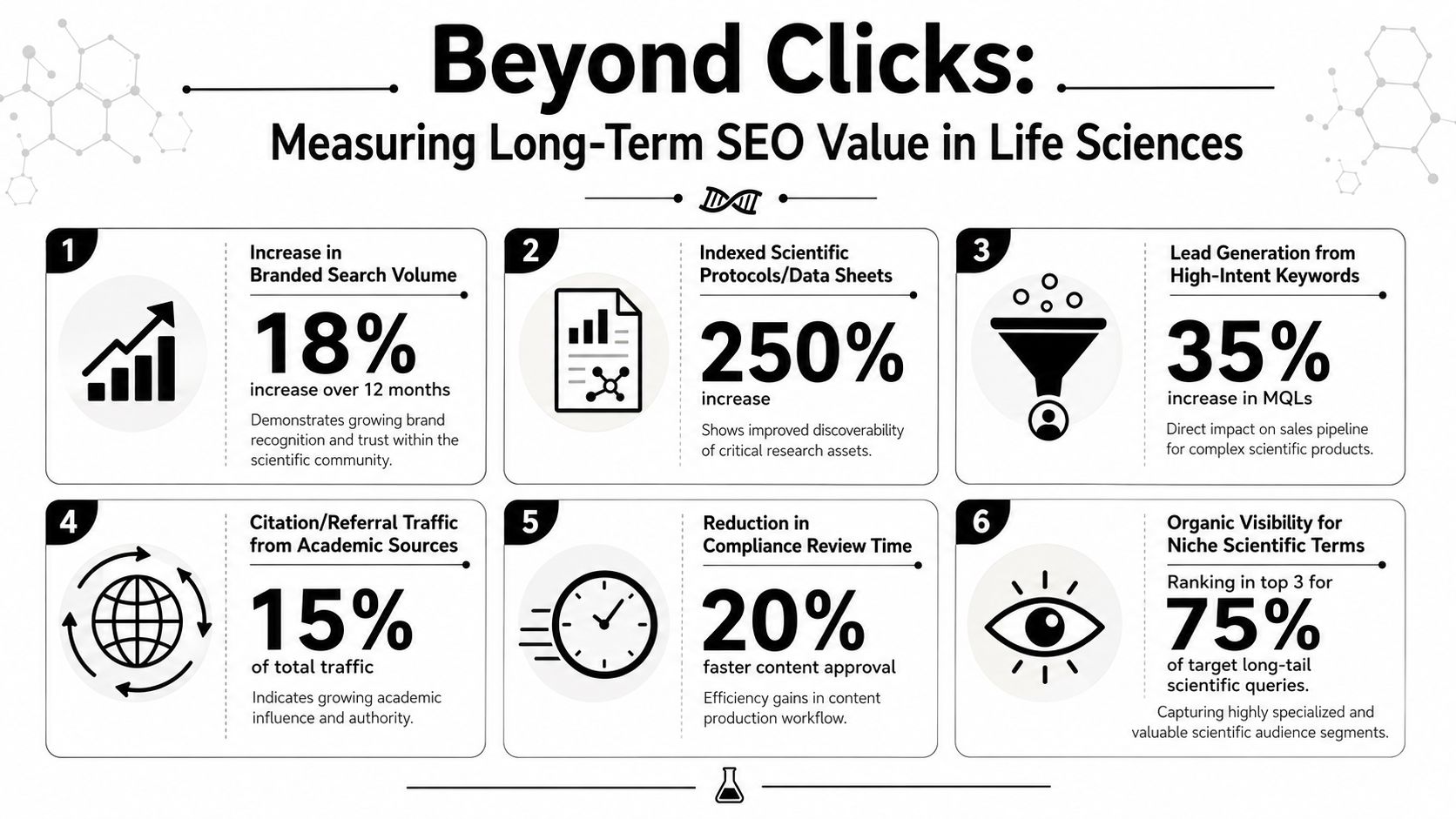
Life sciences buyers rarely convert in one session. A scientist may discover a methods page through search, return later for a protocol, share it internally, and only contact sales after procurement, legal, or clinical stakeholders have weighed in. That makes last-click reporting too narrow for this category.
Ranking still matters. Search visibility is concentrated, and a life sciences SEO analysis from Pivotal Scientific notes that 75% of searchers do not go past page one, while one case study in the same analysis reported a 435% traffic increase and a tripling of inbound leads after a structured SEO program (Pivotal Scientific). The practical takeaway is simple. Track rankings as an early signal, but do not present them as the outcome.
A better scorecard ties discovery to commercial relevance:
- Qualified organic conversions: Demo requests, contact forms, distributor inquiries, sample requests, or trial signups from pages tied to real product or service demand.
- Scientific asset engagement: Protocol views, technical document downloads, webinar registrations, calculator use, and time spent on high-intent resource pages.
- Topic ownership: Whether priority pages gain visibility for the exact assay, platform, indication, instrumentation, or therapeutic-area terms the business wants to own.
- Institutional lead quality: Which companies, hospitals, universities, CROs, or research groups enter through organic search.
- Assisted pipeline influence: Whether organic landing pages appear early in journeys that later convert through sales outreach, events, partners, or direct traffic.
I usually separate metrics into two groups. Early indicators show whether the program is gaining traction. Business indicators show whether that traction is turning into pipeline.
| Leading indicators | Lagging indicators |
|---|---|
| Indexation improvements | Sales-qualified opportunities influenced by organic |
| Ranking movement on target topics | Closed revenue tied to organic discovery |
| Growth in non-branded relevant traffic | Pipeline contribution over time |
| Engagement with scientific assets | Increased branded search and direct return visits |
That distinction matters in regulated categories because review cycles are slower and content deployment often depends on legal, medical, or quality approval. A team can make real progress months before revenue attribution catches up.
Common mistakes that stall performance
Weak performance usually comes from avoidable operating mistakes.
One is writing page copy that sounds marketable but cannot survive scientific or regulatory review. The page gets softened during approvals, key claims lose precision, and the final version ranks poorly because it no longer matches how expert audiences search. Stronger teams solve this upfront. They define claim boundaries, approved phrasing, and source requirements before drafting starts.
Another issue is treating publication as the finish line. In life sciences, content has a shelf life tied to evidence, standards, product changes, and competitive claims. If no owner revisits core pages, rankings slip and trust erodes at the same time.
Several other patterns show up often:
- Letting PDFs carry the message: If product detail, validation data, or application guidance lives only in downloadable files, search engines and users get a thinner view of the topic.
- Using press releases as isolated announcements: Releases work best when they support core pages, reinforce priority topics, and send users to substantive assets. A practical framework for using press releases for SEO helps teams connect announcements to long-term authority building rather than short news spikes.
- Reporting raw traffic without qualification: More visits do not help if the audience is off-target or the content attracts students, job seekers, or irrelevant geographies.
- Expecting paid-media speed from organic search: Search compounds over time, especially in categories where trust, citation quality, and review workflows affect how fast content can ship.
Press release SEO deserves more attention here than it usually gets. In life sciences, a release can do more than announce a funding round, study milestone, product launch, or partnership. It can create a credible, indexable signal that supports entity recognition, strengthens branded search, earns industry coverage, and points users toward deeper scientific pages. That only works when the release is tied to evidence, aligned with approved claims, and connected to the site architecture that matters.
How to report results to leadership
Leadership teams respond to business framing. A page moving from position 11 to position 5 means more when the team explains that the page covers a priority assay category, supports a high-margin service line, or captures discovery-stage demand from biopharma accounts the company already targets.
Use plain reporting language:
- What topic gained visibility
- Why that topic matters commercially
- Which audience segment it attracts
- What users did after landing
- Whether the page influenced qualified opportunities or partner interest
For programs that use announcements as part of the authority mix, include release-driven outcomes in the same report. Show whether a release supported branded search growth, referral visits to scientific content, earned mentions, or improved visibility for adjacent topic clusters. That creates a more accurate picture of how authority is built in this field. Search performance, scientific credibility, and communications strategy are often working on the same problem from different angles.
The strongest life sciences SEO programs are measured the same way they are built. With discipline, clear claim control, and evidence that the work is attracting the right audience, not just more traffic.
Press Release Zen supports communications teams that need practical help planning, writing, and distributing announcements with SEO value. For life sciences organizations balancing media visibility, search discoverability, and compliance, Press Release Zen offers guides, templates, and workflow-oriented resources that can fit alongside a broader authority-building strategy.