A lot of founders reach the same frustrating point. The line sheet looks sharp, the product photography is clean, the Instagram grid is polished, and friends keep saying the brand “looks ready.” Yet editors aren't replying, stylists aren't requesting samples, and every launch feels quieter than it should.
That gap is usually not a product problem. It's a communications problem. A good fashion PR company helps a brand move from being aesthetically credible to being editorially relevant. That means sharper angles, better timing, tighter media handling, cleaner sample logistics, and a story that people outside the brand can repeat.
Most brands don't need more random outreach. They need a partner that understands how fashion attention is built across seasons, launches, market appointments, press moments, founder visibility, influencer touchpoints, and earned media. They also need a process for choosing that partner without getting trapped in vague promises or expensive confusion.
Table of Contents
- Why Your Brand Needs Strategic PR
- Define Your Goals and Budget Before You Search
- How to Find and Shortlist Potential Agencies
- The Vetting Process Questions to Ask and Red Flags to Watch
- Making the Hire Contracts Onboarding and the Creative Brief
- Managing the Relationship and Measuring Success
Why Your Brand Needs Strategic PR
Fashion is crowded, fast-moving, and reputation-driven. Before COVID-19, the global fashion industry was estimated at between $1.7 trillion and $2.5 trillion, and Louis Vuitton ranked as the best-performing fashion brand globally with a brand value of $47.2 billion, according to FashionUnited's global fashion industry statistics. In a market that large, visibility isn't a nice extra. It's part of how brands compete.
A fashion PR company earns its place by creating that visibility in places brand-owned channels can't fully control. Editorial coverage, stylist familiarity, influencer trust, founder positioning, showroom pull, and event relevance all sit in that lane. Paid media can buy reach. PR helps build meaning.
Brands often underestimate how much modern PR now overlaps with content operations. If the internal team is producing campaigns, founder clips, backstage footage, and product storytelling, those assets need to support earned media too. Teams that need help tightening short-form assets can borrow from broader strategies for video content success, especially when they want campaign visuals to work across social, press follow-up, and creator seeding.
Practical rule: A strong collection without a strong narrative usually gets admired privately and ignored publicly.
That's why hiring shouldn't start with “Which agency has a nice website?” It should start with “What business outcome needs PR support, and what kind of partner can create momentum around it?” Founders who need a baseline on the mechanics of industry communications can also review this overview of public relation in fashion before starting agency conversations.
Define Your Goals and Budget Before You Search
A founder who says “we want press” is giving an agency almost nothing useful. A founder who says “we need editorial credibility in specific titles, regular sample requests, and a founder profile tied to our sustainability position” is giving an agency something it can build against.
Start there.
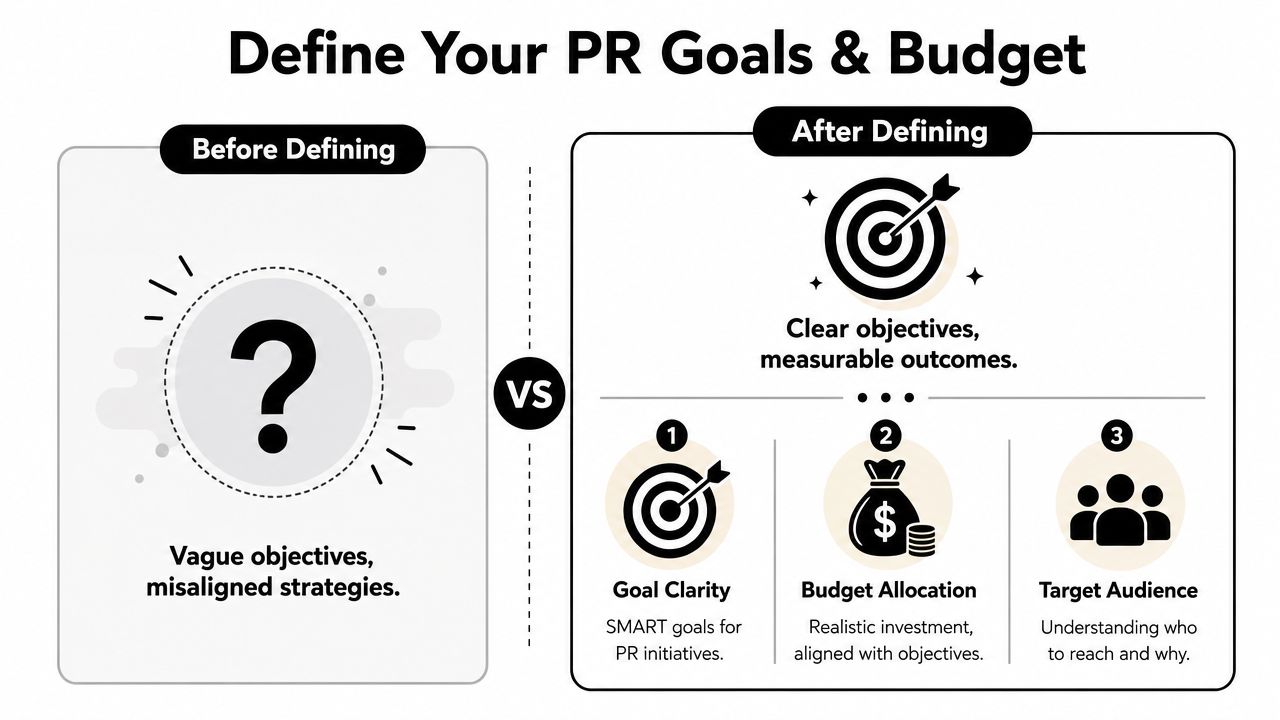
Turn vague hopes into operating goals
Good PR goals have three traits. They are specific, tied to a business priority, and realistic for the brand's stage.
A pre-launch label needs different outputs than an established contemporary brand. One may need brand introduction and selective editor awareness. The other may need a campaign rollout, event attendance, and consistent placements around key drops.
Use this founder checklist before contacting any agency:
- Brand objective: Is PR supposed to support launch, wholesale conversations, direct-to-consumer growth, fundraising credibility, founder profile, or retailer confidence?
- Priority audience: Are the key audiences editors, stylists, creators, buyers, customers, or investors?
- Story angle: What's the clearest reason this brand matters now?
- Seasonal triggers: Which moments matter most, such as fashion week, a collaboration, store opening, capsule, or awards dressing?
- Internal capacity: Who will approve quotes, provide samples, confirm inventory, and turn around requests quickly?
The easiest way to waste a PR retainer is to hire before the brand can answer basic operational questions.
Choose a pricing structure you can actually manage
Pricing matters, but structure matters more. The wrong structure creates friction even when the agency is competent.
| Fashion PR Company Pricing Models (2026 Benchmarks) | Typical Cost Range (USD/month) | Best For |
|---|---|---|
| Monthly retainer | Varies by agency scope and market | Brands needing ongoing media relations, sample trafficking, launch support, and steady counsel |
| Project-based engagement | Varies by campaign complexity | Single launches, fashion week support, a collaboration, or a store opening |
| Hybrid model | Varies based on base retainer plus project work | Brands with always-on needs plus occasional high-intensity moments |
Because no verified benchmark numbers are available here, the safest approach is qualitative. Retainers usually make sense when the brand has a year-round calendar and enough internal responsiveness to feed the agency. Project fees work when there's a discrete milestone. Hybrid agreements fit brands that need continuity but don't want every month staffed at the same intensity.
A budgeting worksheet should include:
- Agency fee
- Sample messenger and shipping costs
- Event production support if needed
- Photography or lookbook production
- Influencer gifting logistics
- Press release drafting or distribution
- Contingency for rush requests
If a founder can't explain what the budget is meant to buy, the agency conversation will drift. Clear goals keep everyone honest.
How to Find and Shortlist Potential Agencies
Most founders search badly. They either ask a friend for one referral and stop there, or they collect a random list of agencies with glossy websites and no fit discipline. A better search looks more like intelligence gathering.
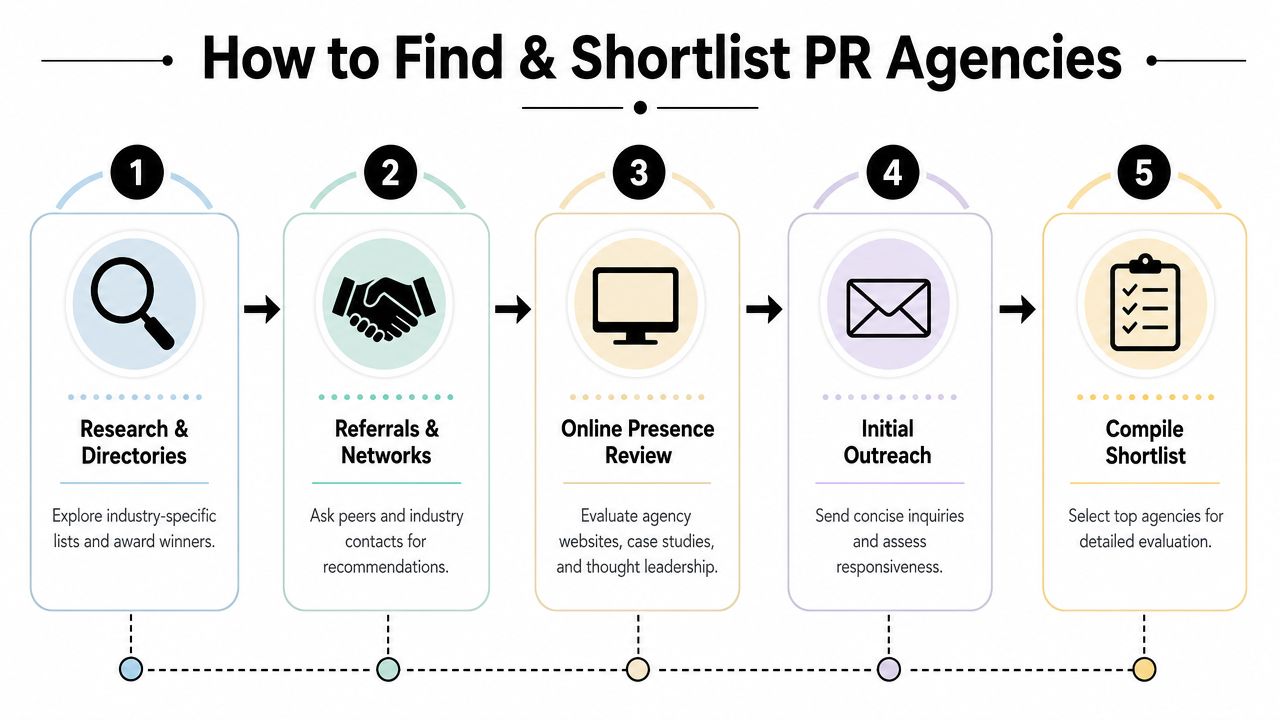
Where strong candidates usually surface
Build a longlist from several channels, then cut it down.
- Competitor mapping: Look at brands with similar price point, design language, distribution stage, or customer profile. Review their press mentions, launch patterns, and event presence. Agencies often appear in release materials, credits, or professional profiles.
- Industry directories and networks: Trade groups, communications organizations, and fashion business communities often surface firms with sector concentration.
- LinkedIn searches: Search terms like “fashion PR,” “beauty and fashion communications,” “VIP and celebrity relations,” or “sample trafficking” will quickly show whether an agency's team has relevant depth.
- Editorial pattern review: If an agency claims strength in fashion media, check whether its clients appear in the types of outlets the brand wants, not just generic lifestyle lists.
- Peer referrals: Ask showroom partners, photographers, stylists, production contacts, and founders at a similar stage. These people often know who delivers and who overpromises.
A shortlist should usually include a mix of boutique and midsize options. Boutique firms may offer tighter attention. Larger firms may offer broader infrastructure. Neither is automatically better.
Outreach template for first contact
The first email should be brief, direct, and easy to answer.
Subject: PR support inquiry for [Brand Name]
Hello [Agency Contact],
[Brand Name] is a [brief brand descriptor] preparing for [launch, collection drop, retail opening, collaboration, or seasonal push]. The brand is looking for PR support focused on [media relations, sample management, founder visibility, influencer outreach, event support, or a combination].
A few details:
- Brand category: [ready-to-wear, accessories, jewelry, footwear, fashion tech]
- Price point: [brief description]
- Core audience: [brief description]
- Timing: [month or season]
- Main objective: [brief description]
Please share whether the agency is taking new clients, what services would be most relevant, and what the engagement structure typically looks like. Relevant experience with similar brands would be helpful as well.
Thank you,
[Name]
[Role]
[Website / Instagram if relevant]
What should a founder assess from the reply? Speed, clarity, fit, and whether the agency answers the actual question. If the response is vague at the first touch, it rarely becomes sharper after the invoice is signed.
The Vetting Process Questions to Ask and Red Flags to Watch
The interview phase is where bad hires can still be avoided. A polished deck can hide weak execution. A confident founder call can hide a junior team. A famous client list can hide the fact that the agency's current attention is somewhere else.
Real fashion PR is not random outreach. It's recurring operational work tied to the fashion calendar. According to Factory PR's explanation of what a fashion PR agency does, the function includes season-based campaign planning around runway shows, press days, store openings, and awards season, plus press showrooms, sample circulation, lookbooks, and ongoing media and influencer relationships. That description is useful because it gives founders a concrete standard for what the agency should be able to discuss.
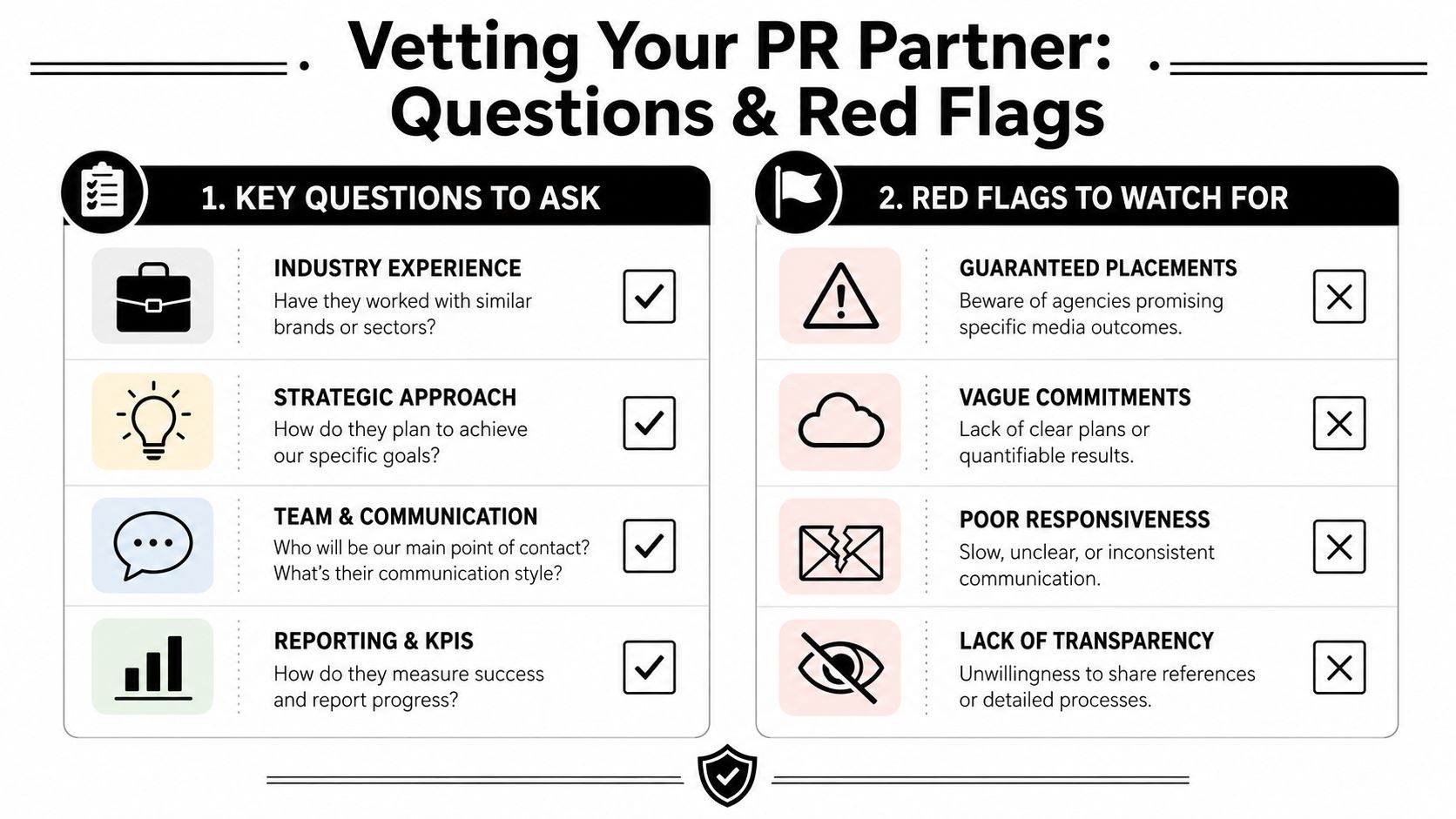
Questions that reveal how the agency really works
Don't ask only “Who have you worked with?” Ask how they operate.
Experience and fit
- Which brands in our category or adjacent category has the team handled? Similarity matters more than prestige.
- What kinds of editors, stylists, or creators typically respond to the agency's work? This reveals whether the agency knows its lane.
- Have they handled brands at our stage? Early-stage brands need different handling than household names.
Strategy and first steps
- What would the first ninety days look like? A serious agency can describe setup, messaging work, press asset needs, and early outreach priorities without pretending to know everything before onboarding.
- What would they need from the brand in the first two weeks? Good agencies ask for assets, access, samples, founder availability, and inventory realities.
- How would they position this brand if they had to pitch it tomorrow? This tests messaging discipline.
Operations and team structure
- Who is managing day-to-day communication? Get names, not titles.
- How do they handle sample requests, returns, and showroom tracking?
- What's their response window for fast-moving media opportunities?
Measurement
- What do they report beyond clip counts?
- How do they evaluate quality of coverage, message pull-through, and placement relevance?
- What would they consider a warning sign in the first quarter?
A smart agency won't promise universal enthusiasm. It will explain the work needed to find the right angle and the right targets.
Red flags that should slow the deal down
Some warning signs are obvious. Others are subtle.
- Guaranteed placements: No credible agency can guarantee earned coverage in specific top-tier outlets.
- One-size-fits-all proposals: If every founder gets the same package, the agency is probably selling process without strategy.
- No operational detail: A team that can't explain sample movement, approvals, asset needs, or contact flow may be weak in the work that fills the month.
- Prestige fog: Some agencies lean heavily on past logos and avoid discussing the current account team.
- Thin listening: If the agency talks more than it asks, expect generic pitching later.
- Messy communication: Sloppy follow-up during the courtship phase often becomes worse after contract signature.
A useful final question is simple: “What kind of client doesn't succeed with your team?” The answer often reveals more than the capabilities slide.
Making the Hire Contracts Onboarding and the Creative Brief
The selection is only half the decision. The handoff from “yes” to “go” determines whether the relationship starts cleanly or slides into confusion within the first month.
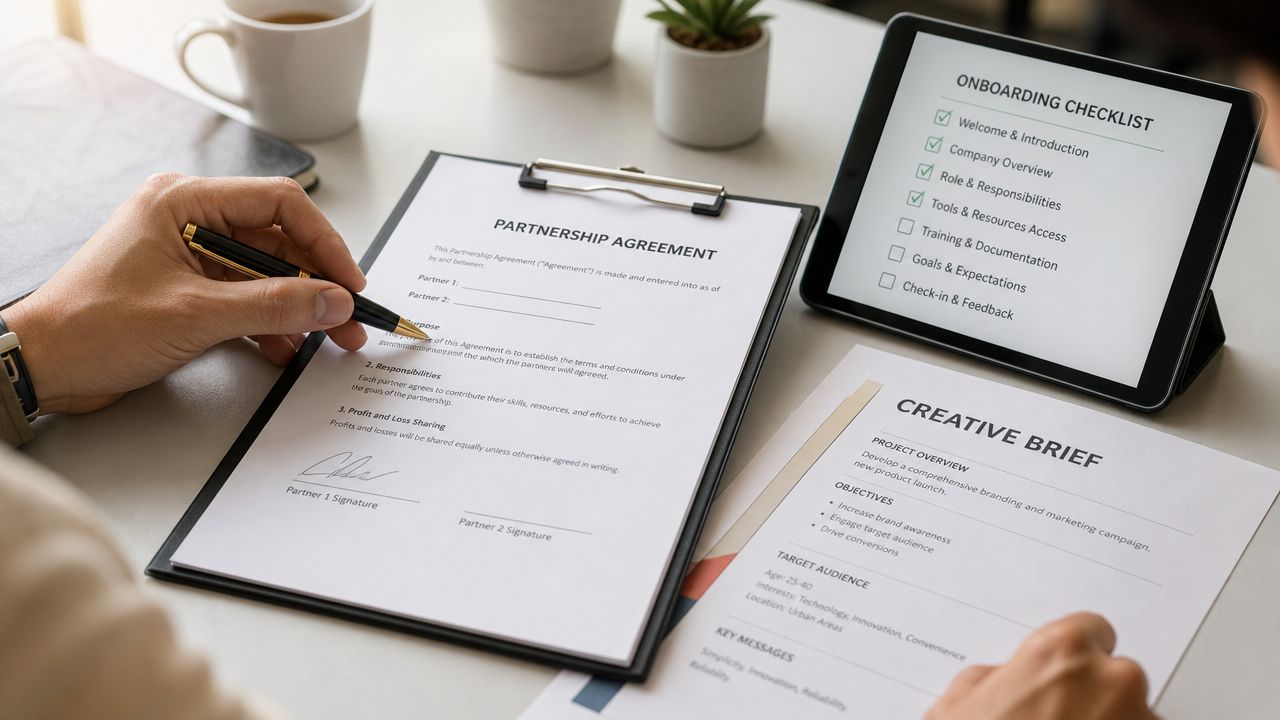
Before signing, founders should review the contract like an operator, not a fan. A fashion PR company can be excellent and still present terms that are too vague.
Contract review checklist
Use this list against the draft agreement:
- Scope of work: Does it specify services in plain language, such as media relations, influencer outreach, sample trafficking, showroom support, event coordination, press material development, or crisis support?
- Team assignment: Does it identify senior oversight and day-to-day contacts?
- Approval process: Who approves messaging, quotes, imagery, gifting, event spend, and outreach lists?
- Term and termination: How long is the initial commitment, what notice is required, and what happens to outstanding expenses?
- Expenses: Which costs are included, and which are billed separately?
- Usage of materials: Who owns press materials, copy, contact research, and creative outputs developed during the engagement?
- Confidentiality: Is the brand's commercial information protected?
- Exclusivity: Does the agency represent direct competitors?
- Reporting cadence: Weekly, biweekly, or monthly. It should be explicit.
Contract check: If “strategy,” “support,” or “outreach” appear in the agreement without a practical description of the work, ask for specificity before signing.
The onboarding pack should also include the materials a publicist needs to move quickly. For brands that don't already have a strong announcement format, this guide on how to write a killer press release for a fashion brand sample template example is a useful starting point for tightening launch materials before the agency starts pitching.
Some founders also benefit from reviewing examples of what journalists need in a usable press kit. This collection of Resources for journalists covering B2B data isn't fashion-specific, but it's a solid reminder that reporters respond better when facts, assets, and context are organized for fast use.
Creative brief template for a fashion PR company
A weak brief creates weak pitching. The agency shouldn't have to guess the story.
Use this template.
Brand overview
One paragraph on what the brand makes, who it serves, and where it sits in the market.
Founder story
Why the founder started the brand. Keep it concrete, not cinematic.
Current priority
Pick one: launch, collection release, collaboration, retail opening, awards dressing, market awareness, founder profile, or reputation recovery.
Key products or collection focus
List the pieces, categories, or hero items that matter most right now.
Audience definition
Describe the ideal customer and any secondary audiences such as editors, stylists, or buyers.
Messaging guardrails
Include the points the brand wants emphasized and the claims it wants avoided.
Proof points
Materials, craftsmanship, design process, manufacturing story, notable supporters, retail context, or cultural relevance. Keep every claim factual.
Media targets
Publications, verticals, creator categories, and geographies that make sense.
Visual assets available
Lookbook, campaign imagery, founder portraits, product cutouts, behind-the-scenes content, runway assets.
Operational details
Sample availability, shipping process, spokesperson availability, launch dates, and approval chain.
Founders who deliver this brief before kickoff usually get better work faster because the agency can spend its early energy on strategy and relationships, not archaeology.
Managing the Relationship and Measuring Success
Once the contract is live, the founder's job changes. The brand is no longer evaluating the agency from the outside. It's now co-producing results with it.
The healthiest agency relationships run on rhythm. That means a predictable call cadence, quick approvals, shared calendars, and honest internal updates. If a launch date shifts, inventory is delayed, or a founder becomes unavailable, the agency needs to know immediately. PR plans break when the client protects the wrong information.
How to be a client an agency can actually help
The most useful client behaviors are boring and operational.
- Reply quickly: Media opportunities can expire in hours, not weeks.
- Centralize approvals: One decision-maker beats three conflicting voices.
- Share commercial context: If a product is sold out or a wholesale meeting matters, the agency should know.
- Keep assets current: Outdated lookbooks and missing credits slow coverage.
- Respect editorial logic: Not every story belongs in every outlet.
An agency also needs room to tell the truth. If messaging isn't landing, if visuals are too generic, or if a product line lacks a clear hook, a competent team should say so. That's not negativity. That's the work.
What to measure instead of vanity reporting
Modern fashion PR should not be judged by clip piles alone. One industry playbook from 5WPR on turning data into fashion PR coverage recommends sorting brand data into trend signals, behavioral evidence such as cart abandonment or repeat purchase patterns, and sentiment indicators such as social reactions, reviews, and influencer engagement before building a story. It also stresses cross-checking those signals and testing personalized pitches to improve coverage quality, not just coverage volume.
That gives founders a better measurement language.
Track metrics such as:
- Outlet relevance: Did the placement appear where the target audience pays attention?
- Message pull-through: Did the coverage reflect the intended story, or did it flatten the brand into a generic mention?
- Visual inclusion: Were product images, campaign assets, or founder visuals used well?
- Placement prominence: Was the brand central to the piece or buried in a roundup?
- Referral behavior: Did earned media send meaningful traffic or inquiry signals?
- Sentiment quality: Did comments, creator responses, and customer conversations align with the intended message?
A brand that wants support on distribution mechanics alongside agency work can also review these comparisons of fashion press release distribution best services cost. That's useful when earned media outreach and formal announcement distribution need to work together rather than as separate tracks.
Coverage volume can look busy while strategy is failing. Quality, relevance, and message accuracy matter more.
The right fashion PR company won't just chase attention. It will help the brand earn the right kind of attention, at the right times, with the right story discipline behind it.
Press Release Zen offers practical support for teams handling fashion communications in-house or alongside an agency. Its guides, templates, and distribution resources can help brands tighten release writing, structure media materials, and manage announcement workflows with less guesswork.