Beyond the send, the hard part starts. A press release goes out, coverage lands in places the team expected and places it didn't, and then someone asks for a clean report by tomorrow morning. That report usually needs more than links. It needs context, clips, licensed content, alerting, and a format that leadership or clients can effectively use.
Press clippings services exist to solve that problem, but the category has changed a lot. What began as manual press clipping in print newspapers has been around since 1852, when a Polish newsagent in London established the first formal service. The industry later expanded beyond print in the 1960s, when agencies began using audio and video recorders to monitor radio and television broadcasts. Today, teams expect cloud delivery, automation, and easier reporting because AI adoption has become common across business workflows, including customer service and digital assistants.
That shift matters because most PR teams aren't choosing a tool based on features alone. They're choosing based on job to be done. Some need US broadcast clips fast. Some need licensed print access for legal redistribution. Some want one stack for monitoring, outreach, and distribution. Others just need dependable coverage reports without enterprise overhead. For broader PR and digital marketing insights, it helps to see monitoring as part of the full earned media system, not a separate task.
Table of Contents
- 1. Onclusive
- 2. Meltwater
- 3. Cision
- 4. Muck Rack
- 5. Talkwalker
- 6. Agility PR Solutions
- 7. LexisNexis Nexis Newsdesk
- 8. Metro Monitor
- 9. News Exposure
- 10. Newz Group
- Top 10 Press Clippings Services Comparison
- How to Choose and Implement Your Clipping Service
1. Onclusive
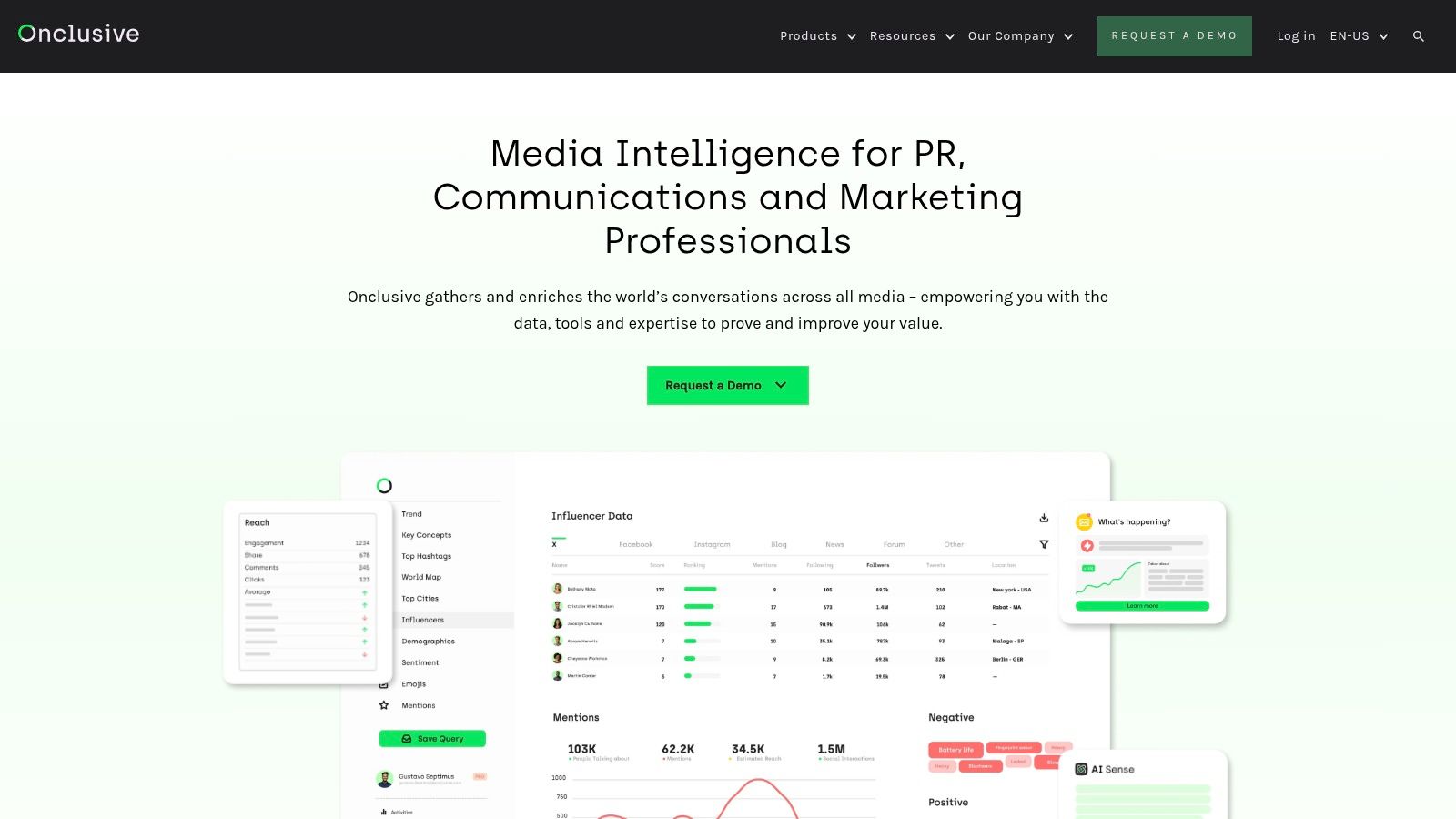
Onclusive is a strong fit when a communications team needs broad media intelligence and especially strong US broadcast monitoring. The Critical Mention piece is the differentiator. It's built for teams that can't treat TV and radio as a nice-to-have.
This is the platform category for national brands, large agencies, and public affairs teams that need online news, print access through licensed partnerships, social coverage, and clip retrieval in one environment. It's less attractive for a small organization that only needs web mentions and a weekly summary.
Best for broadcast-heavy enterprise monitoring
Critical Mention's strength sits in TV, radio, and podcast tracking, with downloadable clips and closed-caption indexing. That solves a very specific reporting problem. Leadership rarely wants to hear that a segment aired. They want the actual clip.
A practical reason to consider Onclusive is reporting depth across channels. Teams measuring earned media coverage and its broader role in PR performance usually need more than a count of mentions. They need alerts, dashboards, sentiment views, and share-of-voice style analysis tied to executive reporting.
Practical rule: If broadcast is mission-critical, ask the vendor to show clip retrieval, transcript search, licensing workflow, and report export in the same demo.
The trade-off is cost and packaging complexity. Pricing isn't public, and enterprise buyers need to confirm what's included in the specific package. Mention limits, social add-ons, and integration access can change the economics quickly.
For teams that already know they need enterprise-scale monitoring and US broadcast depth, Onclusive is easy to shortlist. For teams that don't need broadcast, it may be more platform than they'll use.
2. Meltwater
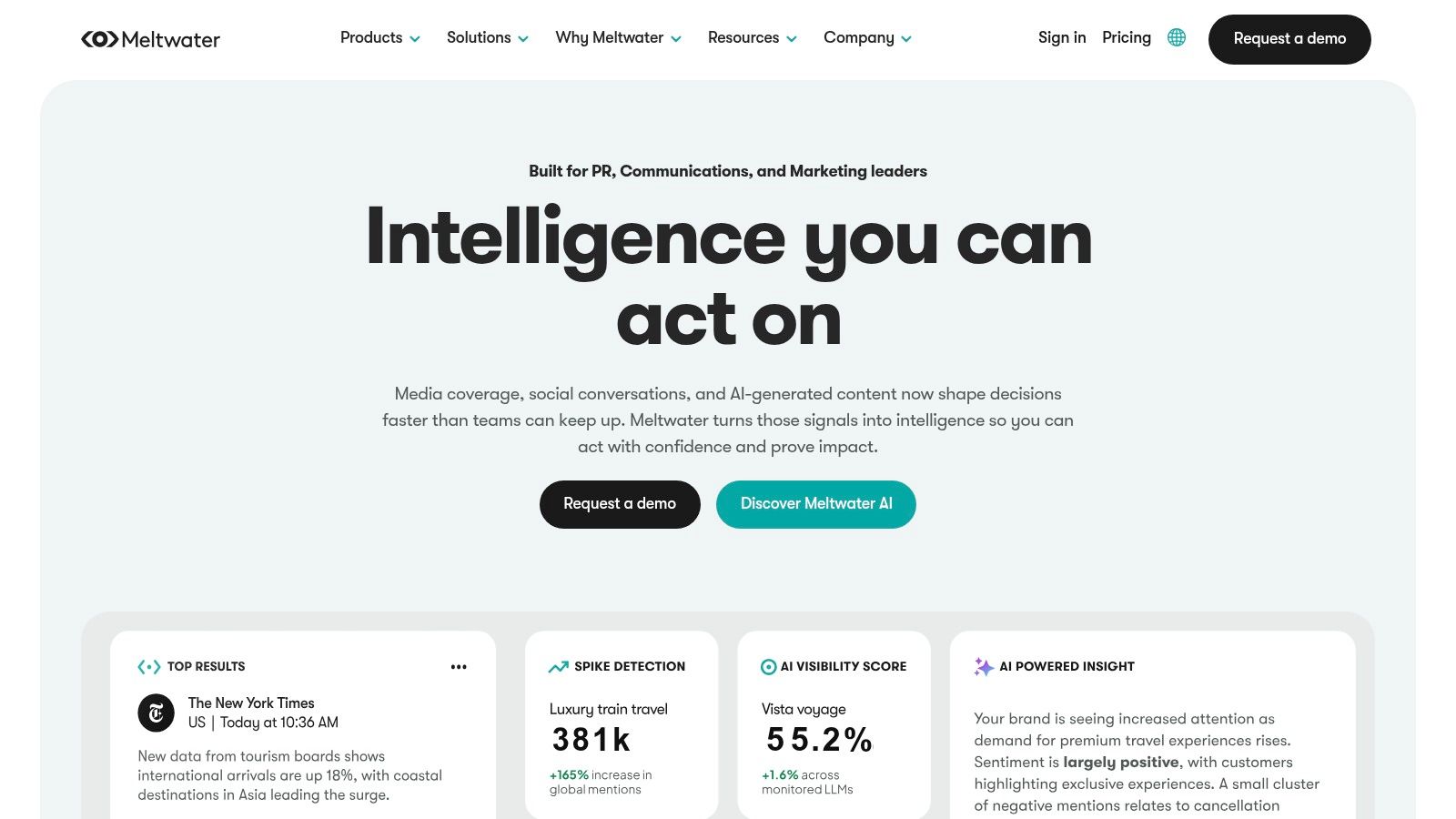
A common PR ops problem looks like this: the team tracks news mentions in one tool, social chatter in another, then spends Friday afternoon stitching screenshots and exports into one report. Meltwater is built for buyers who want to collapse that process into a single vendor.
Meltwater fits best when the job is bigger than clipping articles. It suits in-house communications teams that need to monitor earned media, watch social conversation, route alerts quickly, and turn all of that into reporting leadership will read. That makes it a stronger fit for mid-market and enterprise teams than for a small company that only needs basic web mention tracking.
Best for teams combining earned and social in one vendor
The practical appeal is operational. Meltwater gives PR teams one place to manage monitoring, social listening, dashboards, and AI-assisted summaries, which can cut down vendor sprawl and shorten reporting cycles. If your stakeholders care about both press coverage and public reaction, that alignment matters.
The trade-off is configuration. All-in-one platforms only work well when search queries, source sets, regions, and dashboards are set up carefully. If they are not, the team gets more data but not better signal.
A useful buying test is to run one real campaign through the demo and pressure-test four areas:
- Brand ambiguity: Can it separate your company from unrelated mentions with the same name?
- Cross-channel context: Can the team see whether a news spike also triggered social discussion, or are those views still disconnected?
- Regional filtering: Can users cleanly segment by market, language, or business unit without building messy workarounds?
- Executive output: Can the platform produce a board-ready report, or will someone still need to rebuild everything in slides?
For teams focused on press release measurement and campaign reporting, Meltwater can work well as the day-to-day reporting hub. Teams that are also comparing it against larger PR suites should review how Cision's feature set and pricing differ in practice, especially if outreach and distribution may become part of the buying decision later.
My advice is simple. Choose Meltwater when the main objective is to connect earned and social monitoring under one team workflow. Skip the extra modules if you only need straightforward digital clipping, because that added scope can raise both cost and setup time without improving results.
3. Cision
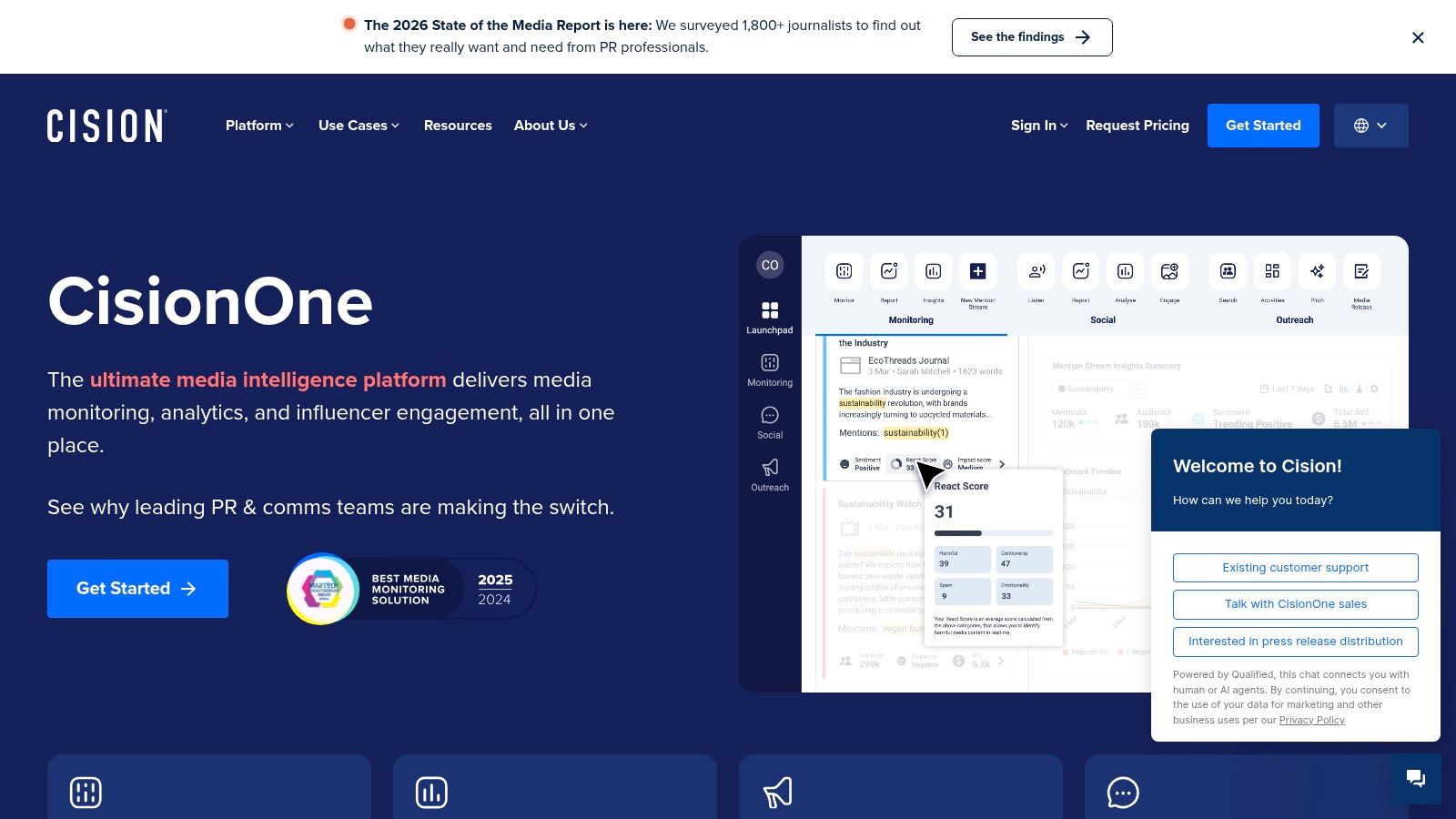
Cision makes the most sense when monitoring can't be separated from outreach and distribution. That's its core value proposition. CisionOne, the media database, and PR Newswire can give a large team one connected stack from send to pickup to reporting.
This matters for enterprise PR departments that want fewer vendors and cleaner internal process. If the same platform handles journalist discovery, outreach, distribution, and coverage monitoring, reporting tends to be easier to standardize across teams.
Best for integrated monitoring, outreach, and distribution
Cision is built for scale. It supports broad international monitoring, licensed and paywalled source access through partnerships, social listening options, and APIs for organizations that want data to move into other systems. For a large communications operation, that can reduce workflow sprawl.
The strongest reason to choose Cision is orchestration. A team can distribute through PR Newswire, monitor resulting coverage, tie it back to contacts and campaigns, and roll that into enterprise reporting. That won't matter to every buyer, but it matters a lot to teams that live inside one communications system all day.
The best Cision demo uses a real press release, a real media list, and a real reporting request from leadership.
The caution is straightforward. Buyers need to test search precision and output quality with their own queries, not canned examples. Teams also need to be honest about whether they'll use the full ecosystem or just pay for it.
For buyers weighing platform depth against budget, a focused review of Cision's features, pricing context, and alternatives becomes useful. Cision is a strong answer for complex workflow integration. It's not always the best answer for simplicity.
4. Muck Rack
Muck Rack is often the easiest press clippings service to like quickly. The interface is modern, the journalist database is central to the product, and the workflow suits lean PR teams that need to move fast without a lot of internal training.
That combination makes it especially appealing to startups, mid-sized brands, and agencies that need outreach and monitoring in one place but don't want a heavy enterprise feel. The platform tends to fit teams that care as much about usability as raw source breadth.
Best for lean PR teams that want modern workflow speed
Muck Rack's biggest practical strength is operational efficiency. Monitoring, pitching, journalist research, alerts, and reporting can live in the same environment. For a small communications team, that's often better than stitching together separate tools.
It's also relevant to a common reporting pain point in the category. PR professionals have publicly discussed how some clipping platforms produce reports that still need manual reformatting to meet client expectations, leaving agencies to clean up exports after paying for the software. That frustration shows up in active industry discussion around how PR teams are handling press clipping and reporting workflows.
Muck Rack helps when the team values speed and cleaner daily use, but buyers still need to confirm the details around broadcast and social depth because those can depend on add-ons.
A short evaluation should focus on three things:
- Journalist workflow: Does the database reduce prospecting time?
- Coverage reporting: Can account teams send polished reports without spreadsheet surgery?
- Monitoring fit: Does the source mix match the organization's channels, especially if broadcast matters?
For teams with straightforward PR operations, Muck Rack often feels more usable than bigger suites. For buyers needing deep licensed print archives or heavy governance controls, it may not be the first choice.
5. Talkwalker
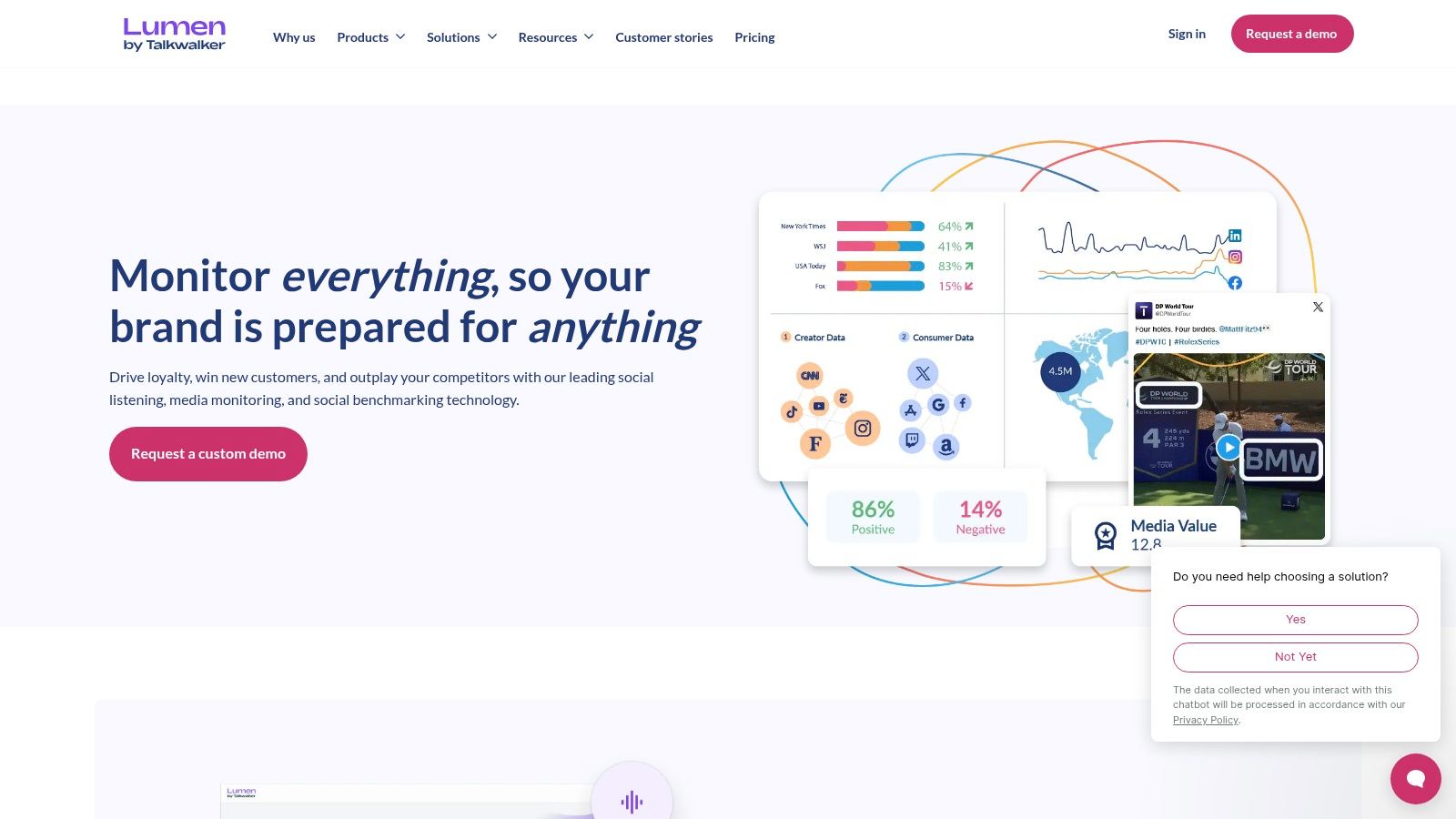
Talkwalker belongs on the shortlist when leadership expects analytics-heavy reporting, market comparison, and strong social intelligence alongside news monitoring. It's a better fit for brand intelligence than basic clipping.
This is the kind of platform that earns its place when a global brand team needs benchmarking, crisis views, sentiment tracking, and executive dashboards that look polished without extra design work. Teams that won't use advanced analytics usually end up underusing it.
Best for analytics-first global brand teams
Talkwalker's strength is interpretation. It's built to help teams understand coverage patterns, reputation movement, and competitive context rather than just collect mentions. That's especially useful in multi-market environments where volume alone isn't a meaningful KPI.
Its visualizations are usually the deciding factor in internal buy-in. Communications leaders often need reports that can go straight into board decks or cross-functional briefings. A platform that reduces manual chart building can save real time even if the subscription itself is substantial.
Field note: Advanced analytics only pay off when one person owns taxonomy, dashboards, and reporting standards.
The downside is weight. Talkwalker is a serious platform and usually priced accordingly. It's best for teams with enough scale to make use of its insight depth, not for organizations looking for the simplest way to gather links and clips.
A practical buying question is whether the team needs a media monitoring tool or a brand intelligence platform. If the answer includes crisis monitoring, competitor benchmarking, and cross-market analysis, Talkwalker is usually the stronger match.
6. Agility PR Solutions
Agility PR Solutions is a practical option for teams that want a broad PR platform without defaulting to the biggest enterprise vendors. Monitoring, media database access, outreach, and reporting all sit under one roof, and managed intelligence services are available for organizations that need more support.
That last point matters. Some teams don't just need software. They need briefings, analysis, or hands-on help making sense of what coverage means.
Best for teams that want value plus optional human support
Agility sits in a useful middle ground. It can serve self-serve teams, but it also supports organizations that want more curated outputs. That makes it attractive for smaller communications departments, public sector teams, and agencies that need flexibility in service level.
Its positioning also aligns with the long arc of the category. Media monitoring started as manual clipping and then expanded into broadcast and digital channels, as noted earlier. Agility's own historical overview of the industry reflects that shift from pure clipping to a wider monitoring and analysis function.
Two things make Agility worth a close look:
- Managed support: Daily briefings and analyst services can reduce internal workload.
- Broader PR utility: Monitoring and outreach can stay in one platform instead of being split.
The caution is standard but important. Buyers should verify exact source coverage, licensing terms, and report outputs during the sales process rather than assuming parity with larger vendors.
For teams that need press clippings services plus some human backup, Agility can be a strong operational compromise. It won't always match the deepest enterprise analytics stack, but it often matches the way real teams work.
7. LexisNexis Nexis Newsdesk
LexisNexis Nexis Newsdesk is the option to examine when licensed content access, archival depth, and governance matter as much as convenience. This is not just about monitoring. It's about compliant use of media content.
That distinction is easy to overlook until a team needs to redistribute articles internally, maintain historical records, or work under stricter legal and procurement standards. Then it becomes central.
Best for licensed content and governance-heavy organizations
A recurring problem in the press clippings services market is that many guides don't explain how smaller organizations can aggregate media coverage legally and affordably. One important point often missed is that media monitoring companies must hold authorizations from newspaper editors to incorporate articles into dossiers, a compliance issue highlighted in this explainer on what a press clipping is and how clipping services work.
That's where Nexis Newsdesk stands out. It's a strong fit for regulated industries, government teams, universities, and enterprise organizations that need confidence around licensed access and historical search depth. It's less about flashy UX and more about defensibility.
A buyer should prioritize Newsdesk when these needs are present:
- Licensed redistribution: Internal sharing has to be compliant.
- Archive depth: Historical coverage matters, not just current alerts.
- Governance: Procurement, legal, and IT need a vendor that fits enterprise controls.
The trade-off is clear. This kind of platform tends to be premium and can feel heavier than mid-market tools. But if copyright, archives, and documented source access are core requirements, cheaper alternatives can become false economies quickly.
8. Metro Monitor
Metro Monitor solves a narrower problem than the giant all-in-one suites, and that's exactly why it deserves attention. It's a strong candidate when US television and radio clips are the specific requirement and the buyer doesn't want to pay for an oversized enterprise stack.
This can be the right answer for agencies handling regional clients, advocacy groups watching local TV, and communications teams that need actual broadcast files fast. For them, simpler often wins.
Best for US broadcast clipping without a giant suite
Metro Monitor is known for US-focused broadcast monitoring, downloadable clips, alerting, and responsive service. The contract flexibility also matters. Some organizations don't need a long-term enterprise commitment. They need dependable coverage around a campaign, issue, or season.
Its appeal comes from fit, not flash. Large suites often bundle many capabilities that smaller teams never use. Metro Monitor can be a better buy when the core need is reliable local and national broadcast clipping with workable reporting.
A smart evaluation looks like this:
- Clip turnaround: How quickly are segments available?
- Market coverage: Are the exact stations and regions included?
- Reporting use: Are exports clean enough for clients or leadership?
Buy a focused broadcast tool when broadcast drives decisions. Don't pay suite pricing for channels the team won't monitor closely.
The limitation is breadth. Teams needing broad global monitoring, integrated outreach, or advanced social analysis will usually need more than Metro Monitor alone. But for a lot of US PR work, that focus is a benefit, not a weakness.
9. News Exposure
News Exposure is useful for organizations that still need genuine print clipping alongside digital, social, and broadcast monitoring. That sounds old-fashioned until a board, donor, public official, or executive still expects newspaper and magazine coverage to appear in the report.
A lot of modern vendors are strongest in digital channels. News Exposure is worth considering when print is still part of the reporting reality.
Best for organizations that still need true print clipping
Its mix of in-house print clipping, online tracking, social monitoring, broadcast coverage, and managed service options gives it a practical niche. Not every team wants self-serve only. Some want a partner that can do more of the clipping work for them.
This can be especially useful for associations, healthcare groups, nonprofits, and executive communications teams preparing regular briefings. A managed workflow often matters more than an impressive dashboard if the end product is a curated archive or stakeholder packet.
There's also a measurement point worth keeping in mind. Many clipping reports still lean on proxy metrics such as OTS or economic value, but those can be a poor match for smaller organizations trying to justify PR spend in credible terms, as noted earlier in the legal and practical discussion around clipping services. News Exposure is strongest when buyers focus on usable coverage tracking and briefing outputs rather than inflated vanity metrics.
The main caution is to confirm source licensing and redistribution rights for the organization's intended use. That conversation should happen before procurement, not after the first clipping report goes out.
10. Newz Group
Newz Group fills a gap that larger platforms sometimes miss. It's especially useful when stakeholder-impacting coverage appears in local, statewide, or rural newspapers that don't always surface well in broad global monitoring products.
That's a real issue for public sector teams, nonprofits, education institutions, and regional advocacy organizations. National coverage might matter less than what appears in a county paper or a statewide association title.
Best for local and rural newspaper coverage
Newz Group's distinctive strength is access to local print ecosystems through press association relationships and regional newspaper coverage. For organizations that answer to community stakeholders, elected officials, donors, or local boards, that kind of source depth can be more valuable than advanced global dashboards.
This is one of the clearest job-to-be-done cases on the list. If the communications team needs to know what small-market papers are saying, a major enterprise suite may not be the cleanest answer. A specialist can be the better primary tool or a useful complement.
A practical buying framework:
- Primary geography: Are local and rural titles central to the brief?
- Audience accountability: Do boards or public stakeholders care about community papers?
- Stack strategy: Is this the main monitoring tool or a supplement to a larger platform?
Newz Group may need to be paired with another product for broader international, social, or analytics-heavy coverage. But for organizations that live or die by local visibility, it addresses a blind spot that bigger platforms can leave open.
Top 10 Press Clippings Services Comparison
| Product | Core coverage & features | UX & analytics | Pricing & value | Best for | Unique selling point |
|---|---|---|---|---|---|
| Onclusive (incl. Critical Mention) | Online, licensed print, social + US TV/radio/podcasts (clip downloads, CC indexing) | Cross‑channel dashboards, sentiment, SOV, alerts, API | Enterprise pricing (opaque); higher TCO reported | PR teams needing comprehensive earned media & US broadcast depth | Rare depth in US broadcast monitoring with downloadable clips and closed‑caption indexing |
| Meltwater | Global online/print/broadcast/social monitoring, influencer discovery | Modern dashboards, GenAI summaries, reporting & alerts | Opaque; flexible, configurable bundles by region/language | Teams wanting one vendor for earned + social with AI insights | GenAI Lens and highly configurable packaging |
| Cision (CisionOne + PR Newswire) | Wide global sources (190+ countries), licensed paywalled access, wire distribution | Integrated media database, scalable reporting, API integrations | Premium/custom pricing; all‑in‑one workflows | Organizations needing monitoring, outreach and distribution in one stack | PR Newswire distribution + large integrated media database |
| Muck Rack | Cross‑channel monitoring + integrated journalist/media database and pitching tools | Praised UX, fresh journalist data, AI summaries (PressPal), automated reports | Pricing by quote; good for small-to-mid teams | PR teams focused on outreach and accurate journalist targeting | Live journalist database combined with monitoring and pitching workflows |
| Talkwalker | Social listening + news monitoring at scale with LLM features | Advanced visualizations, benchmarking, crisis dashboards, LLM insights | Enterprise‑level pricing (opaque); best when analytics are used | Brands needing deep analytics, multi‑market monitoring | Analytics‑heavy platform with powerful visual reporting and non‑sampled data claims |
| Agility PR Solutions | Monitoring, media database/outreach, reporting + optional managed intelligence | AI‑assisted workflows (PR CoPilot), daily briefings, analyst services | Positioned as cost‑effective alternative; tiered/custom pricing | Teams seeking value and optional managed briefings | Offers both self‑serve tools and human‑curated managed intelligence |
| LexisNexis Nexis Newsdesk | Licensed global news, paywalled/print access, deep historical archives | Dashboards, alerts, enterprise SLAs, integrations within LexisNexis | Premium, seat‑based enterprise pricing (opaque) | Regulated, government and enterprise customers needing compliance & archives | Strong licensed/payd content access and long historical depth |
| Metro Monitor | US TV/radio clip service + web monitoring and reporting | Downloadable broadcast clips, alerts, reach/value metrics | Month‑to‑month flexible plans; often more affordable than large vendors | Organizations that need reliable US broadcast clips without full enterprise suite | Flexible month‑to‑month broadcast clipping with attentive client service |
| News Exposure | In‑house print clipping + online, social and broadcast monitoring | Shareable archives, impact metrics; self‑serve or managed options | Custom quotes; mix of DIY and managed pricing | Orgs that still require true newspaper/magazine clippings alongside digital monitoring | In‑house newspaper and magazine clipping services plus modern monitoring |
| Newz Group | US monitoring with strong local & rural newspaper coverage via press associations | Clipping delivery with archives, online/social add‑ons, tailored reports | Custom pricing; complements broader monitoring tools | Public sector and organizations tracked by regional/local outlets | Direct press‑association access to local and rural print titles |
How to Choose and Implement Your Clipping Service
It usually happens on a busy Monday. A leadership team wants a coverage recap before 10 a.m., a client asks for broadcast proof from the weekend, and the PR lead is still cleaning exports from three different tools. That is the point where a clipping service stops being a nice-to-have and becomes an operating decision.
The best choice depends on the job your team needs done. A local nonprofit that only needs regional print and online mentions should not buy the same platform as a multinational brand routing coverage data into BI dashboards. A broadcast-heavy team needs fast clip retrieval and clear licensing terms. A digital-first team may care more about search precision, alerting, and integrations. An agency often needs shareable reports, multi-account workflows, and client-ready exports more than a long list of features.
Market expectations have also changed. Teams now expect monitoring data to move quickly into dashboards, briefs, and executive updates, not sit in spreadsheets waiting for cleanup. The result is that implementation quality matters almost as much as vendor selection.
Quick-Start Selection Checklist
Before you book demos, define the operating requirements.
- Media types: Do you need online news only, or also print, TV, radio, podcasts, and social?
- Coverage footprint: Is the brief local, national, multi-country, or multilingual?
- Team structure: Will one communications lead use it, or will agency, marketing, leadership, and regional teams all need access?
- Primary job to be done: Is the tool mainly for daily clip delivery, campaign reporting, crisis alerts, executive visibility, or archived research?
- Budget fit: Do you need a focused service, a mid-market platform, or an enterprise contract with support and governance?
- Integration needs: Does data need to flow into a CRM, BI tool, Slack, email digests, or a custom reporting process?
- Proof in demo: Ask every vendor to track the same live brand terms, competitor names, spokesperson names, and campaign keywords. Then ask them to show alerts, clip retrieval, de-duplication, export quality, and final report output.
Do not stop at search results.
Ask to see the messy parts: false positives, missed mentions, print and broadcast licensing rules, duplicate handling, and how long it takes to turn raw monitoring into a report a client or executive would read. I have found that examining these aspects quickly exposes weak fits. A polished dashboard can hide a clumsy workflow.
A useful demo should answer one practical question. Which manual tasks disappear if the team buys this tool?
Integrating Monitoring into Your PR Workflow
Implementation works best when monitoring is tied to decisions, not treated as an archive. Set alert rules by use case. Executive mentions may need immediate notification. Product campaign terms may need a daily digest. Competitor tracking may only need a weekly summary unless the account is high risk.
Standardize outputs early. Leadership usually wants a short brief with top coverage, message pull-through, notable risks, and one clear takeaway. Account teams need clip sets, commentary, and clean exports they can turn around quickly. Marketing or content teams may want pattern spotting, such as which angles, publications, or spokespeople generate pickup.
Assign ownership. Someone should own search logic, someone should review noise and missed hits, and someone should own reporting format. If nobody owns query maintenance, precision drops within weeks. That is a common failure point, especially after a campaign ends and attention shifts elsewhere.
Run a short pilot before a full rollout. Test one real workflow for two to four weeks. Measure how many false positives appear, how fast clips arrive, how much formatting is still manual, and whether teams use the alerts. This is usually where the trade-offs become clear. A broad platform may offer better integrations but require more setup. A niche clipping service may deliver cleaner broadcast or print outputs with less effort, but give you fewer analytics options later.
The best implementations create a feedback loop. If one media angle keeps earning coverage, build future outreach around it. If important mentions are showing up in outlets you never targeted, update media lists and spokesperson prep. If the tool creates more cleanup than it saves, fix the workflow during onboarding or choose a better fit.
The best press clippings services help teams report faster, defend PR value with better evidence, and act on coverage while it is still useful.
Press Release Zen helps teams turn coverage into a repeatable PR system, not just a one-off win. For practical templates, tool comparisons, and straightforward guidance on writing, distributing, and measuring announcements, visit Press Release Zen.