A small business owner usually reaches for a press release at the same moment pressure spikes. A launch date is close. A new location is opening. A partnership is finally signed. Someone on the team says, “We should send this to the media,” and then the question lands. Is this news, and what happens after it goes out?
That's where most advice falls short. It explains format, but not judgment. It gives a template, but not a full operating plan. A useful press release for small business needs more than a headline and a quote. It needs a decision filter, a writing system, a distribution plan, follow-up scripts, and a way to tell whether the announcement did anything useful after publication.
Table of Contents
- When to Write a Press Release and What to Expect
- How to Write and Format Your Press Release
- Optimizing for SEO and Google News Visibility
- Your Small Business Press Release Distribution Plan
- Post-Publication Follow-Up and Measuring Success
- FAQ and Ready-to-Use Resources
When to Write a Press Release and What to Expect
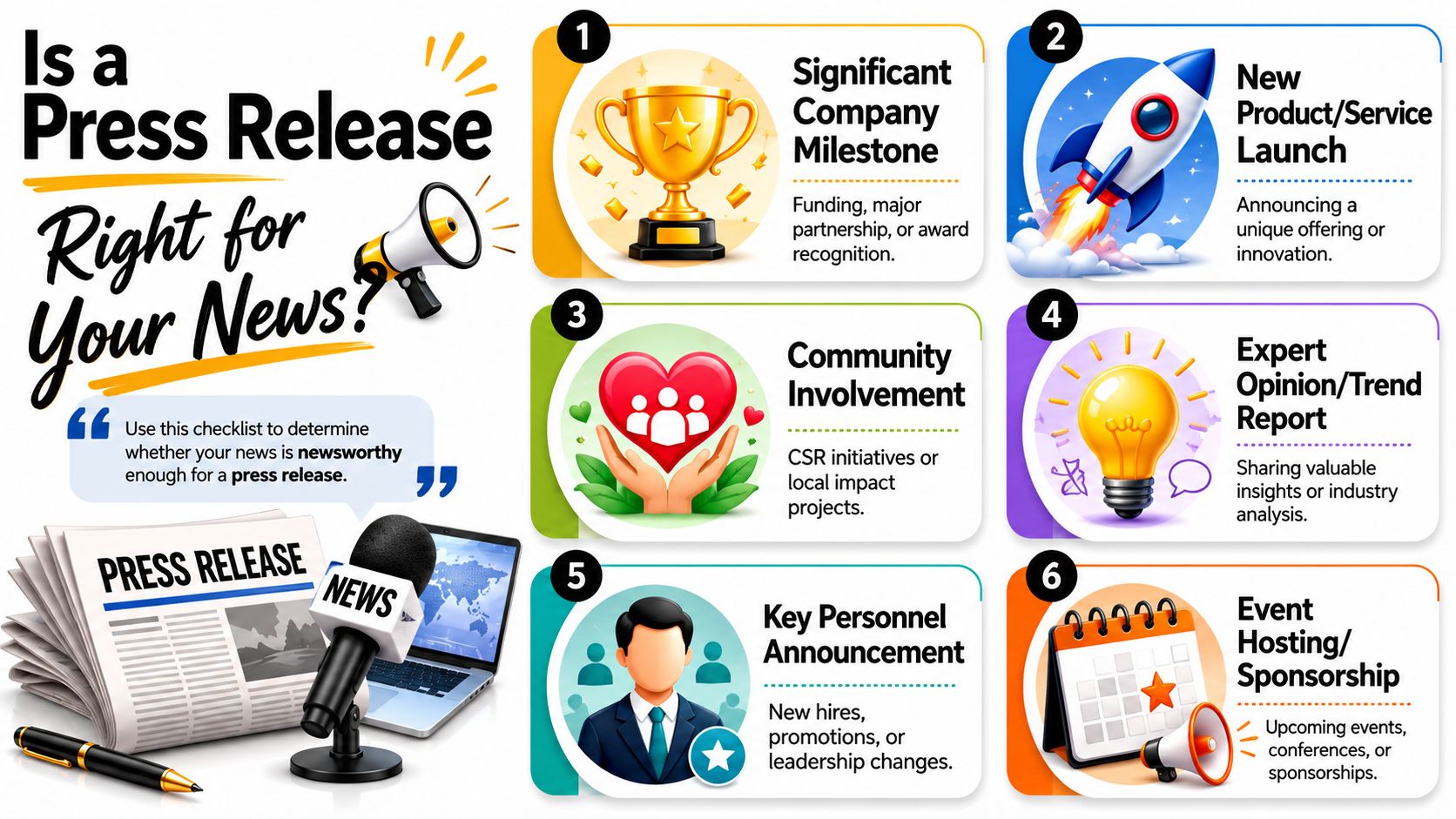
The first mistake small businesses make is treating every update as press release material. A press release works best when something changed that matters beyond the company itself. That usually means a launch, opening, award, major partnership, event, research angle, leadership move, or a concrete community initiative.
A release still matters because journalists haven't stopped using them. 74% of journalists say press releases and news announcements are the content they most like receiving from PR professionals, according to Fit Small Business press release statistics. That doesn't mean every release gets coverage. It means the format still fits how newsrooms work.
Newsworthy beats important-to-us
A useful filter is simple. Ask whether the announcement gives an outsider a reason to care now. “We redesigned our website” usually isn't news. “We opened a second location creating easier access for a local neighborhood” might be. “We hired a marketing coordinator” usually isn't. “We brought in a former industry executive to lead a new service line” can be.
Use this checklist before drafting:
- Milestone with consequence: A funding event, major partnership, award, or expansion changes the company's position in a way others can report.
- Clear public value: The update helps customers, a community, an industry niche, or a local economy.
- Time sensitivity: There's a reason the news should run this week, not sometime later.
- Specific proof: The business can support the announcement with hard details, not slogans.
- Audience match: A local paper, trade outlet, partner organization, or community group would reasonably care.
Practical rule: If the strongest argument for sending a release is “people should know we exist,” it probably needs a different marketing asset, not a press release.
Press coverage is not the only win
Many owners evaluate a press release too narrowly. They think the only outcome is a media hit. That misses one of the best strategic uses. Public-policy analysis highlighted by Brookings on supporting microbusinesses in underserved communities points to a stronger angle for many small firms: use a release to attract partners, grantmakers, lenders, and local agencies, especially when access to capital depends on trust, documentation, and practical support.
That changes the framing. Instead of writing only for a reporter, the business can write for people who influence opportunity. A release about a workforce program, community expansion, or grant-backed initiative can help a lender, chamber, local nonprofit, or municipal office understand why the business is credible and worth supporting.
For founders building visibility beyond one announcement, a broader digital foundation helps. A thoughtful online presence strategy for creators is useful because journalists and partners often look beyond the release itself and check whether the business looks established across its own channels.
Set realistic expectations before sending
A press release isn't a magic button. It's a packaged announcement. It can earn coverage, strengthen credibility, support search visibility, and give partners something official to reference. But routine releases sent to broad lists usually disappear.
A small team should also think about timing. This guide on the best time to send a press release is helpful because good timing won't rescue weak news, but it can improve the odds that the right person sees the email.
What to expect in real terms:
| Scenario | Likely outcome |
|---|---|
| Strong local angle, tight targeting | Better chance of pickup or follow-up questions |
| Generic company update, broad blast | Little to no response |
| Useful partner or grant angle | More credibility with stakeholders even without media coverage |
| Good release on weak website | Interest may fade when people investigate |
| Strong release with direct outreach | Best chance of practical results |
How to Write and Format Your Press Release
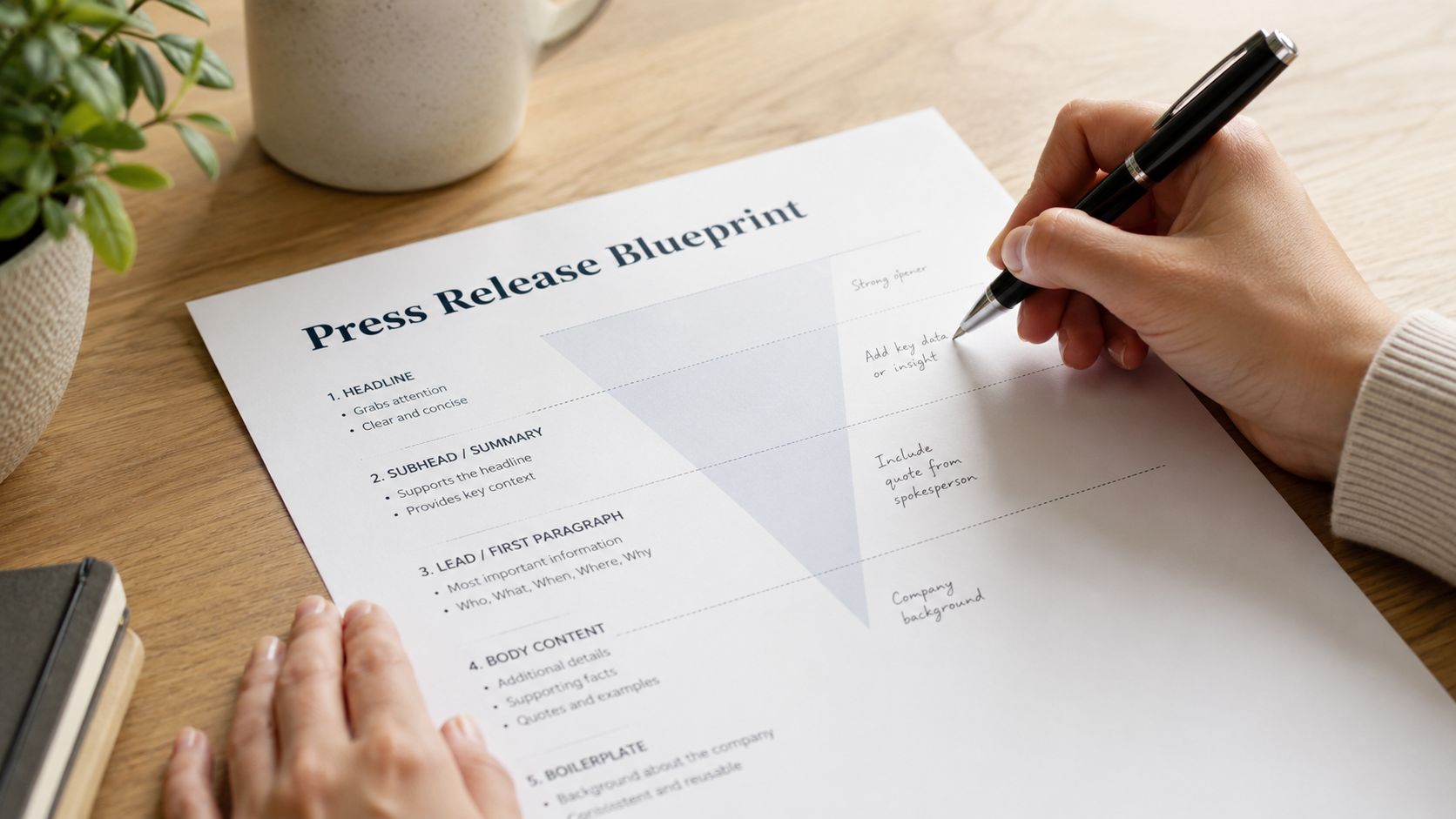
Most small-business releases fail for one reason. They read like ads. Reporters want usable facts, not brand voice exercises. The safest structure is the inverted pyramid, which means the most important information appears first and everything after that supports, clarifies, or proves it.
According to PR Newswire's press release best practices, a standard release should be 300 to 500 words with a headline of no more than 100 characters. That range forces discipline. It also makes the release easier to scan, forward, and lift from when an editor needs the basics fast.
Use the inverted pyramid
The top of the release should answer the essential questions immediately. Who is announcing what, where, when, and why it matters. If that information is buried in paragraph four, the release is already weaker than it should be.
A clean structure looks like this:
Headline
Short, factual, and specific. Avoid puns and inflated language.Dateline
City, state, and date.Lead paragraph
Cover the 5 Ws and 1 H quickly.Body paragraphs
Add context, proof, and relevant details.Quote
One quote is enough if it adds meaning.Call to action
Tell readers what to do next if action matters.Boilerplate
Short company description.Media contact
Name, email, phone, and website.
A good release lets an editor understand the story after reading only the headline and first paragraph.
Write each section like an editor is skimming
Here's the standard many PR and business guides use. A one-page release, often around 400 words, with one strong quote and a boilerplate, makes newsroom use easier, as described in Square's guide to writing a press release.
Headline
Bad headline:
“Local Brand Revolutionizes Customer Experience With Exciting New Solutions”
Better headline:
“Maple Street Bakery Opens Second Downtown Location”
The second version says what happened. It gives a newsroom something to work with.
Lead paragraph
Use a direct opening:
Springfield, Illinois, [date], Maple Street Bakery announced the opening of its second downtown location, expanding weekday breakfast and catering service for customers in the central business district.
That opening gives the editor the event, company, place, and practical relevance in one sentence.
Body copy
Many small businesses often get vague. Replace “growing rapidly” with specifics the business can verify. One guide for small businesses recommends using concrete figures rather than generic claims and warns against hype. It also suggests limiting links to two or three at most to avoid clutter, as noted in Hiscox's small-business press release guide.
Examples of stronger body language:
- Weak: “The company has seen amazing demand.”
- Stronger: “The company now serves customers across three neighborhoods and added weekend pickup to support demand.”
- Weak: “The service improves efficiency.”
- Stronger: “The service cuts manual appointment scheduling by moving bookings online.”
Quote
Most quotes are useless because they say the team is “thrilled” or “excited.” A quote should interpret the announcement.
Try this pattern:
“Downtown customers asked for earlier pickup and simpler catering ordering, so the new location is built around those needs,” said [name], [title].
That quote explains the business reason behind the announcement.
A simple fill-in structure
Use this template when drafting a press release for small business:
| Element | What to write |
|---|---|
| Headline | State the announcement in plain English |
| Lead | Company + action + audience impact |
| Paragraph 2 | Why now, and why it matters |
| Paragraph 3 | Evidence, specifics, or local relevance |
| Quote | Interpretation from founder, customer-facing leader, or partner |
| CTA | Visit, apply, RSVP, inquire, or contact |
| Boilerplate | What the company does and for whom |
A boilerplate can be as simple as this:
“Maple Street Bakery is a neighborhood bakery and catering business serving downtown Springfield. The company offers fresh breakfast, lunch, and event catering for local residents and offices.”
That's enough. It doesn't need slogans, mission-heavy language, or every service the business has ever offered.
Optimizing for SEO and Google News Visibility
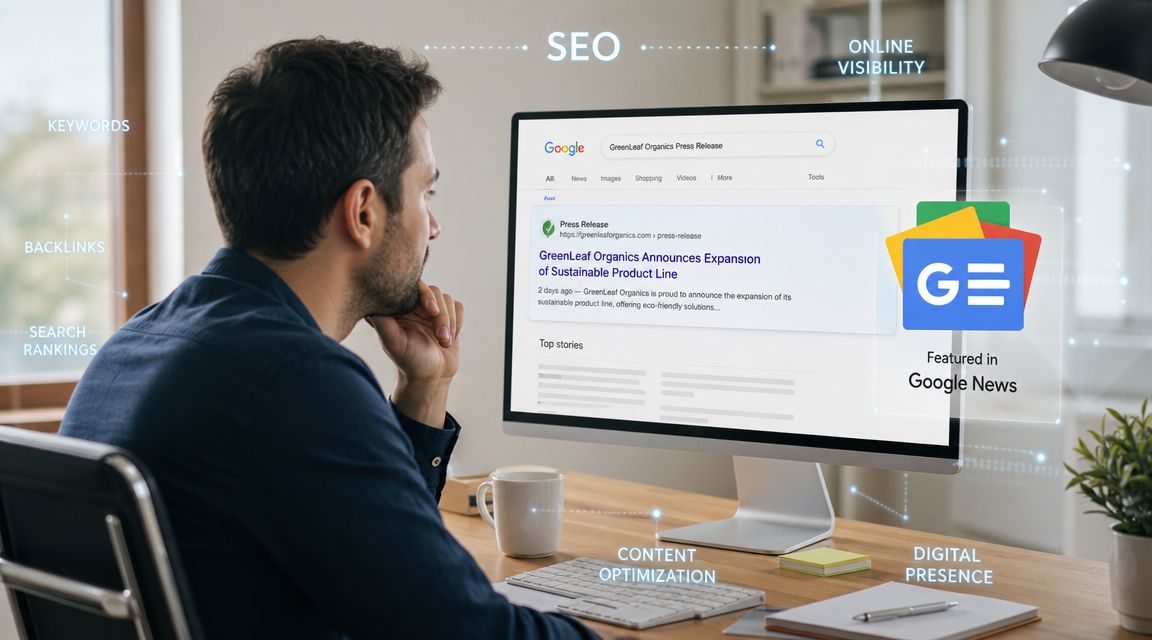
A press release no longer lives only in inboxes. It also sits on the company website, gets shared on social channels, appears in search results, and may be indexed by news surfaces. That means the release should be written for humans first, then tightened so search engines can understand it.
Search intent matters more than clever wording
If the release is about a new service, the title and page URL should reflect the actual phrase people would search. A local business opening a second location should say “opens second location” rather than “expands footprint.” A software company launching a tool should name the tool category, not hide it behind brand language.
A simple keyword process works:
- Primary phrase: Use the plain-language topic once in the headline and early in the page copy.
- Secondary phrases: Add nearby terms naturally in subheads, image alt text, and supporting paragraphs.
- Location terms: For local businesses, include the city or service area where it makes sense.
- Entity details: Name the business, product, executive, event, or partner consistently.
One useful technical guide on getting a press release into Google News explains the publication side well. The biggest practical point for small businesses is that visibility usually improves when the release lives on a clean, indexable page on the company website, not only inside a PDF attachment.
On-page elements that help
A press release page should be easy to parse.
Use this checklist:
- Clear page title: Match the actual announcement.
- Short introductory paragraph: Make the news obvious right away.
- Descriptive image file name: Use the company, topic, or event name, not “IMG_2048.”
- Helpful alt text: Describe what the image shows.
- Internal links: Link to the product page, event page, or application page if relevant.
- Media assets: Add one relevant image or short video if the announcement benefits from visual proof.
Editorial check: If the release page still makes sense after removing every adjective like “innovative,” “leading,” and “cutting-edge,” it's probably in good shape.
What not to do for visibility
Many businesses over-optimize and make the release worse. Don't stuff the same key phrase into every sentence. Don't turn the first paragraph into a list of keywords. Don't upload a release as a graphic or image-based PDF and expect search engines to do much with it.
Also avoid splitting one announcement into multiple weak pages. One strong canonical page is usually cleaner than several thin posts saying nearly the same thing.
For small companies, the goal isn't gaming Google News. It's publishing a release that is readable, indexable, and anchored to a page the business controls. If journalists, prospects, or local partners find that page later, it should still look credible months after the send date.
Your Small Business Press Release Distribution Plan
A small business owner finishes a release at 6 p.m., hits publish, posts it once on LinkedIn, and waits for coverage that never comes. I see this pattern all the time. The writing gets all the attention, while the distribution plan gets improvised at the last minute.
That order should be reversed. Before you send anything, decide who needs to see the news, what action you want from them, and which channel gives you the best chance of a response. A release about a new hire, local event, funding win, product launch, or community partnership will travel differently. The right plan depends on the announcement, not on a generic checklist.
Build distribution in three layers
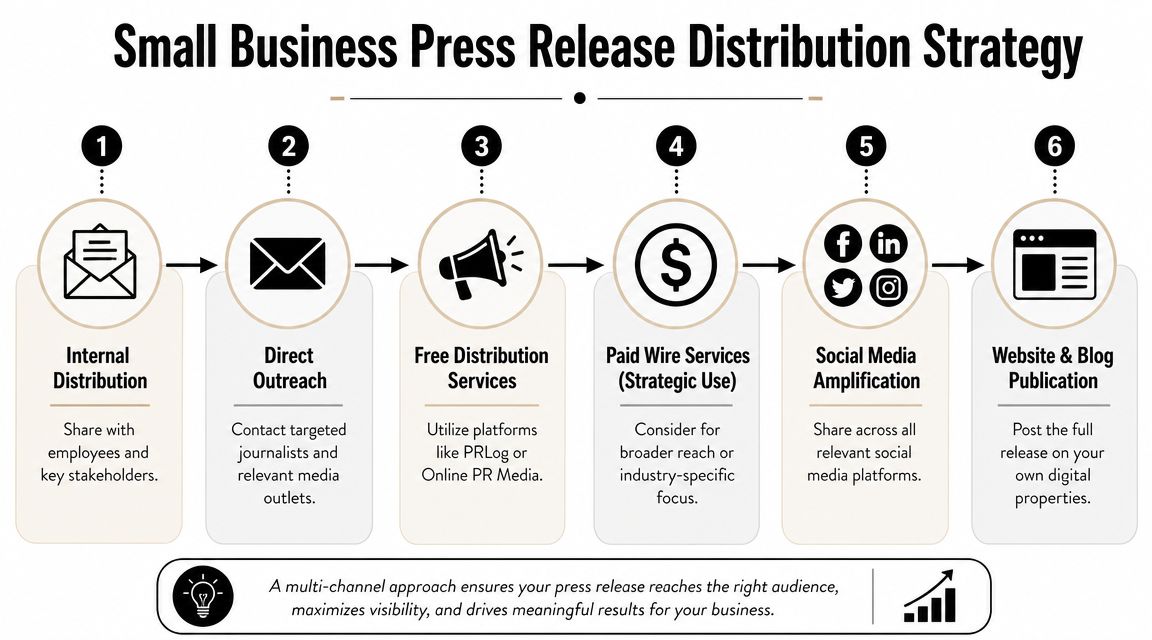
For small teams, the strongest setup usually has three parts. Publish on channels you control. Send targeted outreach to people who cover your type of news. Use wider distribution tools only when the announcement justifies the cost.
That mix gives you reach, control, and a realistic workload.
Layer one: Start with channels you own
Get the release live on your site first. That gives every email pitch, social post, and partner share a clean destination you control.
Use owned channels in this order:
- Website newsroom or blog: Publish the full release on a permanent page.
- Email list: Send a brief version with one clear link to the full announcement.
- Social channels: Adapt the release into short posts, a founder message, event details, a customer-facing summary, or a quick video.
- Google Business Profile or local community pages: Useful for openings, events, seasonal programs, and service changes.
One release can support a week of promotion if you adapt it properly. This step-by-step social media for small businesses resource is useful if your team needs help turning one announcement into several channel-specific posts without repeating the same copy everywhere.
Layer two: Do manual outreach to a short, relevant list
Small businesses usually get the best return through this.
A local bakery opening a second location does not need a giant media database. It needs the city business reporter, a neighborhood publication, a community newsletter editor, a chamber contact, maybe a local food writer, and a few partners who already speak to the right audience. A B2B service firm announcing a new contract or certification may get more value from trade editors, association newsletters, and referral partners than from general local media.
Start with a list like this:
| Contact type | Why they matter |
|---|---|
| Local business reporter | Covers openings, hiring, expansion, and partnerships |
| Community editor | Cares about neighborhood impact, events, and local interest |
| Trade journalist | Pays attention if the news affects a specific industry |
| Chamber or economic development group | Can amplify the announcement and add credibility |
| Nonprofit or civic partner | Useful for community programs, grants, and joint initiatives |
A detailed walkthrough on how to distribute a press release can help if you are deciding how much to handle through direct outreach versus broader distribution services.
Layer three: Use paid distribution selectively
Newswire distribution has a place. It can help when you need broad syndication, a visible digital footprint for investors or partners, or reach across a national industry. It is less useful for routine local announcements with no larger angle.
Small businesses often waste money here because the wire feels official. In practice, a paid distribution service rarely fixes a weak story, a vague headline, or an irrelevant audience list. If the news matters to a small set of local or trade contacts, direct outreach usually beats a broad blast.
A simple rule works well:
- Use manual outreach first for local openings, events, partnerships, awards, community programs, and small product updates.
- Consider a wire for funding news, executive announcements with broad industry relevance, major launches, M&A activity, franchising news, or compliance-related announcements that need wide pickup.
Email scripts that are ready to send
Send the release in the body of the email unless the journalist or editor asked for attachments. Attachments slow people down and often go unopened.
Script for a local journalist
Subject: New downtown opening from [Business Name] in [City]
Hi [Name],
[Business Name] is opening a new [type of business or location] in [City] on [date]. This is relevant for your audience because [one sentence on local jobs, neighborhood demand, accessibility, partnership, or event details].
The full release is below. If useful, [spokesperson name] is available for a short interview, and I can send photos right away.
Best,
[Name]
[Title]
[Phone]
[Email]
Script for a trade editor or niche publication
Subject: [Business Name] announcement relevant to [industry/topic]
Hi [Name],
[Business Name] is announcing [news]. I thought it may fit your coverage because [specific industry reason, customer impact, compliance angle, or market relevance].
The release is below. I can also send product details, supporting images, or a short quote from the founder if that helps.
Best,
[Name]
Script for a partner, grantmaker, or community organization
Subject: Announcement from [Business Name] relevant to [program/community/topic]
Hi [Name],
[Business Name] is announcing [news]. This may be useful to your audience because [clear stakeholder reason]. The release is below, and the team can share program details, application information, or a contact for follow-up.
Best,
[Name]
Shorter works better. Relevance matters more than volume.
Common distribution mistakes
A press release can be well written and still fail because the send plan is weak. These are the mistakes I would fix first:
- Sending to a list that is too broad: More contacts usually means fewer replies if the story is a poor fit.
- Burying the angle in a long email: State the news and why it matters in the first two sentences.
- Pitching without assets ready: Have photos, logos, founder availability, and event details prepared before you send.
- Treating every announcement the same way: A local event, a product launch, and a funding round need different channels and different targets.
- Using a wire as a substitute for judgment: Paid distribution is a tool, not a strategy.
The goal is not to put your release everywhere. The goal is to get it in front of the people most likely to publish it, share it, or act on it. That is the difference between distribution that looks busy and distribution that actually works.
Post-Publication Follow-Up and Measuring Success
Sending the release is the midpoint, not the finish line. Most of the value comes from what happens in the next several days and how the business uses any response.
How to follow up without annoying people
One follow-up is usually enough for most contacts. Keep it short. Reference the original email, restate the local or industry angle, and offer one useful asset such as photos, a founder interview, or event access.
A polite follow-up can be this simple:
Checking back on the announcement below in case it's relevant for your coverage this week. Happy to send photos, a short quote, or scheduling details if useful.
Don't send guilt-based messages. Don't ask whether they “got a chance” to read a long release. Don't forward the same email repeatedly with no new reason to engage.
What success actually looks like
Coverage is one outcome, but it's not the only one worth measuring. A smart review looks at several signals together:
- Referral traffic: Did the release page or linked landing page get visits from media, partners, or newsletters?
- Inbound responses: Did journalists, event organizers, lenders, community groups, or prospects reply?
- Search visibility: Did the release page start appearing for branded or announcement-related queries?
- Stakeholder action: Did people register, apply, inquire, book, or request more information?
- Secondary use: Did the team reuse the announcement in sales decks, grant materials, or outreach emails?
Many owners overlook a significant advantage. A release that doesn't generate a formal article can still help a banker, grant reviewer, commercial landlord, or local partner validate that the business is active, organized, and worth taking seriously.
How to extend the life of one announcement
One release can generate weeks of usable content if the business repackages it properly.
Use the announcement in several formats:
Website proof point
Add the release to a newsroom, updates page, or “in the news” section.Sales enablement
Include the announcement in proposals, partnership decks, and outreach materials.Email newsletter
Rewrite it as a short founder update with one clear next step.Social follow-ons
Share photos, behind-the-scenes details, event recaps, or FAQs after the initial news goes live.
A release earns more value when it becomes part of the company record, not a one-day campaign artifact.
FAQ and Ready-to-Use Resources
The last few practical decisions tend to slow teams down more than the writing itself. These are the questions that come up repeatedly.
Common questions
Should a press release go in the email body or as an attachment?
Put it in the email body. That makes it easier for a journalist or editor to scan quickly. A linked web version is useful too. A PDF can exist for recordkeeping, but it shouldn't be the only format.
What's the difference between a press release and a media alert?
A press release explains news. A media alert is a shorter notice used to invite coverage of a specific event, appearance, or time-sensitive happening. If the business is hosting a ribbon-cutting, panel, workshop, or public event, a media alert may accompany the release rather than replace it.
How often should a small business send press releases?
Only when something is newsworthy. A business that sends weak releases too often trains contacts to ignore future emails. Fewer and stronger beats frequent and forgettable.
Should the release include multiple quotes?
Usually no. One quote is often enough. Add a second only if it gives a different perspective, such as a partner, customer-facing leader, or community stakeholder.
Does a community-focused business need anything beyond the release?
Often yes. For businesses serving underserved communities, Neighborhood & Economic Innovation research on reaching underserved small businesses points to the need for multilingual options, trusted intermediary organizations, and follow-through after publication. A release alone may not convert awareness into participation.
Ready-to-use checklist and template prompts
Use this pre-send checklist:
- News test: Is there a clear reason someone outside the company would care now?
- Audience match: Is the release aimed at journalists, partners, grantmakers, customers, or all four with separate outreach?
- Fact check: Are names, dates, titles, locations, links, and claims accurate?
- Support assets: Are photos, logos, interview availability, and landing pages ready?
- Action path: Can a reader easily RSVP, apply, inquire, book, or learn more?
- Follow-up owner: Is one person responsible for responses after send?
Template prompts for drafting:
- Headline: “[Business Name] announces [specific news] in [place/topic]”
- Lead: “[Business Name] today announced [news], giving [audience] [practical benefit or context].”
- Quote: “This move matters because [real reason tied to customers, operations, or community].”
- CTA: “For [booking/applications/interviews/details], contact [name/email].”
Industry examples
Restaurant
Lead with opening date, location, menu angle, chef or ownership relevance, and any neighborhood or event tie-in. Good supporting details include reservation timing, opening-week events, and local supplier relationships if they're central to the story.
Tech startup
Lead with product category, user problem, launch context, and what changed. Keep jargon low. A release about “AI-powered orchestration” is weaker than one about automating a specific workflow for a named audience.
Nonprofit or community organization
Lead with program purpose, participating partners, who benefits, and what action people should take next. If the audience includes underserved communities, include language access, trusted local partners, and what follow-through support exists after the announcement.
A small business doesn't need a massive PR machine to use press releases well. It needs judgment, discipline, a short list of relevant contacts, and a clear reason for the announcement to exist.
Press Release Zen offers practical help for teams that want to move faster without cutting corners. Its guides, templates, and distribution resources make it easier to plan, write, format, and send a press release that's built for real-world use. Explore Press Release Zen if a business needs a reliable starting point or a cleaner process for the next announcement.