The most common starting point is messy, not dramatic. A leadership team knows a serious incident could happen, the communications lead has a draft plan somewhere in a shared drive, and everyone assumes they'll “figure it out” when the time comes. Then a customer complaint turns into a viral post, an outage stretches past the first promised update, or an employee posts partial information before the company is ready to respond.
That's when the gap shows. The issue usually isn't the absence of smart people. It's the absence of rehearsal, role clarity, and message discipline under pressure. Crisis communications training closes that gap by turning a static plan into a practiced response system across leadership, operations, legal, HR, customer-facing teams, and digital channels.
Table of Contents
- Why Proactive Crisis Training Is Non-Negotiable
- What Every Crisis Communications Program Must Cover
- Choosing Your Training Approach
- Building Your Training Agenda and Exercises
- Running Your First Training Session
- Preparing for Digital and AI-Driven Crises
- Equipping Frontline Teams for De-Escalation
- Measuring Success and Fostering a Crisis-Ready Culture
Why Proactive Crisis Training Is Non-Negotiable
A crisis rarely announces itself in a neat, manageable way. It usually arrives as fragments. A screenshot from a customer. A reporter asking for comment before the internal team has aligned. A regional manager hearing one version of events while headquarters hears another. By the time leadership realizes this is a reputational event, several people have already started communicating on the organization's behalf.
That's why a written plan isn't enough. Teams don't fail in crises because they lack documents. They fail because pressure exposes weak handoffs, slow approvals, unclear authority, and channels nobody has tested recently. A plan on a shelf can't do any of that work for them.
The business case for training is getting harder to ignore. A major 2024 benchmark from the Business Continuity Institute found that dissatisfaction with emergency and communications tools rose to 20.3%, up from 16.2% in 2023 according to the Business Continuity Institute benchmark. That matters because even good messaging breaks down if the tools, workflows, and escalation paths don't hold up in real use.
Training is operational, not cosmetic
Many organizations still treat crisis communications as a media skills issue. That's too narrow. Media performance matters, but it's only one visible piece of the response.
A real program covers things like:
- Notification discipline: Who gets alerted first, by what channel, and with what minimum information.
- Stakeholder prioritization: Which groups need immediate outreach, and which can wait for the next verified update.
- Holding statement readiness: What can be said early, before all facts are confirmed.
- Approval flow: Who must review language, and who can approve under time pressure.
Practical rule: If a team hasn't practiced sending, approving, and updating messages under time pressure, it hasn't really tested its crisis capability.
That broader definition is what separates communications theater from readiness. For teams that need a baseline definition before building a program, this overview of what crisis communications is is a useful starting point.
What works and what doesn't
What works is repetition in realistic conditions. Short drills. Escalation exercises. Message drafting under incomplete information. Post-exercise review that identifies where decisions slowed down.
What doesn't work is a one-time slide deck, generic talking points, or a spokesperson session that excludes operations, legal, HR, customer support, and digital teams. Crises don't stay inside a comms function. Training can't either.
What Every Crisis Communications Program Must Cover
Strong crisis communications training isn't random. It follows a sequence, because crisis response itself follows a sequence. The best programs teach teams how to move from uncertainty to coordinated action without getting trapped in internal confusion.
A widely used public-sector framework lays out 10 steps for effective crisis communications, beginning with anticipating and planning and ending with post-crisis analysis, as described in this public-sector crisis communications framework. That matters because it gives organizations a complete model instead of a collection of disconnected tactics.
Use a full lifecycle model
The first mistake many teams make is over-focusing on the public statement. The public statement matters, but it sits in the middle of a much larger workflow.
A sound training program should prepare people to handle the full lifecycle:
- Anticipate likely scenarios. Product failure, executive misconduct allegation, cyber incident, service outage, safety event, activist pressure, regulatory scrutiny.
- Identify spokespersons and backups. Not every issue belongs with the CEO. Not every expert can face the media without coaching.
- Build monitoring and notification habits. Teams need to know how incidents are surfaced and when they become “comms-active.”
- Map stakeholders. Employees, customers, partners, regulators, investors, local communities, and media don't need identical messages.
- Draft holding statements. Early language should be accurate, restrained, and useful.
- Assess and adapt. As facts change, messages need to evolve without creating contradictions.
- Review performance after the event. If the debrief is skipped, the same weaknesses return.

The six pillars that show up in strong programs
Most effective programs, regardless of industry, include the same core building blocks.
- Risk assessment and planning: Teams identify the incidents most likely to force rapid communication decisions.
- Roles and responsibilities: People need clear authority, not vague expectations.
- Message development: This includes holding statements, FAQs, internal briefings, and channel-specific language.
- Media and stakeholder engagement: Different audiences require different briefing styles and response timing.
- Simulation and drills: Practice exposes friction that planning documents hide.
- Post-crisis analysis: The team reviews what happened, what slowed response, and what should change.
Good programs don't train people to “sound polished.” They train people to make sound decisions, then communicate those decisions clearly.
For organizations tightening the link between response and operational discipline, Halo AI incident management insights can help communications teams understand how incident structure affects message speed and coordination.
Choosing Your Training Approach
The right training design depends less on fashion and more on organizational reality. Some teams need external challenge because internal politics make honest critique difficult. Others already have capable communications leadership and need a practical in-house format they can repeat often.
There isn't one correct model. There is only the model the organization will use, fund, and repeat.
In-house training versus external facilitation
An internal program usually works best when the organization already has mature communications leadership, documented procedures, and enough credibility to gather cross-functional participation.
In-house training advantages
- Context familiarity: Internal teams know the culture, approval habits, and political fault lines.
- Lower friction: Scheduling is often easier when the trainer already works inside the organization.
- Repeatability: Short refreshers and department-specific drills are easier to run regularly.
In-house training drawbacks
- Blind spots: Teams may normalize broken processes because “that's how it's always been done.”
- Reduced candor: Junior participants may hold back if senior leaders are grading them.
- Limited specialization: Media handling, social response, cyber-adjacent crises, and executive coaching may require deeper expertise.
External facilitation is often the better choice for a first program, a high-stakes sector, or a politically sensitive culture.
| Option | Best for | Main strength | Main trade-off |
|---|---|---|---|
| In-house | Organizations with capable internal comms leadership | Easier cadence and customization | Can miss structural weaknesses |
| External consultant | First-time programs or sensitive environments | Objectivity and facilitation skill | More prep needed for context |
| Hybrid model | Most mid-size and large teams | Internal ownership plus outside challenge | Requires more coordination |
Match the format to the risk
A full-day simulation isn't always the right first move. Some organizations need a shorter tabletop to clarify roles before they attempt a high-pressure exercise.
Common formats include:
- Leadership tabletop: Best for executives, legal, HR, and operations leaders who need to practice decision flow.
- Spokesperson workshop: Useful when designated media-facing leaders need interview discipline and message control.
- Digital response drill: Best for teams managing social channels, rumor response, and rapid approval cycles.
- Frontline workshop: Critical for customer service, field staff, site managers, or community-facing employees.
- E-learning primer: Helpful for broad baseline awareness, but weak as a standalone solution.
A short, realistic tabletop with the right people usually beats a large theatrical simulation with the wrong people.
The best choice usually combines formats. A leadership tabletop builds authority lines. A comms workshop sharpens message work. A later simulation tests how those decisions hold up under pressure.
Building Your Training Agenda and Exercises
Most first-time programs become too abstract. They spend hours discussing principles and very little time forcing participants to do the work they'll need to do in a live event. A strong agenda fixes that. It puts drafting, approving, updating, and responding at the center of the day.
The agenda also has to respect fatigue. People can stay sharp for a demanding exercise, but not if every block is long, lecture-heavy, and disconnected from a clear scenario.
A sample one-day agenda
Below is a practical structure that works for many first programs.
| Time | Module | Activity/Focus |
|---|---|---|
| 9:00 to 9:30 | Scenario briefing | Introduce the incident, business context, stakeholders, and escalation conditions |
| 9:30 to 10:15 | Roles and decision rights | Confirm who leads, who approves, who drafts, who monitors, who briefs leadership |
| 10:15 to 11:00 | Message mapping | Draft key messages, proof points, red lines, and likely tough questions |
| 11:00 to 11:15 | Inject one | Add new facts, uncertainty, and stakeholder pressure |
| 11:15 to 12:00 | Holding statement drill | Draft a first response for internal and external audiences |
| 1:00 to 1:45 | Media response practice | Simulate reporter outreach, executive briefing, and interview prep |
| 1:45 to 2:30 | Social and customer response | Create channel-specific responses for comments, inboxes, and service teams |
| 2:30 to 2:45 | Inject two | Introduce misinformation, a leaked screenshot, or conflicting internal claims |
| 2:45 to 3:30 | Escalation meeting | Decide whether to update, apologize, pause, investigate, or elevate leadership visibility |
| 3:30 to 4:15 | Stakeholder communications | Draft updates for employees, customers, partners, and regulators if relevant |
| 4:15 to 5:00 | Debrief | Review timing, decisions, bottlenecks, message consistency, and next actions |
Exercises that actually build skill
Some drills work because they mirror the actual constraints of a crisis. Others fail because they reward polished discussion instead of execution.
The most useful exercises include:
- Holding statement under time pressure: Give the team limited facts and a short deadline. The goal is to produce language that is accurate, calm, and usable.
- Message map compression: Ask participants to reduce a complex issue to a few defensible points with supporting facts and one clear tone standard.
- Approval bottleneck drill: Force legal, operations, and communications to approve a statement in real time. This usually reveals where speed breaks down.
- Mock media questioning: Use tough, repetitive questions to test whether a spokesperson can stay aligned without sounding evasive.
- Customer response queue: Have support or community teams answer realistic inbound complaints while leadership is still clarifying facts.
A useful exercise design principle is contrast. One inject should test uncertainty. Another should test emotion. Another should test scale.
The point of an exercise isn't to prove the plan works. The point is to expose where the plan fails while the stakes are still low.
A final note on scenario design. Generic scenarios produce generic learning. A retailer should test store-level customer tension, returns, safety concerns, and social complaints. A software company should test outage updates, customer trust, security questions, and executive visibility. A healthcare organization should test empathy, patient communication, and approval discipline. The more realistic the scenario, the more transferable the learning.
Running Your First Training Session
The first session should feel structured, serious, and safe enough for people to make mistakes. If participants think they're being ambushed or publicly graded, they'll protect themselves instead of practicing. That defeats the purpose.
A technically sound program should assign a small, senior-led team, typically including the CEO, PR lead, legal counsel, and heads of key divisions, and build an emergency communications tree with primary and alternate contacts, according to Crisis Navigator's guidance on the ten steps of crisis communications. That structure should be visible in the training, not buried in a binder.

Set up the room before the scenario starts
Preparation determines whether the exercise feels realistic or sloppy.
Before the session begins, the facilitator should confirm:
- Participant list: Decision-makers, drafters, approvers, and channel owners are all represented.
- Role cards or assignments: Everyone knows whether they're acting as spokesperson, legal reviewer, customer lead, social lead, or executive sponsor.
- Communications tree: Primary and backup contacts are current.
- Scenario materials: Initial brief, likely questions, inject schedule, and any mock screenshots or reporter inquiries are ready.
- Debrief capture method: Someone is assigned to document delays, contradictions, and decisions.
For leaders who need focused spokesperson preparation alongside team drills, executive-facing media training support is often a necessary parallel track.
Facilitate pressure without creating chaos
A good facilitator controls the pace. They don't overload the room with twists every few minutes, and they don't let the group drift into abstract debate. They present facts, set deadlines, and force choices.
Useful facilitation habits include:
- Introduce injects only after the team has committed to a course of action.
- Ask who owns the next message, not just what the message should say.
- Require channel choices. Website, email, internal chat, customer support macro, executive note, or social statement.
- Pause when confusion rises and ask where the decision right sits.
The debrief matters as much as the simulation. Teams should leave with a short, concrete action list. Update the contact tree. Clarify who approves first statements. Prepare role-specific checklists. Build a better holding statement library. Tighten coordination between legal and communications. That's where the core value sits.
Preparing for Digital and AI-Driven Crises
Many organizations still train for yesterday's crisis. They prepare for a reporter call, a press statement, and a carefully managed update cycle. Digital crises don't behave that way. False claims, altered media, clipped video, and coordinated rumor bursts can force a communications response before the organization has fully verified the underlying event.
That shift matters because the training target has changed. Teams now need to practice not only what to say, but when to intervene, when to hold, how to verify, and how to coordinate across social, customer, legal, security, and executive channels.
Train for narrative volatility
The World Economic Forum's Global Risks Report 2025 ranks misinformation and disinformation among the top short-term risks, as noted in this BCI crisis communications course overview. For communicators, that means the crisis may be partly factual and partly narrative. Both require response.
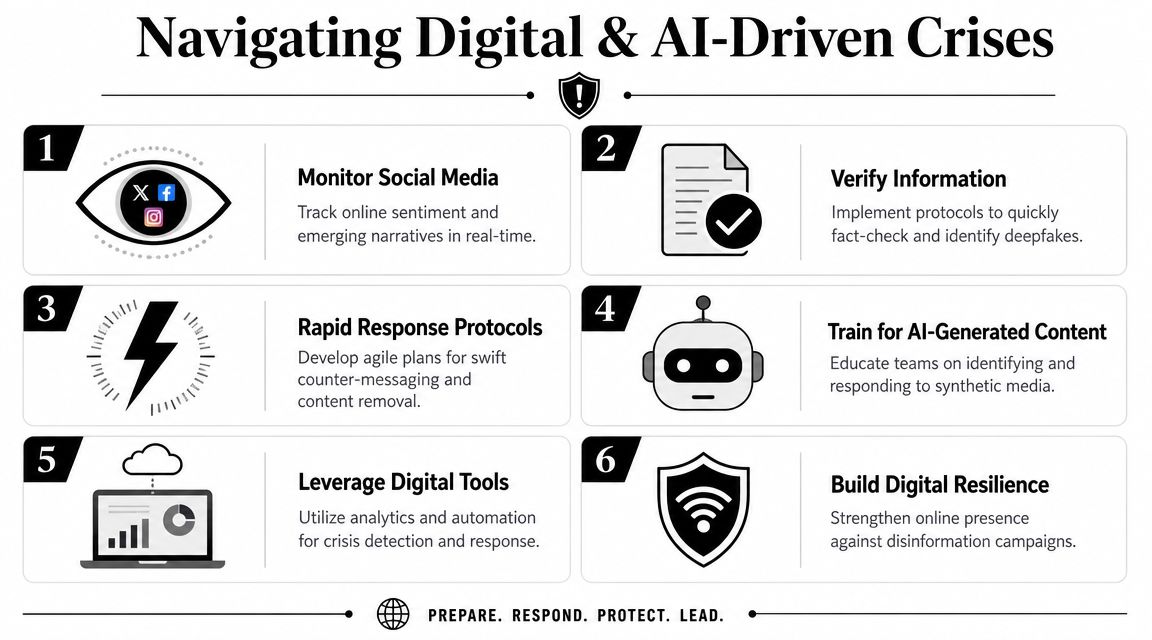
A modern digital drill should include at least one of these complications:
- A false screenshot that appears to come from an internal system
- An edited clip that removes context from a leader's statement
- A fake account impersonating a company executive
- A real incident with inaccurate commentary spreading faster than official updates
- A cyber event where operational and reputational timelines diverge
When the underlying incident has a cyber component, communications teams also benefit from technical context around comprehensive ransomware detection, because public statements often fail when the comms team doesn't understand what security teams are investigating.
Digital drills need decision thresholds
The biggest weakness in digital response training is vagueness. Teams say they'll “monitor closely” or “correct misinformation quickly,” but they haven't defined what triggers action.
Effective drills force the team to decide:
- What qualifies as actionable misinformation
- Who validates whether content is false, misleading, or merely hostile
- Which channels merit direct correction
- When silence protects the response and when silence concedes the narrative
- How fast customer support, social, and leadership teams must align
A practical digital curriculum should also include rumor-response protocols, escalation thresholds, and platform-specific response choices. A public post, for example, may require a different tone and timing than a direct customer message or an internal employee update.
For teams developing that capability, this guide to crisis communications and social media is useful because it connects traditional response discipline with channel-specific realities.
In digital crises, speed without verification creates new damage. Verification without speed creates a vacuum. Training has to prepare teams for that tension.
Equipping Frontline Teams for De-Escalation
A brand's first crisis message often doesn't come from the communications department. It comes from a gate agent, store manager, receptionist, nurse, driver, customer support rep, or field technician facing an upset person in real time. That interaction may never appear in a press release, but it can define how the incident is experienced and later described online.
This is one of the biggest gaps in many training programs. An underserved angle in crisis preparedness is frontline de-escalation training, not just executive or media messaging. Many courses focus on media handling but leave frontline employees underprepared for the first 5 minutes of a crisis, when trust is often won or lost, as highlighted in AAAE's frontline de-escalation training overview.

The first interaction shapes the whole incident
Consider two versions of the same moment. In the first, a customer asks what's happening after a visible service failure. The employee says, “Nobody's told us anything,” looks defensive, and tries to end the conversation. In the second, the employee acknowledges the frustration, explains what is known, avoids speculation, and tells the customer when the next update will come.
The facts may be identical. The reputational outcome won't be.
Frontline teams don't need legal language or executive talking points. They need practical skills they can remember under stress:
- Active listening: Let the person feel heard before trying to redirect.
- Person-centered language: Speak to the immediate concern, not a script.
- Emotional cue recognition: Notice when frustration is becoming panic or aggression.
- Boundaries without escalation: Decline unsafe or inappropriate demands without sounding dismissive.
- Escalation judgment: Know when to bring in security, a supervisor, clinical support, or comms.
What frontline practice should look like
This training works best in short, scenario-based role plays. Long theory sessions rarely transfer to live encounters.
Useful role-play prompts include:
- A customer filming on a phone while demanding an answer.
- A family member seeking information the employee can't yet release.
- A passenger, patient, or visitor who is upset by delays and conflicting instructions.
- A member of the public repeating false information they saw online.
The facilitator should coach for tone, body language, wording, and handoff. Did the employee stay calm? Did they acknowledge emotion without admitting unknown facts? Did they avoid guessing? Did they know when to escalate?
Frontline de-escalation isn't separate from crisis communications training. It's the earliest live version of it.
When organizations ignore this layer, they often discover too late that their first visible failure wasn't the incident itself. It was a preventable human interaction.
Measuring Success and Fostering a Crisis-Ready Culture
A training session is only useful if it changes behavior. Attendance alone doesn't tell much. Neither does a positive reaction from participants who enjoyed the workshop. The better question is whether the organization communicates faster, more clearly, and with less confusion after practicing.
Measure behavior, not just attendance
Useful indicators are usually operational and observable:
- Decision clarity: Did participants know who could approve what?
- Message consistency: Did internal, customer-facing, and public responses align?
- Draft quality: Were holding statements usable without major rewriting?
- Escalation speed: Did the right leaders and backups get involved quickly?
- Debrief quality: Did the team identify concrete fixes instead of vague lessons?
For teams that want a structured evaluation lens, this guide for L&D teams offers a practical way to think about training effectiveness beyond attendance and satisfaction.
Build a repeatable cadence
Crisis readiness fades when it isn't refreshed. Staff changes, tools change, leadership changes, and risk changes. Training should be treated as a cycle, not an event.
A sensible cadence often includes a substantial annual simulation, smaller tabletop exercises during the year, and targeted refreshers for spokespeople, digital teams, and frontline staff after major organizational changes. Debrief findings should feed directly into updated templates, contact trees, approval paths, and role checklists.
A crisis-ready culture is visible before the crisis. People know who leads. Backups are identified. Language has been tested. And teams understand that speed, empathy, and coordination are skills that need practice.
Press Release Zen helps organizations turn difficult announcements into clear, usable communications. For teams building response plans, drafting holding statements, or tightening media workflows before the next incident, Press Release Zen offers practical guides, templates, and examples that make crisis communication work more manageable.