A team writes a sharp press release. The headline is clear. The quote sounds human. The timing seems right. Then the release goes out and almost nothing happens.
That silence usually isn't a writing problem. It's a distribution problem shaped by fragmentation in media. The old assumption was simple: get into the right outlet, and the market will see the story. That assumption doesn't hold anymore. Audiences split their attention across streaming, newsletters, search, social feeds, niche podcasts, creator channels, trade sites, community groups, and private networks.
For PR teams heading into 2026, the challenge isn't just getting coverage. It's building a release campaign that can travel across multiple attention environments without losing the core message. A press release now works best as the center of an asset system, not as the whole system.
Table of Contents
- Why Your Press Release Isn't Getting Noticed
- What Media Fragmentation Actually Means for PR
- The Key Drivers of Media Fragmentation
- How to Measure Your Audience's Fragmentation
- A Modern PR Framework for Fragmented Media
- Tactics and Templates for Multi-Channel Releases
- Your Fragmentation-Proof PR Plan in Action
Why Your Press Release Isn't Getting Noticed
Most underperforming releases have the same hidden flaw. They were built for a media world that no longer exists.
A team still writes one formal document, sends it to a broad list, posts it once on the company site, and waits for pickup. That worked better when a smaller set of editors and broadcasters controlled a larger share of public attention. In 2026, that same workflow often produces weak results because the audience isn't sitting in one place waiting to be reached.
The practical problem looks like this:
- Journalists see no channel fit: The release may be accurate, but it doesn't match the beat, format, or audience style of the person receiving it.
- The story has no second life: If earned pickup doesn't happen fast, the campaign stalls because there are no supporting assets for LinkedIn, YouTube, email, or community distribution.
- Search visibility is thin: The core announcement isn't shaped for how people now discover information through search, summaries, and answer-style results. Teams working on implementing an AEO strategy often fix this by turning one announcement into structured, findable supporting content.
Practical rule: A press release shouldn't be treated as the campaign. It should be treated as the source document for the campaign.
When teams say, "The story was good, but nobody covered it," the next question shouldn't be about adjective choice in the headline. It should be, "Where did the target audience spend attention, and what version of the story was built for each place?"
That's the shift. PR teams don't need louder releases. They need release systems built for fragmented discovery.
What Media Fragmentation Actually Means for PR
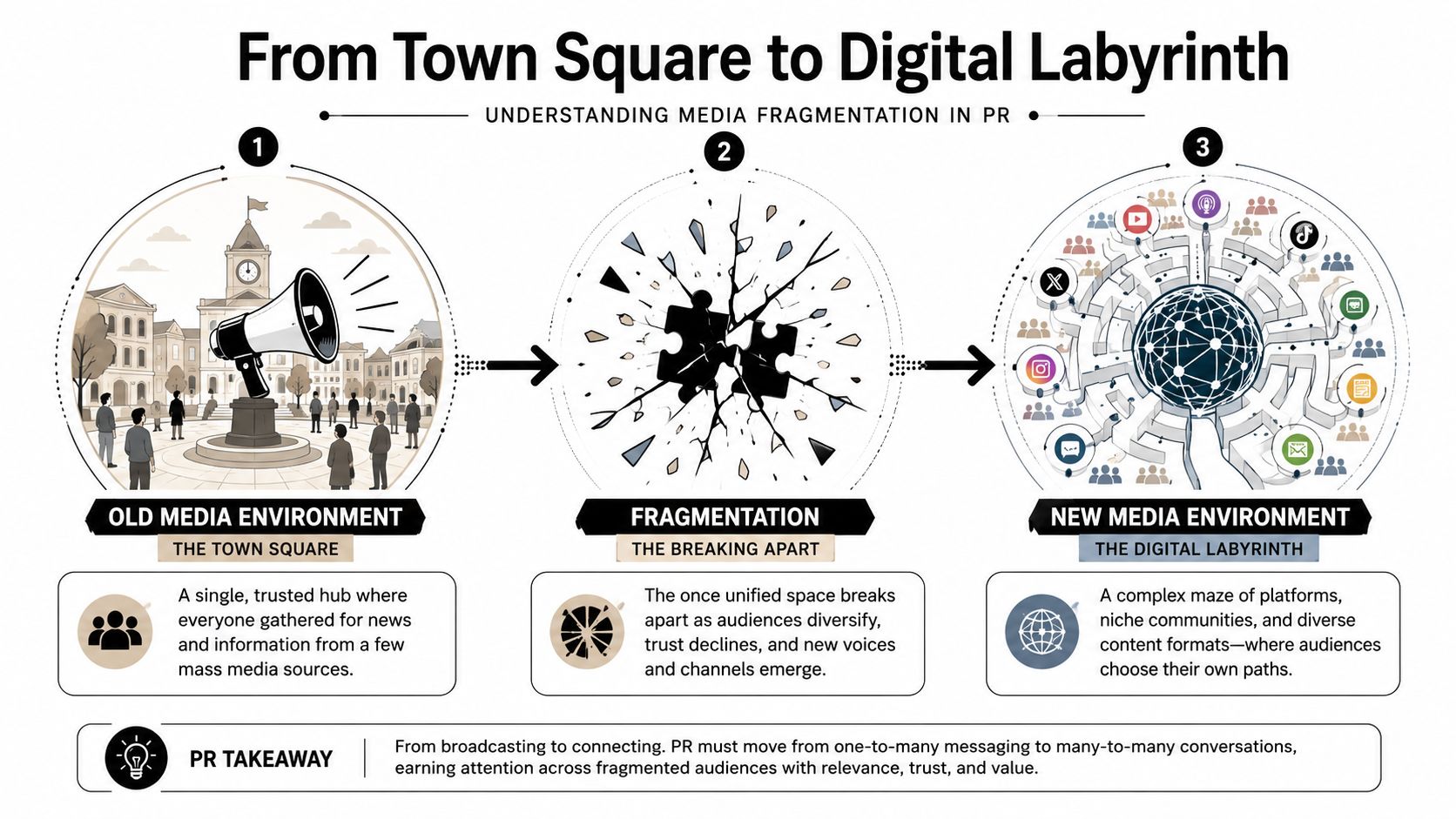
Media fragmentation used to sound like a broad industry term. For PR, it's much more concrete. It means the audience no longer gathers in one giant town square. It moves through many smaller rooms, each with its own rules, gatekeepers, formats, and expectations.
The town square is gone
The easiest analogy is local geography. The old media system looked like one central square where nearly everyone passed through. If a brand earned attention there, a large share of the market saw it. The current environment looks more like dozens of neighborhood venues, private clubs, and side streets. Some are large. Many are small. Most don't overlap as much as PR teams wish they did.
A foundational sign of this shift comes from television itself. Nielsen reported that by August, 60.7% of time spent with television was with streaming platforms, which shows attention moving away from a single dominant linear environment and into a more dispersed mix of services, apps, and devices, as summarized by eMarketer's coverage of media fragmentation.
For PR, the lesson isn't limited to TV. It's a broader attention pattern. Once people get used to choosing exactly what, when, and where they consume, they don't return to one-size-fits-all media habits.
What that changes in day-to-day PR work
Many teams miss the point: more channels doesn't automatically mean more opportunity. It also means more adaptation work.
A release now has to survive several filters at once:
- Format fit: A trade editor, Substack writer, LinkedIn reader, and podcast host won't respond to the same packaging.
- Context fit: The same announcement may need a market angle for journalists, an operational angle for customers, and a leadership angle for investors.
- Discovery fit: Some people will find the story through direct outreach. Others through search, social posts, newsletters, or a quoted mention in someone else's content.
A useful way to think about outlet strategy is to separate "media" from "media outlet." A national newspaper, a niche podcast, an independent industry newsletter, and a YouTube channel can all function as outlets now. Teams that need a cleaner way to define that media environment usually benefit from this explanation of what counts as a media outlet.
The best release in the market still loses if it's packaged for the wrong room.
PR used to reward broad targeting with decent odds of accidental relevance. Fragmentation in media punishes that habit. The more scattered the audience becomes, the more a release must be intentionally translated for each meaningful channel.
The Key Drivers of Media Fragmentation
Fragmentation in media didn't happen because audiences suddenly became impossible to reach. It happened because distribution technology expanded faster than old PR habits did, and audience behavior changed with it.
More channels, less concentrated attention
On the supply side, there are more places to consume information. Streaming services multiplied. Creator platforms matured. Trade newsletters became mini-publications. Audio found loyal niche audiences. Social feeds stopped acting like public front pages and started acting like personalized recommendation engines.
Within television alone, the shift is already visible. Nielsen reported that in March 2025, streaming accounted for 43.8% of total TV viewing, versus cable at 24.0% and broadcast at 20.5%, showing that fragmentation isn't only about people moving across media categories. It's also happening within categories themselves, as noted in Nielsen's explanation of what media fragmentation means for reaching audiences.
That matters to PR because the same pattern repeats elsewhere. News is no longer consumed in one routine. Entertainment isn't either. Professional insight isn't either. Every announcement competes inside a stack of algorithmic feeds, direct subscriptions, and specialized communities.
Audience behavior changed with the tools
Technology created the menu. Audiences changed the eating habits.
People now expect on-demand access, personalized feeds, niche expertise, and short paths to relevance. They don't wait for scheduled programming or broad editorial bundles if a creator, analyst, newsletter writer, Reddit thread, or vertical site gives them faster value.
That changes how PR should think about "reach." The old goal was mass exposure from one big hit. The current goal is coordinated exposure across a small set of places the audience already trusts.
A few practical shifts define the new environment:
- Appointment consumption weakened: Fewer people shape their day around one broadcast moment unless the event is unusually large.
- Identity-based media habits grew: Buyers often choose sources that reflect their role, industry, geography, or worldview.
- Algorithms mediate discovery: Even strong announcements need formatting that gives platforms something usable, such as sharp hooks, clear summaries, visual assets, and direct relevance.
A fragmented audience isn't random. It's organized around preference, convenience, and trust.
This is why generic media lists underperform. They assume attention is spread evenly. It isn't. Specific audiences cluster. The work is to find the clusters that matter, then build release assets that belong there.
How to Measure Your Audience's Fragmentation
PR teams often jump straight from "we have news" to "let's distribute it." That's backwards. The smarter sequence is diagnose, then distribute.
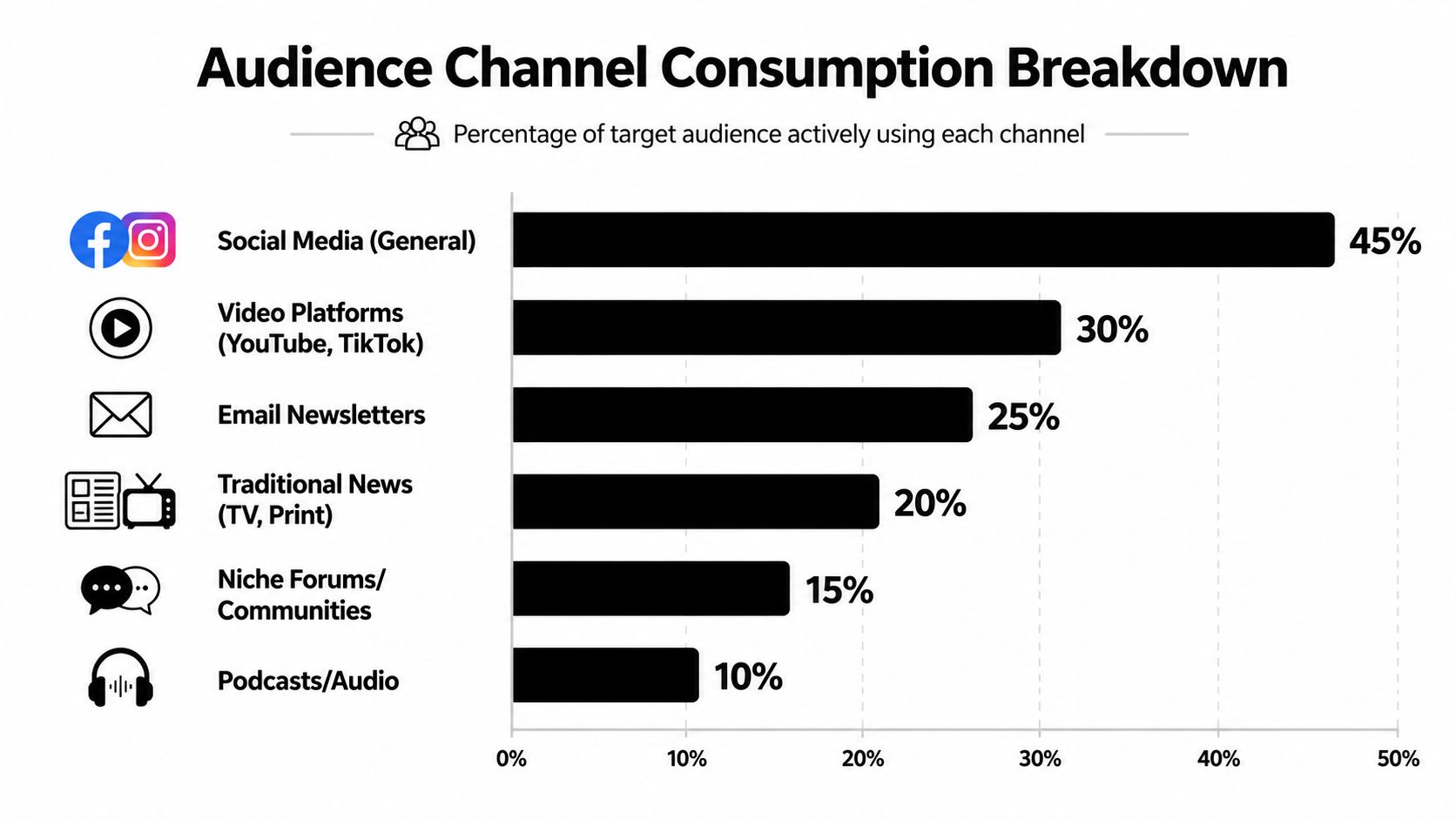
Map attention before writing the pitch
Audience fragmentation has to be measured for the specific public a release needs to influence. A B2B cybersecurity buyer, a local donor base, and a consumer beauty audience don't fragment in the same way. Yet many teams use one distribution pattern for all three.
Start with evidence already inside the organization:
- Referral traffic review: Google Analytics can show whether past announcement traffic came from search, direct visits, LinkedIn, niche publications, or email.
- Social engagement breakdown: Native analytics on LinkedIn, YouTube, Instagram, or X can show which topics and formats get attention from the audience that matters.
- CRM and sales feedback: Sales teams often know which publications, podcasts, or creators prospects mention during evaluation.
- Audience research tools: SparkToro, customer interviews, intake forms, and post-demo surveys can reveal what people read, watch, and trust.
One useful benchmark comes from younger audiences. One analysis reported that for Gen Z, no single channel exceeded 20% share of media time, with websites at 16.1%, YouTube at 15.5%, and TV at 14.0%, which implies that effective reach planning needs a four-to-five-channel baseline, according to OneElevate's analysis of fragmented media use.
That doesn't mean every brand should use five channels. It means teams shouldn't assume one channel can do the whole job.
Use unduplicated reach, not channel vanity
A common reporting mistake is adding channel metrics together as if they represent unique people. They often don't.
If the same executive sees a LinkedIn post, an industry newsletter mention, and a trade publication story, that may be excellent campaign reinforcement. But it isn't three separate people reached. That's why unduplicated reach matters. PR teams need to know where overlap is useful and where it creates waste.
A clean KPI set usually includes:
- Primary reach channels: Where first exposure is most likely
- Reinforcement channels: Where credibility and recall improve
- Action channels: Where the audience clicks, signs up, books, donates, or shares
- Search footprint: Whether the announcement produces discoverable assets after launch
Teams that need a stronger measurement structure can use frameworks like these press release KPIs for measuring performance.
A simple diagnostic table
| Audience question | What to check | Why it matters |
|---|---|---|
| Where do they first hear about companies like this? | Referral sources, surveys, sales notes | Identifies discovery channels |
| Where do they go deeper? | Time on page, webinar signups, repeat visits | Identifies owned content role |
| Who influences trust? | Journalists, creators, analysts, local leaders | Sharpens outreach targets |
| Which formats get attention? | Video completion, post saves, email clicks | Shapes the asset package |
| Where is overlap high? | Shared audience patterns across channels | Prevents wasted distribution |
Field note: If a team can't name the audience's top three trust environments, it isn't ready to distribute a release yet.
The point of measurement isn't theoretical neatness. It's to stop sending the same document into channels that require different stories, different timing, and different proof.
A Modern PR Framework for Fragmented Media
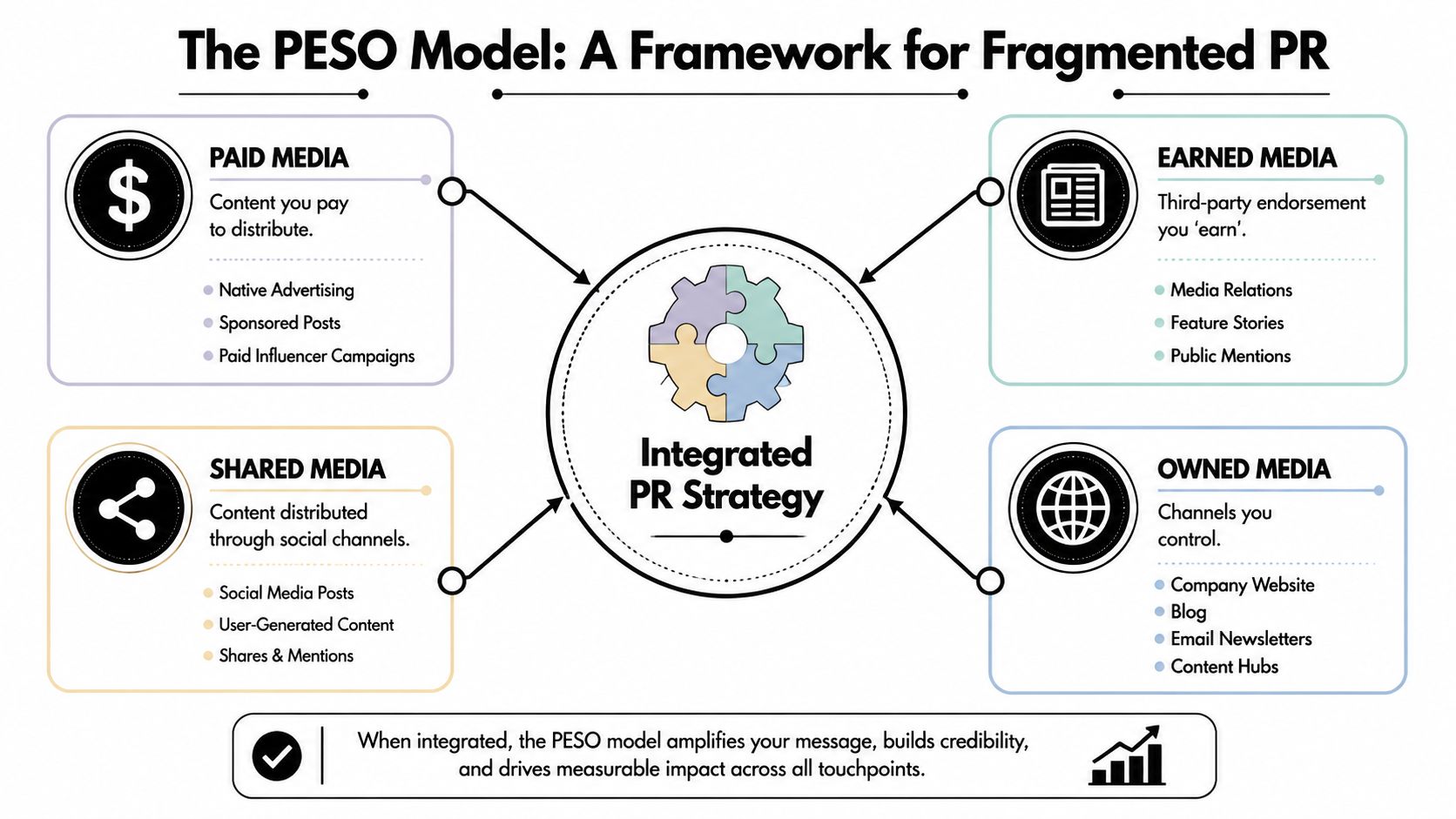
Once attention is scattered, PR needs a system that can hold the message together. The most practical framework for that is PESO, because it forces teams to coordinate paid, earned, shared, and owned media instead of treating each as a separate department problem.
Why PESO fits this environment
Fragmentation in media creates two simultaneous problems. First, no single channel reliably carries the whole campaign. Second, teams often overreact by scattering activity without coordination.
PESO solves that by giving each channel type a job. It also aligns with an important nuance in the research. A Reuters Institute cross-national study found that online news audiences were usually less fragmented than offline audiences, and that fragmentation varied sharply by country. That means digital audiences can still overlap meaningfully when campaigns are coordinated well, as explained in the Reuters Institute study on cross-national news audience fragmentation.
That finding matters for PR. It suggests digital doesn't always equal chaos. It can still deliver repeated exposure when the channels are chosen carefully.
How the four parts support one release
A release campaign works better when each PESO component does distinct work.
- Owned media holds the full story. This is the newsroom page, blog post, landing page, FAQ, executive statement, or resource center the brand controls.
- Earned media adds credibility. Journalists, newsletter editors, podcasters, and trade writers validate the announcement through third-party attention.
- Shared media carries social proof. Employee advocacy, customer reposts, founder commentary, community sharing, and creator mentions move the story through networks.
- Paid media fills the gaps. Sponsored LinkedIn posts, native promotion, boosted clips, or targeted retargeting can put the story in front of people who won't see it organically.
A useful release plan isn't "send wire, then post on social." It's closer to this sequence:
- Publish the complete owned asset set.
- Pitch earned angles by audience segment.
- Repurpose key lines and visuals for shared distribution.
- Use paid support where organic visibility is unlikely or too slow.
The message should stay consistent. The packaging shouldn't.
Teams often struggle because they expect earned media to do the awareness job, the education job, the conversion job, and the search job all at once. In fragmented conditions, that expectation breaks. PESO works because it spreads those jobs across the right channels.
Tactics and Templates for Multi-Channel Releases
The traditional release isn't dead. It's just incomplete. A single text document can't do the work that fragmented channels now demand.
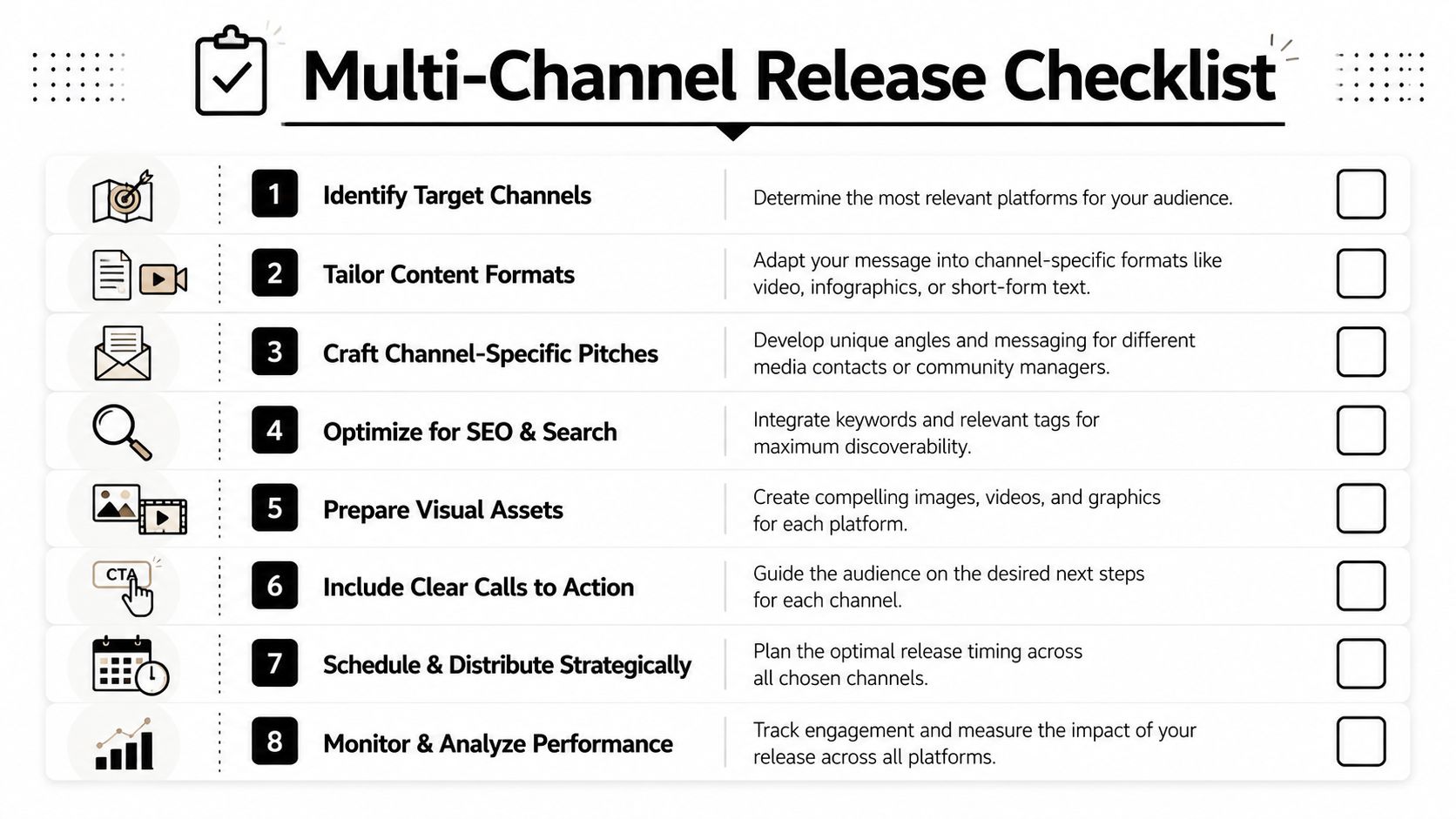
Build a press release asset package
The practical replacement is a press release asset package. One story. Multiple usable parts.
A strong package usually includes:
- Formal release: The standard announcement for the newsroom, wire service, and journalist reference.
- Short pitch variants: Separate email intros for trade press, local media, partner publications, and newsletter writers.
- Executive quote cards: Clean visuals for LinkedIn, X, and internal advocacy.
- Short video summary: A founder clip, spokesperson statement, demo snippet, or event invitation for social and landing pages.
- FAQ sheet: Useful for reporters, customer teams, and search visibility.
- Image set: Product screenshots, executive headshots, event photos, charts, or branded graphics.
- Landing page or blog version: A less formal, more contextual story hosted on owned media.
- Community copy: Short versions adapted for Slack groups, Discord communities, association forums, or local Facebook groups.
Many teams quickly become more effective. They stop asking one asset to perform eight jobs.
Channel matching works better than copy-paste distribution
Not every audience fragment has equal value. Research analyzing TV audience fragmentation found that a one-standard-deviation increase in fragmentation was associated with an 11% decrease in daytime broadcast advertising prices, but a 7% increase in prime-time prices, which shows that not all audience slices carry the same commercial value, according to the CUNY research on TV audience fragmentation and pricing.
The PR equivalent is straightforward. Some audience pockets are cheap to reach but weak in influence. Others are smaller but far more valuable. A niche trade newsletter read by buyers can outperform broad exposure in the wrong context.
That is why channel matching matters more than blanket distribution. Teams should adapt the story based on who needs to act next.
A simple decision framework helps:
| Channel type | Best use | Wrong use |
|---|---|---|
| Trade publication outreach | Credibility with a defined professional audience | Broad consumer awareness |
| LinkedIn organic and paid | Executive messaging, B2B reach, employee amplification | Local community mobilization |
| Email newsletter | Direct updates for existing subscribers and partners | Cold audience discovery at scale |
| Short video platforms | Humanizing launches, quick demos, event energy | Dense policy announcements without visual hooks |
| Community groups and forums | Trust-based niche sharing | Corporate copy pasted without adaptation |
For smaller organizations, this kind of coordinated rollout often overlaps with a broader effective SMB marketing approach, especially when PR, social, and email have to share the same limited resources.
A working template for launch day
A useful launch-day sequence often looks like this:
- Morning publish: Put the release, media kit, and landing page live.
- Targeted earned outreach: Send segmented pitches to the highest-fit contacts first.
- Executive social posts: Publish a leadership angle on LinkedIn and supporting short-form posts elsewhere.
- Direct stakeholder email: Notify customers, partners, donors, investors, or members with a customized message.
- Community distribution: Share adapted versions in relevant groups where the topic already belongs.
- Paid boost if needed: Support the strongest owned or earned asset, not the weakest one.
- Rapid follow-up: Answer journalist requests, update FAQs, and circulate pickup internally.
- Measurement review: Track which channels produced attention, trust signals, and next-step actions.
Teams that need a repeatable operational checklist can formalize this through a documented process for how to distribute a press release.
The release package isn't extra work for the sake of complexity. It's what makes the same core story usable in the places where the audience pays attention.
Your Fragmentation-Proof PR Plan in Action
A B2B SaaS company announcing a developer-facing feature shouldn't chase broad business coverage first. The smarter plan is narrower and more connected. The team publishes the formal release on its newsroom page, creates a technical blog post for owned media, gives the founder a concise LinkedIn post for executive audiences, and prepares a product clip for communities where practitioners discuss tools. The earned pitch to journalists focuses on market relevance. The version sent to developer newsletters focuses on workflow impact. The same announcement travels, but it doesn't travel in the same clothes.
A local nonprofit promoting a fundraising event uses the same logic at a smaller scale. It posts the release on its site, creates a short community-friendly event summary, prepares image assets for neighborhood groups, and sends a local angle to city bloggers and regional news desks. Board members share a personal version through their own networks. A local sponsor gets prewritten copy to extend reach. The organization doesn't need mass national attention. It needs the right local overlap.
Those examples point to the core mindset shift. A release is no longer a finished product when the text is approved. It's finished when the organization has built the supporting assets, chosen the right channels, and defined what success looks like in each one.
Fragmentation in media doesn't make PR impossible. It makes lazy distribution impossible. Teams that map audience attention, use a coordinated framework, and build channel-specific assets still get noticed. Often, they get noticed more efficiently because they're no longer wasting effort on the wrong rooms.
Press Release Zen helps teams turn announcements into workable PR campaigns with practical guides, templates, and distribution advice. For communicators who want clearer release structure, stronger outreach, and better execution across channels, Press Release Zen is a useful place to start.