AI Overviews now appear for about 21% of keywords, and 97% of those answers cite at least one source from pages already ranking in the top 20 organic results, according to an industry synthesis on AI SEO. That changes press release strategy fast, because visibility in AI answers is still tied to real authority, not just polished wording. For PR teams, ai search engine optimization is no longer a side project, it's part of how news gets discovered, summarized, and credited.
Press releases used to be judged mostly by pickup, backlinks, and newsroom indexing. Now they also need to be written for systems that extract facts, compare sources, and decide whether a page deserves to be cited in an answer box or summary panel. That means the job isn't only to publish faster. It's to publish in a format that AI can parse, trust, and reuse.
Table of Contents
- Why AI Search Changes the Press Release Game
- How AI Search Systems Evaluate and Cite Content
- Traditional SEO Signals Versus AI Ranking Factors
- Optimizing Press Releases for AI Citation and Visibility
- The Off-Site Reputation Factor Most Guides Miss
- Measuring AI Visibility and Managing Ethical Risks
- Your AI-Optimized Press Release Workflow
Why AI Search Changes the Press Release Game
The volume shift is already visible in the search layer. One 2026 market summary says monthly AI sessions are now 56% the size of traditional search globally and 34% in the U.S., while search-related AI prompts account for 28% of search volume worldwide and 17% in the U.S. A separate industry source reports that Google's AI Overviews reached 2 billion monthly users and that AI search referrals grew 527% year over year (Position Digital). For communications teams, that's not an abstract trend line, it's a redistribution of attention.
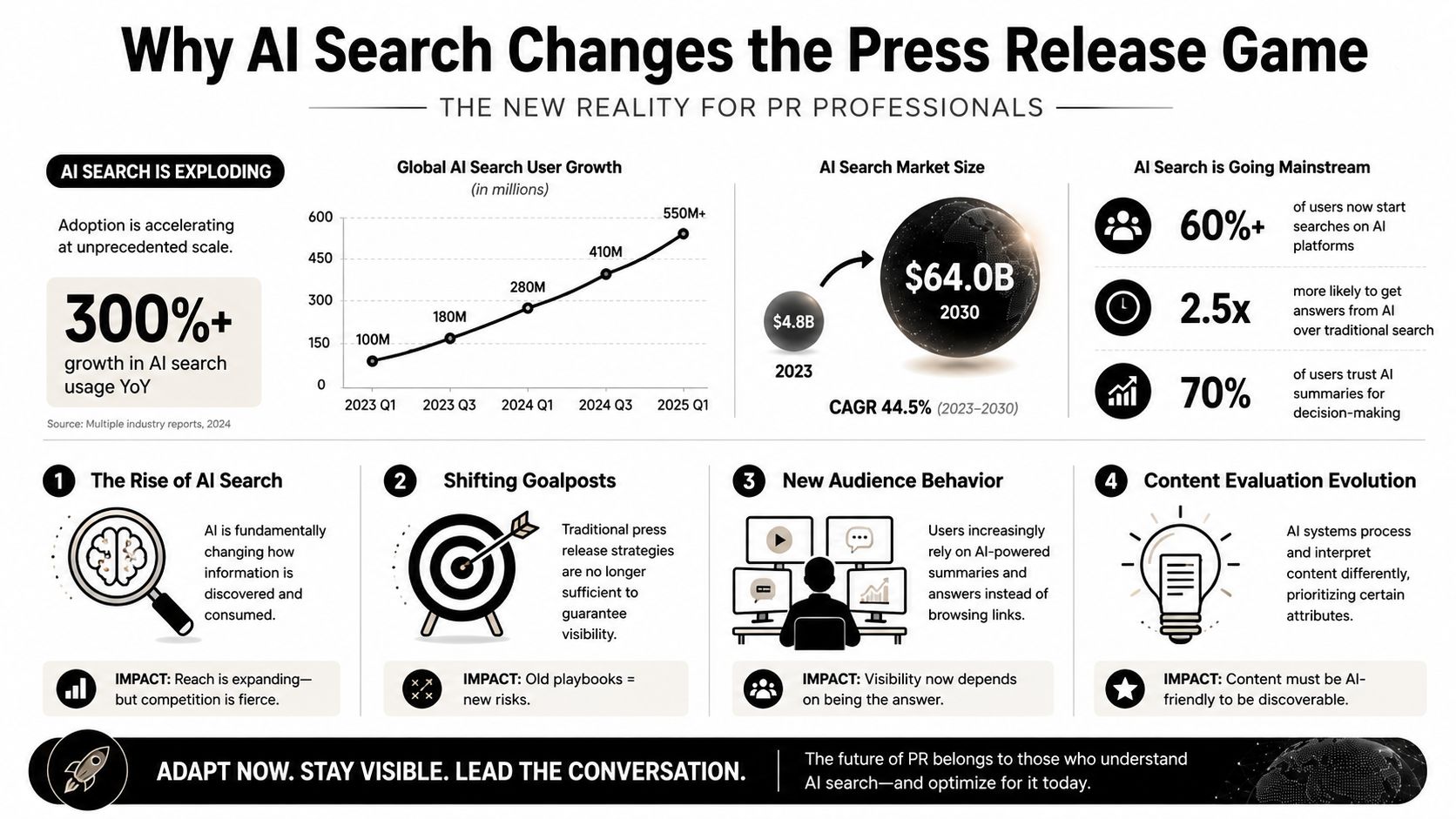
Discovery now starts before the click
A press release can do everything right for a traditional newsroom and still lose visibility if the answer is delivered upstream in Google, Copilot, or another generative interface. That's the core shift. Users are getting the gist before they ever land on a brand page, which makes the release itself, not just the distribution, a discovery asset.
Practical rule: if a release can't be summarized cleanly in one or two sentences, AI systems are less likely to extract it well.
The bigger implication is that PR distribution can't rely on syndication alone. Placement on a wire service still matters, but the release also has to earn its way into organic search and into AI surfaces that favor concise, factual, query-aligned content. In practice, that pushes teams toward stronger headlines, cleaner structure, and messages that answer a recognizable question.
Newsworthy doesn't automatically mean citeable
A release can be important and still be poor AI fodder. If the announcement is buried in jargon, padded with boilerplate, or wrapped in vague brand language, AI systems have less to work with. They can summarize a topic without citing the brand, or they can lean on a competitor's cleaner explanation instead.
That's why press release strategy now sits closer to editorial SEO than many PR teams are used to. Topical depth, crawlability, and clear informational intent matter because AI search currently favors content that explains something, not just promotes something. Educational releases, product explainers, funding announcements with real context, and data-led updates often have more AI potential than generic promotional copy.
Press teams that adapt early get a second benefit. They don't just improve AI visibility for one release, they create a distribution pattern that helps future announcements get indexed, understood, and cited more reliably. That compound effect is where ai search engine optimization starts to look like a core PR competency instead of a technical add-on.
How AI Search Systems Evaluate and Cite Content
Google says a page must be indexed and already eligible to appear in Google Search with a snippet before it can qualify for generative AI features in Search. Google also recommends crawling best practices, semantic HTML, and JavaScript SEO best practices for script-rendered content (Google Search Central). That matters for press releases because the AI layer doesn't rescue a page that search can't see in the first place.
Indexability comes first
If a press release page is blocked, hidden behind a script-heavy template, or stripped of snippet eligibility, AI systems have less chance of using it. Google's guidance is blunt on that point. The page has to be reachable, readable, and structured enough for search to understand it.
A release that looks good in a CMS preview can still be invisible to AI if the crawlable HTML is weak.
That's why server-side rendering and clean HTML are not niche technical preferences. Independent AI-search guidance notes that AI crawlers often work with tighter time budgets than Googlebot, so raw HTML delivery, JSON-LD schema, and fast load times can affect whether content gets parsed before the crawler gives up (Amsive). For PR teams publishing on tight deadlines, that means the publishing stack is part of the message.
Parsability decides whether facts get extracted
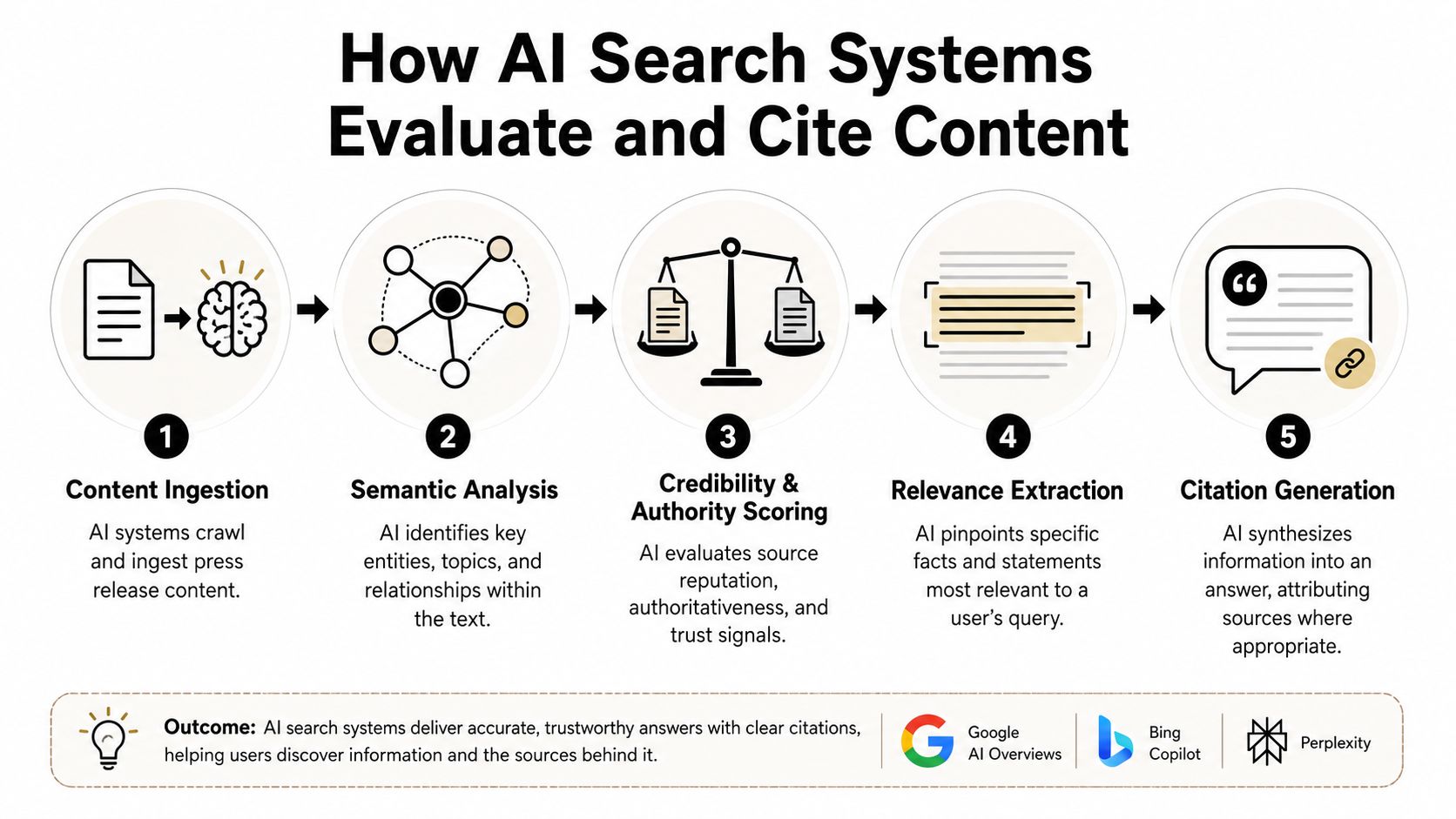
Once a page is crawlable, AI systems break it into smaller units. They look for entities, relationships, and language that can be reused in an answer. A release with a clean headline, one-sentence summary, quote blocks, and bulleted facts gives them obvious chunks to work with. A long wall of prose forces the system to do more reconstruction, which weakens citation odds.
A useful way to think about it is this sequence:
- Ingestion. The release is crawled and stored.
- Semantic analysis. Entities, dates, and relationships are identified.
- Authority scoring. The source is weighed against other available pages.
- Relevance extraction. The specific answerable facts are selected.
- Citation generation. The system assembles the answer and chooses sources where appropriate.
That process is why concise structure beats decorative writing. It also explains why a release buried on a cluttered page often underperforms a simpler page hosted on a clearly indexed newsroom or wire destination.
For tracking whether a release is showing up in AI answers, a useful outside reference is see your brand in AI answers from AI SEO Tracker. It's more practical than generic visibility talk because it focuses on the citation layer, not just rank positions.
Traditional SEO Signals Versus AI Ranking Factors
The biggest mistake in this space is treating AI search like a clean break from SEO. It isn't. The data says otherwise. 97% of AI Overview answers cite at least one source from pages already ranking in the top 20 organic results, which means AI visibility still leans heavily on traditional authority signals (SEOProfy). AI search changes the selection layer, but it doesn't erase the SEO foundation.
| Factor | Traditional SEO | AI Search Optimization |
|---|---|---|
| Discoverability | Crawlable pages, backlinks, and rankings | Indexable pages, snippet eligibility, and parseable structure |
| Core signal | Keywords and authority | Authority plus information gain and semantic clarity |
| Content shape | Page-level optimization for ranking | Modular, extractable facts that can be cited |
| Success measure | Clicks, rankings, and traffic | Citations, inclusion in answers, and answer share |
| Best press release use | News dissemination and link acquisition | Citable source for factual, informational queries |
What stayed the same
Press releases still need a real news hook. They still need to be easy to crawl, internally linked, and published on pages with enough authority to compete. They still need clean copy, because search engines and AI systems both hate ambiguity.
That's why the classic release checklist hasn't become obsolete. It's become the entry requirement. Strong metadata, a sensible URL, and a recognizable publishing domain still matter because AI systems are not selecting from a blank slate. They're choosing from content that already proved itself in organic search.
What changed
AI search rewards answerability. That means a release can't just announce something, it has to make it easy for a system to quote the important part. Product launches need concise definitions. Funding releases need actual use cases. Executive announcements need a clear role explanation, not a vague career victory lap.
The other change is information gain. Google's evolving AI search guidance stresses clear structure and helpfulness, while industry guidance increasingly emphasizes unique insight, proprietary data, and expert analysis that go beyond obvious summaries (Google Search Central Blog). In practical terms, a release that repeats what everyone already knows is easier for AI to paraphrase than to cite.
That's the new editorial test for press teams. Does the release contribute something new enough to deserve extraction? If not, it may still distribute well, but it won't necessarily earn AI visibility. The bar is higher, and it's about usefulness, not just polish.
Optimizing Press Releases for AI Citation and Visibility
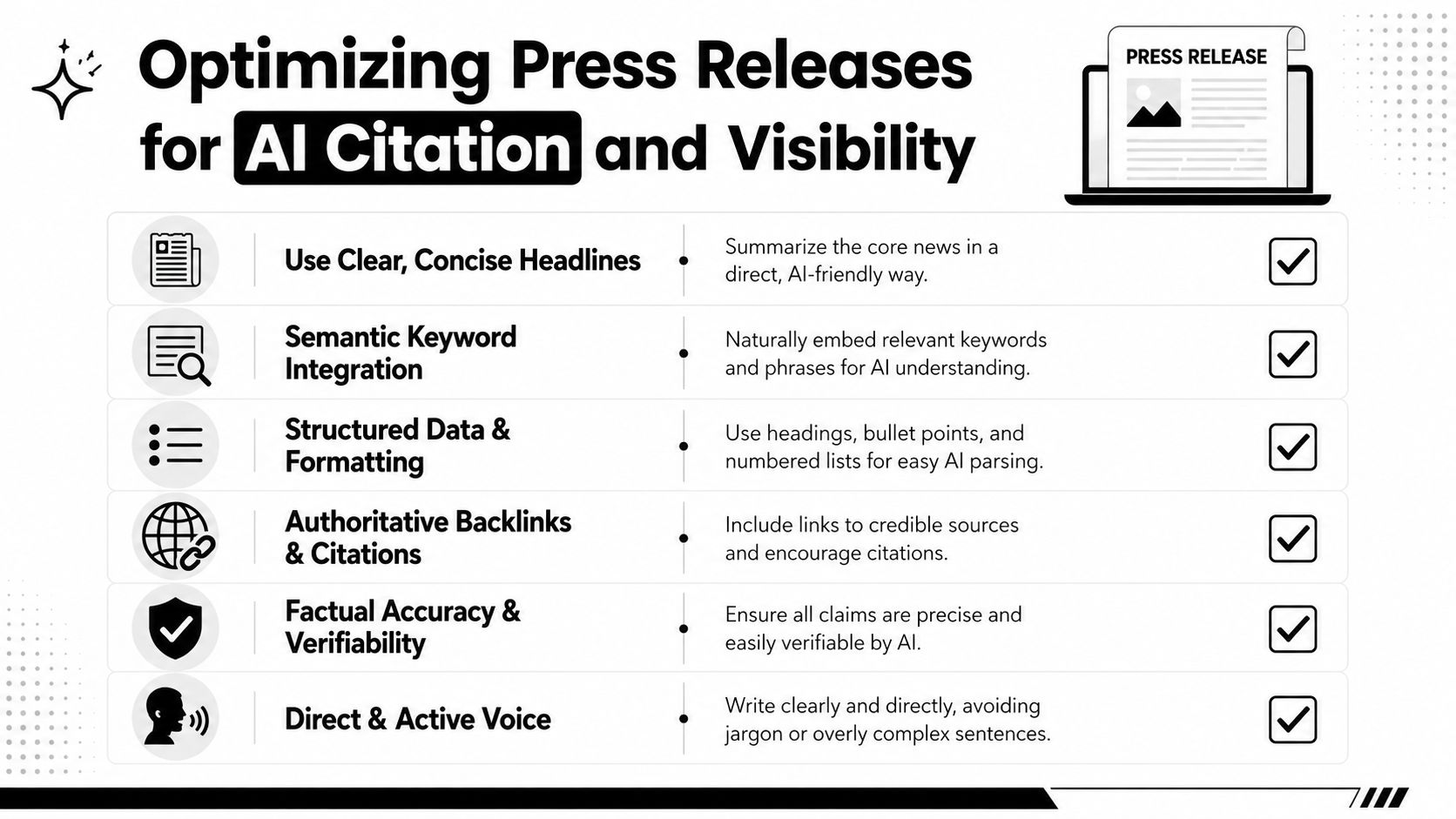
A press release optimized for AI search should read like a clean answer source, not a brand brochure. The headline has to tell the truth fast. The lede has to state the news in plain language. The body has to use entity names, relationships, and facts that AI can isolate without guessing.
Start with extractable structure
Headlines should summarize the core event directly, not theatrically. The first paragraph should answer who, what, where, and why it matters. Then the release should move into supporting details that reinforce the same topic rather than wandering into boilerplate.
Structured formatting helps a lot. Headings, bullets, short paragraphs, and clear attribution make the page easier for AI systems to slice into usable pieces. That's one reason many teams now treat a release as both a media asset and a structured content object.
A practical optimization hierarchy looks like this:
- Lead with the news. Put the core announcement in the first two sentences.
- Use named entities early. Brands, products, locations, and people should appear plainly.
- Add factual detail. Give AI something concrete to extract, not just adjectives.
- Keep quotes functional. A quote should clarify meaning, not repeat the headline.
- Close with context. Link the announcement to a broader business change or market need.
Schema and metadata are not optional extras
JSON-LD schema can help search engines understand the release type, organization identity, and relevant entities. Metadata helps define the page before the body copy is even parsed. Title tags, meta descriptions, and Open Graph tags all contribute to how the release is interpreted and displayed.
For teams that want a deeper process reference, content for software agency founders from 100Signals is useful because it treats AI visibility as a publishing and packaging problem, not just a keyword problem. That mindset translates well to PR teams that need releases to work across wires, search, and social previews.
The same logic applies to internal resources like Press Release Zen's SEO-focused press release guide, which can help teams align release structure with search visibility without turning every announcement into dry SEO copy. One Press Release Zen angle that's relevant here is its library of news article templates and guides for AI searches, which fits this shift toward citation-ready writing.
Publish something worth citing
A release that merely restates a press kit is easy to ignore. A release that includes a useful statistic, a precise explanation, or a genuinely new angle has a better chance of being surfaced. That's where PR and SEO finally overlap in a useful way.
The trade-off is real. More structure can make the writing feel less glossy, but it also makes the page more legible to AI systems. The goal isn't to flatten the voice. It's to make the voice easy to parse.
The Off-Site Reputation Factor Most Guides Miss
McKinsey notes that AI-powered search answers are built from owned content, third-party content, and communities (McKinsey). That single point should reset how PR teams think about citation eligibility. A press release can be technically perfect and still miss out if the wider web doesn't reinforce the brand's credibility.
AI doesn't trust only your newsroom
Reddit threads, forum posts, review sites, and trade coverage all feed the environment AI systems draw from. If a brand's name appears consistently in trustworthy places, it has a better chance of being recognized as relevant. If the brand only speaks on its own website, the evidence base is thinner.
What matters most: off-site consistency often does more for AI trust than another paragraph of branded copy.
That's especially important for announcements that depend on reputation, like executive hires, partnerships, launches, or crisis responses. A clean release helps, but AI systems also look for external confirmation. They may prefer a trade article, a community discussion, or a review page that repeats the same entities and relationships in a different context.
PR, SEO, and community management need to coordinate
The primary operational gap is usually coordination. McKinsey's recommendation for cross-functional GEO capability points to the same problem many PR teams already feel: measurement is scattered, and responsibility is fragmented. One team publishes the release, another handles social, and a third watches search, but nobody owns the full citation footprint.
A tighter workflow helps:
- Monitor Reddit, forums, and review sites for brand mentions.
- Align executive bios, About pages, and release bylines so entities match.
- Earn trade mentions that reinforce the same claim made in the release.
- Respond to inaccurate summaries quickly, especially when a release touches sensitive topics.
That's where an internal page like Press Release Zen's press release for SEO guide can be useful as a practical reference point for teams trying to connect release writing with search strategy. The important lesson is simple. AI visibility is a reputation system as much as a content system.
Measuring AI Visibility and Managing Ethical Risks
AI visibility is still hard to measure cleanly. There's no universal dashboard that says a press release was cited in every answer engine. That leaves teams with a patchwork of manual checks, third-party tools, and prompt-based audits.
A practical monitoring approach starts with a prompt set. Track a mix of branded and unbranded queries, then compare results across Google AI Overviews, Bing Copilot, ChatGPT, and Perplexity. Look for whether the release itself appears, whether the brand is named, and whether the answer credits the right source.
Measurement has to be cross-platform
Teams should not rely on a single query set or one browser profile. AI systems can personalize results based on account history, geography, or session context, so spot-checking from multiple environments gives a better picture. Manual review still matters because the citation layer is often invisible inside standard analytics.
The ethical risk sits right next to the measurement problem. If a release contains vague language, a wrong date, or an inflated claim, AI systems can repeat it widely. Attribution gaps are just as damaging, because a system may summarize a brand's work without clearly naming the source. Both cases can distort reputation quickly.
Simple standard: if a fact can't be defended in a media interview, it shouldn't be buried in a press release.
That's why factual accuracy matters more under AI search than it did under traditional distribution. A thin claim can spread faster when a summary engine lifts it. The safest releases are the ones with clear sourcing, plain language, and no loose statements that invite misreadings.
For teams building a monitoring routine, the best blend is usually manual review, citation tools, and a recurring prompt audit. Add a human review step for sensitive announcements, especially anything involving executive changes, product claims, or regulated industries. The goal isn't perfect measurement. It's reducing surprise.
Your AI-Optimized Press Release Workflow
The cleanest workflow starts before the draft. Teams should identify the exact informational question the release needs to answer, then shape the announcement around that question. If the answer is fuzzy, the AI visibility usually is too.
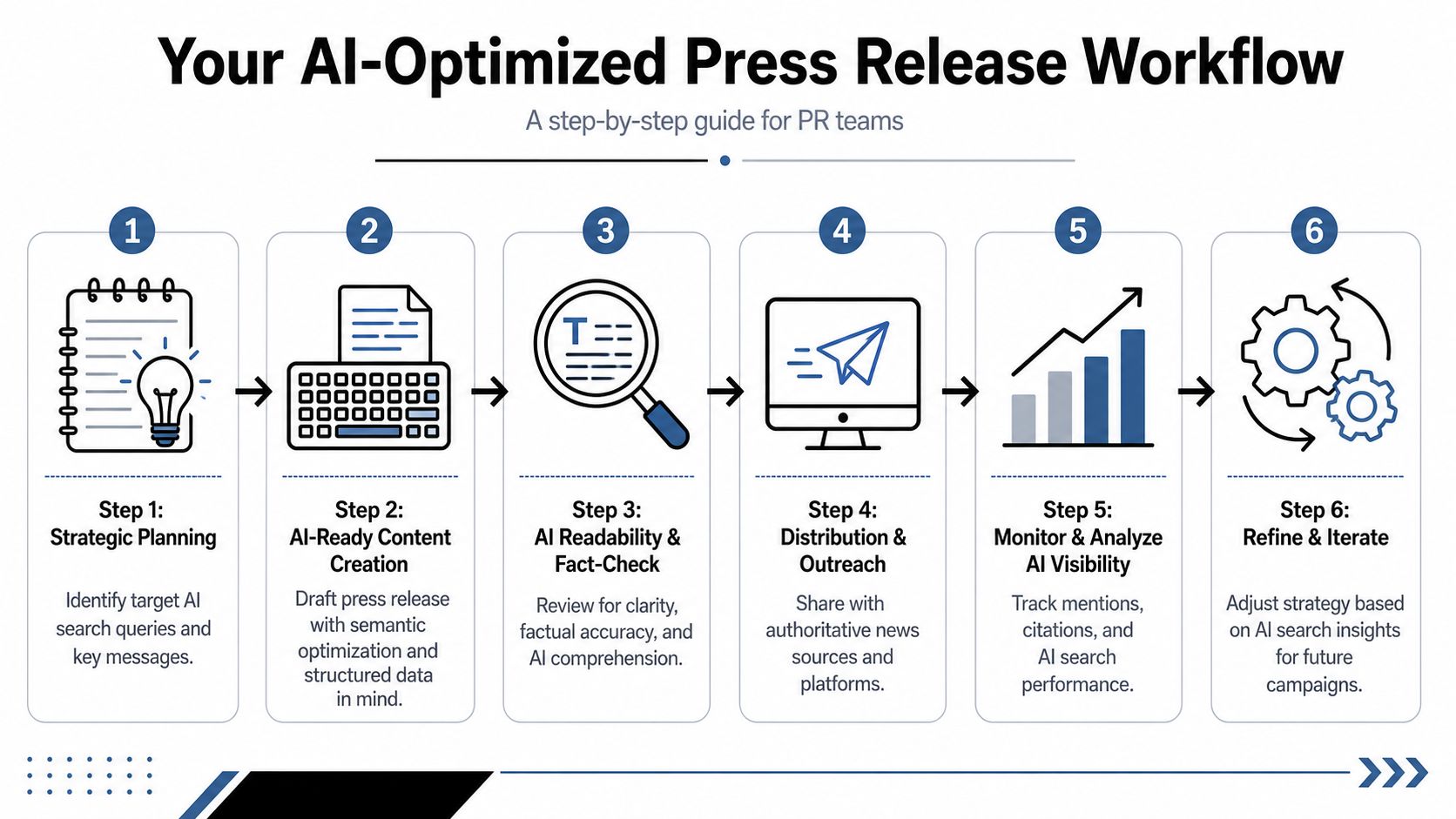
Build the release in six checkpoints
- Strategic planning. Define the news angle, target query, and key entities before drafting.
- AI-ready drafting. Write the headline, summary, and body in a structure that can be parsed cleanly.
- Fact-check and readability review. Remove jargon, verify claims, and tighten any sentence that hides the point.
- Distribution and outreach. Publish through authoritative channels and support the release with consistent earned media.
- Visibility monitoring. Check AI answers, search snippets, and referral patterns after distribution.
- Iteration. Update templates, schema, and structure based on what was cited and what was ignored.
A useful drafting prompt for teams is simple: write the release so the first paragraph can stand alone as a factual summary, then make every later paragraph support that summary with one distinct detail. That keeps the page modular without making it robotic.
Use templates, but don't let them flatten the story
Templates help with consistency. They also reduce formatting errors, which matters for crawlability and snippet extraction. But overused templates can make releases sound interchangeable, and AI systems don't need more generic copy.
The best teams treat templates as scaffolding, not final copy. They use them to lock in the structure, then customize the facts, entities, and supporting detail. That balance is especially important for recurring announcements like launches, funding rounds, leadership moves, and event recaps.
A final internal resource that fits this workflow is Press Release Zen's AI prompt guide for press releases. It's relevant because prompt discipline and release structure are starting to converge, especially when teams want their content to be easy for humans and AI systems to understand.
Press Release Zen helps teams turn announcements into structured, search-aware assets with guides, templates, and practical publishing advice. For PR teams adapting to AI search engine optimization, it offers a useful place to build cleaner releases, sharper metadata, and better distribution habits. Visit Press Release Zen to explore resources that can support your next AI-ready press release.