At 8:12 a.m., the issue still looks containable. A customer complaint is gaining traction on LinkedIn. By 9:00, employees are forwarding screenshots internally. By lunch, a reporter has emailed for comment, a board member wants talking points, and the CEO is asking whether the company should post, wait, apologize, or say nothing.
That's the moment many organizations realize they don't have a communications problem. They have a decision problem under pressure.
A crisis communications specialist steps into that gap. Not as a magician, and not as a public-facing spin doctor. The role is closer to a calm navigator in rough weather. This person helps leadership decide what must be said, what can't be said yet, who needs to hear from the company first, and how to keep one bad day from becoming a lasting trust problem.
For teams that haven't built that muscle, the first hours feel chaotic. Legal wants caution. Marketing wants speed. HR wants employee guidance. Executives want certainty that rarely exists at the start of a crisis. A specialist brings process to that uncertainty.
Leaders who need a primer on the discipline itself can start with this overview of what crisis communications means in practice. The more urgent question is how to use the role before, during, and after a real event.
Table of Contents
- Introduction When the Unthinkable Happens
- What a Crisis Communications Specialist Actually Does
- Core Skills That Separate an Expert from a Novice
- When to Engage a Specialist Proactive vs Reactive Hiring
- The Crisis Playbook Key Components and Templates
- After the Crisis Measuring Impact and Leading Recovery
- Frequently Asked Questions About Crisis Communications
- Is a crisis communications specialist different from a PR manager
- Should a small business hire one before anything goes wrong
- What should a company do first if a crisis starts today
- What makes hiring decisions go wrong
- Can an aspiring communicator move into this specialty
- Does every organization need a full crisis playbook
Introduction When the Unthinkable Happens
A crisis rarely arrives as a neatly labeled event. It often starts as noise. One angry post. One customer allegation. One internal complaint that leaks outside. One technical failure that customers describe more vividly than the company ever could.
Most leadership teams lose time at this stage because they're trying to answer the wrong question. They ask, “How bad is this?” when the better question is, “What decisions must be made in the next hour?” That shift matters because the early window is about containment, clarity, and sequence.
A crisis communications specialist helps leaders work that sequence. First, identify who is affected. Next, determine what's confirmed and what's still under review. Then align the company's public position with legal reality, operational facts, and stakeholder expectations. That sounds simple until multiple audiences need different versions of the same truth at the same time.
Practical rule: The first communication decision isn't whether to publish a polished statement. It's whether the organization knows enough to issue a credible holding response without creating a second problem.
The companies that handle crises well usually look composed from the outside because they've already decided who leads, who approves, and which channels matter most. The rest scramble in public.
What a Crisis Communications Specialist Actually Does
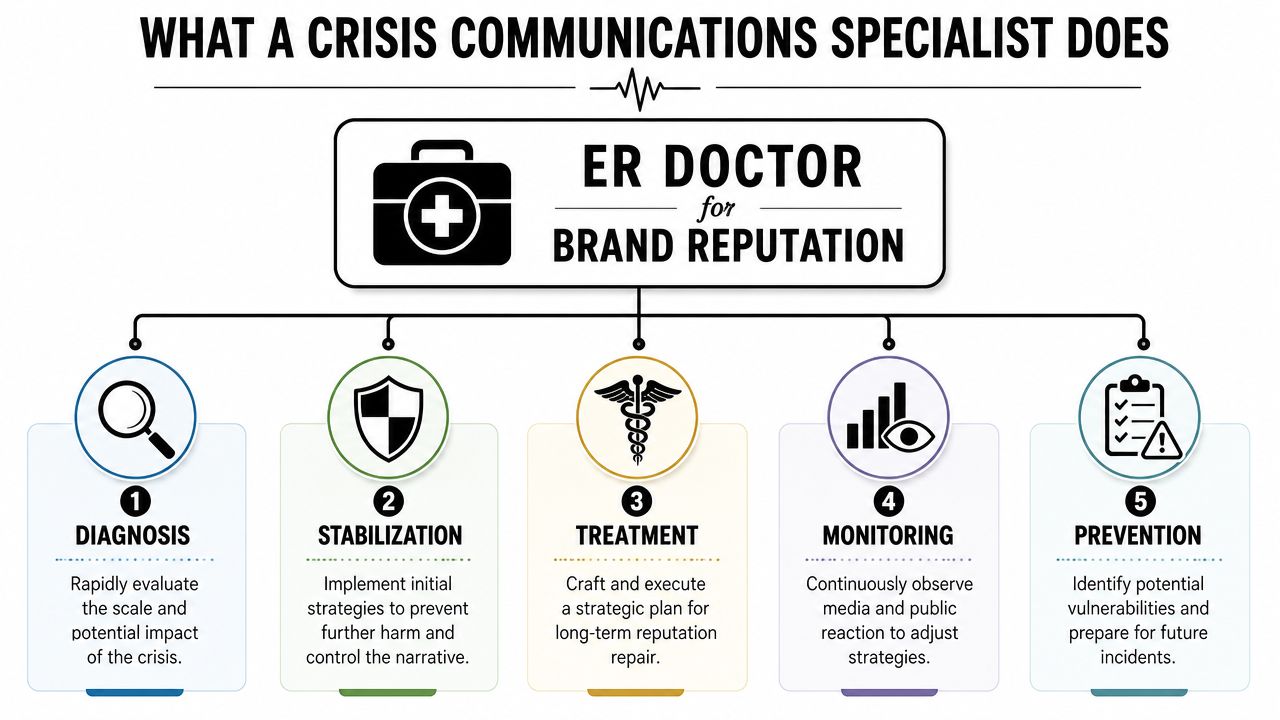
A crisis communications specialist is the ER doctor for brand reputation. The specialist doesn't perform every function alone, but does assess severity, stabilize the situation, communicate with stakeholders, and guide recovery.
Crisis communication is formally recognized as a distinct sub-specialty of public relations, and modern theory emphasizes rapid detection, response, and recovery. The field also treats the pre-crisis stage as part of the job, not an optional extra, with trained teams monitoring risks before an incident escalates, as outlined in the crisis communication overview.
Pre-crisis work that prevents bad decisions
The most valuable work often happens before anything goes wrong. A specialist maps likely scenarios, pressure-tests approval workflows, identifies spokespersons, and builds draft language for high-risk events.
This is also where teams decide how facts move. Who confirms operational details. Who signs off on legal wording. Who can pause scheduled posts. Who informs employees before they hear the news from outside sources. Without those answers, companies waste time negotiating authority in the middle of the event.
For organizations that need rapid internal video updates during a live issue, a practical tool can help. A video production app can support quick executive explainers, employee briefings, or customer updates when written statements alone won't carry enough clarity.
What happens when the crisis is live
Once the issue breaks, the specialist becomes a traffic controller. Not every message should go out at once, and not every audience needs the same level of detail.
Typical live-crisis responsibilities include:
- Assessment: Determine whether the issue is operational, reputational, legal, or all three.
- Message control: Draft a holding statement, talking points, FAQs, and spokesperson guidance.
- Channel alignment: Keep website updates, media responses, employee guidance, and social replies consistent.
- Escalation management: Surface new facts quickly so leadership can adjust the response before contradictions appear.
What doesn't work is treating the statement as the strategy. The statement is only one output. The core work is coordinating facts, timing, approvals, and audience expectations.
A weak response usually fails in one of two ways. It says too little for too long, or it says too much before the facts are ready.
Recovery work after the headlines fade
After the immediate pressure passes, the specialist's work shifts from response to repair. That includes documenting what happened, identifying where decisions slowed down, and revising templates, contact trees, and approval rules.
Recovery also has a reputational side. Stakeholders want evidence that the organization learned something. That may mean a leadership note, updated customer guidance, revised internal processes, or a more visible escalation path for future concerns.
The strongest specialists don't just help companies survive the incident. They make the next one easier to manage.
Core Skills That Separate an Expert from a Novice
This isn't junior PR with a more dramatic job title. One job-description template notes that employers typically look for 5+ years of experience in crisis communications, public relations, or reputation management, often in an agency or high-growth corporate setting, as shown in this crisis communications specialist role description. That requirement reflects the level of judgment involved when someone must coordinate executives, legal counsel, media relations, and internal teams under deadline.

Strategic judgment
An expert sees the second-order effect. A novice hears “issue a statement” and starts writing. A specialist asks what that statement commits the company to, which stakeholders must hear first, and whether the wording will hold up if new facts emerge later.
Strategic judgment includes knowing when not to overcommunicate. If a company speculates too early, it may create inconsistency between public statements and later findings. If it waits too long, others define the story first. The specialist helps leadership find the narrow path between those mistakes.
Useful signs of real strategic ability include:
- Executive fluency: The person can brief a CEO in plain language, not jargon.
- Risk prioritization: They know which issues are reputationally survivable and which ones can trigger wider scrutiny.
- Stakeholder sequencing: They understand when employees, customers, partners, or regulators need priority.
Tactical control
Crisis work is also highly technical. The specialist must write fast without sounding rushed, simplify legal input without distorting it, and create message consistency across formats.
That means producing materials such as:
- Holding statements that acknowledge the issue without overcommitting.
- FAQs that answer the obvious next questions.
- Press guidance that gives reporters usable information instead of defensive filler.
- Internal notes that tell managers what to say to teams and what to escalate.
A novice often writes for one audience at a time. An expert writes a system of messages that stays coherent across email, social, media outreach, and executive remarks.
Field note: Strong crisis writing is usually shorter than marketing writing, clearer than legal drafting, and more disciplined than executive instinct.
Interpersonal fortitude
Pressure exposes temperament. Some communicators freeze. Others become combative. Neither helps.
A strong crisis communications specialist can sit between legal caution and executive impatience without losing control of the process. That requires empathy, negotiation skill, and the ability to challenge senior people politely but firmly. The role also demands emotional steadiness. Teams borrow calm from the person who appears to know what happens next.
The hard skill underneath that calm is translation. Experts routinely convert technical investigations, policy language, and attorney feedback into plain English that customers, staff, and journalists can understand.
When to Engage a Specialist Proactive vs Reactive Hiring
Most companies hire late. They wait until the issue is public, the inbox is flooded, and leadership wants immediate answers. That's understandable, but it's rarely efficient.
A crisis communications specialist often has to coordinate messages across media, employees, regulators, and the public while monitoring sentiment and press inquiries to keep communication channels synchronized, as described in this overview of cross-channel crisis communications coordination. That kind of coordination is easier to build in advance than in the middle of a live event.
The proactive model
A proactive engagement works like insurance, except it's operational rather than financial. The specialist helps the organization identify likely risks, train spokespeople, define approval paths, and prepare core materials before the first urgent call comes in.
This model fits organizations that have one or more of these conditions:
- Visible leadership: Founders, executives, or public-facing experts whose behavior can quickly become company news.
- Regulated operations: Industries where legal exposure and public scrutiny tend to overlap.
- Lean internal teams: Marketing or comms staff who can run day-to-day work but not a full live-crisis operation.
- Frequent announcements: Businesses that already operate in the press, on social channels, or with active customer communities.
For teams evaluating outside support, this guide to choosing a crisis communications agency is a practical reference point.
The reactive model
Reactive hiring happens when the issue is already underway. A board asks for outside help. Internal staff are overloaded. The CEO wants an experienced operator who's handled similar pressure before.
This can still work. An experienced specialist can quickly create order, establish a command structure, and stop the organization from making avoidable errors. But reactive hiring comes with real trade-offs. The specialist has less context, less trust with leadership, and less time to prepare stakeholder-specific messaging.
The other problem is cultural. In the middle of a crisis, some leaders want expert advice but resist expert process. They keep too many approvers, improvise on social, or bypass the agreed spokesperson. That's where outside help stalls.
How to choose the right setup
The right model depends on risk exposure, internal maturity, and budget discipline.
A simple comparison helps:
| Hiring model | Best fit | Main advantage | Main limitation |
|---|---|---|---|
| In-house specialist | Organizations with regular public scrutiny | Institutional knowledge and faster internal access | Harder to justify if crises are infrequent |
| Agency retainer | Mid-size or growing organizations | Broader bench and simulation support | Less day-to-day immersion |
| Independent consultant | Smaller teams or targeted needs | Senior expertise without full agency scope | Limited bandwidth if multiple issues hit at once |
When vetting candidates or firms, leaders should ask practical questions, not generic ones.
- Scenario depth: What kinds of crises has the specialist managed?
- Approval discipline: How do they keep review cycles from collapsing under pressure?
- Channel handling: How do they coordinate employee, media, and social communication without drift?
- Post-crisis rigor: What does their debrief process look like after the event?
A good answer sounds operational. A weak answer sounds polished.
The Crisis Playbook Key Components and Templates
A crisis playbook is not a binder that sits untouched until a disaster. It's a working system for making sound decisions quickly. The most impactful technical work in this role is building a pre-approved message architecture through risk assessments, scenario simulation, and stakeholder-specific workflows, because that preparation improves response speed, consistency, and transparency, as explained in this guide to crisis communication planning and message architecture.

The components that matter most
Many playbooks fail because they're too abstract. They describe principles instead of giving teams usable tools. A strong playbook includes specific documents, named owners, and approval rules.
The essentials usually include:
- Crisis response team sheet: Names, roles, backup contacts, and decision authority. This should answer who leads, who approves, and who steps in if someone is unavailable.
- Holding statement library: Draft language for common scenarios such as service disruption, executive misconduct allegations, workplace incidents, product complaints, or data-related concerns.
- Message architecture template: Core message, supporting facts, known unknowns, proof points, and audience adaptations.
- Spokesperson matrix: Which leader speaks to media, which one addresses employees, and who should remain off-camera.
- Monitoring protocol: What the team watches, who logs developments, and how false claims are escalated for response.
- Internal cascade plan: The order for informing board members, executives, managers, and frontline teams.
One useful external reference for building this material is this set of newsroom-tested crisis comms advice that focuses on planning under real media pressure.
The playbook should reduce thinking time, not replace thinking. If a template forces a bad response, the template is wrong.
Organizations that want a starting point can also review this sample crisis communication plan, which shows how a structured template can support faster drafting and cleaner internal alignment.
Sample crisis response timeline
The first day needs sequencing. A simple timeline keeps everyone from working at cross-purposes.
| Timeframe | Key Actions | Lead |
|---|---|---|
| T+0 | Confirm the incident, pause scheduled content if needed, alert the response lead, begin fact gathering | Crisis lead |
| T+1 hour | Draft and approve holding statement, brief executives, prepare employee guidance, assign media monitoring | Communications lead |
| T+6 hours | Update public channels if needed, answer priority inquiries, refine FAQs, document open issues and next actions | Specialist with legal and operations |
| T+24 hours | Review stakeholder reactions, adjust messages, brief leadership on risks, plan follow-up communications | Executive team and specialist |
What good templates actually look like
A useful holding statement is short and disciplined. It acknowledges awareness, states what is being assessed, identifies the audience's concern, and promises an update when facts are verified.
A useful FAQ does something different. It anticipates emotional and practical questions: What happened, who is affected, what should people do now, and when will the company share more?
A useful message map is tighter still. It identifies one core position and prevents each department from inventing its own version. That's often the difference between a company that looks coordinated and one that looks split internally.
Teams should review the playbook regularly. Leadership changes. Approval chains drift. Contact lists go stale. The document only works if it matches the actual organization.
After the Crisis Measuring Impact and Leading Recovery
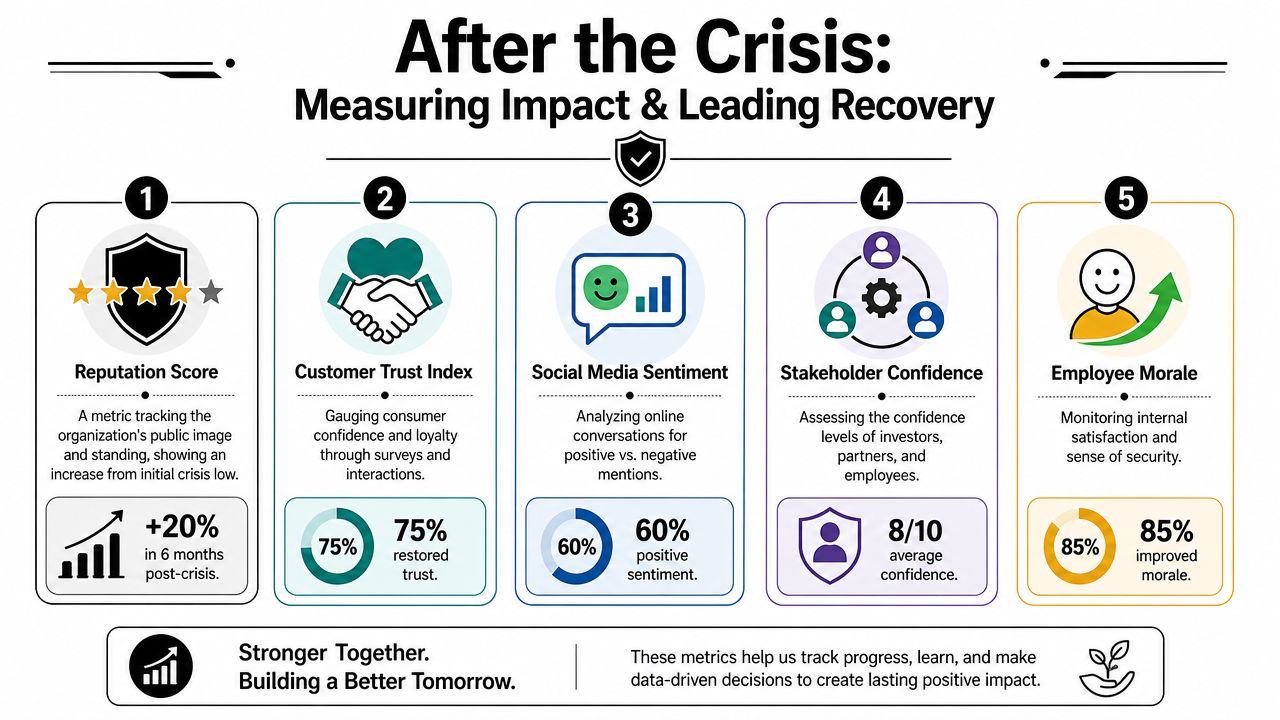
The news cycle moves on faster than trust does. That's why the recovery phase matters. A crisis communications specialist doesn't stop when the last urgent media request slows down. The work shifts into review, repair, and resilience.
Modern crisis communication also has a speed problem that many organizations underestimate. AOE Digital University notes that crisis work may include responding to social media comments, client e-blasts, and multi-platform follow-ups, highlighting the challenge of maintaining accuracy, empathy, and legal safety across channels at high speed in this overview of modern crisis communications demands.
How to review the response honestly
A proper post-crisis review isn't a self-congratulatory recap and it isn't a blame session. It's an operational audit.
The review should ask:
- What did the organization know, and when did it know it?
- Which approvals helped, and which ones slowed response unnecessarily?
- Where did messages stay consistent, and where did channels drift apart?
- What questions kept repeating from employees, customers, or reporters?
- What did leadership avoid saying that stakeholders clearly needed addressed?
Some of this analysis is quantitative in practice, but for many organizations the most valuable insight is qualitative. Customer emails, staff feedback, sales-team objections, partner concerns, and reporter questions often reveal more than a dashboard alone.
Recovery starts when the organization can explain not just what happened, but what changed because of it.
Recovery is operational not cosmetic
A public statement about lessons learned only matters if the business can point to real changes. That might mean revised reporting lines, clearer escalation triggers, a stricter spokesperson policy, refreshed templates, or formal media training for leadership.
The strongest post-crisis teams also clean up their channel logic. If social replies contradicted the press statement, that process has to change. If managers learned key facts from news alerts instead of internal guidance, the internal cascade failed.
Handled well, the post-crisis phase leaves the organization stronger than it was before the event. Not because the crisis was valuable, but because the company finally fixed weaknesses it had ignored when conditions were calm.
Frequently Asked Questions About Crisis Communications
Is a crisis communications specialist different from a PR manager
Usually, yes. A PR manager may handle media relations, announcements, executive visibility, and day-to-day brand messaging. A crisis communications specialist is focused on high-pressure situations where timing, legal exposure, stakeholder trust, and message discipline collide. Some senior PR leaders can do both, but not every generalist is built for live-crisis work.
Should a small business hire one before anything goes wrong
If the business operates in a high-trust environment, has visible founders, handles sensitive customer issues, or relies heavily on online reputation, early support is smart. That doesn't always mean a full-time hire. It may mean a consultant engagement to create a playbook, train spokespeople, and prepare templates.
What should a company do first if a crisis starts today
Pause nonessential scheduled content. Confirm the facts that are known. Decide who owns the response. Draft a short holding statement if stakeholders are already aware of the issue. Brief employees before they start improvising externally. Then build from there.
What makes hiring decisions go wrong
Leaders often hire for polish instead of pressure performance. They choose someone who speaks confidently about brand voice but can't manage approval bottlenecks, executive friction, or legal constraints. The right candidate should sound procedural, not theatrical.
Can an aspiring communicator move into this specialty
Yes, but not by skipping fundamentals. The path usually runs through media relations, corporate communications, reputation management, internal communications, or agency work. The specialist role depends on judgment developed over time, especially in writing, stakeholder handling, and executive counsel.
Does every organization need a full crisis playbook
Every organization needs a usable response framework. The format can vary. A startup may keep a lean version with scenario notes, holding statements, and a contact tree. A larger company may need a deeper system with designated spokespeople, channel protocols, and review workflows. What matters is that the material is practical enough to use under stress.
Press Release Zen offers practical resources for teams building that framework, including crisis-related templates, examples, and guidance for drafting statements under pressure. For organizations that need clearer structure before the next difficult day arrives, Press Release Zen is one useful reference point.