A conference date gets approved. The speaker list is half locked. Registration is live. Then the request lands on a communicator's desk: write the announcement press release and get media attention.
That's where many conference launches go sideways.
Most conference announcement press releases read like internal calendar invites turned into formal copy. They list the venue, the date, and a few speakers, then expect journalists to care. Reporters usually don't. A routine event notice isn't automatically a story. Guidance on event PR makes that point clearly: the hard part isn't announcing that a conference exists, it's proving why the event matters beyond the organizer's own audience, and the strongest releases often lead with a major industry development or speaker rather than the conference itself (eReleases guidance on press release angles).
That changes the job.
A strong conference release doesn't start with formatting. It starts with editorial judgment. It asks what's new, timely, useful, or consequential for people outside the company. Once that answer is clear, the release becomes much easier to write, pitch, and publish.
Table of Contents
- Introduction From Announcement to News Story
- Your Strategic Plan Before You Write a Word
- Crafting the Anatomy of an Effective Press Release
- Writing Headlines and Subject Lines That Get Opened
- Adding Credibility with Quotes and Your Boilerplate
- Distribution Strategy SEO and Media Outreach
- Frequently Asked Questions About Conference Releases
Introduction From Announcement to News Story
A press release for a conference usually fails for one reason. It answers the organizer's question instead of the journalist's.
The organizer asks, “How do we announce the event?” The journalist asks, “Why should anyone outside your attendee list care?” Those are different questions, and they produce different copy. If the release leads with logistics alone, it feels promotional. If it leads with a meaningful development, a notable speaker, a market shift, a public issue, or a fresh data point the event will address, it has a shot at coverage.
Generic event announcements rarely earn attention. Relevance does.
That's the practical shift from announcement to story. The conference is the vehicle, not always the headline. Sometimes the right lead is the issue the conference tackles. Sometimes it's the keynote name. Sometimes it's the fact that the event brings together a group that rarely appears in one place. The format stays familiar, but the editorial center changes.
A useful test is simple: if the event name were removed from the first paragraph, would the story still feel newsworthy? If the answer is no, the release probably needs a stronger angle.
Your Strategic Plan Before You Write a Word
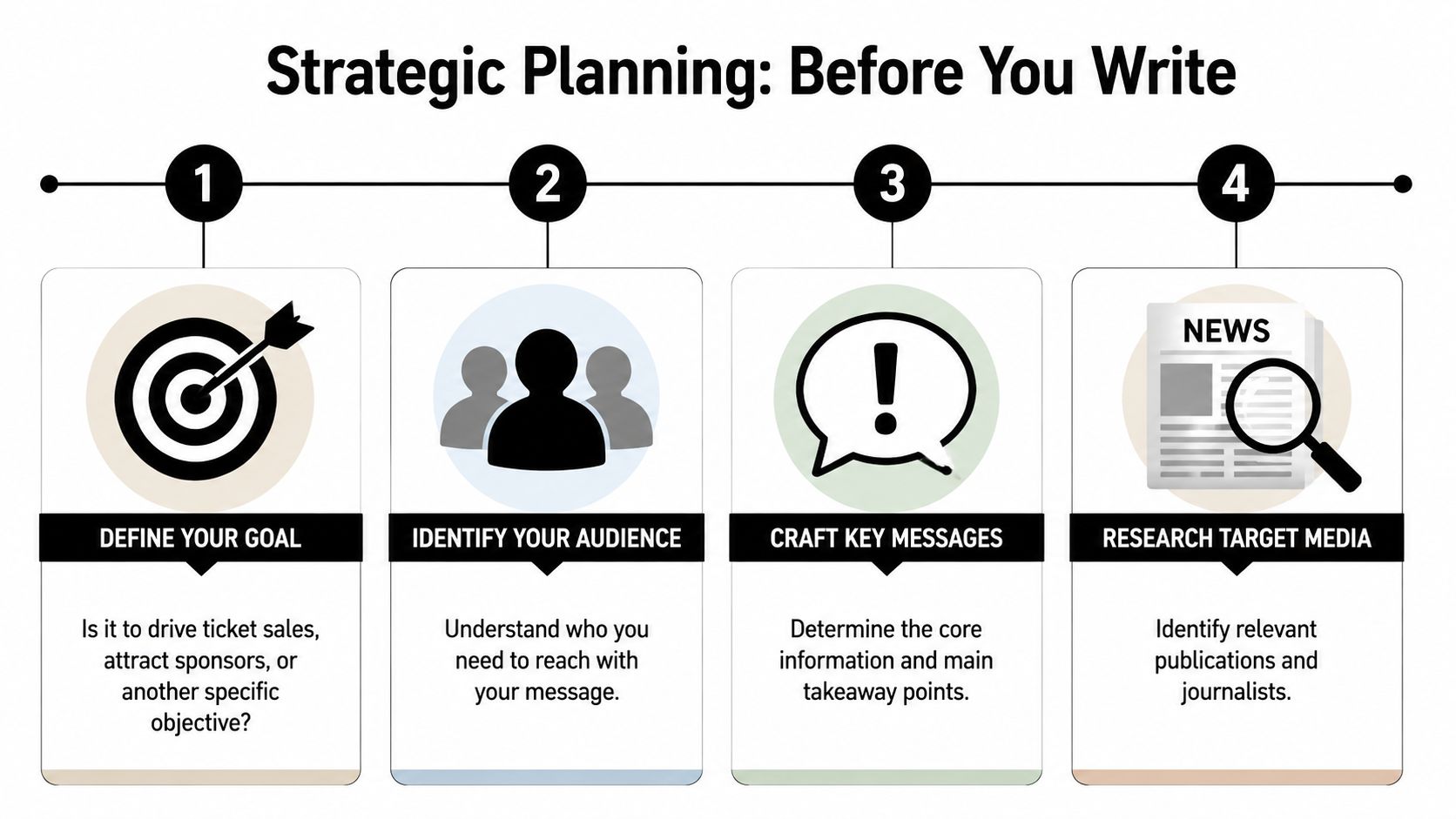
Start with the outcome, not the draft
A release can't do every job at once. If the team wants ticket sales, sponsor attention, analyst attendance, local business coverage, and national trade press pickup from one short document, the message usually gets diluted.
Pick the primary outcome first. That choice shapes the angle, the proof points, and the call to action.
A practical planning grid looks like this:
- Attendance goal: Lead with what attendees will gain. Focus on agenda relevance, notable participants, and registration details.
- Media coverage goal: Lead with the strongest editorial hook. Strip back promotional language and make the story usable.
- Sponsor or partner goal: Highlight industry significance, audience quality, and why the event is a serious platform.
- Brand positioning goal: Center the theme, the host's point of view, and why the conference signals leadership in a category.
When teams skip this step, approval rounds multiply. Everyone tries to force their priority into the same paragraph. Before copy moves, align on what success looks like. If the organization already has approval bottlenecks, a documented workflow such as this social media content approval guide can help communications teams lock owners, reviewers, and deadlines before launch assets get stuck.
Find the angle a reporter can defend to an editor
The strongest angle usually sits one layer beneath the event itself.
Instead of “Company hosts annual cybersecurity conference,” the stronger angle might be a policy shift, a product category inflection point, a high-stakes customer problem, or a speaker with real market relevance. That's the angle an editor can justify assigning.
Questions that surface stronger angles:
- What changed recently in the industry? Tie the event to that change.
- Who on the program creates real news value? A major speaker can carry the lead.
- What problem does the conference address right now? Urgency beats tradition.
- What specific proof can the organizer share? Not generic claims. Clear facts, names, milestones, and agenda specifics.
- What would still matter if nobody attended in person? That's often the actual story.
Practical rule: If the angle only matters to people already registered, it's marketing copy, not press material.
Build the timeline before copy exists
Timing is part of strategy, not an afterthought. Event PR guidance recommends sending a conference announcement 2–4 weeks before the event so journalists have enough lead time, and it also recommends identifying the media angle before writing and building a targeted journalist list early (PRLab event press release guidance).
That timeline matters because a release competes with assignment calendars, editorial meetings, travel planning, and inbox volume. If it lands too late, the story may still be good, but the outlet can't act on it.
A simple pre-draft checklist:
- Finalize the hook: One sentence that explains why the event matters now.
- Confirm the facts: Date, location, registration path, top speakers, media contact.
- Segment the media list: Trade, local business, local broadcast, association press, niche newsletters.
- Prepare support assets: Speaker headshots, venue image, logo files, agenda highlights.
- Schedule distribution thoughtfully: Avoid weekends and holidays when possible.
Plenty of teams think writing is the work. Planning is the work. Writing just records the decisions already made.
Crafting the Anatomy of an Effective Press Release
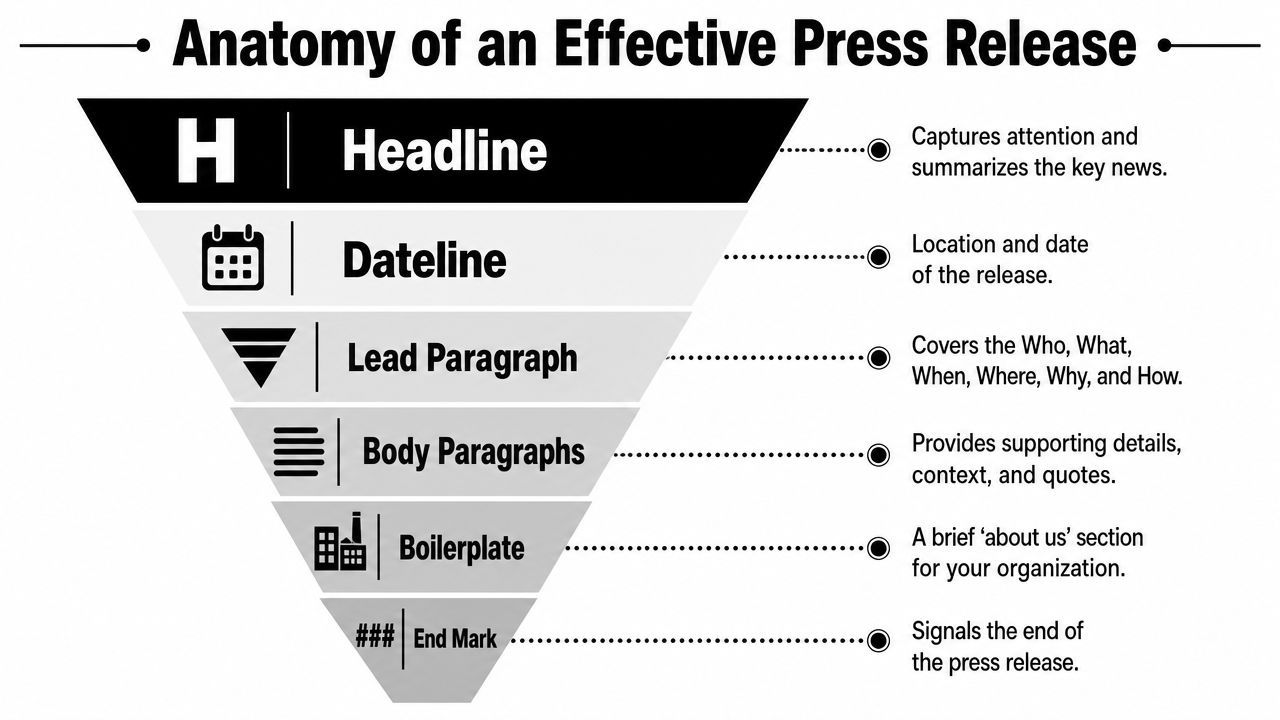
A conference release fails fast when the first paragraph reads like registration copy. Journalists are not looking for your event page in paragraph form. They are looking for a usable news item they can sort, trim, quote, or ignore in under a minute.
That changes how the release should be built.
Put the news in the first paragraph
The opening needs to answer the editor's first question: why should anyone outside your attendee list care? If the lead only says your company is hosting a conference, you have not given them a story. If it says the conference will address a live industry problem, feature a noteworthy announcement, gather decision-makers around a policy shift, or mark a material business milestone, you have something they can work with.
Event release guidance from Guidebook recommends using the inverted pyramid, answering the basic facts early, keeping the copy tight, and timing distribution for business hours in the journalist's time zone (Guidebook event press release guidance).
For conference announcements, that means the lead has one job. Deliver the event facts and frame the reason this event matters now.
Bad lead:
“Acme is pleased to announce its upcoming innovation summit, which will bring together leaders for an exciting day of insight and networking.”
Better lead:
“Acme will host its manufacturing innovation summit in Chicago on May 14, where supply chain executives will address automation costs, labor shortages, and plant digitization.”
The second version gives a reporter a clearer filing path. It also gives them language they can use.
Build the release in the order reporters expect
A conference announcement does not need to be clever. It needs to be scannable, factual, and easy to lift from.
Use this structure:
| Element | What it must do | Common mistake |
|---|---|---|
| Headline | State the actual news angle | Naming the event without showing why it matters |
| Dateline | Show the city and release date clearly | Burying it or formatting it inconsistently |
| Lead paragraph | Give the core facts and the reason for coverage | Opening with brand language or scene-setting |
| Body paragraph one | Add context that makes the event timely | Repeating the lead in different words |
| Body paragraph two | Add useful details such as speakers, program themes, registration, or media access | Listing every session like an agenda page |
| Quote | Add judgment, stakes, or purpose | Using a generic executive compliment |
| Boilerplate | Explain who the organizer is in plain language | Dropping in a long company history |
| Media contact | Give a direct route for follow-up | Making journalists hunt for a person |
That middle section is where many teams lose the story. They start stuffing in sponsor names, breakout tracks, meal functions, and every panel title. A reporter does not need the full run of show. A reporter needs proof that the conference has reach, relevance, and a concrete angle.
A strong body usually includes three kinds of specifics:
- the issue or trend the conference is responding to
- the strongest proof points, such as a notable speaker, announcement, attendee profile, or market context
- the practical information a journalist needs to decide whether to cover, attend, or request an interview
The release should be easy to mine. A reporter should be able to pull the lead, one quote, and two facts without rewriting the whole piece.
What belongs in the body, and what does not
Include details that strengthen the news case. Cut details that only help someone already planning to attend.
Useful details:
- A policy change, market shift, funding trend, or technology issue driving the conference theme
- A keynote speaker with real relevance to the topic
- A first-time program element, research release, award announcement, or executive gathering tied to the event
- Media access details, interview availability, and registration link
Less useful details:
- “Exciting networking opportunities”
- Full agenda descriptions
- Brand slogans
- Long welcome language from the host organization
- Claims of being “premier” or “industry-leading” without proof
That trade-off matters. Every line you spend on promotion is a line you are not spending on news value.
Conference announcement press release template
Use this as a working draft, then tighten it until every sentence earns its place.
FOR IMMEDIATE RELEASE
Headline
[Main news angle] at [Conference Name] in [City]
Dateline
[City, State] [Month Day, Year]
Lead paragraph
[Organization] will host [Conference Name] on [date] at [venue/location], bringing together [audience] to address [timely issue, market change, policy development, or major trend].
Second paragraph
The event will feature [notable speaker or speaker group], sessions focused on [key topic], and discussion of [practical challenge or business impact]. [Add one fact that makes the event more newsworthy, such as a first-time initiative, industry report release, or milestone.]
Third paragraph
Media can register at [conference page] or contact [name] to arrange interviews with speakers, organizers, or attending executives. Additional event details include [short list of one or two useful specifics only].
Quote
[Name, title] said, “[Specific statement about why this conference matters now, what problem it addresses, or what decision-makers will come to discuss.]”
Boilerplate
About [Organization]: [One to three sentences explaining what the organization does, who it serves, and why it is connected to this event.]
Media contact
[Full name]
[Title]
[Email]
[Phone]
###
Editing rules that improve the draft immediately
Cut adjectives first. Words like “premier,” and “groundbreaking” usually signal marketing copy and weaken trust.
Name the issue directly. “AI governance,” “hospital staffing pressure,” or “new state energy rules” is stronger than branded theme language.
Keep paragraphs short, but do not strip out meaning. Short copy helps scanning. Specifics create coverage.
Write the quote last. That is usually where weak releases show themselves. If the spokesperson cannot say why the conference matters in plain terms, the angle is still soft.
Writing Headlines and Subject Lines That Get Opened
A strong release can still die in the inbox if the headline and pitch subject line are bland. These two lines do different jobs.
The headline sits on the release and frames the story. The subject line earns the open. They shouldn't be identical by default. A subject line can be more direct, more targeted, and more audience-specific.
Why weak headlines fail
Weak headlines usually make one of three mistakes. They're too generic, too self-congratulatory, or too internal.
“Company Announces Annual Conference” says almost nothing. “Leading Brand Unveils Exciting Event Experience” says too much while communicating very little. The fix is to lead with the actual news angle and make the wording specific enough that a journalist can sort it instantly.
For subject lines, readability matters. Even details like title case versus sentence case can affect how professional and clear a pitch feels, so practical references on email subject line capitalization are worth checking before a send.
A headline workshop often gets easier when teams review examples and formulas. A focused guide on crafting an attention-grabbing headline for a press release can help if the draft still sounds like an internal memo.
Headline and subject line examples
| Conference Type | Weak Headline | Strong Headline | Effective Subject Line |
|---|---|---|---|
| Tech conference | Company Announces Developer Conference | Developer Conference to Tackle AI Governance and Enterprise Deployment Challenges | Interview opportunity: executives and developers discuss AI governance at upcoming conference |
| Nonprofit conference | Annual Nonprofit Leadership Summit Announced | Nonprofit Leadership Summit to Focus on Local Workforce Access and Community Partnerships | Local angle: nonprofit summit brings workforce and community leaders together |
| Corporate user conference | Brand to Host Customer Event | Customer Conference Will Spotlight Supply Chain Visibility and Automation Strategies | Customer conference pitch: automation and supply chain story with speaker access |
| Healthcare conference | Healthcare Conference Coming Soon | Regional Healthcare Conference to Address Care Access, Staffing, and Digital Coordination | Healthcare media: staffing and care access themes at regional conference |
| Association event | Registration Opens for Annual Meeting | Association Meeting to Convene Industry Leaders Around Compliance and Market Change | Trade press opportunity: compliance and market changes lead annual meeting |
A few patterns show up in the stronger versions:
- They lead with the issue, not the event brand.
- They give an editor a category quickly.
- They imply why coverage would matter now.
- They leave room for follow-up reporting.
Good subject lines don't try to be clever. They help a busy reporter triage.
Adding Credibility with Quotes and Your Boilerplate
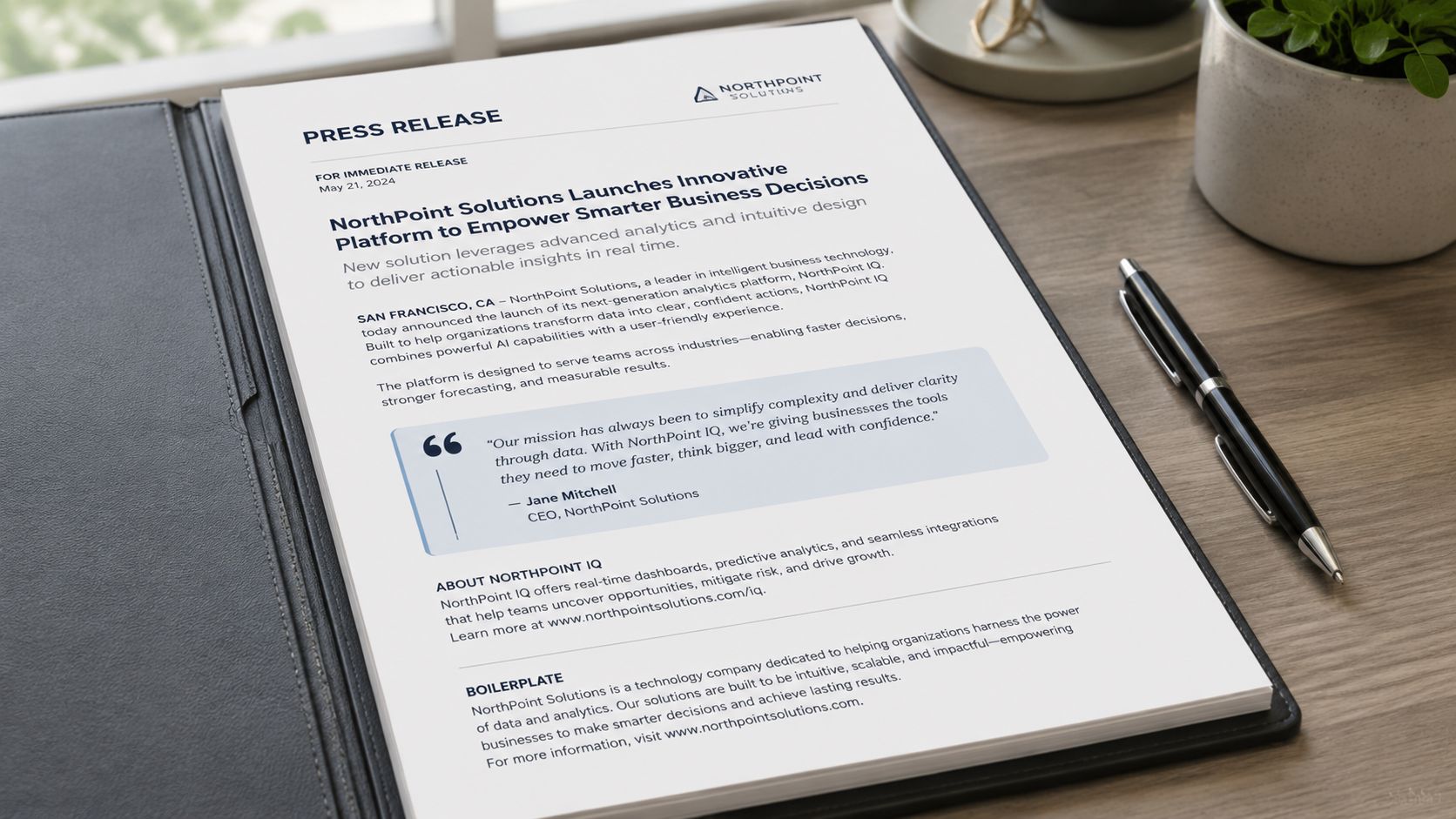
An editor can spot filler fast. Quotes and boilerplate often decide whether your release reads like an announcement or a piece of reporting support.
Write quotes that add reporting value
A strong quote gives the release a human voice, but that is not its main job. Its real job is to add a claim, a point of view, or a clear reason this conference matters now. If the quote only repeats the headline in warmer language, it weakens the whole release.
Weak quote:
“We are thrilled to welcome attendees to this exciting event.”
Usable quote:
“This program was built around the issues our customers are trying to solve this year, including hiring pressure, compliance changes, and implementation risk.”
The difference is simple. The second version gives a journalist something they can use. It frames the conference around problems, not promotion.
Choose the speaker carefully. The CEO works when the story is about company direction or industry stakes. A program chair works better when the news is the agenda itself. A customer or partner can add outside credibility, but only if the quote sounds specific and earned.
If your team needs examples of how to write quotes that sound credible instead of scripted, this guide on using quotes and testimonials in press releases is a useful reference.
Build your boilerplate for trust, not tradition
Boilerplate is often the last thing teams touch, and it shows. Reporters use it to answer a practical question fast: who is hosting this event, and do they have standing in this space?
Keep it tight. State what the organization does, who it serves, and why it has a legitimate reason to convene this audience. If the host has a long history, a large member base, or a clear role in the industry, include only the detail that supports the conference story.
A solid boilerplate usually includes:
- Core identity: What the organization is
- Relevant audience: The sector, membership, or customer group it serves
- Reason to host: Why it can credibly bring this group together
- Basic contact path: Website and media contact in the release package
Here is the trade-off. A short boilerplate can feel too plain to internal stakeholders who want every achievement included. A long boilerplate makes a reporter work harder and buries the event angle. In practice, the shorter version usually does more.
Example boilerplate:
“NorthPoint Solutions is a software and advisory firm serving enterprise operations teams in manufacturing, logistics, and healthcare. The company hosts annual industry programs focused on compliance, implementation, and operational performance. Learn more at northpointsolutions.com.”
That is enough. It gives identity, audience, and relevance without turning into a company history.
Good quotes show why the conference matters. Good boilerplate shows why your organization is qualified to make that case. Together, they turn a standard event release into something a journalist can trust and build on.
Distribution Strategy SEO and Media Outreach
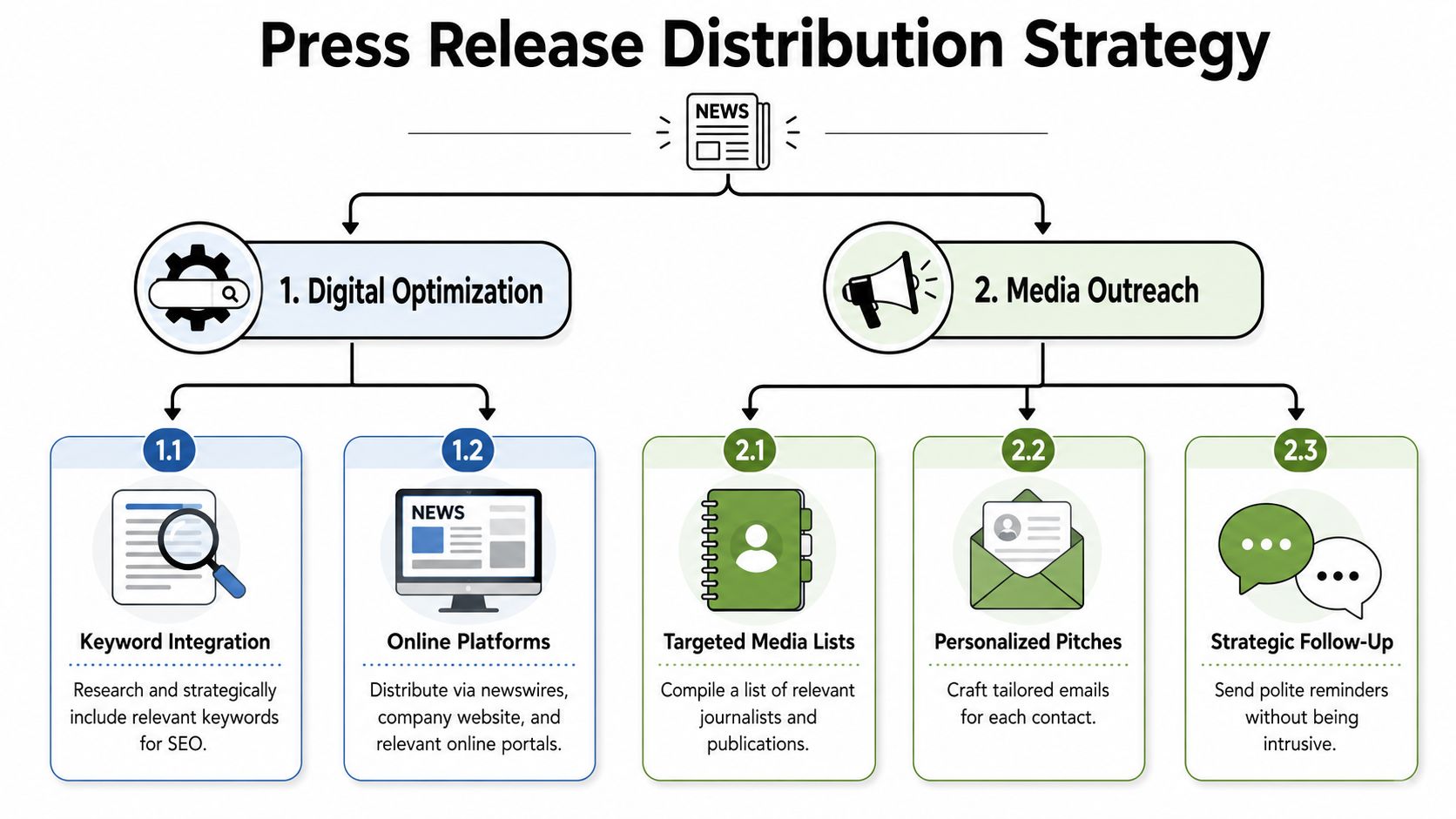
A conference announcement press release needs two distribution paths at the same time. One is built for discovery. The other is built for response.
Treat search visibility and journalist outreach as one system
The release should live on the organization's site, link clearly to the conference page, and use language people would search. That usually means naming the industry, issue, audience, and location naturally in the headline and body. No keyword stuffing. Just useful specificity.
Multimedia also matters here. Guidance comparing media advisories and press releases notes that releases with images or video can see 2–3x higher pickup rates, which is why a media kit with speaker photos, logo files, and short video clips can improve visibility across the event lifecycle (Signal Genesys on media advisory vs. press release).
That changes what “distribution” means. It's not only sending words. It's packaging a usable story.
A practical digital package includes:
- The hosted release: Published on the newsroom or blog.
- A registration link: Direct and visible.
- Media assets: Headshots, event logo, venue image, short b-roll if available.
- Metadata basics: Clean page title, clear summary, and searchable wording.
- One source of truth: Landing page and release should match on date, venue, and speakers.
For teams comparing channels and workflows, a practical guide on how to distribute a press release can help sort owned publishing, wire distribution, and direct outreach options.
Use the right asset at the right moment
One recurring mistake is trying to make a press release do the job of a media advisory.
They're related, but they serve different needs. The advisory invites attendance. The press release informs and supports publication. For a conference, the sequence often matters more than the document itself.
A practical event sequence:
- Before the event: Send a media advisory to targeted outlets if attendance or camera crews matter.
- Announcement phase: Publish and pitch the press release with the strongest angle.
- Day-of or post-event: Issue follow-up material if there's a real outcome, notable announcement, or newsworthy takeaway.
A release without outreach gets buried. Outreach without a usable release wastes the reporter's time.
Outreach workflow that respects the reporter
Media outreach works better when it feels selective. Generic blasts tell the reporter the organizer didn't do the work.
Keep the pitch short. Reference the angle that fits the outlet. Offer access that reduces friction, such as an interview slot with a keynote speaker, organizer, or subject expert.
A workable outreach sequence:
| Step | What to do | Why it works |
|---|---|---|
| Build the list | Segment by beat and relevance | Reporters cover topics, not everything |
| Personalize the note | Tie the pitch to the outlet's audience | It shows editorial awareness |
| Attach or link cleanly | Provide the release and media assets without clutter | Faster review leads to faster decisions |
| Follow up once, professionally | Ask if more detail or interview access would help | Respectful persistence is fine |
| Update only with real news | Send another note only if something materially changed | Keeps trust intact |
A release can be clean, timely, and still get ignored if the target list is wrong. Distribution is part editorial judgment, part operations.
Frequently Asked Questions About Conference Releases
Specific questions usually show up once the draft is almost done. Most of them come down to choosing the right format, lead, and level of detail.
| Question | Answer |
|---|---|
| What makes a conference announcement press release newsworthy? | A conference becomes newsworthy when the release leads with something broader than the event itself. That may be a timely industry issue, a notable speaker, a major partnership, or a development the conference will address in a concrete way. |
| How long should the release be? | Keep it tight enough that a reporter can scan it quickly. If the copy starts reading like a brochure, it's too long. The release should deliver the angle, the essentials, and the next step without forcing the reader to dig. |
| Should the release lead with the conference name? | Usually not if the event brand means little to outside readers. Lead with the issue, speaker, or development that creates relevance. The conference name can still appear prominently in the headline or lead. |
| Do teams need both a media advisory and a press release? | Often, yes. Use a media advisory when the goal is getting media to attend. Use a press release when the goal is informing outlets and giving them publishable material. They work better as a sequence than as substitutes. |
| What belongs in the first paragraph? | The organizer, event name, date, location, audience, and reason the conference matters now. If one of those details can't fit, trim the adjectives before trimming the facts. |
| How many speakers should the release mention? | Only the speakers that strengthen the story. Listing every session chair makes the release harder to scan. Save the full agenda for the event page. |
| Should registration details go in the release? | Yes, but briefly. Include the registration path and any media contact instructions without overwhelming the editorial angle. |
| What's the biggest mistake first-time writers make? | Treating the release as a logistics notice. A journalist needs a story frame, not a calendar update. |
A polished release helps. A strategic one gets used.
Press Release Zen offers practical resources for teams writing event announcements, including templates, examples, and distribution guidance for a conference announcement press release. For communicators who want a working draft faster and fewer structural mistakes before outreach begins, Press Release Zen is a useful reference point.