A CEO's departure is announced on a Friday afternoon. By Monday, the board wants a confident message, staff members want to know who can approve decisions, funders and partners are asking whether commitments remain intact, and the incoming executive is sorting through years of files, relationships, and unresolved choices. The organization may have named a successor, but that alone doesn't transfer authority, context, or trust.
An effective executive transition plan template treats the handoff as two connected jobs. It gives the incoming executive a practical operating brief while protecting continuity for the outgoing leader, board, staff, and external stakeholders. The strongest plans also account for an interim period, restricted disclosure, and an unexpected departure, rather than assuming a clean start date and a predictable onboarding period.
Table of Contents
- Why Most Executive Transitions Stall Without a Plan
- Inside Your Executive Transition Plan Template
- How to Customize the Template for Your Organization
- Executive Transition Timeline and Communication Sequence
- Common Pitfalls and How to Avoid Them
- Final Handoff Checklist and Next Steps
Why Most Executive Transitions Stall Without a Plan
A leadership handoff often stalls in places that aren't visible on an org chart. The outgoing executive knows why a major partnership is fragile, which board member needs an early briefing, and which initiative should not be accelerated. The successor sees the formal priorities but not the history behind them. Meanwhile, staff members wait for decisions because nobody has clarified whether authority has moved.
That confusion is why a transition document shouldn't be treated as administrative paperwork. It should function as a continuity safeguard, with named owners, decision rights, knowledge-transfer tasks, and communication checkpoints. The plan must preserve operational momentum while the incoming executive learns the role and the outgoing executive closes or transfers responsibilities.
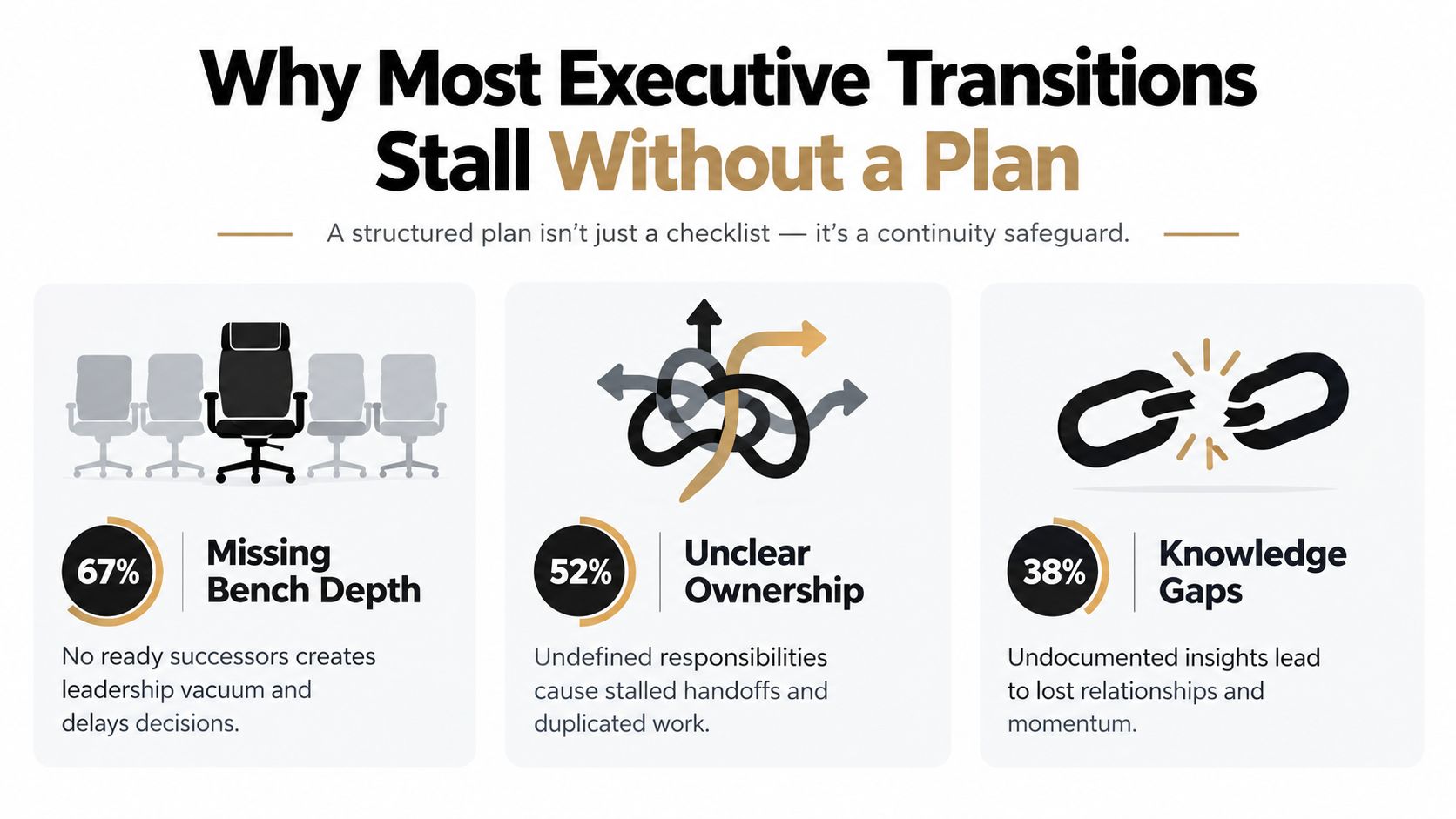
The succession problem predates current leadership pressures. The historical succession-planning benchmark found that only 46% of organizations had a formal process for developing successor candidates for key executive positions, while 25% reported an adequate pool of ready CEO successors. Those findings point to the deeper failure. A transition can be beautifully documented and still become reactive if the organization hasn't developed leadership readiness or identified fallback ownership.
The document isn't the plan
A useful template answers practical questions before they become urgent:
- Who decides: Which decisions remain with the outgoing executive, which move to the interim leader, and which require board approval?
- Who knows what: Which relationships, commitments, risks, and unwritten practices must be transferred directly?
- Who communicates: Who briefs the board, staff, funders, partners, customers, and media, and in what order?
- Who verifies completion: Who confirms that access, documents, introductions, and handoff meetings are finished?
Without those answers, the organization gets duplicated work, delayed approvals, inconsistent messages, and avoidable anxiety. A carefully written guide to executive transitions can support the communications side, but the internal plan still needs operational ownership.
Practical rule: A successor's name identifies a person. It doesn't identify readiness, authority, or a continuity path.
The template described below closes that gap by combining onboarding with organizational protection. It gives the incoming executive a structured route into the role, gives the outgoing leader a controlled handoff, and gives the board a way to test whether the organization can function during uncertainty.
Inside Your Executive Transition Plan Template
A transition template earns its place when people can use it under pressure. It should show what the role protects, what work is active, which relationships require care, and how authority changes hands. A staged methodology with stakeholder roles, a timeline, assigned accountabilities, action items, and communication sequencing is recommended in this executive handoff framework. Used well, the document serves two purposes: it onboards the incoming executive and preserves continuity for the outgoing leader, board, and staff.
Start with control information
Open with the role, current holder, incoming executive or interim owner, board sponsor, plan owner, confidentiality level, approval date, and review dates. Record the transition type, such as planned succession, resignation, medical leave, termination, retirement, or emergency vacancy.
Sample language:
Transition purpose: Maintain authority, stakeholder confidence, and uninterrupted execution while responsibility for the executive role moves from the outgoing leader to the incoming or interim owner.
Tailor the control block to the role. A CEO plan should identify board governance, organizational strategy, major financial commitments, and external confidence. A CFO plan should cover reporting cycles, treasury controls, lender relationships, audit matters, and approval authority. A nonprofit executive director's plan should identify board leadership, funders, grants, community partners, and mission-critical commitments.
Define role scope and immediate priorities
Separate the formal remit from the work currently consuming attention. List active strategic initiatives, recurring decisions, pending commitments, sensitive matters, and work that should pause. Give every item an owner, status, next action, and escalation route.
Sample language:
Priority: Complete the current operating review, preserve existing stakeholder commitments, and present unresolved decisions to the designated approval group before changing direction.
That structure keeps a job description from becoming the entire onboarding brief. It also lets the board distinguish continuity work from the incoming leader's longer-term agenda. The outgoing executive should identify what can wait, what cannot, and what requires a deliberate decision rather than automatic continuation.
Map relationships and knowledge
Create separate fields for internal relationships, external stakeholders, decision history, and tacit knowledge. For each relationship, record current expectations, promises already made, sensitive topics, and the person who should make the introduction.
Useful knowledge-transfer entries include:
- Strategic context: Why a priority exists and which alternatives were rejected.
- Relationship history: Stakeholder concerns, expectations, and preferred communication routes.
- Operational access: Locations of approved documents, calendars, contracts, reports, and process guides.
- Risk context: Open disputes, compliance concerns, retention risks, and commitments that could affect continuity.
Avoid placing confidential credentials in the general plan. Point to the approved access-management process and name the person responsible for permissions. Confirm the transfer rather than treating a folder link as proof that knowledge changed hands.
Clarify authority and interim ownership
Transitions stall when staff cannot tell whether the outgoing executive, interim leader, successor, board chair, or functional deputy has final authority. Add a decision-rights matrix for budget approvals, hiring, external statements, contracts, strategy changes, and crisis escalation. Include interim ownership for each area, including a fallback if the named owner becomes unavailable.
Sample language:
Interim authority: The interim executive may approve operating decisions within the approved budget. Strategic changes, senior appointments, and material commitments require board approval until the formal handoff date.
Close the plan with communications. List each audience, message owner, channel, approval requirement, timing, and anticipated questions. A step-by-step communication plan guide can help organize the supporting materials, but the transition plan should still name internal owners and decision points. Include scenarios such as an accelerated departure, delayed appointment, or sensitive announcement, so the board and staff have a response path when the expected sequence changes.
How to Customize the Template for Your Organization
A blank template becomes useful only after leadership makes deliberate choices about risk, scope, and accountability. Customization should start with the organization, not the successor. Before assigning development tasks, the board or executive sponsor needs a clear view of what could break if authority changes quickly.
Assess the operating reality
Review the role's formal responsibilities against current work. Ask department heads where approvals concentrate, which relationships depend on one person, and which decisions are difficult to reconstruct from existing records. FEMA's chief-officer transition guidance recommends organizational assessment to identify strengths and vulnerabilities before succession decisions are finalized.
The readiness gap deserves candid treatment. Only about 20% of organizations worldwide reported high confidence in their leadership succession pipelines, according to the same guidance. That makes readiness validation more useful than optimistic labels such as “high potential.”
Align the plan with the role
A CEO plan should make governance, strategy, culture, and external confidence visible. A chief technology officer's plan may need deeper treatment of architecture decisions, security ownership, product dependencies, and technical talent. A nonprofit plan should reflect board dynamics, funder reporting, community trust, and mission continuity.
The same discipline applies to organization size. A smaller organization may combine board sponsor, HR owner, and communications lead. A larger organization may need separate owners for legal, security, investor relations, internal communications, and business-unit handoffs.
Broaden candidate review
Avoid allowing one manager's nomination to define the successor pool. The FEMA source reports that 73% of companies identify leadership candidates through a single nomination by the direct manager, a method that can narrow visibility and reinforce local bias. Use a review group that compares evidence from performance, cross-functional work, stakeholder feedback, and demonstrated readiness.
For successor development, an HR team can pair the transition document with a step-by-step training plan HR Management 365. The development plan should name the capability to build, the assignment that will test it, the sponsor who will support it, and the checkpoint that will confirm progress.
Assign ownership and approve the finished plan
The board chair or designated director should approve CEO-transition governance. The outgoing executive should own knowledge capture, while the incoming or interim executive owns questions and validation. HR can coordinate readiness and retention risks, IT can manage access, legal can review confidentiality and authority, and communications can control sequencing and message consistency.
Approval shouldn't end the process. Set review checkpoints for unresolved decisions, stakeholder reactions, knowledge-transfer gaps, and changes in the departure scenario. A board-ready plan is specific enough to run and flexible enough to adapt.
Executive Transition Timeline and Communication Sequence
Timing controls risk because different audiences need different information at different moments. The board may need confidential deliberation before staff hears the news. Staff needs clarity about reporting lines and operating priorities. Funders, partners, customers, and media need a consistent explanation of what changes and what remains stable.
Communication deserves special attention after a CEO change. A transition-planning worksheet reports that email and meeting intensity drops significantly during the first three months after a CEO transition, then rises later to compensate, which makes communication continuity an operational control rather than a courtesy. The plan should therefore schedule contact instead of assuming it will happen naturally.
| Phase | Key Actions and Owner | Communication Checkpoint |
|---|---|---|
| Pre-announcement | Board sponsor confirms decision rights, interim ownership, legal review, stakeholder map, and message approvals. Communications lead prepares internal and external drafts. | Brief the board and essential internal owners first. Confirm who can answer questions before disclosure. |
| Announcement | Board chair or authorized spokesperson announces the change. HR and the communications lead distribute the internal message. | Hold a staff meeting, provide manager talking points, and prepare audience-specific follow-ups. |
| Handoff | Outgoing executive transfers active decisions, relationships, documents, and unresolved risks. Incoming or interim leader validates access and priorities. | Schedule structured meetings with board members, direct reports, major partners, funders, and other critical stakeholders. |
| Early operating period | Incoming executive confirms priorities, decision rights, reporting cadence, and escalation routes. Plan owner tracks open actions. | Publish a concise operating update and give staff a reliable route for questions. |
| First 90 days | Incoming executive reviews commitments, culture signals, talent risks, and strategic assumptions. Board sponsor checks progress against agreed milestones. | Use scheduled board, staff, and stakeholder check-ins. Adjust messages when facts or timing change. |
The announcement itself should be treated as one asset within a sequence, not as the entire communications plan. A practical new CEO press release guide can help structure the public statement, while the transition plan controls internal preparation, approvals, and follow-up.
Silence creates an information vacuum. A short, approved update is usually safer than leaving staff and partners to interpret the change without guidance.
Every checkpoint needs an owner and evidence of completion. That evidence might be an approved message, a completed briefing, a documented decision, or a confirmed stakeholder introduction. The incoming leader shouldn't inherit a calendar full of meetings without context. Each meeting should state its purpose, the desired decision, and the information that must transfer.
Common Pitfalls and How to Avoid Them
The most damaging transition errors often begin as reasonable shortcuts. A board wants to move quickly, a departing executive assumes the successor will ask questions, or the communications team prepares one announcement for every audience. Each choice saves time initially, then leaves authority, context, or expectations unclear.
Planning time is treated as optional
Board attention often centers on choosing the successor rather than preparing the organization for the handoff. The executive-transition framework cited earlier found that 46% of board members said they didn't have an effective CEO-succession process. Boards also devoted limited time to succession planning on average. Reserve dedicated planning sessions instead of fitting transition work between standing agenda items.
Planning should cover both sides of the handoff. The incoming executive needs an organized route into decisions, relationships, and operating context. The outgoing leader, board, and staff need clear boundaries for knowledge transfer, interim ownership, and communication.
The plan exists, but nobody runs it
A document without owners records intentions rather than managing work. Assign every action to a person, add a due date, and set a short review cadence. The plan owner should mark an item complete only after verification, especially for access, document transfer, stakeholder introductions, and approval changes.
The published organizational-science study reports that 98% of business leaders said their organization often or always follows through, compared with 63% of HR professionals, among organizations with a plan. The gap suggests that leaders and HR teams may define “having a plan” and “executing the plan” differently. Require evidence, not a status label.
The scenario is too clean
A planned retirement and cooperative successor represent only one possible path. Add scenarios for a sudden departure, an unavailable successor, a delayed announcement, leadership conflict, and a period when the outgoing executive cannot participate. For each scenario, specify interim ownership, approval rules, communication limits, and the trigger for board review.
Run a tabletop exercise with the board chair, HR, legal, communications, and the likely interim owner. Test whether participants can locate key documents, identify the authorized spokesperson, and make urgent decisions without the departing executive.
Retention and culture are ignored
A successor can have the right technical record and still struggle with culture, team dynamics, or stakeholder expectations. Include retention-risk conversations for key staff and ask what support they need during the transition. Assess culture fit through observed behavior and working relationships, not broad impressions.
The 2025 global executive-talent research projects that 60% of leaders plan to change roles by 2028, according to Korn Ferry's leadership-transition research. That projected mobility supports keeping the plan current, so it can handle both expected succession and accelerated change.
Final Handoff Checklist and Next Steps
The final review should test whether the organization can operate without relying on memory or informal permission. A completed template is not proof of continuity. It becomes proof only when the successor can access the required information, stakeholders know who has authority, and the board can verify that unresolved risks have owners.
Use this checklist before the formal handoff:
- Authority confirmed: The board or authorized sponsor has approved interim and permanent decision rights.
- Documents transferred: Strategy materials, financial information, contracts, active-project records, and approved process documentation are accessible to the correct owners.
- Knowledge captured: The outgoing executive has documented decision history, relationship context, pending commitments, and known vulnerabilities.
- Relationships introduced: The incoming or interim executive has met priority board members, staff leaders, funders, partners, customers, and advisors.
- Access reviewed: IT and security owners have confirmed appropriate access, transfer, and eventual removal procedures.
- Messages approved: Internal, external, and media-facing language is consistent, audience-specific, and ready for questions.
- Open actions assigned: Every unresolved item has a named owner, next step, and review date.
- Follow-through verified: The board sponsor or plan owner has checked completion rather than relying on self-reporting.
The Word version works well for collaborative drafting, tracked changes, and board review. A PDF version is better for preserving the approved record after sign-off. The working plan should remain active in an appropriate project-management or document system, with version control and clear access permissions.
The execution gap deserves a final check. As reported in the earlier organizational-science source, business leaders and HR professionals differ sharply in how often they say succession plans are followed through. That is why the template should end with verification fields, not a signature alone.
Download the executive transition plan template, customize the roles and scenarios, and circulate the approved version to the people responsible for running the handoff. Press Release Zen provides practical resources for executive-transition announcements and related communications, so visit Press Release Zen to align the operational plan with the public message.