A 14-person nonprofit has just learned that its only executive director will leave in 60 days. A funder renewal is pending, staff members aren't sure who can approve expenses, and the board chair is asking whether a press release should go out immediately. The wrong answer is to treat the departure as a single announcement. An executive director transition is a months-long communication campaign, with different messages, messengers, and decisions at each stage.
The stakes are higher than many boards assume. One major foundation source has estimated that about 1 in 10 nonprofits is in a leadership transition in any given year, while broader research found that 15% to 35% of nonprofit executives expected to leave within two years and 61% to 78% within five years. A separate national survey found that 75% of nonprofits lacked a documented succession plan (Nonprofit Quarterly).
The practical question isn't whether the organization needs a polished announcement. It does. The question is whether the organization can keep staff, funders, partners, and the public confident while leadership authority changes hands.
Table of Contents
- Why an Executive Director Transition Is a Campaign, Not a Headline
- Mapping Your Transition Timeline Before Day One
- Choosing the Right Scenario for the Departure
- Press Release Samples You Can Adapt Today
- Stakeholder Outreach and Sequencing the Messages
- What Good and Bad Transitions Look Like in Practice
- Timing, Follow-Up, and Frequently Asked Questions
Why an Executive Director Transition Is a Campaign, Not a Headline
A press release creates awareness. It doesn't create stability, answer every stakeholder's question, or prepare the organization for the weeks between departure and a permanent hire. Those outcomes require a planned sequence of communication, beginning with the board and moving outward to the people who depend on the organization.
Use this four-part decision tree before drafting a single sentence:
- Planned retirement: The board and outgoing director have time to prepare a succession process, honor the leader's tenure, and explain what comes next.
- Voluntary resignation: The message should acknowledge the departure without implying organizational trouble or disclosing the leader's next move before approval.
- Sudden departure: The first priority is continuity. Name the person with authority to act, explain what remains unchanged, and avoid speculation.
- Interim arrangement: The organization needs to communicate that an interim leader is a deliberate stabilizing step, not evidence that the board has lost control of the search.

Cadence beats clever wording
The announcement matters, but message cadence matters more than a perfect headline. Staff need an immediate operational briefing. Funders need personal reassurance. Partners need to know who owns existing commitments. The public needs a clear statement that avoids creating a vacuum that others will fill with rumors.
The audience order should be firm:
- Board, which must agree on authority, process, and language.
- Staff, who need practical answers before they encounter public news.
- Funders, whose confidence depends on direct relationship management.
- Public, including members, media, volunteers, and community partners.
Organizations that serve technical or highly specialized communities can also study how biotech executive leaders communicate role changes across complex stakeholder networks. The lesson is transferable. A leadership announcement should tell people who is responsible now, what remains steady, and when they can expect the next update.
Mapping Your Transition Timeline Before Day One
The transition runway begins before the public announcement. For a planned exit, the board should work backward from the intended announcement date. For an unexpected departure, the same decisions must be compressed into an emergency process, but the sequence still applies.

The pre-announcement runway
Weeks one and two should settle authority. The board chair convenes the relevant committee, confirms the board's position, and establishes who can make operational decisions during the transition. The outgoing director's employment authority, signing authority, access to systems, and relationship responsibilities should be documented. Outside counsel belongs in the process whenever the departure involves termination, complaints, severance, confidentiality obligations, or disputed facts.
The next stage turns agreement into a working plan. The board should decide whether the organization needs an interim executive director, an acting internal leader, or an immediate permanent search. An interim appointment often makes sense when the board needs time to assess strategy, when the departure is sudden, or when staff require a visible stabilizing presence. The decision should include reporting lines, decision limits, compensation approval, and the date for reviewing the arrangement.
The board should prepare three documents before disclosure:
- A board resolution, confirming the transition and delegated authority.
- Separation terms, reviewed for accuracy and confidentiality.
- A one-page transition FAQ, answering who is leaving, who is in charge, what happens to programs, and when the next update will come.
Prepare people, not just paperwork
Staff shouldn't receive a confidentiality instruction without context. The board chair should explain what information is private, why premature disclosure could harm relationships, and how staff can route questions. Funders and institutional partners should be listed by priority, with an owner assigned to each relationship.
A practical blueprint for care management can help boards think about role clarity, escalation, and support during a period when normal management routines are changing. The same discipline should be applied to the transition team.
A written communication plan with examples and step-by-step guidance can organize audience, channel, timing, owner, and approved language. The gating question remains simple: who is authorized to speak on Day Zero, and exactly what may that person say? Until that answer is written down, the organization isn't ready to announce.
Choosing the Right Scenario for the Departure
The departure scenario determines the tone, detail, and timing. Boards get into trouble when they use a retirement announcement for a termination, or when they describe a sudden departure with language that sounds evasive. The public statement should be accurate, limited, and consistent with the organization's legal advice.
Four Executive Director Departure Scenarios Compared
| Scenario | Typical Lead Time | Announcement Tone | Detail Level | Interim vs. Permanent |
|---|---|---|---|---|
| Planned retirement | Extended preparation when circumstances allow | Appreciative, confident, forward-looking | Tenure, contributions, timeline, next steps | Interim or planned successor, depending on search readiness |
| Voluntary resignation for a new role | Notice period varies | Respectful and neutral | Departure date, gratitude, continuity, approved next step | Permanent hire if ready, otherwise interim |
| Involuntary departure | Often limited | Factual, restrained, legally reviewed | Confirm the change and authority, avoid disputed details | Interim appointment is often prudent while the board assesses the search |
| Sudden departure due to health or crisis | Little or no preparation | Compassionate, calm, operational | Share only authorized information, focus on continuity | Acting or interim leader until a permanent process is credible |
A longtime founder stepping down usually needs a different message from a director who has accepted a role at a peer organization. The founder announcement should separate personal legacy from institutional identity and make clear that the board owns the next phase. A voluntary move to another organization calls for gratitude without turning the release into a recruitment advertisement for the departing leader.
Termination for cause demands legal review before any public wording is approved. The organization should not reference severance terms, complaints, investigations, or performance allegations unless counsel has confirmed that disclosure is necessary and defensible. A medical event requires equal care. Compassion doesn't authorize the board to disclose private health information.
An interim leader is appropriate when continuity matters more than speed, when the board needs to rebuild confidence, or when the permanent role requires a thoughtful search. A direct permanent hire makes sense only when the board has completed its process and can announce the person with enough information to explain why the appointment fits the organization's future.
Press Release Samples You Can Adapt Today
A transition release should be short enough to scan and complete enough to prevent speculation. Each template below needs careful editing before distribution. The board chair usually issues the organizational statement, while the outgoing or incoming leader provides a supporting quote only after reviewing the language.
Planned retirement
Headline: [Organization] Announces Retirement of Executive Director [Full Name]
Dateline: [CITY, State], [Month Day, Year]
Opening: [Organization] announced today that Executive Director [Full Name] will retire on [Departure Date] after [tenure length] with the organization. The board has begun [succession process or interim plan], and [authorized person] will serve as the primary contact during the transition.
Board chair quote: “[Full Name] has guided [Organization] through [approved contribution]. The board is grateful for this service and is focused on ensuring continuity for [community or people served].”
Outgoing leader quote: “[Organization] has been a meaningful part of [Full Name]'s professional life. The transition plan reflects confidence in the staff, board, and mission.”
Boilerplate: [Organization] is a [brief description] serving [community] through [program description].
Media contact: [Name], [Title], [Email], [Phone]
Voluntary resignation
Headline: [Organization] Executive Director [Full Name] to Depart for [Approved Description]
Opening: [Organization] announced that [Full Name] will leave the executive director role on [Departure Date]. [Interim or search information] will guide operations while the board manages the next phase.
Board chair quote: “[Full Name] has made important contributions to [Organization]. The board appreciates [his/her/their] service and will communicate further milestones as the transition proceeds.”
Outgoing leader quote: “The mission of [Organization] remains important, and [Full Name] is committed to supporting an orderly handoff through [approved date or activity].”
Interim appointment
Headline: [Organization] Names [Full Name] Interim Executive Director
Opening: [Organization] has appointed [Full Name] as interim executive director effective [Start Date], following the departure of [former leader's name or title]. [Full Name] will oversee [approved responsibilities] while the board evaluates the permanent leadership process.
Board chair quote: “The interim appointment gives [Organization] experienced leadership while the board conducts its work with care and transparency.”
Interim leader quote: “[Organization]'s staff and mission are the immediate priorities. [Full Name] will focus on continuity, communication, and support for the team.”
Permanent hire
Headline: [Organization] Appoints [Full Name] as Executive Director
Opening: [Organization] announced the appointment of [Full Name] as executive director, effective [Start Date]. [Full Name] succeeds [former leader] and brings [verified background relevant to the role].
Board chair quote: “The board selected [Full Name] because [approved reason tied to experience and organizational needs].”
Incoming leader quote: “[Full Name] looks forward to listening to staff, partners, and the community while advancing [approved priority].”
For further structure, the new CEO press release guide offers a useful model for organizing a leadership-change announcement.
Before sending, edit names, dates, tenure length, departure reason, quotes, titles, contact details, and every financial or program metric. Remove any claim no one has verified. Issue the approved release on letterhead when a formal board statement is needed, and use email or a wire format when direct media distribution is the priority. An embargo should be used only when journalists need advance access for legitimate preparation, not to create artificial drama.
Stakeholder Outreach and Sequencing the Messages
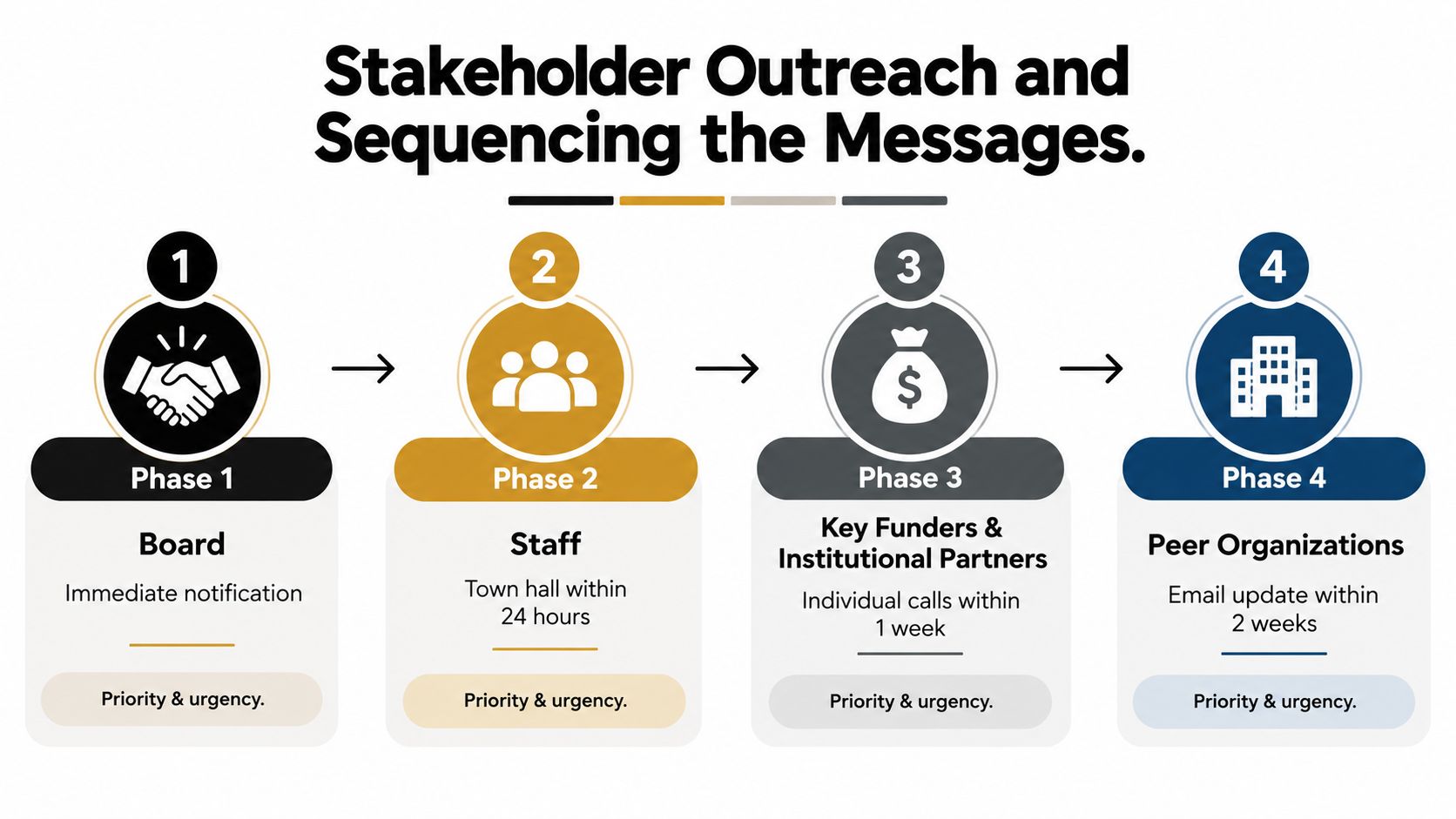
The board shouldn't send the public release until the people with the greatest operational and financial exposure have heard directly from the organization. A funder who discovers the news through social media won't care that the release was technically accurate. The relationship damage comes from being treated like a spectator.
Use a controlled sequence
Board: Confirm the final language in a private meeting or secure call. Every director should know the announcement time, the approved response to likely questions, and the person authorized to speak.
Staff: Hold a live briefing before the public release, preferably with the board chair and outgoing or interim leader together. Staff need to hear who will approve work, whether programs continue, how questions will be handled, and when the next update will arrive.
Key funders and institutional partners: Call the most important relationships personally before publication. The message should acknowledge the leader's departure, describe the continuity plan, and invite questions about active grants or commitments.
Peer organizations: Send a direct note after priority funders have been briefed. Peer leaders often hear news quickly, but they shouldn't receive confidential details that staff or funders haven't received.
Public: Publish the release, website notice, social post, and staff-facing FAQ in coordinated form. The public message should never introduce a different departure reason, interim arrangement, or timeline.
Scripts for difficult conversations
When an interim leader is appointed without a permanent successor, the board chair can say:
Practical rule: “The board has appointed [Name] to provide operational leadership while the permanent process continues. Programs, grant commitments, and staff support remain priorities. The board will share the next milestone when it has verified information.”
For a major funder who strongly supported the departing leader:
“The board wanted [Funder Name] to hear this directly before the public announcement. [Leader Name] is leaving on [date]. The organization has a continuity plan, and [contact] will remain responsible for [grant or relationship]. The board values the partnership and welcomes a conversation about the transition.”
A sequencing calendar should assign one owner and one approved message to every audience. Teams managing the workflow can use an internal versus external communication guide to keep staff updates and public statements aligned. The discipline is simple, even when the circumstances aren't: private notification first, internal briefing next, priority relationship calls after that, and public release last.
What Good and Bad Transitions Look Like in Practice
A regional arts nonprofit had a planned retirement with enough runway to prepare. The board chair briefed major funders before the announcement, staff heard the news in person, and the public release went out on a Tuesday morning with a warm but disciplined quote from the outgoing director. The release honored the leader's contribution without suggesting that the organization depended on one person. Donor relationships remained steady because people had received context before they saw the announcement.
A membership association handled a similar change poorly. The board chair emailed the release to staff shortly before publishing it publicly, the outgoing director hadn't contacted peer organizations, and a funder learned about the departure through a social media post. The release itself was polished. The process made the organization look inattentive.
The difference is process
The arts nonprofit used sequencing, relationship respect, and consistent tone. It gave each audience the information needed for its role. The association treated speed as a substitute for preparation and forced staff and funders to interpret the news without direct guidance.
Neither outcome depended on a magical phrase in the headline. Smooth transitions come from deciding who hears what, from whom, and when. Rocky transitions usually expose a board that drafted the announcement before deciding how the organization would operate after publication.
A clean release can't repair a messy handoff. It can only make the preparation visible.
The practical lesson is especially important for small organizations. A board doesn't need a large communications department to manage this well. It needs one accountable owner, one approved fact pattern, and enough discipline to prevent each stakeholder from receiving a different version of events.
Timing, Follow-Up, and Frequently Asked Questions
The announcement is the opening act. The first day should establish control, but the following weeks determine whether staff and funders believe the organization has control.
Send the public announcement Tuesday through Thursday, between 9 and 11 a.m. local time, when the relevant office, media, and stakeholder contacts are more likely to be available for questions. Staff should hear first, with a meaningful internal window before publication. Key funders should receive personal outreach before the release, and the organization should send a follow-up update within the first week even when there is no major development.
Transition Announcement Timing at a Glance
| Phase | Best Day | Best Time Window | Audience |
|---|---|---|---|
| Board approval and spokesperson briefing | Prior business day | Working hours | Board and transition team |
| Staff briefing | Announcement day | Before public release | Employees and key volunteers |
| Priority relationship calls | Before announcement | During business hours | Major funders and institutional partners |
| Public announcement | Tuesday through Thursday | 9 to 11 a.m. local time | Media, members, community |
| First follow-up | Within the first week | Consistent business-hour schedule | Staff, funders, partners, public |
Questions boards ask after approval
How long should an executive director transition announcement be?
Keep the public release focused on the departure, effective date, interim or search plan, continuity, and one or two approved quotes. Background belongs in a linked biography or boilerplate, not in a long narrative that creates more opportunities for inconsistency.
Who signs it, the board chair or the outgoing leader?
The board chair should sign the organizational announcement because the board governs the executive director role. The outgoing leader can contribute a quote, but shouldn't control the statement when the departure involves disagreement, termination, or sensitive employment terms.
What should major donors hear before the press release?
They need a direct explanation of who is leaving, when the change takes effect, who owns the relationship now, and whether active commitments continue. The call shouldn't promise an outcome the board hasn't approved. A donor briefing is a confidence conversation, not a private version of the press release packed with extra details.
Can the replacement be announced at the same time?
Yes, when the appointment is final, the incoming leader has agreed to the public language, and the board can explain why the person fits the role. If the search isn't complete, an interim announcement is more credible than implying that a permanent choice is imminent.
What if staff leak the news on social media?
Don't punish first and communicate later. The board chair should confirm the approved facts, contact staff with a concise update, and publish only what has been verified. If the post contains confidential or inaccurate information, counsel should advise on the response. Silence can allow speculation to spread, but a rushed correction can create a second problem.
Does a nonprofit need to notify the state attorney general or the IRS?
There isn't a universal answer based solely on the executive director's departure. Requirements depend on the organization's jurisdiction, governing documents, filings, employment arrangements, and the facts of the transition. Counsel or the organization's compliance advisor should determine whether any notice is required. The board shouldn't assume that a personnel announcement automatically creates a federal filing obligation.
Three mistakes that undo good work
The first is over-disclosure, especially around health information, complaints, severance, or disputed performance claims. The second is under-briefing, where staff and funders receive a link but no operational explanation. The third is announcement abandonment, where the board communicates once and then disappears while the search, interim arrangement, or internal uncertainty continues.
The campaign checklist should be compact enough to use in a board meeting:
- Confirm the departure reason: Use neutral, approved language.
- Draft the scenario-specific release: Match the wording to retirement, resignation, involuntary departure, interim leadership, or permanent hire.
- Align board and staff messages: Agree on authority, continuity, and the next update.
- Notify priority funders early: Make personal contact before public distribution.
- Publish Tuesday through Thursday morning: Use the agreed local-time window.
- Brief media: Assign one spokesperson and prepare answers to predictable questions.
- Schedule a 30-day check-in: Report what has happened and what comes next.
- Plan the successor-search kickoff: Define the process, decision owners, and staff participation.
The first 90 days after publication require visible leadership from the board chair and any interim leader. Staff will judge whether the search process is credible, whether decisions are explained, and whether funders continue to receive consistent signals. Organizations that communicate an executive director transition as a campaign, not a headline, give donor trust and staff confidence a much better chance of surviving the change.
Press Release Zen offers practical templates and guidance for writing and organizing leadership-change announcements, including executive transition releases, stakeholder messaging, and media distribution steps. Visit Press Release Zen to turn the approved transition facts into a clear, publication-ready campaign.