Roughly 30,000 new consumer products launch each year, and about 90% fail, according to a widely cited benchmark summarized by CIRadar's product launch statistics guide. That figure changes the question behind “what is new product launch?” A launch isn't just the day a founder publishes an announcement. It's a coordinated operating system that turns a product from an internal project into a market offer, then converts attention into trial, adoption, and revenue.
The most useful launch plans connect product readiness, positioning, sales preparation, distribution, public relations, customer education, and measurement. The announcement matters, but it works only when the surrounding system gives journalists a clear story, buyers a credible reason to act, and internal teams the tools to deliver on the promise.
Table of Contents
- What Counts as a New Product Launch
- The Three Stages Every Launch Moves Through
- How PR Fits Into a Product Launch
- Press Release Template and Sample for a Launch
- A 12-Week Launch Checklist and Timeline
- Sector Notes for Startups, Nonprofits, Real Estate, and Retail
- Measuring Results and Improving the Next Launch
What Counts as a New Product Launch
A new product launch is the planned sequence that moves an offering from internal readiness to market availability, trial, and early adoption. It covers the product and the explanation around it: who needs it, which problem it solves, why it matters now, how people can access it, and what happens after they try it. For a first-time founder, the clearest frame is a 9-to-24-month system, with announcement day serving as one visible checkpoint rather than the whole launch.
Unfamiliar products face several sources of resistance. High upfront investment, crowded shelves, uncertain demand, and cautious buyers can overwhelm an offering that works well technically. Launch research reports that only about 15% of customers buy immediately after launch, while around 50% wait until a product is no longer “new”. Early messaging must therefore reduce uncertainty. A press release can introduce the offer, but demonstrations, customer proof, distribution, sales follow-up, and support help people decide later. These figures and their context appear in CIRadar's overview of product launch benchmarks.
A product launch works like a restaurant opening. Opening night creates visibility, but guests judge more than the sign outside. Before the doors open, the team develops the menu, tests recipes, trains staff, checks suppliers, and decides which dishes deserve attention. Afterward, orders, complaints, repeat visits, and sales patterns show what needs adjustment. A launch follows the same logic. The announcement gives journalists and customers a clear entry point, while the months around it determine whether interest becomes use.
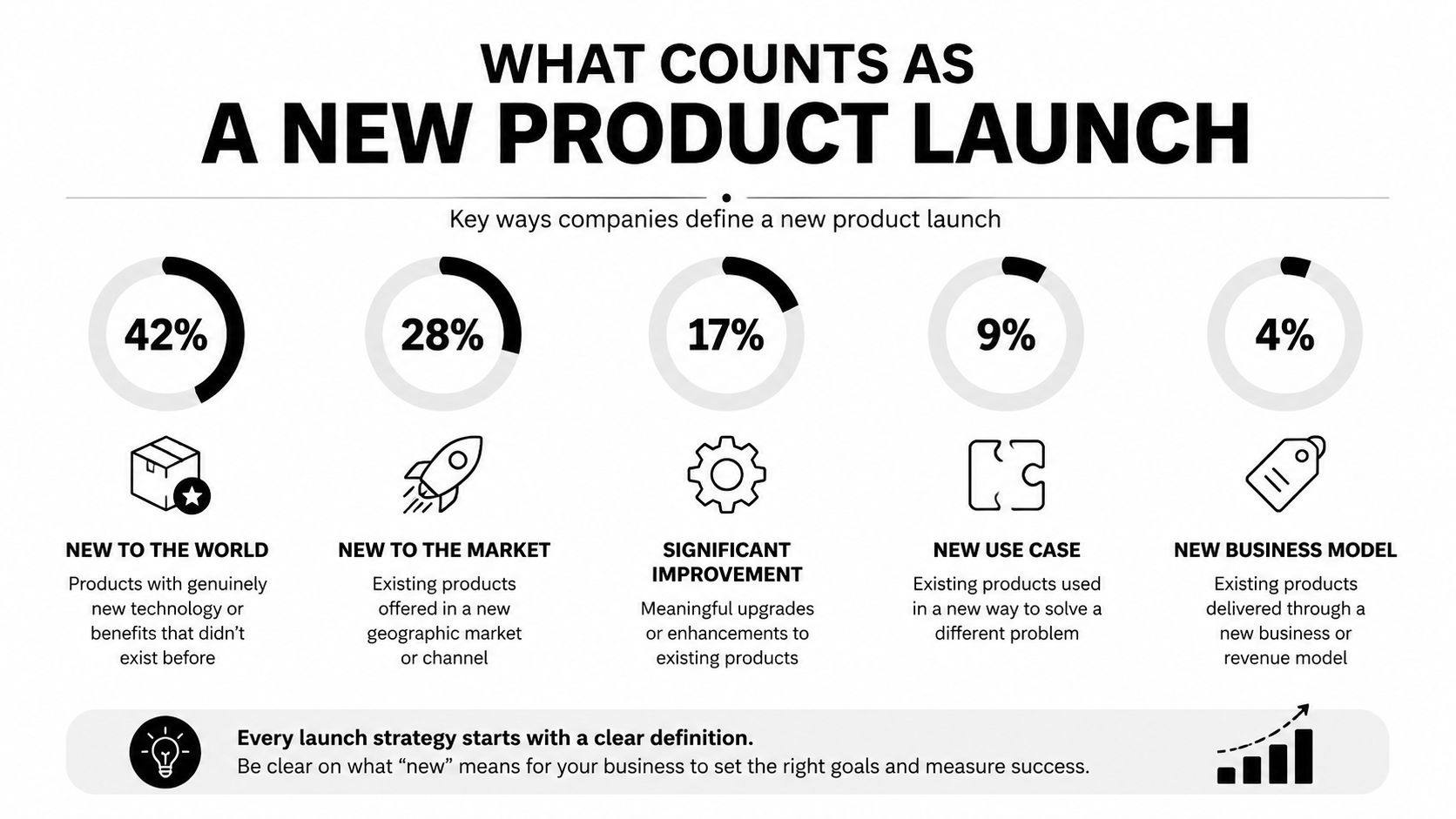
When a release qualifies
Not every product change deserves the same level of launch work.
- A full launch introduces a new offer, opens a new market, or changes how the company sells.
- A soft launch makes the product available to a limited audience so the team can test onboarding, pricing, support, or messaging.
- A beta release invites selected users to try an unfinished or evolving product and provide feedback.
- A rebrand changes the identity or market presentation of an existing offer. It qualifies as a launch when customers must understand a meaningful change in value, ownership, or positioning.
- A feature update improves an existing product. It may need a focused release campaign, but not the same public machinery as a new category entry.
The distinction guides the press strategy. A full launch may require a press release, media briefings, product pages, sales preparation, customer education, and follow-up over the wider system. A minor update may need only a customer email, release note, or in-product message. The right question is how much coordinated work the change requires to earn attention and support adoption.
The Three Stages Every Launch Moves Through
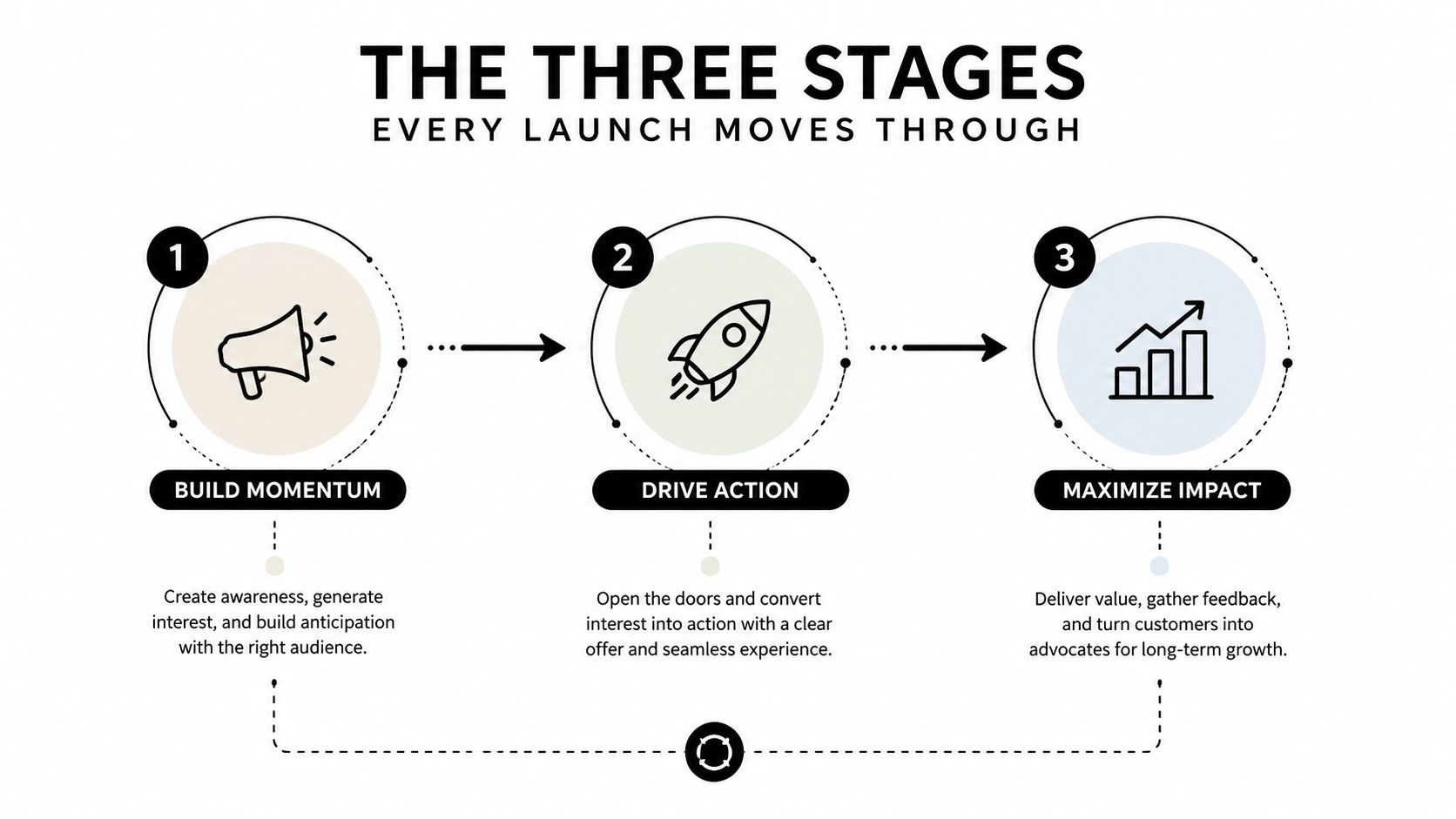
A launch moves through pre-launch, launch, and post-launch. The stages overlap, but they shouldn't be confused. Each answers a different operational question.
Pre-launch asks, “Are the product and the organization ready?” Launch asks, “Can the right audience understand and act on the announcement?” Post-launch asks, “What did the market teach the team, and how should the company respond?”
The film analogy continues here. Pre-launch is production and promotion. Launch is opening night. Post-launch is the period when reviews, audience behavior, ticket sales, and distributor decisions determine whether the film gets a longer run. A product team that skips preparation can't compensate with a louder premiere.
Pre-launch builds the conditions for demand
Pre-launch may include market research, audience selection, positioning, message development, creative assets, website updates, PR pitching, customer previews, and sales enablement. Operations teams confirm inventory or service capacity. Sales leaders prepare qualification guidance, objection handling, demonstrations, and follow-up sequences. Executives agree on the single claim the company can defend publicly.
A useful readiness test asks whether an external person could understand the product without a private explanation from the founder. If not, the positioning needs work.
Launch coordinates the public moment
The launch window brings the announcement into the channels that matter. Those channels can include a press release, media interviews, an event, email, social content, partner communications, paid media, in-store activity, and in-product education. The press release provides a stable public record, but it shouldn't carry every message alone.
A launch project involving physical hardware needs especially careful sequencing across manufacturing, fulfillment, creator outreach, and customer expectations. A practical resource such as Fundl's launch a 3D printer campaign can help founders think through the campaign mechanics around a product that requires both public attention and operational delivery.
Post-launch turns attention into adoption
Post-launch work includes tracking audience behavior, answering questions, gathering feedback, correcting unclear claims, nurturing leads, and helping customers reach the first useful outcome. The product team may change onboarding. Marketing may revise the headline. Sales may narrow the best-fit audience. PR may offer journalists a follow-up angle based on early customer questions.
Practical rule: A launch isn't finished when the announcement is published. It's finished when the team has enough evidence to improve the offer, the message, or the route to market.
How PR Fits Into a Product Launch
Public relations connects the company's internal launch plan with external audiences. It gives journalists, analysts, customers, partners, and searchers a concise account of what changed and why the change deserves attention. PR can extend reach beyond owned channels, but it can't create a credible story where the product has no defined audience or meaningful customer problem.
The press release is the operating document at the center of that effort. Its structure helps a journalist decide quickly whether the announcement contains news. A useful release normally includes:
- A dateline and release status, including an embargo when selected outlets receive the information before publication.
- A specific headline and subhead, focused on the announcement rather than a slogan.
- A direct lede, answering who launched what, for whom, and why now.
- Supporting context, such as the customer problem, product availability, relevant background, and access details.
- A credible quote, usually from an executive, founder, customer, partner, or subject specialist.
- Boilerplate and media contact information, so readers can verify the company and request an interview.
An embargoed release works when journalists need preparation time. It can support coordinated coverage, technical briefings, and interviews that publish together when the embargo lifts. An immediate-release announcement suits straightforward news that can be published as soon as it distributes, particularly when timing depends on availability or a public event.
The difference between a strong and weak angle is usually not the length of the release. It's the clarity of the news.
| Element | Strong Angle | Weak Angle |
|---|---|---|
| Customer problem | Names a specific operational difficulty and the audience affected | Refers vaguely to “changing business needs” |
| Product value | Explains the practical outcome without overpromising | Lists features without showing relevance |
| Evidence | Uses a defensible customer example, demonstration, or market context | Relies on unsupported superlatives |
| Spokesperson | Gives a named person a useful point of view | Quotes the company as if it were a person |
| Timing | Explains why the announcement matters now | Announces availability without a news hook |
Teams planning the release can also use this public relations tactic guide to connect announcement writing with outreach and follow-up. The central principle remains simple: PR should amplify a clear launch strategy across paid, owned, and earned channels. It won't rescue weak positioning.
Press Release Template and Sample for a Launch
A launch release should pass a journalism filter before it passes a brand filter. The brand may want to describe every feature, but the reader first needs to understand the news.
The five blocks of a usable release
Dateline and status: Start with the city, publication date, and release condition. An embargo line should state when the information may be published. If there isn't a genuine reason for early access, immediate release may be cleaner.
Headline and subhead: The headline should state the announcement. The subhead can add the customer context, market category, or practical distinction. A line such as “Northstar Analytics opens beta for revenue forecasting platform built for lean finance teams” gives readers more information than “Northstar revolutionizes business intelligence.”
Opening paragraph: The first paragraph should answer who, what, why, and why now. It shouldn't begin with company history.
Supporting body: Add the problem, how the product addresses it, who can access it, and what the company will do next. Keep paragraphs short and give each paragraph one job.
Boilerplate and contact: End with a factual company description and a media contact who can respond promptly. A journalist needs a person, not a generic inbox alone.
A detailed product launch press release guide can help teams turn these blocks into a working schedule.
Reusable template
FOR IMMEDIATE RELEASE
[Company] launches [product] for [specific audience]
[Subhead explaining the customer problem or market relevance]
[City, State, Date]. [Company] today announced [product], a [category] designed for [audience] that helps them [specific outcome]. [Product] is available [availability detail], with [access or pricing context if confirmed].
[Explain the customer problem in plain language. Describe the product's approach and one or two meaningful capabilities. Avoid turning the paragraph into a feature inventory.]
“[Quote from a named spokesperson explaining the customer need, the reason for the launch, or what the team learned from users],” said [Name, title].
[Add access information, beta terms, launch event details, customer guidance, or the next step. Include a link to the relevant page.]
About [Company]
[Two or three factual sentences describing the company, its audience, and its work.]
Media contact
[Name]
[Title]
[Email]
[Phone]
Sample release
FOR IMMEDIATE RELEASE
Northstar Analytics opens beta for revenue forecasting platform built for lean finance teams
New software helps growing companies connect sales activity with cash planning before monthly close
AUSTIN, Texas, September 3, 2026. Northstar Analytics today announced the beta release of its revenue forecasting platform for finance and operations teams at growing software companies. The platform brings sales pipeline activity, recurring revenue records, and cash planning into one workspace so teams can review assumptions before finalizing a forecast.
Finance leaders often receive pipeline updates in one system, billing information in another, and planning notes in spreadsheets. Northstar Analytics gives teams a shared view of the inputs behind a forecast, with change tracking that shows which assumptions moved and why.
“Finance teams need a practical way to discuss uncertainty without rebuilding a model for every planning conversation,” said Maya Chen, co-founder and chief executive officer of Northstar Analytics. “The beta gives early users a place to test that workflow with their own operating data and tell the team where the product needs to improve.”
The beta is open to selected software companies in North America. Participants receive onboarding support, access to the forecasting workspace, and a direct feedback channel with the Northstar product team. Interested teams can request access at northstaranalytics.example/beta.
About Northstar Analytics
Northstar Analytics develops planning software for finance and operations teams. The company is based in Austin, Texas.
Media contact
Jordan Lee
Communications Director
press@northstaranalytics.example
Three rules keep the draft usable:
- Lead with the news, not the company origin story.
- Keep paragraphs under three sentences so the release scans quickly.
- Quote a person, not a logo, and give that person a point of view.
A 12-Week Launch Checklist and Timeline
A 12-week schedule gives a team enough room to test the story, prepare assets, brief media, and build contingencies. Modern product-development guidance places many launches inside a much longer development cycle, often 9 to 18 months, while the final activation period can be concentrated into a shorter campaign window. G2's product launch statistics guide describes simpler line extensions as taking about 6 to 9 months, core innovations 9 to 15 months, and complex new-to-market launches 12 to 24 or more months. The 12-week plan below covers the final go-to-market runway, not product invention from scratch.
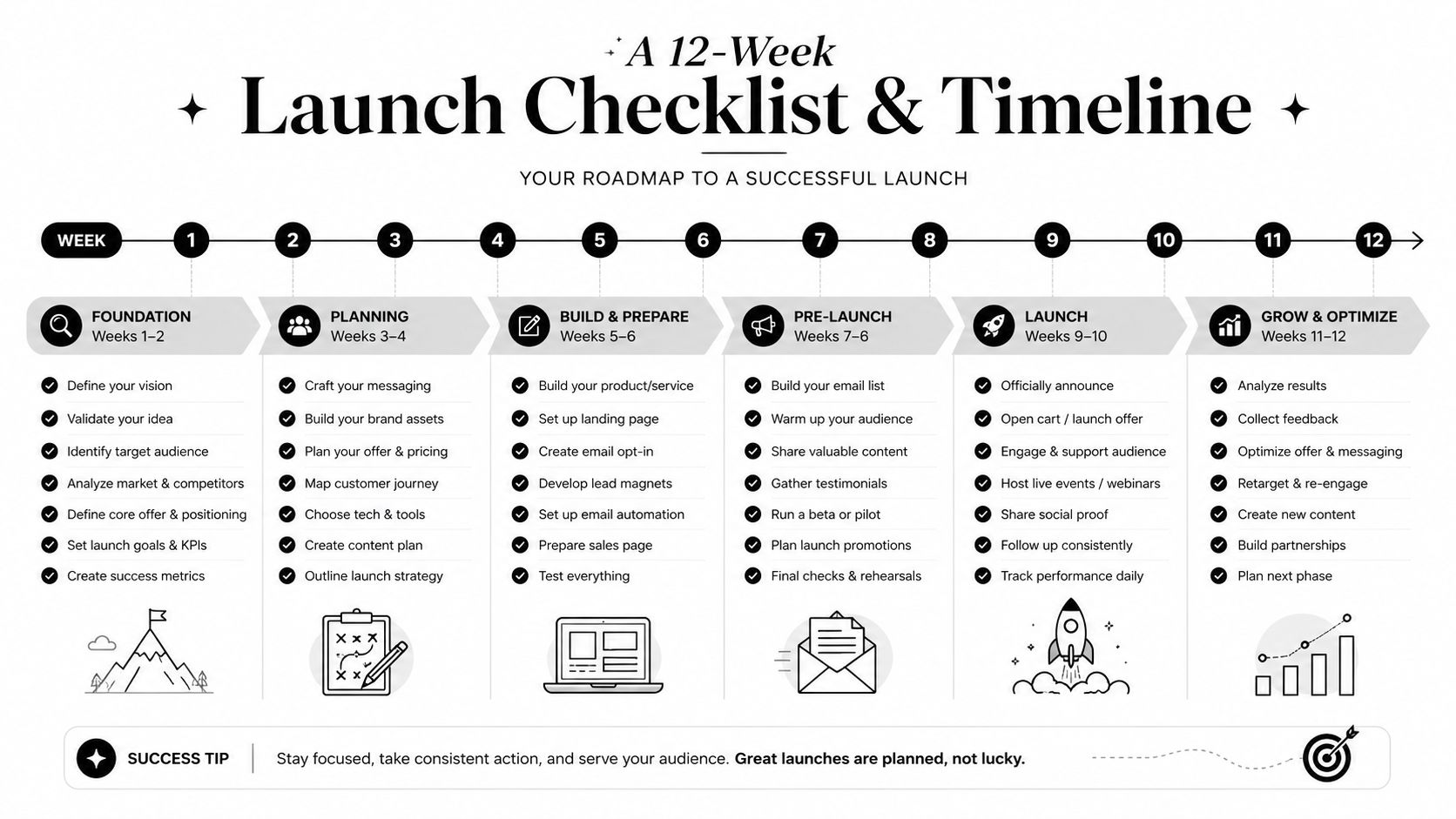
Weeks 12 to 9 build the story and assets
- Week 12, founder and product lead: Confirm the audience, customer problem, launch objective, availability, and proof the company can publish. Checkpoint: can the team describe the offer in one sentence without feature jargon?
- Week 11, product marketing and sales: Draft positioning, objections, audience-specific messages, sales materials, landing-page copy, and customer support guidance. Checkpoint: can sales explain who should not buy?
- Week 10, creative and web owners: Produce the product page, screenshots, demonstrations, email copy, social assets, and release draft. Checkpoint: do all channels use the same product name and promise?
- Week 9, operations and leadership: Confirm inventory, onboarding capacity, legal review, spokesperson availability, and tracking plan. Checkpoint: can the organization fulfill the demand the campaign may create?
Founders who need another working reference can use the SubmitMySaas-1 checklist for founders to compare launch tasks against their own product and team structure.
Weeks 8 to 5 seed media and brief the market
- Week 8: Build the target media list by beat, audience, and relevance. Begin background outreach without flooding journalists with a finished sales pitch.
- Week 7: Confirm the spokesperson interview list, talking points, customer permissions, and briefing materials. Prepare a tier-two list if priority outlets pass.
- Week 6: Offer selected journalists or trade writers early briefings where appropriate. Test the headline with sales calls, customer conversations, and trusted partners.
- Week 5: Lock the release draft, supporting visuals, landing page, email sequence, and social calendar. Checkpoint: does each channel lead to one clear action?
Weeks 4 to 1 rehearse and lock timing
Run a full rehearsal with product, sales, support, operations, executive, and PR owners. Check links, access flows, customer instructions, spokesperson answers, and escalation paths. Set a backup date for a slow-news week, confirm a tier-two media list, and prepare a customer-story swap if the beta testimonial falls through.
At week 2, lock the embargo lift time or immediate-release schedule. At week 1, distribute approved briefing materials, confirm everyone's publishing responsibilities, and freeze nonessential message changes.
Launch week through plus 4
On launch day, monitor coverage, questions, traffic quality, signups, demos, activation, support volume, and sales feedback. Publish the release, send segmented customer communications, activate social and partner channels, and give spokespeople a single source of truth.
During the following weeks, publish practical education, answer objections, nurture prospects, review customer feedback, and update the message where confusion appears. The plan should end with a retrospective, not silence. A new product launch timeline resource can help teams turn this schedule into an owned calendar with dates, responsibilities, and approval checkpoints.
Sector Notes for Startups, Nonprofits, Real Estate, and Retail
The launch stages stay consistent across sectors, but the audience's decision and the proof required change sharply. A startup usually needs early adopters and recurring commercial traction. A nonprofit may need donors, volunteers, advocates, or community participation. A real estate developer needs qualified interest and presales. A retail brand has to create attention that becomes store visits, online orders, and sell-through.
| Sector | Primary Objective | Strongest PR Angle | Key Distribution Channel |
|---|---|---|---|
| Startup | Acquire early adopters and build recurring revenue | A specific customer problem, founder insight, and evidence of product fit | Trade media, founder networks, email, product communities |
| Nonprofit | Attract donors, volunteers, or participants | A human-interest story showing who benefits and why action matters | Local media, community partners, email, social platforms |
| Real estate | Generate qualified leads and presales | Location, design, amenities, access, and buyer or tenant relevance | Property media, local press, broker networks, events |
| Retail | Drive foot traffic and product sell-through | A sensory experience, distinctive product hook, and creator or community participation | Retail media, local outlets, creators, in-store promotion |
A startup's release should avoid claiming that a product is for everyone. A sharper announcement identifies the first audience and explains the pain that audience already recognizes. Founders can serve as spokespeople, but customer language should shape the story.
Nonprofits benefit from a person-centered angle. The organization may have a strong mission, but readers connect more readily with a clearly described community need, a participant's experience, or a volunteer's role. Consent, dignity, and accuracy matter more than emotional exaggeration.
Real estate coverage needs visual and factual substance. Renderings, location context, access information, design rationale, availability, and pricing context can help a journalist assess the project. The launch should distinguish confirmed details from future plans.
Retail teams face category noise. A new product may need an in-store demonstration, a sampling moment, packaging that photographs well, or creator coverage that shows the product in use. The strongest hook gives people a reason to visit or share, not just a reason to know the item exists.
The channel changes, but the discipline doesn't. Audience, proof, message, timing, and follow-through remain the core decisions.
Measuring Results and Improving the Next Launch
A launch dashboard should connect each metric to a decision made earlier. For an awareness goal, track coverage, reach, message presence, and behavior from the relevant audience. For an adoption goal, measure what people do after seeing the announcement. Commercial goals add revenue and retention, but early attention should remain a separate measure.
A useful dashboard has three layers.
Media coverage
Record the number and relevance of placements, the publications or programs involved, the messages they repeated, coverage sentiment, and whether the story included key spokespeople or recognizable customer problems. Share of voice can clarify a competitive launch, provided the team defines the comparison set before outreach begins.
Audience behavior
Review landing-page visits, email responses, content engagement, signups, demo requests, product trials, and in-product actions. Separate channel performance from product performance. A press release may attract qualified visitors while onboarding creates friction. Those findings require different owners and different fixes.
Commercial outcomes
Connect qualified leads, purchases, upgrades, retention, renewal signals, and revenue to the launch only where attribution is credible. Source tracking, campaign labels, sales notes, and customer interviews can show contribution. A later sale should not automatically be credited to one announcement or one traffic spike.
Benchmark context gives the review more meaning than an internal target alone. One industry benchmark database spans 700 million plus data points across more than 500 launches, according to ZoomRx's launch benchmarking guidance. Compare awareness, uptake, and performance with historical launches that match the category, competitive situation, and time point. The same result may indicate strength in one segment and weakness in another.
The 30-day retrospective
At the end of the first month, bring together product, sales, marketing, support, operations, and PR owners. Ask four direct questions:
- Which message earned attention, and which confused the audience?
- Which journalists, partners, and channels produced qualified behavior?
- Where did prospects or customers stop progressing?
- Which assumption should change before the next launch?
Place each answer beside supporting evidence, then turn the finding into a specific action. Possible actions include revising the headline, changing onboarding, preparing a sales-objection guide, interviewing customers, or changing a channel decision. Teams reviewing how customer feedback should appear in launch content can use this product review playbook 2026 for a structured approach to reviews and credibility.
A launch becomes a repeatable system when the review changes the next cycle. Over time, the company learns which stories travel, which audiences respond, which promises hold up, and which operational gaps need attention before another release.
Press Release Zen provides guides, templates, and planning resources for product launch announcements, media outreach, and release timing. Founders and communications teams can visit Press Release Zen to turn launch strategy into a clearer press release and an executable PR plan.