Launch day arrives with the product page ready, the executive post scheduled, and a media list waiting for the announcement. Then legal flags a claim in the release, the social team publishes an earlier version, and analysts receive questions the company hasn't prepared to answer. A strong product launch press release prevents that scramble by treating the announcement as both a newsroom document and a modular content asset for owned channels, search, sales, and measurement.
The format has a long history as a fact-first communications channel. The modern press release is commonly traced to 1906, when Ivy Lee issued a statement after a Pennsylvania Railroad accident and encouraged transparency with the press. That logic still applies to product launches: publish verified details, explain why the announcement matters, and provide quotable context journalists can reuse. Contemporary distribution also operates at significant scale. Industry reporting noted that PR Newswire's 2023 distribution volume reached 450,000 press releases and represented 38% U.S. market share. (Industry reporting on press release distribution)
Table of Contents
- Set the Launch Objective and Approval Plan
- Build the Release Around a Newsworthy Story
- See the Core Release Structure in Action
- Choose Targeted Distribution Over Maximum Reach
- Prepare, Review, and Schedule the Launch
- Measure Coverage, Engagement, and Business Results
- Run a Final Product Launch Release Check
Set the Launch Objective and Approval Plan
A launch team needs one decision before it drafts a headline: what business outcome should this announcement influence? Awareness, sign-ups, retail sell-in, investor positioning, and a competitive counternarrative all require different messages and different measures. A release designed to generate qualified demos shouldn't lead with the same proof point as one intended to reassure investors.
Write the objective in a sentence that names the audience, desired action, and measurement method. For example, a B2B software team might choose, “Increase qualified demo interest among operations leaders through trade coverage and tracked landing-page visits.” The objective then determines whether the release emphasizes workflow impact, technical compatibility, customer access, or category context.
Assign decision rights before drafting
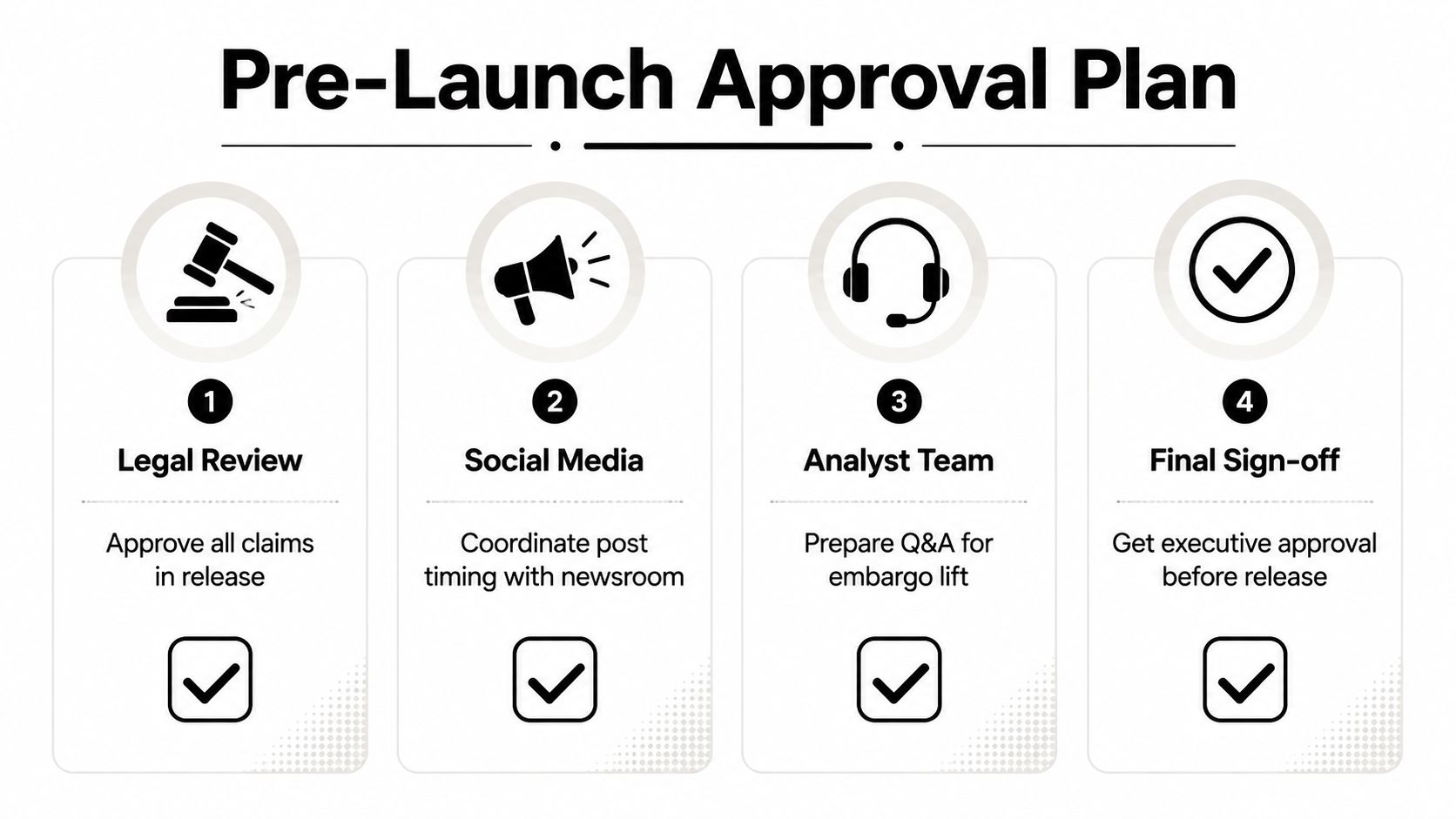
Map every person who can approve, change, or speak for the announcement. Product marketing verifies positioning and feature descriptions. Product leadership confirms technical facts. Legal reviews regulated, comparative, and performance claims. The executive sponsor approves the strategic message, while regional spokespeople prepare for questions from local media and partners.
A single source-of-truth document should hold the approved headline, lead, product name, pricing, availability, quote language, links, media assets, FAQ, and embargo terms. Give the document an owner, record version changes, and capture sign-off timestamps. A pre-approved FAQ also keeps sales, analysts, social teams, and spokespeople from improvising different answers after publication.
Practical rule: Every sentence should earn its place by supporting the chosen objective, proving the announcement, or helping a journalist act on it.
Before approving an edit, ask whether it improves the selected KPI or merely satisfies an internal preference. If the objective is qualified demand, a specific integration may matter more than a broad brand statement. If the objective is category credibility, an independent voice may matter more than another feature paragraph. This framework gives the team a defensible reason to keep, cut, or relocate copy.
Build the Release Around a Newsworthy Story
A product team may have spent months preparing a launch, yet a newsroom still needs a clear reason to cover it. Distribution cannot turn a routine catalogue update into news. The release must show what changed, who is affected, and why the change matters now. That story should also support the launch objective, whether the team is seeking qualified demand, partner attention, category credibility, or search visibility.
Start by testing four possible news angles:
- Market change: Does the product respond to a shift buyers already recognize?
- Known problem: Does it address a concrete frustration for the target audience?
- New audience: Does it make an established category usable by people who previously lacked access?
- Challenged assumption: Does it give readers a credible reason to reconsider how a task is done?
Vague answers signal a weak angle. “Company launches a platform” gives a reporter little to investigate. “Company introduces an analytics tool that combines operational data in an existing workflow” identifies the category, audience, and possible story path. It also gives the company reusable material for its newsroom, product page, sales follow-up, and search content.
Put the change first
Write the headline around the concrete news. Identify the brand or product where that helps the reader. “Northstar Introduces FlowSignal for Real-Time Retail Inventory Analysis” is more useful than “Northstar Announces Its Exciting New Product.” The first version tells a journalist what changed and where the story belongs.
The lead should compress who, what, when, where, and why into two or three sentences. Name the company and product, explain the function in plain language, state availability, and connect the launch to a real audience problem. Leave company history, mission language, and unsupported superlatives out of the opening.
Verifiable details make the release useful after publication. Include pricing when the company can publish it, availability dates, supported regions, compatibility, integrations, and claims that can pass legal review. If pricing is custom, state the pricing model and provide an appropriate contact. Hiding basic access information behind vague language creates work for journalists and weakens conversion on owned channels.
Quotes should add interpretation rather than repeat the lead. An executive can explain why the product exists and why the timing matters. A customer can describe a specific experience, a partner can explain the collaboration, and a qualified third party can frame the market context. Analyst commentary must be clearly attributed and approved for quotation, so journalists understand both the speaker and the limits of the statement.
| News Driver | Release Treatment | Typical Quote Source |
|---|---|---|
| A new solution to a recognized problem | State the problem, explain the product's distinct approach, and provide availability details | Product executive or customer |
| Entry into a new audience or region | Identify the audience, access point, and local relevance | Regional spokesperson or partner |
| A strategic platform expansion | Explain how the product fits existing workflows and integrations | Executive, customer, or technology partner |
| A market assumption challenged | State the assumption carefully, then provide verifiable evidence | Independent analyst or qualified third party |
Treat the release as a useful briefing, not an advertisement. Facts, context, and attributed proof should carry the story. Before final approval, connect each major detail to a KPI. A specific integration may support qualified demand, while an independent voice may strengthen credibility more than another feature paragraph. Remove copy that serves only internal preference.
See the Core Release Structure in Action
Consider a fictional B2B analytics company, Northstar Metrics, launching FlowSignal for multi-location retailers.
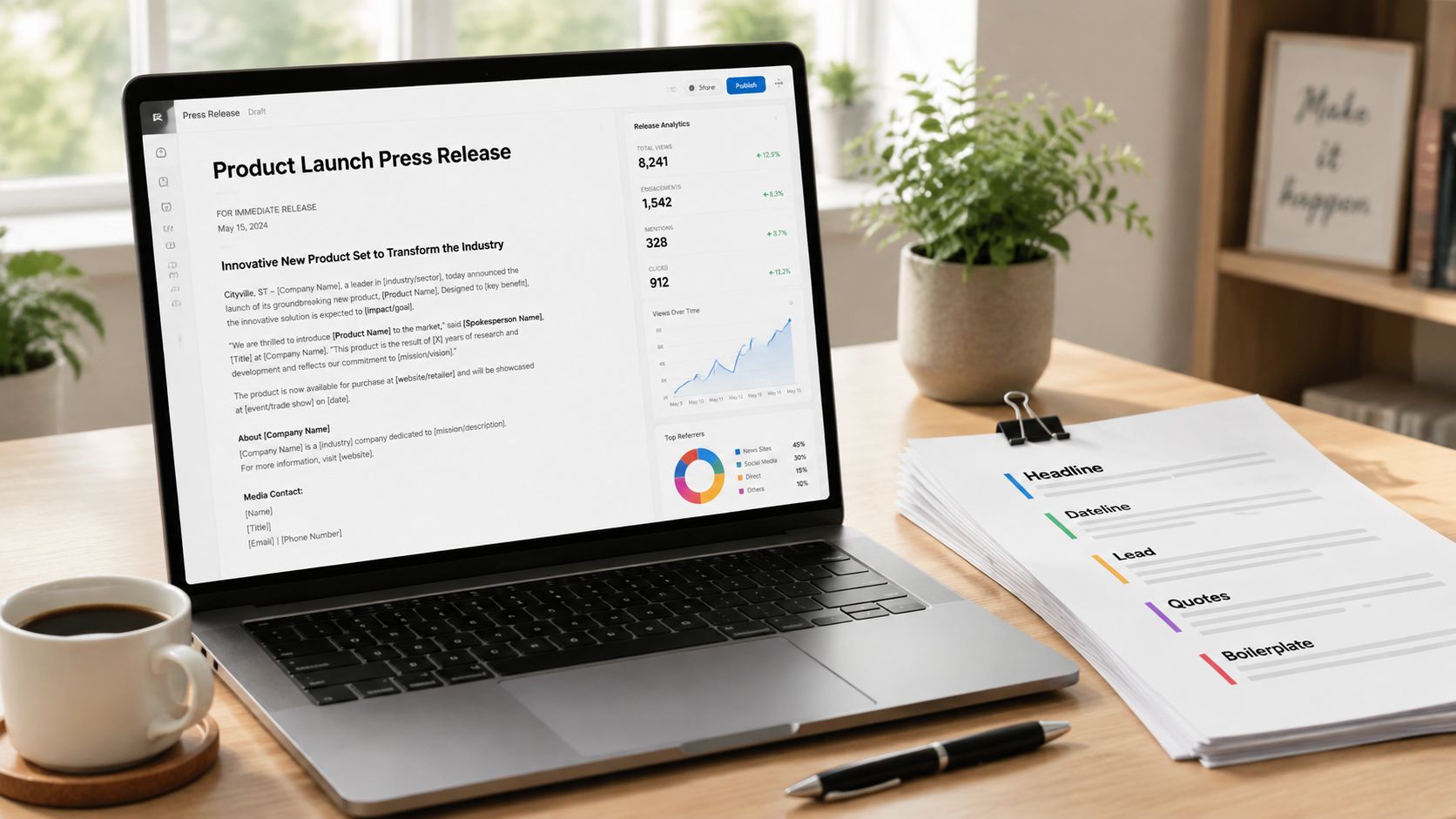
FOR IMMEDIATE RELEASE
Northstar Metrics Launches FlowSignal to Help Retail Teams Combine Inventory Signals
NEW YORK, September 10, 2026. Northstar Metrics today launched FlowSignal, an analytics tool that brings inventory, sales, and fulfillment data into one workspace for multi-location retailers. The product is available to North American customers through Northstar's sales team.
The headline works because it names the change and the audience. It doesn't spend its limited space on “exciting.” The lead answers the essential questions quickly, while the second sentence establishes availability without making a claim the company can't substantiate.
FlowSignal connects with a retailer's existing data sources and presents store-level alerts in a shared dashboard. Teams can use the workspace to identify stock discrepancies, review fulfillment exceptions, and prepare operational reports.
“Retail teams shouldn't have to reconcile separate views before they can decide what needs attention,” said Maya Chen, chief product officer at Northstar Metrics. “FlowSignal gives operations leaders a common workspace for the signals they already use.”
The first body paragraph explains function and relevance. The executive quote adds a human explanation of the problem, rather than restating a feature list. If the quote were replaced with “We're thrilled to bring this platform to market,” the release would lose its most useful context.
FlowSignal supports Northstar's data connectors and is available for customers operating in North America. Product specifications, access requirements, and media images are available in the linked press kit.
Visit the Northstar Metrics website to request a product briefing.
About Northstar Metrics
Northstar Metrics develops analytics software for retail operations teams. Its products help organizations organize business data, identify exceptions, and support day-to-day decisions. Learn more at the company's website.
Media contact
Jordan Lee, communications director
media@example.com
The final product facts answer practical newsroom questions. The boilerplate does quiet work for recap coverage and search by defining the company and category. Short paragraphs, complete quote attribution, a clear call to action, and a separated About section help editors cut the release without damaging its meaning.
For another structural reference, teams can review this sample press release for a new software app launch.
Choose Targeted Distribution Over Maximum Reach
A large audience isn't automatically a useful audience. Reach matters when it reaches people who buy, review, influence, or validate the product. A broad wire can create an indexed public record and support discovery, but it won't replace focused media work when the launch objective depends on qualified coverage or category credibility.
Prioritize outlets by audience overlap, editorial relevance, journalist track record, exclusivity potential, and coverage-per-send. The last measure helps a team compare effort with meaningful results instead of celebrating every low-value mention. A niche trade publication may matter more than a general outlet if its readers participate in the relevant buying decision.
A B2B analytics platform should usually lead with technology trades, operations publications, analyst briefings, and journalists who cover enterprise software. Its pitch may emphasize integrations, deployment context, and the operational problem. A consumer wellness product needs a different treatment. Lifestyle editors, product reviewers, creators, and morning television producers may need product access, visual assets, practical use cases, and a concise consumer benefit.
Match channel to objective
| Channel | Best for | Limits to watch |
|---|---|---|
| Targeted journalist pitch | Qualified editorial coverage and expert interviews | Requires research, personalization, and responsive follow-up |
| Embargoed briefing | Coordinated launch-day stories and deeper product understanding | Journalists must agree to the embargo, and the company must honor it |
| Wire distribution | Broad availability, search visibility, and a central announcement record | Pickup may be shallow or unrelated to the buying audience |
| Owned newsroom and social channels | Message control, reuse, and direct audience access | Owned publication doesn't equal independent editorial validation |
| Partner and analyst outreach | Category credibility and third-party context | Approval and briefing timelines can be longer |
Recent industry data reported that about 18% of press releases receive pickup from at least one outlet within 24 hours. The same benchmark source reported that releases with well-crafted quotes can achieve pickup rates up to 40% higher, while releases with multimedia were reported as 3.5 times more likely to be picked up than text-only releases. (Media relations statistics and benchmarks) Those figures don't guarantee coverage, but they reinforce why targeting, quotes, and usable assets deserve attention.
Teams evaluating distribution workflows can also review recent API improvements when they need to connect release data with internal systems. For broader execution guidance, the guide to distributing a press release can help organize wire, direct outreach, and owned-channel decisions.
Prepare, Review, and Schedule the Launch
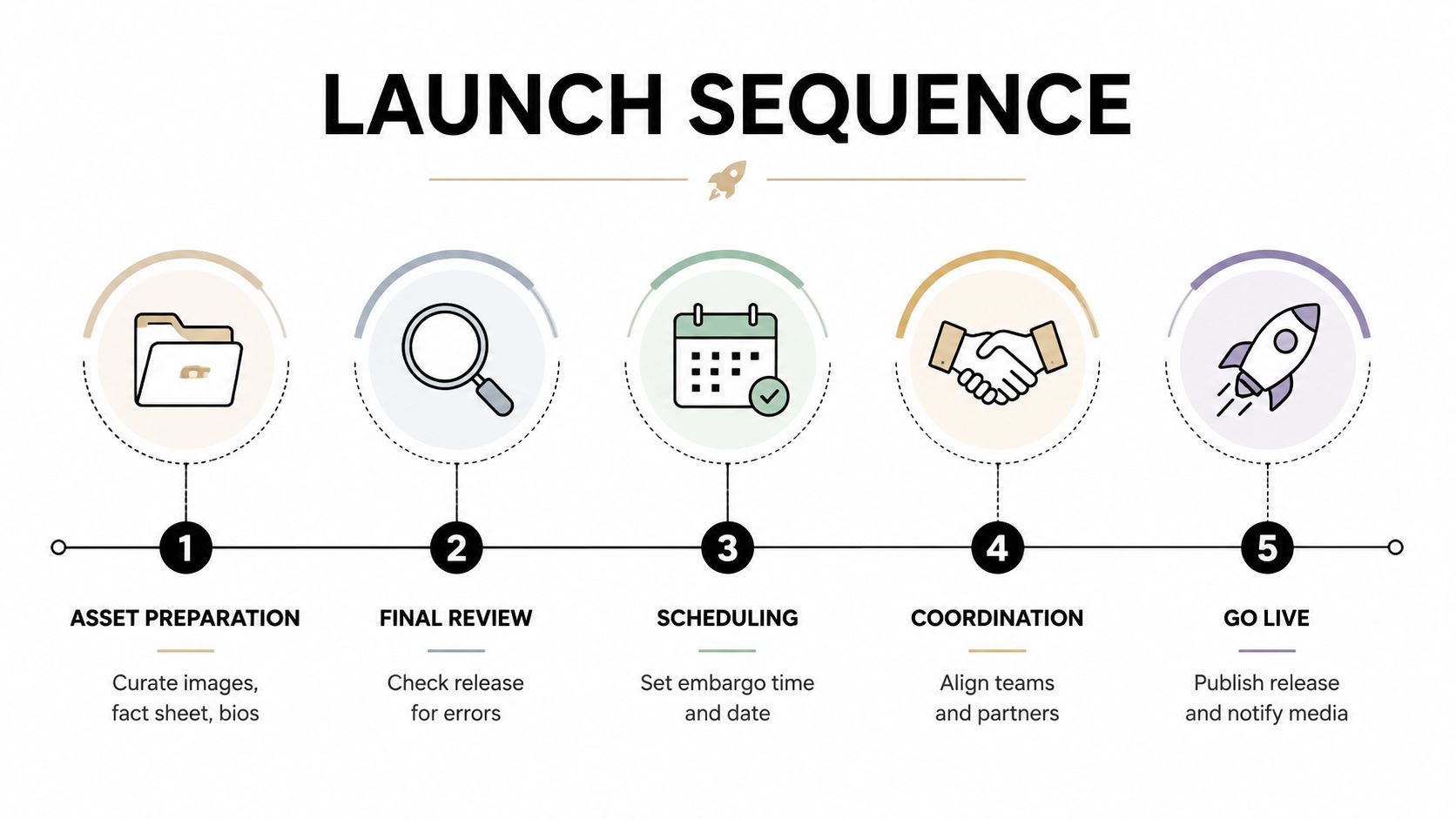
A polished draft can still fail if the surrounding launch system is incomplete. Prepare the assets before the release enters final review, so journalists aren't sent to a media kit containing missing files, broken links, or outdated product names.
The core package should include high-resolution product images, a fact sheet, executive bios, pricing and availability information, a media contact, and a short FAQ. Add a demo or product walkthrough when the announcement depends on understanding how the product works. Teams developing that supporting asset can use guidance on planning a demo video script to keep the demonstration focused on the user problem rather than a sequence of disconnected features.
Use a controlled review sequence
Assign a named approver to each category of information:
- Product claims: The product manager confirms functionality, integrations, supported environments, and availability.
- Commercial details: Product marketing or revenue operations verifies pricing, packaging, regions, and access instructions.
- Quotes: Each named speaker approves the exact wording and attribution.
- Legal language: Counsel reviews regulated claims, competitor references, guarantees, and evidence requirements.
- Embargo status: Communications confirms the date, time, timezone, recipients, and publication conditions.
Keep all changes in one shared document with a visible version label. Separate drafts create subtle inconsistencies, such as one market using a different product name or a social post promising access before the release is live.
A practical operating rhythm starts 72 hours before launch. At that point, the team should test every link, confirm media-kit permissions, verify the landing page, check the FAQ against the release, and confirm that each approver knows the deadline. Scheduling should account for target-outlet time zones, embargo lift, social posts, partner announcements, and analyst briefings. The order matters because journalists who receive the news after publication have less time to prepare meaningful coverage.
A large timing study of 56,606 press releases found the strongest distribution window was Tuesday through Thursday between 8:00 and 10:00 a.m. Eastern time, while noon was described as the most crowded period on the wire. (Timing study of 56,606 press releases) Use that as an operational benchmark, not a substitute for local newsroom knowledge.
Measure Coverage, Engagement, and Business Results
The release should be measured against the objective chosen before drafting. A team seeking awareness needs a different success definition from a team seeking demos, retail sell-in, or investor confidence. Counting every pickup as equal obscures that distinction.
Use three measurement layers.
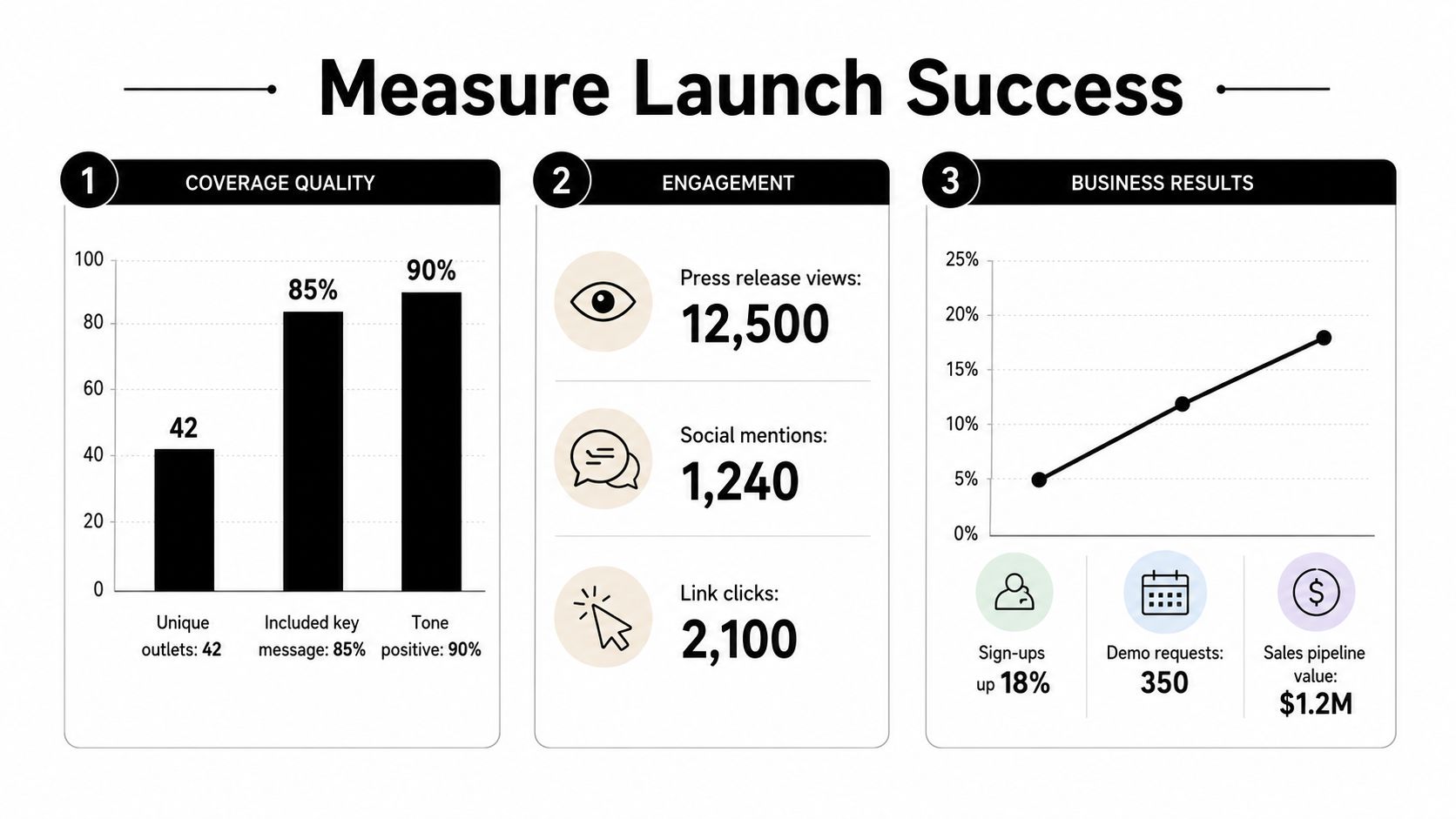
Coverage quality
Record the outlet, audience, editorial tier, geographic relevance, sentiment, and whether the key message survived editing. Track share of voice when competitors are part of the objective, but don't treat a mention that omits the product's central point as equivalent to a useful story. Segment results by journalist and pitch angle to identify relationships worth developing.
Engagement signals
Review release views, article reads, time on page, social sharing, branded search activity, and inbound links. Use distinct tracking links for the wire, newsroom, executive post, partner email, and journalist pitch. That setup shows which channel produced attention and which produced action.
PR Newswire's 2025 global report says 91% of communicators reuse press release content on other channels, while 57% say press releases increased visibility for their brand or products. The report also says more than half use generative AI to craft some release components. (PR Newswire's 2025 global report) These findings support a modular workflow, but human review remains essential for claims, tone, approvals, and attribution.
Business results
Connect traffic and coverage to the commercial action that matters. Depending on the launch, that may be demo requests, trial sign-ups, influenced sales pipeline, retailer conversations, or sell-through. Compare performance by channel, audience, geography, and message variant. A wire mention may create discovery, while a trade article may influence a buying committee, and an analyst briefing may strengthen later sales conversations.
Repurpose the strongest approved material. Pull quotes can support sales decks, product facts can inform social posts, and journalist relationships can support future exclusives. A release can also become a durable newsroom page and a source of search visibility when the page is clear, accessible, and connected to relevant product resources.
For a practical measurement framework, teams can use this guide to press release KPIs and performance measurement.
End with a short retro while details are fresh:
- Keep: Which message, outlet, asset, or spokesperson produced the most useful result?
- Change: Where did approval, timing, targeting, or follow-up slow the launch?
- Test: What single adjustment should the next product launch press release make?
- Reuse: Which approved facts, quotes, and assets can support sales, search, or social content?
Run a Final Product Launch Release Check
Before submission, the team should be able to answer every question with yes.
Objective alignment
- Does the headline support the launch KPI?
- Does the lead identify the audience, product, change, and availability?
- Does the call to action match the desired next step?
- Is the boilerplate current and factually approved?
Editorial readiness
- Has every product claim been checked against an authoritative internal source?
- Have pricing, regions, integrations, and dates been verified?
- Has each quoted speaker approved the exact wording and attribution?
- Are the embargo terms clear and consistent?
- Are the media assets uploaded in the correct formats and accessible without avoidable friction?
Distribution control
- Is the embargo or publication time aligned across target regions?
- Have priority journalists received the right briefing or pitch?
- Are social, partner, analyst, and newsroom posts coordinated?
- Is the measurement sheet ready to record outlet quality, message survival, engagement, and business results?
- Is a named person responsible for responding to inbound media requests?
Skipping this check causes preventable re-sends, conflicting versions, and missed launch windows. Clean writing matters, but approval control and measurement readiness protect the announcement just as much as the headline does.
Press Release Zen offers practical guides, examples, templates, and measurement resources for teams planning and distributing product announcements. Use Press Release Zen to organize the release, approval process, targeting, and post-launch evaluation before the announcement goes live.