An organization can have a polished event on the calendar and still struggle to give journalists a reason to attend. A date, venue, speaker list, and registration link describe logistics, but they don't automatically create a story. The strongest PR event examples connect a timely news hook with useful access, credible spokespeople, and evidence that can be reported, photographed, recorded, or demonstrated.
That evidence might be a product in action, an executive available for questions, a partnership affecting a community, or a public response to a serious incident. The event becomes more valuable when journalists leave with material they couldn't get from a routine announcement.
The ten formats below treat each event as a repeatable communications playbook. Each one identifies the news hook, audience, media assets, suggested press angle, sample announcement copy, execution risks, and follow-up workflow. When the plan is ready to become a formal release, Press Release Zen can support announcement structure, formatting, templates, and distribution decisions.
Table of Contents
- 1. Press Conference
- 2. Product Launch Event
- 3. Media Breakfast or Lunch Briefing
- 4. Webinar and Virtual Press Event
- 5. Sponsorship and Trade Show Activation
- 6. Expert Commentary and Op-Ed Placement
- 7. Award Submission and Recognition Campaign
- 8. Community Sponsorship and Local Event Partnerships
- 9. Crisis Communication and Response Press Release
- 10. Media Kit and Digital Newsroom
- 10 PR Event Types Comparison
- Turn an Event Into a Media-Ready Story
1. Press Conference
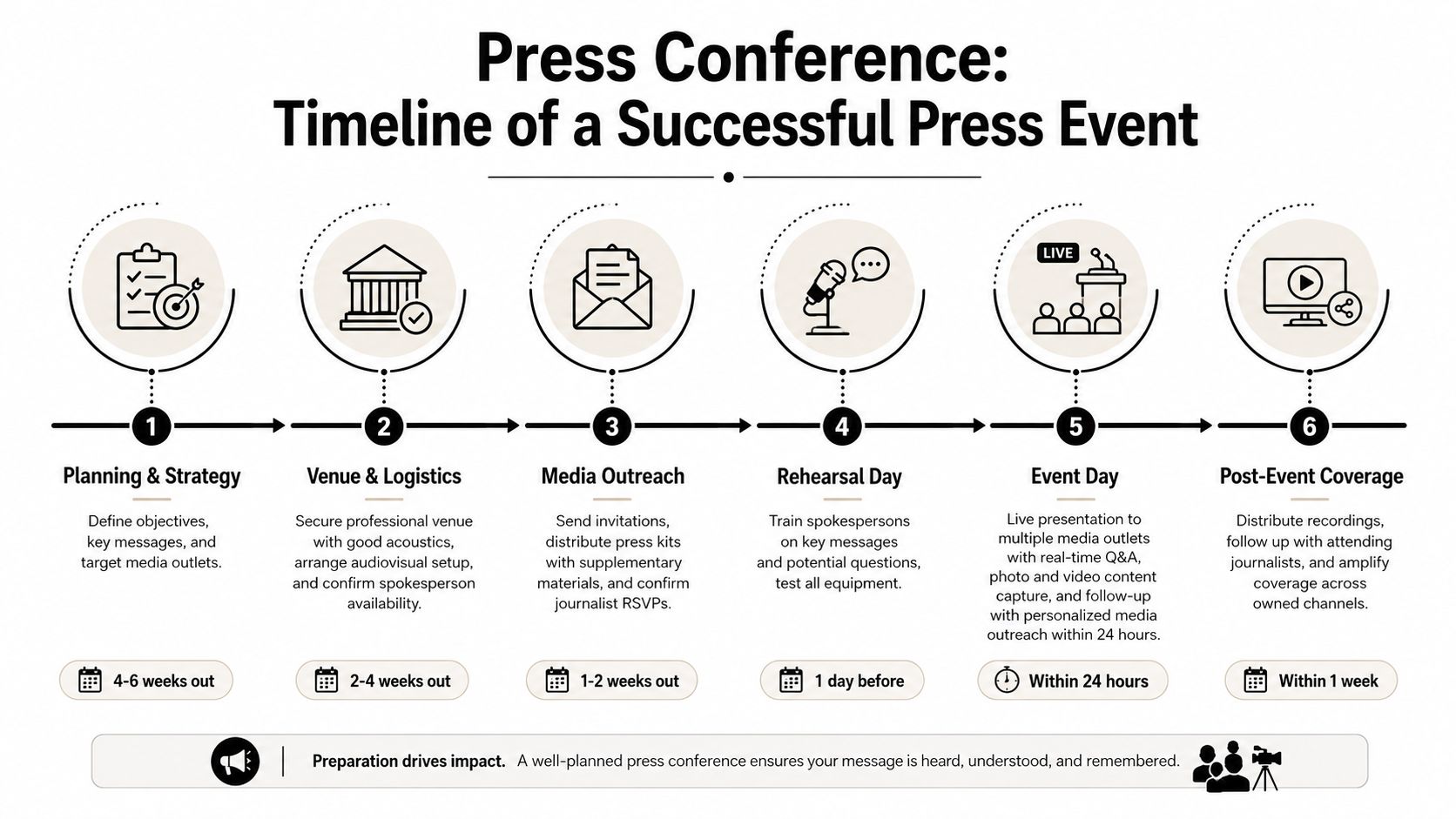
A press conference works when the news requires explanation, authority, or immediate questions. It suits a major partnership, acquisition, executive transition, public safety response, or corporate announcement where journalists need direct access to a spokesperson rather than a document alone. Apple's product events illustrate the announcement model, while crisis briefings show why a controlled Q&A can matter when the organization's credibility is under pressure.
The primary audience is beat reporters, broadcasters, photographers, and specialist media with a direct interest in the announcement. The media assets should include prepared remarks, a concise fact sheet, executive photographs, presentation visuals, and a livestream or recording. A professional venue matters because poor acoustics, weak lighting, or an obstructed camera position can turn a strong announcement into unusable footage.
Build the press moment around the news
The press release should lead with the consequence of the announcement, not the existence of the press conference. A useful angle might be the operational change created by a partnership, the customer problem solved by a new initiative, or the immediate action being taken after an incident.
Practical rule: If the spokesperson's opening statement doesn't explain why the news matters to the audience, the release won't rescue the event.
Sample copy:
[Organization] announces [specific development], creating [clear audience or business impact]. [Spokesperson] will address the announcement and answer questions at [event details].
Send the press kit before the event, train the spokesperson for difficult questions, and provide a direct media contact. The main trade-off is control versus spontaneity. A tightly scripted event reduces message drift, but journalists may view an overly managed Q&A as evasive.
Afterward, issue the recording and relevant assets, then contact priority reporters personally within the next day. Track unique editorial placements rather than counting every syndicated copy. A practical measurement framework defines a 7-, 14-, or 30-day observation window, removes reposts to unique domains, and divides unique earned placements by unique outlets pitched, as explained in this press-release pickup-rate framework.

2. Product Launch Event
A product launch earns attention when journalists can see, test, or experience something new. A restaurant grand opening can offer a media tasting, a vehicle launch can provide demonstrations, and a software announcement can give reporters access to a working beta. The event shouldn't read like a catalogue of specifications. It should show how the product changes a real user experience.
The audience may include product reporters, trade publications, creators, customers, analysts, and local media. Those groups need different assets. Product journalists may want technical documentation, creators may need visual access, and local outlets may need a clear explanation of who benefits in the surrounding market.
Turn features into a narrative
A strong launch has a beginning, demonstration, and proof point. The opening establishes the problem, the demonstration shows the solution, and the supporting materials answer questions about availability, leadership, pricing, compatibility, or safety without forcing the event presentation to carry every detail.
Teams preparing the announcement can use this new product launch timeline to coordinate development, approvals, media access, and release timing.
Sample copy:
[Organization] introduces [product], designed to help [defined audience] [solve a specific problem]. Media attendees can experience [demonstration or exclusive access] at [event details].
Distribute the release when the event begins so coverage can publish while the news is active. Offer interviews, product trials, still images, video, and a clean demonstration area. A hybrid format can extend access to journalists who can't attend, but remote viewers need a reliable stream, clear audio, and downloadable assets.
The main risk is confusing spectacle with news. An impressive stage doesn't compensate for an unclear benefit or unavailable product. Another risk is giving selected journalists early access without a consistent embargo process. The follow-up should include a personalized note, the recording, product specifications, image files, and answers to questions that surfaced during demonstrations.
3. Media Breakfast or Lunch Briefing
A media meal is most effective when the organization has a nuanced story that benefits from conversation. Financial announcements, healthcare policy developments, major property projects, and nonprofit strategy updates can require context that a short pitch can't provide. The informal setting helps executives answer follow-up questions, but it doesn't guarantee coverage.
The guest list should be curated by beat, publication, and likely editorial relevance. A finance reporter may care about a business development that a lifestyle writer won't cover. A healthcare journalist may need background on regulation, research, or patient impact before evaluating the announcement.
Use intimacy without losing discipline
The event should feel conversational, but the communications team still needs a message map. Prepare executive talking points, anticipated questions, background documents, and a clear distinction between on-the-record material and any agreed background discussion. The venue should support quiet conversation, easy introductions, and credible brand positioning.
Sample copy:
[Organization] briefs [beat or sector] journalists on [development], including its expected effect on [audience, market, or community]. [Executive] will discuss the announcement and take questions at [venue and date].
A small group encourages meaningful dialogue, while a larger invitation list may improve attendance but reduce access to each executive. Food and hospitality also create compliance concerns for some publications, so the invitation process should respect individual newsroom policies.
The media kit can include a release, executive biography, glossary, charts, photographs, and a direct follow-up contact. Don't hand journalists a dense corporate deck and expect the meal to create the story. The press angle must remain simple enough to explain in one sentence.
Within two days, send the release and promised materials. Personalize follow-up messages around each journalist's beat, answer unanswered questions, and record which topics generated genuine interest. Coverage may take longer than it would after a breaking event, so the team should continue offering interviews and relevant evidence without repeatedly pushing the same announcement.

4. Webinar and Virtual Press Event
A webinar removes travel barriers and gives distributed journalists access to the same presentation, speakers, and documents. It suits software demonstrations, earnings briefings, healthcare updates, nonprofit impact reporting, and educational announcements. The format is especially useful when the story depends on screen sharing, data visualization, or a specialist who can't attend a physical venue.
The media audience needs a reason to register beyond “company update.” The invitation should identify the news, name the relevant expert, and explain what attendees will be able to see or ask. A recording can extend the event's usefulness, but a recording alone rarely creates urgency.
Design for journalists who aren't in the room
Send speaker biographies, slides, background materials, and calendar details in advance. Test the platform, screen sharing, microphones, cameras, recording, captions, and backup connection. Keep the presentation focused, reserve time for named speakers to answer questions, and assign someone to monitor the chat and collect unanswered questions.
Sample copy:
[Organization] will present [news or development] in a virtual media event featuring [speaker and expertise]. Attendees can view [demonstration, briefing, or data] and submit questions during the session.
The central trade-off is reach versus attention. Virtual access can bring in journalists from different locations, but competing alerts and technical distractions can weaken engagement. A short, visual presentation with a clear release and downloadable fact sheet performs better than a long corporate lecture.
Teams needing a focused announcement can consult this webinar and training workshop press-release guide.
Distribute the release, recording, slides, transcript, and image assets immediately afterward. Follow up with attendees who asked questions, then offer a short interview to journalists who registered but couldn't attend. The recording should also be indexed in the digital newsroom so future pitches can point to a useful source of context.
5. Sponsorship and Trade Show Activation
A trade show booth isn't automatically a PR event. It becomes one when the organization has a specific announcement, demonstration, expert, or market point that gives journalists a reason to stop. A company exhibiting at CES, SXSW, a healthcare conference, or a sector summit can combine the physical presence with interviews, product trials, panel participation, and a focused release.
The audience includes trade reporters, analysts, influencers, partners, prospects, and event organizers. Media appointments should be scheduled before the show, not left to chance. A high-visibility booth helps, but the experience must still communicate a clear story in seconds.
Give the activation a reportable angle
A launch, partnership, expert panel, new application, or industry response can provide the hook. The release should describe what has changed and why the trade show is the right setting to see it.
Sample copy:
[Organization] brings [product, demonstration, or announcement] to [trade show], giving [industry audience] access to [specific insight or experience]. Executives [names] will be available for scheduled interviews.
Create a media area with quiet interview space, product information, photography, and a single contact. Prepare social content, live updates, and short clips, but don't let social activity replace direct media outreach. The most common failure is a visually busy booth with no exclusive news.
A sponsorship tier can increase visibility, but it also raises expectations for measurable access and useful programming. Teams should confirm what the organizer permits, coordinate with speakers, and avoid claiming exclusivity that other exhibitors can challenge. An event agenda resource for trade show and expo planning can help align the activation with the wider program.
After the show, send personalized follow-ups while conversations remain fresh. Include promised images, product details, interview answers, and the release. Review media meetings, editorial opportunities, qualified contacts, and content created, rather than treating booth traffic as proof of coverage.
6. Expert Commentary and Op-Ed Placement
An op-ed or expert commentary campaign turns an event or announcement into a broader industry argument. It works when a leader can explain an important shift, challenge a common assumption, or offer practical interpretation that extends beyond the organization's own interests. The resulting byline may not look like traditional event coverage, but it can establish a spokesperson as a source for future reporting.
The target audience is publication editors, specialist reporters, analysts, and readers who follow the issue. The story needs an editorial thesis, not a company profile. A technology executive might address a changing workflow, a healthcare leader might explain a policy consequence, and a nonprofit director might interpret an emerging community need.
Pitch the argument, not the résumé
Research the target publication's recent themes, submission rules, tone, and audience. Build a forward editorial calendar, then pitch an editor with a concise premise, proposed structure, evidence, and reason the author is qualified to contribute. The organization should supply original insight or verified material rather than repackaging promotional copy.
Sample pitch language:
[Author] proposes an analysis of [issue], explaining how [specific development] affects [audience] and what decision-makers should do next. The piece will draw on [verified evidence or direct experience] and avoid promotional product language.
The trade-off is control. An authored piece offers depth and authority, but the publication controls edits, timing, headline, and placement. Exclusivity may improve the pitch to a priority outlet, while distributing the same article widely can weaken its editorial value.
Once published, place the byline in the media kit, share it through owned channels, and use it as supporting material in relevant journalist pitches. Don't treat publication as the end of the campaign. The author should remain available for interviews and commentary when related news develops.
7. Award Submission and Recognition Campaign
Awards create a third-party validation opportunity, but only when the recognition aligns with the organization's audience and actual work. A product award can support a launch, a workplace award can support recruitment communications, and a community award can reinforce a local partnership. The award itself is the hook, while the submission evidence gives journalists a reason to believe the claim.
The audience includes industry publications, local outlets, customers, prospects, employees, and partners. Maintain a central record of deadlines, eligibility, submission requirements, fees if applicable, supporting evidence, and expected announcement dates. Collect photographs, testimonials, project records, and outcome documentation throughout the year rather than reconstructing the story at the deadline.
Make the recognition useful after the ceremony
A winning release should identify the award, category, recognized work, judging context if publicly available, and practical significance. It shouldn't imply that a badge proves more than it does. Avoid vague claims such as “best in the industry” unless the award program itself uses that wording and the organization can substantiate it.
Sample copy:
[Organization or leader] receives [award] for [specific work], recognizing its contribution to [audience, sector, or community]. The recognition follows [brief verified description of the initiative].
A master submission template improves consistency, but every entry still needs specific evidence. The main trade-off is effort versus strategic relevance. Entering every available award can consume staff time and dilute the meaning of genuine recognition.
When a win is confirmed, prepare the press release, executive quote, approved logo, event photographs, and social copy. Contact journalists who cover the sector and local media connected to the organization's work. Add the recognition to the website, sales materials, recruitment resources, and digital newsroom, but keep the original project story visible so the award supports a substantive narrative rather than replacing it.
8. Community Sponsorship and Local Event Partnerships
A community partnership can generate local coverage when the organization contributes something meaningful and gives residents a visible role. School fundraisers, charity runs, festivals, STEM programs, and benefit dinners provide natural opportunities for photographs, interviews, volunteer stories, and public discussion. The announcement should center the community benefit, not the sponsor's logo.
The best audience fit is local news, community publications, neighborhood newsletters, cause-focused media, and relevant trade outlets. Select causes that align with the organization's values and operating footprint. A short-term sponsorship with no staff participation may look transactional, while sustained involvement gives the story continuity.
Put people and outcomes in the frame
Secure permission for photography, identify community spokespeople, and coordinate timing with the partner organization. A local press release can announce the partnership before the event, while a follow-up release or media note can share photographs, participant voices, and what happened afterward.
Sample copy:
[Organization] partners with [community organization] to support [specific initiative], bringing [resources, volunteers, or expertise] to [local audience]. Representatives will join residents at [event details].
Visible signs and program mentions help recognition, but branding shouldn't overwhelm the cause. Employee volunteering can create authentic access, yet staff shouldn't be staged as the main story when community members carry the impact. A sponsorship package may offer useful exposure, but the communications team should confirm exactly what the partner can promise.
Pitch local media early with a clear angle, practical event details, and contact information for both organizations. Afterward, send a thank-you note, selected images, attendance or participation information when verified, and any next steps. Track media mentions, community response, partner feedback, and employee participation qualitatively unless the organization has reliable measurement methods.
9. Crisis Communication and Response Press Release
A crisis statement has a different job from a promotional event release. It must establish what the organization knows, acknowledge affected people, explain immediate actions, and create a reliable path for updates. Data breaches, product recalls, workplace incidents, environmental issues, executive departures, and financial restatements all require careful coordination among PR, legal, operations, HR, and leadership.
The audience includes affected customers or employees, regulators, journalists, partners, and the wider public. The first statement should avoid speculation, blame, unsupported reassurance, and legal conclusions that haven't been approved. It should still be direct. Silence or evasive language leaves others to define the story.
Prepare before the incident
Maintain a crisis template, an approval chain, a spokesperson plan, a media monitoring process, and a secure fact-gathering workflow. The organization can use crisis communication best practices to review message structure and response preparation. A useful statement names the incident, expresses concern, describes verified actions, and explains when the next update will arrive.
Sample copy:
[Organization] is responding to [incident] affecting [people, service, or location]. The organization has [immediate action], is working with [relevant parties], and will provide another update when verified information is available.
The trade-off is speed versus completeness. Waiting for every detail can create an information vacuum, but releasing unverified details can cause further harm. A short initial statement is often safer when it includes a clear update process.
Use one authorized spokesperson and route media inquiries through a named contact. Update the statement as facts change, preserve a record of corrections, and follow up with directly affected audiences through the channels they use. Coverage measurement comes after accountability. The organization must first demonstrate responsible action, then make the release and supporting documents easy for journalists to verify.
For additional drafting context, teams can review these press release writing tips for Morristown.
10. Media Kit and Digital Newsroom
A digital newsroom turns ongoing communications into an accessible media resource. It can contain press releases, executive biographies, headshots, logos, product photographs, video, backgrounders, reports, event recordings, and contact details. Unlike a single event, the newsroom supports journalists before, during, and after multiple announcements.
The audience includes reporters researching a company, bloggers preparing coverage, producers seeking images, analysts checking background, and partners looking for approved information. The page should be discoverable from the organization's main website and simple to use. A journalist shouldn't need to search through marketing pages to find the latest release or identify the correct media contact.
Organize assets for fast reporting
Separate content by type, maintain a chronological archive, feature recent announcements prominently, and label files clearly. High-resolution images, multiple logo formats, executive biographies, captions, usage guidance, and downloadable fact sheets reduce unnecessary email exchanges. A subscription option can alert interested contacts when new releases appear.
Sample announcement copy:
[Organization] launches its digital newsroom, giving journalists access to current releases, executive resources, approved images, and background information about [organization or initiative].
The main risk is treating the newsroom as a static archive. Outdated biographies, broken downloads, missing dates, or inconsistent facts weaken confidence in every release. Assign ownership, review links regularly, and update the page whenever an announcement changes the available information.
The newsroom should support, not replace, outreach. A journalist may find the release through search, but a focused pitch can explain why the news matters to that publication. After each event, add the approved recording, images, transcript, presentation, and follow-up statement. The organization then builds a reusable evidence base for future media work without forcing every reporter to request the same materials.
10 PR Event Types Comparison
| Event Type | Implementation complexity | Resource requirements | Expected outcomes | Ideal use cases | Key advantages |
|---|---|---|---|---|---|
| Press Conference | High, venue, AV, spokesperson training | High, budget, PR staff, AV, media outreach | Immediate media pickup, multimedia assets, clear messaging | Major announcements, crises, high-profile spokespeople | Real-time Q&A, high newsworthiness, direct journalist access |
| Product Launch Event | Very high, production, staging, experiential design | Very high, production, venue, talent, marketing, logistics | Strong buzz, social amplification, influencer engagement | New product debuts, brand positioning, consumer reveals | Memorable experiences, demo opportunities, highly shareable content |
| Media Breakfast or Lunch Briefing | Medium, curated invites, venue prep | Low–Medium, small budget, targeted guest list, prep materials | In-depth coverage, stronger journalist relationships, targeted placements | Complex topics, earnings, B2B or trade-specific updates | Intimate dialogue, relationship-building, controlled messaging |
| Webinar and Virtual Press Event | Low–Medium, platform setup and rehearsals | Low, webinar platform, presenter prep, digital promotion | Scalable reach, recordings for repurposing, measurable engagement | Distributed audiences, demos, analyst briefings, tutorials | Cost-effective, global access, analytics and on-demand content |
| Sponsorship and Trade Show Activation | High, booth design, staffing, logistics | High, sponsorship fees, booth build, travel, demos | Concentrated industry exposure, lead generation, media opportunities | Industry conferences, product trials, thought leadership positioning | Access to concentrated audience, speaking slots, hands-on demos |
| Expert Commentary & Op‑Ed Placement | Medium, research, writing, targeted pitching | Low–Medium, writing resources, editor outreach, research | Authority building, SEO/backlink value, editorial credibility | Thought leadership, reputation building, niche expertise topics | High credibility, long-lasting published content, editorial amplification |
| Award Submission & Recognition Campaign | Medium, research and application preparation | Low–Medium, time, documentation, possible entry fees | Third-party validation, press opportunities on wins, credibility boost | Product recognition, employer branding, sector awards strategy | External endorsement, promotional badges, ongoing visibility |
| Community Sponsorship & Local Partnerships | Low–Medium, local coordination and logistics | Low, sponsorship funds, staff volunteers, local promo | Local goodwill, modest media coverage, community engagement | CSR, local brand awareness, small business outreach | Authentic community ties, employee engagement, accessible for small orgs |
| Crisis Communication & Response Release | High, rapid coordination with legal/ops | Medium, crisis team, monitoring, rapid dissemination | Narrative control, stakeholder reassurance, misinformation mitigation | Data breaches, recalls, safety incidents, executive crises | Fast transparency, reduces speculation, preserves reputation |
| Media Kit & Digital Newsroom | Medium, content organization and web setup | Medium, hosting, content creation, ongoing maintenance | Easier journalist access, improved accuracy, SEO and archival value | Ongoing media relations, press resource centralization | 24/7 accessible assets, cost-effective, measurable journalist engagement |
Turn an Event Into a Media-Ready Story
The right format depends on the type of news and the access journalists need. A press conference suits complex, high-stakes announcements that require questions. A product launch works when demonstration and experience carry the story. A media briefing supports focused relationship building and nuanced context. A virtual event helps distributed journalists access specialists, screens, and recordings.
A trade show activation adds industry visibility when the booth includes a real announcement or useful expert access. An op-ed campaign extends an event into a broader argument. An award campaign turns recognition into third-party credibility when the underlying work is specific and verifiable. Community partnerships create local goodwill when residents and beneficiaries remain central. Crisis communication prioritizes rapid accountability, verified facts, and consistent updates. A digital newsroom gives every format a dependable home for approved assets.
A repeatable workflow keeps the event from becoming a disconnected set of tasks:
- Define the news hook: State what changed, who is affected, and why the timing matters.
- Match journalists to the story: Build a focused list by beat, publication, geography, and audience.
- Prepare spokespeople: Create key messages, difficult-question responses, biographies, and contact routes.
- Build the media assets: Prepare photographs, video, demonstrations, fact sheets, transcripts, and approved data.
- Draft the release: Write a clear headline, concise lead, supporting details, quote, event information, and media contact.
- Choose distribution deliberately: Use direct outreach, a newsroom, a suitable distribution service, or a combination based on the story.
- Follow up with relevance: Send personalized notes, answer questions, share promised materials, and continue offering access.
- Measure editorial value: Separate unique earned placements from syndicated reposts and review results within a defined observation window.
Press Release Zen's event, conference, crisis, webinar, and product-launch resources can help teams check structure, formatting, timing, and distribution before publication. Even promotional details, including swag ideas for events, should support the event's story rather than distract from it.
Before distribution, the communications team should confirm headline clarity, verified details, useful visual assets, spokesperson contact information, Q&A preparation, and post-event follow-up ownership. A well-run event gives journalists a reason to cover the news, the access needed to report it, and the evidence required to publish confidently.
Press Release Zen provides practical guides, templates, and distribution advice for turning event plans into structured media announcements. Visit Press Release Zen to prepare the release, review its format, and choose the next distribution and follow-up steps.