The communications plan is in a Google Doc. The campaign ideas are in three different spreadsheets. Program staff keep sending “quick” requests in Slack. Development wants stronger donor retention. Leadership wants more press. The board wants clearer proof that communications is working.
That's a familiar place for nonprofits to be. They aren't struggling because they lack passion. They're struggling because their messaging, channels, workflows, and reporting don't connect tightly enough to mission goals.
A strong nonprofit communications strategy fixes that. It gives teams a shared narrative, a practical operating system, and a way to measure impact that goes beyond donations alone. It also helps nonprofits adapt to different supporter preferences without sounding like a different organization on every channel.
Table of Contents
- Establish Your Strategic Foundation
- Define Your Audience and Key Messages
- Select and Integrate Your Communication Channels
- Operationalize Your Plan with an Editorial Calendar
- Measure Success and Report on Impact
- Prepare for the Unexpected with a Crisis Plan
Establish Your Strategic Foundation
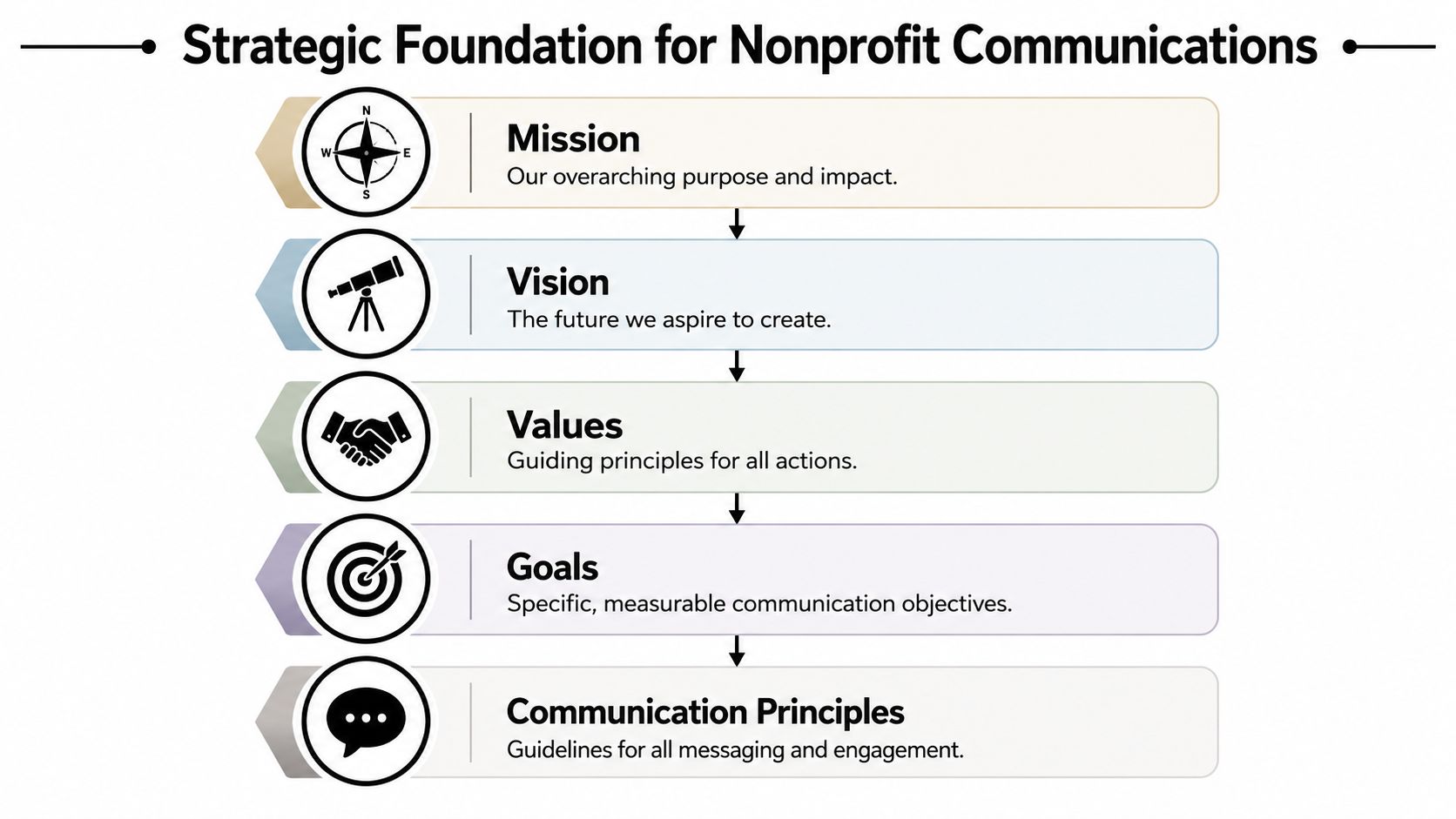
A nonprofit communications strategy starts before content. It starts with choices. Which audiences matter most this year. What outcomes matter most. Which messages are essential. Who approves what. What the organization will say yes to, and what it will deliberately leave alone.
Nearly half of nonprofit organizations expanded their communications teams in the past year, according to Meyer Partners' reporting on nonprofit communications. That 49% figure matters because it signals a shift in how nonprofits treat communications. Not as a support function that writes copy when asked, but as a strategic discipline that shapes fundraising, visibility, trust, and long-term supporter relationships.
The foundation has to be clear enough that a board member, a program manager, and a social media coordinator can all describe the organization the same way.
Turn mission into operating guardrails
Mission statements are often too broad to guide daily communications decisions. “Advance equity in education” is important, but it doesn't tell staff how to frame a volunteer appeal, what proof points belong in a donor email, or how to answer a reporter's question.
That's where guardrails come in. A usable foundation usually includes these elements:
- Mission: The core purpose the organization serves.
- Vision: The future the organization is working toward.
- Values: The principles that shape language, imagery, and partnerships.
- Communication principles: Rules for tone, storytelling, audience respect, and evidence.
- Priority outcomes: The specific changes communications should help produce this year.
A team that needs structure can benefit from a framework used to create a nonprofit marketing plan, then narrow that broader plan into communications-specific goals, channels, and approvals.
Practical rule: If staff can't explain the organization's work in similar language, the public won't understand it either.
Internal alignment has to happen early. Staff and board members need a shared narrative. Program and development teams need agreement on how impact is described. Communications can't fix public confusion if internal language keeps shifting.
For teams that need a more formal structure for turning strategy into execution, a detailed guide on how to write a communication plan with examples can help convert broad intent into timelines, owners, and channel decisions.
Set goals that teams can actually execute
SMART goals are useful. SMARTIE goals are better for nonprofits because they force one more question. Is the plan inclusive and equitable in both message and delivery?
A weak goal sounds like this: increase awareness.
A stronger goal sounds like this:
- Specific: Increase volunteer applications for the after-school tutoring program.
- Measurable: Track qualified applications, attendance at info sessions, and follow-through.
- Achievable: Match the target to current staff capacity and recruitment resources.
- Relevant: Tie the effort directly to service delivery, not just visibility.
- Time-bound: Set a firm deadline tied to the school-year cycle.
- Inclusive: Make sure messages reach communities beyond the usual donor list.
- Equitable: Review language, imagery, and channel access so outreach doesn't exclude people the program is meant to serve.
Nonprofits often over-index on activity metrics. More posts. More emails. More events. None of that proves strategic value on its own. The goal has to describe a real organizational outcome.
Resource the work honestly
Budget conversations get easier when communications leaders stop pretending everything is equally important. It isn't. If the year's top priorities are year-end fundraising, volunteer recruitment, and policy education, then content, media outreach, design support, and analytics should line up behind those priorities.
A one-person shop needs a narrower strategy, not a more heroic one. A larger team needs role clarity. Who owns donor email. Who manages media. Who approves executive messaging. Who updates the CRM. Who closes the loop on performance.
The strongest foundations are simple enough to use under pressure. If the strategy only works in a planning meeting, it won't survive campaign season.
Define Your Audience and Key Messages
Most nonprofits know their broad audiences. Donors. Volunteers. Program participants. Partners. Media. Policymakers. That's a start, but it's not enough to drive message decisions.
Real strategy starts when those audiences become specific enough to picture. Not just by age or income, but by motivation, channel preference, decision-making style, and what they need to hear before taking action.

Build personas around motivation not just demographics
A practical persona doesn't need twenty fields. It needs enough detail to help a team write better. A useful format includes:
- Role in the ecosystem: recurring donor, first-time volunteer, local reporter, school partner
- Primary motivation: community pride, measurable impact, urgency, advocacy, belonging
- Barrier to action: skepticism, time, unclear ask, lack of trust, too much jargon
- Preferred channels: email, short video, direct mail, local news, webinars
- Proof they respond to: beneficiary stories, outcomes data, expert commentary, testimonials
Teams that want a simple starting point can borrow methods from a buyer persona creation guide and adapt them for nonprofit supporters, stakeholders, and community partners.
Here's what that looks like in practice.
A generic message says: “Support our youth program and help change lives.”
That message isn't wrong. It's just too flat.
A Boomer donor might respond better to a message built around continuity, stewardship, and detailed proof: the program served local families, staff can show what support made possible, and the donor's gift sustains a proven effort.
A Millennial supporter may want a story that connects giving to shared values, community outcomes, and visible participation. They often want the organization to sound human, specific, and accountable.
A Gen Z supporter may engage with a sharper, more visual narrative that shows lived experience, centers community voice, and gives a clear, low-friction action step they can take immediately.
Create message pillars that stay consistent
CCS Fundraising reports that donors aged 18 to 34 prefer social-driven, visual storytelling, while donors 55 and older favor email newsletters and detailed impact reports. The same report says 78% of nonprofits still use a one-size-fits-all messaging approach, which lowers engagement among younger constituencies, according to CCS Fundraising's nonprofit communications strategy insights.
That doesn't mean a nonprofit needs a different brand voice for every generation. It means the organization needs message pillars that remain stable while examples, format, and cadence shift by audience.
A strong messaging framework usually includes three to four pillars such as:
| Pillar | What it communicates | Example angle |
|---|---|---|
| Mission urgency | Why the issue needs action now | Families are facing an immediate service gap |
| Tangible impact | What support makes possible | Tutoring hours, meals delivered, legal guidance provided |
| Community voice | Who is speaking and how they're represented | Participants, volunteers, and partners speak in their own words |
| Trust and accountability | Why the organization is credible | Clear reporting, responsible use of funds, transparent decisions |
Strength-based storytelling works better when beneficiaries keep their agency. The organization’s role is to frame context, not to speak over the people closest to the issue.
Use generational preferences without breaking the brand
Brand integrity comes from repetition at the principle level. The organization should sound like itself every time. What changes is the packaging.
For an older donor segment, the same campaign might lead with an email that includes context, program details, and a clear explanation of how support fits into a longer-term plan.
For younger supporters, that same campaign might begin with a short-form video, a concise caption, and a simple pathway to learn more, share, register, or donate.
The narrative spine stays fixed:
- Who is affected
- What the nonprofit is doing
- Why it matters now
- How the supporter can help
- What accountability looks like
When teams skip that structure, tailoring turns into fragmentation. One channel sounds urgent. Another sounds bureaucratic. Another sounds casual to the point of vagueness. Supporters notice.
Good segmentation doesn’t produce mixed messages. It produces the same message, translated well.
Select and Integrate Your Communication Channels
Nonprofits lose momentum when channel choices are reactive. A platform becomes popular, so the team starts posting there. A staff member likes video, so video becomes the priority. A board member wants press coverage, so communications scrambles to draft announcements without a wider campaign behind them.
A better approach is to build a channel system. The most useful framework for that is the PESO model: paid, earned, shared, and owned media. It forces discipline. Each channel has a job. Each job supports the others.
Use the PESO model as a decision filter
The point of the PESO Model®, created by Gini Dietrich, isn’t to make every nonprofit use every category equally. It’s to stop random acts of communication.
| Category | Description | Nonprofit Examples |
|---|---|---|
| Paid | Promotion the organization pays to place | Social ads for event registration, sponsored search, boosted advocacy content |
| Earned | Coverage or attention gained through media relations | Press releases, reporter outreach, local news stories, op-eds |
| Shared | Content distributed through social interaction and community participation | Instagram, LinkedIn, Facebook, supporter reposts, partner tags |
| Owned | Channels the organization controls directly | Website, blog, email newsletter, annual report, webinar series |
Owned channels are the home base. They hold the organization's deepest thinking, clearest proof, and strongest calls to action. Shared channels distribute and adapt that material. Earned media validates it through outside attention. Paid promotion fills reach gaps when a strategic audience needs an extra push.
Map one story across multiple channels
The best campaigns don't create separate stories for each platform. They create one campaign narrative and express it differently depending on where the audience encounters it.
An example makes this easier to see.
A nonprofit launches a workforce program. The website hosts the full story, participant outcomes, FAQs, and signup information. That's owned media. Social posts feature short clips from participants, staff, and community partners. That's shared media. A press release highlights the community need, leadership perspective, and local relevance, then supports outreach to reporters and civic publications. That's earned media. Targeted digital promotion helps the campaign reach likely volunteers, employers, or supporters in the right geography. That's paid media.
This integrated approach matters because organizations pursuing layered campaigns that let donors engage through their preferred channel at a comfortable cadence see stronger results than those relying on single-channel outreach, according to Falls & Co. on nonprofit communications strategies.
A channel mix should reduce friction for the audience. If someone needs three extra clicks to understand the ask, the system is working for the team, not for the supporter.
Treat earned media as a credibility layer
Earned media is often underused because it feels less controllable than email or social. That's true. It's also why it matters.
A well-placed local story gives the organization something paid media can't manufacture. Third-party credibility. For nonprofits working on complex issues, public trust often grows when a reporter, local outlet, or sector publication explains the work to a broader audience.
Press releases should support that effort, but they should rarely stand alone. They work best when they amplify something real: a report, milestone, partnership, leadership perspective, event, policy response, or community initiative. The release should point back to owned content where readers can get the full picture.
Teams that struggle to connect public relations and social execution can sharpen that handoff by studying approaches to using PR for social media, especially when a newsworthy announcement needs to drive engagement beyond the first media hit.
Channel selection gets easier when each tactic answers one question. Why this audience, on this platform, for this objective, at this moment. If the team can't answer that, the channel probably doesn't belong in the plan.
Operationalize Your Plan with an Editorial Calendar
A strategy document doesn't create momentum. A working calendar does.
At this stage, strong plans usually either become real or fall apart. Without an editorial calendar, communications gets hijacked by urgency. Whoever asks loudest gets published first. The result is a messy feed, inconsistent email cadence, and content that reflects internal politics more than public priorities.
The 2026 Nonprofit Communications Trends Report found that 66% of nonprofits have a system for planning content, while 34% don't have a structured process for handling communications requests from other departments, creating significant inefficiencies, according to Nonprofit Marketing Guide's 2026 communications trends highlights.
Build a calendar that reflects strategy not noise
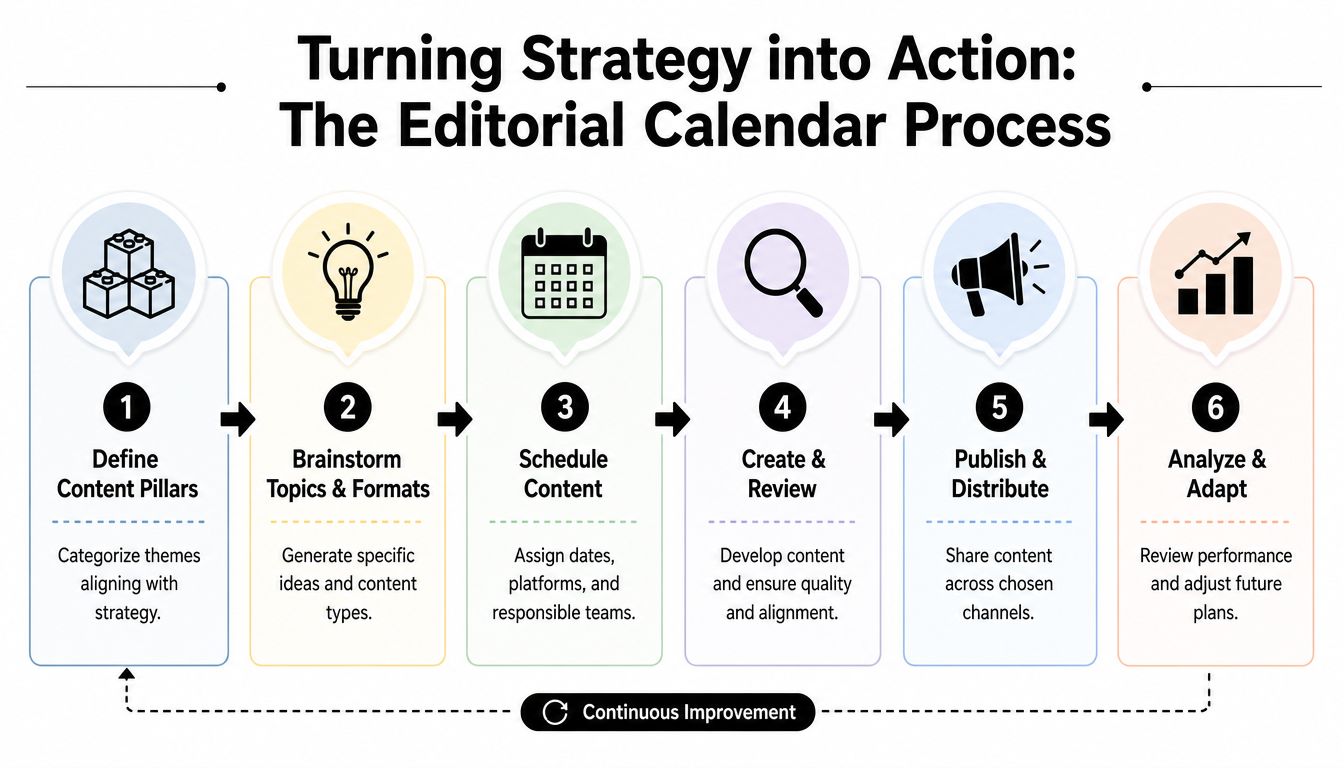
A useful editorial calendar does more than list publish dates. It should show the relationship between content and mission priorities.
At minimum, each item should include:
- Campaign or content pillar: What strategic theme it supports
- Audience: Who it's for
- Primary channel: Where it appears first
- Supporting channels: Where it gets repurposed
- Owner: Who drafts and who approves
- Purpose: Inform, recruit, advocate, retain, convert, or reassure
- Asset needs: Photo, quote, graphic, video, landing page, media list
A practical calendar often starts with fixed points. Awareness dates. Signature events. Annual reports. Legislative sessions. Year-end fundraising. Then the team fills in recurring communications that maintain rhythm between major pushes.
Create a workflow for inbound requests
Most internal chaos doesn't come from bad intent. It comes from the lack of a request system.
Program staff need visibility for good reasons. Development has deadlines that matter. Leadership wants responsiveness. The fix isn't to block requests. The fix is to route them through a standard intake and review process.
A workable internal workflow looks like this:
- Use one intake form: Every request comes through the same channel, whether that's Microsoft Forms, Asana, Airtable, or another shared tool.
- Require core details: Audience, goal, deadline, approver, supporting assets, and why the request matters now.
- Score requests against strategy: Priority goes to work tied to annual goals, legal requirements, or reputational risk.
- Set review windows: Not every ask needs same-day turnaround.
- Close the loop: Communications should explain decisions when a request is delayed, reframed, or declined.
Operational test: If staff members bypass the process because it's easier to send a Slack message, the workflow is too vague or too slow.
Run a sustainable publishing rhythm
The calendar also needs a realistic production rhythm. That means batching work where possible.
Some teams plan one month ahead and draft one week ahead. Others create campaign kits that include email copy, social captions, approved quotes, image selects, and landing page language in one package. Both approaches can work if ownership is clear and review cycles are short.
The strongest calendars also include post-publication review. Not a major meeting every time. Just a short look at what landed, what got ignored, and what needs adjustment before the next cycle. That simple habit keeps the calendar alive instead of decorative.
Measure Success and Report on Impact
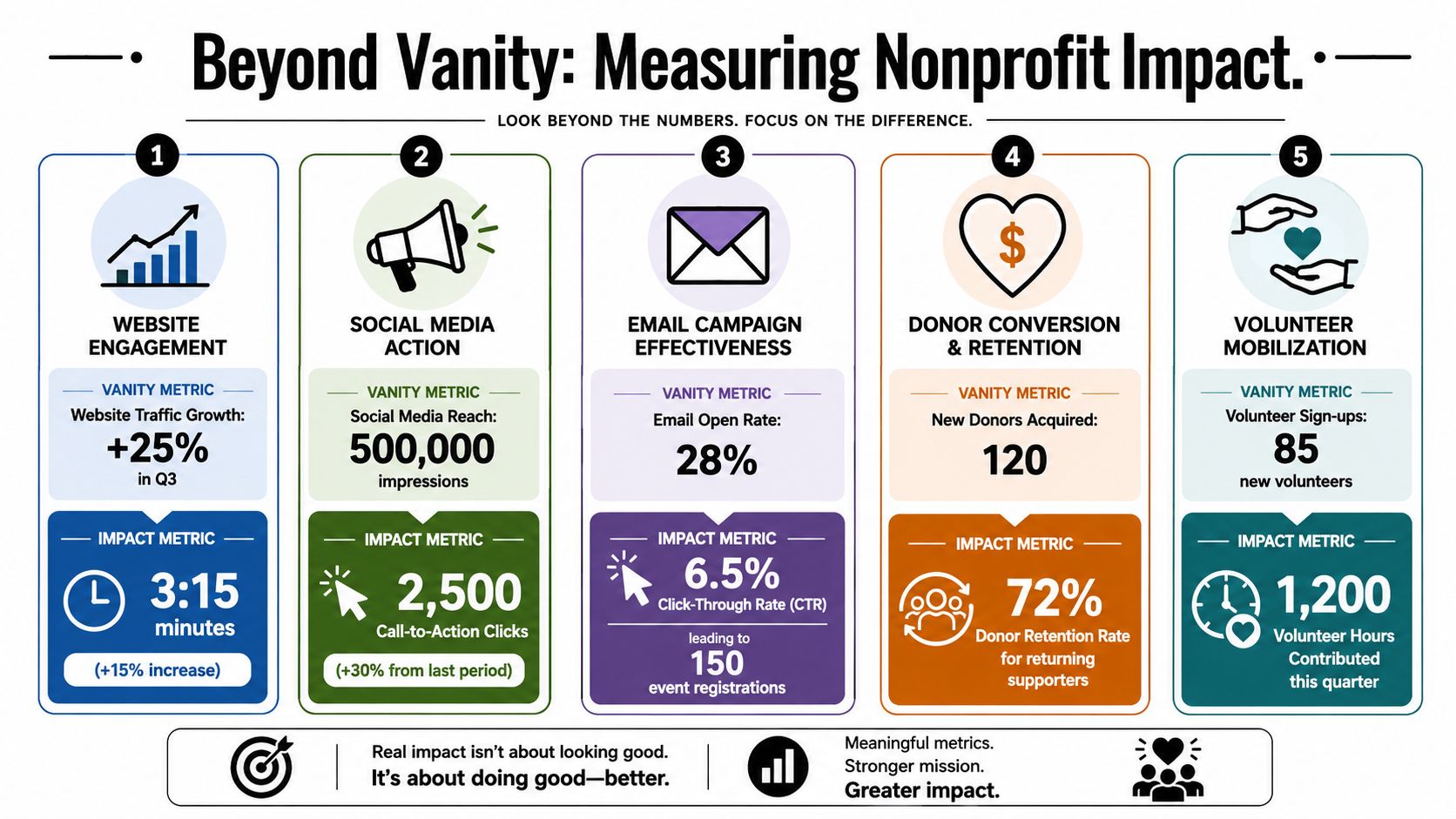
Communications teams get boxed into weak reporting when they only bring vanity metrics to leadership. Opens, impressions, likes, followers. Those numbers can be useful, but on their own they rarely answer the question leadership is asking.
Did communications deepen trust. Did it move the right people to act. Did it strengthen the organization's position in the community. Did it support fundraising, volunteerism, policy goals, or public understanding.
That broader view matters because 91% of Americans believe nonprofits should explain how they support causes, according to the National Council of Nonprofits data cited by St. Vincent's nonprofit communication strategies article. The same source notes that donors increasingly value mission alignment and social ROI, which means teams need to track non-monetary indicators such as volunteer retention and media narrative shifts.
Stop reporting vanity metrics in isolation
A report that says social engagement increased may sound positive, but it leaves leadership guessing. Increased among whom. In response to what content. Did the audience take any next step. Did the organization gain trust or merely attention.
A stronger approach pairs surface metrics with deeper indicators.
| Weak reporting | Better reporting |
|---|---|
| Email open rate | Open rate plus click quality, reply patterns, and downstream action |
| Social impressions | Impressions plus saves, shares, volunteer interest, or event signups |
| Website traffic | Traffic plus time on key pages, return visits, and form completion |
| Media mentions | Mention quality, message accuracy, spokesperson inclusion, and local relevance |
The point isn't to abandon top-line numbers. It's to stop pretending they tell the whole story.
Build a dashboard around mission outcomes
A communications dashboard should match the organization's actual goals. If the year's priorities include trust, volunteer recruitment, donor stewardship, and policy visibility, the dashboard should reflect those exact outcomes.
Good categories often include:
- Audience engagement depth: repeat visits, meaningful clicks, replies, content completion
- Trust signals: transparent reporting views, stakeholder feedback themes, message accuracy in media coverage
- Community action: volunteer applications, event participation, advocacy signups
- Fundraising support: donor response by segment, retention-related engagement, year-end campaign participation
- Narrative movement: how the issue is framed by partners, media, and public officials over time
Boards don't need more data. They need the right interpretation. A dashboard should tell them what changed, why it matters, and what decision should follow.
One useful habit is to separate communications outcomes into three buckets. What people saw, what people did, and what people believed or understood afterward. That last category is often neglected, even though it's where trust and mission alignment become visible.
Report findings in language leaders understand
The cleanest dashboard in the world still fails if it reads like a channel report instead of an organizational report.
Instead of saying, “LinkedIn engagement improved,” say, “Leadership thought pieces generated stronger partner response and drove more qualified interest from institutional stakeholders.”
Instead of saying, “Our annual report page got traffic,” say, “Stakeholders spent meaningful time with the organization's impact and accountability materials, which supports trust-based fundraising and board reporting.”
The best communications reporting helps leadership choose. Where to invest. Which audience needs attention. Which message needs refinement. Which campaign deserves expansion. Measurement isn't the end of strategy. It's how the next round gets smarter.
Prepare for the Unexpected with a Crisis Plan
Every nonprofit needs a crisis communications plan, even if the organization is small and highly trusted. Trust lowers risk. It doesn't eliminate risk.
A crisis can start with a negative local story, a social post that gains traction for the wrong reason, an allegation involving staff conduct, a data mishap, a canceled program, or a public misunderstanding that spreads faster than the facts. When that happens, the worst time to decide who speaks, who approves, and what the organization stands for is in the middle of the problem.
Decide who leads before anything goes wrong
A crisis plan is insurance. Organizations often hope they won't need it. Serious teams build it anyway.
At minimum, the plan should name:
- Crisis lead: Usually the executive director, communications lead, or both
- Spokesperson: The person authorized to speak publicly
- Approvers: Legal, executive, board chair, or program lead as needed
- Monitoring owner: Whoever tracks media, social, inboxes, and stakeholder feedback
- Escalation path: What triggers internal alerting and response levels
Not every issue deserves the same treatment. A routine complaint might need a direct reply and internal note. A reputational threat may require a holding statement, board notification, staff guidance, and coordinated media response.
Write holding statements before you need them
Holding statements save time and reduce panic. They should be plain, factual, and adaptable.
Strong holding statements usually do four things:
- Acknowledge the issue
- State that the organization is reviewing or responding
- Identify the organization's core commitment
- Promise an update when confirmed information is available
They should avoid speculation, defensive language, and overpromising. They also need a review process. If every draft must pass through too many people, the organization will respond too slowly.
Teams that haven't built this framework can use a crisis communications plan template to formalize roles, escalation steps, and message preparation before a live issue forces rushed decisions.
Silence is sometimes necessary while facts are checked. Confusion is not. Internal staff should know who's speaking, what's known, and what they should avoid saying publicly.
Walk through a realistic crisis scenario
Consider a plausible scenario. A local outlet publishes a critical story questioning whether a nonprofit used restricted funds appropriately. The facts are incomplete, but the headline spreads quickly on social media.
A prepared team would move in this order.
First, the crisis lead activates the response group and confirms what's known. Finance and leadership verify the underlying facts. Communications starts monitoring coverage, comments, and direct outreach.
Next, the spokesperson issues a brief holding statement. It acknowledges the concern, states that the organization takes stewardship seriously, and says a fuller response will follow after review.
Then the team aligns internal audiences. Staff gets a short memo explaining who handles media inquiries. Board members receive a version suited to governance, not rumor control. Major funders and close partners may need direct outreach before they hear the story from someone else.
After that, the external response gets more specific. If the story contains errors, the organization requests corrections and provides documentation. If the organization made a mistake, the response should say what happened, what's being fixed, and how accountability will work.
The final step is the one teams often skip. Debrief. Update the plan. Save approved language. Note what stalled the response. Strengthen the weak points before the next issue arrives.
A crisis plan doesn't make bad news disappear. It helps a nonprofit respond with speed, discipline, and credibility when trust is under pressure.
Press teams and nonprofit communicators don't need more theory. They need usable tools. Press Release Zen offers practical guides, templates, and step-by-step resources for planning announcements, writing stronger press releases, and building a media workflow that holds up under pressure.