The phone rings late, the product-safety lead has just confirmed the risk, legal wants the exact wording, and customer care is already asking what to tell callers. In that moment, the product recall press release is doing two jobs at once. It has to satisfy the regulator and it has to give consumers a clear next step before rumors fill the gap.
That pressure is why recall communication fails when teams treat the notice like a routine media hit. The better move is to treat it as a controlled public record, one that matches the filing, matches the remedy, and can be updated without drifting off-message. A strong release is only the first asset in a larger recall communication system.
Table of Contents
- The Recall Announcement Scenario
- Legal and Regulatory Foundations
- Anatomy of a Recall Press Release
- Writing the Core Messaging
- Localizing for Multilingual and Cross-Border Markets
- Distribution Channels and Outreach Scripts
- Follow-Up Cadence After the First Release
The Recall Announcement Scenario
A recall night usually begins with a quality flag, a lab result, or a retailer complaint that suddenly becomes a hazard decision. By the time communications enters the room, the work is already under a clock. The company may be inside the 24-hour notification clock the CPSC expects after learning a product may create a substantial hazard or an unreasonable risk of serious injury or death, and the public statement has to move on that same timetable.
What has to happen at once
The common mistake is treating a recall like a straight line. Legal first, then drafting, then approval, then distribution. In practice, those workstreams have to run together, because the message cannot wait for every internal team to finish in order.
Practical rule: the release should be drafted while the regulator notice is being finalized, not after it is closed. A workable timeline often looks like legal lock by hour 2, draft by hour 4, and channel prep before the wording goes live.
That parallel workflow usually has four jobs. First, legal has to settle the facts, scope, and remedy enough to support public language without creating a mismatch. Second, drafting has to turn those facts into plain language a consumer can use immediately, including what is affected and what action to take. Third, distribution has to prepare the newsroom, wire, owned channels, and hotline script so the notice appears in the places people will look. Fourth, follow-up has to be planned before launch, because the first notice is rarely the last statement the company will need.
The release is also part of a formal risk-control process tied to legally reportable defects and noncompliance under Section 15 of the CPSA, so every sentence has to match the official record. That is why speed cannot come at the expense of control. Fast recall communication is disciplined, factual, and synchronized across the people who approve it and the channels that carry it.
A useful way to look at the night of the recall is simple. The company is not trying to persuade the public that the problem is small. It is trying to make sure the right people know exactly what the hazard is, which product is affected, what they should do now, and where they will keep seeing updates if the recall expands, changes, or needs a multilingual version for other markets.
Legal and Regulatory Foundations
A recall notice starts with the legal record, because that record sets the boundaries for every public sentence that follows. In the U.S., recall reporting is not background work. It determines what the company can say, when it can say it, and how much room exists before lawyers start redlining the draft. The CPSC's 24-hour notification expectation after a company learns of a substantial hazard or unreasonable risk sets the tempo for the response.
The release has to mirror the regulator record
A recall press release works best when it tracks the filing language instead of improvising around it. The communications lead needs the same product identity details that appear in the regulator file, especially the affected product description, production dates or ID codes, quantity recalled, and the hazard type. The release also needs separate media contacts and consumer contacts, because reporters, retailers, and end users are looking for different instructions. For teams that need a clean reference on how to structure the body once those facts are fixed, this guide to organizing the core message is useful as a drafting check.
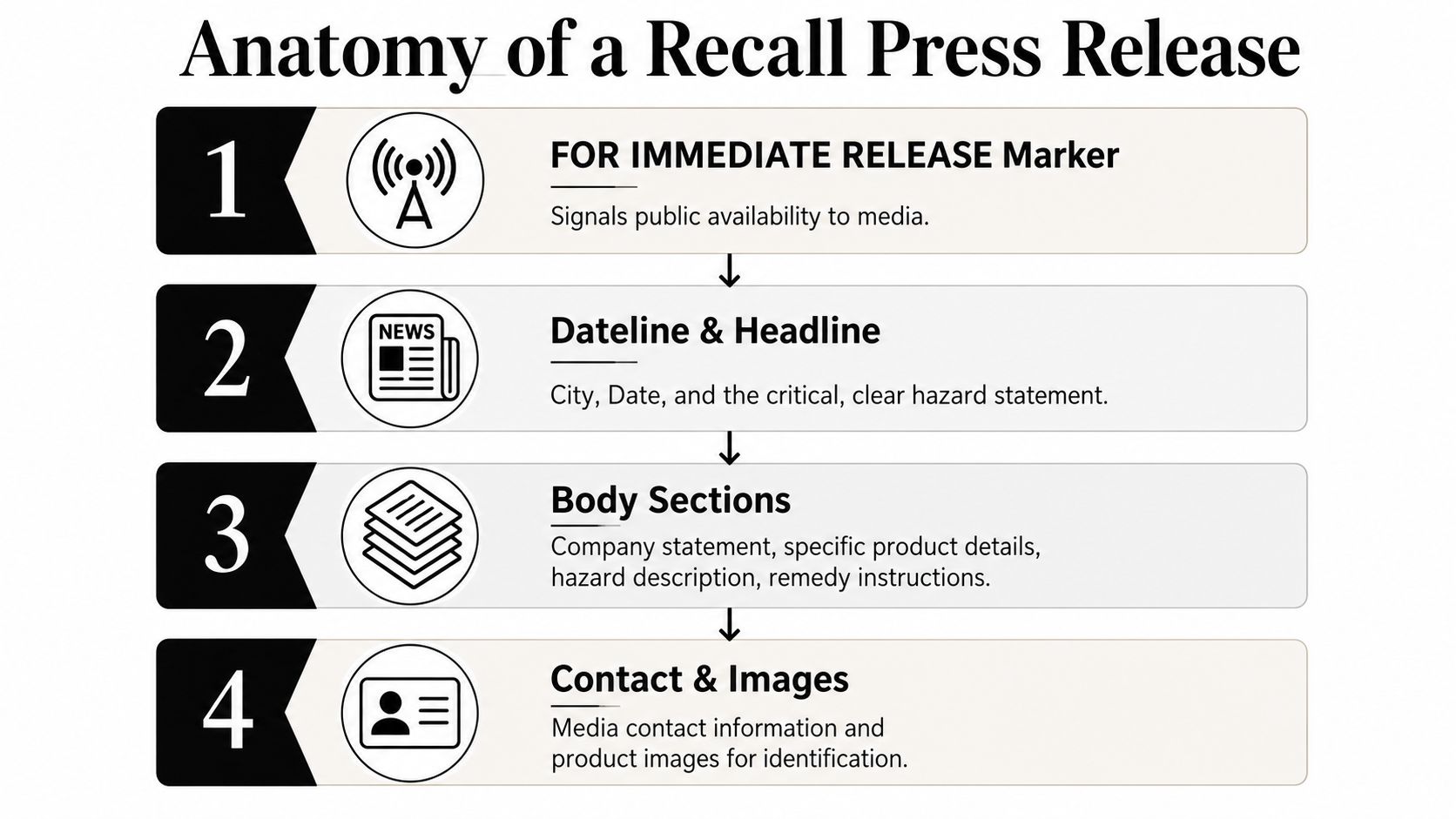
The practical advantage is precision. Regulators and consumers use the same identifiers to match the notice to inventory and risk exposure, so vague phrasing creates confusion quickly. If the product is sold under multiple labels or through multiple channels, the identity block becomes the anchor that keeps the notice from drifting into ambiguity.
Don't let the public statement outrun the legal facts
One recurring failure is broad, reassuring language before the scope has been locked. That may sound calm in the room, but it can make later corrections look like contradictions in print. The safer path is to state only what the company can defend in the filing and in the public notice, then leave room for updates if the recall expands or the remedy changes.
For teams dealing with parallel litigation or product-specific claims, outside reference points can help frame the legal context without turning the recall note into a legal memo. When counsel needs to distinguish recall language from product liability exposure, a resource like Zantac recall lawsuit help can clarify the boundary and keep the public statement from drifting into admissions that belong in a separate legal track.
The working checklist is simple. Match the filing. Match the product identifiers. Match the remedy. Match the contact paths. If the public notice and the regulator record say different things, the company has created a second problem before the first one is even resolved.
Anatomy of a Recall Press Release
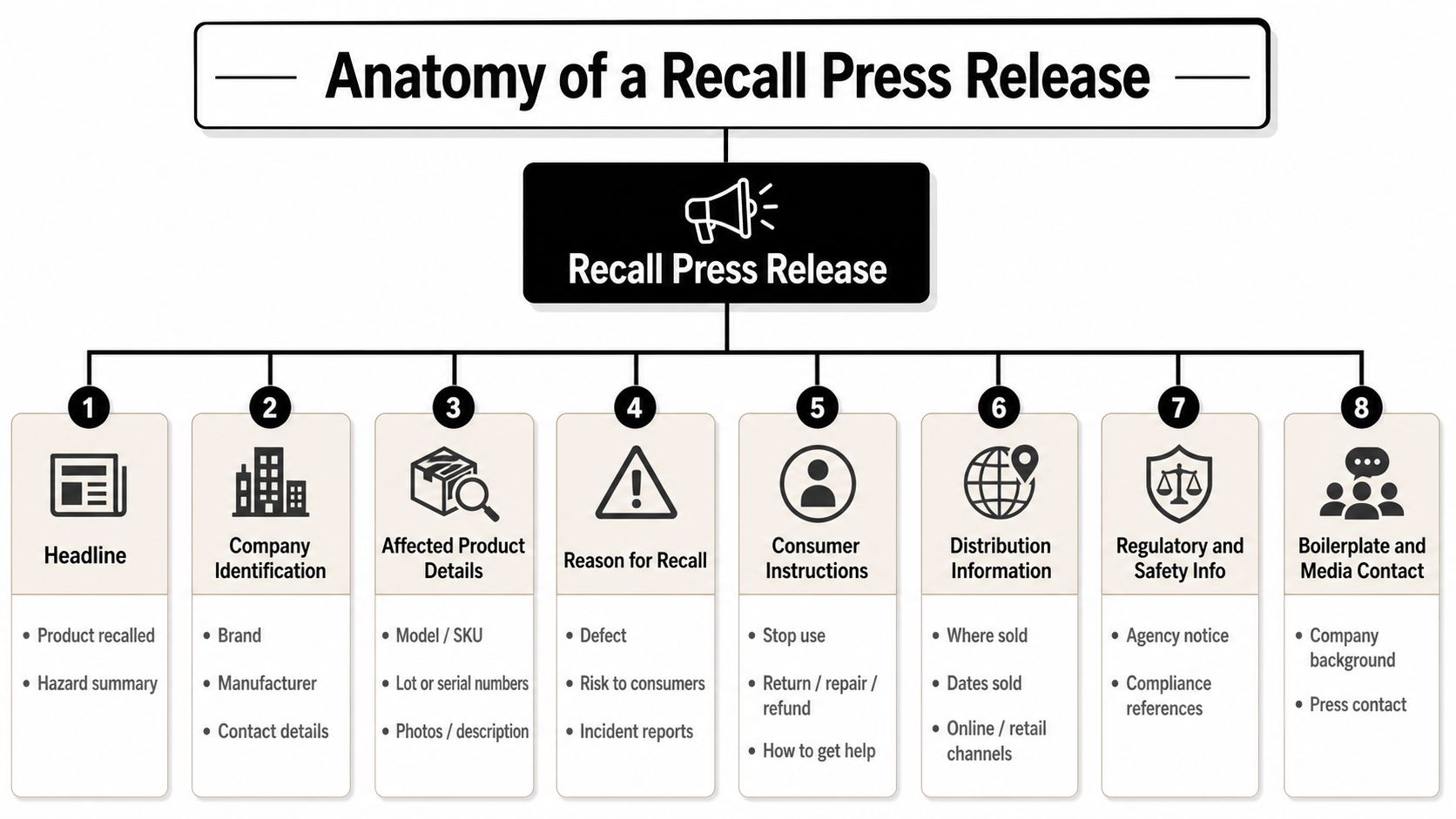
A recall release gets scanned in a fixed order. Editors, regulators, and consumers all look for the same core items first, so the structure carries as much weight as the wording. The strongest versions put the hazard and the remedy up front, then make identification and contact details easy to find.
The structure that works
The notice should begin with FOR IMMEDIATE RELEASE, then a clear dateline, then a headline that names the hazard in plain language. After that comes the product identity block, which should include the firm name and contacts, product description, model or SKU details, production dates or lot or batch codes, quantity recalled, and the hazard type. That block is the operational anchor that regulators use to match the release to inventory and risk exposure.
The body should then answer three questions quickly. What happened. What should consumers do. How can they get help. The consumer contact path needs to stand out from the media contact because callers, reporters, and retailers are rarely looking for the same thing.
For body organization, a clean section structure helps more than decorative language. A practical reference for structuring the body of a press release is useful when the recall note has to stay short and readable under pressure. When counsel needs to separate recall language from broader liability exposure, outside reference points can help frame the legal context without turning the notice into a legal memo. In those cases, Zantac recall lawsuit help can clarify where the public statement stops and the legal track begins.
The product identity block is not filler. It is the part that prevents the wrong inventory from being pulled or the wrong customers from assuming they're affected.
What belongs near the end
After the facts, the release can include a measured company statement, but the quote should never compete with the remedy or bury the identifiers. Boilerplate belongs last, along with any standard company description. Media and consumer contacts should remain separate, and the consumer path should be easy to repeat over the phone, since many recall inquiries come from people reading fast and calling once.
A senior communicator should be able to hand this structure to legal or a junior writer without losing precision. If a draft skips the product codes, blurs the remedy, or mixes consumer and media contact details, it is not ready.
Writing the Core Messaging
The core message has to do seven things cleanly, and each one needs to be useful to a consumer under stress. That means the draft should read like instructions, not brand language. If a sentence sounds polished but doesn't move someone to act, it's working against the notice.
Start with action, not atmosphere
The headline and first lines should tell people what to stop doing. Phrases like stop using or do not consume work because they create an immediate behavioral cue. That directness matters more than style, because recall templates recommend keeping the notice to roughly one page or about 400–700 words so the facts stay readable in crisis conditions (Instant Press).
The hazard description should stay plain and specific. Say what the risk is in language a non-specialist can understand, then identify exactly which products are affected. If a product has lot, batch, serial, or UPC identifiers, those should be visible and unambiguous. Consumers should never have to interpret the scope from marketing copy.
Give one dominant remedy
A recall notice can offer several operational paths in the back end, but the consumer-facing message should usually point to one dominant remedy. That may be a refund, replacement, repair, discard instruction, or return process. Splitting the main action into too many choices can slow response and create confusion at the hotline.
Practical rule: one headline, one hazard, one consumer action, one help path.
The contact section should include a dedicated hotline or website, and the language around it should make the next step obvious. When relevant, the notice can mention symptoms to watch for or health advice, but only if that helps the consumer decide what to do now. Otherwise, extra detail can wait for the FAQ page or follow-up update.
Keep the quote measured
A company quote can help show accountability, but it should not become a legal argument. The safest tone accepts responsibility for the response, expresses concern for affected customers, and keeps the facts in focus without wandering into liability language. That balance matters because the public will judge the recall on clarity and response quality, not on polished sentiment.
The boilerplate should be short and standard. It's there to identify the company, not to reframe the crisis. Marketing-style lines, brand promises, and vague reassurance weaken trust and can make the notice sound detached from the actual hazard.
Localizing for Multilingual and Cross-Border Markets
A single English master release is often not enough once products move across borders or into culturally diverse domestic markets. The factual backbone has to stay stable, but the consumer instructions often need local rewriting. That is especially true when hotline hours, return logistics, and regulator contacts differ by region.
What stays fixed and what changes
The safest way to localize a recall notice is to separate fixed facts from market-specific execution. Product identifiers, hazard class, and the core remedy should stay identical across versions. Language, consumer support paths, return instructions, and references to local regulators may need revision so each audience gets a usable notice instead of a translated one.
The OECD's guidance emphasizes clear product images, key identifiers, simple participation steps, contact details, and, when products are sold globally or to culturally diverse populations, information in relevant languages (OECD4/FINAL/en/pdf)). That point matters because a product can be technically recalled in one country and still sit in households or warehouses elsewhere under different distribution rules.
A localized matrix helps avoid contradictions. For example, the U.S. release might route people to a consumer hotline and company landing page, while another region might need a local distributor contact or market-specific return process. The point is consistency of facts, not identical wording.
Multiple consumer versions are often safer than one universal notice
A contrarian but practical view is that the best recall release may need multiple consumer versions rather than one universal master notice. That's not overengineering. It's risk control. If a global product has different packaging, different regulatory contacts, or different remediation steps in each market, one blended notice can create confusion that gets quoted back in complaints or litigation.
For multilingual domestic audiences, the standard is similar. Translation alone is not enough if the instructions still assume the same return channel, the same support hours, or the same reading level. The company needs people who can act on the notice in the language they use.
When the distribution map is messy, local clarity beats global elegance.
The practical test is simple. A consumer in every affected market should be able to look at the version meant for them and answer three questions without calling twice. What product is this. What should happen next. Who handles my market.
Distribution Channels and Outreach Scripts
Distribution decides whether a recall notice is seen as authoritative or buried as a website update. The launch package should go out through the newsroom, the wire, a dedicated recall landing page, and every owned channel that can carry the instruction quickly. Retail and marketplace partners should receive the same facts at the same time so they can pause sales, update listings, and brief their support teams.
The same-day channel mix
The cleanest distribution stack usually includes wire services, the corporate newsroom, a recall-specific landing page, email, app push where available, and social updates. For Google News visibility, the release should live on a standalone URL with a clear dateline, original images with alt text when appropriate, and structured markup that helps search systems recognize the page as an original announcement. Duplicate syndication can dilute indexing, so the canonical page has to be the primary source.
For broader execution, a distribution checklist can be paired with a simple launch process like the one outlined in how to distribute a press release. That matters in a recall because the same message has to reach media, consumers, retailers, and service teams without creating version drift.
Outreach scripts should be short and repeatable
Tier-one reporters who call back in the first hour need a concise answer path. The outreach email should lead with the hazard, the product name, the remedy, and the contact path, then point back to the release and landing page. A phone script should do the same thing and avoid speculative detail.
A practical reporter script looks like this:
- State the recall in one sentence. Name the product and the risk without additional commentary.
- Confirm the consumer action. Say what people should do right away.
- Route follow-up correctly. Direct safety questions to the consumer channel and media questions to the press contact.
The consumer hotline team needs its own handoff language. It should give callers a consistent explanation of the hazard, the affected identifiers, and the remedy, then avoid ad hoc improvisation. When that handoff is clean, reporters get the facts they need and consumers get a path they can use.
Follow-Up Cadence After the First Release
The first announcement is the opening move, not the finish. Recall communication usually needs updates when the scope expands, when new injury information becomes available, when remediation milestones are reached, or when the recall is being closed out. That's where many teams go quiet too soon and let the story drift without guidance.
A practical cadence for staying credible
In the first 72 hours, the landing page, hotline script, and retailer notices should be checked constantly for consistency. If new facts change the consumer action, a fresh update should go out immediately rather than waiting for a routine cycle. In the first two weeks, the company should use short update bulletins to note important changes without rebuilding the entire release.
Quarterly communication through closure is useful when the recall remains active for a long period, especially if returns, replacements, or corrective actions are still in motion. The update doesn't need to be long. It just has to be specific about what changed and what consumers should do now.
What triggers a new notice
A follow-up is justified when the company has something material to say. That includes a broader product scope, new batch identifiers, different remediation steps, reported injuries, or a confirmed closure of the recall. If the public-facing message no longer matches the operational reality, the release should be refreshed before calls and social posts create a second narrative.
Rule of thumb: update when the consumer action changes, not only when the legal team asks for a new PDF.
A short update bulletin can be enough if the core message hasn't changed. One sentence for the change, one sentence for the current action, one sentence for the contact path. That format keeps the recall present in search and media coverage without forcing another long release.
A useful planning aid is a recall calendar, especially when multiple updates, social posts, and FAQ revisions need to stay aligned. A simple framework for that sits well alongside creating a press release calendar, because recall PR works better when the follow-up cadence is mapped before the first call goes out.
A strong recall program ends the same way it starts, with clarity. The team should keep the product identifiers, remedy language, consumer contact path, and update schedule close at hand, because the next hazard rarely arrives on a convenient timeline.
A CTA for Press Release Zen.