You're staring at a blank document, the announcement is real, and the deadline is not moving. A launch, a hire, a funding round, a local partnership, all of it needs to become something a journalist can scan fast and decide is worth covering. That's where how to write a PR stops being a writing exercise and becomes a packaging problem, because the release itself is only one part of what a newsroom needs to say yes.
The strongest releases still follow the old newsroom logic. They lead with the news, answer the basic questions quickly, and stay short enough that a busy editor can read them without hunting for the point, which is why Rutgers centers the classic release on the headline, dateline, lead sentence, and inverted-pyramid order and Purdue OWL keeps the document to one or two pages with contact details and every sentence doing useful work Rutgers press-release basics, Purdue OWL press releases. But modern distribution adds a second layer, the email, the newsroom page, the multimedia bundle, and the follow-up. If that layer is sloppy, even a solid story can get ignored.
Table of Contents
- Finding Your Newsworthy Angle Before You Write
- Structuring Your Press Release Using the Inverted Pyramid
- Crafting Headlines and Quotes That Command Attention
- Formatting and Packaging for Modern Distribution Channels
- Optimizing for SEO and Google News Visibility
- Distribution Strategy and Follow-Up Outreach
Finding Your Newsworthy Angle Before You Write
A founder opens a blank page and types the company name first. That usually leads nowhere useful. Journalists do not open releases because a business wants attention, they open them because the story gives them a reason to care, and the gap between those two mindsets is where most releases die.
That's where how to write a PR shifts from a writing exercise to a packaging problem. The release is only one part of the job. Editors also need a clear pitch, a usable angle, and the supporting assets that make the story easy to verify and publish.
Test the story before you draft the release
A workable angle has to survive a simple editor test. Would someone outside the company care if they saw this in a crowded inbox? If the answer is no, the announcement probably needs reframing, not more adjectives. The strongest angle often ties a routine update to a broader trend, a public impact, or a timely event, which is the practical insight behind this guide on finding a newsworthy press release angle.
Practical rule: if the update sounds like internal housekeeping, it needs a wider frame before anyone writes the first sentence.
A release about new software access is company-centric. A release about how that software helps a defined audience respond to a known problem is audience-centric. A store opening is a location note. A store opening tied to neighborhood development, local employment, or a seasonal event has a clearer journalistic hook.
The same logic applies to the rest of the package. A strong angle gives you a sharper headline, a better reporter pitch, and a cleaner set of assets to attach or link, so the newsroom can move without chasing basic context.
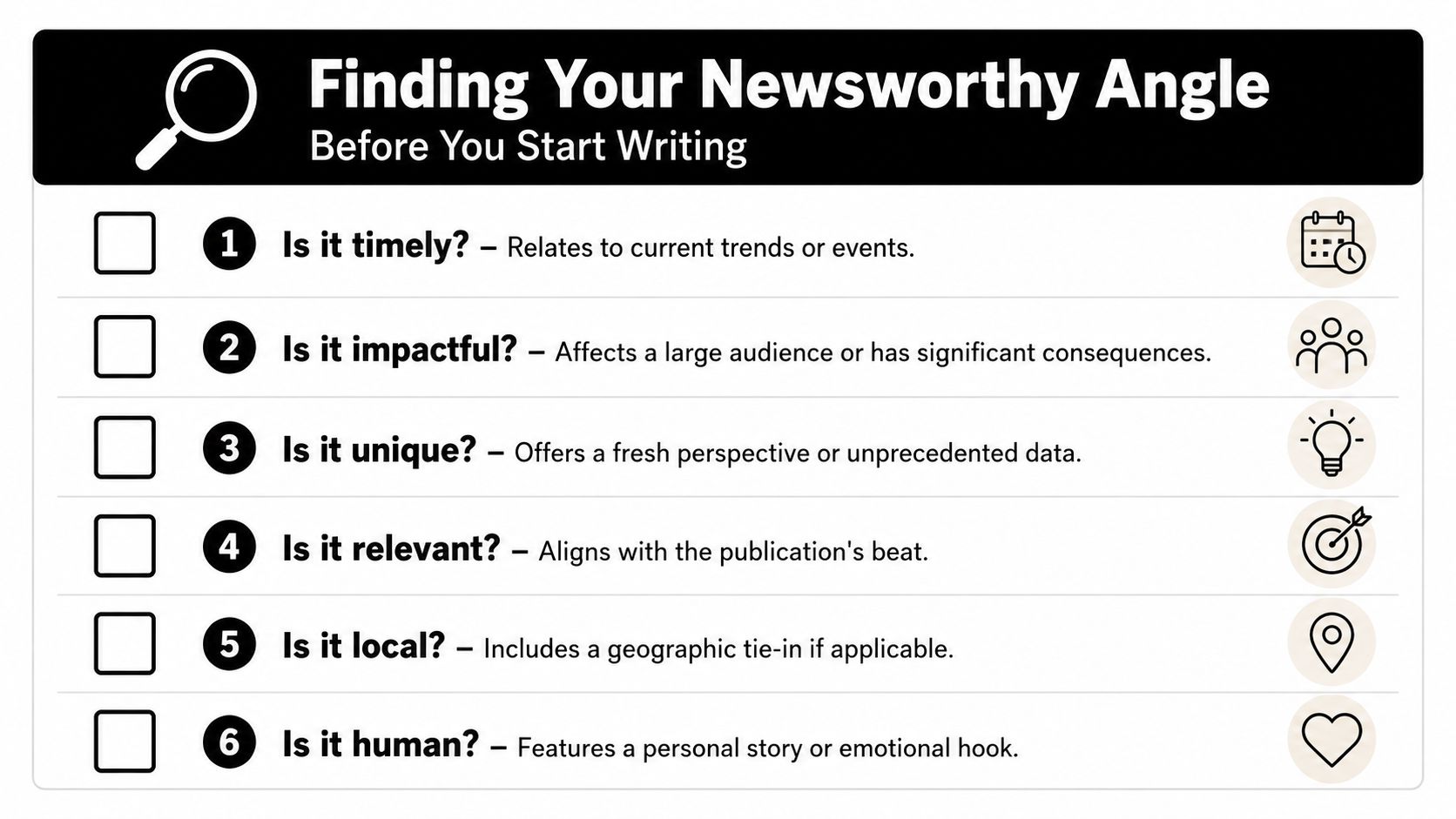
Use a simple angle stress test
A quick decision framework keeps the process honest:
- Timeliness: Does the announcement connect to current news, a known calendar moment, or a live issue?
- Impact: Does it matter to customers, residents, readers, or a niche community beyond the company?
- Specificity: Is there a concrete milestone, metric, date, or product detail that proves the story is real?
- Relevance: Does it fit the outlet's beat, audience, or geography?
- Human interest: Is there a person, problem, or outcome that gives the story a face?
If the announcement only passes one of those checks, it is probably not enough. If it passes several, the release has a usable hook.
The hardest part is restraint. A mundane announcement can still become coverage-worthy when it is connected to something larger, but forcing novelty where none exists usually backfires. Editors spot inflated language immediately, and they also notice when the release lacks the basic materials a reporter needs to work fast. A quieter frame that feels credible beats a loud one that feels manufactured.
Structuring Your Press Release Using the Inverted Pyramid

A release that reaches a reporter's inbox has already entered a workflow that rewards speed. The inverted pyramid fits that reality. Put the most important facts first, then add the context, then the supporting detail. Rutgers' basics page lays out the standard newsroom structure, and Purdue OWL reinforces the same practical constraint, a release should be short, scannable, and built for follow-up, not for storytelling flourishes. Rutgers press-release basics, Purdue OWL press releases Editors triage fast, so if the core news is buried, the release gets skipped.
Put the essentials where skimmers expect them
Start with the headline, then the dateline, then a lead that answers the five Ws, who, what, when, where, and why. The opening paragraph should let someone understand the announcement without reading further, because newsroom desks often sort dozens of pitches at once and decide in seconds whether a story is usable.
The body supports the lead. Add context, then the quote, then the proof point or background detail that makes the release credible. PR Newswire's guidance on modern best practice encourages relevant statistics, survey results, historical context, or industry trends to support claims, because journalists want evidence, not just assertions. When the release stays tight, those details feel authoritative instead of padded. If you want a fuller explanation of how the middle section should work, this body-structure guide breaks down the structure clearly.
Respect the format signals that tell editors you know the game
The small pieces matter more than many teams expect:
- Headline: keep it concise and news-first, not clever for its own sake.
- Lead paragraph: make it complete enough that it stands alone.
- Body paragraphs: keep them short and focused on one supporting idea each.
- Boilerplate: explain who the company is without turning the release into an ad.
- Contact line and end marker: include clear media contact details and a standard closing marker such as ### or Ends.
A release that runs long usually hides its best point. A release that stays readable signals discipline, and discipline is one of the first things an editor notices. Newsrooms also need the release to sit alongside the rest of the pitch package, including contact details, assets, and anything a reporter may need to publish without chasing basics. An inverted pyramid infographic explaining the structure of a press release from most to least important information.
Crafting Headlines and Quotes That Command Attention
A weak headline usually tries to cover too much, says too little, or sounds like it was written to impress the sender. A strong one tells a journalist what changed, why it matters, and why it deserves attention now. It also has to survive the way reporters work, in inbox previews, syndication feeds, and search snippets. That is why headline writing is part craft and part packaging.
Before and after, the difference is usually precision
Weak headline: New Company Announcement
Stronger headline: Local nonprofit opens new youth program in South Austin
Weak headline: Company launches platform
Stronger headline: Fintech startup adds fraud alerts for small business accounts
The stronger versions name the subject, the action, and the angle. They do not oversell. They give an editor a usable summary instead of a marketing slogan, and they make it easier for the release to fit into a broader pitch-and-assets workflow instead of sitting there as a standalone document.
Quotes deserve the same discipline. Too many read like they were approved by committee, not written for a journalist or a reader. They praise the team, repeat the headline, and add nothing that helps someone report the story. Modern guidance emphasizes proof points and supporting detail rather than empty enthusiasm.
Write quotes like a human would say them
A flat quote often sounds like this:
We're thrilled to announce this exciting milestone and look forward to continuing our commitment to excellence.
That tells the reader nothing. A more useful version sounds specific and grounded:
This launch gives customers a faster way to track requests without switching tools, and that saves them time in the part of the process they complain about most.
The second version does three things at once. It explains the change, shows the benefit, and sounds like a person with actual context. Editors tend to keep that kind of quote because it reads like someone who knows the work, not someone repeating a corporate script.
A good quote can also carry a proof point when the detail fits naturally. A release that includes a concrete metric, date, or milestone looks more credible because it gives the journalist something to verify and reuse. That matters in the pitch-and-assets package too, because the headline, quote, and supporting material should all work together instead of forcing a reporter to hunt for the missing piece. The release gets stronger when the quote adds texture the headline cannot carry on its own, and when the full package gives the newsroom enough context to publish without back-and-forth.
Formatting and Packaging for Modern Distribution Channels
A strong release can still miss the mark if it arrives in the wrong format. Journalists do not all work the same way, so the old habit of sending one document for every channel creates friction. The email version should be built for fast scanning. The newsroom or press room version can hold richer assets, fuller context, and supporting material that helps a reporter move faster. Recent guidance from PR Lab treats the email release and newsroom version as separate documents, and that distinction is one of the most useful updates in the modern workflow PR Lab on writing a press release.
Choose the format that matches the job
Microsoft Word still has an advantage when a journalist needs to copy, paste, and edit quickly. PDF preserves layout, but it can be harder to extract text from and may not play well with newsroom systems. A plain-text email body often wins for the first touch because it is the easiest format to scan fast. The format trade-off is simple, readable and editable versus visually fixed.

The packaging around the release matters too. A newsroom-ready asset bundle can include a logo, headshots, charts, product images, or other visuals that make publication easier. That is the workflow gap many teams miss. A journalist is not only asking, “Is this news?” They are also asking, “Can I build the story quickly?”
Keep the mechanics professional and predictable
Short paragraphs, careful copyediting, contact details, and a standard close such as ### or Ends still help a release read like a newsroom document. Some toolkits also specify doublespaced readability and consistent type choices, which makes the file compatible with newsroom habits.
For teams that want a practical distribution workflow, Xholic AI's creator playbook is a useful reminder that packaging is part of distribution, not an afterthought. Different channels need different cuts of the same core message, and the release should be built with that reality in mind. Press Release Zen's Google News distribution guidance is useful here as well, because the release, the assets, and the channel plan need to work together if you want the newsroom to pick it up without extra back-and-forth.
Optimizing for SEO and Google News Visibility
A press release can serve two purposes at once, earn pickup and support search visibility. That only works if the copy still reads like it was written for people. Search terms belong where a human expects them, in the headline, lead, and body. They do not belong crammed into every paragraph. The release should start with news value, then support it with relevant detail.
Write for discovery without sounding engineered
Headline language should match the actual announcement, not a keyword list. The first paragraph should state the news in plain language, because Google News and readers both depend on clarity. A release that reads like a brochure usually loses on both fronts.
Google News inclusion also rewards discipline around source material and consistency. Many teams keep the release on their own site, then distribute a clean copy elsewhere, so the original version stays authoritative and easy to reference. This Google News guide is useful for teams working through those practical decisions.
The release should sound like a newsroom document first, and a search asset second.
This balance is important. If the copy is overloaded with keywords, it feels artificial. If it ignores search entirely, it leaves organic visibility on the table. The strongest releases treat the headline and first paragraph as the main discovery surface, then use the body to add context that helps both indexers and readers.
Timing still matters, but only within reason. A release sent when journalists are already overloaded is easier to miss. A release sent with a clear topical connection, a clean angle, and a relevant beat fit has a better chance of being used. The practical move is to align the announcement with the news cycle instead of fighting it. If the story belongs to a seasonal, regulatory, local, or industry-specific moment, the release should say so early.
The same thinking applies to packaging. If a journalist can move from the release to supporting assets without extra digging, the story is easier to publish. That is where the broader pitch-and-assets workflow matters, because amplify your published assets online depends on more than the text alone.
Distribution Strategy and Follow-Up Outreach
A release that never reaches the right inbox is just a document. Distribution starts with a targeted media list, not a blast list. The better the match between outlet, beat, and angle, the less likely the pitch is to feel generic. The asset package matters too, because direct outreach works better when the journalist can open the email, understand the angle, and grab the supporting material without asking for three follow-ups.
Match the channel to the story
Wire services can help with broad visibility, especially when the goal is public distribution and search pickup. Direct email works better when the release is aimed at a specific reporter or editor. The strongest campaigns often use both, but not in the same way. The wire handles reach. The pitch email handles relevance.
For teams that need to amplify what has already been published, Bruce and Eddy's distribution strategy guide is a helpful reference point. The key idea is that distribution doesn't end when the file is sent. It continues through targeted outreach, syndication, and asset reuse.
Follow up without becoming the problem
A follow-up should add value, not pressure. Wait long enough for the journalist to read, then send a short note that reminds them of the angle and gives them one practical reason to look again. If the first outlet passes, adapt the framing for another beat or another publication rather than repeating the same pitch unchanged.
Sector-specific releases need sector-specific packaging:
- Real estate: Lead with neighborhood relevance, timing, and local impact.
- Nonprofits: Emphasize community need, beneficiaries, and public-facing outcomes.
- Retail: Focus on customer experience, store footprint, product availability, or seasonal relevance.
- B2B and SaaS: Make the problem, workflow change, or proof point easy to grasp fast.
A pre-send checklist keeps the campaign from stalling on preventable errors:
- Angle check: The story has a real hook, not just internal significance.
- Structure check: The lead answers the five Ws fast.
- Quote check: The quote adds context, not filler.
- Formatting check: The release is readable in the intended channel.
- Asset check: Supporting visuals are ready if needed.
- Distribution check: The media list fits the beat and outlet type.
- Follow-up check: The team knows who will reply, when, and with what next step.
A release campaign works when the writing, packaging, and outreach all pull in the same direction. One strong paragraph can't save a weak angle, and a perfect angle can still disappear if the email, assets, and follow-up are careless. Treat the release as part of a workflow, not a standalone artifact, and it starts behaving like the newsroom-ready asset it was meant to be.
Press Release Zen can help teams turn an announcement into a usable release, then package it for distribution with clearer structure, formatting guidance, and workflow support. If a launch, funding update, or local announcement is sitting in a draft folder right now, start shaping the angle, tightening the lead, and preparing the asset bundle today.