You’ve booked the venue, confirmed the date, maybe even lined up a speaker you’re proud of. Then the hard question lands. How do you get anyone outside your own email list to care?
That’s where event press releases usually go wrong. People treat them like a formality, write one generic announcement, blast it everywhere, and hope coverage appears. It rarely works that way. A good event press release isn’t just an announcement. It’s a structured media asset built for a crowded inbox, a fast scan, and a skeptical editor.
If you’re learning how to write a press release for an event, the biggest shift is this. Stop thinking in terms of one document. Start thinking in terms of a campaign. Your main release matters, but so do the timing, the follow-up, the recap, and the way you measure whether any of it moved attendance, interest, or coverage.
Planning Your Event Announcement Strategy
Most first-time organizers start writing too soon. They open a blank doc before they’ve decided what the release is supposed to do.
That creates a predictable mess. The announcement tries to sell tickets, impress sponsors, explain the event concept, summarize the whole agenda, and tell the brand story all at once. Journalists don’t need all of that in one pass. They need a reason to pay attention now.
Current guidance often skips the sequencing problem entirely. As noted in this discussion of news release timing gaps, many resources don’t address how to plan multiple releases across an event lifecycle or how to avoid audience fatigue when details emerge in stages.
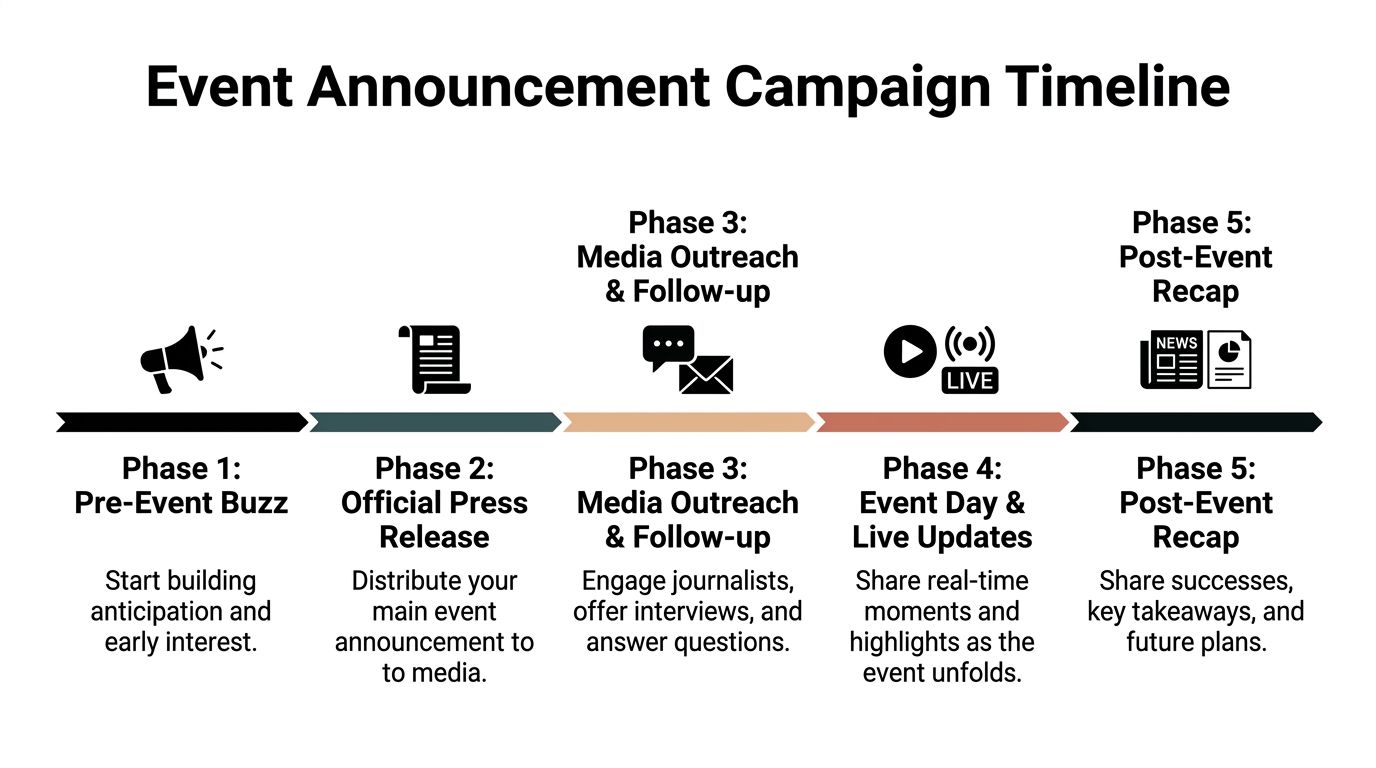
Treat the event like a campaign, not a single send
A serious event PR plan usually has several moments, not one:
| Phase | Timing | Release Focus | Primary Goal |
|---|---|---|---|
| Pre-Event Buzz | Early planning stage | Teaser angle, event purpose, save-the-date signals | Build awareness and early curiosity |
| Official Press Release | Main announcement window | Full event details, registration, core hook | Generate media interest and attendee action |
| Media Outreach & Follow-up | After distribution | Tailored pitches, interviews, clarifications | Convert announcement into actual coverage |
| Event Day & Live Updates | During event | Highlights, visuals, speaker moments | Sustain momentum and social proof |
| Post-Event Recap | Immediately after event | Outcomes, quotes, next steps | Extend visibility and support future events |
This approach keeps each communication focused. Your first message doesn’t have to do every job.
A nonprofit gala might lead with mission impact and honorees. A tech conference might hold the main push until it can announce a notable keynote or product tie-in. A local community event may get more mileage from neighborhood relevance than from a broad “industry” angle. The sequence changes with the event type.
Practical rule: If a release doesn’t have a clear reason to exist on its own, don’t send it.
Map what gets announced when
The easiest way to avoid a weak release is to decide in advance which details belong to which stage.
Use the early phase for information that creates anticipation without overloading the story. That could be the event name, date range, city, mission, or audience. Save denser material, such as program tracks, guest speakers, or sponsor news, for later moments if those details can support their own angle.
For many teams, it helps to build the event plan and the PR plan together. If you’re still shaping the event itself, this complete guide to creating an event is useful because it forces you to clarify the audience, structure, and experience before you try to pitch the media on it.
A simple planning sheet should answer:
What’s the strongest hook now
Is it the launch, the speaker, the cause, the location, the audience need, or the recap?What’s still missing
Don’t pitch a half-formed event if the essentials aren’t settled.Who needs each message
Local media, trade outlets, sponsors, attendees, and community partners rarely care about the exact same framing.What action matters most
Registration, media attendance, interview requests, partner interest, or post-event credibility.
Build a calendar before you draft copy
A release sent at the wrong moment can be technically well written and still fail. The problem isn’t always the prose. Often it’s that the event team waited until too late, or sent too many updates with no fresh angle.
A press release calendar keeps everyone honest. It shows when each release should be drafted, approved, distributed, and followed up on. It also prevents the common internal scramble where a sponsor reveal, schedule update, and final reminder all collide in the same week. If you need a practical framework, this guide to creating a press release calendar and scheduling announcements is worth using as a working checklist.
One more point matters here. A post-event release is not optional if the event was significant. It closes the loop. It gives media a second chance to cover the story. It also gives your next event a credibility asset you can reuse.
The teams that look polished aren’t always the ones with bigger budgets. They’re the ones that decide, early, what story gets told at each phase.
The Anatomy of a Winning Event Press Release
Once the timing is set, format starts doing real work. Journalists don’t want to decode your creativity. They want to scan, assess, and decide.
That’s why standard structure still matters. According to PR Newswire’s event press release guidance, 300 to 800 words is the standard range, and releases under 500 words can achieve up to 25% higher open rates among journalists. The same guidance notes that 87% of journalists prioritize the five Ws in their initial scan, and releases with images see 2.3x more engagement.
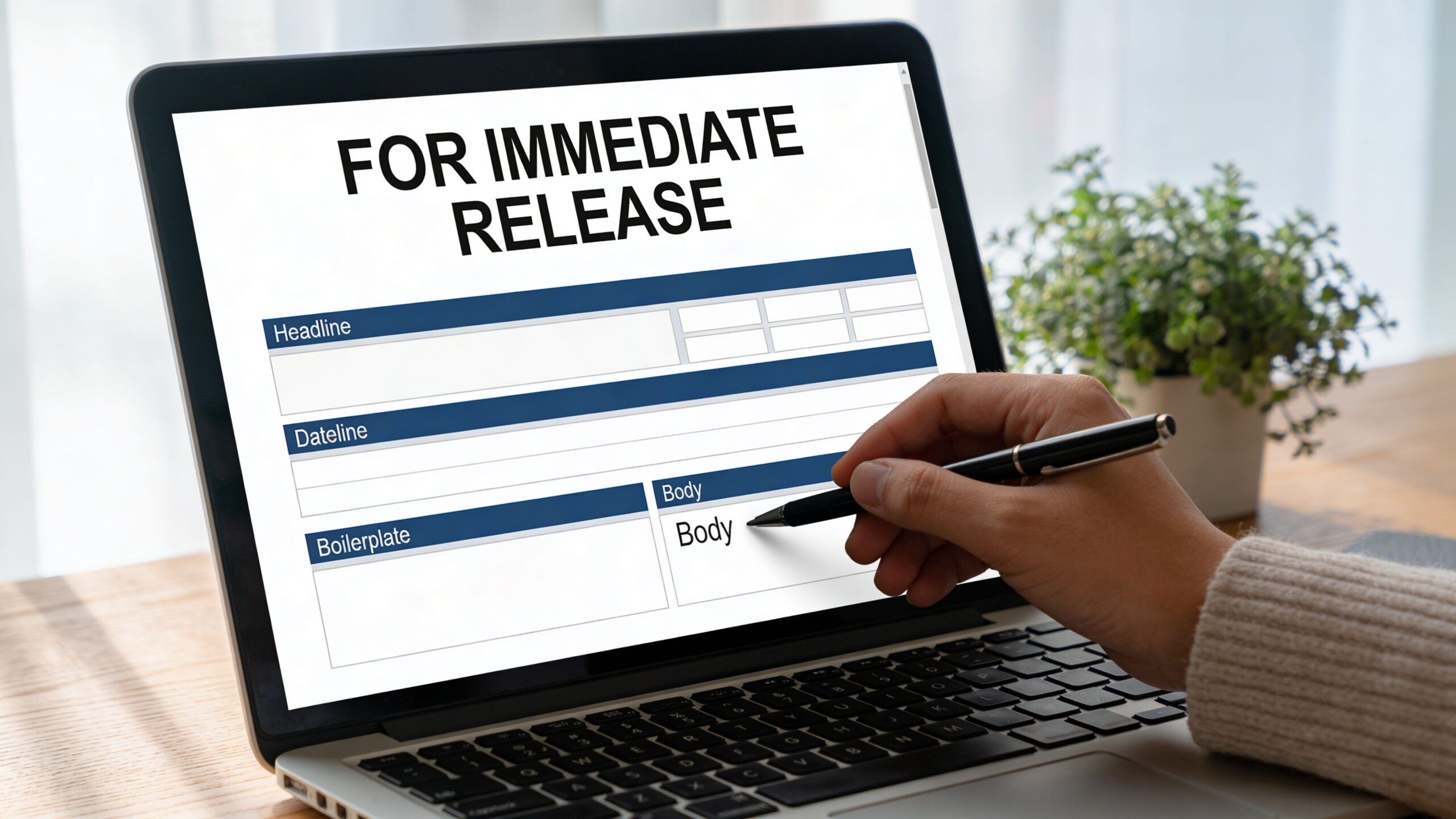
Start with the top matter
A usable event release usually opens with a few required elements:
Release designation
“For Immediate Release” still serves a purpose. It tells the recipient there’s no embargo confusion.Headline
Short, factual, and direct. Not cute. Not mysterious.Dateline
City and date belong right up front.
Those pieces tell an editor what they’re looking at before they read a sentence of body copy.
The lead has one job
Your first paragraph must answer who, what, when, where, and why without wandering into a sales pitch. If the basics are buried in paragraph three, you’ve already lost a lot of readers.
A clean lead sounds something like this in practice:
Springfield, Illinois, June 15, 2026. BrightPath Health will host its community wellness summit on July 20 at the Riverfront Convention Center, bringing local providers, nonprofit partners, and residents together to address access to preventive care.
That’s not flashy. It’s useful. Useful wins.
Build the middle for scanning
The body should expand, not repeat. Most event releases work best when the middle answers the questions a journalist would ask next.
Those usually include:
- Why this event matters now.
- What attendees can expect.
- Who notable participants are.
- How people can register or attend.
- Whether there’s a visual or local angle worth covering.
Many organizers overstuff the release. They paste the full agenda, a sponsor roll call, every panel title, and three paragraphs of brand messaging. Cut aggressively. The press release is the invitation to learn more, not a substitute for your event landing page.
Quotes, boilerplate, and contact details
Quotes belong in the body, but only if they add perspective. The organizer quote should explain intent. A speaker quote should add authority or urgency. If both say “we’re excited,” neither is doing any work.
Then close with the pieces people often rush through:
| Component | What it should do | Common mistake |
|---|---|---|
| Boilerplate | Briefly explain who the organizer is | Turning it into a long company history |
| Media contact | Give one clear person and method to reach them | Listing a generic inbox with no owner |
| CTA | Tell readers what to do next | Hiding the registration step in the middle |
| Assets | Point to images or supporting materials | Forgetting to include them at all |
A boilerplate should build trust in a few lines, not rehearse your entire origin story.
If you want a visual reference before drafting your own, this sample event press release is helpful for checking layout and flow.
What a strong release feels like
A winning event press release has a certain rhythm. It opens fast, delivers facts early, expands with purpose, includes one or two useful quotes, and ends with a clean path to action.
What it does not do is behave like a flyer. Flyers sell. Press releases inform. The overlap exists, but the tone is different. If your document reads like ad copy with a dateline pasted on top, editors will treat it like promotion, not news.
The safest test is simple. Remove the logo and ask whether a stranger could understand the event and why it matters in under a minute. If not, rebuild the structure before you polish the language.
Writing Compelling Content That Earns Coverage
A structurally correct release can still be forgettable. That’s the next hurdle.
The difference usually comes down to angle. A journalist won’t cover your event because it exists. They’ll consider it if the event connects to a timely issue, a meaningful community need, a notable person, a first-of-its-kind element, or a clear local impact.
According to AddEvent’s event press release methodology, releases without a unique hook see 60% lower pickup. The same guidance recommends a headline under 10 words, a lead built around the five Ws, one organizer quote and one speaker quote, and notes that multimedia links can boost engagement by 30%. It also warns that passive voice halves readability.

Find the angle before you write the headline
Here’s the mistake I see most often. The organizer starts with logistics, not news value.
Bad angle:
- Annual business conference returns this fall
Better angles:
- Regional employers gather to address hiring gaps
- Local health summit expands access conversations
- Founder event brings first-time operators and investors together
- Charity run funds a specific community initiative
The event itself isn’t always the story. Often the story is the problem it addresses, the people it convenes, or the timing that makes it relevant.
Turn dry details into a usable lead
Compare these two openings.
Weak version
XYZ Events is proud to announce its upcoming leadership forum, which will feature dynamic speakers, exciting sessions, and exceptional networking opportunities for attendees from across the region.
It’s vague, stuffed with filler, and tells a reporter almost nothing.
Stronger version
Denver, Colorado, September 10, 2026. XYZ Events will host its leadership forum on October 4 downtown, bringing regional founders and operators together for sessions on hiring, retention, and market expansion.
The second one gives location, timing, audience, and subject matter immediately. It respects the reader’s time.
If your lead could describe almost any event in almost any city, it isn’t specific enough.
Write quotes that sound like people
Most quotes in event releases are dead on arrival. They’re packed with words like “thrilled,” “honored,” and “excited,” but they don’t add information.
A useful organizer quote does one of three things:
- explains why the event exists,
- identifies the audience problem,
- or frames why this moment matters.
A useful speaker quote should bring expertise, not just approval.
For example:
Weak organizer quote
“We are thrilled to host this exciting event and welcome attendees for an unforgettable experience.”Stronger organizer quote
“Small employers don’t need more theory. They need practical ways to recruit and keep people, and that’s what this program is built around.”Weak speaker quote
“I’m honored to be part of this amazing conference.”Stronger speaker quote
“Many organizations know they have a retention problem. Few have a repeatable process for fixing it. That’s what I’ll address on stage.”
That’s the difference between decoration and substance.
Add proof points without turning the release into a report
Not every release needs hard numbers from the organizer. In fact, many first-time event teams don’t have them. That’s fine. You can still be concrete.
Use specifics such as:
- named speakers,
- session themes,
- a charitable component,
- the intended audience,
- a venue with local relevance,
- or a practical takeaway for attendees.
Then support the story with assets. A speaker headshot, event logo, short promo clip, or media kit link gives a reporter material to work with.
A quick visual explainer can help if you're training a team or reviewing a draft with stakeholders:
Keep the language active
Passive voice drains urgency from event copy.
Instead of:
- The event will be attended by business leaders.
- Discussions will be led by experts.
- Registration is being encouraged by organizers.
Use:
- Business leaders will attend the event.
- Industry experts will lead the discussions.
- Organizers are inviting early registration.
That shift seems small. It changes how alive the release feels.
A simple writing checklist that catches most weak drafts
Before sending, test the release against this list:
Angle check
Can you state the hook in one sentence without mentioning your company slogan?Lead check
Are the five Ws clear in the first paragraph?Quote check
Do the quotes add meaning, or are they just ceremonial?Specificity check
Are there concrete details that make the event real?Trim check
Could a journalist understand the release in a quick skim?
Strong event PR doesn’t sound grand. It sounds clear, timely, and useful. That’s what earns coverage.
Formatting, Distributing, and Targeting Your Release
A good draft can still fail in execution. I’ve seen strong releases sent as messy pasted emails, attached in the wrong format, or blasted to people who never cover that kind of event.
That’s not a writing problem. It’s an operations problem.
According to Accelevents’ event press release guide, AP Style formatting in 12pt Arial or Times New Roman and sending as a PDF provides 95% compatibility. The same source recommends sending 2 to 4 weeks pre-event on Tuesdays through Thursdays between 8 and 10 AM EST, a window associated with 40% higher coverage in US and EU markets. It also notes that 72 DPI images and short video links can boost pickup by 25%.
Format for usability, not for decoration
Keep the document simple. Fancy design usually makes a release harder to use, not easier.
Use:
- A standard font such as Arial or Times New Roman
- 12pt type
- AP style
- A PDF attachment for cleaner compatibility
- A plain-text version in the email body when appropriate
The PDF preserves layout. The body copy makes it easy for journalists to scan without opening an attachment. Sending both is often the most practical move.
Build a list that matches the event
Mass distribution feels efficient because it’s fast. It usually wastes time.
A local food festival should not go to national fintech reporters. A B2B SaaS summit should not be pitched like a neighborhood fair. Start with relevance:
| Outlet type | Best fit | What they usually need |
|---|---|---|
| Local media | Community events, civic impact, fundraisers | Clear local angle, visuals, attendance relevance |
| Trade publications | Industry conferences, niche summits | Subject matter relevance, speaker expertise |
| Business press | Founder events, economic stories, regional growth | Market angle, executive access, business significance |
| Community calendars | Public events and open attendance | Clean logistics, ticket or registration details |
Targeting matters more than volume. A shorter, smarter list beats a giant list that isn’t aligned.
Distribution choices that make sense
You have three common paths.
Manual outreach works best when the event has a strong niche or local angle and you already know the relevant contacts.
A distribution service can widen reach and create a formal publication trail, but it won’t fix weak targeting or weak copy.
A hybrid approach is usually the most practical. Use a service if visibility matters, then personally pitch the outlets that are most likely to care.
If you’re comparing those options, this guide on how to distribute a press release effectively covers the trade-offs clearly.
Send the release broadly only after you know who must receive a personal note first.
Don’t separate the send from the follow-up plan
Before you distribute, prepare three things:
- a short custom pitch for priority reporters,
- a link to images or media assets,
- a fast answer for the obvious questions.
Those questions are predictable. Is media registration available? Can the organizer or keynote do interviews? Is there parking, access, livestream information, or a press contact on-site?
The smoother you make that process, the easier you make coverage.
A lot of event PR underperforms because the team thinks “distribution” means “uploading the release somewhere.” It doesn’t. Distribution is targeting, timing, formatting, asset prep, and response handling working together.
Measuring Success and Following Up Professionally
Most event teams can tell you whether the release was sent. Fewer can tell you what it did.
That’s the blind spot. The guidance available to small teams is still thin here. As noted in Remo’s discussion of event press release measurement gaps, many resources don’t explain how to track which elements influenced event attendance, ticket sales, media coverage, or journalist response. That leaves small businesses and startups guessing.
What to measure after distribution
Distribution reports are not the whole story. They tell you that a release moved through a system. They don’t tell you whether the right people cared.
For an event campaign, track outcomes in layers:
Media pickup
Which outlets mentioned the event, republished the release, requested comments, or attended?Site behavior
Did traffic hit the event page after distribution? Did visitors stay, register, or leave quickly?Conversion paths
Which links led to registration, RSVP requests, or sponsor inquiries?Message performance
Which angle got responses? Which subject line drew opens? Which quote or framing got reused?Post-event reuse value
Did the release create assets you can use again in sales decks, sponsor conversations, or the next event launch?
Use a simple ROI framework
You don’t need a complex dashboard to get useful answers. For many teams, a working spreadsheet is enough if it’s set up before the release goes out.
A practical version includes these fields:
| Metric area | What to log | Why it matters |
|---|---|---|
| Outreach | Outlet, contact, send date, follow-up date | Shows who was actually pitched |
| Coverage | Mention, article, interview, calendar listing | Separates real pickup from distribution noise |
| Traffic | Visits to event page after release | Connects PR activity to audience behavior |
| Conversion | Registrations or inquiries from tracked links | Shows whether attention turned into action |
| Learnings | Best angle, strongest subject line, common objections | Improves the next release |
If you’re using registration pages, add UTM links so you can see whether traffic came from email outreach, a published release, a partner share, or social amplification. Without tracked links, you’re relying on guesswork.
For teams that also run webinars, hybrid sessions, or digital events, this roundup of event metrics and KPIs to track can help you think beyond vanity metrics and focus on outcomes that matter.
Good PR measurement answers a business question, not just a reporting question.
Follow up like a professional, not a pest
Follow-up gets mishandled in two ways. Some teams never do it. Others do it so aggressively that they burn goodwill.
A professional follow-up is short, relevant, and easy to ignore without friction. It usually works best when it offers something useful:
- an interview with the organizer,
- a local data point or community angle,
- a speaker availability window,
- or event-day access for media.
What not to send:
- “Just checking in on this”
- “Did you get my email?”
- “Bumping this to the top of your inbox”
What works better:
- a concise note that connects the event to the journalist’s beat,
- a fresh angle that wasn’t obvious in the original release,
- or a logistical update that makes coverage easier.
Compare versions and learn from each release
A single event may give you several chances to improve. Test two subject lines for different segments. Try one angle for local press and another for trade outlets. Review which version triggered replies.
You don’t need to overcomplicate this. The point is to stop treating press outreach as unmeasurable. It’s measurable enough to improve if you track inputs, pickups, traffic, and conversions consistently.
And if no one responded, that’s still useful information. It usually means one of four things failed. The angle wasn’t strong, the list wasn’t right, the timing was off, or the release didn’t make action easy.
Frequently Asked Questions About Event Press Releases
How is a virtual or hybrid event press release different?
The structure stays the same, but the logistics change. Replace physical venue details with platform information, access instructions, time zone clarity, and registration steps. Be explicit about whether sessions are live, recorded, or both.
For hybrid events, avoid cramming both experiences into one fuzzy paragraph. Explain what in-person attendees get, what virtual attendees get, and whether media can cover either format remotely.
What if a major event detail changes after I send the release?
If the change affects the event’s accuracy, send an updated version quickly. Speaker changes, venue moves, date changes, and major schedule shifts all qualify.
Don’t edit the website and expect it to go unnoticed. Send a concise correction to anyone you pitched directly, and make the update obvious in your public-facing materials. If the change creates a new angle, you may be able to turn it into a useful follow-up instead of a damage-control note.
Should I use a press release distribution service or send it manually?
Usually both, but not for the same reason.
Manual pitching is best when relevance matters most, especially for local coverage, niche industry press, or relationship-based outreach. A distribution service can broaden visibility and create formal publication, but it won’t replace direct media work. If budget is tight, prioritize the method that gets your release in front of the most relevant people first.
How many event press releases should I send?
Send as many as the event supports. For many campaigns, that means a main announcement, one or more angle-driven updates, and a post-event recap.
The key test is whether each release contains real news. If nothing meaningful has changed, don’t force another send.
What belongs in a post-event press release?
The recap should capture what happened and why it mattered. Include attendance numbers if you have them, outcomes, a quote, strong visuals, and what comes next.
A post-event release isn’t a victory lap for its own sake. It’s proof that the event had substance, and it can help future sponsors, attendees, and media take the next announcement more seriously.
What’s the fastest way to tell if my draft is too promotional?
Read the headline and first paragraph out loud. If they sound like ad copy, they probably are.
A press release should sound like news first. Your promotion happens through relevance, clarity, and a strong call to action, not through exaggerated language.
If you want templates, examples, and practical guidance without the usual PR jargon, Press Release Zen is a useful place to start. It’s built for teams that need to plan, write, and distribute stronger releases with less guesswork.