You’ve got news. Real news. A product launch, a funding event, a new executive hire, a partnership, an expansion, an award, a community initiative, maybe even a crisis that needs a fast, clear statement.
Then the same problem hits almost every inexperienced team. They post on LinkedIn, send a few emails, maybe add a banner to the homepage, and hope someone notices. Usually, not much happens.
That’s where a press release earns its keep.
A social post is a quick conversation. A press release is an official record. It tells journalists, customers, investors, partners, and search engines the same thing in the same words, on the record, with a timestamp. That matters more than is commonly understood.
Your Official Megaphone for Important News
A founder gets a big retail partnership. A nonprofit opens a new program. A local business wins a contract that changes its trajectory. The instinct is often to announce it casually, the same way you’d text good news to a friend.
That’s usually the wrong move.
A press release is closer to a formal invitation than a text message. It says, “This is important, this is official, and here are the facts you can use.” That difference is why the format has survived every platform shift.

Plenty of clients assume press releases are old-school because social media feels faster. Faster, yes. Better for official news, not always. 74% of journalists still prefer to receive news via press releases as of 2025, and 68% of businesses report heightened brand or product visibility from publishing them, according to this 2025 press release statistics guide.
Those numbers line up with what happens in practice. Reporters need something they can scan quickly. Editors need something factual. Internal teams need a version of the story everyone can align around. A good press release does all three.
Why it still works
The format works because it solves a simple problem. News gets ignored when the sender makes the recipient work too hard.
Journalists don’t want a rambling founder note. They don’t want six paragraphs of branding language before the actual announcement. They want the core facts up front, supporting detail below, and contact information at the end.
Practical rule: If a reporter can’t understand the news in the first few lines, your release is doing too much marketing and not enough communication.
A press release also creates discipline inside the company. Teams often think they’re ready to announce something until they try to write it down plainly. Then the gaps appear. What exactly is launching? Who benefits? When does it happen? Why should anyone outside the building care?
That’s why learning what is a press release matters. It’s not just a document. It’s a test of whether your announcement is clear enough to travel.
When a press release makes sense
Use one when the news affects people outside your organization and deserves an official statement.
Typical examples include:
- Product launches: New features, services, or product lines with a clear customer impact
- Company milestones: Funding rounds, acquisitions, expansions, certifications, or major hires
- Public events: Conferences, ribbon cuttings, nonprofit campaigns, community programs
- Sensitive situations: Recalls, service disruptions, legal responses, or crisis communication
If the news is minor, internal, or purely promotional, a press release usually won’t help. If it’s real news with public relevance, it often becomes the most efficient way to announce it.
Defining the Press Release and Related Terms
A press release is an official written statement issued to the media and the public to announce something newsworthy in a clear, standardized format.
That’s the plain-English version.
It isn’t an ad. It isn’t a blog post. It isn’t a cold email. It isn’t a one-sheet. It’s a factual announcement written so a journalist, editor, producer, analyst, or partner can quickly understand what happened and decide whether to cover it or act on it.
What a press release actually does
At its best, a press release performs three jobs at once:
- States the facts clearly: What happened, who’s involved, when it matters, and why it matters
- Creates an official version of the story: Useful for reporters, customers, staff, and stakeholders
- Supports distribution: Through email outreach, wire services, newsroom pages, and search visibility
People often use related terms loosely, which causes confusion. The biggest mistakes happen when someone sends a pitch but calls it a press release, or writes a full release when a brief media advisory would’ve done the job.
Press Release vs. Media Advisory vs. Pitch
| Term | Primary Purpose | Audience | Format |
|---|---|---|---|
| Press Release | Announce official news in a publishable format | Journalists, editors, analysts, stakeholders, public | Structured document with headline, dateline, lead, body, boilerplate, contact info |
| Media Advisory | Alert media to an upcoming event or appearance | Reporters, assignment editors, producers | Brief logistics-focused notice |
| Pitch | Persuade a specific journalist to consider a story angle | Individual journalist or small list | Personalized email, usually informal and concise |
Where people get tripped up
A media advisory is basically an event alert. It answers practical questions like where to go, when to arrive, who will be there, and whether cameras are welcome. It’s short because its job is attendance, not storytelling.
A pitch is even narrower. It’s a custom note to a specific journalist that explains why a story fits their beat, audience, or recent coverage. Good pitches are selective and personal. Bad pitches feel mass-produced and die in inboxes.
A press release sits in the middle. It’s broad enough to function as the official announcement, but structured enough that a journalist can lift facts and quotes from it quickly.
If a media advisory is the invitation and a pitch is the personal ask, the press release is the official statement everyone can refer back to.
Related labels you may hear
You’ll also hear “news release,” “media release,” and sometimes “press note.” In most business settings, “press release” and “news release” are used interchangeably. The differences are usually about preference, geography, or house style, not substance.
What matters isn’t the label. What matters is whether the document matches the job.
Use a press release when you need a formal, reusable, on-the-record announcement. Use something else when you don’t.
The Strategic Value of a Press Release
A press release isn’t valuable because it exists. It’s valuable because it helps you control an important moment.
Without one, the message fragments fast. Sales says one thing. Marketing says another. Social shortens the nuance. A reporter asks for confirmation and gets a rushed reply. The result is avoidable confusion.
Authority you can point to
Press releases create time-stamped records that journalists can rely on. That’s one reason they remain central in B2B communications. 82% of B2B stories originate from such releases, according to PRLab’s overview of press release definition and value.
That single point changes how you should think about them. A release isn’t just something you send. It becomes a citable asset.
When your company announces a funding event, a senior hire, a partnership, or a policy response, people want the official version. A press release gives them one place to get it.
Control the narrative before others do
When teams skip the release, they often hand the framing of the story to everyone else.
A journalist may summarize your news using partial information. A customer may misunderstand what changed. A partner may repeat a rough version they saw on social. None of that is malicious. It’s what happens when you leave a communication gap.
A release narrows that gap. It tells people what happened and why it matters in language you chose carefully.
This matters even more when the news is mixed, complicated, or sensitive.
The first clear public statement usually becomes the reference point. If you don’t provide it, someone else will.
It works in crises because speed and clarity matter
In a crisis, vague language creates risk. Silence creates more.
PRLab notes that immediate transparency via a release can mitigate reputational damage by 50% because it gives journalists quotable facts without verification delays. That’s why seasoned teams use press releases for recalls, service issues, investigations, leadership changes, and incident responses.
A good crisis release doesn’t over-explain. It confirms what’s known, acknowledges what’s not yet known, states what actions are being taken, and gives media a contact.
That approach won’t erase the problem. It does keep the company from looking evasive.
Press releases also help with search and sales support
Many teams treat a release as media-only. That’s too narrow.
A strong release can support SEO when it lives on your site and points readers toward relevant pages, assets, and background materials. It can also support sales by giving reps, partners, and customer success teams an approved explanation they can share with prospects and clients.
That’s especially useful for announcements that need context, such as:
- A product update: Explain the problem solved, not just the feature list
- An executive hire: Show why the appointment matters strategically
- A funding announcement: Clarify what the capital enables
- A new location or market entry: Make the business impact obvious
- A nonprofit initiative: Connect the announcement to the people served
If you’re deciding whether your update is substantial enough, this guide on what makes a press release newsworthy, with examples and tips is useful because it forces the right question. Why would anyone outside your company care?
That’s the strategic test. Not whether you have news. Whether you have news other people can use.
Anatomy of a Press Release Journalists Love
Most bad releases fail before the second paragraph.
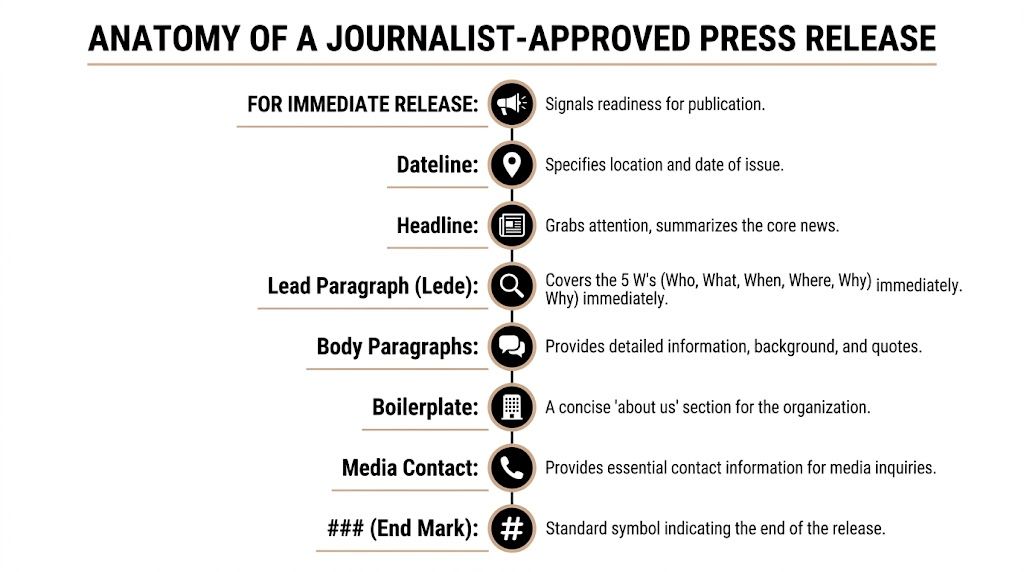
They either hide the news, over-polish the language, or ignore the standard structure journalists expect. That’s expensive because reporters gravitate toward copy they can work with immediately. According to Respona’s guide to press release format, the standard format includes nine core structural elements, and non-compliant releases can see up to 70% lower pickup rates, while releases matching AP Style achieve 3x more Tier-1 placements.
That sounds harsh, but it makes sense. Journalists are busy. If your release is hard to scan, they move on.
Start with the top matter
The opening cues tell the reader what this document is and how to treat it.
Include these elements near the top:
- FOR IMMEDIATE RELEASE: Use this when the news can be published right away
- Dateline: City and date of issue
- Headline: The clearest summary of the actual news
- Subheadline: Optional, but useful when the headline needs support
A weak headline says, “Company X Announces Exciting New Chapter.”
A usable headline says, “Company X Opens New Distribution Center in Austin.”
One is branding language. The other is information.
Write the lead like a reporter would
The lead paragraph does the heavy lifting. It should answer the core questions fast: who, what, when, where, and why it matters.
Many teams inadvertently undermine their efforts. They start with mission statements, founder passion, or a long setup. Journalists don’t need warm-up copy. They need the news.
Working test: If someone reads only the headline and first paragraph, they should still understand the announcement.
Keep the lead direct. Name the company, the action, the timing, and the significance. Don’t force suspense into a format designed for speed.
For a deeper walkthrough, Press Release Zen has a practical reference on the 8 key elements of a well-written press release.
Build the body in descending order of importance
After the lead, stack the information from most important to least important. That’s the inverted pyramid. It’s not fancy, but it works.
Use the next paragraphs for:
- Essential context such as market relevance, customer effect, or background
- A quote from an executive or relevant spokesperson
- Supporting details like timing, availability, partners, or event specifics
- Boilerplate describing the organization
- Media contact information
- ### to signal the end
This section should feel modular. A reporter should be able to trim from the bottom without losing the central point.
Quotes need to sound human
Most press release quotes are terrible. They’re packed with buzzwords and say nothing that wasn’t already obvious.
A strong quote adds one of three things:
- interpretation
- stakes
- intent
Bad quote: “We are thrilled to apply this advanced solution to deliver excellence.”
Better quote: “Customers told us setup took too long, so we rebuilt the onboarding flow to remove the biggest bottlenecks.”
That second version sounds like a person. It also gives the journalist something usable.
If you want another practical model, Natural Write published a helpful piece on how to write a press release that gets noticed, especially for turning flat announcements into readable copy.
A quick visual refresher helps here:
Don’t overlook the close
The boilerplate is your standard company description. Keep it short, factual, and reusable. Think of it as your permanent “about” paragraph for media use.
The media contact should include a real person or monitored inbox. If a journalist replies and gets silence, the opportunity dies quickly.
Then end with ###. It looks small, but it signals professionalism and clarity.
Here’s the underlying rule. Every part of the release should reduce friction. If a reporter can copy, verify, trim, and publish with minimal effort, your odds improve. If they have to rewrite half of it, you’ve already made the job harder than it needs to be.
Getting Your Press Release Seen and Measured
A strong release that nobody sees is just tidy documentation.
Distribution is where many teams either overspend blindly or underperform. They pay for reach without a targeting plan, or they send a mass email and call that PR. Neither approach is enough on its own.

Choose distribution based on the job
The right distribution method depends on the announcement.
A wire service like PR Newswire or Business Wire can help when you need broad visibility, formal syndication, or market-facing documentation. Public companies, larger brands, and regulated industries often lean this way.
Targeted outreach works better when the story needs context. That means a curated list of journalists, editors, newsletter writers, podcast hosts, and trade publications that cover your sector or region.
Your owned channels matter too. Publish the release in your newsroom or blog archive, share it with customers and partners, and equip the internal team with the link and approved summary.
In many campaigns, the strongest approach is a mix:
- Wire for broad availability
- Direct email for relevant media
- Website publication for search and reference
- Social amplification for visibility and clicks
Don’t treat SEO as an afterthought
Press releases can support SEO, but only if you write and publish them with intent.
That means using the language people search for, linking to relevant pages on your site, and giving the release enough context to stand on its own. Stuffing keywords into a headline won’t help. Writing a clear, specific release on a page that search engines can crawl often will.
Useful SEO habits include:
- Match search intent: Use product category terms, service names, and location details naturally
- Link with purpose: Send readers to product pages, event registration, reports, or newsroom resources
- Support with assets: Include images, logos, fact sheets, or downloadable materials where relevant
This is one place where process matters. If your team manages releases in-house, tools and guides from platforms such as Cision, Business Wire, and Press Release Zen can help standardize templates, structure, and distribution workflows without turning every announcement into a reinvention.
Measure what happened after the send
Most guidance falls apart because, as Pressbeat’s piece on press release best practices notes, most press release advice explains writing and distribution but doesn’t explain how to measure effectiveness or calculate ROI.
That gap matters because “we sent it” isn’t a result.
Track outcomes in layers:
| Measurement area | What to look for | Why it matters |
|---|---|---|
| Media response | Coverage, mentions, journalist replies, interview requests | Shows whether the story resonated with media |
| Website behavior | Referral traffic, time on page, clicks to target pages | Shows whether the release drove attention and interest |
| Business response | Demo requests, contact form fills, registrations, donations, inquiries | Connects communication to action |
| Reputation signals | Sentiment in replies, stakeholder feedback, follow-up questions | Helps assess message clarity and trust |
A practical measurement setup doesn’t need to be fancy. It does need consistency. Use campaign links. Create a tracking sheet. Note who you contacted, who responded, what got published, and what happened on-site afterward.
If you want a framework for that process, this guide on tracking and measuring the success of your press releases is a good starting point.
A press release is only “successful” if it changes something you can observe, such as coverage, traffic, leads, inquiries, or stakeholder understanding.
Inclusive distribution is part of the strategy
A lot of organizations send releases only to mainstream outlets and then wonder why the people they most need to reach never see the news.
That’s a mistake, especially for nonprofits, local service organizations, public-interest campaigns, and community-based businesses.
Inclusive distribution means asking better questions. Which community newsletters reach the audience? Which local radio producers, neighborhood publishers, bilingual outlets, trade groups, and hyperlocal creators cover this issue? Does the language fit the audience, or only the executive team?
Mainstream placement can be valuable. But if the people most affected by the announcement never receive it in a useful channel or voice, the distribution plan wasn’t complete.
Common Press Release Mistakes That Guarantee Silence
Silence usually isn’t random. Most ignored press releases share the same avoidable flaws.
They read like ads, hide the news, or go to the wrong people. In other words, the problem is rarely just “media doesn’t care.” More often, the release gave them no reason to care.
Mistake one: writing a sales brochure
Before: “We’re proud to offer a groundbreaking solution that transforms customer experience.”
After: “The company launched a same-day repair program for commercial clients in three service areas.”
Journalists cover news, not slogans. If the sentence could sit on a homepage hero banner, it probably doesn’t belong in your lead.
Mistake two: vague headlines
Before: “ABC Company Announces Major Milestone”
After: “ABC Company Expands Mental Health Program to Rural Counties”
The second version gives a reason to keep reading. The first version forces the reader to guess.
Mistake three: burying the lede
Some teams hide the actual announcement in paragraph four because they want a dramatic build. That approach works in storytelling. It fails in newsroom communication.
State the news first. Background comes later.
If your most important fact is buried, many readers won’t reach it.
Mistake four: using jargon nobody would say aloud
Watch for phrases like “leveraging synergies,” “industry-leading approach,” and “reimagining excellence.” They make the release sound inflated and untrustworthy.
Plain language travels better. It also survives editing better.
Mistake five: including a useless quote
A quote should add perspective, not repeat the headline with more adjectives.
If your spokesperson quote doesn’t explain why the news matters, what problem it solves, or what changes next, cut it and rewrite it.
Mistake six: sending to the wrong outlets
A national technology reporter probably won’t cover a neighborhood ribbon cutting. A local community editor may care a lot.
That targeting error gets worse when organizations rely only on mainstream media lists. The Reuters Institute notes that mainstream journalism often caters to wealthier audiences and can exclude underserved communities, which is why inclusive distribution needs intentional planning beyond standard wire services. The point is covered in this piece on community-first outlets serving marginalized audiences.
For nonprofits and community groups, that’s not a side issue. It changes whether the right people ever hear the news.
Mistake seven: attaching the wrong assets carelessly
Teams often add logos, headshots, or event photos without checking whether they’re allowed to use them, especially when assets came from freelancers, past campaigns, or AI workflows.
Before you distribute visual assets, it’s smart to review ownership and licensing. A practical primer on how to check image copyright can help you avoid creating a legal problem around an otherwise simple announcement.
The common thread in all these mistakes is friction. Bad releases make the reader work. Good releases remove work.
Your Press Release Questions Answered
Should I send the release in the email body or as an attachment?
Put the text in the email body whenever possible. That lets a journalist scan it fast on desktop or mobile.
You can also link to a webpage version and include downloadable assets separately. If you attach a file, use an editable format when the situation calls for it.
Should I use a PDF?
Usually, no as the primary format for outreach. PDFs are harder to copy from and slower to work with.
Use a PDF only when preserving layout matters for a specific supporting asset. The release itself should stay easy to read and paste.
What’s an embargo?
An embargo means you’re sharing the news before publication with the understanding that coverage won’t appear until a specified time.
Use embargoes carefully. They can help with complex announcements that need preparation time, but only when the timing is clear and the recipient agrees to it.
Do I need quotes in every press release?
Not always, but most releases benefit from at least one good quote.
The key word is good. If the quote doesn’t add meaning, skip the filler and tighten the release instead.
How long should a press release be?
Long enough to state the news clearly, provide needed context, and give a journalist what they need to act.
Shorter is usually better than padded. But too short can create follow-up questions you should’ve answered in the release.
Can I include images or video?
Yes, when they help tell the story. Product images, executive headshots, charts, event photos, and short videos can improve usefulness.
Just make sure the assets are relevant, labeled clearly, and easy to access.
When shouldn’t I issue a press release?
Don’t use one for every minor update. If the news has no broader relevance, a customer email, blog post, sales enablement note, or social post may be enough.
A press release works best when the news is public, meaningful, and likely to matter beyond your existing audience.
If you’re ready to move from guesswork to a repeatable process, Press Release Zen offers practical guidance, templates, and tutorials for planning, writing, distributing, and measuring press releases without turning the job into agency jargon.