Key Takeaways
- A strong AI prompt for a press release must include the company name, the announcement, the target audience, a named quote request, the desired tone, and a word count so the model can produce a publication-ready draft.
- Most drafts come out generic because the prompt is vague. Telling the AI to “write a press release about our launch” skips the facts, audience, and tone the model needs to write anything usable.
- The fix is a structured prompt that answers every question upfront, paired with distribution that actually puts the release in front of readers. AmpiFire handles the second half by turning one announcement into multiple content formats across hundreds of sites.
- A well-built prompt plus multi-format distribution changes the numbers. One AmpiFire case study generated 245 first-page Google placements for a single campaign, a reach no standalone wire service press release can match.
- AmpiFire’s AmpCast AI converts a single press release topic into 8 content formats and distributes them to 300+ high-authority platforms including Fox affiliates, Spotify, and YouTube.
How to Write an Effective AI Prompt for a Press Release
The fastest way to get a usable press release from an AI model is to write a prompt that names the company, the announcement, the target audience, the quote you want (with the speaker’s name and title), the tone, and the word count. Prompts built this way skip the back-and-forth revision loop and produce a draft a journalist can actually read. After the draft is written, AmpiFire’s AmpCast AI turns that single release into 8 content formats and distributes them across 300+ platforms so the announcement reaches more than a single wire.
Most businesses get weak output from AI because their prompts are too vague. Telling an AI to “write a press release about our product launch” produces a generic shell. Telling it to write a 500-word release for a specific audience, with a named quote, a defined tone, and a clear announcement detail, produces something a journalist can actually read and use.
The strategies and tips below break down exactly how to build prompts that work, how to refine the output, and why distribution deserves just as much attention as the writing.
Why Press Releases Don’t Work Anymore
Smart Businesses Are Moving Beyond Traditional PR
• The Problem: Press releases reach one audience through one channel, while your customers are everywhere online. Most get buried within days with poor ROI.
• The Solution: AmpiFire’s AmpCast creates 8 content formats (news articles, blog posts, interview podcasts, longer informational videos, reels/shorts, infographics, flipbooks/slideshows, and social posts) from a single topic and distributes them across 300+ high-authority sites, including Fox affiliates, Spotify, and YouTube.
What You’ll Learn on PR Zen:
✓ Why multi-channel content delivers 10x better results than press releases
✓ How to amplify your PR efforts across multiple platforms
✓ Real case studies of businesses dominating search, social, video, and podcasts
✓ Cost-effective alternative to expensive PR agencies
Ready to Replace Press Releases? Learn the AmpiFire Method →
What Makes a Good AI Prompt for Press Releases
A good AI prompt for a press release gives the model everything it needs to write without having to guess. The structure of your prompt determines the structure of your output.
The most effective prompts follow a clear formula. They begin by telling the AI what type of content to create (a press release), then provide the core facts of the announcement, and finally give instructions on tone, format, and audience.
Here is a reliable base prompt structure you can adapt:
“Write a press release for [Company Name] announcing [the news/event]. The target audience is [journalists/consumers/investors]. Include a headline, dateline, opening paragraph with the five Ws, one or two supporting paragraphs, a quote from [name and title], a boilerplate about the company, and a media contact section. The tone should be [formal/informative/enthusiastic]. Keep it under 500 words.”
This format works because it removes ambiguity. The AI knows the format, the voice, the length, and the content before it generates a single word.
Proven Strategies for Writing AI Press Release Prompts

Before writing your prompt, list the essential facts of your announcement. This includes the company name, the news being announced, the date, the location, who is involved, and why it matters to the audience. Feed all of this directly into the prompt instead of leaving the AI to fill in gaps. The more specific your facts, the more usable the draft.
Before writing your prompt, list out the essential facts of your announcement. This includes the company name, the news being announced, the date, the location, who is involved, and why it matters to the audience. Feed all of this directly into the prompt rather than leaving the AI to fill in gaps. The more specific your facts, the more usable the output.
Specify the Audience and Publication Goal
A press release aimed at trade journalists reads differently than one aimed at local news or consumer blogs. Tell the AI who will read this release and where you plan to send it. For example: “Write this for submission to technology industry publications” will produce more relevant language and framing than a generic instruction.
Include a Quote Request
Press releases almost always include a quote from a company spokesperson, founder, or executive. Tell the AI which quote to include and what point it should make.
For example: “Include a quote from the CEO expressing excitement about the product launch and its impact on small businesses.” This saves you the effort of writing the quote separately.
Ask for a Headline and Subheadline
Headlines are where most press releases succeed or fail. Add a specific instruction to generate multiple headline options.
For example: “Generate three headline options for this press release, with one focused on the business benefit and one written for search.” Having options lets you choose the strongest angle.
Request SEO-Friendly Language
If your press release will be published online, it needs to include keywords that people are actually searching for. Add a line to your prompt such as: “Incorporate the keyword [your keyword] naturally in the headline and first paragraph.” This helps the content perform better in search results even before any distribution strategy is applied.
Tips for Refining AI-Generated Press Release Drafts
AI output is a starting point, not a finished product. Once you have a draft, run through this checklist before publishing or distributing:
- Verify every fact in the release, including dates, names, titles, and statistics.
- Check that the headline accurately reflects the news, not a generic description.
- Read the opening paragraph aloud. If it takes more than two sentences to get to the point, tighten it.
- Confirm the quote sounds like a real person said it. Edit it if it sounds formal or robotic.
- Make sure the boilerplate accurately describes the company and includes a website URL.
- Remove any filler language the AI added that does not add meaning.

Why Press Release Distribution Matters as Much as the Writing
Even a perfectly written press release has limited reach if it reaches only a handful of wire services. Most press releases are indexed briefly and then buried. They typically reach only one channel (news wires), which means they miss audiences who spend time on video platforms, podcast apps, and social media.
This is where multi-format content distribution changes the equation. Distributing your announcement as a news article, a blog post, a short video, a podcast episode, and a social post means it reaches people across the platforms they already use. A case study from AmpiFire shows that a single campaign using this approach generated 245 first-page Google placements for a client, though this reflects results from one specific case, and outcomes will vary by business and market.
How AmpiFire Turns One Prompt Into Full-Scale Reach
A well-built AI prompt gives you a solid first draft, but a draft alone does not get your announcement read. The writing and the distribution matter equally, and skipping the second half leaves even the best release sitting on a single wire.
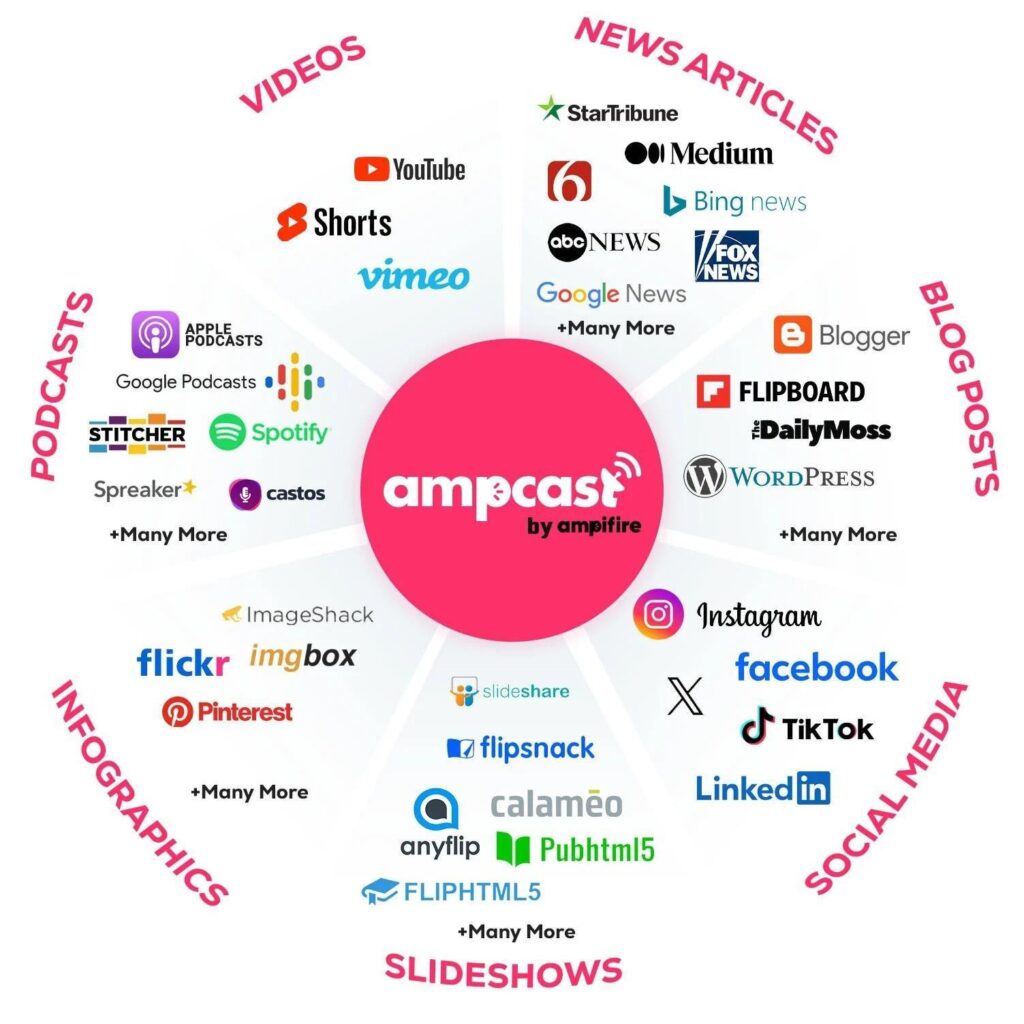
AmpiFire’s AmpCast AI takes a finished press release and rebuilds it as 8 content formats, including news articles, blog posts, interview podcasts, long-form and short-form videos, infographics, slideshows, and social posts. Each piece is distributed across 300+ high-authority platforms such as Fox affiliates, Spotify, Apple Podcasts, and YouTube, so your news reaches audiences that never touch a press wire.
Ready to Amplify Your Brand Reach? Try the AmpiFire Method →
Frequently Asked Questions (FAQs)
What is the ideal length for a press release written with AI?
Most press releases should run between 400 and 600 words. When prompting AI, specify this range upfront. A shorter release forces the AI to focus on what matters most, the core announcement, without padding it with unnecessary background information that editors will cut anyway.
Can AI write a press release headline that actually gets attention?
Yes, but you need to ask for it specifically. Prompt the AI to generate multiple headline options and specify that one should focus on the news angle and another on the reader benefit. Always review the options yourself before selecting one, since the best headline usually needs a small human edit to feel natural.
What information should I never leave out of an AI press release prompt?
Leave nothing to assumption. Always include the company name, the specific announcement, the date, the audience, a requested quote with the speaker’s name and title, the desired tone, and the target length. Missing any of these will produce a draft that needs heavy editing before it is usable.
How do I make sure an AI-written press release sounds like it came from my company?
After generating the draft, rewrite any section that uses generic corporate language. Adjust the quote to match how your team actually speaks. Swap out any phrasing the AI defaulted to that does not reflect your brand voice. Treat the AI output as a first draft that still needs your voice added.
How does AmpiFire help businesses that want to go further than a press release?
At AmpiFire, we build on your announcement by creating 8 types of content from a single topic and distributing them to over 300 high-authority platforms. This means your news reaches audiences across search, social media, YouTube, Spotify, and more, rather than sitting on a single news wire. Our service is available at multiple levels, from self-managed to fully done-for-you, making it accessible for businesses of any size.