A campaign has just wrapped. Coverage landed, the team posted wins in Slack, and someone exported a spreadsheet full of links, impressions, and social mentions. Then leadership asks the question that changes the tone of the room: what did PR do for the business?
That's the moment a public relations report stops being an admin task and becomes a leadership document. A weak report lists activity. A strong one explains movement, context, and business relevance. It shows what changed, why it mattered, and what the organization should do next.
That shift matters more now because PR is operating in a bigger, more scrutinized market. The global public relations market was valued at nearly $100.06 billion in 2024 and is projected to reach $132.51 billion by 2029, a sign that organizations increasingly see PR as a business-critical function rather than a reactive cost center, according to Sprout Social's PR market overview. That recognition raises the reporting standard. Leaders don't want clip books. They want evidence.
A useful model comes from adjacent measurement work. Teams trying to connect social activity to commercial outcomes often face the same reporting problem, and the framework in this Narrareach experiment to prove ROI is a helpful reminder that visibility metrics only become persuasive when tied to downstream outcomes. The same principle applies in PR.
For teams building campaign reporting from scratch, it also helps to anchor the work in a broader planning process instead of treating the report as an afterthought. A practical reference point is this guide to public relations campaigns, because good reporting starts long before the results slide is drafted.
Table of Contents
- What a PR Report Is and Why It Matters
- The Anatomy of a Powerful PR Report
- A Step-by-Step Workflow for Creating Your Report
- PR Report Templates and Annotated Examples
- Customizing Reports for Your Audience
- Common Questions About Public Relations Reporting
What a PR Report Is and Why It Matters
A public relations report has two jobs.
First, it's a report card. It shows whether the team did what it said it would do. Did the campaign secure relevant coverage, improve message visibility, support the launch, strengthen executive presence, or drive qualified attention from the right audiences?
Second, it's a GPS. It points to the next move. It tells leadership which messages traveled, which outlets mattered, which angles underperformed, and where the team should place its next bet.
That distinction is where many reports break down. Junior teams often treat the document like a storage bin for metrics. They paste in media hits, a chart from Google Analytics, a few screenshots from LinkedIn, and call it complete. Leadership sees activity, but not meaning.
A useful way to frame the document
The strongest reports answer three questions in order:
- What happened
- Why it mattered
- What should happen next
That sequence keeps the report from becoming a data dump. It also protects the team from overclaiming. PR rarely operates in isolation, so the report should show contribution, not pretend every business outcome came from earned media alone.
A public relations report earns credibility when it connects communications activity to business decisions, not when it tries to inflate every placement into revenue.
What separates a strong report from a weak one
A weak report usually does one or more of these things:
- Leads with volume: It opens with the number of clips before explaining whether any of those placements were strategically useful.
- Mixes goals: It treats awareness, lead generation, executive visibility, and crisis containment as if they should be measured the same way.
- Stops at outputs: It shows what the team produced, but not what audiences did next.
A strong report looks different.
| Report type | What it sounds like |
|---|---|
| Weak | “We secured broad media coverage across multiple outlets.” |
| Strong | “Coverage concentrated in outlets the target buyer already trusts, and the strongest stories carried the product positioning the sales team needed.” |
| Weak | “Engagement was positive.” |
| Strong | “Audience response aligned with the campaign's intended theme, but headline framing diluted the company's secondary message in several placements.” |
Why it matters internally
A public relations report also protects future budget. It gives finance, the CEO, and cross-functional partners a record of what PR contributes when it's working well. Just as important, it gives the team a disciplined way to show what didn't work.
That honesty is what turns reporting into strategy. If a campaign generated noise but missed the core audience, the report should say that plainly. If one spokesperson consistently produced better coverage than another, the report should show it. The point isn't to make every month look perfect. The point is to help the organization make better communication decisions.
The Anatomy of a Powerful PR Report
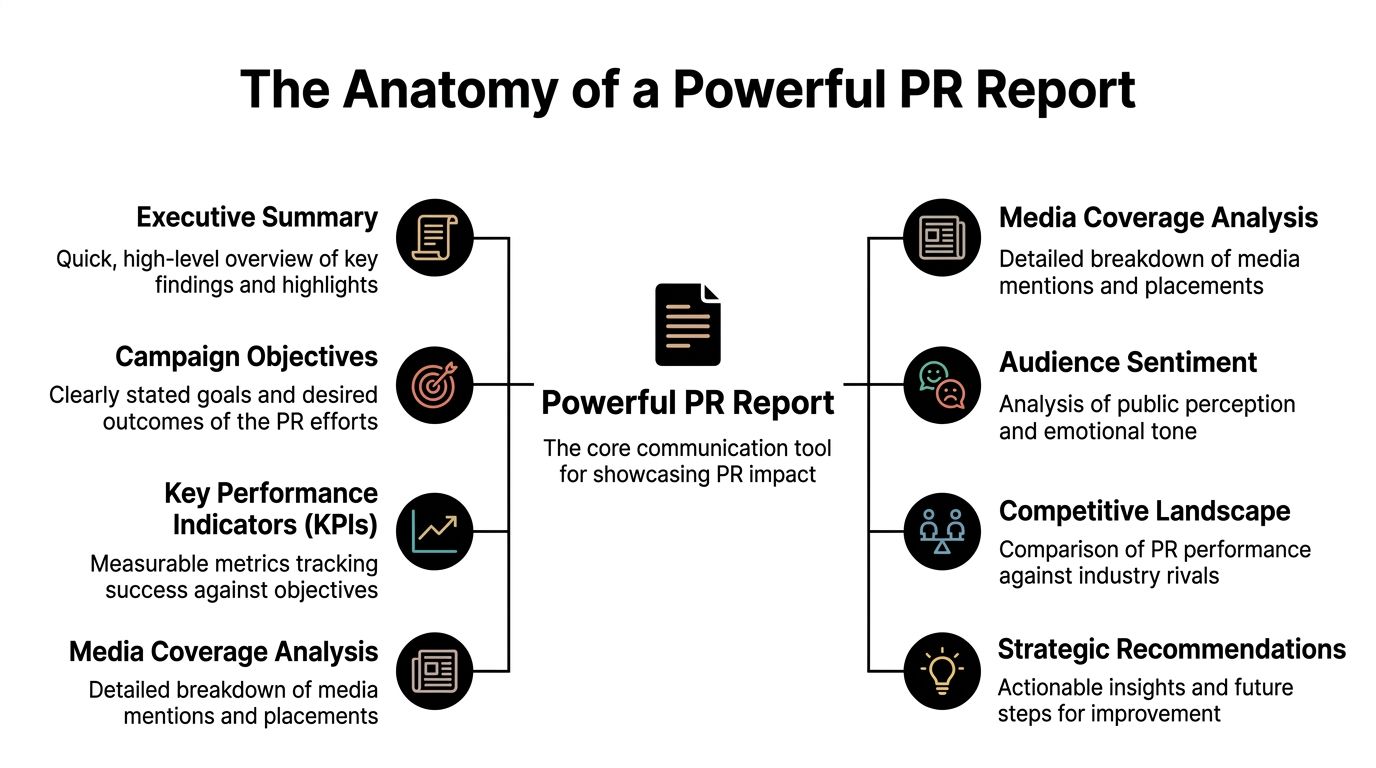
A persuasive public relations report has structure. Without it, even strong results look scattered.
Start with the business question
Every report should begin with a short executive summary. Not a history of the campaign. Not a timeline. A summary.
That opening should state the objective, the key result, the most important interpretation, and one recommendation. If an executive reads only that block, the value of the work should still be clear.
After that, the report needs a clean backbone:
- Objectives: What the campaign was meant to achieve.
- KPIs: The evidence used to evaluate progress.
- Coverage analysis: Where the brand appeared and how relevant those placements were.
- Message pull-through: Whether the intended themes showed up in coverage.
- Audience response: What the reaction suggested about perception and relevance.
- Recommendations: What to repeat, adjust, or stop.
Teams that need a sharper framework for selecting the right measures can borrow from this guide to press release KPIs and performance measurement, especially when the report needs to connect announcement performance to wider communications goals.
Pair numbers with judgment
Many reports either become useful or collapse into vanity metrics here.
A 2026 PR glossary defines qualitative evaluation as the non-numerical assessment of coverage that reveals the “why” and “how” behind performance. That matters because 78% of journalists say coverage must directly affect their audience's community, which means reports built on volume alone miss strategic value, as noted by Fullintel's glossary entry on qualitative evaluation.
That should change how the report is written.
Don't just show the number of placements. Show whether the placement reached an outlet that decision-makers trust. Don't just label sentiment as positive. Explain whether the story framed the company as forward-thinking, defensive, expensive, community-oriented, or category-leading. Don't just count mentions of a spokesperson. Note whether the spokesperson sounded authoritative, evasive, technical, or clear.
Practical rule: If a metric can rise while strategic value falls, it can't stand alone in the report.
A good qualitative layer usually includes these questions:
- Message accuracy: Did coverage reflect the message the team intended to land?
- Outlet credibility: Was the mention in a publication that matters to buyers, regulators, investors, recruits, or partners?
- Narrative framing: Did the article place the company in a favorable, neutral, or problematic storyline?
- Context quality: Was the company the focus, a passing mention, or one of many quoted sources?
Include digital and search value
PR reporting should also reflect what happened after coverage appeared.
That doesn't mean stuffing the report with every analytics screenshot available. It means tying earned media to digital behavior in a way that marketing and leadership can act on. Useful additions include referral traffic from coverage, backlinks from relevant publications, branded search movement, landing page behavior, and whether media placements improved the discoverability of priority topics.
This is also where the report can draw a clean line between PR and adjacent teams. Marketing may own conversion reporting. SEO may own technical ranking analysis. PR's role is to show how earned visibility supported those outcomes.
The best reports don't try to claim the whole customer journey. They document where PR clearly influenced it.
A Step-by-Step Workflow for Creating Your Report
A good reporting process removes panic from the end of the month. It also prevents the team from collecting the wrong data and trying to invent a story later.
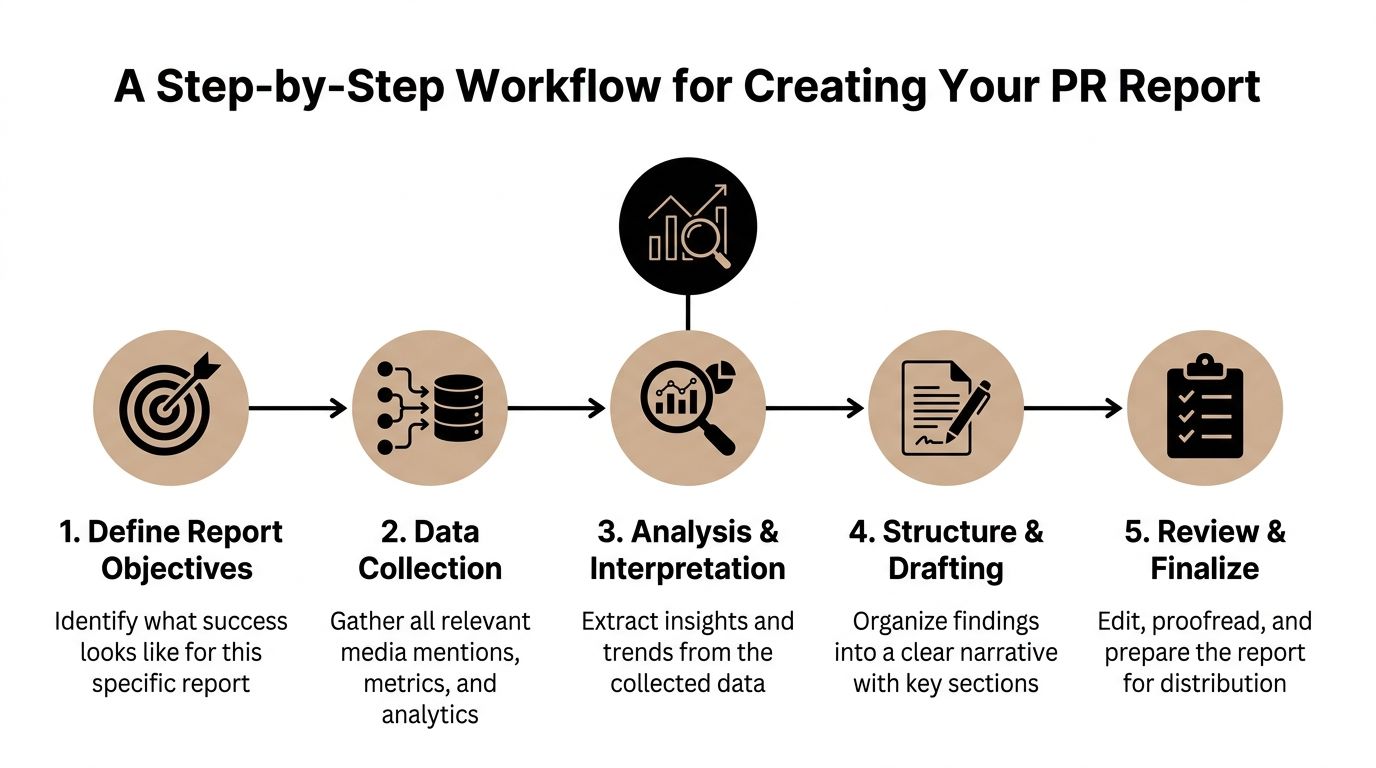
Step one through step three
Step one is defining the objective before the campaign launches.
If the team doesn't know what success looks like in advance, the report turns into retrospective guesswork. A launch report needs different proof than an executive thought leadership report. A crisis update needs different proof than a funding announcement.
Step two is setting the evidence sources.
That usually means pulling from media monitoring, web analytics, CRM notes, social listening, newsletter data, and sales feedback. Product names vary by team, but many PR groups rely on combinations such as Cision, Meltwater, Google Analytics, Looker Studio, HubSpot, and native platform analytics.
By 2025, 64% of PR professionals were actively using AI-powered writing tools for content creation and campaign analytics, reflecting a broader reliance on technology to speed up data gathering and analysis, according to PRLab's PR statistics roundup. AI can help summarize coverage, cluster themes, and draft first-pass insights. It shouldn't make judgment calls without review.
Step three is interpretation.
This is the hardest part because software can assemble data faster than it can be thoughtfully analyzed. The job here is to ask better questions:
- Did top-tier coverage carry the main message or bury it?
- Which outlet produced the strongest downstream response?
- Did the campaign attract the audience the business wanted?
- What objections or misunderstandings showed up in the way journalists framed the story?
The report gets stronger when the team spends less time decorating charts and more time writing two or three honest observations that explain what leadership should learn from them.
A practical operating model for recurring reporting is to maintain a live source sheet during the campaign, then shape the final narrative from that material. Teams that need a cleaner system can use a dedicated approach to public relations reporting so the month-end build doesn't start from zero.
Step four and step five
Step four is drafting for readability.
Most reports should move in a simple sequence:
- Executive summary
- Objectives and KPIs
- Results
- Qualitative analysis
- Recommendations
This order keeps the report strategic. It also helps different stakeholders stop where they need to stop. A CEO may read only the first page and the recommendation section. A marketing lead may spend time inside channel analysis and message pull-through.
Step five is review and final polish.
Before sending, the team should test every page against one standard: can a non-PR executive understand why this matters? If the answer is no, the report is still too internal.
A final review checklist helps:
| Check | What to confirm |
|---|---|
| Clarity | The summary states the result in plain language |
| Relevance | Every metric links back to an objective |
| Context | Qualitative notes explain what the numbers can't |
| Actionability | Recommendations are specific enough to guide next steps |
The workflow doesn't need to be elaborate. It needs to be repeatable.
PR Report Templates and Annotated Examples
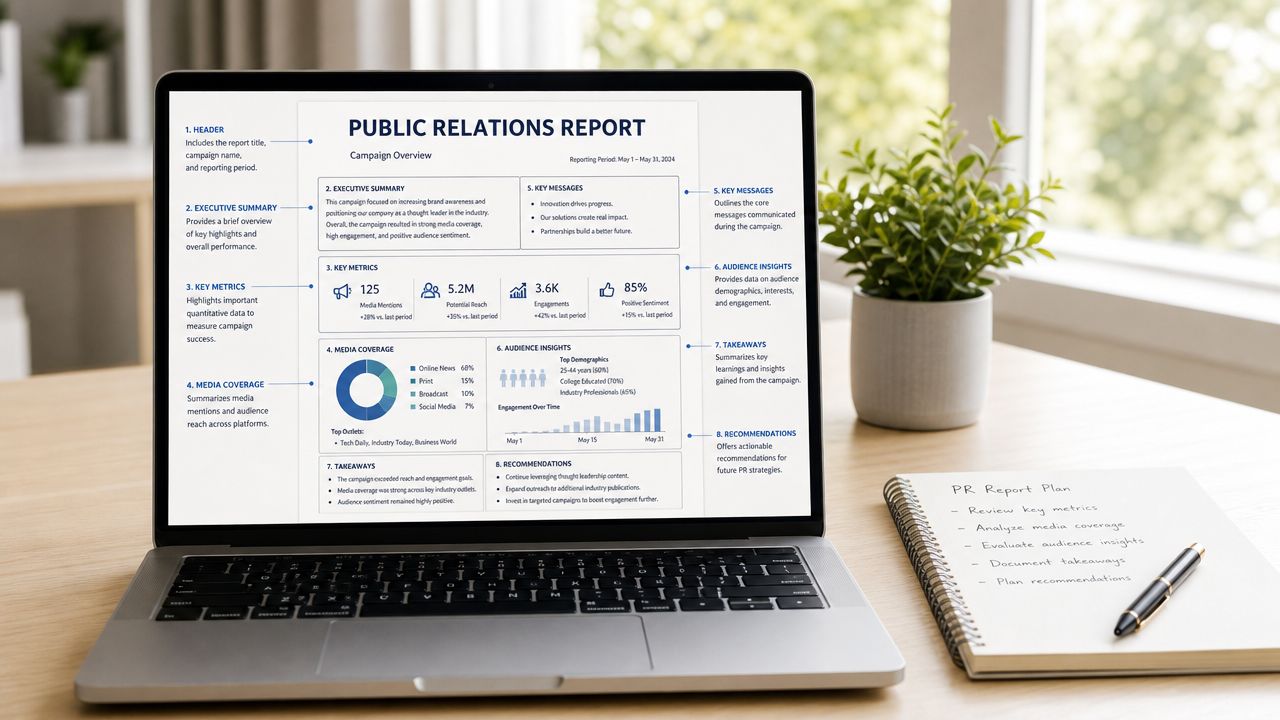
Templates matter because they reduce inconsistency. They also keep teams from reinventing the report every cycle.
Monthly dashboard template
A monthly public relations report should be short, readable, and stable from month to month. Leadership should be able to scan it in minutes.
Suggested outline
- Executive summary
- Top developments this month
- Coverage highlights
- Message pull-through
- Audience and digital signals
- Risks or watchouts
- Next month's focus
Annotated note: The executive summary shouldn't repeat every metric. It should name the single most important movement and why leadership should care.
Example summary language:
Coverage quality improved because the strongest placements aligned with the company's target narrative, even though overall volume was uneven. The clearest opportunity next month is tightening spokesperson language so secondary messages appear more consistently.
That wording does two things. It gives credit where it's deserved, and it signals the next action. It also avoids inflated claims.
A monthly report is especially useful when there are multiple ongoing workstreams, such as executive profiling, product PR, partner news, and reactive commentary. In that environment, the report should favor consistency over detail.
Campaign deep-dive template
An end-of-campaign report needs more room for interpretation. In it, the team should explain outcomes, not just archive evidence.
Suggested outline
- Campaign objective and audience
- Key announcements or storylines
- Coverage analysis by outlet type
- Narrative framing and sentiment
- Traffic and search support
- Cross-functional impact
- Lessons learned
- Strategic recommendations
Example commentary inside the qualitative section:
Several placements delivered visibility but framed the announcement as a routine update instead of a market shift. That reduced strategic distinction. The strongest stories were the ones tied to a specific customer problem rather than a product feature list.
Another useful note for campaign reports:
Recommendation language should sound like an operating decision, not a motivational slogan. “Continue building momentum” says nothing. “Lead the next pitch round with the customer consequence, not the feature release” tells the team exactly what to do.
A campaign report can also include a short appendix for media lists, raw links, and supporting screenshots. Keeping those materials in the back protects the main body from becoming cluttered.
Customizing Reports for Your Audience
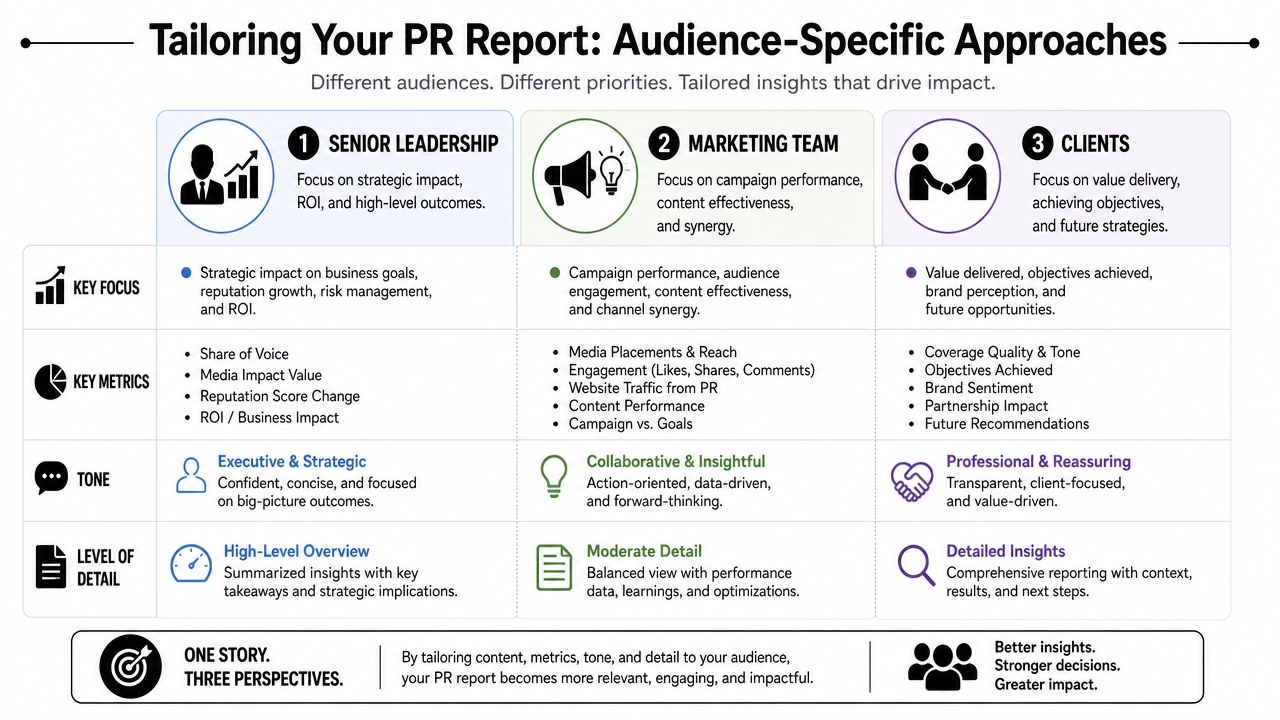
One report rarely works for everyone. The same campaign data needs different framing depending on who's reading it.
What the CEO needs
A CEO usually wants compression, not detail.
That audience needs a short read on business relevance: did PR strengthen positioning, reduce reputational risk, support a commercial priority, or create trust with a group that matters? The report for senior leadership should stay high level, minimize jargon, and focus on implications.
Useful emphasis areas include:
- Strategic visibility: Where the brand showed up in conversations that matter
- Narrative control: Whether the company's message held in public coverage
- Decision support: What leadership should approve, change, or watch
What the marketing team needs
A marketing leader often needs more granularity because they're coordinating channels, campaigns, and attribution models.
That version of the public relations report can go deeper into message resonance, article-level traffic, topic alignment, landing page behavior, and how earned media supported content, paid, email, or social activity. This is also the audience most likely to benefit from a cleaner operational setup, especially if reporting currently lives across too many tabs and exports. For teams trying to avoid spreadsheet chaos in reporting, the broader lesson is simple: centralize inputs, standardize views, and separate raw data from executive-ready interpretation.
One set of results, two different stories
The underlying facts may be identical. The story changes with the audience.
| Same result | CEO framing | Marketing framing |
|---|---|---|
| Strong trade coverage | “The brand gained visibility in the outlets that shape category perception.” | “Trade placements carried the core product message more consistently than broad business press.” |
| Mixed social response | “Attention was high, but the message needs sharper discipline.” | “Posts tied to customer pain points generated stronger conversation than feature-led posts.” |
| Referral traffic from earned media | “PR supported measurable movement beyond awareness.” | “Specific articles drove qualified visits that can inform future outlet targeting and content briefs.” |
This isn't spin. It's translation.
A strong PR lead doesn't send the same deck to every stakeholder and hope each one finds what matters. The report should be built for the decision each audience needs to make next.
Common Questions About Public Relations Reporting
A public relations report gets easier once the team establishes rules for cadence, tools, and special cases.
How often should a public relations report go out
The right frequency depends on the pace of the work.
For active campaigns, a short weekly snapshot can help internal alignment. For most in-house teams, a monthly report is the practical default because it gives enough time for patterns to appear without letting reporting drift. Quarterly reporting works best for leadership reviews, budget discussions, and broader strategic resets.
The key is consistency. A report sent irregularly often turns into a defense document instead of a management tool.
What tools belong in the workflow
No single platform covers everything well. Teams typically need a stack.
Media monitoring tools help gather coverage and mentions. Web analytics tools show downstream behavior. CRM systems help connect PR activity to pipeline context. Presentation tools make the output readable. AI tools can speed up drafting and categorization, but human review still matters most in interpretation, especially for framing, message accuracy, and strategic recommendations.
Choose tools based on the questions the report needs to answer, not on how impressive the dashboard looks in a demo.
How should crisis reporting change
Crisis reporting should measure control, clarity, and trust, not just attention.
A crisis public relations report usually needs different evidence than a campaign recap. The team should document timeline discipline, message consistency, stakeholder response, media framing, and whether updates reduced confusion over time. Qualitative notes matter even more here because high visibility alone may signal reputational pressure rather than success.
In those moments, a report should also separate confirmed facts from unresolved issues. Leadership needs a record that is accurate, sober, and usable for post-incident review.
The broader principle stays the same in every scenario. A good public relations report doesn't ask leadership to admire activity. It helps them understand impact and make a better next decision.
Press Release Zen helps teams turn messy announcement workflows into clear, effective communications. For practical guides, templates, and examples that support stronger releases and sharper reporting, visit Press Release Zen.