Your team has news. Maybe it’s a launch, a funding milestone, a new hire, a partnership, a community initiative, or a response to a difficult moment. The problem usually isn’t the news itself. The problem is that the announcement exists in isolation.
Someone drafts a few talking points. Someone else posts on LinkedIn. A release gets written late. Outreach starts without a clear angle. Then everyone wonders why nothing moved.
That’s where most first-time public relations campaigns break down. They treat distribution as the strategy. It isn’t. A campaign is the system around the announcement: the message, the timing, the target list, the supporting content, the follow-up, and the measurement. The press release sits in the middle of that system because it gives the whole effort one factual, reusable source of truth.
What Are Public Relations Campaigns and Why They Matter
Public relations campaigns are coordinated efforts to shape how people understand a company, issue, event, or organization over a defined period. They aren’t random bursts of publicity. They turn a piece of news into a narrative people can find, understand, and repeat.
That matters because most organizations don’t suffer from a lack of things to say. They suffer from saying them without structure.
A business might have a strong announcement and still get no traction because the story wasn’t framed for the right audience, the outreach started too late, or the message changed depending on who wrote the email. Public relations campaigns solve that by forcing discipline. They connect a business goal to a communications plan.
What a campaign does that a single announcement can’t
A single post or one-off pitch can create a short spike of attention. A campaign gives you:
- Direction: Everyone knows the goal, whether that’s awareness, trust, credibility, stakeholder reassurance, or market positioning.
- Consistency: The release, pitch email, spokesperson notes, social copy, and landing page all reinforce the same core message.
- Control: You can’t control coverage, but you can control the facts, framing, assets, and timing.
- Measurement: You can review what landed, what missed, and what to improve next time.
That difference is becoming more important as PR becomes more advanced. The global public relations market is projected to grow from $100.06 billion in 2024 to over $133 billion by 2027, with some forecasts predicting nearly $215 billion by 2030, driven by digital media and data-driven strategy, according to Ranko Media’s PR statistics roundup.
If you’re still treating PR as “send a release and hope,” you’re operating below the level the market now expects.
Why trust is the real outcome
Most clients initially ask for exposure. What they usually need is credibility. That’s why examples of earned media that builds trust are more useful than generic publicity advice. Earned coverage works when it signals relevance, not just reach.
Publicity without a clear business purpose creates noise. Publicity tied to a message, audience, and outcome creates momentum.
If you need a clean baseline before building a campaign, this explanation of what PR stands for in business is useful because it separates publicity tactics from the broader role of reputation and communication.
The Anatomy of a Modern PR Campaign
A modern campaign has three parts you can’t skip: objectives, audience, and message. If one of them is weak, the rest of the work gets expensive fast.
Treat it like a blueprint. Before anyone pours concrete, they need to know what they’re building, who it’s for, and how it should function.

Objectives come first
A campaign without a defined objective usually turns into a vague request for “coverage.” That’s not an objective. It’s an activity.
A stronger campaign goal sounds more like this:
- Brand introduction: You need the market to understand who you are and why you matter.
- Launch support: You’re introducing a product, service, office, initiative, or partnership.
- Reputation repair: You need to address concern, confusion, or criticism.
- Thought leadership: You want to position a founder or executive as a reliable source.
- Stakeholder reassurance: You need customers, investors, staff, or the public to hear a stable, factual message.
These goals can overlap, but one has to lead. Otherwise the campaign starts pulling in different directions.
Audience has to be more precise than demographics
“Small business owners” is too broad. “Local business owners in a regulated industry who care about compliance and cost control” is more useful. So is “parents in one region who need practical information and already trust community organizations more than institutions.”
Audience work in public relations campaigns should answer questions like:
- What does this group already believe?
- What would make them care now?
- Which messengers do they trust?
- What language will they reject?
- Where do they encounter information?
That last point gets missed often. Teams choose channels based on habit instead of audience behavior.
Practical rule: If you can’t describe what the audience is worried about before your announcement, your messaging is probably still too company-centered.
Message is the structure that holds everything together
Messaging isn’t a slogan. It’s the set of claims you can support consistently across every asset.
At minimum, a campaign needs:
- One core message that expresses the main point in plain language.
- Three supporting points that add proof, context, or relevance.
- A clear audience benefit that answers “Why should I care?”
- A factual backbone so your release, spokesperson, and outreach all match.
Here’s where teams often stumble. They write for themselves. They lead with internal pride, technical detail, or corporate phrasing. Journalists and audiences don’t care that the company is excited. They care whether the news changes something, solves something, or signals something important.
A simple campaign blueprint
| Campaign part | Key question | What good looks like |
|---|---|---|
| Objective | What are we trying to change? | One primary outcome, clearly named |
| Audience | Who needs to think differently after this? | A defined group with known concerns and media habits |
| Message | What do we want them to remember? | One clear idea, repeated consistently |
When these three are solid, everything downstream gets easier. The press release writes faster. Media lists get tighter. Spokespeople stay aligned. Follow-up becomes more focused instead of more frantic.
Planning Your Campaign From Start to Finish
Planning keeps a PR campaign from becoming a chain of rushed tasks. Good planning doesn’t make the campaign rigid. It makes it usable under pressure.
The easiest way to plan is to treat the campaign like a project with milestones, owners, assets, and review points.
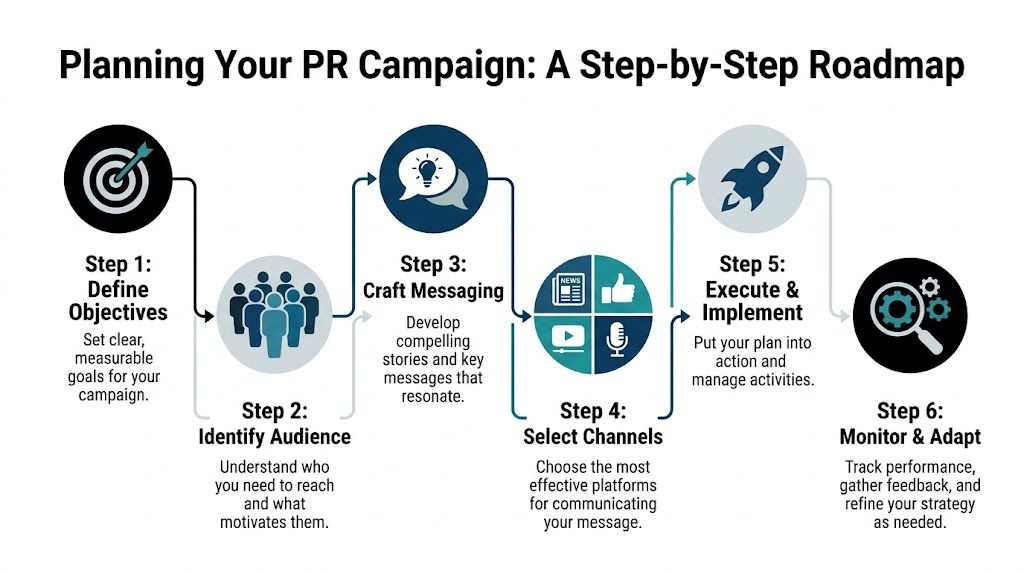
For a broader planning framework you can compare against your own workflow, this guide to public relations plans is a useful companion.
Start with a campaign brief
Before anyone writes a press release, build a brief. Keep it short enough that people will read it and specific enough that they can act on it.
Include:
- Business context: What’s happening in the business or market that makes this campaign necessary now?
- Primary objective: Pick the single outcome that matters most.
- Target audiences: Name the main audience first, then secondary groups.
- Core message: Write the central claim in one plain sentence.
- Proof points: Add supporting facts, quotes, examples, and approved claims.
- Constraints: Legal review, embargoes, partnership approvals, spokesperson availability, timing limits.
A one-page brief prevents weeks of confusion.
Build the message before the materials
A lot of junior teams do this backward. They draft a release, social posts, and pitch emails before locking the message. Then every revision becomes painful.
Create a simple messaging matrix first.
A practical messaging matrix
| Audience | What they care about | Main angle | Proof or support |
|---|---|---|---|
| Journalists | Why this matters now | Timely, relevant news hook | Release, data, spokesperson |
| Customers | What changes for them | Clear benefit or reassurance | FAQ, website page, email |
| Partners | Why this is credible | Business value and alignment | Statement, direct outreach |
| Internal team | What to say consistently | Approved summary and talking points | Internal memo or briefing |
This step saves time because it reveals where your story is thin. If an audience angle doesn’t have proof behind it, fix that before launch.
Set a realistic timeline
Campaigns slip when nobody defines approval dates. Public relations campaigns involve dependencies. Legal may need to sign off. A partner may need to approve their quote. An executive may rewrite messaging late. If you don’t account for those realities, the launch date becomes fiction.
A usable PR timeline usually includes:
- Strategy approval
- Press release draft
- Internal review
- Media list build
- Asset preparation
- Distribution and outreach
- Follow-up
- Measurement review
Don’t just assign dates. Assign owners.
A campaign calendar should show who owes what by when. If it only shows launch day, it isn’t a real plan.
Budget for the parts people forget
PR budgets don’t fail only on distribution cost. They fail because teams ignore the surrounding work.
Common budget lines include:
- Writing and editing: Release, pitches, bylines, statements, FAQs
- Distribution: Wire services, direct pitching tools, monitoring platforms
- Creative support: Graphics, media kits, executive headshots, landing pages
- Spokesperson prep: Talking points, interview prep, internal briefing
- Measurement tools: Tracking links, reporting dashboards, monitoring subscriptions
Even when the budget is small, be honest about the labor. Time is a cost, whether or not it appears on an invoice.
Prepare for launch day before launch day
The strongest campaigns look calm from the outside because the team prepped for friction.
Run a launch checklist:
- Confirm the final release version
- Check links and attachments
- Verify spokesperson availability
- Approve quote language
- Segment the media list
- Prepare follow-up emails
- Set up tracking URLs
- Create a response protocol for inbound interest
That last item matters. If a journalist replies, somebody has to answer quickly with the right materials. Delays kill momentum.
Plan for adaptation, not perfection
No campaign goes exactly as expected. Sometimes a stronger angle emerges from early responses. Sometimes one publication bites while another ignores the story. Sometimes the social conversation highlights a concern you didn’t anticipate.
Planning should make those adjustments easier. If your team knows the objective, audience, and approved message, you can change tactics without losing control.
The Press Release as Your Campaign Anchor
In many public relations campaigns, the press release is the only asset every stakeholder touches in some form. Journalists use it to verify facts. Executives pull language from it. marketers adapt it into posts and emails. Sales teams borrow talking points from it. Customers may read it directly if it ranks in search or appears in a newsroom.
That’s why the release shouldn’t be treated as a formality. It’s the campaign anchor.
Why the release carries more weight than people think
When outreach underperforms, teams often blame the media list or the timing. Sometimes that’s true. Often the bigger problem is that the release itself doesn’t do enough work.
The environment is crowded. Staff editors receive an average of 53 pitches per day, the average journalist response rate to a PR pitch is 3.43%, and only about 8% of pitches result in media coverage, according to PRLab’s public relations statistics.
Those numbers should change how you write. Your release can’t just announce. It has to frame significance quickly and cleanly.
If you need a basic reference point for the format itself, this explainer on what is a press release covers the standard structure.
What an effective release must do
A campaign release needs four jobs done well.
Lead with the actual news
The headline and first paragraph should make the news obvious. Don’t hide it behind branding language or scene-setting. Journalists are scanning fast. If the release makes them search for the point, they move on.
Weak lead:
A company is proud to announce an exciting milestone in its ongoing commitment to innovation.
Stronger lead:
The company launched a new service, opened a new market, appointed a new executive, or responded to a specific event.
Specificity wins.
Show why this matters now
Timeliness is where many first drafts collapse. Ask:
- Why is this relevant this week?
- What changed in the market, organization, or community?
- Why would an editor assign this now instead of later?
If there’s no urgency, don’t fake one. Find a sharper angle or narrow the audience.
Give journalists usable material
A release should reduce work for the reporter. Include what they need to move quickly:
- Clear facts
- Approved names and titles
- A quote that adds perspective, not fluff
- Context on the company or issue
- Links to supporting assets or contact information
A bloated quote is one of the easiest ways to weaken a release. If the executive quote says nothing beyond “we are thrilled,” cut it.
The best quote in a press release sounds like something a real person could say in an interview without embarrassment.
Use the release across the whole campaign
A release becomes more valuable when you stop treating it as a single-send document.
Repurpose it into:
- Pitch emails: Pull one audience-specific angle instead of pasting the full release.
- Spokesperson briefs: Turn the key points into interview language.
- Website updates: Publish a newsroom version and link supporting pages.
- Social posts: Extract the sharpest lines for different platforms.
- Customer communication: Adapt the main message for email or account outreach.
The release acts as an anchor, keeping every other asset from drifting into a different story.
What doesn’t work
A few habits consistently hurt campaign performance:
| Problem | Why it hurts |
|---|---|
| Writing for internal approval only | The release becomes safe but uninteresting |
| Leading with company pride | The audience still doesn’t know why it matters |
| Overloading the quote | Journalists can’t extract a useful angle |
| Sending the same pitch to everyone | The release may be solid, but the outreach feels irrelevant |
Good public relations campaigns don’t ask the release to do everything. They do ask it to hold the campaign together. That’s a much more important job.
Selecting Your PR Tactics and Channels
Once the release is solid, the next question is where the campaign should live. That answer shouldn’t be “everywhere.” A scattered campaign burns time and muddies the message.
Choose tactics based on the objective, the audience, and the kind of proof the market expects from you.
Different tactics solve different problems
Media relations is useful when outside validation matters. Social media helps reinforce and extend the message. Speaking opportunities can deepen authority when the topic is complex. Awards can support positioning, but they rarely create momentum on their own. Influencer collaboration can work when trust sits with creators rather than institutions.
A practical channel mix often looks something like this:
- Press release distribution: Best when you need a factual public record and a reusable story asset.
- Direct media outreach: Best for targeted relevance, especially when the angle fits a specific beat.
- Owned content: Blog posts, founder articles, newsroom pages, and FAQs help you control detail and context.
- Social amplification: Useful for reach, repetition, and stakeholder visibility.
- Speaking and events: Strong when your goal is credibility in a niche space.
- Awards and nominations: Better for reputation support than immediate campaign lift.
- Influencer or creator outreach: Useful when your audience follows personalities more closely than publications.
PR tactic comparison
| Tactic | Primary Goal | Resource Investment (Time/Cost) | Typical Time to Impact |
|---|---|---|---|
| Press release | Establish official narrative and factual record | Moderate writing effort, variable distribution cost | Short to medium |
| Direct media pitching | Earn coverage in relevant outlets | High time investment, lower direct cost if done in-house | Short to medium |
| Thought leadership article | Build authority | High drafting and approval effort | Medium |
| Social media campaign | Reinforce message and engage community | Moderate ongoing effort | Short |
| Speaking engagement | Deepen credibility | High preparation effort | Medium to long |
| Award submission | Third-party validation | Moderate time, possible entry fees | Long |
| Influencer collaboration | Reach niche or trust-based audiences | Variable cost and coordination effort | Short to medium |
| Case study or customer story | Add proof and business relevance | Moderate interview and approval effort | Medium |
Match the tactic to the moment
A few trade-offs come up often.
If the announcement is sensitive, direct outreach may outperform broad distribution because you can control context more tightly. If the message needs search visibility and long shelf life, a release plus owned content usually works better than social-only promotion. If the brand is unknown, pairing media outreach with founder commentary often gives journalists a stronger reason to care.
One option in the workflow mix is Press Release Zen, which provides templates and guidance for writing and distributing press releases. That’s useful when the team needs help standardizing release structure before layering on outreach, social, and follow-up tactics.
Build an integrated mix, not a pile of activities
A good channel plan answers one question for every tactic: what job is this doing?
Use a simple filter:
- Does this channel reach the audience we need?
- Does it support the central message, or create a second story?
- Can the team execute it well enough to protect quality?
- Will it create evidence we can measure later?
More tactics don’t make a campaign stronger. Better alignment does.
If a tactic doesn’t support the objective clearly, cut it. Public relations campaigns usually improve when teams do fewer things with more discipline.
Measuring What Matters in Your Campaign
Measurement is where PR teams either build trust internally or lose it. If the campaign report only says “we got attention,” the next budget conversation gets harder.
Start with one rule: separate outputs from outcomes. Outputs are what you produced or secured. Outcomes are what changed because of that activity.

What to track first
Useful PR measurement usually starts with a short set of business-relevant signals.
Outputs
These show execution and media activity:
- Published coverage: Which outlets ran the story
- Message pull-through: Whether the coverage reflected the intended angle
- Journalist responses: Which pitches generated interest
- Referral traffic: Whether readers clicked through from coverage
- Spokesperson opportunities: Interviews, comments, contributed quotes
Outcomes
These connect PR work to business movement:
- Improved perception among the target audience
- Increased qualified interest from the right market
- Stronger partner or stakeholder confidence
- Better search visibility around the announcement
- A measurable lift in site activity from earned coverage
If you need a practical finance-side refresher before building your reporting model, this guide on how to calculate marketing ROI can help frame the conversation with stakeholders who want a clearer return discussion.
Why Share of Voice matters
One of the more useful competitive metrics in public relations campaigns is Share of Voice, or SOV. It measures your brand’s media presence relative to competitors.
That matters because coverage volume alone can mislead. Ten mentions in weak placements may matter less than fewer mentions in the outlets that shape category perception.
A benchmark cited by Prowly’s guide to measuring PR campaigns showed that a tech firm reaching 35% SOV in Google News produced a 22% lift in website referral traffic from earned media. That’s a practical example of visibility connecting to a business result.
A simple reporting structure
| Metric type | Question it answers | Why it matters |
|---|---|---|
| Coverage quality | Did the right outlets cover us? | Relevance beats raw count |
| Message pull-through | Did coverage reflect our intended narrative? | Shows if the story landed accurately |
| Referral traffic | Did earned media drive visits? | Connects attention to action |
| Share of Voice | Did we gain ground against competitors? | Adds market context |
| Lead or inquiry quality | Did the campaign attract the right people? | Protects against vanity reporting |
A strong report also includes interpretation. Don’t just list coverage. Explain what it means. Which angle worked? Which publications responded? Which messages got ignored? Which outreach segments underperformed?
Here’s a useful overview of the measurement mindset in action:
What to avoid in PR reporting
The common trap is overreporting broad visibility and underreporting meaningful movement.
Watch for these issues:
- Counting everything equally: A minor mention isn’t the same as a feature that carries your key message.
- Ignoring traffic behavior: Coverage matters more when it sends engaged visitors.
- Skipping competitive context: Your campaign may have performed well in isolation but poorly within the market conversation.
- Reporting too late: If you wait until the campaign is over, you lose the chance to adjust while momentum still exists.
If the metric can’t help you make a better next decision, it probably doesn’t belong at the center of the report.
Common PR Campaign Pitfalls to Avoid
Most weak campaigns don’t fail because the team didn’t work hard enough. They fail because the strategy was fuzzy and the execution kept papering over that problem.

The predictable mistakes
Some problems show up again and again.
- Vague objectives: If the team can’t define success, every tactic seems equally justified and none of them get evaluated properly.
- Weak audience targeting: Broad targeting creates bland messaging. Bland messaging gets ignored.
- Inconsistent language: If the release says one thing, the spokesperson says another, and social says a third, trust drops.
- Late measurement planning: Teams launch first, then scramble to decide what success means after the fact.
These aren’t small errors. They affect everything from story angle to internal confidence.
The overlooked mistake
One of the most damaging assumptions in public relations campaigns is that a message that works for one audience will work for all audiences.
That’s especially risky when the campaign touches underserved communities. A 2023 study highlighted in the University of Washington capstone on connection, communication, and culture found that strength-based messaging on Facebook and WhatsApp increased engagement with Latino immigrant communities, while generic one-size-fits-all messaging missed the mark.
That has a direct campaign lesson. Tailoring isn’t cosmetic. It changes whether people trust the message at all.
What culturally flat campaigns get wrong
They usually fail in one of three ways:
| Pitfall | Result |
|---|---|
| Using generic language for every community | The message sounds distant or uninformed |
| Choosing channels based on internal preference | The audience never sees the message in the right place |
| Framing people around deficits or problems only | Trust drops and engagement weakens |
If your campaign serves multiple communities, build adaptation into the plan early. Review channel choice, imagery, examples, spokesperson fit, and tone. Don’t bolt that work on after launch.
A campaign can be accurate and still miss the audience if it doesn’t respect how that audience receives information.
Avoiding the slide into reactive PR
The fastest way to lose control is to launch without a response plan. If criticism appears, if a journalist asks a harder question than expected, or if a partner wants changes, the team needs approved language and clear owners.
Public relations campaigns work best when they’re prepared for friction, not surprised by it.
Frequently Asked Questions about PR Campaigns
How much should a PR campaign budget be?
There isn’t one standard budget because campaign cost depends on scope, timeline, internal capacity, creative needs, and whether you use outside support. A focused local or niche campaign can be lean if the message is tight and the outreach list is disciplined. A broader campaign with executive prep, design assets, monitoring, and distribution will cost more.
Start by listing required work, not by guessing a headline number.
How do small teams measure ROI if sales cycles are long?
Use intermediate outcomes. Track coverage quality, referral traffic, inbound inquiries, message pull-through, stakeholder responses, and assisted conversions where possible. Long sales cycles make attribution harder, which is one reason 70% of small PR teams struggle with measurement, according to the Journal of Public Relations Education research summary linked here: small PR teams and ROI measurement.
That same source notes that niche outreach can outperform broader outreach. In the auto repair sector, local media hit rates can reach 40%, with 3x higher conversion than broader national outreach. The lesson is practical. Tight relevance often beats broad visibility.
What’s the difference between a PR campaign and a marketing campaign?
A marketing campaign usually focuses on demand generation, customer acquisition, or revenue-related outcomes across paid, owned, and earned channels. A PR campaign focuses more directly on reputation, narrative, trust, and stakeholder perception, though it can still support leads and sales.
In practice, the two often overlap. The clearest dividing line is the primary job. If the effort is centered on shaping public understanding and earning third-party credibility, it’s PR-led.
How long should a PR campaign run?
Long enough to support the objective and short enough to stay coherent. Some campaigns are built around a single announcement window. Others run in phases, especially when a launch needs follow-up commentary, customer proof, or executive visibility.
A fixed calendar matters less than having clear milestones, assets, and review points.
If you're building a campaign and need practical help with the release at the center of it, Press Release Zen is a useful resource for templates, how-to guides, and scenario-specific press release support that helps teams move from announcement ideas to structured execution.