The celebrity endorsement market reached $61.2 billion in 2024 and is projected to reach $74.5 billion by 2027 (source). That scale changes the conversation immediately. Public relations for celebrities is not a vanity layer on top of fame, it is a commercial system that shapes awareness, trust, and buying intent across every platform a public figure touches.
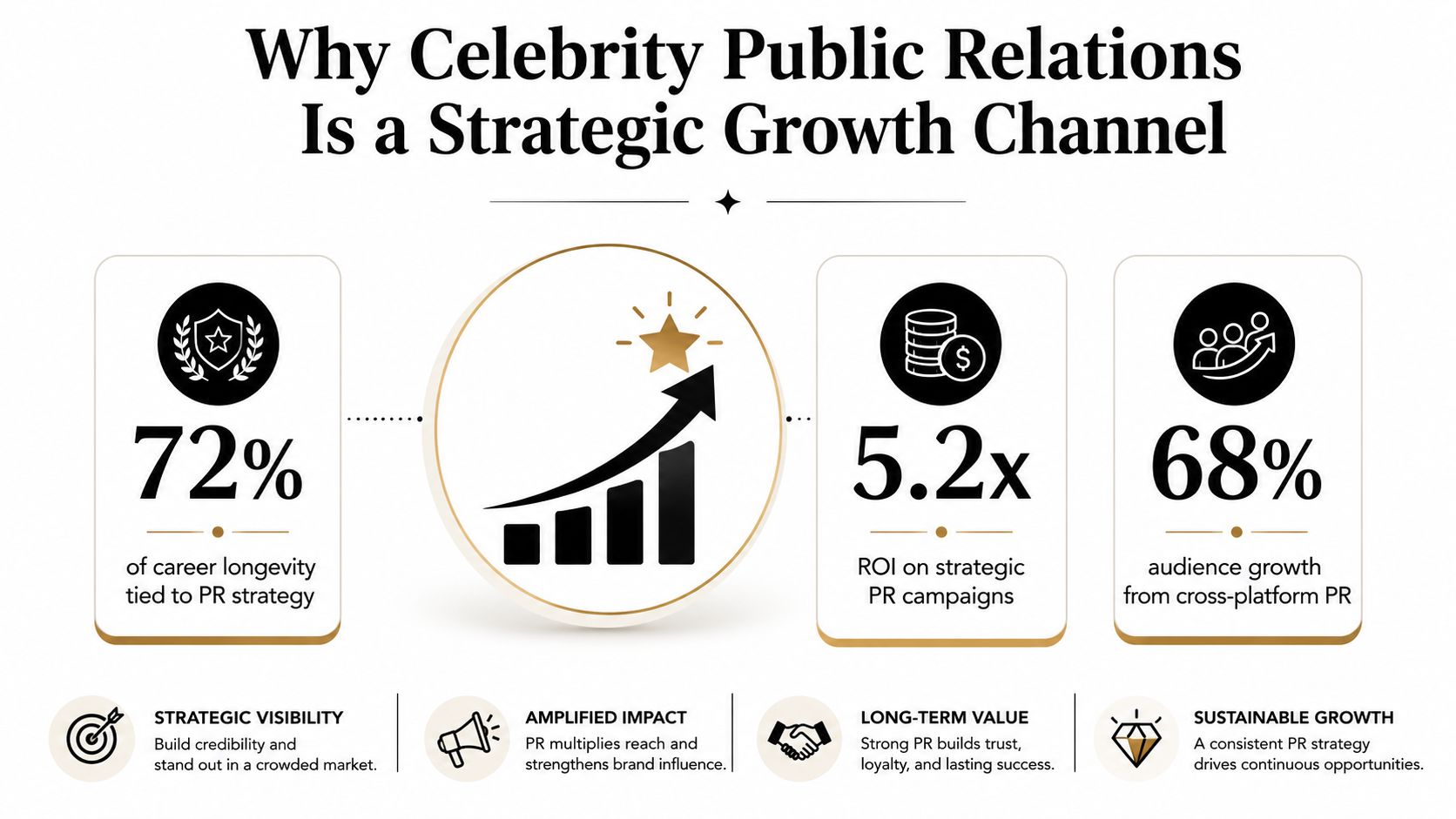
The work sits at the intersection of reputation and revenue. Brands invest because celebrity-driven advertising is reported to account for 18% of total global ad spending in 2025, and 42% of global consumers are said to be more likely to buy from a brand endorsed by a celebrity they follow (source). The average ROI of celebrity marketing campaigns globally is reported as 4.6x (source), which explains why the best teams treat PR as operating infrastructure, not a press-release reflex.
Table of Contents
- Why Celebrity Public Relations Is a Strategic Growth Channel
- Building a Personal Brand Strategy That Holds Up Across Channels
- Orchestrating Media Relations and Cross-Platform Momentum
- Crafting and Distributing Celebrity Press Releases That Get Picked Up
- Crisis Response and Reputation Recovery Workflow
- Coordinating Agents Managers and PR Teams Without Overlap
- Measuring PR Impact Beyond Media Mentions
Why Celebrity Public Relations Is a Strategic Growth Channel
Celebrity publicity works best when it is run like a growth channel with rules, sequencing, and risk controls. In India, the celebrity endorsement market was valued at $1.2 billion in 2023, while the broader celebrity management industry was estimated at $300 million to $400 million in 2023 and projected to reach $700 million by 2025 (source). Those figures show why public relations for celebrities is not a side task. It sits inside a structured commercial ecosystem, and the team behind it has to treat each public move as part of a larger revenue conversion plan.
The strategic value comes from four jobs that work together. Awareness shaping gets the name into the market at the right moment. Narrative control keeps the story from being written by gossip pages, critics, or stray clips. Trust building turns visibility into credibility, and monetization potential makes endorsements, appearances, and project launches easier to convert into action.
That only works if the team sequences the public moments instead of firing off one-off hits. A teaser on social, a podcast appearance, a feature in traditional media, and a follow-up inside fan communities can build on one another if they are staged with intent. The strongest rollouts use short, connected micro-moments across TikTok, podcasts, press, and community channels, because each touchpoint gives the next one more context.
A reactive approach misses that combination. A celebrity who only shows up when there is a product launch or a problem ends up looking managed by events instead of strategy. Strong teams build the message before the public ever sees the announcement, then decide which platform should carry the first signal, which one should add detail, and which one should close the loop.
Practical rule: if the audience cannot tell what the celebrity stands for after three different appearances, the public team has built noise, not strategy.
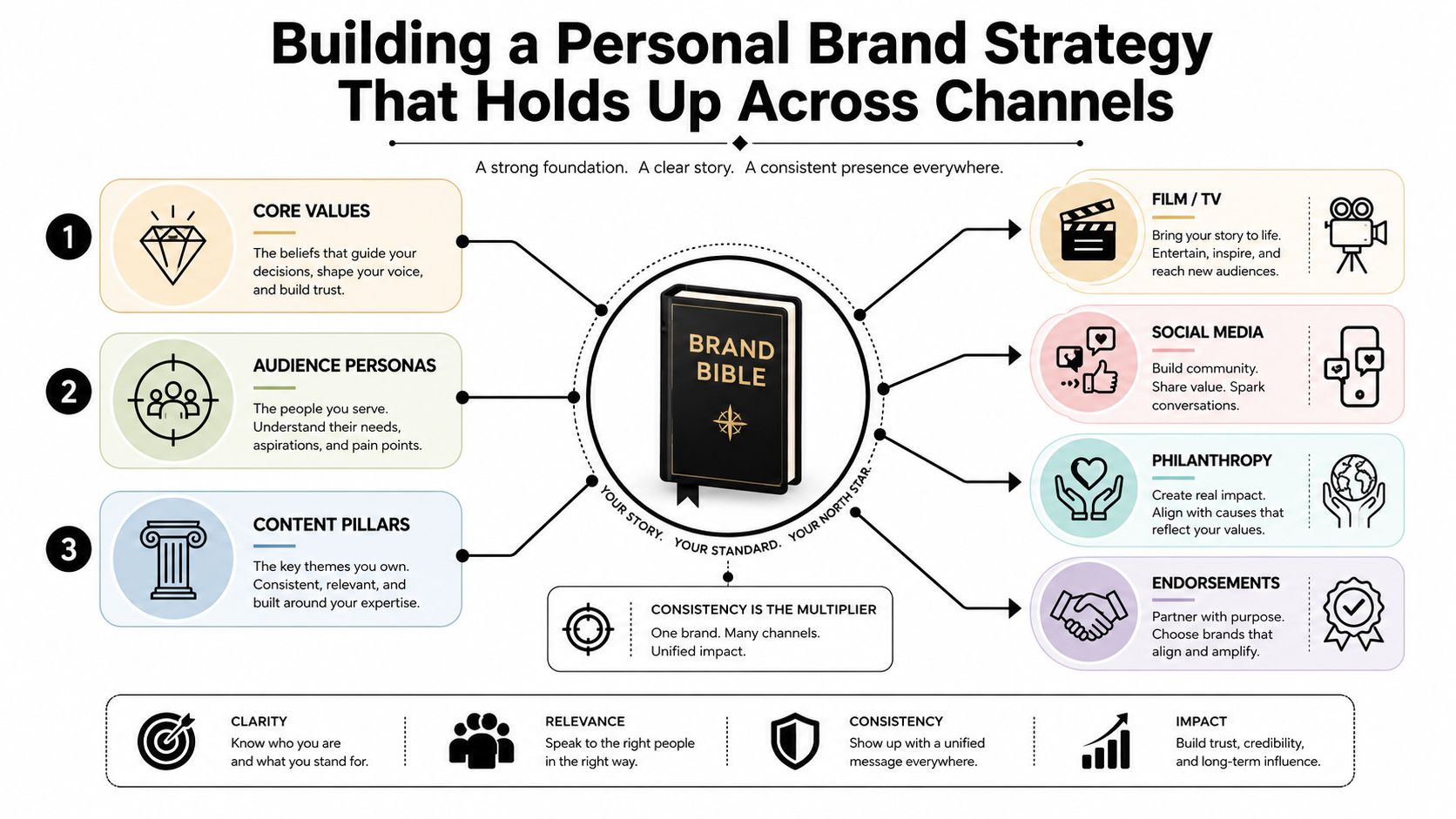
A useful mental model is simple. The celebrity's image is an asset, but assets only compound when the same story shows up across interviews, social content, live appearances, charitable work, and commercial partnerships. Good teams ask what each placement does to the broader narrative, not just what got covered. For a practical companion on entertainment-facing PR structure, see PR in entertainment. A useful reference for the social side of that discipline is how to be consistent on social platforms.
Building a Personal Brand Strategy That Holds Up Across Channels
A celebrity brand breaks down fastest when different teams publish in different voices. Agents chase opportunities, managers protect the career arc, social teams feed the algorithm, and publicists manage visibility. Without a shared architecture, each part can be technically correct and still feel inconsistent. The fix is a brand bible, a working document that defines the public identity before anyone writes copy or books an interview.
Start with message pillars, not content ideas
The best brand bibles begin with message pillars. Those are the themes the public should remember after the post, the profile, or the appearance is over. One pillar might center on craft, another on philanthropy, another on entrepreneurship, and another on family or personal values. The point is not to sound polished. The point is to sound coherent.
From there, teams map those pillars to audience personas and platforms. A fan community on Instagram may want behind-the-scenes proof of access. A business audience on LinkedIn may care about discipline, leadership, and partnerships. A podcast audience often wants context and voice, not just a headline. The same celebrity can speak to all of them, but not with the same format, level of intimacy, or pacing.
A good resource for the social side of that discipline is how to be consistent on social platforms from Kraken Agency. The point of that kind of guidance is not volume for its own sake, it is reducing the whiplash that happens when one post sounds like a personal diary, the next sounds like a brand ad, and the third sounds like a legal disclaimer.
Give voice and visual rules real teeth
A brand architecture document should also cover voice, visual identity, and approval boundaries. That means deciding what the celebrity never jokes about, which topics need pre-clearance, what kind of photography fits the public persona, and where the line sits between candid and careless. If those rules are vague, multiple teams will improvise, and the audience will feel the inconsistency before anyone on the inside does.
Useful standard: authenticity doesn't mean saying everything. It means the public can recognize the same person across formats without feeling they've been sold a new version each week.
The hard trade-off is obvious. Tight control can make a celebrity seem guarded. Too much freedom makes the public image drift. The strongest brands hold both truths at once, enough flexibility to feel human, enough structure to stay legible.
Orchestrating Media Relations and Cross-Platform Momentum
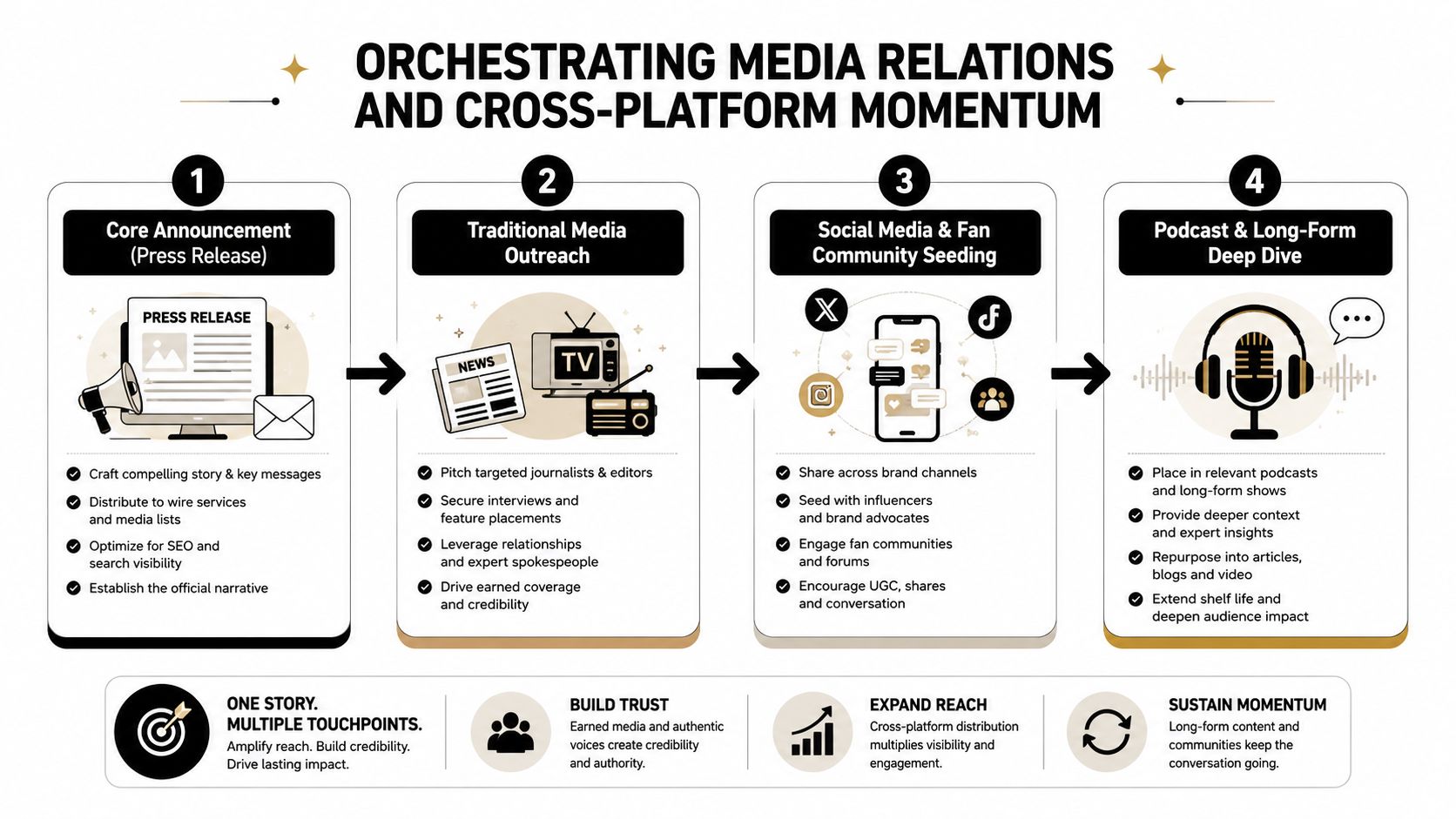
A modern launch rarely starts with a clean press blast and ends with one good article. It starts with a signal, then builds through a chain of smaller moments. A well-run campaign can use traditional media, TikTok, Instagram, podcasts, and fan communities as separate but connected stages, each one handing the story to the next without repeating it.
Take a project announcement. The earliest move might be a controlled leak to a trusted outlet, not because secrecy is fashionable, but because anticipation often lands better than surprise alone. The next move is platform-specific messaging, a short clip for social, a sharper angle for entertainment press, and a longer, more reflective explanation for a podcast. Each format earns attention in a different way, and none of them should do all the work.
The biggest mistake is treating creator channels as an afterthought. If the celebrity's audience lives in fan communities, the rollout should give those communities something to activate around, a teaser, a behind-the-scenes frame, a countdown, or a moment worth reposting. That's how momentum compounds. A single article can create awareness. A sequence of micro-moments can create conversation.
The sequencing also matters because attention is fragmented. A traditional feature may provide legitimacy, but short-form clips often do more to keep a story circulating after the first wave. Podcasts can deepen the narrative and correct misconceptions, while fan communities can keep the release alive long enough for search, social, and media pickup to reinforce one another.
For a practical framework on how entertainment teams coordinate those steps, PR for social media is worth reviewing as a planning reference.
A rollout fails when every channel says the same thing at the same time. It works when each channel adds a new layer of meaning.
The trade-off is real. More platforms create more control points, more approval loops, and more chances for drift. Still, the alternative is worse. A one-off placement can generate a headline and vanish. A sequenced rollout can make the celebrity feel unavoidable for several days without forcing the same audience to read the same message twice.
Crafting and Distributing Celebrity Press Releases That Get Picked Up
A celebrity press release earns pickup when it gives editors a clean reason to care and a quick way to tell the story. The headline has to work in two places at once, in a newsroom inbox and on social platforms where the audience scans fast. The body should be lean, specific, and easy to excerpt.
The strongest structure usually follows a simple order. Open with the news, not the biography. Explain why the announcement matters now, whether that is a project, endorsement, philanthropic move, or career milestone. Then add context that makes the story human and usable.
The release should also include a concise boilerplate, high-resolution visuals, and a contact path that doesn't make reporters chase basic information. Multimedia matters because entertainment outlets and social accounts both need assets that can travel quickly. When the release is buried in generic text and low-quality attachments, even a strong story gets stuck.
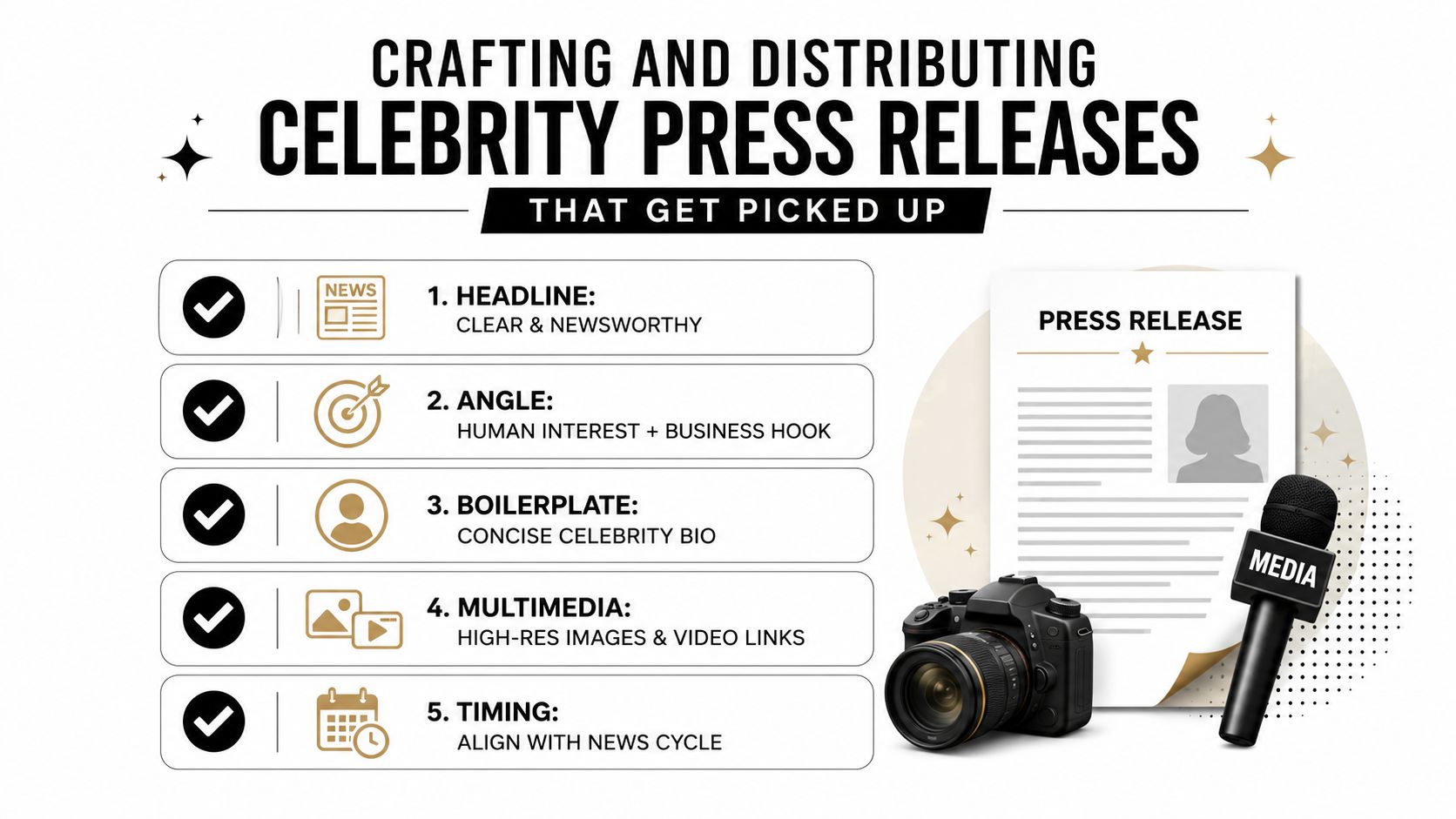
Here is the working checklist many experienced teams use:
- Headline: Clear and newsworthy, with the actual announcement up front.
- Angle: A human-interest hook plus a business reason the audience should care.
- Boilerplate: Short celebrity background that avoids inflated claims.
- Multimedia: High-res images, short video, or direct links that editors can use.
- Timing: Coordinated with the news cycle and social activation, not dropped at random.
The release also needs a distribution plan. If the goal is media pickup, the publicist should know which outlets are likely to care first, which ones may require exclusivity, and which social posts will amplify the release after publication. A release sent without follow-up usually gets buried. A release paired with a tight outreach window and a clear social plan has a far better chance of being used.
Press Release Zen is one practical reference for teams that need templates and process guidance around release writing and distribution, but the underlying principle stays the same. The release is not the campaign. It is the anchor that makes the rest of the campaign legible.
Crisis Response and Reputation Recovery Workflow
Celebrity crises fail fastest when teams respond as if one statement can solve everything. The stronger model is operational. First comes assessment, where the team sizes the issue and watches sentiment to understand whether the problem is a rumor, a genuine outrage cycle, or a legal concern. Then comes strategic response, where the message is customized to the platform instead of copy-pasted everywhere. Only after that does narrative reclamation begin, through content, appearances, and disciplined follow-through.
That sequencing matters because a rushed response can deepen the problem. A statement that tries to answer everything often amplifies the most damaging version of the story. A better response acknowledges the issue clearly, takes responsibility when it's warranted, and names concrete next steps. When a celebrity team handles a public misstep well, it doesn't erase the event. It reduces confusion and stops the public from filling in the blanks.
The recovery phase is usually where teams underestimate the work. Reputation doesn't rebuild itself because the apology was sincere. It rebuilds when the celebrity's next moves are consistent enough to make the apology believable in hindsight. That can mean a quieter media footprint, more careful platform use, or structured content that reintroduces the person through work, service, or expertise.
For a practical framework on message discipline under pressure, crisis communication best practices is a useful companion. A broader online reputation guide can also help teams think about what lingers long after the headline fades.
The best crisis response is usually not the loudest statement. It is the fastest accurate one, followed by behavior that matches it.
The trade-off is uncomfortable. Silence can look evasive, but overexplaining can create more headlines than the original issue. Smart teams choose the narrowest response that is still honest, then let recovery happen through actions instead of constant commentary.
Coordinating Agents Managers and PR Teams Without Overlap
Celebrity teams fail when everyone thinks they own the same decision. Agents usually focus on deals, bookings, and commercial opportunity. Managers often look at overall career direction and day-to-day coordination. Publicists own media relations, reputation defense, and the shape of the public story. Legal counsel protects exposure and contract position. Each role is distinct, but the boundaries blur quickly if the celebrity operates without a shared system.
A clean setup begins with a shared calendar and a single source of truth for announcements, appearances, and approvals. That prevents the common problem where an agent is pitching a brand collaboration while the publicist is trying to slow down visibility after a controversy. It also reduces the kind of duplication that happens when two people send the same pitch to different outlets with slightly different language.
The simplest way to prevent overlap is to define decision rights in advance. Commercial offers with public implications should route through the manager and publicist together. Media requests should not move forward until the messaging position is clear. Legal needs a defined escalation path for anything that could touch contracts, liability, or sensitive disputes.
Some teams also benefit from a short weekly checkpoint with all the relevant parties. It doesn't need to be elaborate. It does need to be disciplined. Without that rhythm, everyone starts solving the same problem in different directions, and the celebrity ends up being represented by friction instead of strategy.
The hardest conflict shows up when an agent wants maximum exposure and a publicist wants reduced visibility. That's not a sign that one team is wrong. It means the team has to decide whether the immediate commercial upside justifies the reputational risk. Good coordination doesn't eliminate tension. It gives the celebrity one place to resolve it before the outside world sees it.
Measuring PR Impact Beyond Media Mentions
Counting clips is easy. Understanding whether those clips changed the story is harder, and more useful. A celebrity campaign needs a measurement system that looks beyond raw volume and tracks whether the public is moving in the right direction across channels.
The first layer is sentiment, but not sentiment alone. Teams should watch whether the tone around the celebrity is becoming more favorable, more skeptical, or more polarized after each appearance. That tells them whether the campaign is clarifying the narrative or just adding noise. The second layer is engagement quality, especially on short-form content, where shares, thoughtful comments, and saved posts usually say more than vanity views.
A third layer is share of voice within a narrative category. That means looking at whether the celebrity is being discussed for the intended topic, such as a film, an endorsement, a business venture, or a charitable effort, rather than being dragged back into an unrelated controversy. The fourth layer is commercial correlation, which can include endorsement interest, booking momentum, or greenlight conversations. Those outcomes are rarely caused by PR alone, but PR often shapes whether the conversation starts in the first place.
A dashboard should therefore answer practical questions, not just produce charts. Did the campaign move the right story forward? Did the audience respond in the intended platform? Did the message hold after the first wave of coverage? If the answer is no, the next rollout needs a different sequence, a different platform mix, or a different spokesperson angle.
What gets measured for a celebrity should match what the celebrity is actually trying to protect, reputation, momentum, or deal flow.
The ROI conversation matters too. Brand stakeholders are rarely satisfied with impressions alone. They want to know whether the strategy changed perception enough to support the next project, the next endorsement, or the next chapter of the public narrative. That is where disciplined measurement becomes a management tool instead of a reporting chore.
Press Release Zen gives teams a practical place to start when they need structure for announcements, crisis messaging, or media outreach. For celebrity campaigns that need tighter sequencing and cleaner execution, Press Release Zen offers guides and templates that can help turn strategy into an organized rollout.