Entertainment PR is the strategic art of managing the public story for a person, project, or company in the entertainment world. It’s all about shaping perception, creating a deafening buzz, and helping turn creative projects into full-blown cultural events.
Think of an entertainment publicist as the director of a brand’s public narrative, making sure it connects with both audiences and the media.
What Is PR In Entertainment And Why It Matters
Ever wonder how a blockbuster film becomes the talk of the town before a single ticket is sold? You’ve seen the trailers, read cast interviews, and caught a behind-the-scenes look on a morning show. This tidal wave of awareness isn't magic; it's the work of masterful PR in entertainment.
This specialized field moves at the speed of light, right where creativity, celebrity, and commerce collide. Unlike corporate PR, which might focus on shareholder reports and product specs, entertainment PR is all about selling a story, an experience, or a personality. The "product" here is an emotion, a powerful performance, or a can't-miss cultural moment.
The core difference is the currency. Corporate PR trades in trust and stability. Entertainment PR trades in attention and desire. Its success hinges on capturing the public's imagination in an incredibly crowded market.
To really get the distinction, let's break down how these two worlds differ.
Entertainment PR vs Corporate PR: A Quick Comparison
While both disciplines fall under the public relations umbrella, their day-to-day realities are worlds apart. One is about building a stable corporate identity, while the other is about creating a spectacle.
Here's a side-by-side look at what sets them apart:
| Aspect | PR In Entertainment | Corporate PR |
|---|---|---|
| Primary Goal | Generate buzz and cultural relevance | Build and protect brand reputation |
| "Product" | An experience, emotion, or persona | A service, product, or company |
| Key Currency | Attention and public desire | Trust and market stability |
| Pace & Cycle | Extremely fast-paced, project-based | Slower, long-term strategic cycles |
| Audience | Fans, general public, and critics | Investors, customers, and employees |
| Core Tactics | Media tours, red carpets, exclusive interviews | Press conferences, financial reports, CSR |
As you can see, the strategies and stakes are fundamentally different. An entertainment publicist's playbook is designed for a completely different game.
The Core Goals Of Entertainment PR
While the tactics can change in a heartbeat, the objectives of any campaign really boil down to three key pillars. The work is dynamic and high-stakes because public perception can make or break commercial success. A great publicist has to be a strategist, a storyteller, and a crisis manager—often all in the same day.
These primary goals include:
- Generating Explosive Buzz: The number one goal for any launch—be it a film, album, or new series—is to create an unmissable event. This means doing everything from landing high-profile magazine covers to engineering viral social media moments that get everyone talking.
- Managing Reputation: For individual artists and celebrities, their public image is their most valuable asset. Publicists work around the clock to build, shape, and defend this image, fielding media requests and stamping out potential crises before they catch fire.
- Driving Commercial Success: At the end of the day, PR efforts have to deliver tangible results. This means pushing ticket sales for a tour, boosting opening weekend box office numbers, or driving subscriber growth for a streaming service. Strong PR creates the demand that fuels the entire entertainment machine.
The Key Players In The Entertainment Ecosystem
PR in entertainment doesn't happen in a vacuum. It involves a complex web of stakeholders, each with their own goals and pressures. The publicist sits right in the middle, coordinating messages and managing relationships to make sure everyone is on the same page for a powerful campaign.
The main players a publicist juggles are:
- Artists, Actors, and Musicians: The talent at the very heart of the project.
- Studios and Production Companies: The powerhouses funding and creating the content.
- Streaming Giants: Platforms like Netflix and Sony LIV that need a constant drumbeat of PR to keep subscribers hooked.
- Event Organizers and Venues: The promoters for concerts, festivals, and live theater.
By understanding how to serve each of these players, a publicist can shape narratives, manage the intense glare of the spotlight, and spark the cultural conversations that define success in the entertainment business.
The Modern Entertainment PR Workflow In Action
Think of an entertainment publicist as the director of a movie's real-world story. Their job goes way beyond just sending out a press release. They orchestrate a massive, fast-paced campaign designed to grab the world's attention. The modern PR in entertainment workflow is an intense, event-driven cycle that starts months, sometimes years, before the public ever hears about a new project.
This is a totally different ball game from other industries. While a corporate PR team might map out their year in quarters, an entertainment campaign is a full-out sprint, with everything hurtling toward a single premiere date or album drop. It’s all about building a wave of excitement that crests at the perfect moment.
The Initial Strategy And Pre-Launch Phase
Everything kicks off with some serious strategic planning. This is where the publicist decides what story they're telling. Is this an underdog's triumph? A high-fashion blockbuster? A gritty, true-to-life drama? Every single decision from here on out will flow from that core narrative.
Key tasks in this phase are non-negotiable:
- Building Curated Media Lists: This isn't just exporting a generic contact sheet. It means hand-picking the journalists, critics, and influencers whose voices actually matter to the project's specific audience.
- Crafting Compelling Pitches: An editor's inbox is a battlefield. To win, a pitch has to be sharp, personal, and frame the story in a way that outlet can't possibly ignore.
- Developing a Narrative Arc: You don't drop all your news at once. The story is rolled out in carefully planned stages. Early on, the goal is to lock in exclusive "first look" features with major trade publications like Variety or The Hollywood Reporter to build credibility within the industry.
The pre-launch phase is the foundation for the entire campaign. Get this part wrong, and even the most brilliant film or album can get lost in the noise.
A publicist’s real talent is turning a piece of art into a news event. They don’t just announce a movie; they spark a cultural conversation and make sure it becomes part of the public consciousness.
This process flow breaks down how the core functions of an entertainment PR campaign work together to connect buzz, reputation, and ultimate success.
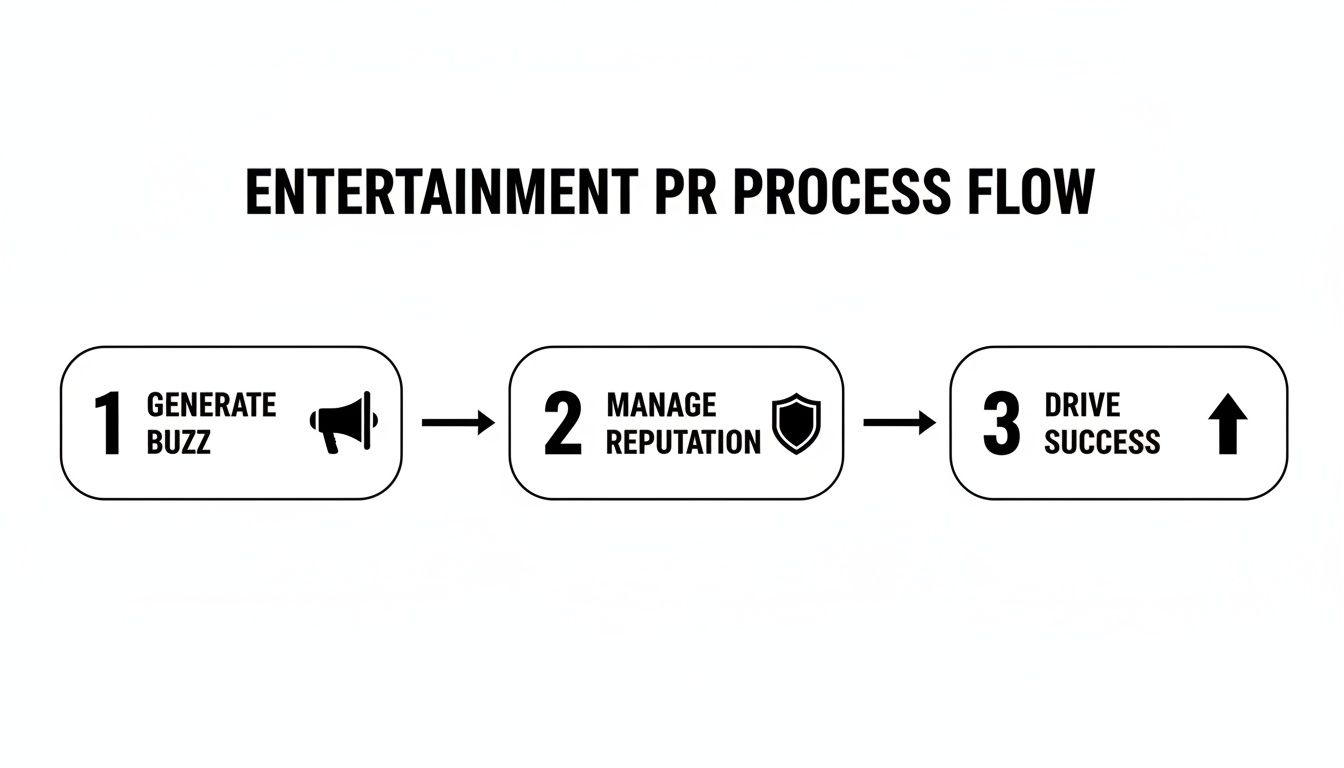
As you can see, generating buzz is what gets the engine started. But that buzz has to be paired with savvy reputation management to actually drive tangible results.
Navigating The Launch And Post-Launch Momentum
As launch day gets closer, the pace becomes an absolute frenzy. The publicist's job shifts to coordinating high-stakes events where anything can happen. We're talking about organizing press junkets, booking A-listers on talk shows, and managing the controlled chaos of a red carpet premiere. Every interview is a chance to drive the narrative home.
This constant activity is more important than ever. The media world is incredibly fragmented, especially with the decline of traditional TV. AlixPartners predicts that legacy TV subscriptions will crash below 50 million by 2025—that's less than half of what they were a decade ago. This means PR pros have to be surgically precise to reach audiences scattered across countless streaming services and social platforms.
Once a project is out, the work is far from over. Post-launch PR is all about keeping the momentum going.
- Securing "Think Piece" Coverage: Pitching stories that dig into the project's cultural impact.
- Driving Awards Campaign Buzz: Strategically positioning the film or talent for Golden Globes, Oscars, and other major awards.
- Leveraging Success: Using big box office numbers or streaming data to spark a whole new round of media coverage about the project's runaway success.
This constant drumbeat is what separates a flash in the pan from a lasting hit. A great PR workflow ensures a project doesn't just launch; it dominates the conversation for weeks and months to come. For a closer look at timing all these moving parts, check out our guide on creating a press release calendar.
How To Craft An Entertainment Press Release That Gets Noticed
In the entertainment world, a press release isn't just a dry announcement—it's your opening scene. It’s the tool you use to tell a story. When a journalist opens that email, they need to instantly see the headline, get the story, and feel the buzz.
This is what separates a two-paragraph mention from a full-blown feature story. Your press release is your first, and sometimes only, shot to convince a busy editor that your project is the next big thing.

The Anatomy Of A Powerful Entertainment Announcement
Every single piece of your press release has a job. Think of it like a movie trailer: you hook them with an explosive opening, give them the key details, introduce the stars, and leave them wanting more. If one part is weak, the whole thing falls flat.
Let’s break down the must-have components.
1. The Headline Is Your Hook
This is your one chance to grab a journalist's attention in a crowded inbox. It must be active, newsworthy, and frankly, irresistible. A flat "New Film Announced" is a guaranteed path to the trash folder.
Try something with punch: "Academy Award Winner Jane Doe to Star in Sci-Fi Epic 'Chronos' from Visionary Director Sam Smith." See the difference?
2. The Dateline and Introduction Set the Scene
Your first paragraph has one job: answer the five Ws (Who, What, When, Where, Why) immediately. Don't bury the lead.
For example: "LOS ANGELES, CA – [Date] – Echo Studios today announced its smash-hit series, 'The Crimson Tide,' will return for a second season, premiering exclusively on StreamFlix on October 25, 2026."
3. The Body Builds the Narrative
This is where you add the color. Drop in a compelling quote from a key player—the director, a lead actor, or a studio exec. It gives journalists a ready-made soundbite and adds that crucial human touch.
Follow that with 2-3 short paragraphs that fill in the gaps. This is where you can tease the plot, introduce new cast members, or explain what makes this project so unique.
A well-crafted press release does more than inform; it equips a journalist to champion your story. By providing compelling quotes and rich context, you're not just sending news—you're delivering a story kit.
When you're working with the press, your goal is to make their job as easy as possible. Give them everything they need in a clear, concise package.
Beyond Text: The Power Of Multimedia
In an industry as visual as entertainment, sending a text-only press release is a huge missed opportunity. High-quality multimedia isn't a bonus anymore; it's an absolute must.
Journalists are far more likely to run with a story if you give them stunning visuals they can use right away. Your announcement should always link out to a digital press kit.
Your kit should contain:
- High-Resolution Production Stills: At least 3-5 approved images from key scenes.
- Official Poster and Artwork: The project's main branding imagery.
- Behind-the-Scenes Clips: Short videos (15-30 seconds) are perfect for social media and online articles.
- Talent Headshots: Professional, approved photos of the main cast and director.
This simple step transforms your announcement from a basic document into a complete, ready-to-publish resource.
Putting It All Together: A Ready-To-Use Template
Okay, let's move from theory to practice. Here is a basic framework you can adapt for almost any entertainment announcement. The details will change, but the bones stay the same.
For a deeper dive, check out our full guide on the 8 key elements of a well-written press release.
| Section | Purpose | Example |
|---|---|---|
| Headline | Grab immediate attention with the biggest news. | "Global Pop Star Nova Announces 'Eclipse' World Tour Kicking Off in New York" |
| Introduction | State the core announcement clearly and directly. | "NEW YORK, NY – [Date] – Multi-platinum artist Nova confirmed her return to the stage…" |
| Body Paragraph 1 | Add context and key details like dates or venues. | "The 20-city arena tour, produced by Live Nation, begins September 1st at Madison Square Garden…" |
| Quote | Provide a personal, engaging quote from the artist. | "'I can't wait to reconnect with my fans and share this new music,' said Nova." |
| Body Paragraph 2 | Include extra info, like supporting acts or ticket sale dates. | "Special guest Leo Vance will join the tour for all North American dates." |
| Boilerplate | A short "About Us" paragraph for the company or artist. | "About Nova: Nova is a Grammy-winning singer-songwriter known for her chart-topping hits…" |
| Media Contact | List the name, email, and phone for the PR rep. | "Media Contact: Alex Chen, [email protected], 555-123-4567" |
Using a structured approach like this ensures your announcement looks professional, feels newsworthy, and is easy for a journalist to turn into their next big story.
Strategic Timing For Maximum Entertainment Buzz
In entertainment PR, when you announce something is just as important as what you’re announcing. The most brilliant campaign can completely fizzle out if it’s dropped on a day when no one is listening or, worse, when something much bigger is happening. Think of strategic timing as the secret ingredient in pr in entertainment; it’s what turns a simple update into a cultural moment.
It’s a lot like producing a show. You have your opening act, the big reveal, and a show-stopping finale. A publicist’s job is to map out this entire timeline. Do you tease out information piece by piece to build a slow, rising tide of anticipation? Or do you go for one massive, explosive reveal designed to own the news cycle for a solid 24 hours?
The Art Of The Announcement Cadence
There’s no magic formula for scheduling an entertainment PR campaign. The right rhythm depends on everything—the project itself, the talent attached to it, and what’s currently happening in the media. A surprise album drop from a pop megastar demands a totally different playbook than the slow-and-steady rollout for an indie film hoping to make a splash at a festival.
You generally have two paths to choose from:
- The Slow Burn: This is all about releasing information in calculated drips. You might start with an exclusive story for a trade publication, follow up with a cast announcement, then a "first look" photo, and finally, the trailer. This approach builds a narrative over time, keeping your project on people’s minds for weeks or even months.
- The Big Bang: This strategy involves holding back everything for one single, coordinated launch. A perfect example is dropping a surprise trailer in the middle of a huge televised event like the Super Bowl. It’s a high-risk, high-reward move that aims to create an instant, overwhelming tidal wave of conversation.
Choosing the right approach means having a gut-level understanding of your audience and what the media is hungry for. It’s always a calculated bet on how to best grab the spotlight.
Navigating The Industry Calendar And News Cycle
Great timing isn’t just about your own schedule; it’s about everyone else’s, too. A sharp publicist is like a newsroom meteorologist, constantly checking the forecast to find that perfect clear day for an announcement. Dropping major news during the Oscars, the World Cup, or a national crisis is just asking to be ignored.
The goal is to own a news cycle, not get lost in one. This means scheduling announcements to work with key industry moments—like revealing a new horror film trailer in October or dropping a festival lineup just as the ticket-buying frenzy starts.
This is where a tool like an embargo becomes incredibly powerful. An embargo is essentially a request to journalists to hold a story until a specific date and time. By giving them key info in advance under embargo, you let them craft thoughtful, detailed stories that can all go live at once. This creates a powerful "surround sound" effect where it feels like your news is everywhere. Our guide offers more on how to effectively use a press release embargo to get the biggest bang for your buck.
And don't forget modern tactics. A What is a PR drop, for instance, is a perfectly timed release of exclusive items or experiences designed to generate instant buzz.
Distributing For A Surround-Sound Effect
Once you know when you’re going to announce, you have to nail down how. Today, distribution is all about creating that feeling of inevitability—making it seem like your audience is seeing the news absolutely everywhere they look. This multi-channel blitz is what makes a story feel important. It's especially crucial when you look at the industry's sheer size. With PwC forecasting global entertainment revenues to hit a staggering US$3.5 trillion by 2029, just getting noticed is a major victory.
This is why multimedia is non-negotiable. Press releases packed with photos and videos don’t just get more attention; they blow text-only releases out of the water. The data is clear: releases with just one image see 2x the engagement, and that number jumps to 6x for releases with multiple images. Announcing a concert or movie with rich media isn't just a nice-to-have; it's essential for getting picked up by major outlets and featured on platforms like Google News. You can see more on these global entertainment market trends on pwc.com.
Measuring Success In The World Of Entertainment PR
So, how do you prove your PR efforts are actually working? In the world of pr in entertainment, likes and retweets are nice, but they don’t pay the bills. Studio execs, producers, and talent need to see a clear return on investment (ROI). This means looking past vanity metrics and zeroing in on the key performance indicators (KPIs) that really count.
Success in entertainment PR isn't a one-size-fits-all deal. The goals for a blockbuster film are worlds apart from those for a new streaming series or a musician on tour. For a movie, success might hinge on opening weekend box office numbers. For a TV show, it could be viewership figures and that coveted "Certified Fresh" score on Rotten Tomatoes.
The trick is to define what victory looks like before the campaign even kicks off. By setting up a clear framework from the start, you can track progress and show real, tangible value that gets stakeholders nodding in approval.

Blending Quantitative And Qualitative Data
A powerful PR report tells a story using both numbers and nuance. It weaves hard data with sharp analysis to paint the full picture of your campaign’s impact. If you rely on just one or the other, you’re only telling half the story.
Quantitative Metrics (The "What")
These are the hard numbers. They give you a measurable snapshot of your reach and performance—objective, straightforward, and easy to track.
- Media Mentions: The raw count of how many times your project or talent got featured across online, print, and broadcast media.
- Box Office or Ticket Sales: The most direct measure of commercial success for films and live events. If a film smashes its $50 million opening weekend projection, that’s a clear PR win.
- Streaming Viewership: For a platform like Sony LIV, this could be the number of unique viewers in the first week or total hours streamed.
- Website and Social Media Traffic: Did visits to the official site or social profiles spike after a big announcement? That’s a key indicator.
- Audience Reach: The potential number of people who saw your message, often measured in the Unique Monthly Visitors (UMVs) of the media outlets you secured.
Qualitative Metrics (The "So What")
This is where you dig into the quality and impact of the coverage. These metrics add context and prove the real value of your work.
- Tone of Coverage: Was the press positive, neutral, or negative? A sentiment analysis reveals the overall feeling toward your project.
- Key Message Pull-Through: Did the media actually include the core messages you wanted to get across? This shows your narrative is cutting through the noise.
- Placement Quality: A feature in The New York Times carries a lot more weight than a mention on a small blog. High-authority placements are king.
- Quote Inclusion: How often were the quotes from your talent or director used? This proves that journalists found your provided material valuable.
By marrying these two types of data, you can build a comprehensive report that moves beyond simple numbers to demonstrate strategic success.
In entertainment PR, proving value is about connecting the dots. It’s showing how a magazine cover and a string of glowing reviews directly fueled sold-out shows or record-breaking streaming numbers. That's how you build trust and lock in future budgets.
Compiling A Report That Demonstrates ROI
The final step is to wrap your findings into a report that’s clear, concise, and compelling. Your audience—whether it's a studio head, an artist, or an agent—is busy. They need to get the results, and get them fast.
A strong report should always include:
- An Executive Summary: Start with the big picture. Put the 2-3 biggest wins right at the top.
- Goals vs. Results: Circle back to the original goals you set and show exactly how you met or crushed them with specific data.
- Key Coverage Highlights: This is your highlight reel. Showcase the best press clippings with links and screenshots of your biggest wins, like a major TV segment or a rave review from a top critic.
- Data Visualization: Use charts and graphs. A simple pie chart showing sentiment or a bar graph tracking mentions over time is way more effective than a wall of numbers.
- Learnings and Next Steps: End with insights you gained and recommend what to do next, whether it’s targeting new media outlets or tweaking the messaging.
This structured approach transforms a basic activity summary into a powerful tool that proves the essential role of pr in entertainment. It shows your work isn't just creating buzz; it's driving the business forward.
Frequently Asked Questions About PR In Entertainment
Even with a solid game plan, entertainment PR will always throw you a curveball. The industry is packed with unique situations that just don't fit into the standard playbook.
Let’s tackle some of the most common questions that come up. Think of this as the stuff you learn on the job—the practical insights that will help you navigate the tricky scenarios every entertainment publicist eventually runs into.
How Is Crisis Communication Different For A Celebrity Versus A Corporation
When a celebrity crisis breaks, it's personal, and it moves at the speed of social media. A corporation can hide behind official statements and a team of designated spokespeople, but for a celebrity, their reputation is their brand. The response has to feel authentic and connect directly with the public’s emotions.
For a celebrity, time is not on your side. A small misstep can explode into a worldwide scandal in a matter of hours. The strategy usually boils down to a few carefully chosen options:
- A personal statement, written in their voice, posted directly on their own social media.
- A strategic, high-profile interview with a journalist they trust.
- In some situations, a period of calculated silence to see if the storm blows over.
A corporate crisis response is all about business continuity and reassuring stakeholders—investors, partners, and customers. A celebrity’s response is about salvaging their relationship with their audience and protecting a career built entirely on public perception. The stakes are deeply personal, not just financial.
What Is The Role Of Social Media In Modern Entertainment PR
Social media isn't just a side dish in entertainment PR anymore; it’s the main course. It offers a direct, unfiltered pipeline between talent, projects, and their biggest fans.
Publicists now use platforms like Instagram and TikTok to tell a story piece by piece, building a campaign's narrative over weeks or months. You might see behind-the-scenes clips, live Q&A sessions with the cast, or viral challenges designed to pull the audience in. For any big film or TV show, the social media campaign often kicks off long before the first trailer is even a thought.
Social media is the modern-day focus group, providing an instant, unfiltered gauge of public sentiment. It allows PR teams to see what's resonating and adjust their strategy in real time.
On top of that, working with influencers is now a core—and incredibly effective—tactic. These creators can tap into specific, niche audiences in a way that feels far more genuine than a traditional ad. A truly successful pr in entertainment campaign weaves social media into its DNA from the very beginning. It’s not an add-on; it’s the engine.
How Do I Start A Career In Entertainment PR With No Experience
Breaking into the hyper-competitive world of entertainment PR without a stacked resume can feel impossible, but it’s absolutely doable if you have the right approach and a lot of grit. It's less about what you've done and more about your hustle, your industry knowledge, and your passion.
First, you need to live and breathe the industry. That means you’re reading trade publications like Variety, The Hollywood Reporter, and Deadline every single day. You have to know who the key players are, what projects are bubbling up, and which campaigns are making noise. This knowledge becomes your currency when you start to network.
Next, you have to build a portfolio, even if that means working for free at the start.
- Offer pro-bono work: Find local bands, indie filmmakers, or community theaters. Offer to write their press releases, run their social media for a launch, or pitch them to local blogs.
- Start a blog or podcast: Create your own space to analyze entertainment PR campaigns. This is a powerful way to show off your expertise and prove you’re serious.
- Document everything: For every project, track your results. Did you land a media mention? Did you grow their social following by 25%? These are the tangible wins you’ll bring up in interviews.
An internship is still the most direct route into the business. The hands-on experience is great, but the connections you make are priceless. Don’t be afraid to start at the mailroom level, work your tail off, and prove you belong. Focus on becoming an exceptional writer, developing a thick skin, and having a genuine passion for the business that no one can deny. That’s what will ultimately get you in the door.